
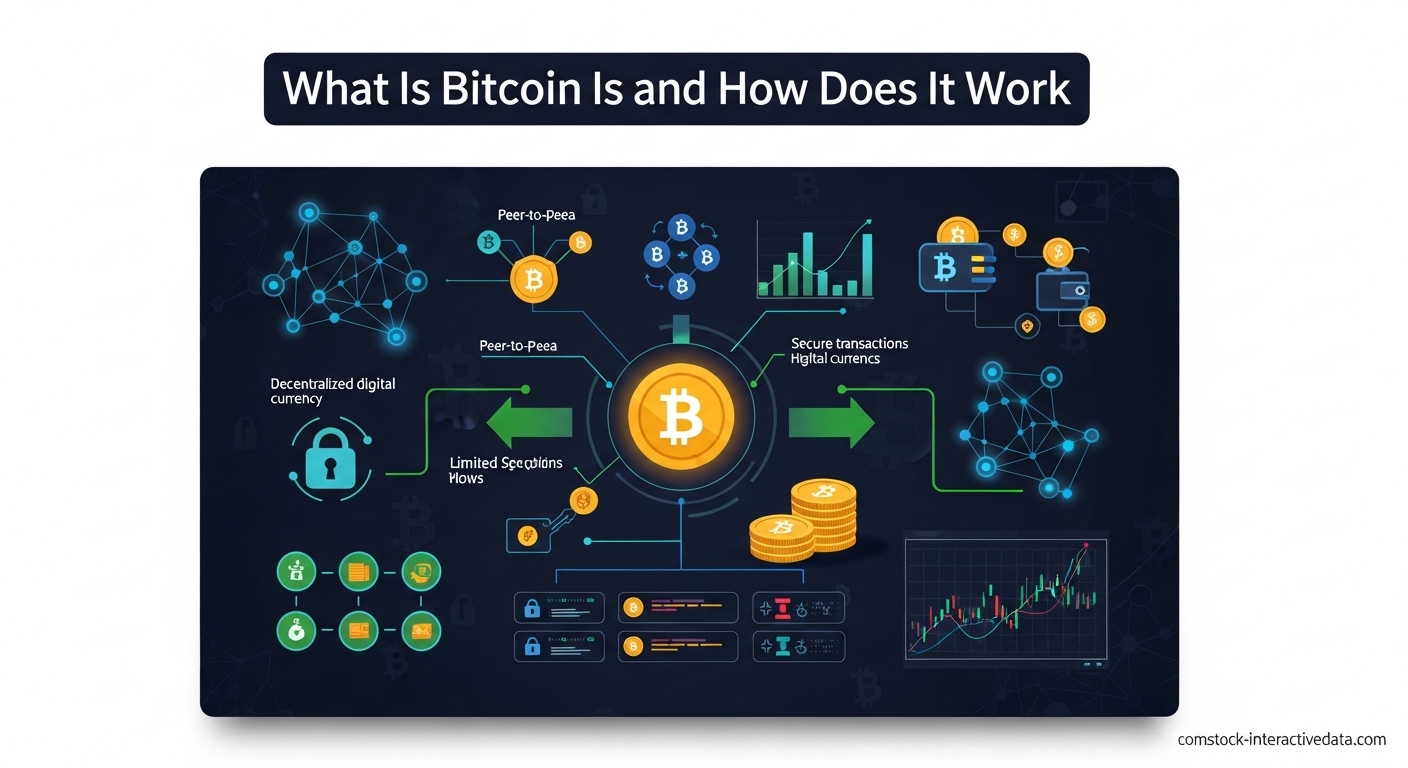
What is Bitcoin and how does it work? This question has become increasingly common as digital currencies transform how we think about money. Bitcoin represents the first successful implementation of a decentralized cryptocurrency, created to allow people to send value directly to one another without relying on traditional financial institutions.
Our team has spent years studying cryptocurrency markets and blockchain technology to bring you this comprehensive guide. Whether you are completely new to Bitcoin or looking to deepen your understanding, this article will walk you through everything from the basic concepts to the technical mechanics that make this revolutionary system function.
By the end of this guide, you will understand not just how Bitcoin works, but why it matters in 2026 and how it differs from the dollars, euros, or yen you use every day.
Key Takeaways:
- Bitcoin is a decentralized digital currency that operates without banks or governments, allowing peer-to-peer transactions across the internet.
- Blockchain technology records all Bitcoin transactions on a public ledger that is maintained by a global network of computers.
- Bitcoin mining secures the network and creates new coins through a process called proof-of-work, which requires significant computing power.
- Users store Bitcoin in digital wallets protected by cryptographic private keys, making security practices essential.
- With a fixed supply of 21 million coins, Bitcoin serves as both a payment method and a store of value often called “digital gold.”
Table of Contents
What Is Bitcoin?
Bitcoin is a digital currency that exists entirely online, with no physical coins or bills to hold in your hand. Unlike traditional money issued by governments, Bitcoin operates on a decentralized network of computers spread across the globe, making it resistant to censorship and control by any single authority.
The concept was introduced in 2008 by an anonymous person or group using the pseudonym Satoshi Nakamoto. In October of that year, Satoshi published a whitepaper titled “Bitcoin: A Peer-to-Peer Electronic Cash System” that outlined the technical foundation for a currency that could function without banks. The actual Bitcoin network launched in January 2009 when the first block, known as the Genesis Block, was mined.
What makes Bitcoin truly distinctive is its fixed supply cap. Only 21 million Bitcoins will ever exist, and this scarcity is programmed directly into the protocol. As of 2026, approximately 19.8 million Bitcoins have already been mined, leaving less than 1.2 million yet to be created. This limited supply contrasts sharply with fiat currencies, which governments can print in unlimited quantities.
How Bitcoin Differs from Traditional Currency?
Traditional currencies like the US dollar or euro are centralized fiat currencies, meaning they are issued and controlled by central banks and governments. These institutions can create new money, set interest rates, and freeze accounts. Your bank maintains a private ledger of your transactions, and you must trust them to manage your funds honestly.
Bitcoin flips this model entirely. Instead of a central authority maintaining the ledger, thousands of computers around the world work together to verify and record every transaction. Anyone can participate in this network, and every transaction is visible on the public blockchain. You control your own funds through cryptographic keys, eliminating the need to trust any institution.
Key Characteristics of Bitcoin
Bitcoin possesses several defining characteristics that distinguish it from other forms of money. It is decentralized, meaning no single entity controls the network. It is borderless, allowing instant transfers to anyone with an internet connection regardless of location. It is transparent, with every transaction permanently recorded on the blockchain.
The system is also pseudonymous, meaning transactions are linked to digital addresses rather than real-world identities. While not fully anonymous, this provides privacy benefits compared to traditional banking. Additionally, Bitcoin is irreversible, meaning once a transaction is confirmed, it cannot be undone or charged back.
How Does Bitcoin Work?
Understanding how Bitcoin works requires grasping a few fundamental concepts about its network architecture. At its core, Bitcoin functions as a peer-to-peer network where users can send digital payments directly to one another without intermediaries. The system relies on cryptographic techniques to secure transactions and maintain consensus about who owns what.
When you send Bitcoin to someone, you are not actually transferring a digital file from your computer to theirs. Instead, you are broadcasting a transaction to the entire network, declaring that you are assigning a portion of your Bitcoin balance to another address. Network participants called nodes verify this transaction using established rules, and once confirmed, it becomes part of the permanent record.
The Role of Nodes and Network Consensus
Nodes are computers running Bitcoin software that maintain copies of the entire blockchain and validate transactions. There are thousands of nodes distributed globally, ensuring the network remains operational even if some go offline. Each node independently verifies that transactions follow Bitcoin protocol rules, rejecting any that attempt to spend funds the sender does not own.
For the network to function, all nodes must agree on the current state of the ledger. This consensus mechanism ensures that everyone sees the same transaction history and that no one can spend the same Bitcoin twice. The system achieves this agreement through a combination of cryptographic proof and economic incentives that reward honest behavior.
How Bitcoin Transactions Are Processed?
A Bitcoin transaction begins when the sender creates a message containing the recipient’s address and the amount to transfer. This message is digitally signed using the sender’s private key, proving they own the funds without revealing the key itself. The signed transaction is then broadcast to the network and enters a pool of unconfirmed transactions.
Miners select transactions from this pool to include in new blocks. They prioritize transactions based on fees offered, with higher fees typically processed faster. Once a miner successfully creates a valid block, it is broadcast to the network, and other nodes verify its accuracy before adding it to their copy of the blockchain. The transaction is now confirmed, and the recipient can spend the received Bitcoin.
Transaction Confirmations and Finality
One confirmation means your transaction has been included in a block. Each subsequent block added to the chain provides additional confirmations, making the transaction increasingly difficult to reverse. Most exchanges and merchants consider six confirmations sufficient for large transactions, which typically takes about an hour.
The more confirmations a transaction has, the more secure it becomes. An attacker would need to control more than half of the network’s computing power to attempt reversing a confirmed transaction, a scenario that becomes practically impossible after several confirmations. This security model allows users to trust the system without trusting any individual participant.
What Is Blockchain Technology?
Blockchain is the foundational technology that makes Bitcoin possible, functioning as a distributed ledger that records all transactions in a secure and transparent manner. Imagine a digital notebook that is simultaneously copied across thousands of computers worldwide, with each copy automatically updating whenever a new transaction occurs. This is essentially how a blockchain operates.
The blockchain consists of a chain of blocks, each containing a batch of recent transactions. Every block references the previous block through a cryptographic hash, creating an unbreakable chronological chain. Changing any historical transaction would require recalculating every subsequent block, a computational task so massive that it becomes effectively impossible.
How Blocks Are Structured?
Each block in the Bitcoin blockchain contains several key components. The block header includes a reference to the previous block’s hash, a timestamp, and a summary of all transactions in the block called a Merkle root. It also contains a nonce, a number that miners adjust to meet the network’s difficulty requirements.
The body of the block contains the actual transactions, including the sender and recipient addresses, amounts transferred, and digital signatures. A special transaction called the coinbase transaction creates new Bitcoins as a reward for the miner who successfully created the block. This reward halves approximately every four years in an event known as the halving.
Immutability and Security
The blockchain’s immutability is its most powerful security feature. Once a transaction is buried under several blocks, altering it would require redoing all the proof-of-work for those blocks plus catching up to and surpassing the current chain. The computational resources needed make such attacks economically irrational for any realistic gain.
This immutability creates an authoritative record of every Bitcoin transaction since the network’s inception in 2009. Researchers, auditors, and everyday users can verify the complete transaction history without relying on any trusted third party. This transparency represents a radical departure from traditional financial systems where records are kept private by institutions.
Public vs Private Blockchains
Bitcoin operates on a public blockchain that anyone can join, view, and participate in without permission. This openness is fundamental to its decentralized nature and censorship resistance. Other cryptocurrencies and blockchain projects may use different models, including private blockchains where participation is restricted to authorized entities.
The public nature of Bitcoin’s blockchain means that while addresses are not directly tied to real-world identities, all transactions are permanently visible. This transparency enables the ecosystem to self-regulate and allows sophisticated users to verify the integrity of the system. Privacy-focused users employ various techniques to enhance their anonymity, though true anonymity requires significant technical expertise.
Bitcoin Mining: How New Bitcoins Are Created
Bitcoin mining serves two essential functions: it secures the network by validating transactions, and it introduces new Bitcoins into circulation in a controlled manner. Miners compete to solve complex mathematical puzzles, with the winner earning the right to add the next block to the blockchain and receiving a reward in newly created Bitcoin.
The mining process uses a consensus mechanism called proof-of-work, which requires miners to expend computational resources to find a specific hash value. This energy expenditure is not wasted, as it serves as the foundation of Bitcoin’s security model. The difficulty of these puzzles automatically adjusts every 2016 blocks to maintain a consistent block creation time of approximately ten minutes.
Understanding Proof-of-Work
Proof-of-work requires miners to find a hash of the block header that falls below a specific target value set by the network. Miners achieve this by repeatedly changing the nonce value in the header and calculating the resulting hash until they find one that satisfies the requirement. This process involves trillions of calculations per second across the entire network.
The computational difficulty makes it prohibitively expensive for any single entity to dominate the network or alter historical transactions. An attacker would need to control more than fifty percent of the global mining power to successfully execute a double-spend attack, and even then would face economic incentives that discourage such behavior. The cost of attacking the network far exceeds any potential benefit.
Mining Rewards and Halving Events
When Bitcoin launched in 2009, miners received fifty Bitcoins for each block they successfully mined. Every 210,000 blocks, roughly four years, this reward halves. The first halving in 2012 reduced the reward to twenty-five Bitcoins, the 2016 halving to twelve and a half, and the 2020 halving to six and a quarter Bitcoins per block.
The most recent halving occurred in April 2024, reducing the block reward to three and one-eighth Bitcoins. This halving schedule will continue until approximately the year 2140, when the final Bitcoin will be mined. At that point, miners will rely solely on transaction fees for income. This predictable issuance schedule makes Bitcoin’s monetary policy more transparent than any fiat currency.
Mining Hardware Evolution
Early Bitcoin miners used standard computer processors, but the increasing difficulty soon made this approach unprofitable. Miners transitioned to graphics cards, then to specialized hardware called ASICs (Application-Specific Integrated Circuits) designed exclusively for Bitcoin mining. Today’s mining operations use warehouses full of these efficient machines.
The professionalization of mining has shifted the industry toward regions with cheap electricity and favorable climates. Major mining centers have emerged in areas with abundant hydroelectric power, stranded natural gas, or renewable energy resources. This geographic distribution helps maintain network decentralization while reducing the environmental impact per Bitcoin mined.
Environmental Considerations
Bitcoin mining’s energy consumption has become a significant topic of debate. The network uses approximately 150 terawatt-hours annually, comparable to the energy usage of medium-sized countries. However, context matters: traditional banking and gold mining also consume substantial resources, and Bitcoin provides unique benefits that justify its energy expenditure for many users.
The industry is increasingly moving toward renewable energy sources. Studies suggest that over fifty percent of Bitcoin mining now uses renewable energy, a higher percentage than most national power grids. Additionally, miners can use stranded or waste energy that would otherwise be flared or unused, potentially improving overall energy efficiency.
Bitcoin Wallets and Security
A Bitcoin wallet does not actually store your coins in the way a physical wallet holds cash. Instead, it stores the cryptographic keys that prove your ownership of Bitcoin recorded on the blockchain. These keys allow you to sign transactions and spend your funds, making their security absolutely paramount.
Each Bitcoin wallet contains a pair of keys: a public key that functions like an account number you can share to receive payments, and a private key that acts as your password and signature. Anyone with access to your private key can spend your Bitcoin, and if you lose this key, your funds become permanently inaccessible. There is no customer service to call for recovery.
Understanding Public and Private Keys
Your public key is derived from your private key through a mathematical process that works only in one direction. This means someone can calculate your public key from your private key, but cannot reverse the process to determine your private key from your public key. This asymmetry enables secure transactions without revealing sensitive information.
When you receive Bitcoin, the sender uses your public address, which is a shortened form of your public key. When you spend Bitcoin, you use your private key to create a digital signature that proves you own the funds without revealing the key itself. The network verifies this signature against your public key to confirm the transaction’s validity.
Types of Bitcoin Wallets
Bitcoin wallets come in several varieties, each with different security and convenience trade-offs. Software wallets run on your computer or smartphone and offer easy access for regular transactions. These are considered “hot wallets” because they remain connected to the internet, making them convenient but more vulnerable to hacking.
Hardware wallets are physical devices that store your private keys offline, providing enhanced security for significant holdings. Paper wallets involve printing your keys on paper for cold storage, though this method requires careful handling to prevent loss or damage. Exchange wallets provided by trading platforms offer convenience but introduce counterparty risk, as you do not control the private keys.
Hot Wallets vs Cold Storage?
Hot wallets maintain a constant internet connection, making them ideal for day-to-day transactions and small amounts you plan to spend soon. Mobile apps, desktop software, and browser extensions all fall into this category. While convenient, hot wallets present a larger attack surface for malware and phishing attempts.
Cold storage keeps private keys completely offline, providing maximum security for long-term holdings. Hardware wallets, paper wallets, and even metal plates etched with seed phrases represent cold storage methods. Many experienced Bitcoin users follow a strategy of keeping small amounts in hot wallets for spending while storing the majority in cold storage.
Security Best Practices
Protecting your Bitcoin requires vigilance and adherence to security fundamentals. Always back up your wallet’s seed phrase, typically twelve or twenty-four words that can restore access if your device fails. Store these backups in multiple secure locations, protected from fire, water, and unauthorized access.
Enable two-factor authentication on any exchange accounts, use strong unique passwords, and be extremely cautious of phishing attempts. Never share your private keys or seed phrase with anyone, regardless of how legitimate their request may appear. Verify transaction addresses carefully before sending, as Bitcoin transactions cannot be reversed once confirmed.
Benefits and Disadvantages of Bitcoin
Bitcoin offers compelling advantages that have driven its adoption from a niche experiment to a globally recognized asset class worth over one trillion dollars. However, it also presents significant challenges that potential users should understand before participating. A balanced assessment requires examining both the revolutionary potential and the practical limitations.
Key Benefits of Bitcoin
Decentralization represents Bitcoin’s foundational benefit, eliminating the need to trust banks, governments, or payment processors to manage your money. You can send any amount, anywhere in the world, at any time, without requesting permission or providing identification. This censorship resistance protects financial freedom in ways impossible with traditional systems.
The fixed supply of twenty-one million coins creates predictable scarcity that many investors compare to digital gold. Unlike fiat currencies that lose purchasing power through inflation, Bitcoin’s issuance schedule is transparent and unchangeable. This monetary policy has attracted institutional investors seeking inflation hedges and portfolio diversification.
Borderless transactions settle in approximately one hour for large transfers, compared to days for international wire transfers. Fees typically range from one to five dollars regardless of the amount sent, making Bitcoin particularly valuable for remittances and cross-border commerce. The transparency of the blockchain enables anyone to verify transactions without intermediaries.
Disadvantages and Challenges
Price volatility remains Bitcoin’s most cited drawback, with values capable of moving twenty percent or more in single days. This instability makes Bitcoin challenging to use as a unit of account for everyday pricing, though it has not prevented adoption as a store of value or investment asset. Dollar-cost averaging can help mitigate volatility for long-term holders.
Regulatory uncertainty creates challenges as governments worldwide develop policies for cryptocurrency taxation, reporting, and legality. Some countries have banned Bitcoin entirely, while others embrace it as legal tender. Users must stay informed about their local regulations and tax obligations, which vary significantly by jurisdiction.
Technical complexity presents barriers for mainstream adoption. Managing private keys, understanding transaction fees, and securing wallets require learning curves that intimidate casual users. Lost keys have rendered billions of dollars in Bitcoin permanently inaccessible, highlighting the importance of education before investment.
Comparing Bitcoin to Other Cryptocurrencies
Bitcoin was the first cryptocurrency and remains the largest by market capitalization, but thousands of alternatives now exist. Ethereum offers programmable smart contracts that enable decentralized applications beyond simple payments. Other projects focus on faster transaction speeds, enhanced privacy, or specific use cases like supply chain tracking.
What distinguishes Bitcoin is its security, decentralization, and established network effects. After fifteen years of operation without a single successful hack of the protocol itself, Bitcoin has earned a reputation as the most reliable cryptocurrency. Newer projects may offer innovative features, but none have matched Bitcoin’s combination of security and longevity.
How to Buy, Store, and Use Bitcoin?
Getting started with Bitcoin has become increasingly accessible as the ecosystem matures. Numerous platforms now offer straightforward methods to purchase Bitcoin using traditional payment methods, store it securely, and use it for transactions. Understanding these basics will help you participate safely in the Bitcoin economy.
Buying Bitcoin Through Exchanges
Cryptocurrency exchanges function as marketplaces where buyers and sellers trade Bitcoin for fiat currencies or other cryptocurrencies. Major exchanges like Coinbase, Kraken, and Binance serve millions of users worldwide, offering user-friendly interfaces, educational resources, and various payment options including bank transfers and debit cards.
To purchase Bitcoin, you will typically create an account, complete identity verification as required by regulations, link a payment method, and place a buy order. The exchange holds your Bitcoin in their custody until you withdraw it to a personal wallet. For security, experts recommend moving significant holdings to wallets where you control the private keys.
Alternative Acquisition Methods
Beyond exchanges, several other methods exist for acquiring Bitcoin. Bitcoin ATMs allow cash purchases in physical locations, though fees tend to be higher than online options. Peer-to-peer platforms connect buyers directly with sellers, enabling various payment methods and sometimes better privacy. Some employers now offer Bitcoin paycheck options, allowing workers to receive part of their salary in cryptocurrency.
Earning Bitcoin through work, services, or products represents another acquisition path. Freelancers increasingly accept Bitcoin payments from international clients, avoiding the delays and fees of traditional cross-border transfers. Small businesses can integrate Bitcoin payment processors to accept it alongside credit cards and cash.
Using Bitcoin for Payments
Once you own Bitcoin, various merchants and services accept it directly for goods and services. Major companies including Microsoft, Overstock, and AT&T accept Bitcoin payments through payment processors that instantly convert to fiat. The Lightning Network, a second-layer solution built on Bitcoin, enables near-instant micropayments with minimal fees, opening possibilities for streaming money and machine-to-machine payments.
Bitcoin debit cards allow spending at any merchant that accepts Visa or Mastercard, automatically converting your Bitcoin to fiat at the point of sale. These cards bridge the gap between cryptocurrency holdings and traditional retail, though they introduce the same counterparty risks as exchange wallets. For maximum privacy and self-sovereignty, direct Bitcoin payments remain preferable.
Converting Bitcoin to Cash
Selling Bitcoin follows the same basic process as buying, with most exchanges supporting both directions of trading. You can sell Bitcoin for fiat currency and withdraw to your bank account, typically within one to five business days depending on your location and the platform. Bitcoin ATMs also support cash withdrawals, though limits and fees vary by machine.
Tax considerations are important when selling Bitcoin. Most jurisdictions treat Bitcoin as property or an investment asset, meaning sales may trigger capital gains taxes. Keeping detailed records of your purchase prices and sale proceeds enables accurate tax reporting. Consult a tax professional familiar with cryptocurrency to ensure compliance with your local laws.
Frequently Asked Questions
How much is $1 Bitcoin in US dollars?
The price of Bitcoin fluctuates constantly based on market demand. As of 2026, one Bitcoin trades for approximately $65,000 to $75,000, meaning one dollar buys roughly 0.000015 Bitcoin. Check any major financial website or cryptocurrency exchange for current prices.
How do you explain Bitcoin to a beginner?
Bitcoin is digital money that works without banks. Think of it like cash for the internet: you can send it directly to anyone worldwide, and no company or government controls it. It runs on a public ledger called blockchain that records all transactions securely.
What happens if I put $100 in Bitcoin?
Your $100 buys a fractional amount of Bitcoin based on current prices. This amount will fluctuate in value as Bitcoin’s price changes. You might see gains or losses depending on market movements. Only invest what you can afford to lose, and consider dollar-cost averaging for long-term positions.
How exactly do you make money from Bitcoin?
People make money from Bitcoin through price appreciation (buying low and selling high), long-term holding as a store of value, or earning Bitcoin through work or business. Some also earn through mining, though this requires significant technical expertise and investment.
Is Bitcoin safe?
The Bitcoin protocol itself has never been hacked in fifteen years of operation. However, risks exist from exchange hacks, lost private keys, scams, and price volatility. Secure your holdings properly using hardware wallets, strong passwords, and vigilant security practices to minimize risks.
Who created Bitcoin?
Bitcoin was created by a person or group using the pseudonym Satoshi Nakamoto, who published the whitepaper in 2008 and launched the network in 2009. Satoshi’s true identity remains unknown, and they disappeared from public communication in 2011, leaving Bitcoin to develop through community consensus.
Conclusion
What is Bitcoin and how does it work? Throughout this guide, we have explored how this revolutionary digital currency functions through blockchain technology, peer-to-peer networks, and cryptographic security. Bitcoin represents more than just a new form of money; it offers a fundamentally different approach to financial sovereignty and trust.
The combination of decentralization, fixed supply, and transparent monetary policy has established Bitcoin as a significant force in modern finance. While challenges remain regarding volatility, regulation, and user experience, the technology has demonstrated remarkable resilience since its creation in 2009. Major institutions now hold Bitcoin, countries have adopted it as legal tender, and millions of individuals use it for savings, payments, and investment.
Whether you choose to participate in the Bitcoin ecosystem or simply observe from the sidelines, understanding this technology becomes increasingly important as digital currencies reshape the financial landscape in 2026 and beyond. Start with small amounts, prioritize security education, and remember that Bitcoin represents both an opportunity and a responsibility to manage your own financial destiny.