
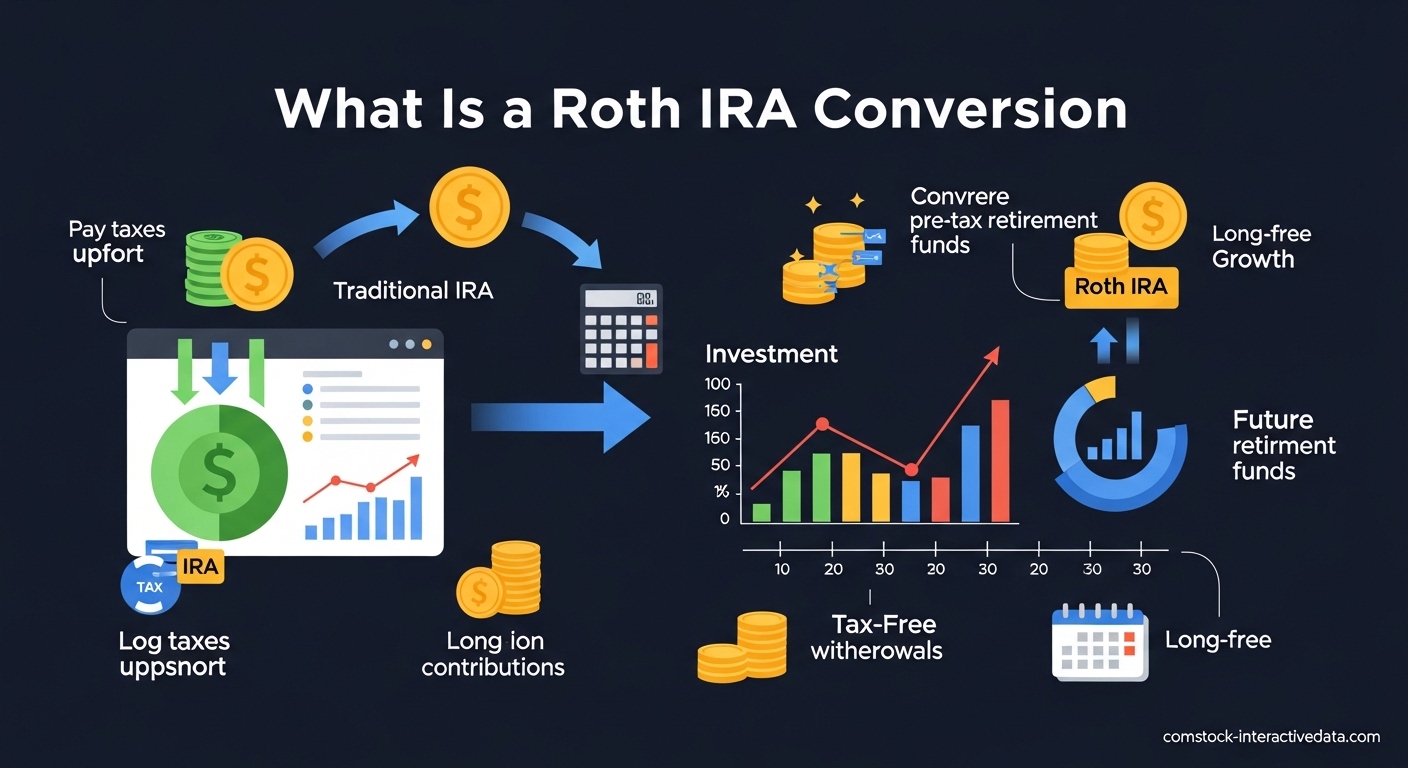
A Roth IRA conversion is the process of moving money from a traditional, tax-deferred retirement account into a Roth IRA. You pay taxes on the converted amount in the current year in exchange for tax-free growth and withdrawals in retirement. Understanding when this strategy makes sense and when it does not could save you thousands in taxes over your lifetime.
I have spent years studying retirement tax strategies and have seen both the tremendous benefits of well-timed conversions and the costly mistakes that occur when people rush into decisions without understanding the full picture. This guide will walk you through everything you need to know about Roth IRA conversions in 2026, including the latest rule changes and strategies that most articles miss.
Table of Contents
What Is a Roth IRA Conversion?
A Roth IRA conversion involves transferring funds from a pre-tax retirement account into a Roth IRA. The accounts you can convert include traditional IRAs, rollover IRAs, 401(k)s from former employers, 403(b)s, SEP IRAs, and SIMPLE IRAs (after meeting participation requirements).
When you convert, you move pre-tax dollars into the Roth IRA. The amount you convert gets added to your taxable income for the year. You pay ordinary income tax on that amount now rather than later. Once the money is inside the Roth IRA, it grows completely tax-free. After age 59½ and once you have satisfied the five-year holding period, you can withdraw both contributions and earnings without paying any federal income tax.
The fundamental trade-off is paying taxes today versus paying taxes tomorrow. With a traditional IRA, you defer taxes until retirement, hoping you will be in a lower tax bracket later. With a Roth conversion, you pay taxes now in exchange for never having to pay taxes on that money again, regardless of how much it grows.
How Does a Roth IRA Conversion Work?
The mechanics of a Roth conversion are straightforward, though the tax implications require careful planning. You start by contacting the financial institution that holds your traditional IRA or the administrator of your employer-sponsored retirement plan. You request a conversion of a specific dollar amount or percentage of your account.
Most institutions allow you to complete the conversion online or over the phone. You can choose to convert cash, or you can convert shares of investments directly. Converting shares during market downturns can be particularly advantageous because you convert more shares for the same tax cost.
The Five-Year Rule Explained
The five-year rule is critical to understand before converting. Each conversion has its own five-year clock that starts on January 1 of the year you convert. If you withdraw converted principal within five years and you are under age 59½, you may owe a 10% early withdrawal penalty on that amount.
Additionally, the Roth IRA itself must have been open for at least five years for earnings to be withdrawn tax-free, regardless of your age. This is separate from the conversion five-year clocks. Keeping track of multiple conversion dates matters if you plan partial withdrawals before age 59½.
Tax Treatment in the Conversion Year
The converted amount gets added to your ordinary income for the year. If you convert $50,000 and you are in the 22% federal tax bracket, you will owe approximately $11,000 in federal taxes on that conversion. This could also push you into a higher tax bracket, making the effective tax rate higher than you anticipated.
You cannot spread the tax bill across multiple years for a single conversion. The entire converted amount counts as income in the year you complete the conversion. This is why many people use systematic conversion strategies, converting smaller amounts annually to manage their tax brackets.
When Does a Roth IRA Conversion Make Sense?
Roth conversions make sense in specific financial situations. The strategy works best when your current tax rate is lower than what you expect to pay in retirement, or when the long-term benefits outweigh the immediate tax cost.
During Lower Income Years
The most common scenario where Roth conversions make sense is during years when your taxable income drops. This often happens after retirement but before you begin taking Social Security benefits, start Required Minimum Distributions at age 73, or tap pension income.
I have seen retirees successfully convert hundreds of thousands of dollars while staying within the 12% or 22% tax brackets during these gap years. One couple I worked with converted $80,000 annually for five years after retiring at 62, paying taxes at 12% rather than the 24% they would face once RMDs and Social Security began.
For Estate Planning and Heirs
Roth IRAs offer powerful estate planning benefits. Since the SECURE Act eliminated the stretch IRA for most non-spouse beneficiaries, heirs must now empty inherited accounts within ten years. With a traditional IRA, those distributions are taxable income to your heirs, potentially during their peak earning years.
By converting to Roth, you pay the taxes now so your heirs inherit tax-free money. They still must follow the ten-year distribution rule, but they will not owe income tax on withdrawals. This can be particularly valuable if you expect to leave assets to children who are already in high tax brackets.
To Eliminate Future RMDs
Traditional IRAs force you to begin taking Required Minimum Distributions at age 73 (rising to 75 in 2033). These distributions are taxable and can push you into higher tax brackets, increase Medicare premiums, and cause more of your Social Security to become taxable.
Roth IRAs have no RMDs during the original owner’s lifetime. By converting traditional IRA funds to Roth, you reduce or eliminate future RMDs, giving you more control over your taxable income in retirement. This flexibility becomes increasingly valuable as you age.
During Market Downturns
Market declines present unique conversion opportunities. When your traditional IRA balance drops 20%, you can convert more shares for the same tax cost. When the market recovers, all that growth happens inside the Roth IRA tax-free.
One investor I know converted shares of a broad market index fund when prices were down 30% in early 2020. He paid taxes on the reduced value, and when the market recovered, the gains were all tax-free in his Roth IRA. This strategy requires having cash available to pay the conversion taxes and a long-term investment horizon.
When a Roth IRA Conversion Does NOT Make Sense?
Roth conversions are not universally beneficial. Several situations exist where converting would cost you more in taxes than you would save, or where the strategy simply does not fit your financial circumstances.
If You Cannot Pay Taxes from Outside Funds
The biggest mistake I see is people converting without having cash outside their retirement accounts to pay the taxes. Using IRA funds to pay the tax bill defeats the purpose of the conversion and may trigger early withdrawal penalties if you are under 59½.
If you convert $50,000 and use $12,000 of that money to pay taxes, you only have $38,000 growing in the Roth IRA. You have reduced your retirement savings and still owe taxes on the full $50,000 conversion amount. Never convert unless you can pay the taxes from savings, taxable investments, or current income.
If You Need the Money Soon
Roth conversions require time to recover the tax cost. If you expect to need the money within five to ten years, the conversion may not make sense. You need enough years of tax-free growth to offset the taxes you paid upfront.
Additionally, remember the five-year rule. If you are under 59½ and withdraw converted principal within five years, you could owe a 10% penalty. If you anticipate needing these funds for a major purchase, emergency, or living expenses soon, keep them in the traditional account.
If You Plan to Leave Assets to Charity
If you intend to leave retirement assets to qualified charities, do not convert those funds. Charities can withdraw money from traditional IRAs tax-free using Qualified Charitable Distributions starting at age 70½. Converting to Roth would force you to pay taxes that the charity would never have owed.
Age and Time Horizon Considerations
At what age does it not make sense to do a Roth conversion? While every situation differs, conversions become less attractive as you approach your late 70s or 80s. You have fewer years for tax-free growth to offset the conversion taxes, and you may already be subject to RMDs that complicate the strategy.
However, age alone should not disqualify you. I have seen 75-year-olds benefit from conversions when they have significant traditional IRA balances, expect to leave money to high-income heirs, and have other assets to pay the taxes. The general rule is that the longer you can leave money inside the Roth after converting, the more effective the conversion becomes.
Common Roth Conversion Mistakes to Avoid
The biggest Roth conversion mistake is converting too much in a single year without understanding the tax ripple effects. I have seen people jump into the 32% or 35% tax bracket unnecessarily, trigger higher Medicare premiums, and lose eligibility for certain tax credits.
Ignoring the Medicare IRMAA Impact
Medicare premiums are income-based through Income-Related Monthly Adjustment Amounts (IRMAA). If your modified adjusted gross income exceeds certain thresholds, your Medicare Part B and Part D premiums increase significantly. These surcharges are based on your tax return from two years prior.
A large conversion can trigger IRMAA surcharges that cost you thousands in additional Medicare premiums over the following year. For example, crossing into the first IRMAA tier can increase your annual Medicare costs by over $1,000. Factor these potential surcharges into your conversion calculations.
Converting Without Considering State Taxes
State income taxes add another layer of cost. If you live in a high-tax state like California or New York, your combined federal and state tax rate on conversions could exceed 40%. Conversely, if you plan to move to a no-tax state in retirement, converting now while in a high-tax state makes little sense.
Forgetting Conversions Are Irrevocable
Before 2018, you could undo a Roth conversion through recharacterization. That option no longer exists. Once you convert, the decision is permanent. You cannot change your mind if the market drops immediately after or if you realize the tax bill is larger than expected.
Double-check your tax calculations before converting. Consider working with a tax professional to model different conversion amounts and their effects on your overall tax picture. The irrevocability means you must get it right the first time.
Misunderstanding the Pro-Rata Rule
If you have both pre-tax and after-tax money in traditional IRAs, the pro-rata rule applies. You cannot selectively convert only the after-tax portion. Each conversion is treated as containing a proportional amount of pre-tax and after-tax money based on your total IRA balances.
This trips up many backdoor Roth contributors who do not realize existing traditional IRA balances affect the tax treatment. If you have $100,000 in traditional IRAs and $10,000 of that is after-tax contributions, any conversion is considered 90% taxable regardless of which account you convert from.
Step-by-Step: How to Complete a Roth IRA Conversion
Follow these steps to execute a Roth conversion properly and avoid common pitfalls. Taking time to plan each step will save you money and stress at tax time.
Step 1: Evaluate Your Current Tax Situation
Start by projecting your current year taxable income. Review your pay stubs, investment income, business profits, and other sources. Determine how much room remains in your current tax bracket before hitting the next higher rate. This remaining room represents your conversion opportunity without triggering higher marginal rates.
Step 2: Determine How Much to Convert
Based on your tax bracket analysis, decide on a conversion amount that keeps you within your target bracket. Consider not just the bracket thresholds but also IRMAA tiers, net investment income tax thresholds ($200,000 single, $250,000 married filing jointly), and any phase-outs for deductions or credits you want to maintain.
Step 3: Choose Your Funding Source
Identify where you will get the cash to pay conversion taxes. Ideally, you will use taxable savings or brokerage account funds. Avoid using the converted IRA funds themselves. Calculate the exact tax cost including federal, state, and any applicable surcharges.
Step 4: Initiate the Conversion
Contact your IRA provider or use their online platform to request the conversion. Specify the dollar amount or share quantity you want to convert. If converting from a 401(k), contact your former employer’s plan administrator. The funds will move from your pre-tax account to your Roth IRA, either as a direct transfer or rollover.
Step 5: Pay the Taxes
Set aside the tax money immediately so you are not tempted to spend it. If you are self-employed or make estimated tax payments, adjust your quarterly payments to account for the conversion income. Employees may need to adjust withholding or make estimated payments to avoid underpayment penalties.
Step 6: Track Your Five-Year Clocks
Document the conversion date and amount for your records. Remember that each conversion starts its own five-year clock for penalty-free withdrawals of converted principal if you are under 59½. Keep a spreadsheet tracking conversion years in case you need to reference them later.
Special Roth Conversion Strategies
The Backdoor Roth IRA
High-income earners who exceed Roth IRA contribution limits use the backdoor Roth strategy. You make a non-deductible contribution to a traditional IRA, then immediately convert it to Roth. Since the contribution was after-tax, the conversion itself is tax-free (assuming no other pre-tax IRA balances subject to the pro-rata rule).
This strategy allows contributions to Roth IRAs regardless of income level. For 2026, the direct Roth IRA contribution phase-out starts at $150,000 for single filers and $236,000 for married couples filing jointly. Above these limits, the backdoor strategy becomes the only way to get new money into a Roth IRA.
Roth Conversion Ladder for Early Retirement
The FIRE (Financial Independence, Retire Early) community popularized the Roth conversion ladder for accessing retirement funds before age 59½ without penalties. You convert traditional IRA funds to Roth, wait five years, then withdraw the converted principal penalty-free. By planning conversions five years ahead of when you need the money, you create a tax-efficient income stream.
529-to-Roth IRA Rollover (New 2024 Provision)
A significant new rule took effect in 2024 allowing unused 529 college savings plan funds to roll over into a Roth IRA. Beneficiaries can roll over up to $35,000 over their lifetime, subject to annual Roth contribution limits and the 529 account being open for over 15 years. This provides a valuable safety valve for families who saved more than needed for education.
The rollover counts against the annual Roth IRA contribution limit, so if you roll over $7,000 in a year, you cannot make an additional regular Roth contribution that year. The 529 beneficiary must have earned income at least equal to the rollover amount. This strategy is brand new and presents opportunities that few competitors are discussing.
Frequently Asked Questions
Do Roth conversions really make sense?
Yes, Roth conversions make sense when your current tax rate is lower than your expected retirement tax rate, when you have cash outside retirement accounts to pay the taxes, and when you can leave the money growing tax-free for many years. They work particularly well during gap years between retirement and starting Social Security or RMDs. However, they do not make sense if you cannot pay taxes from outside funds, need the money soon, or would jump into a much higher tax bracket.
What is the biggest Roth conversion mistake?
The biggest Roth conversion mistake is converting too much in one year without calculating the total tax impact. This includes not just the immediate income tax but also potential Medicare IRMAA surcharges, net investment income tax, and loss of tax credits or deductions. Another major mistake is using IRA funds to pay conversion taxes rather than paying from outside savings.
When should I not do a Roth conversion?
You should not do a Roth conversion if you cannot pay taxes from outside funds, expect to need the money within five to ten years, plan to leave the assets to charity, or would be pushed into a significantly higher tax bracket. Conversions also make less sense for those in their late 70s or 80s with limited time for tax-free growth to offset the conversion cost.
At what age does it not make sense to do a Roth conversion?
Conversions generally become less attractive after age 75 or 80 because you have fewer years for tax-free growth to offset the tax cost. However, age alone is not the deciding factor. Some 75-year-olds benefit from conversions if they have large traditional IRA balances, high-income heirs, and other assets to pay taxes. The key is having enough time for the Roth benefits to exceed the conversion cost.
Is there a downside to Roth conversions?
Yes, the main downside is paying taxes now rather than later, which reduces your current cash flow and investment capital. Conversions also increase your current taxable income, potentially triggering higher Medicare premiums, net investment income tax, or reduced eligibility for tax credits. Additionally, conversions are irrevocable since 2018, meaning you cannot undo them if you change your mind.
Are Roth conversions going away in 2026?
No, Roth conversions are not going away in 2026. Congress has discussed limiting Roth strategies in various tax reform proposals, but no legislation eliminating Roth conversions has passed. The backdoor Roth IRA and mega backdoor Roth strategies also remain legal as of 2026. Tax laws can change, so consult current IRS guidance or a tax professional for the latest rules.
Can I convert my 401k directly to a Roth IRA?
Yes, you can convert 401k funds to a Roth IRA, but typically only after leaving the employer. You would roll over the 401k to a traditional IRA first, then convert to Roth IRA. Some employer plans allow in-plan Roth conversions (converting to a Roth 401k). If you roll over company stock with net unrealized appreciation, special rules apply that may make converting less advantageous.
How much can I convert to Roth each year?
There is no limit on how much you can convert to a Roth IRA each year. You can convert your entire traditional IRA balance in one year if you wish. However, large conversions push you into higher tax brackets, trigger Medicare surcharges, and create other financial consequences. Most people benefit from systematic conversions spread over multiple years to manage tax brackets.
Final Thoughts on Roth IRA Conversions
A Roth IRA conversion is a powerful tool for retirement tax planning when used correctly. The strategy makes the most sense during low-income years, when leaving assets to heirs, when seeking to eliminate future RMDs, or when markets present conversion opportunities. Understanding when Roth conversion does not make sense is equally important to avoid costly mistakes.
Before converting, calculate your total tax cost including federal, state, and Medicare impacts. Ensure you have cash outside your retirement accounts to pay the taxes. Consider working with a tax professional or financial advisor to model different scenarios. The irrevocability of modern Roth conversions means careful planning is essential. With proper analysis, a Roth IRA conversion can save you thousands in taxes and provide flexibility throughout your retirement years.