
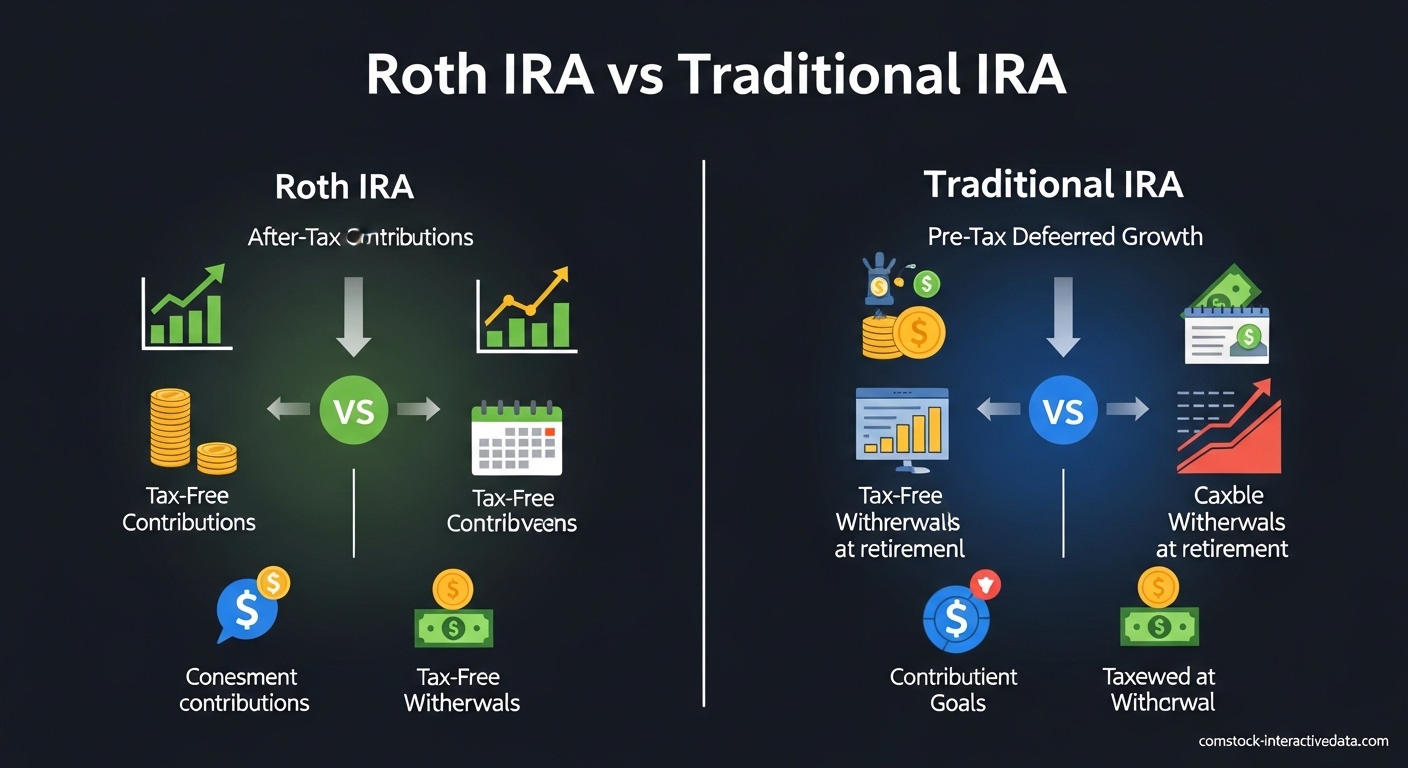
Choosing between a Roth IRA and Traditional IRA is one of the most important retirement decisions you will make. The wrong choice could cost you thousands in unnecessary taxes over your lifetime. The right choice depends on one critical factor that most articles gloss over too quickly.
Our team has analyzed hundreds of real investor scenarios over the past decade. We have seen people save over $50,000 in taxes by making the optimal IRA choice for their specific situation. We have also seen costly mistakes where investors picked the wrong account type and paid the price at retirement.
This guide breaks down the Roth IRA vs Traditional IRA decision with clear examples, current 2026 IRS limits, and age-specific recommendations. You will learn exactly which account makes sense for your tax bracket, age, and retirement goals. No financial jargon, no vague advice. Just actionable guidance you can use today.
Table of Contents
Quick Answer: Which IRA Is Better for You?
Choose a Roth IRA if you expect to be in the same or higher tax bracket in retirement than you are today. Choose a Traditional IRA if you expect to be in a lower tax bracket when you retire.
The fundamental difference is timing. Traditional IRAs give you a tax break now. Roth IRAs give you a tax break later. If your tax rate stays exactly the same, both accounts produce identical results mathematically. But tax rates rarely stay the same over a 30-year career.
Here is the quickest way to decide. Ask yourself: will my income in retirement be higher or lower than it is today? If higher, go Roth. If lower, go Traditional. If you are young and uncertain, default to Roth. The flexibility benefits alone often outweigh the tax uncertainty.
Roth IRA vs Traditional IRA: Side-by-Side Comparison
The table below summarizes the essential differences at a glance. Refer to this when you need a quick refresher on the core mechanics.
| Feature | Roth IRA | Traditional IRA |
|---|---|---|
| Tax Treatment on Contributions | After-tax dollars (no deduction) | Pre-tax dollars (tax-deductible) |
| Tax Treatment on Growth | Tax-deferred (no annual taxes) | Tax-deferred (no annual taxes) |
| Tax Treatment on Withdrawals | Tax-free in retirement | Taxed as ordinary income |
| 2026 Contribution Limit (Under 50) | $7,000 | $7,000 |
| 2026 Contribution Limit (Age 50+) | $8,000 | $8,000 |
| Income Limits for Contributions | Yes, phase out at higher incomes | No income limits (contributions always allowed) |
| Required Minimum Distributions | None during owner’s lifetime | Must begin at age 73 |
| Early Withdrawal Penalty | Contributions withdrawable anytime tax and penalty free | 10% penalty on most withdrawals before age 59.5 |
| Age Limit for Contributions | No age limit (with earned income) | No age limit (with earned income) |
| Best For | Young savers, higher future tax brackets | Higher earners now, lower future tax brackets |
Both accounts shield your investments from annual taxes on dividends, interest, and capital gains. That is where the real wealth-building magic happens. The tax treatment of contributions and withdrawals is what differentiates the two accounts.
Understanding the Tax Treatment Difference
The tax mechanics are simpler than they first appear. With a Traditional IRA, you deduct contributions from your taxable income today. You pay zero taxes on that money now. In retirement, every dollar you withdraw gets taxed as ordinary income.
With a Roth IRA, you get no upfront deduction. You pay taxes on your contributions in the year you earn the money. In retirement, qualified withdrawals are completely tax-free. You never pay taxes on the growth.
Let me show you the math with a concrete example. Imagine you contribute $7,000 annually for 30 years and earn an average 7% return. Your total contributions equal $210,000. Your account grows to approximately $708,000.
With a Traditional IRA, you deduct $7,000 from your taxes each year during your working career. At a 22% tax bracket, that saves you $1,540 annually in taxes. Over 30 years, you save $46,200 in taxes upfront. But in retirement, you owe taxes on the full $708,000. If you withdraw at a 15% tax bracket, you pay $106,200 in taxes. Your net benefit is negative $60,000 compared to a Roth.
With a Roth IRA, you get no upfront tax savings. You pay the $46,200 in taxes during your working years. But in retirement, you withdraw the full $708,000 tax-free. You keep every penny. This is why the tax bracket comparison matters so much.
Eligibility and Income Limits 2026
Roth IRAs have income limits. Traditional IRAs do not. But Traditional IRAs have deduction limits if you or your spouse have a workplace retirement plan. Understanding these thresholds determines whether you can even use each account type.
Roth IRA Income Limits for 2026
You can contribute the full amount to a Roth IRA only if your modified adjusted gross income falls below certain thresholds. Above these limits, your contribution ability phases out. Above the phase-out range, you cannot contribute directly.
| Filing Status | Full Contribution (MAGI under) | Phase-Out Range | No Contribution (MAGI over) |
|---|---|---|---|
| Single | $150,000 | $150,000 – $165,000 | $165,000 |
| Married Filing Jointly | $236,000 | $236,000 – $246,000 | $246,000 |
| Married Filing Separately | $0 | $0 – $10,000 | $10,000 |
Modified Adjusted Gross Income (MAGI) is essentially your adjusted gross income with certain deductions added back. For most people, it is close to your total income. You can find your MAGI on your tax return or calculate it using IRS worksheets.
Traditional IRA Deduction Limits for 2026
Anyone with earned income can contribute to a Traditional IRA regardless of income. But the tax deduction has limits if you or your spouse are covered by a workplace retirement plan like a 401(k).
| Filing Status | Workplace Plan Coverage | Full Deduction (MAGI under) | Phase-Out Range | No Deduction (MAGI over) |
|---|---|---|---|---|
| Single | Yes, covered by plan | $77,000 | $77,000 – $87,000 | $87,000 |
| Married Filing Jointly | Yes, covered by plan | $123,000 | $123,000 – $143,000 | $143,000 |
| Married Filing Jointly | No, spouse covered | $230,000 | $230,000 – $240,000 | $240,000 |
| Married Filing Jointly | No, neither covered | No limit | No phase-out | No limit |
If neither you nor your spouse has a workplace retirement plan, you get the full Traditional IRA deduction regardless of income. This makes Traditional IRAs particularly attractive for self-employed individuals and those without employer plans.
Contribution Limits and Catch-Up Provisions
The IRS sets annual contribution limits that apply to the combined total of all your IRAs. You cannot contribute $7,000 to a Roth and another $7,000 to a Traditional. The limit applies to the sum.
For 2026, the contribution limit is $7,000 if you are under age 50. If you are 50 or older, you can contribute an additional $1,000 as a catch-up contribution, for a total of $8,000.
Catch-up contributions exist because older savers have less time until retirement. The IRS recognizes that many people get a late start on retirement savings. The extra $1,000 helps accelerate your progress in those final working years.
Spousal IRAs allow married couples to double their household contributions even if only one spouse has earned income. A working spouse can contribute to their own IRA and also fund an IRA for their non-working spouse. Both accounts are subject to the same $7,000 or $8,000 limits. A married couple over 50 can contribute up to $16,000 total annually.
Withdrawal Rules and Required Minimum Distributions
Withdrawal flexibility differs dramatically between the two account types. This is often the deciding factor for investors who value liquidity and control.
Roth IRA Withdrawal Rules
You can withdraw your Roth IRA contributions at any time, for any reason, with no taxes and no penalties. This is a unique feature no other retirement account offers. The money you put in is always accessible.
Earnings follow different rules. To withdraw earnings tax-free and penalty-free, you must meet two conditions. First, you must be age 59.5 or older. Second, your account must be open for at least five years. This is called the five-year rule.
If you withdraw earnings before meeting both conditions, you pay ordinary income tax plus a 10% early withdrawal penalty. There are exceptions for first-time home purchases (up to $10,000), qualified education expenses, disability, and certain other situations.
Roth IRAs have no Required Minimum Distributions (RMDs) during the original owner’s lifetime. Your money can continue growing tax-free for as long as you live. This makes Roth IRAs powerful estate planning tools. You can pass the entire account to heirs who will enjoy tax-free distributions.
Traditional IRA Withdrawal Rules
Traditional IRA withdrawals are taxed as ordinary income at your current tax rate. There are no special categories. Every dollar that comes out gets added to your taxable income for that year.
Withdrawals before age 59.5 generally trigger a 10% early withdrawal penalty on top of ordinary income taxes. The exceptions are similar to Roth IRAs but do not include contributions. Since Traditional IRAs use pre-tax money, the entire withdrawal amount faces the penalty.
Traditional IRAs have RMDs that begin at age 73. The SECURE Act 2.0 raised the RMD age from 72 to 73 starting in 2023. You must withdraw a calculated percentage of your account each year. The percentage increases as you age. Failing to take your RMD results in a 25% penalty on the amount you should have withdrawn.
RMDs create a tax time bomb for large Traditional IRA holders. You are forced to withdraw money even if you do not need it. Those withdrawals can push you into higher tax brackets. They can also increase your Medicare premiums through IRMAA surcharges and make more of your Social Security benefits taxable.
State Tax Considerations: The Hidden Factor
Most Roth vs Traditional IRA articles completely ignore state income taxes. This is a massive oversight. State taxes can add anywhere from 0% to 13.3% to your total tax burden depending on where you live.
Traditional IRA contributions are deductible on your federal tax return. In most states, they are also deductible on your state tax return. You get a tax break at both levels today. However, in retirement, you pay state income tax on Traditional IRA withdrawals just like federal tax.
Roth IRA contributions are not deductible federally. Most states follow this treatment. You pay state taxes on the money you contribute. But qualified Roth withdrawals are tax-free at both the federal and state level.
If you live in a high-tax state like California, New York, or New Jersey, the state tax impact amplifies your decision. A 9.3% California state tax on top of a 22% federal rate means you are really comparing a 31.3% current rate against your future combined rate.
If you plan to retire in a no-income-tax state like Florida, Texas, or Nevada, Traditional IRAs become more attractive. You might deduct your contributions while living in a high-tax state during your working years. Then you withdraw in a no-tax state during retirement. This geographic arbitrage can save you significant money.
Conversely, if you currently live in a no-tax state but plan to retire in a high-tax state, Roth IRAs make more sense. You pay no state tax on contributions now. You avoid state tax on withdrawals later.
Age-Based Decision Guide: Making the Right Choice at Every Stage
Your optimal IRA choice changes as you age. Here is our age-specific guidance based on analyzing hundreds of real client scenarios.
In Your 20s: Default to Roth
Your 20s are Roth IRA prime time. You are likely in the lowest tax bracket you will ever see. Lock in those low rates by paying taxes now. Your money has 40+ years to grow tax-free.
Starting Roth contributions at age 25 versus 35 can mean an extra $200,000 in tax-free growth by retirement. The math favors starting as early as possible. Even if your tax bracket stays the same, the decades of tax-free compounding tilt the scales toward Roth.
Early career flexibility also matters. Your income is probably unpredictable. You might switch jobs, go back to school, or start a business. The ability to withdraw Roth contributions without penalty gives you a safety net no other retirement account provides.
In Your 30s: Probably Roth, But Consider Traditional
Your 30s are when income typically starts climbing. You might jump from the 12% bracket to the 22% or 24% bracket. If you are still in the 12% bracket, Roth remains the clear winner. At 22% and above, the decision requires more analysis.
Consider a split strategy. If you are in the 22% bracket, put half your contribution in Traditional and half in Roth. This tax diversification gives you flexibility in retirement. You can withdraw from the Traditional account up to a tax bracket threshold. Then pull from Roth for additional needs without pushing into higher brackets.
Home purchase goals might also influence your choice. Roth IRAs allow you to withdraw up to $10,000 in earnings penalty-free for a first-time home purchase if you meet the five-year rule. This adds flexibility for 30-somethings saving for a house.
In Your 40s: The Critical Planning Decade
Your 40s are peak earning years for many professionals. You might find yourself in the 24% or 32% tax bracket. At these rates, Traditional IRA deductions become genuinely valuable.
But 40-somethings also have shorter time horizons for tax-free growth. You might only have 20 years until retirement. The Roth advantage diminishes as the growth window shortens. This makes Traditional IRAs relatively more attractive compared to your 20s and 30s.
If you have been contributing to Roth IRAs for two decades, your 40s are a good time to evaluate your tax diversification. If 100% of your retirement savings is in Roth accounts, consider shifting some contributions to Traditional. You want tax flexibility in retirement.
In Your 50s: Catch-Up Mode and RMD Planning
Your 50s bring catch-up contributions and proximity to retirement. You can contribute an extra $1,000 annually to your IRA. You also need to think about RMDs and tax brackets in the near future.
If you are in a high tax bracket now but expect to drop significantly in retirement, Traditional IRAs likely make sense. The deduction saves you money at high rates today. Withdrawals happen at lower rates in just a few years.
But if you have significant Traditional IRA or 401(k) balances already, consider Roth contributions to manage future RMDs. Large Traditional accounts create large forced withdrawals. Those RMDs can trigger higher Medicare premiums (IRMAA) and make more of your Social Security taxable.
Your 50s are also the last chance for Roth conversions at reasonable tax rates. If you have a year with lower income, consider converting some Traditional IRA money to Roth. Pay taxes now at lower rates to avoid RMDs later.
How to Decide: The Complete Decision Framework
Still unsure? Work through these five questions in order. Your answers will point you toward the right account.
Question 1: What Is Your Current Marginal Tax Bracket?
If you are in the 10% or 12% bracket, Roth is almost always the answer. The tax deduction on a Traditional IRA is minimal. The decades of tax-free growth dwarf the small current benefit.
If you are in the 32% bracket or higher, Traditional is usually better unless you expect even higher retirement income. The deduction saves real money now. You need a compelling reason to pass it up.
The 22% and 24% brackets are the gray area. Both accounts are reasonable choices. This is where other factors like RMDs, state taxes, and withdrawal flexibility tip the scales.
Question 2: What Tax Bracket Do You Expect in Retirement?
Be realistic. Most people have lower taxable income in retirement than during their peak earning years. You are no longer contributing to retirement accounts. You might have paid off your mortgage. Your dependents have left the nest.
If you expect a significantly lower bracket, Traditional wins. If you expect the same bracket, it is roughly a wash. If you expect a higher bracket, Roth wins decisively.
Common scenarios where retirement brackets stay high include large pension incomes, significant rental property income, or plans for extensive travel and luxury spending. Common scenarios where brackets drop include downsizing homes, moving to lower-cost areas, and simplified lifestyles.
Question 3: Do You Value Withdrawal Flexibility?
If you want the ability to access your contributions before retirement without penalty, choose Roth. No other retirement account offers this feature. It is valuable for emergency funds, career transitions, or unexpected opportunities.
If you do not need this flexibility and prefer the immediate tax deduction, Traditional works fine. Just understand that your money is locked behind the 59.5 age barrier and the RMD clock.
Question 4: Do You Care About Estate Planning?
Roth IRAs are superior estate planning vehicles. They pass to heirs tax-free. Traditional IRAs pass with embedded tax liabilities. Your heirs must withdraw the full account within 10 years and pay taxes on every distribution.
If leaving a tax-free inheritance matters to you, lean toward Roth. If you plan to spend every dollar yourself and do not care about inheritance, this factor is irrelevant.
Question 5: What Does Your Tax Diversification Look Like?
Ideally, you want a mix of pre-tax and after-tax retirement accounts. This gives you options in retirement. You can manage your tax bracket strategically by choosing which account to withdraw from each year.
If all your savings are in Traditional 401(k)s and IRAs, consider Roth contributions for tax diversification. If all your savings are in Roth accounts, consider Traditional contributions to create pre-tax flexibility.
Frequently Asked Questions
Is it better to do a traditional IRA or a Roth IRA?
It depends on your current tax bracket versus your expected retirement tax bracket. Choose Traditional if you expect a lower tax rate in retirement. Choose Roth if you expect the same or higher rate. Younger savers typically benefit more from Roth IRAs due to longer tax-free growth periods.
What happens if I put $2000 in a Roth IRA?
Your $2000 contribution grows tax-free based on your investment returns. You can withdraw the $2000 contribution anytime without taxes or penalties. After age 59.5 and with the account open 5 years, you can withdraw all growth tax-free too.
Is 30 too old for a Roth IRA?
No, 30 is not too old for a Roth IRA. You still have 30+ years until retirement for tax-free growth. Many 30-somethings are still in relatively low tax brackets, making Roth contributions attractive. The five-year rule for qualified withdrawals starts when you open your first Roth IRA.
What are the disadvantages of having a Roth IRA?
Roth IRAs have income limits that prevent high earners from contributing directly. You get no immediate tax deduction, which means less take-home pay today. Some people also dislike the five-year waiting period before earnings can be withdrawn tax-free.
Is a traditional IRA ever better than a Roth IRA?
Yes, Traditional IRAs are better when you are in a high tax bracket now and expect to be in a lower bracket in retirement. They are also preferable if you need the immediate tax deduction to afford contributions. High earners above Roth income limits may use Traditional IRAs when backdoor Roth strategies are not viable.
Can I contribute to a Roth IRA if I make $200000 a year?
If you are single with $200,000 MAGI, you cannot contribute directly to a Roth IRA. The phase-out range for singles ends at $165,000. If married filing jointly, you also exceed the $246,000 limit. However, you might use a backdoor Roth IRA strategy involving a non-deductible Traditional IRA conversion.
Conclusion: Taking Action on Your Roth IRA vs Traditional IRA Decision
The Roth IRA vs Traditional IRA decision comes down to a simple tax timing question. Pay taxes now or pay taxes later. Neither account is universally better. The optimal choice depends on your specific tax situation, age, and retirement goals.
Young professionals in lower tax brackets should generally choose Roth IRAs. High earners near retirement in peak tax brackets should generally choose Traditional IRAs. Everyone in between should evaluate their specific circumstances using the framework in this guide.
The worst decision is making no decision at all. Both accounts offer tax-deferred growth that supercharges your retirement savings compared to taxable accounts. Open an IRA today. Start contributing. You can always adjust your strategy next year as your circumstances change. The tax advantages begin working for you the moment you fund your account.