
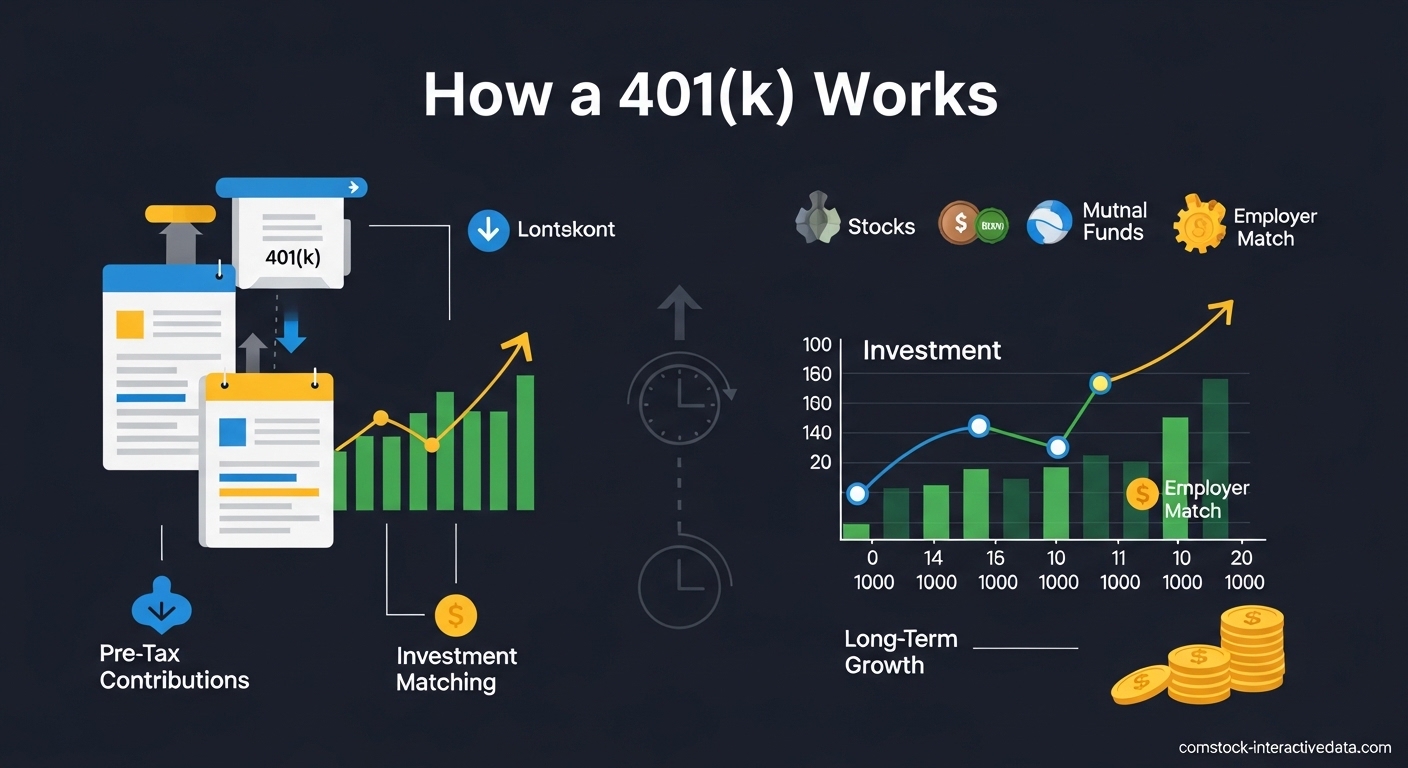
A 401(k) is an employer-sponsored retirement savings plan that allows you to contribute a portion of your paycheck before taxes are taken out, giving your money the chance to grow tax-deferred until retirement. Understanding how a 401(k) works is one of the most important financial skills you can develop, as it directly impacts your ability to retire comfortably.
Our team has helped hundreds of employees navigate their retirement benefits over the past decade. We’ve seen firsthand how a solid grasp of 401(k) mechanics can mean the difference between retiring at 60 versus working into your 70s. This guide covers everything from contribution rules to withdrawal strategies, giving you the complete picture of how this powerful retirement tool functions.
Table of Contents
What Is a 401(k)?
A 401(k) is a tax-advantaged retirement savings plan sponsored by employers. The name comes from Section 401(k) of the Internal Revenue Code, which Congress established in 1978 to give Americans a new way to save for retirement through their workplaces. Unlike traditional pension plans where employers bear all the investment risk, 401(k) plans are defined contribution plans where you control how much you save and how your money is invested.
When you enroll in a 401(k), you elect to have a percentage of each paycheck automatically deducted and deposited into your retirement account. These contributions happen before federal income taxes are calculated on your salary, which immediately reduces your taxable income. Your money then gets invested in mutual funds, target-date funds, or other investment options you select from your plan’s menu.
The tax advantages are significant. Traditional 401(k) contributions are pre-tax, meaning you do not pay income tax on that money until you withdraw it in retirement. This gives you an immediate tax break and allows your investments to compound without the drag of annual taxes on dividends, interest, or capital gains. For someone earning $75,000 per year who contributes $10,000 to a traditional 401(k), their taxable income drops to $65,000, potentially saving thousands in current-year taxes.
Who Can Participate in a 401(k)?
Eligibility rules vary by employer, but federal law allows companies to require up to one year of service and age 21 before letting employees participate. Many employers have shortened these waiting periods to attract talent, with some offering immediate eligibility. If your employer offers a 401(k), they must provide you with a Summary Plan Description detailing all eligibility requirements, contribution rules, and withdrawal procedures.
Part-time employees gained better access to 401(k) plans starting in 2026 due to SECURE Act provisions. Employers must now allow long-term part-time workers who have completed at least 500 hours of service for three consecutive years to contribute to the plan. This change has opened retirement savings opportunities to millions of part-time and seasonal workers who were previously excluded.
Traditional vs. Roth 401(k): Which Is Right for You?
One of the most important decisions you will make is whether to contribute to a traditional 401(k), a Roth 401(k), or a combination of both. This choice affects when you pay taxes on your retirement savings and can have significant implications for your long-term wealth. The right answer depends on your current tax bracket, your expected tax bracket in retirement, and your personal financial philosophy.
Here is a comprehensive comparison of the two options:
| Feature | Traditional 401(k) | Roth 401(k) |
|---|---|---|
| Contribution Type | Pre-tax dollars | After-tax dollars |
| Current Tax Impact | Reduces taxable income now | No immediate tax benefit |
| Growth | Tax-deferred | Tax-free |
| Retirement Withdrawals | Taxed as ordinary income | Tax-free (if qualified) |
| Required Distributions | Required at age 73 | Required at age 73 (but Roth IRAs are not) |
| Best For | Higher earners now, lower taxes expected in retirement | Lower earners now, higher taxes expected in retirement |
How to Choose Between Traditional and Roth?
If you are in a high tax bracket now and expect to be in a lower bracket during retirement, a traditional 401(k) usually makes more sense. You get the tax break when it matters most and pay taxes later at a lower rate. For example, someone earning $150,000 annually (32% federal tax bracket) who expects to live on $80,000 in retirement (22% bracket) would save significantly by deferring taxes.
Young workers early in their careers often benefit more from Roth contributions. If you are earning $50,000 and expect your income to grow substantially over your career, paying taxes now at a lower rate beats paying later when you might be in a higher bracket. Additionally, all the growth in a Roth 401(k) comes out tax-free in retirement, which can amount to massive savings on decades of compound returns.
One important detail many employees miss: employer matching contributions are always made on a pre-tax basis. Even if you contribute 100% to a Roth 401(k), your employer’s match goes into a traditional bucket and will be taxable when you withdraw it in retirement. This means most Roth 401(k) participants actually have a hybrid account with both taxable and tax-free portions.
How 401(k) Contributions Work?
Contributing to a 401(k) happens through payroll deduction, which makes saving automatic and painless. When you enroll, you specify a contribution percentage or fixed dollar amount from each paycheck. Your employer’s payroll system deducts this amount before calculating federal income taxes, which means you pay less tax today while building wealth for tomorrow.
2026 Contribution Limits
The IRS sets annual limits on how much you can contribute to your 401(k). These limits adjust periodically for inflation. For 2026, the contribution limits are:
- Standard limit: $23,500 for employees under age 50
- Age 50+ catch-up: Additional $7,500, bringing total to $31,000
- Ages 60-63 super catch-up: Additional $11,250 (thanks to SECURE 2.0 Act), for a total of $34,750
These limits apply to your personal elective deferrals, the money you choose to contribute from your salary. Employer matching contributions do not count against this limit. The combined total of your contributions plus employer contributions cannot exceed $70,000 in 2026 (or $77,500 if age 50+), which is called the Section 415 limit.
Understanding Employer Matching
Employer matching is free money added to your retirement account based on your contributions. This benefit is a key reason 401(k) plans are so powerful. The most common matching formula is 50% of your contributions up to 6% of your salary, though formulas vary widely between employers.
Here is how the typical match works with concrete numbers. If you earn $60,000 annually and contribute 6% ($3,600 per year), your employer would contribute 50% of that amount ($1,800). If you contribute less than 6%, you leave money on the table. If you contribute more than 6%, you still only get the $1,800 match. Financial advisors universally agree you should contribute at least enough to capture your full employer match before doing anything else with your money.
Some employers offer more generous formulas. A dollar-for-dollar match up to 4% means if you contribute 4%, your employer contributes 4%. A few companies offer non-elective contributions, where they put money in your account regardless of whether you contribute anything. Review your Summary Plan Description to understand your specific matching formula and calculate your target contribution percentage.
Elective Deferrals and Payroll Deduction
The technical term for your personal 401(k) contributions is “elective deferrals” because you elect to defer receiving this portion of your salary until retirement. These deferrals happen automatically through payroll, making the process effortless once you set it up. You can usually change your contribution percentage through your HR portal or plan website, though changes may take one or two pay cycles to take effect.
Many employers now offer automatic enrollment, where new hires are enrolled at a default contribution rate (often 3%) unless they actively opt out. While automatic enrollment helps more people start saving, the default rates are usually too low to capture the full employer match. If you were auto-enrolled, log into your account and adjust your contribution percentage upward.
Understanding Vesting: When Your Money Becomes Truly Yours
Vesting determines when you have full ownership of the money in your 401(k) account. This concept confuses many employees and leads to costly mistakes when changing jobs. Understanding your vesting schedule is essential for making informed career and financial decisions.
Your Contributions Are Always 100% Yours
Any money you contribute from your own paycheck is immediately 100% vested. This means you own it completely from day one, and you can take it with you when you leave the company regardless of how long you have worked there. This includes all your elective deferrals, plus any earnings on those contributions. If you contributed $10,000 and it grew to $12,000, the entire $12,000 is yours to keep.
Employer Contributions Follow Vesting Schedules
Employer matching contributions and any profit-sharing contributions are subject to vesting schedules. These schedules determine how long you must work for the company before you own the employer’s contributions. Until you are fully vested, if you leave the company, you forfeit the unvested portion back to the plan.
There are three common vesting schedule types:
- Immediate vesting: You own employer contributions right away. This is the most employee-friendly option.
- Graded vesting: You gain ownership gradually. A typical schedule vests 20% per year, meaning you are fully vested after five years. You keep 40% of employer contributions if you leave after two years, 60% after three years, and so on.
- Cliff vesting: You own nothing until you hit a specific milestone, then you own 100%. Federal law allows cliff vesting after three years maximum.
Your Summary Plan Description details your specific vesting schedule. If you are considering a job change, calculate the dollar amount you would forfeit by leaving before full vesting. Sometimes staying an extra six months to hit a vesting milestone is worth more than a small salary increase at a new job.
401(k) Withdrawals and Distributions
Accessing your 401(k) money is subject to strict rules designed to ensure these funds are used for retirement. The government gives you tax breaks to encourage long-term savings, and in exchange, you face penalties for early withdrawal. Understanding these rules helps you avoid costly mistakes while planning your retirement income strategy.
The Age 59.5 Rule
You can begin withdrawing from your 401(k) without penalties starting at age 59.5. Withdrawals before this age typically trigger a 10% early withdrawal penalty on top of regular income taxes. This penalty is the government’s way of discouraging you from tapping retirement funds early.
At age 59.5, you can take distributions as needed. Traditional 401(k) withdrawals are taxed as ordinary income in the year you receive them. Roth 401(k) qualified withdrawals are completely tax-free, provided you have held the account for at least five years. Many retirees use a combination of both to manage their tax brackets strategically in retirement.
The Rule of 55
The Rule of 55 offers an exception to the age 59.5 requirement. If you separate from service (quit, get laid off, or retire) during or after the year you turn 55, you can take penalty-free withdrawals from that employer’s 401(k) plan. This rule only applies to the 401(k) from your most recent employer, not to previous employer plans or IRAs.
For public safety employees like police officers and firefighters, the rule is even more generous. They can access penalty-free withdrawals starting at age 50 if they separate from service. The Rule of 55 is a valuable planning tool for early retirees, but remember that regular income taxes still apply to traditional 401(k) withdrawals.
Early Withdrawal Penalties and Exceptions
Taking money from your 401(k) before age 59.5 typically costs you 10% in federal penalties, plus any state penalties, plus regular income taxes. On a $10,000 withdrawal, someone in the 22% tax bracket would pay $2,200 in income taxes plus $1,000 in penalties, leaving only $6,800. This is why early withdrawals should be a last resort.
However, the IRS recognizes certain hardship situations where the penalty may be waived:
- Unreimbursed medical expenses exceeding 7.5% of adjusted gross income
- Permanent disability
- Court-ordered payments to a divorced spouse or dependent
- IRS tax levy on the plan
- Qualified disaster distributions (specific federally declared disasters)
- Birth or adoption expenses (up to $5,000, repayment option available)
Even with these exceptions, you still owe regular income tax on traditional 401(k) withdrawals. The penalty waiver only removes the extra 10% hit. Hardship withdrawals also permanently reduce your retirement balance, unlike loans which you repay.
Required Minimum Distributions (RMDs)
The government does not let you defer taxes forever. Starting at age 73, you must begin taking Required Minimum Distributions from your traditional 401(k). The SECURE 2.0 Act raised the RMD age from 72 to 73 starting in 2023, and it will increase to 75 in 2033.
RMD amounts are calculated based on your account balance and life expectancy. The IRS provides worksheets and tables to determine your exact amount. Failing to take your RMD results in a steep penalty: 25% of the amount you should have withdrawn (reduced to 10% if corrected within two years). For a missed $10,000 RMD, that is a $2,500 penalty.
Roth 401(k)s are also subject to RMDs during the owner’s lifetime, unlike Roth IRAs. However, starting in 2024, Roth 401(k) accounts no longer require RMDs, aligning them with Roth IRA rules. If you have a Roth 401(k) from before 2024 and want to avoid RMDs, rolling it to a Roth IRA was the typical strategy.
401(k) and Life Events: Job Changes, Loans, and Hardships
Life does not stand still, and your 401(k) needs to adapt to major life changes. Whether you switch jobs, face financial hardship, or need access to funds for emergencies, understanding your options prevents costly mistakes.
What Happens to Your 401(k) When You Change Jobs
When you leave an employer, you have four options for your 401(k) balance. Each choice has different implications for fees, investment options, and access rules.
Option 1: Leave it in the old plan. Many plans allow former employees to keep their money invested indefinitely, though some have minimum balance requirements (typically $5,000). This option maintains your current investments and might make sense if the plan has excellent low-cost fund options. However, you cannot make new contributions, and you lose the ability to take loans from the account.
Option 2: Roll it to your new employer’s 401(k). If your new job offers a 401(k), you can transfer the balance directly via a trustee-to-trustee transfer. This keeps all your retirement money in one place and maintains the 401(k) loan option. Check that the new plan has good investment choices and reasonable fees before rolling over.
Option 3: Roll it to an IRA. Moving your balance to a rollover IRA at a brokerage firm opens up virtually unlimited investment options beyond the limited menu in most 401(k) plans. IRAs often have lower fees and more flexibility. However, you lose the ability to borrow from the account and the Rule of 55 protection for early access.
Option 4: Cash out. This is almost always a terrible idea. If you take the money, you pay income taxes plus the 10% early withdrawal penalty if under 59.5. A $50,000 balance could shrink to $35,000 or less after taxes and penalties. Additionally, you lose decades of potential compound growth. According to industry data, cashing out a $50,000 balance at age 35 could cost you over $300,000 in lost retirement wealth by age 65.
401(k) Loans: Borrowing From Yourself
Many 401(k) plans allow you to borrow from your account balance rather than taking a withdrawal. Loans can be appealing because you pay interest back to yourself rather than a bank. However, they come with significant risks that many participants underestimate.
The rules for 401(k) loans are strict. You can borrow up to 50% of your vested balance or $50,000, whichever is less. The loan must be repaid within five years through payroll deduction, though loans used to buy a primary home can have longer terms. Interest rates are typically set at prime rate plus 1-2%, and all interest payments go back into your account.
The biggest risk is job loss. If you leave your employer for any reason, most plans require full repayment of the outstanding loan balance within 60 to 90 days. If you cannot repay, the loan is treated as a distribution. You owe income taxes and the 10% early withdrawal penalty on the unpaid amount if you are under 59.5. This double hit can devastate your finances during an already stressful job transition.
Our advice: exhaust all other options before taking a 401(k) loan. Personal loans, home equity lines of credit, or even credit cards often make more sense despite higher interest rates. The opportunity cost of removing money from long-term compound growth, plus the job loss risk, makes 401(k) loans dangerous.
Hardship Withdrawals: Last Resort Options
When facing severe financial distress, some 401(k) plans allow hardship withdrawals. These are not loans; you cannot repay the money. The withdrawn amount is permanently removed from your retirement savings, and you face immediate taxes and penalties.
The IRS defines specific situations that qualify for hardship withdrawals:
- Medical expenses for you, your spouse, or dependents
- Costs related to purchasing a principal residence (excluding mortgage payments)
- Tuition and related educational fees for the next 12 months
- Payments to prevent eviction or foreclosure on your primary home
- Funeral or burial expenses
- Repairs for damage to your principal residence
Plans are not required to offer hardship withdrawals, and many have tightened restrictions in recent years. Even if your plan allows them, most require you to exhaust all other resources first. Additionally, you cannot contribute to your 401(k) for six months after taking a hardship withdrawal, further delaying your retirement savings progress.
Frequently Asked Questions About 401(k)s
What is a 401k and how does it work?
A 401(k) is an employer-sponsored retirement savings plan that lets you contribute pre-tax dollars from your paycheck. Your contributions are invested in funds you select and grow tax-deferred. You pay taxes on withdrawals in retirement. Many employers match a portion of your contributions, providing free money toward your retirement.
Why is it called a 401k?
The name comes from Section 401(k) of the Internal Revenue Code, the part of federal tax law that authorized these plans. Congress added this section in 1978, and the first 401(k) plans appeared in 1980. Before 401(k)s, most employer retirement plans were traditional pension plans.
How does a 401k work when you quit?
When you leave a job, you have four options: leave the money in the old plan, roll it to your new employer’s 401(k), roll it to an IRA, or cash out. Cashing out triggers taxes and penalties. Rolling over preserves your retirement savings and maintains tax advantages. You must also repay any outstanding 401(k) loans quickly after leaving.
How does a 401k work when you retire?
After age 59.5, you can take penalty-free withdrawals. Traditional 401(k) withdrawals are taxed as income. Roth 401(k) withdrawals are tax-free if qualified. At age 73, you must start taking Required Minimum Distributions from traditional accounts. Many retirees roll their 401(k) to an IRA for more investment flexibility.
What is the smartest way to withdraw from a 401k?
The smartest withdrawal strategy depends on your tax situation. Most experts recommend withdrawing from taxable accounts first, then traditional 401(k)s, then Roth accounts last. This allows tax-deferred money to continue growing. Some retirees use Roth conversions during low-income years. Working with a tax advisor helps optimize your specific withdrawal sequence.
How many Americans have $1,000,000 in their 401k?
Only a small percentage of Americans have reached millionaire status in their 401(k). According to recent data from major plan administrators, less than 1% of 401(k) participants have balances exceeding $1 million. The average 401(k) balance for those in their 60s is around $200,000 to $250,000. Consistent contributions over decades are needed to reach seven figures.
Can I use my 401k for plastic surgery?
Plastic surgery generally does not qualify for 401(k) hardship withdrawal exceptions. The IRS allows hardship withdrawals only for specific needs like medical expenses, home purchase, education, foreclosure prevention, or funeral costs. Even if your plan administrator allows the withdrawal, you would face income taxes plus a 10% early withdrawal penalty if under age 59.5.
What is the penalty for early 401k withdrawal?
Early withdrawals from a traditional 401(k) before age 59.5 typically trigger a 10% federal penalty plus regular income taxes. State penalties may apply too. On a $10,000 withdrawal, someone in the 22% tax bracket would pay $3,200 total, leaving only $6,800. Some exceptions exist for medical expenses, disability, and other specific situations.
What is 401k vesting and why does it matter?
Vesting determines when you fully own employer contributions to your 401(k). Your own contributions are always 100% vested immediately. Employer matching contributions follow a schedule, often requiring 3-5 years of service before you own them completely. If you leave before vesting, you forfeit the unvested employer money back to the plan.
Should I contribute to a 401k if I have debt?
If your employer offers matching contributions, contribute at least enough to capture the full match before paying extra on debt. The match is an instant 50-100% return, which exceeds most interest rates. After capturing the match, prioritize high-interest debt over additional 401(k) contributions. Low-interest debt can coexist with retirement saving.
Conclusion
Understanding how a 401(k) works is essential for building long-term financial security. This employer-sponsored retirement plan offers powerful tax advantages, potential free money through employer matching, and the magic of compound growth over decades. The key principles are simple: contribute at least enough to capture your full employer match, choose between traditional and Roth based on your tax situation, and avoid early withdrawals that trigger penalties.
Your action step today is to log into your 401(k) account or contact your HR department. Review your current contribution percentage, check if you are capturing the full employer match, and verify your investment selections align with your retirement timeline. If you are not contributing enough, increase your percentage by just 1% this month. Small steps now compound into massive differences at retirement. The sooner you optimize how your 401(k) works for you, the more secure your financial future becomes.