
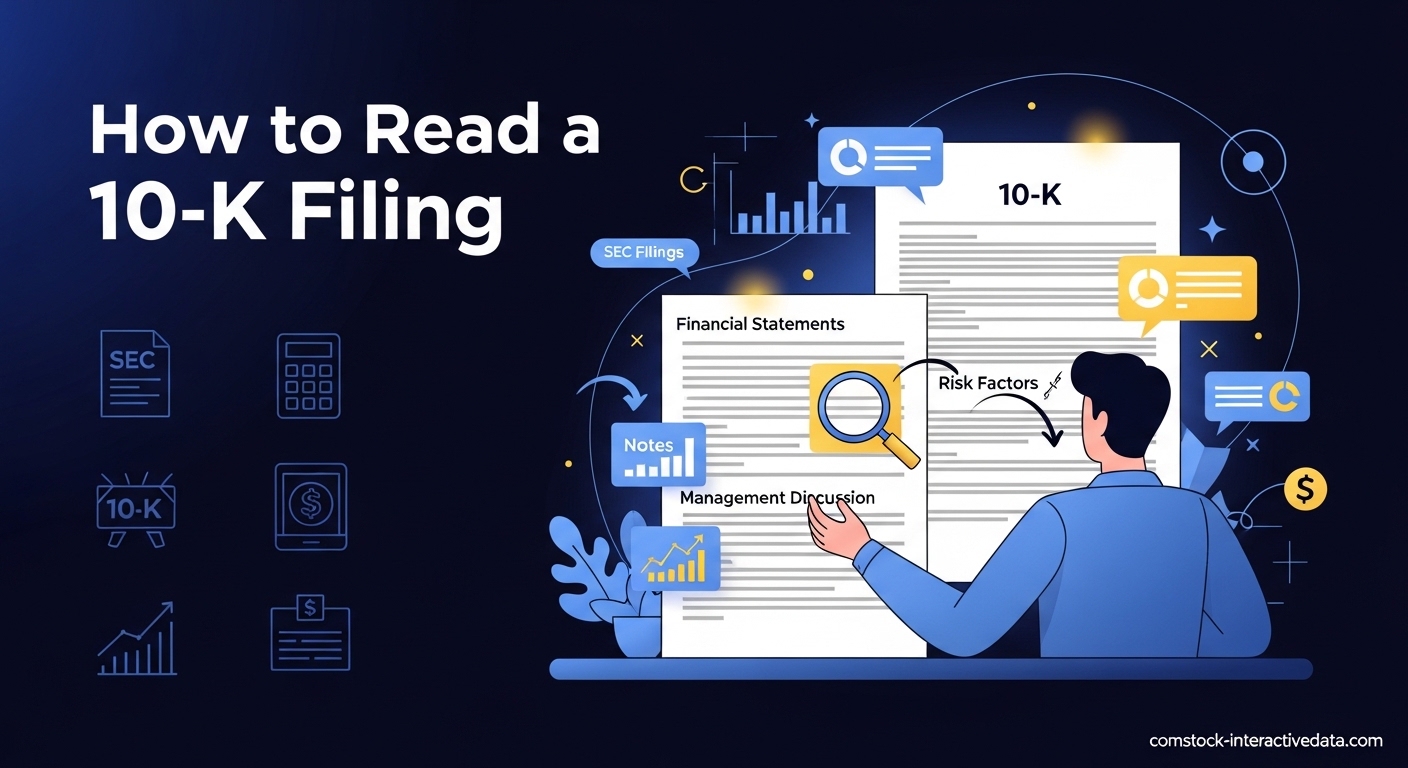
If you’re investing in stocks, knowing how to read a 10-K filing is one of the most valuable skills you can develop. I’ve read hundreds of these documents over the years, and I’ll tell you exactly what matters, what to skip, and how to extract the insights that move stock prices.
A 10-K contains everything a public company must disclose about its business, finances, and risks each year. It’s the most comprehensive document a company produces, filed with the Securities and Exchange Commission (SEC). Unlike earnings calls or press releases, the 10-K is legally required and audited.
In this guide, I’ll show you my proven approach to reading 10-Ks efficiently. You’ll learn which sections actually matter, what red flags to watch for, and how to avoid getting overwhelmed by 200+ pages of financial jargon.
Table of Contents
What Is a 10-K Filing?
A 10-K is an annual report that public companies must file with the SEC within 60 to 90 days after their fiscal year ends. It provides a comprehensive overview of the company’s business operations, financial performance, risk factors, and corporate governance.
The requirement comes from the Securities Exchange Act of 1934, designed to protect investors by ensuring companies disclose material information. Every public company trading on U.S. exchanges must file a 10-K each year, no exceptions.
What makes the 10-K different from other SEC filings? It’s audited by independent accountants, making it more reliable than quarterly 10-Q reports or press releases. The financial statements follow GAAP (Generally Accepted Accounting Principles) standards, ensuring consistency across companies.
Think of the 10-K as the company’s annual physical exam. It’s thorough, standardized, and reveals problems that marketing materials might hide. I’ve found more investment red flags in 10-Ks than anywhere else.
How to Find 10-K Filings?
Finding 10-K filings is straightforward once you know where to look. The easiest method is the SEC’s EDGAR database, which houses all public company filings for free.
Here’s my quick search method: Go to sec.gov/edgar and type the company name or ticker symbol in the search box. You’ll see a list of recent filings. Look for “10-K” in the filing type column. The most recent annual report will be at the top of the list.
You can also find 10-Ks on company investor relations websites, usually under the “SEC Filings” or “Financials” section. However, I prefer EDGAR because it’s faster and shows all companies in one place.
Pro tip: Bookmark the EDGAR search page for companies you own or are researching. This makes it easy to check when new filings drop, which happens within days of each quarter’s end.
How to Read a 10-K Filing?
Most beginners make the mistake of starting on page one and reading straight through. Don’t do this. I’ve wasted countless hours this way before learning a smarter approach.
The smartest way to read a 10-K is to focus on the 30-40 pages that actually matter. The rest is mostly boilerplate legal language and standard disclosures that rarely change year to year.
Here’s my proven reading order, developed after analyzing hundreds of filings:
Step 1: Start with Item 7 (MD&A)
Management’s Discussion and Analysis (MD&A) is where executives explain what happened in plain English. This section tells you the story behind the numbers. I always read this first because it frames everything else.
Look for management’s explanation of revenue changes, profit margins, and strategic initiatives. Pay attention to what they emphasize and what they downplay. When management gets vague about problems, that’s a signal to dig deeper.
Step 2: Check Item 1A (Risk Factors)
Risk Factors list everything that could hurt the business. I scan this section for new risks added in the current year compared to the previous 10-K. New or significantly reworded risks often signal emerging problems.
Don’t get bogged down reading every generic risk about economic conditions or competition. Focus on company-specific risks that could materially impact the business model. These are the red flags that matter.
Step 3: Review Item 8 (Financial Statements)
This section contains the audited financial statements: income statement, balance sheet, and cash flow statement. Look for trends in revenue growth, profit margins, and cash generation. Compare the current year to the previous two years.
The footnotes to the financial statements are actually more important than the statements themselves. This is where companies hide accounting tricks, off-balance-sheet obligations, and significant business changes. I always spend extra time here.
Step 4: Skim Item 1 (Business Description)
Read this if you’re unfamiliar with the company. It explains what the company does, how it makes money, and who its customers are. For companies you already know, a quick skim is usually enough.
Step 5: Check the Auditor’s Report
Near the front, you’ll find the independent auditor’s report. Look for “unqualified opinion” or “clean opinion” wording. If you see anything about “going concern doubts” or “qualified opinion,” that’s a major red flag requiring further investigation.
Key Sections of a 10-K You Need to Read
Not every section of a 10-K deserves your time. After years of reading these documents, I’ve identified the sections that actually move the needle for investment decisions.
Item 1 – Business
This section describes what the company does, its products, markets, and competitive position. It’s useful for understanding the business model but rarely contains surprising information. Read it once when you first research a company, then skim annually.
Item 1A – Risk Factors
Critical for identifying potential problems. Companies must disclose risks that could reasonably affect their business. I compare this year’s risk factors with last year’s to spot new concerns. Pay special attention to risks related to customer concentration, regulatory changes, and competitive threats.
Item 7 – Management’s Discussion and Analysis (MD&A)
This is the most important narrative section in the entire 10-K. Management explains financial results, discusses trends, and provides forward-looking guidance. I read every word here because it reveals how management thinks and what they’re focused on.
Look for explanations of unusual items, one-time events, and significant changes in business segments. Management’s tone matters here – confident explanations of problems are better than vague excuses.
Item 8 – Financial Statements and Supplementary Data
The audited financial statements and detailed footnotes. This is where you’ll find the income statement, balance sheet, cash flow statement, and statement of shareholders’ equity. The footnotes reveal accounting policies, debt details, lease obligations, and significant business arrangements.
I spend more time on the footnotes than the financial statements themselves. This is where sophisticated investors find the accounting red flags that others miss.
Item 9 – Changes in and Disagreements With Accountants
This section discloses any disagreements with auditors or changes in accounting principles. If a company changed auditors or had a dispute about accounting treatment, it will appear here. I check this section every time because auditor conflicts often signal bigger problems.
Red Flags to Watch For in 10-K Filings
After reading hundreds of 10-Ks, I’ve developed a checklist of warning signs that deserve extra scrutiny. These aren’t automatic deal-breakers, but they warrant deeper investigation before investing.
Going Concern Warnings
If the auditor raises doubts about the company’s ability to continue as a going concern, that’s a major red flag. This language means the company might not survive the next year without significant changes. I’ve seen this before bankruptcies more often than not.
Material Weaknesses in Internal Controls
A material weakness means the company’s financial reporting controls are broken. This increases the risk of accounting errors or fraud. While one material weakness isn’t fatal, recurring problems suggest deeper management issues.
Frequent Auditor Changes
Companies that change auditors frequently often have something to hide. Auditors resign when they disagree with management or uncover problems they can’t fix. I always investigate why a company switched auditors.
Unusual Revenue Recognition
Check the footnotes for revenue recognition policies that seem aggressive. Channel stuffing (shipping more product than customers want), long payment terms, and booking revenue before delivery are all warning signs of future problems.
Rising Debt Levels
Compare total debt from year to year in the balance sheet. Rapidly increasing debt, especially when combined with declining cash flow, can signal a business struggling to fund operations. I get nervous when debt grows faster than revenue.
Related Party Transactions
Transactions between the company and insiders (executives, major shareholders) raise conflict-of-concern concerns. These deals should be minimal and at arm’s length. Excessive related-party transactions suggest poor governance.
10-K Filing Deadlines by Company Size
Companies must file 10-Ks within a specific timeframe after their fiscal year ends. The deadline depends on the company’s public float (total market value of outstanding shares):
Large Accelerated Filers (public float over $700 million): 60 days
Accelerated Filers (public float between $75 million and $700 million): 75 days
Non-Accelerated Filers (public float under $75 million): 90 days
Companies that miss these deadlines often file Form 12b-25 to notify the SEC of the expected delay. While late filings happen occasionally, repeated delays or vague reasons for being late are concerning. I track filing dates for companies I own because patterns emerge.
Pro tip: Set calendar reminders for companies you follow. Most 10-Ks drop within a week of the deadline, and the information often moves stock prices. Being among the first to read important disclosures can give you an edge.
Frequently Asked Questions
How long does it take to read a 10-K?
Focused reading of key sections takes 30-60 minutes for most companies. First-time readers may need 2-3 hours. Speed comes with practice – I can now review most 10-Ks in under an hour by focusing on Item 7 (MD&A), Item 1A (Risk Factors), Item 8 (Financial Statements), and scanning for red flags. Skip the boilerplate sections.
What’s the difference between 10-K and annual report?
The 10-K is the legal filing with the SEC containing detailed financial data and risk disclosures. The annual report is a glossy marketing document sent to shareholders, often with photos and highlights. The 10-K is more comprehensive and reliable. Some companies combine them, but the SEC filing (10-K) is what matters for investors.
What’s the difference between 10-K and 10-Q?
10-K is the annual report filed once per year with audited financials. 10-Q is the quarterly report filed three times per year with unaudited financials. 10-K is more comprehensive. Think of 10-Q as progress updates, while 10-K is the full annual exam. Both matter, but 10-K carries more weight for investment decisions.
Do I need to read every page of a 10-K?
Absolutely not. Focus on Items 1, 1A, 7, 8, and 9. The rest is mostly standard legal boilerplate that rarely changes. Experienced investors ‘diff’ filings by comparing this year’s 10-K with last year’s, focusing only on what changed. This efficient approach saves time while catching important updates.
Can I trust everything in a 10-K?
Mostly yes, but verify key claims. Financial statements are audited, providing reliability. However, management’s narrative in MD&A can spin positively. Risk factors often downplay real threats. Cross-reference financial statements with management’s explanations. When numbers and story don’t align, trust the numbers. The footnotes often reveal what management minimizes in the narrative.
Next Steps for Your 10-K Reading Journey
Reading your first few 10-Ks will feel overwhelming. That’s normal. I remember staring at my first 10-K, wondering how anyone could make sense of hundreds of pages of financial jargon. But like any skill, it gets easier with practice.
Start by picking a company you’re familiar with and download its most recent 10-K from EDGAR. Focus only on Items 7 (MD&A) and 8 (Financial Statements) for your first read. Don’t worry about understanding everything – just get comfortable with the format and language.
For your second 10-K, compare the current year with the previous year. Notice what changed and what stayed the same. This comparison technique is how experienced investors quickly spot important developments.
Within five to ten 10-K reads, you’ll develop a rhythm. You’ll know what to skim, what to study carefully, and what red flags to watch for. Most importantly, you’ll have a skill that gives you an information advantage over investors who rely solely on summaries and analysis from others.
The 10-K is one of the most powerful tools in an investor’s arsenal. Now that you know how to read it efficiently, you have access to the same information as professional analysts. Use it wisely, and you’ll make better investment decisions.