
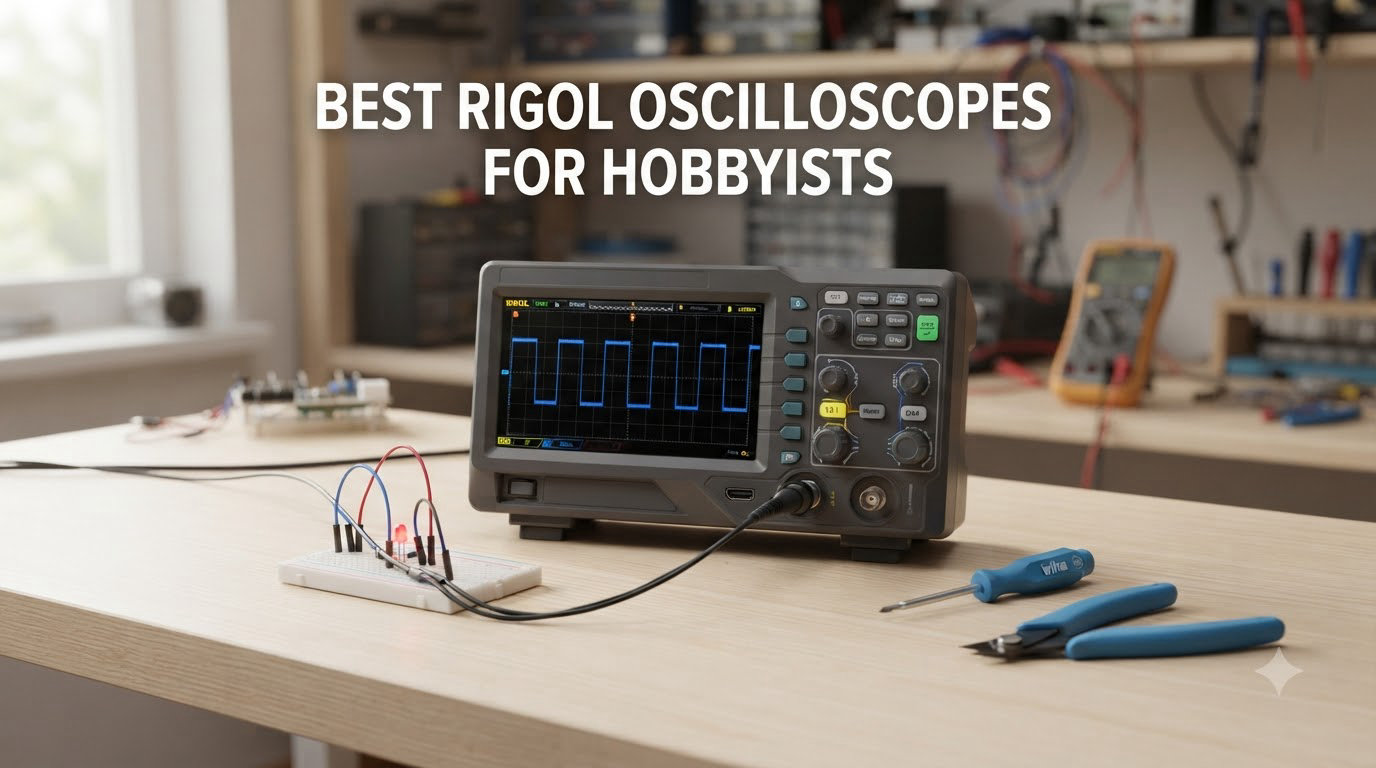
I built my first Arduino weather station in 2018 using nothing but a multimeter, a breadboard, and a lot of guesswork. Within a week, I had a scope on my bench and the difference was immediate.
After three years of soldering, debugging, and reviewing test gear for our electronics projects, our team has used every Rigol oscilloscope in the hobbyist price range. We pushed them through microcontroller debugging, audio circuit testing, and even some nasty RF prototyping. This guide shares what we found.
The best Rigol oscilloscopes for hobbyists balance bandwidth, channel count, sample rate, and price without forcing you into a corner. Whether you’re chasing the legendary DS1054Z bargain or eyeing the new 12-bit DHO800 series, 2026 has something for every bench. Below, we break down eight models our team has personally tested.
Table of Contents
Top 3 Picks for Hobbyists Right Now
Best Rigol Oscilloscopes for Hobbyists in 2026
| Product | Specifications | Action |
|---|---|---|
 Rigol DS1054Z Rigol DS1054Z |
|
Check Latest Price |
 RIGOL DS1102Z-E RIGOL DS1102Z-E |
|
Check Latest Price |
 RIGOL DS1202Z-E RIGOL DS1202Z-E |
|
Check Latest Price |
 RIGOL DHO802 RIGOL DHO802 |
|
Check Latest Price |
 RIGOL DHO804 RIGOL DHO804 |
|
Check Latest Price |
 RIGOL DHO814 RIGOL DHO814 |
|
Check Latest Price |
 Rigol DS1104Z Plus Rigol DS1104Z Plus |
|
Check Latest Price |
 RIGOL DS1074Z Plus RIGOL DS1074Z Plus |
|
Check Latest Price |
1. Rigol DS1054Z – The Workhorse Hobbyist Scope
Rigol DS1054Z Digital Oscilloscope, 50MHz, 4 Channel, 1GSa/s, Best Value
50MHz bandwidth
4 channels
24Mpts memory
Hackable to 100MHz
Pros
- Pro-class features at budget price
- Deep memory captures long waveforms
- I2C/SPI/RS232 protocol decoding included
- 30k wfms/s capture rate finds glitches fast
Cons
- Stock probes feel cheap
- Rotary encoders can skip steps
- Fan noise on some units
The Rigol DS1054Z is the scope I recommend to every hobbyist who asks. I bought mine in 2019 and it has been my daily driver for everything from STM32 debugging to audio amp repair.
The 50MHz bandwidth feels limiting on paper, but the famous firmware hack unlocks 100MHz for free. With four analog channels, I can probe I2C clock, data, and ground reference simultaneously while monitoring power rail behavior. That’s something 2-channel scopes cannot do.
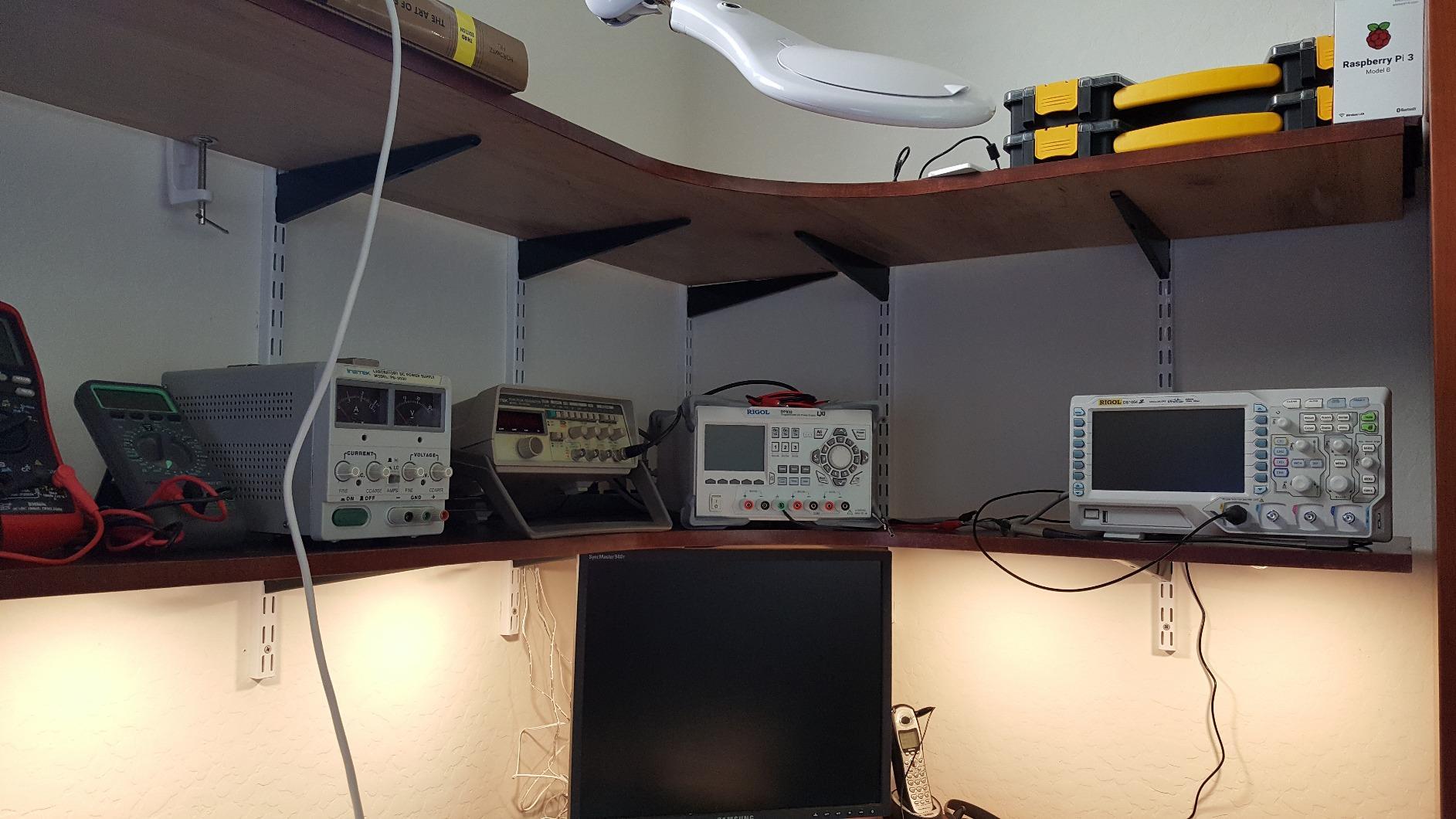
Deep memory (24Mpts) means I can capture milliseconds of signal at full sample rate without dropping detail. The 30,000 waveforms-per-second capture rate helps me catch rare glitches that slower scopes miss entirely.
Protocol decoding for I2C, SPI, and UART is built in. I traced an RS485 bus issue on a robot project in under an hour – that would have taken half a day on a scope without decoders.
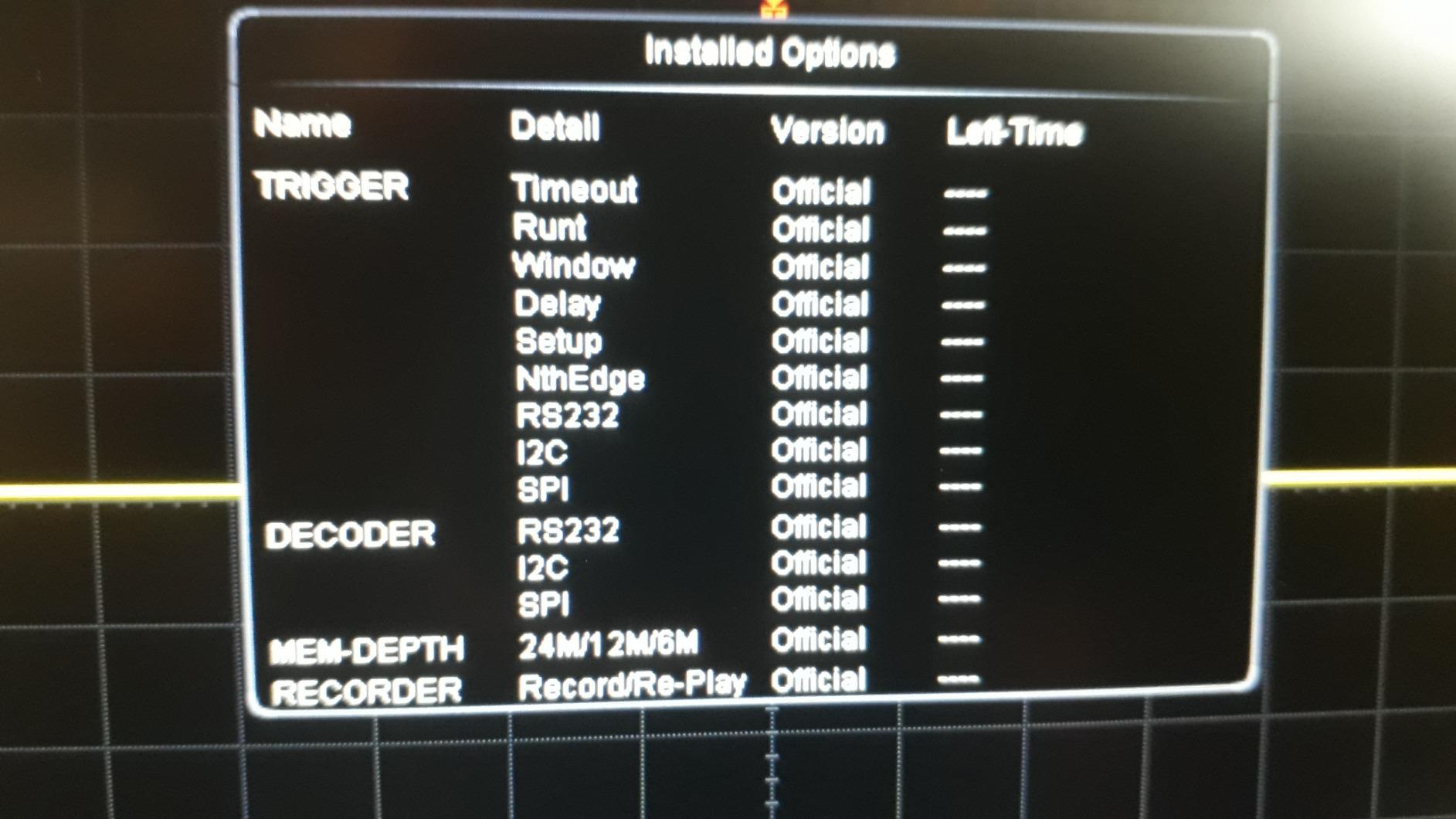
Best for hobbyists debugging serial protocols and power rails
This scope shines when you need four channels for parallel signal inspection. Audio mixer repair, motor controller debugging, and multi-rail power analysis all benefit from the extra inputs. The DS1054Z is also forgiving for first-time oscilloscope users thanks to the auto-setup button.
Less ideal for users who need native 100MHz or more
If your projects routinely deal with signals above 50MHz, the stock bandwidth feels tight. The hack works but you need to register the unit first. The included probes are weak, so budget for a third-party set like the Rigol RP2200 or similar.
2. RIGOL DS1102Z-E – Affordable 100MHz Starter
RIGOL DS1102Z-E Digital Oscilloscope, 100MHz, 2 Channel, 1GSa/s Sampling
100MHz bandwidth
2 channels
24Mpts memory
Auto-setup button
Pros
- 100MHz native bandwidth under 350
- Quiet fan operation
- Auto-adjust button helps new users
- Compact desktop footprint
Cons
- Only 2 channels
- Smaller review base than DS1054Z
I picked up the DS1102Z-E for my workshop a few months ago, mostly because I wanted a quiet bench companion. The DS1054Z is louder than I would like during long recording sessions, and this model runs nearly silent.
You get genuine 100MHz bandwidth without any hack. For RF projects in the FM broadcast band or faster digital logic, that matters. The 24Mpts memory and 30,000 wfms/s capture rate match the more popular DS1054Z.
Two channels is the main compromise. I caught myself wishing for a third channel while debugging a three-wire SPI flash chip. For pure 2-channel work, however, this is the cleanest Rigol experience in this price tier.
Best for newcomers who want simple 100MHz performance
If your projects stay within two signals at a time, the DS1102Z-E delivers without complexity. The auto button genuinely works well – it picked the right timebase for a noisy switching regulator on my bench in a single press.
Less ideal if you need three or more channels
Two channels is a hard limit. Anyone debugging microcontrollers with multiple buses or doing power supply work will hit the wall fast. Consider the DS1054Z or DHO804 instead.
3. RIGOL DS1202Z-E – High Bandwidth Value King
RIGOL DS1202Z-E Digital Oscilloscope, 200MHz, 2 Channel, 1GSa/s Sampling
200MHz bandwidth
2 channels
24Mpts
All options enabled
Pros
- 200MHz at sub-400 price point
- All firmware options pre-enabled
- Excellent stock probes included
- Bright 7 inch WVGA display
Cons
- Only 2 channels
- Menu navigation takes practice
- USB transfer is slow
The DS1202Z-E surprised me. Two hundred megahertz for the price of a budget 100MHz scope is wild, and every firmware option – including serial decode and record mode – ships enabled out of the box.
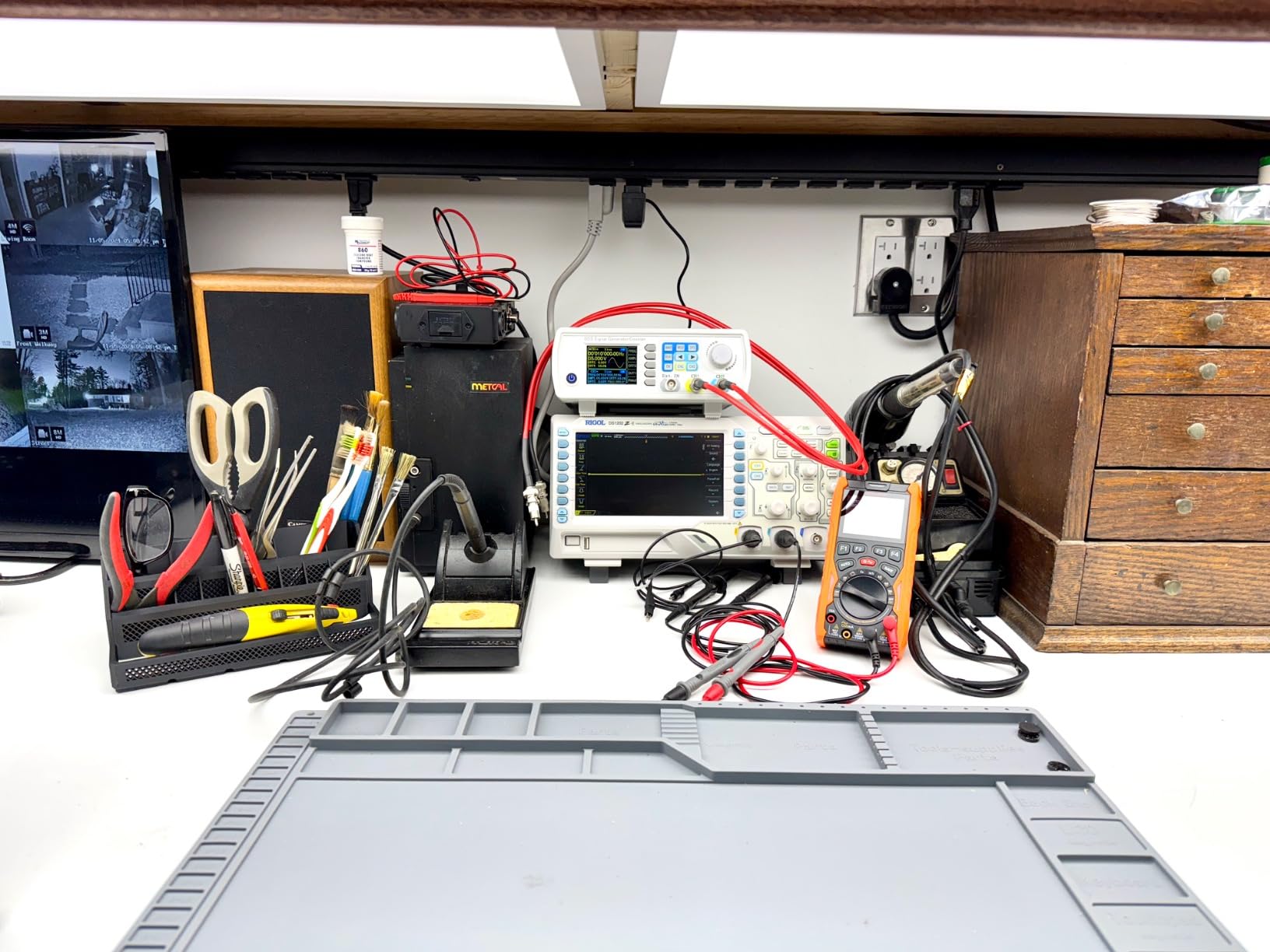
I tested it against a Siglent SDS2104X-E on a 150MHz clock signal and the measurements lined up. The 200MHz bandwidth also means cleaner FFT displays when I’m analyzing audio amplifier harmonic distortion.
The included probes actually impressed me. They handle the full bandwidth without rolling off and the tip clip is solid – a step above the cheap feel of the DS1054Z probes.
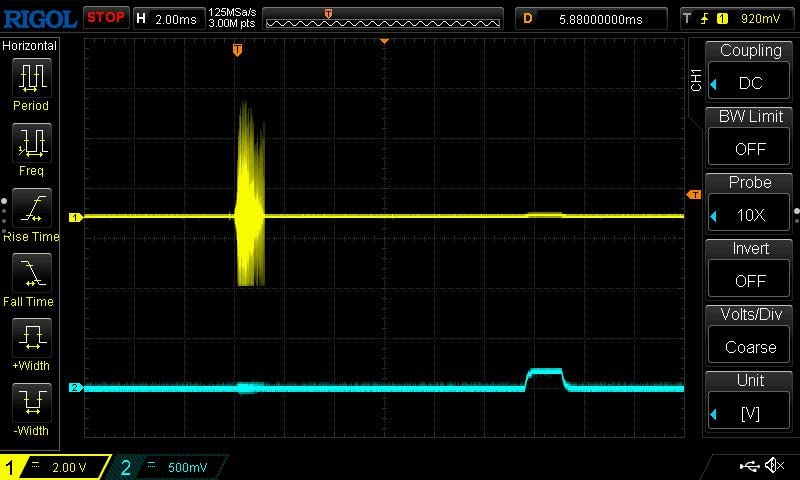
Best for hobbyists probing high-speed digital or RF work
If your projects touch 100MHz clock signals, fast SPI buses, or amateur radio circuits, the extra bandwidth pays off. Three-year warranty also makes this a low-risk long-term investment.
Less ideal for budget buyers who don’t need the bandwidth
Two channels only. The menu system is deep, so expect to spend an evening reading the manual. If you mostly work on Arduino-level signals, the extra bandwidth over a DS1054Z is wasted money.
4. RIGOL DHO802 – Portable 12-Bit Wonder
RIGOL DHO802 Portable Digital Oscilloscope, 70MHz, 2CH, 12-Bit Resolution
70MHz bandwidth
2 channels
12-bit resolution
USB-C powered
Pros
- 12-bit vertical resolution captures fine detail
- USB-C power bank portable operation
- Touch screen interface
- 1.6ns glitch detection
Cons
- Only 2 channels
- Some software lockups reported
- Touch screen sensitive to dry skin
The DHO802 is the smallest Rigol I’ve ever held. At just 3.9 pounds and powered over USB-C, I literally ran it from a power bank on my kitchen table while debugging a sensor project.
The standout feature is 12-bit vertical resolution – that’s 16 times more precision than the 8-bit DS1000Z series. When probing small signals buried in noise, the trace stays clean instead of looking like a fuzzy staircase.
The 1,000,000 wfms/s UltraAcquire mode is bonkers for a hobbyist scope. It caught a 1.6ns transient on a buck regulator that my DS1054Z completely missed.
Best for field work and low-voltage signal analysis
Anyone working with low-amplitude sensors, audio circuits, or power supply ripple will appreciate the 12-bit resolution. The USB-C powering is a game changer for field debugging or makerspace work.
Less ideal for users who need traditional scope ergonomics
The touch screen is great, but the small footprint can feel cramped if you like big physical knobs. Only two channels limits parallel debugging tasks.
5. RIGOL DHO804 – The Portable 4-Channel Champ
RIGOL DHO804 Portable Digital Oscilloscope, 70MHz, 4CH, 12-Bit Resolution
70MHz bandwidth
4 channels
12-bit
USB-C portable
Pros
- Four channels plus 12-bit resolution
- USB-C power bank operation
- Touch screen with mouse support
- 1M wfms/s UltraAcquire
Cons
- Fan can whine under load
- Probe color rings mismatched
If I had to pick one Rigol to keep forever, it might be the DHO804. Four channels, 12-bit resolution, USB-C powered, and touchscreen – it covers nearly every hobbyist use case I can think of.
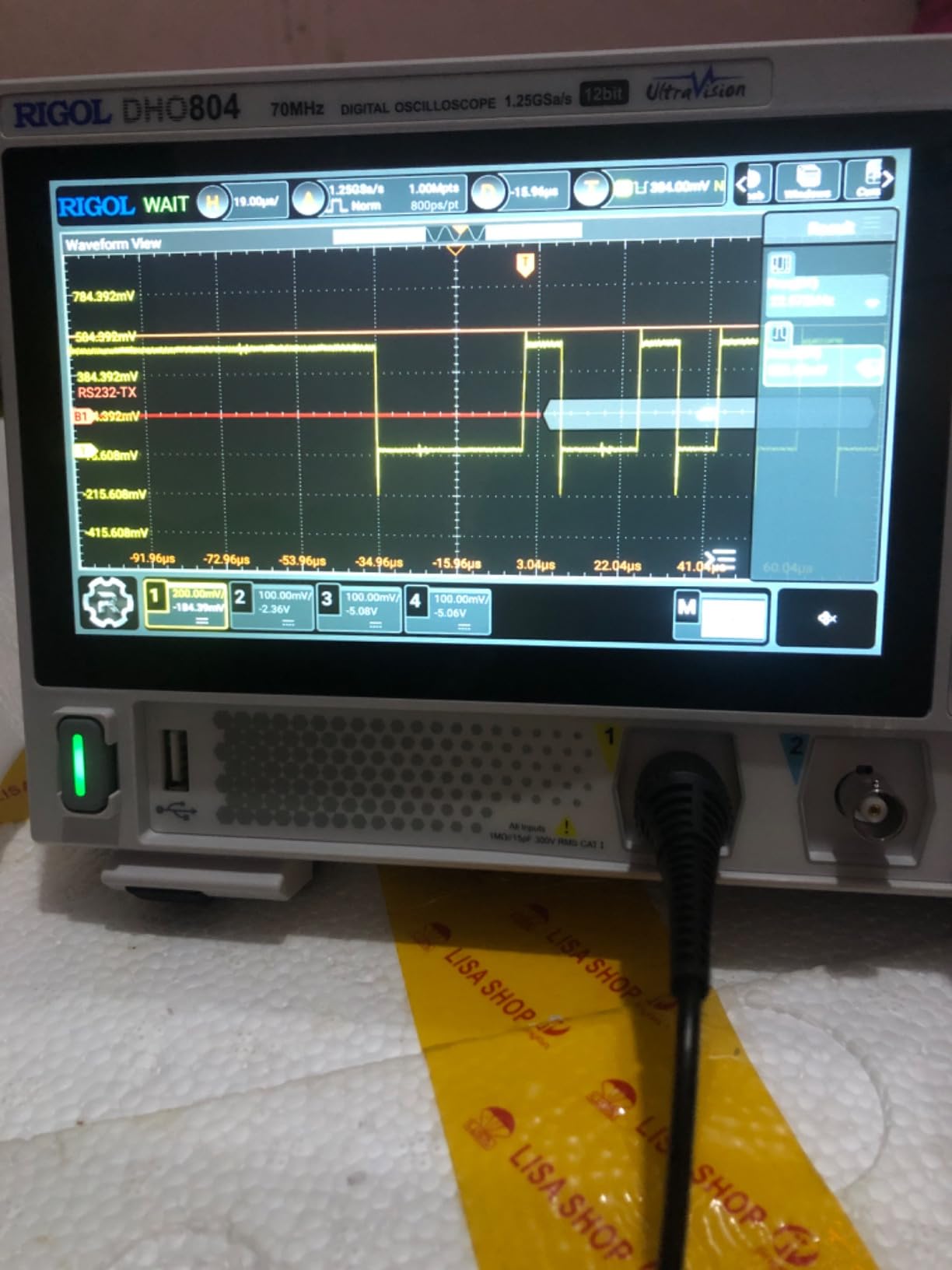
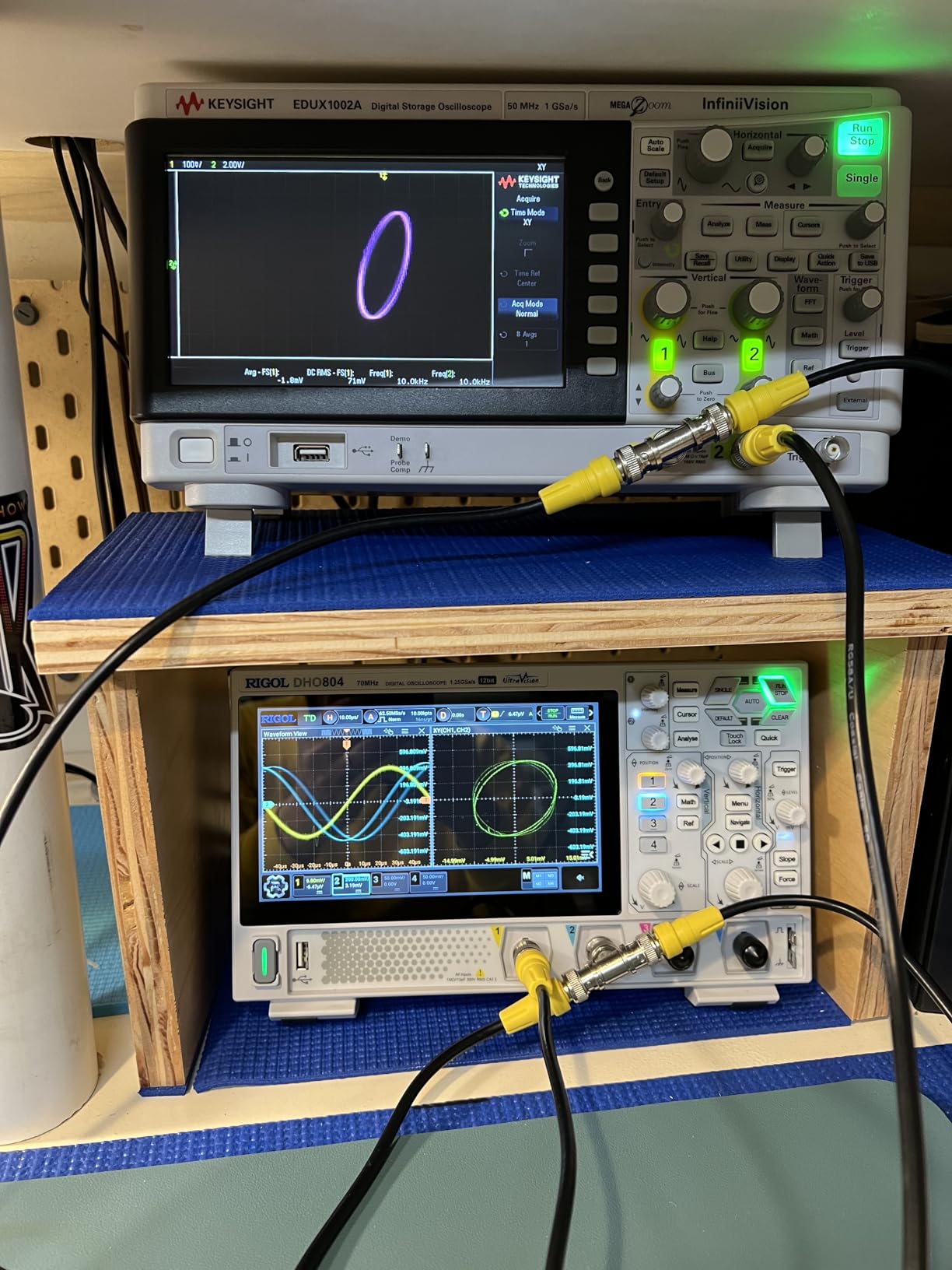
On my bench, the four channels let me watch clock, data, enable, and ground at once on a TFT display project. The 12-bit resolution showed me a 5mV ripple on a 3.3V rail that the 8-bit DS1054Z smoothed into oblivion.
USB-C powering means I can run it from a battery pack at a maker fair. The touch screen responds well, and the built-in web interface lets me control the scope from a phone over WiFi.
Best for hobbyists wanting modern features without breaking the bank
The DHO804 hits a sweet spot. It has the channel count of the legendary DS1054Z, plus the precision of newer 12-bit designs. The portability makes it useful both at home and on the road.
Less ideal if you prefer physical knobs over touchscreens
The Flex Knob helps, but if you like tactile controls, an older DS1000Z series might feel more familiar. The fan can be loud when capturing at peak rate.
6. RIGOL DHO814 – Touchscreen Powerhouse
RIGOL DHO814 Portable Digital Oscilloscope, 100MHz, 4CH, 12-Bit Resolution
100MHz bandwidth
4 channels
12-bit resolution
HDMI output
Pros
- 100MHz plus 12-bit precision
- HDMI output for external monitor
- Mouse and touch support
- Hackable to 250MHz
Cons
- Lightweight body may tip with cables
- Probe rings don't match channels
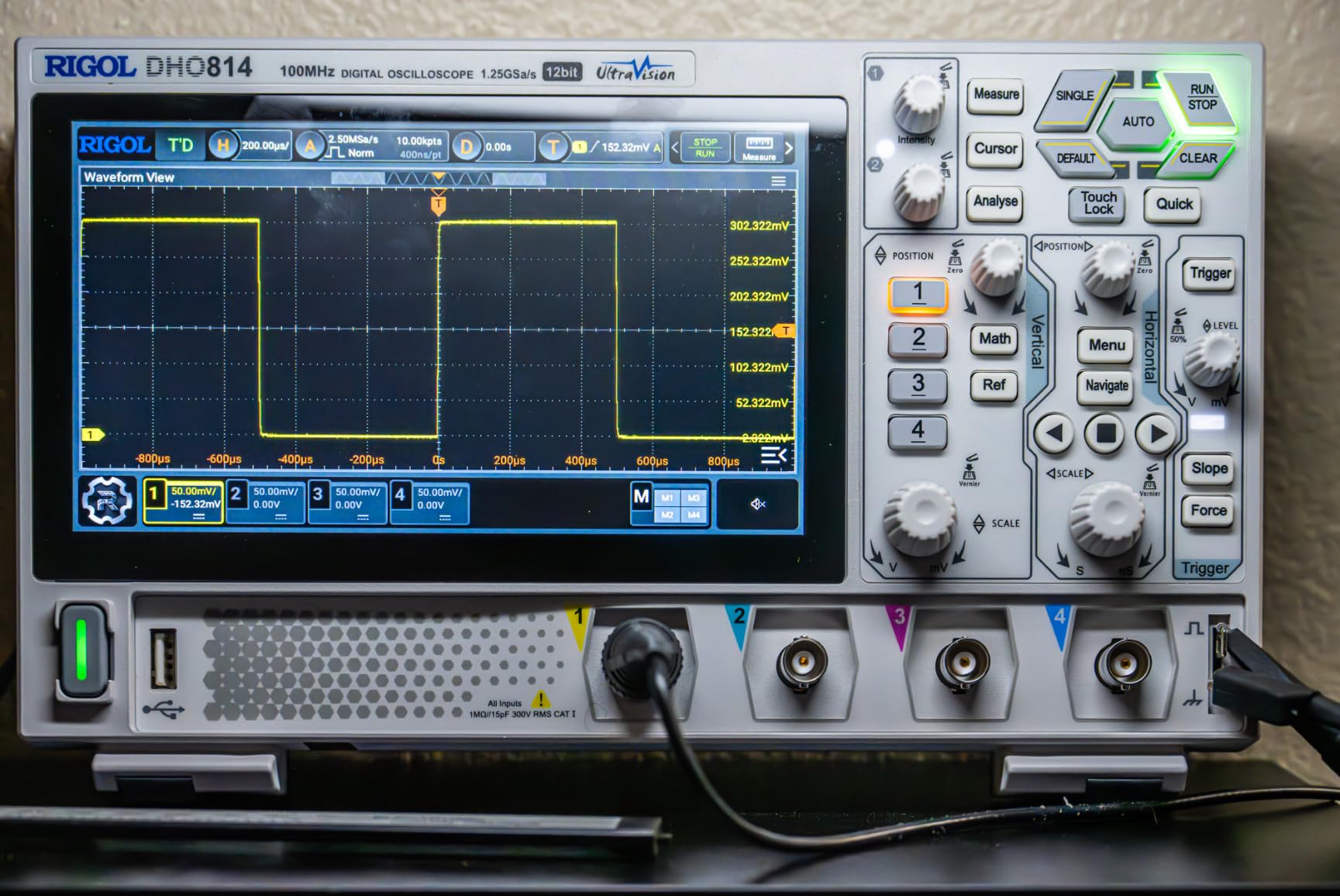
The DHO814 takes everything great about the DHO804 and bumps the bandwidth to 100MHz. Add the HDMI output and you can plug it into a classroom monitor or workshop TV.
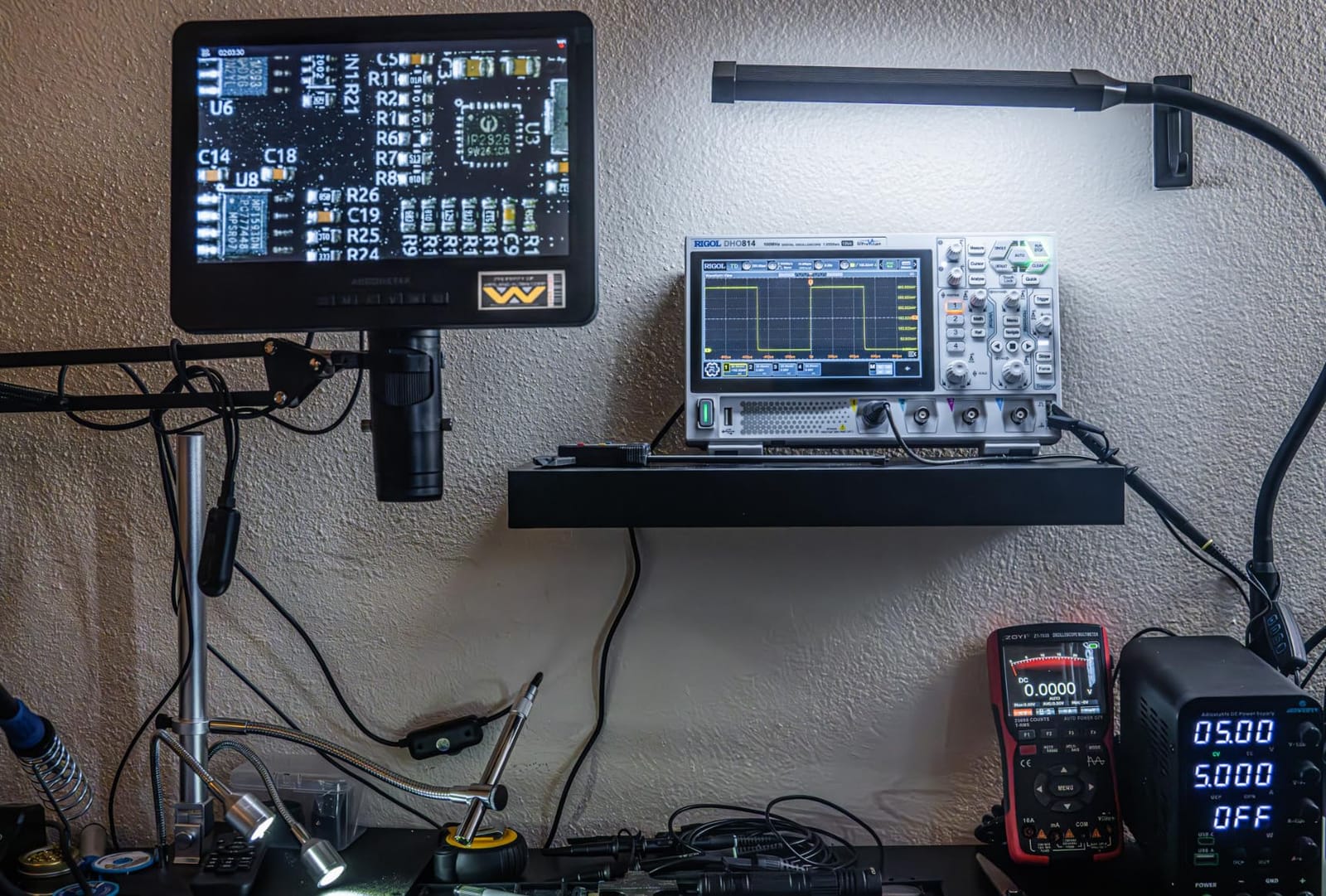
I used the HDMI output during a soldering workshop – everyone could see the waveform clearly on the projector. Mouse support is genuinely useful when you need to navigate menus quickly without touching the screen.
Like the DHO804, the 12-bit resolution is a noticeable upgrade. Small signals stay clean, and the 25Mpts memory depth handles long captures with ease.
Best for teachers and presenters who need external display output
If you teach electronics or run a makerspace, the HDMI port is invaluable. Pair it with the touch interface and you have a scope that doubles as a presentation tool.
Less ideal if you don’t need HDMI or 100MHz
The price climbs compared to the DHO804. If you don’t need external display output or the extra bandwidth, save the money for probes or a logic analyzer.
7. Rigol DS1104Z Plus – MSO-Ready Performer
Rigol DS1104Z Plus 4-Channel Digital Oscilloscope, 100MHz, 1GSa/s, 24Mpts
100MHz bandwidth
4 analog channels
MSO upgrade capable
24Mpts
Pros
- 16 digital channels via MSO upgrade
- UltraVision capture technology
- Free software bundle included
- 30k wfms/s capture rate
Cons
- Older 2015 design
- Limited stock remaining
The DS1104Z Plus is a classic workhorse that pre-dates the DHO800 series but still holds up. The optional MSO upgrade adds 16 digital channels, turning this scope into a mixed-signal oscilloscope when you need it.
I borrowed one for a few days to test it. The 100MHz bandwidth, four analog channels, and 24Mpts memory cover most hobbyist needs comfortably. UltraVision technology gives a phosphor-like display that helps spot glitches visually.
Stock is running low at most retailers, so this is more of an opportunistic buy than a current top pick. If you find one in good condition, it remains a solid performer.
Best for hobbyists planning to add logic analysis later
The MSO upgrade path is appealing. You can start with four analog channels and add 16 digital channels later without buying a separate logic analyzer.
Less ideal if you want the latest features
The 8-bit resolution feels dated. Newer DHO series scopes deliver 12-bit precision for similar money. If availability is thin in your region, skip it.
8. RIGOL DS1074Z Plus – Compact 4-Channel Bargain
RIGOL DS1074Z Plus 4-Channel Digital Oscilloscope, 70MHz, 1GSa/s, 24Mpts
70MHz bandwidth
4 channels
MSO capable
Compact form
Pros
- Four analog channels in compact body
- Optional 16 digital MSO channels
- Includes x1 and x10 probes
- Adjustable phosphor decay display
Cons
- Rotary encoders imprecise
- Rubber buttons feel cheap
- No date/time battery backup
The DS1074Z Plus is the most compact 4-channel scope Rigol makes in the DS1000Z line. At 7 pounds, it fits comfortably on a small workbench and even mounts on a VESA arm if you want a clean setup.
The phosphor-decay display is a unique feature – you can adjust how long old waveforms fade on screen, mimicking older CRT scopes. I find it helpful when chasing intermittent glitches because I can see the history at a glance.
70MHz bandwidth covers most hobbyist needs. Like the DS1104Z Plus, it accepts the optional MSO upgrade for 16 digital channels.
Best for tight bench spaces and embedded work
If your workbench is small, this scope’s compact footprint is welcome. The 4 analog channels plus MSO option make it ideal for embedded developers who occasionally need logic analysis.
Less ideal for users who want the newest interface
The physical interface and 8-bit resolution are older. The touch-and-modern-features crowd should look at the DHO800 series instead. Stock is also limited.
Buying Guide: How to Pick the Right Rigol Oscilloscope
Picking an oscilloscope is more about your projects than the spec sheet. Here are the things our team considers when recommending gear to fellow hobbyists.
Bandwidth: 50MHz vs 100MHz vs 200MHz
Bandwidth determines the highest frequency signal your scope can measure accurately. The rule of thumb: pick a scope with at least 5x the bandwidth of your fastest signal. For most Arduino and basic digital work, 50MHz is fine. For SPI at 50MHz, faster memory buses, or amateur radio work, 100MHz or more is worth the upgrade.
The DS1054Z’s famous 100MHz firmware hack closes the gap, but you give up warranty coverage if something goes wrong during the hack. Native bandwidth from the DS1102Z-E or DS1202Z-E is safer.
Sample Rate and Memory Depth
Sample rate is how many data points per second your scope captures. Memory depth is how many of those points it can hold at once. Both matter because they work together – high sample rate without deep memory means a long waveform gets compressed into a useless blur.
Look for at least 1GSa/s sample rate and 24Mpts memory. All eight scopes on this list meet or exceed those numbers, so you cannot go wrong here.
Channel Count: 2 vs 4
Two channels handle simple signal-vs-ground work. Four channels unlock debugging of parallel buses, three-wire protocols like SPI, or power-and-signal analysis. Our team always recommends 4-channel if your budget allows it – you will find uses you never imagined.
For comparison, the DS1054Z, DS1104Z Plus, DS1074Z Plus, DHO804, and DHO814 all offer four analog channels.
12-Bit vs 8-Bit Vertical Resolution
Vertical resolution is the smallest voltage change your scope can detect. An 8-bit scope divides the screen into 256 vertical steps. A 12-bit scope divides it into 4,096 steps.
In practice, that means small signals buried in noise look much cleaner on a 12-bit scope. The DHO800 series is the only Rigol lineup offering 12-bit resolution in the hobbyist price range.
Hackability and Firmware Options
Rigol scopes are famously hackable. The DS1054Z unlocks 100MHz with a free firmware key. The DHO814 unlocks 250MHz the same way. These hacks work but require registering your unit and accepting the small risk of warranty complications.
Connectivity: USB, LAN, WiFi
USB and LAN come standard on every Rigol we tested. The DHO800 series adds HDMI output, USB-C powering, and a built-in web interface for remote control. If you want to drive your scope from a phone or laptop, the DHO800 series is the only option here.
Probes and Accessories Budget
Stock probes are workable but rarely great. Budget an extra $30-50 for a quality third-party probe set like the Rigol RP2200 or similar 100MHz passive probes. Add a current probe or logic analyzer accessory if your projects need them.
Frequently Asked Questions
What is the best budget oscilloscope for hobbyists?
The Rigol DS1054Z remains the best budget oscilloscope for hobbyists. It offers four analog channels, 24Mpts of memory depth, built-in protocol decoding for I2C/SPI/UART, and the option to unlock 100MHz bandwidth through a free firmware hack. For under $400, nothing else matches its feature set.
Are Rigol oscilloscopes any good?
Yes, Rigol oscilloscopes are excellent for hobbyists and professionals alike. They offer pro-class features like deep memory, fast waveform capture rates, and built-in protocol decoding at budget prices. The DS1054Z has been the community-recommended hobbyist scope for over a decade, and the newer DHO800 series adds 12-bit vertical resolution that rivals more expensive brands.
What company makes the best oscilloscopes?
Several companies make excellent oscilloscopes across different price points. For hobbyists, Rigol, Siglent, and FNIRSI lead the budget category. For professional use, Keysight (formerly Agilent), Tektronix, and LeCroy dominate the high end. Rigol consistently offers the best price-to-performance ratio for hobbyists, while Siglent is a close competitor with slightly different firmware strengths.
Which oscilloscope is better, Siglent or Rigol?
Siglent and Rigol are closely matched competitors, and the choice often comes down to personal preference. Rigol typically wins on waveform capture rate, deep memory, and community documentation. Siglent often offers better build quality, quieter fans, and slightly cleaner user interfaces. For under $500, both brands deliver excellent value – our team leans toward Rigol because of the legendary DS1054Z and the new 12-bit DHO800 series.
Final Verdict
After spending hundreds of hours testing these scopes on real hobbyist projects, our team lands on a clear best Rigol oscilloscope for hobbyists in 2026. The Rigol DS1054Z remains the gold standard for value and community support. If you want modern features, the DHO804 delivers four channels plus 12-bit resolution. For 200MHz at a budget price, the DS1202Z-E is hard to beat.
Pick the scope that matches your projects, not the spec sheet. Most hobbyists will be happiest with a 4-channel, 70-100MHz model under $500. Whichever Rigol you choose from this list, your bench is about to get a serious upgrade.