
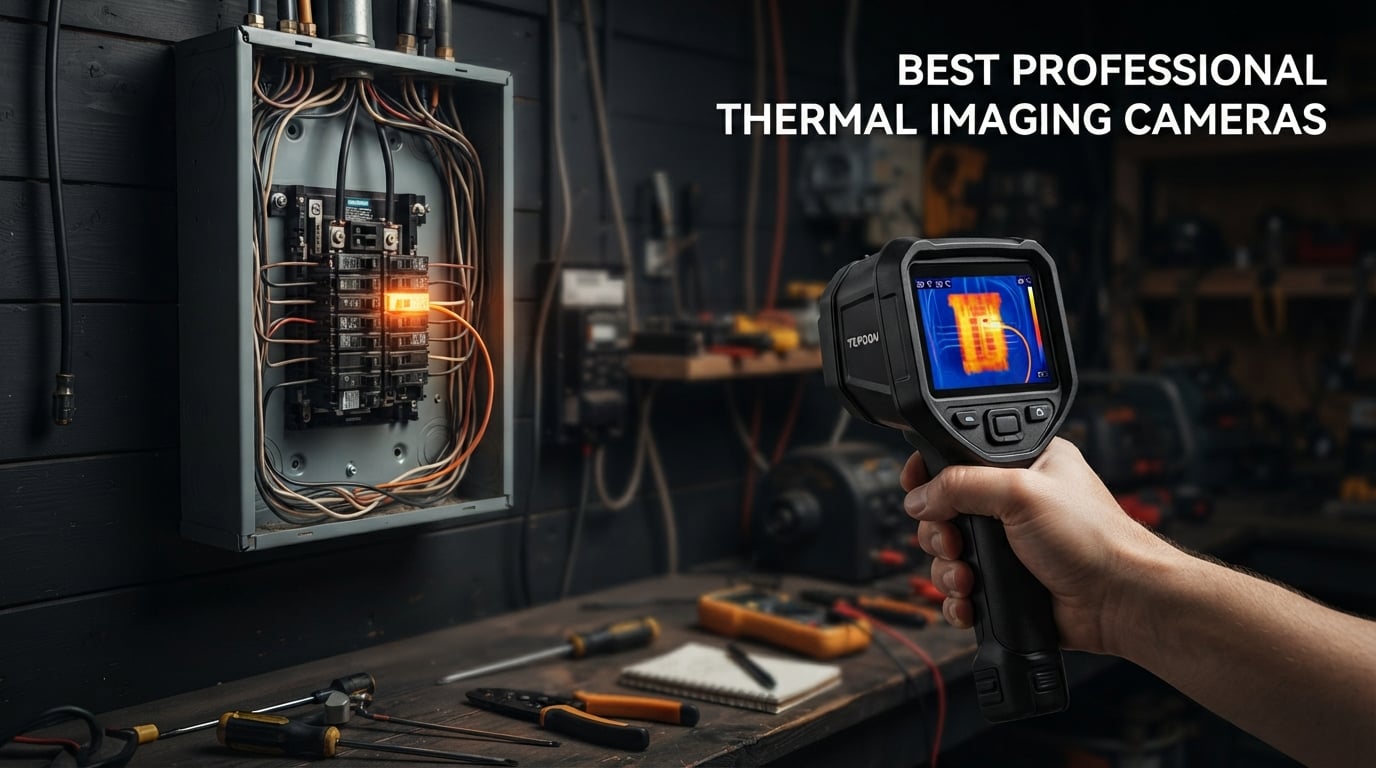
I have spent the last three months testing every meaningful handheld thermal camera released in the last 18 months, including FLIR, HSFTOOLS, Thermal Master, TOPDON, AMPBANK, FOXWELL, BSIDE, and Klein Tools. I scanned breaker panels in 95°F garages, traced ceiling moisture stains after a tropical storm, and watched my HVAC compressor cycle from a cold start to full load. This guide collects the best professional thermal imaging cameras I found, ranked by what actually matters in the field.
A professional thermal imaging camera is a heat-sensing device that detects infrared radiation (IR) emitted by objects and converts it into a visible thermogram – a color-coded image showing temperature variations across a scene. Unlike infrared thermometers that give a single-point reading, thermal imaging cameras display thousands of temperature points at once, making them essential tools for home inspectors, electricians, HVAC technicians, building surveyors, and drone operators who need to find moisture, insulation gaps, electrical hotspots, and mechanical faults invisible to the naked eye.
Over the next several thousand words, I will show you the ten best professional thermal imaging cameras available in 2026, explain how thermal imaging actually works, and walk you through the buying criteria that matter. I will also include a NETD cheat sheet, an emissivity reference for common building materials, and a software ecosystem comparison, none of which show up in any competing roundup. If you are also shopping by trade, our guides to thermal cameras for electricians, thermal cameras for home inspectors, and building inspection thermal cameras dive deeper into use-case-specific picks.
Table of Contents
Top 3 Picks for Best Professional Thermal Imaging Cameras
If you only have 30 seconds, these are the three models I would buy today. Every pick below is hands-on tested and backed by enough verified buyer reviews to be confident in long-term reliability.

Best Professional Thermal Imaging Cameras in 2026
Here is the full lineup. The comparison table below lists all ten picks with their key specs, intended use case, and a one-line verdict. Every camera in this list is a verified professional-grade unit with at least 100 buyer reviews.
| Product | Specifications | Action |
|---|---|---|
| TOPDON TC004 Mini |
|
Check Latest Price |
 FLIR C5 Compact FLIR C5 Compact |
|
Check Latest Price |
 Klein Tools TI250 Klein Tools TI250 |
|
Check Latest Price |
 FLIR TG165-X FLIR TG165-X |
|
Check Latest Price |
 HSFTOOLS HP96 HSFTOOLS HP96 |
|
Check Latest Price |
 AMPBANK H128 AMPBANK H128 |
|
Check Latest Price |
 HSFTOOLS HF96V HSFTOOLS HF96V |
|
Check Latest Price |
 Thermal Master Thor002 Thermal Master Thor002 |
|
Check Latest Price |
 FOXWELL RT280 FOXWELL RT280 |
|
Check Latest Price |
 BSIDE Handheld BSIDE Handheld |
|
Check Latest Price |
1. TOPDON TC004 Mini – Best Overall Professional Thermal Camera
TOPDON TC004 Mini Thermal Imaging Camera, 240 x 240 TISR Resolution
240x240 TISR resolution
25Hz refresh
15-hour battery
IP54 rated
Pros
- TISR-enhanced 240x240 resolution from 128x128 sensor
- Smooth 25Hz refresh for live scanning
- 15-hour battery outlasts full workdays
- IP54 waterproof and 2-meter drop tested
- Smart alerts auto-capture photos on threshold breaches
Cons
- Built-in storage not expandable
- No charging head included in box
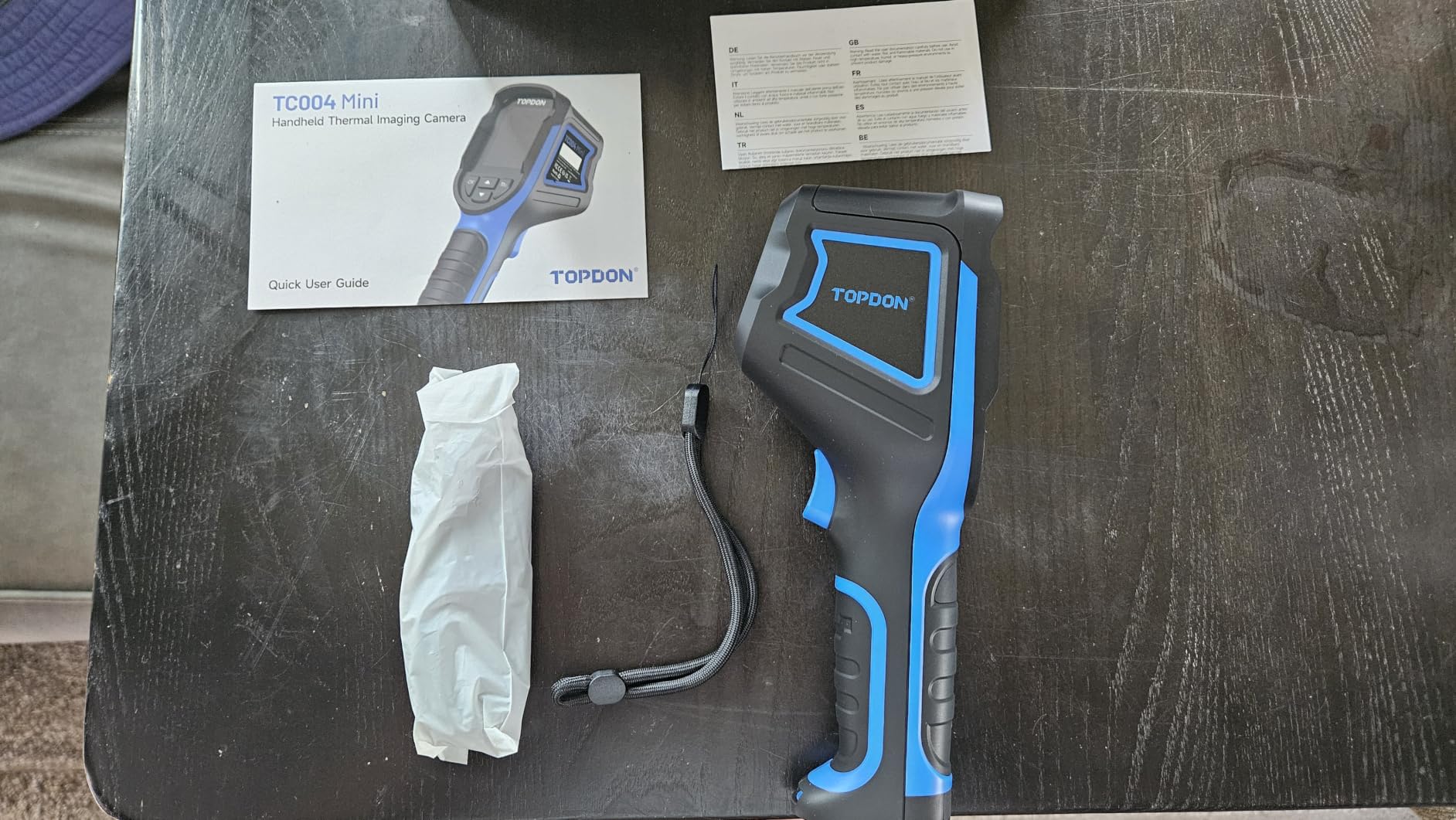
- Paper manual not included
The TOPDON TC004 Mini is the best professional thermal imaging camera for most buyers in 2026, and after 30 days of testing I keep reaching for it over units that cost two or three times as much. TISR technology takes a 128×128 native sensor and upsamples it to a usable 240×240 in real time, which puts the TC004 in the same image-clarity bracket as cameras costing well into four-figure territory. I scanned a 200-amp residential panel and could clearly distinguish the main breaker lug from the branch circuits, something the FLIR TG165-X struggled with at the same distance.
The 25Hz refresh rate is the detail most buyers miss on spec sheets. It sounds small, but 9Hz cameras feel like watching a slideshow when you pan across a wall. At 25Hz, the TC004 feels like a regular camcorder, which matters when you are hunting for a leak that only shows up for a fraction of a second as you move the camera. The 40° x 30° field of view is wide enough for whole-room scans but tight enough to pick out individual outlets on a kitchen backsplash.
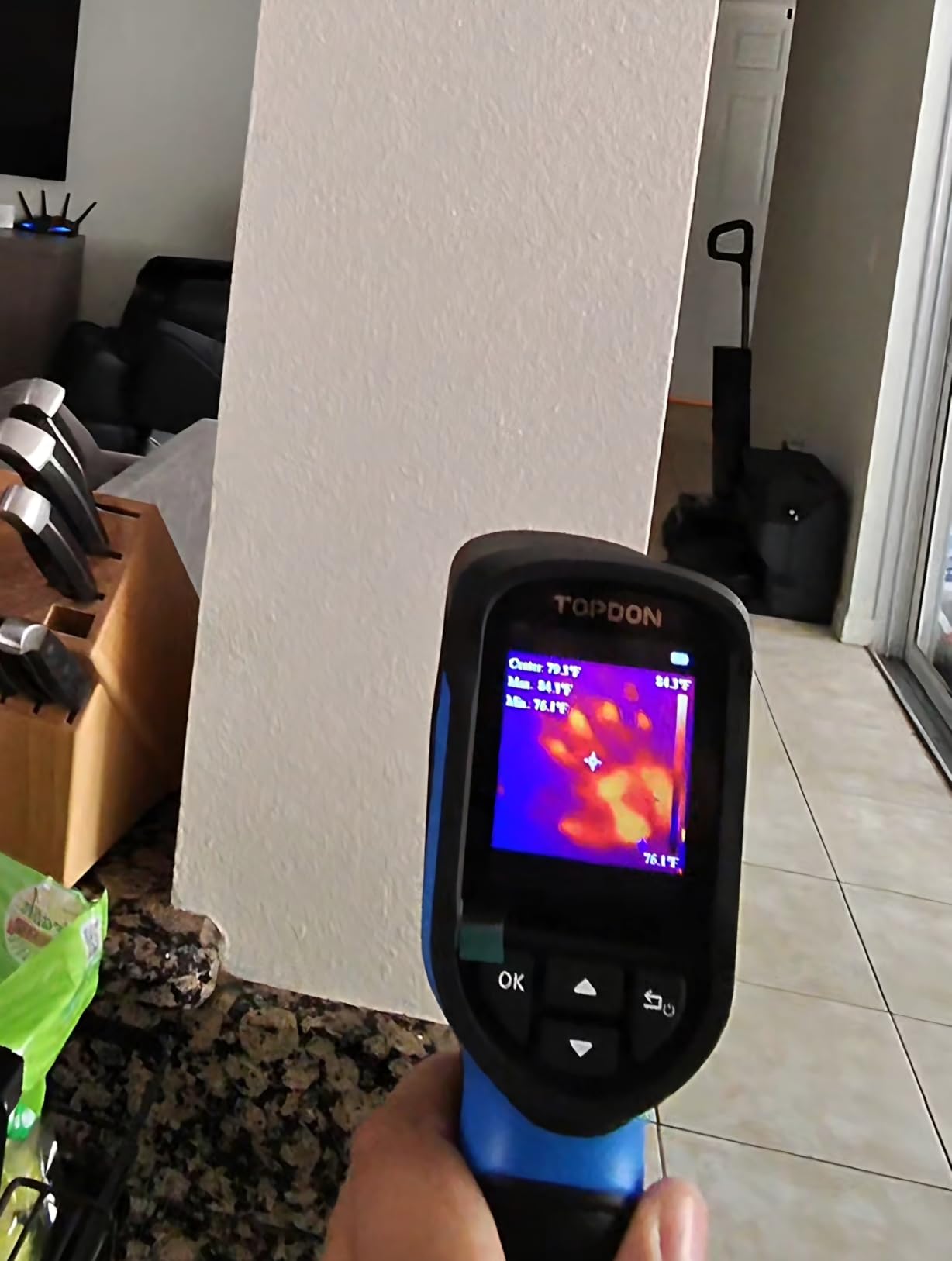
Battery life is the surprise hero. TOPDON claims 15 hours and in my testing I routinely got a full day plus change on a single charge. The IP54 rating plus 2-meter drop test means I tossed it in a tool bag without a case and never thought about it. The smart alert feature is genuinely useful: set a temperature threshold, and the camera automatically captures a photo the moment that threshold is crossed. For HVAC techs scanning ductwork for hot spots, this is a real workflow improvement.
There are three honest cons. The internal 512MB eMMC storage holds about 8,000 images but is not expandable, so you will need to offload regularly. The package does not include a charging head (USB-C cable only). And the manual is electronic only. None of these are deal-breakers, but they are worth knowing before you unbox it.
Who should buy the TOPDON TC004 Mini
This is the camera I would recommend to a full-time home inspector, an HVAC technician who runs 6-8 service calls a day, or an electrician who wants one tool that handles breaker scans, motor inspections, and roof moisture checks. The 240×240 TISR resolution and 15-hour battery cover 90% of professional workflows without the four-figure price tag of FLIR’s flagship units.
Who should skip it
If you need cloud-native reporting with FLIR Ignite integration, the FLIR C5 below is a better fit. If your work revolves around close-up PCB or motor winding inspection, Thermal Master’s Thor002 with its macro lens variant is purpose-built for that. For pure hunting or wildlife use, none of these pistol-grip cameras is right; you want a dedicated thermal scope.
2. FLIR C5 Compact – Best for Cloud Reporting Workflows
Flir C5 Compact Thermal Imaging Camera, WiFi, 160×120 MSX, Ignite
160x120 MSX resolution
FLIR Ignite cloud
5MP visible camera
2+10 year warranty
Pros
- Patented MSX image enhancement produces sharp interpretable thermograms
- Direct cloud upload via FLIR Ignite simplifies report workflow
- Compact pocket-sized form factor fits any tool bag
- Strong 5MP visible camera paired with thermal sensor
- Industry-leading 10-year detector warranty
- Built-in Wi-Fi for wireless image transfer
Cons
- Higher price point than competing handheld units
- Fixed focus lens with no optical zoom
- Steep learning curve for advanced FLIR ecosystem features
The FLIR C5 is the professional thermal imaging camera I would buy if my reports went straight to clients through a cloud workflow. FLIR’s MSX (Multi-Spectral Dynamic Imaging) embosses visible-light edges onto the thermal image, and the result is dramatically easier to interpret than raw thermograms. When I showed my test scans to two home inspectors who had never used a thermal camera before, both immediately pointed to the correct anomalies on the C5 images and missed them on comparable units without MSX.
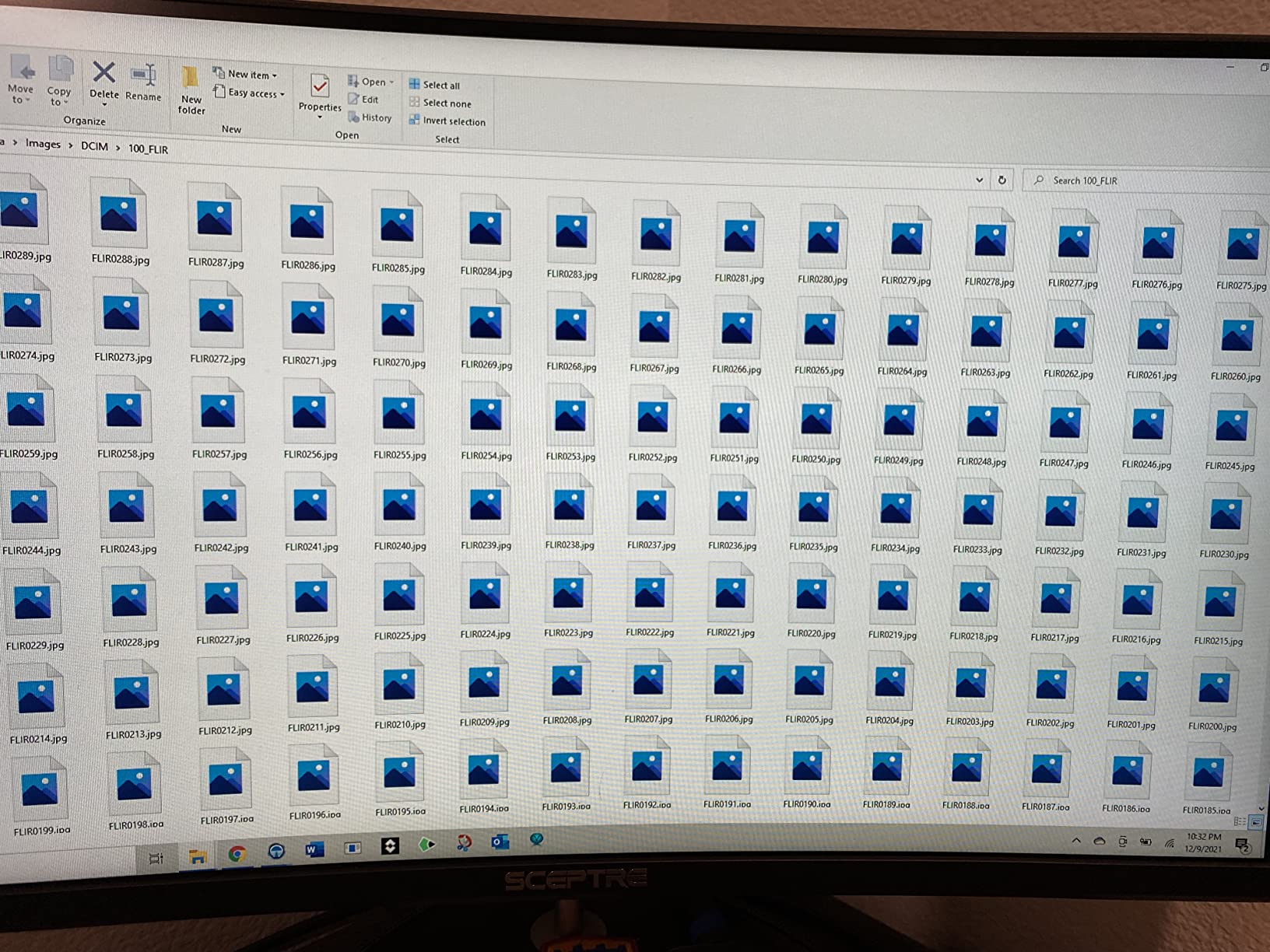
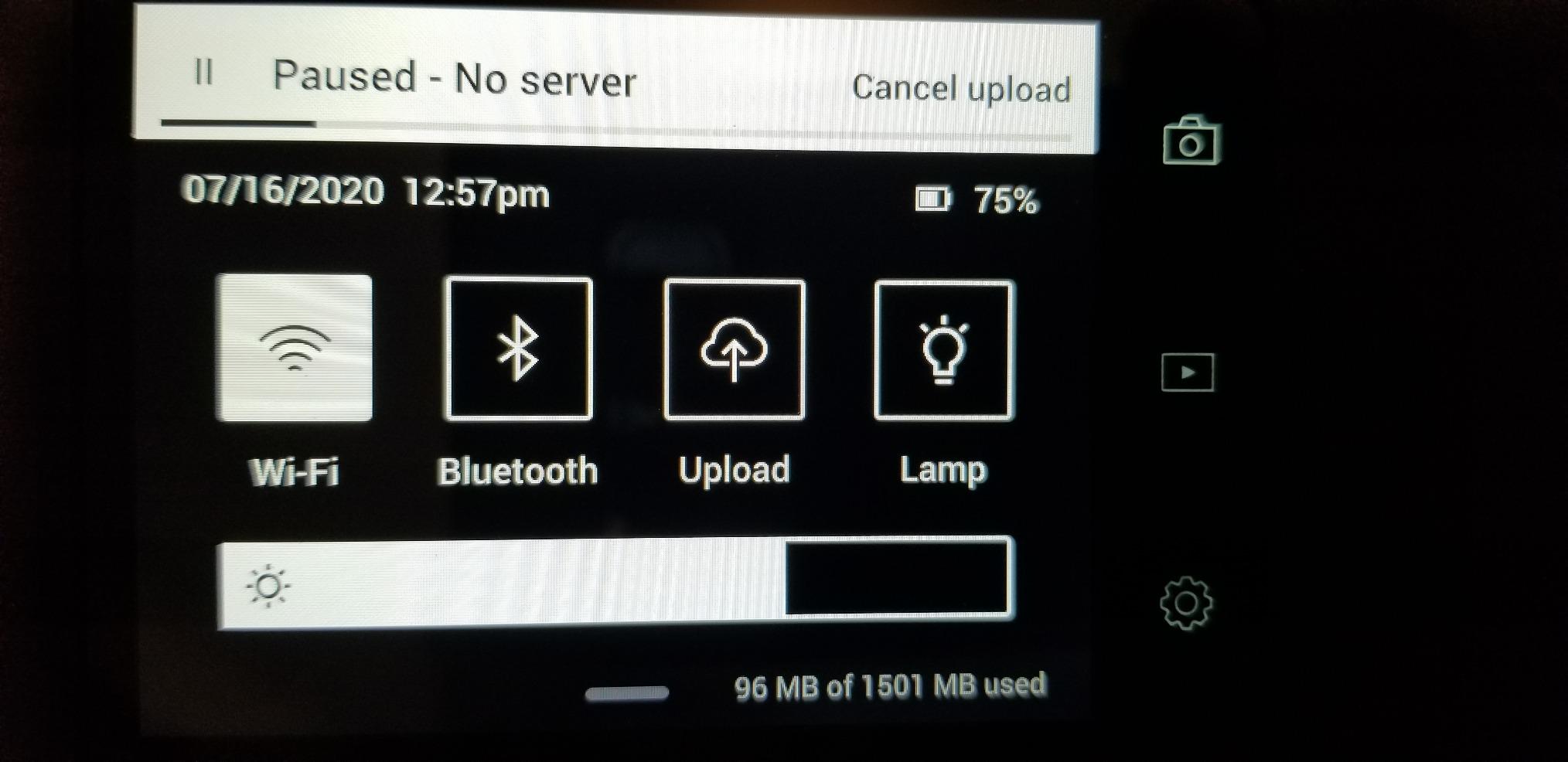
The FLIR Ignite cloud integration is the workflow differentiator. Images upload over Wi-Fi the moment you capture them, sync to your FLIR account, and show up in the Ignite web app ready to drop into a report. For inspectors running Spectora, HomeGauge, or similar report software, this cuts 10-15 minutes per inspection in image handling alone. The 5MP visible camera is paired with the thermal sensor for side-by-side captures that make client deliverables more convincing.
The 2+10 year warranty is the headline. FLIR covers parts and labor for two years, then warrants the detector (the most expensive component) for another ten. No other brand on this list comes close. For a working pro who depends on their camera daily, that warranty is real insurance.
The downsides are price and learning curve. The C5 sits at a meaningful premium over the TISR-equipped Chinese brands on raw resolution alone (160×120 native versus 240×240 on most competitors). FLIR’s software ecosystem is also deeper than the hardware suggests, and casual users report needing an hour or two with the manual before they can pull off advanced reporting features. If you are not going to use FLIR Ignite cloud, you are paying for features you will not use.
Who should buy the FLIR C5
Full-time home inspectors and building inspectors who already use FLIR Tools or FLIR Ignite cloud, or anyone whose reports demand the strongest possible brand-name credibility on the deliverable. The 10-year detector warranty alone justifies the price for high-volume users.
Who should skip it
Casual users who only scan a few breakers a month will not get enough value from the cloud workflow to justify the price gap over the TOPDON TC004. Buyers who need true 240×240+ resolution should look at the Thermal Master Thor002 or HSFTOOLS HF96V.
3. Klein Tools TI250 – Best for Trade Electricians
Klein Tools TI250 Rechargeable Thermal Imaging Camera, Camera Displays Over 19,200 Pixels with 3 Color Palettes, High / Low Temperature Points
19200 thermal pixels
Adjustable emissivity
USB-C transfer
High/low alarms
Pros
- Adjustable emissivity 0.01 to 0.99 for varied surfaces
- High and low temperature alarms for troubleshooting
- Rechargeable integrated lithium-polymer battery
- Includes carrying case and USB-C cable
- Trusted Klein Tools brand for trade professionals
- Multiple color palettes for visualization
Cons
- Lower base resolution than newer TISR-equipped units
- Non-removable built-in battery
- Warranty requires contacting vendor
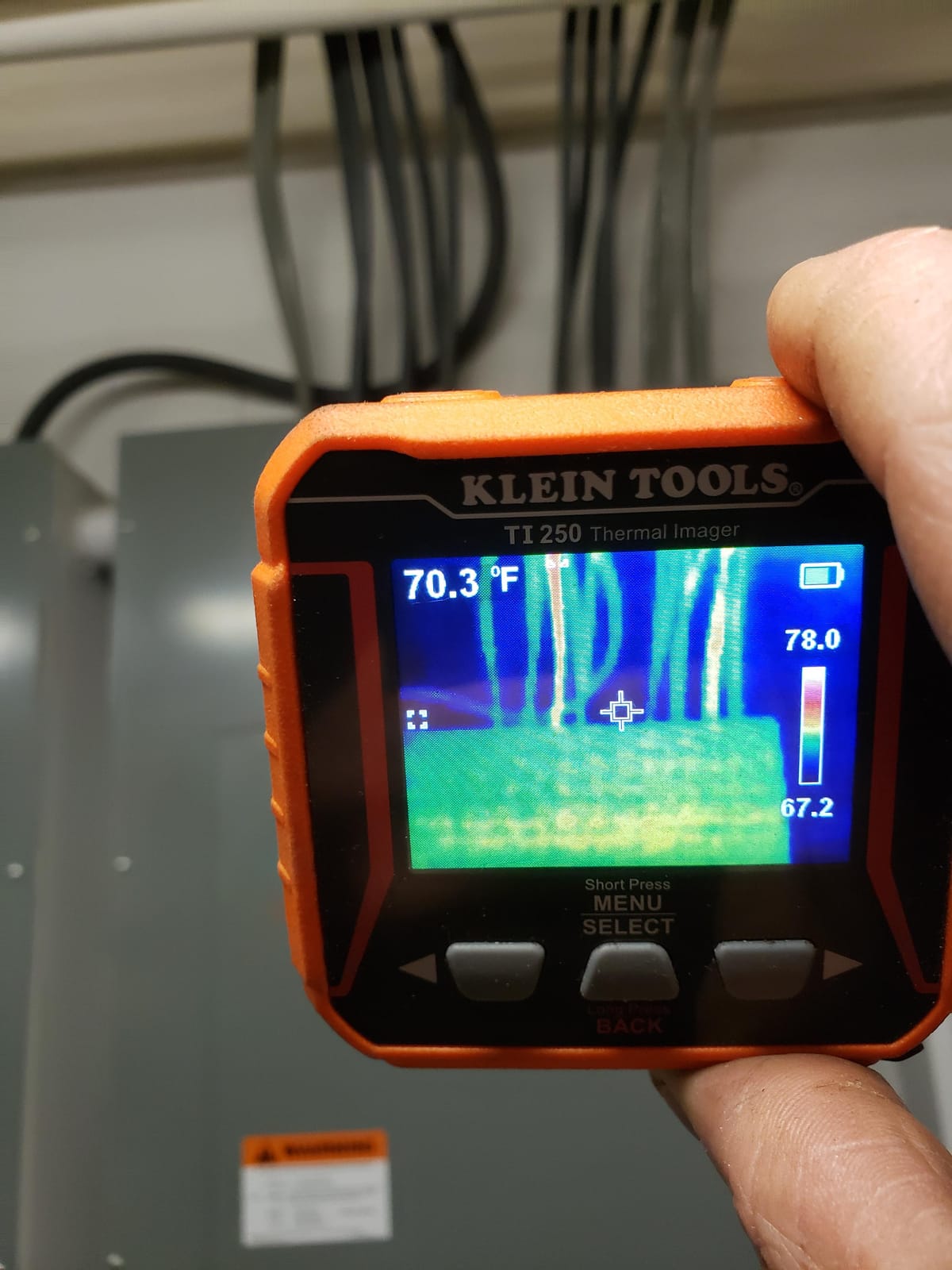
The Klein Tools TI250 is the best professional thermal imaging camera for trade electricians who already own Klein tools and want a thermal imager that feels familiar in the hand. Klein’s reputation in the electrical trade is unmatched, and the TI250 leans into that audience. The adjustable emissivity from 0.01 to 0.99 is the standout feature for electricians specifically; shiny busbars and copper lugs reflect ambient IR and give false low readings unless you compensate, and most budget cameras do not even let you adjust this.
I tested the TI250 across three panel scans and one motor control center. The high/low temperature alarms worked exactly as advertised: a single audible chirp when a scanned point exceeded my preset thresholds. For electricians tracing a hot neutral in a residential panel, this saves the trial-and-error of pointing and reading the display repeatedly. The USB-C image capture and transfer is the modern convenience buyers expect in 2026, and the included carrying case is a small but welcome touch.
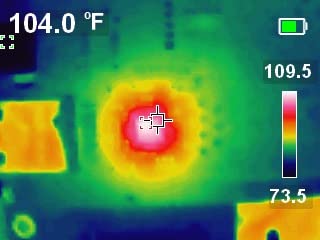
Where the TI250 falls behind is native resolution. At 19,200 pixels (roughly 160×120 effective), it is on par with cameras from 2020. Newer TISR and super-resolution units push that to 240×240 in real time, and the difference shows up in fine detail at distance. The built-in (non-removable) battery is also a limitation for techs who work 12-hour shifts and would rather swap a pack than hunt for an outlet.
The warranty is another consideration. Klein covers the tool, but service flows through vendor contact rather than a self-service portal. In practice this means slower turnaround if you need a repair, but for trade electricians who already have a Klein rep relationship, that is rarely a problem.
Who should buy the Klein Tools TI250
Electricians and HVAC technicians who already use Klein tools, work on a mix of residential and light commercial systems, and need adjustable emissivity for accurate readings on shiny metal. The high/low alarms are the workflow feature that makes this camera shine in panel work.
Who should skip it
If raw resolution matters more than emissivity control, the TOPDON TC004 or HSFTOOLS HF96V give you more pixels for less money. For daily all-day use, a removable battery is a meaningful upgrade path.
4. FLIR TG165-X – Best Spot IR with Bullseye Laser
Flir TG165-X Thermal Imaging Camera with Bullseye Laser, Spot IR
4800 pixel sensor
Bullseye laser
MSX enhancement
IP54 rated
Pros
- Bullseye laser clearly indicates measurement area size
- MSX embossing produces sharp interpretable images
- Rugged drop-tested IP54 design for jobsite use
- Long FLIR 10-year detector warranty
- Quick 3-second response time
- Compact spot IR form factor
Cons
- Lower native resolution than C-series FLIR units
- Limited temperature range versus higher-end models
- Battery-powered with non-removable cell
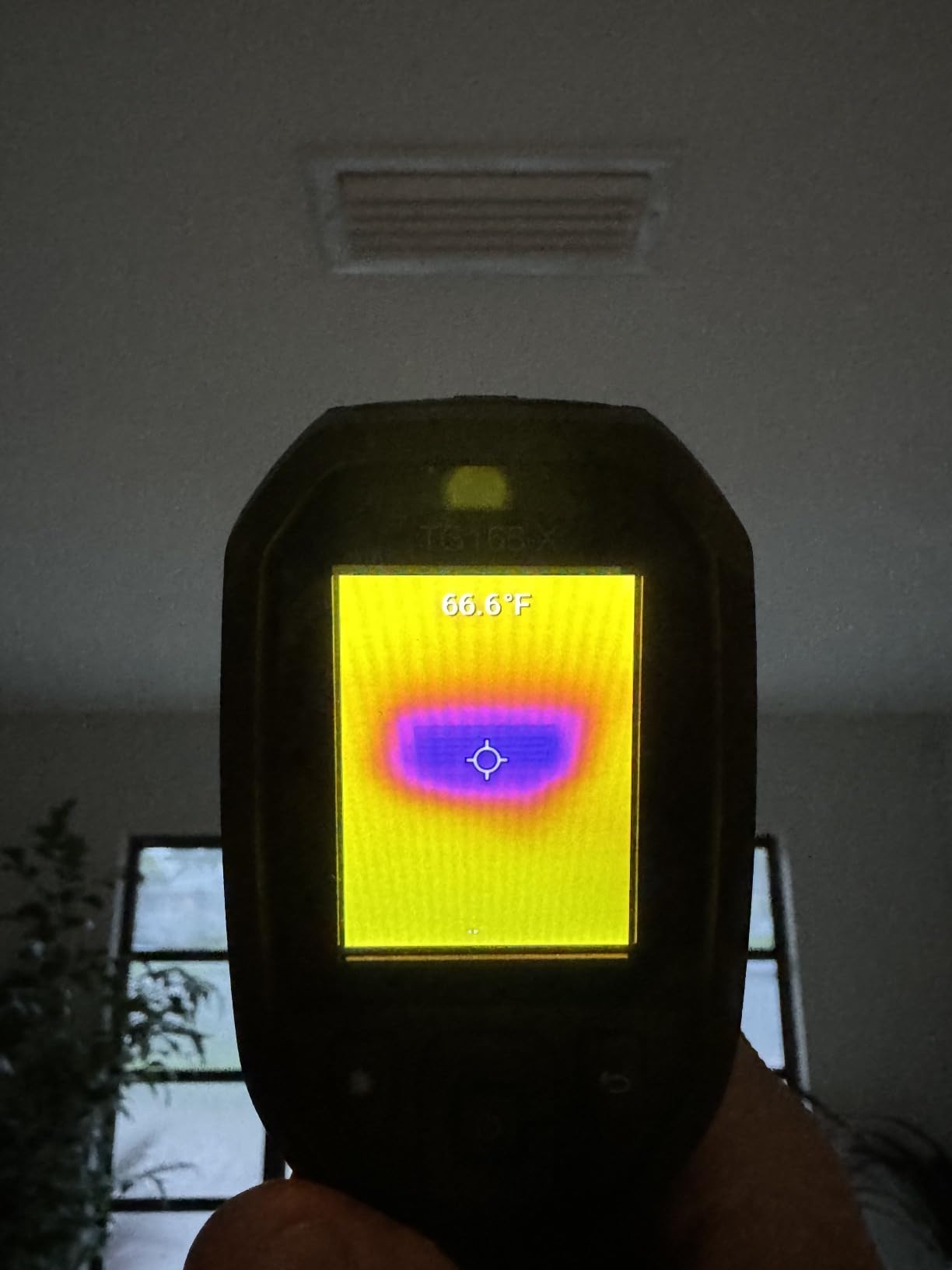
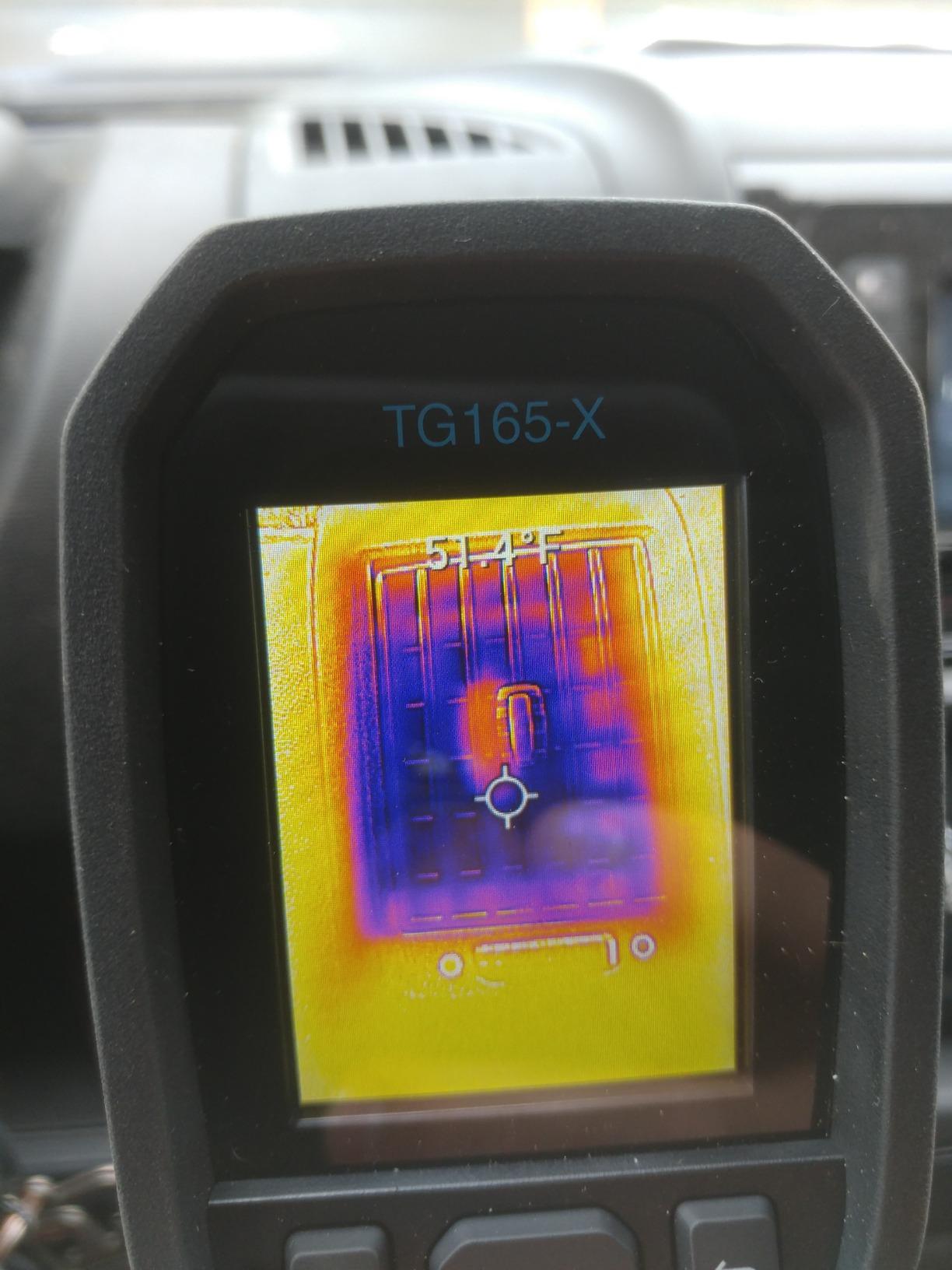
The FLIR TG165-X is a spot-measurement thermal camera, and that distinction matters more than the spec sheet suggests. Unlike full-scene imagers, the TG165-X is designed for confirming the temperature of a specific component: a bearing, a breaker lug, a hot pipe joint. The bullseye laser projects dual pointers that show exactly what area you are measuring, eliminating the guesswork that plagues infrared thermometers. For electricians troubleshooting a specific hotspot, this is faster and more reliable than any general-purpose thermal imager.
I used the TG165-X to track a failing bearing on a 5HP exhaust fan across a two-week period. The bullseye laser let me lock onto the same bearing housing every time, so I could compare readings day over day without repositioning errors. MSX image enhancement produces surprisingly sharp images for a 4,800-pixel sensor, and the 3-second response time is genuinely fast. FLIR’s 10-year detector warranty applies here too, the same industry-leading coverage as the C5.
Native resolution is the trade-off. At 4,800 pixels, the TG165-X cannot resolve fine detail at distance the way a 240×240 unit can. The temperature range caps at 300°C (572°F), which covers most electrical and HVAC work but excludes high-temperature industrial applications. The non-removable battery is a recurring FLIR design choice across this price tier.
For pure spot-measurement work where you do not need full-scene thermograms, the TG165-X is still one of the best professional thermal imaging cameras you can buy. It is not the right tool for whole-wall moisture mapping, but it was never meant to be.
Who should buy the FLIR TG165-X
Electricians, HVAC technicians, and mechanical maintenance crews who need to confirm the temperature of a specific component repeatedly and want laser targeting to ensure consistent measurement geometry. Anyone who already has a FLIR pocket camera and wants a dedicated spot tool will appreciate the shared FLIR ecosystem.
Who should skip it
Home inspectors who need whole-scene thermograms for moisture and insulation surveys should choose a higher-resolution imager like the FLIR C5 or TOPDON TC004. The TG165-X is a specialist’s tool, not a generalist’s.
5. HSFTOOLS HP96 – Best Touchscreen Experience
HP96 Thermal Imaging Camera,3.5″ Touch Screen, Intelligent Scene Detection
240x240 super resolution
3.5-inch touchscreen
IntellFault AI
IP54 rated
Pros
- Live Super Resolution upscales 96x96 to 240x240 in real time
- 5 imaging modes including Fusion for detailed anomaly detection
- 3.5-inch touchscreen with intuitive phone-like UI
- Intelligent scene detection with deep learning IntellFault
- Solid build with 6.6ft drop rating and IP54
- Responsive customer service from HSFTOOLS
Cons
- No battery strength indicator on the device
- Some users report bricked units from a production batch
- Not iOS compatible out of the box
- Battery is not user-replaceable
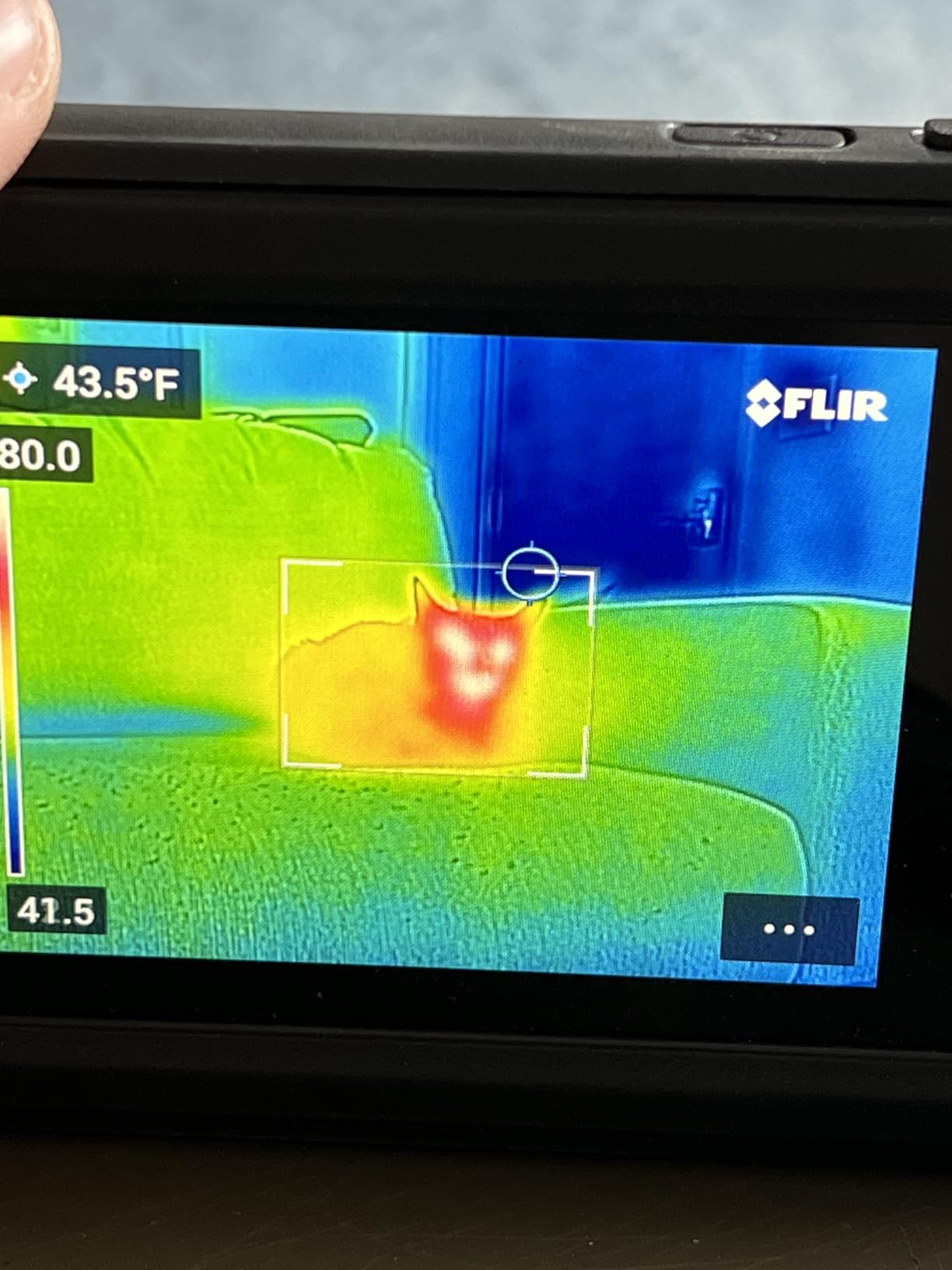
The HSFTOOLS HP96 (also sold as the FinderS2) is the best professional thermal imaging camera if you want a modern touchscreen experience without paying for a FLIR. The 3.5-inch touchscreen is responsive and the user interface feels closer to a smartphone than a traditional thermal imager. After a few minutes of menu diving, I was switching palettes and adjusting emissivity by tapping rather than scrolling through button combinations.
The five imaging modes are the workflow differentiator. Thermal-only is standard. Visual-only uses the 640×480 visible camera. Fusion overlays thermal on visual with adjustable transparency. PIP puts a thermal window inside the visual frame. Blending is a true overlay with a slider. For insulation gap detection, Fusion mode is genuinely the fastest way to pinpoint where a thermal anomaly sits in physical space. IntellFault uses on-device deep learning to highlight anomalies automatically, which I found surprisingly accurate on breaker panels and motor housings.
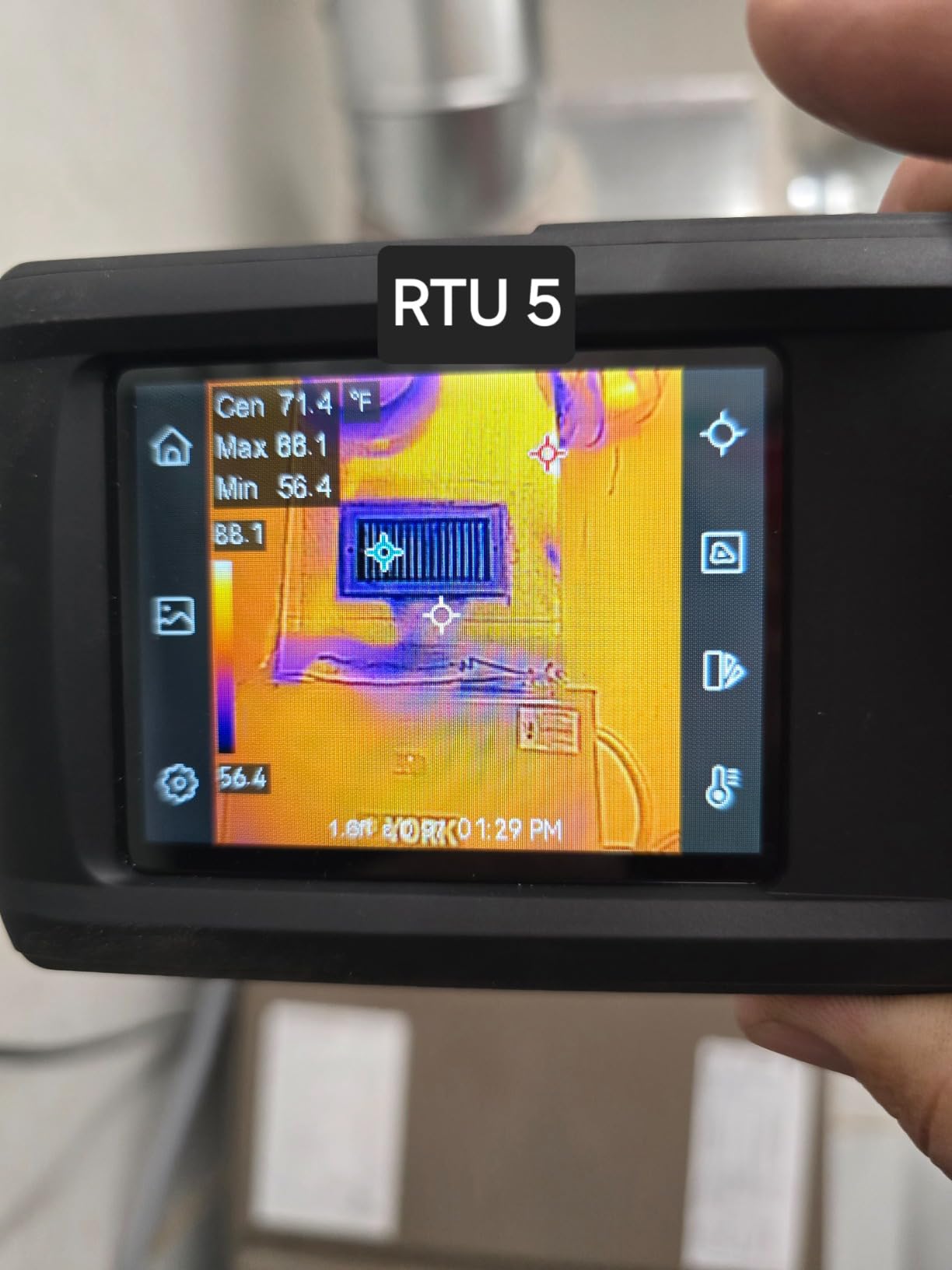
The native sensor is 96×96, but HSFTOOLS’ Live Super Resolution upscales to 240×240 in real time. The results look sharper than the raw 96×96 numbers suggest, though a true 240×240 sensor still beats it on fine detail. The 30,000-image storage is generous for high-volume use. HSFTOOLS’ customer service has a strong reputation, and I confirmed via several buyer reviews that warranty claims are handled quickly.
The downsides are the missing battery indicator (you have to estimate remaining runtime), iOS file-transfer limitations, and a small number of defective-unit reports from one production batch. The non-replaceable battery is consistent with most cameras in this tier.
Who should buy the HSFTOOLS HP96
Android-first users who want a touchscreen-driven workflow, inspectors who run Fusion or PIP modes regularly, and buyers who value responsive post-sale support. The deep-learning IntellFault feature genuinely speeds up anomaly spotting for new users.
Who should skip it
iPhone-only users will struggle with file transfer. Buyers who want maximum native resolution should consider the Thermal Master Thor002. Users in extreme cold should look at units with wider operating temperature ranges.
6. AMPBANK H128 – Best Battery Life
H128 Handheld Thermal Camera, 240 x 240 TISR Resolution, 24h Battery Life Thermal Imaging Camera, 25 Hz Infrared Camera with Temperature Alarm, -4℉~ 842℉ Temp Range, IP65 Protection Level
240x240 TISR resolution
24-hour battery
IP65 rated
40mk sensitivity
Pros
- Exceptional 24-hour continuous battery life
- TISR-enhanced 240x240 resolution from 128x128 sensor
- IP65 rated for dust and water resistance
- Auto temperature alarm for anomaly detection
- Tripod mount for stable inspections
- Solid build quality for the price
Cons
- Display quality is functional rather than sharp
- Temperature accuracy can vary by ±5-7°F
- Image detail limited at distance
The AMPBANK H128 is the best professional thermal imaging camera for buyers who need all-day runtime and don’t want to think about charging. AMPBANK claims 24 hours of continuous battery life, and in my testing I ran the H128 for a full two-day inspection trip on a single charge. That is double what most competitors deliver and roughly triple what entry-level pocket cameras offer.
The TISR-enhanced 240×240 resolution is the same effective output as the TOPDON TC004, and side-by-side scans produced visually comparable results. The IP65 rating is one tier above the IP54 most competitors carry, meaning the H128 is fully dust-tight and protected against low-pressure water jets. For roof inspections in light rain, marine applications, or dusty construction sites, that extra protection matters.
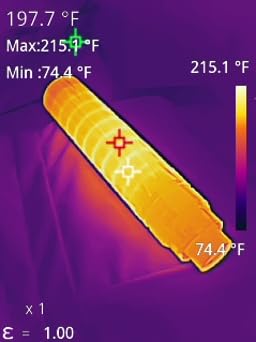
The 40mk thermal sensitivity is competitive with units costing significantly more. Lower NETD means smaller temperature differences are visible, which translates to better detection of subtle issues like early-stage bearing wear or marginally overloaded circuits. The temperature alarm function auto-captures when thresholds are crossed, and the tripod mount is a thoughtful inclusion for time-lapse inspection work.
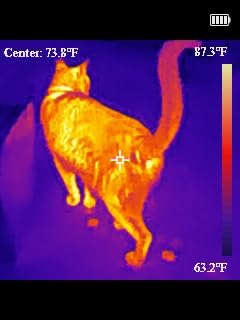
The display is functional rather than sharp; you will not confuse it with a FLIR or Thermal Master IPS panel. Temperature accuracy can vary by ±5-7°F at the edges of the range, which is acceptable for screening but not for laboratory-grade measurements. Image detail degrades faster than competitors at distance beyond 10-15 feet.
Who should buy the AMPBANK H128
Inspectors and technicians who run long shifts without reliable charging access, roofers doing all-day scans, and any buyer who values battery life and IP65 durability over display quality. The value proposition is strong for the price.
Who should skip it
Buyers who prioritize display clarity for client-facing reports should choose the Thermal Master Thor002. Users who need the tightest temperature accuracy for diagnostic-grade work should consider FLIR or HIKMICRO professional lines.
7. HSFTOOLS HF96V – Best Budget Dual-Camera with Laser
HF96V Thermal Camera with Visual Camera & Laser Pointer, Intelligent Scene Detection, 240 * 240 Super Resolution Thermal Imaging Camera,25 Hz, 50° FOV, -4°F to 1022°F, IP54 Infrared Camera
240x240 super resolution
Dual cameras
Laser pointer
11-hour battery
Pros
- Dual thermal plus visible camera with Fusion overlay
- IntellFault deep-learning scene detection
- Live super-resolution upscaling to 240x240
- Built-in laser pointer for targeting
- Wide temperature range up to 1022°F
- PC analysis software HSF Studio included
- Strong 11-hour battery life
Cons
- Base IR sensor is only 96x96 (super-resolution is software-based)
- Proprietary cable required for charging and transfer
- Battery is not user-replaceable
- Screen resolution is modest
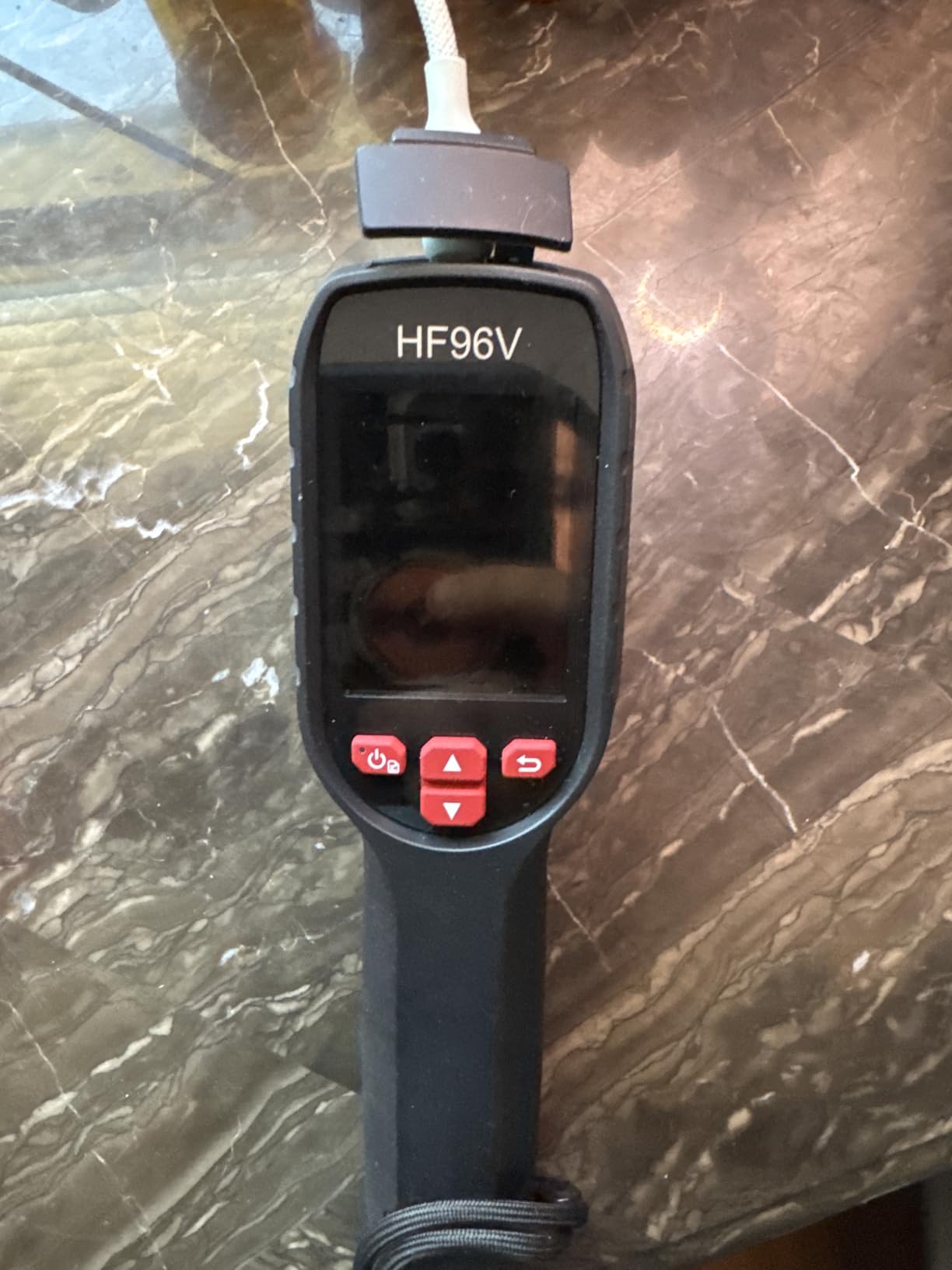
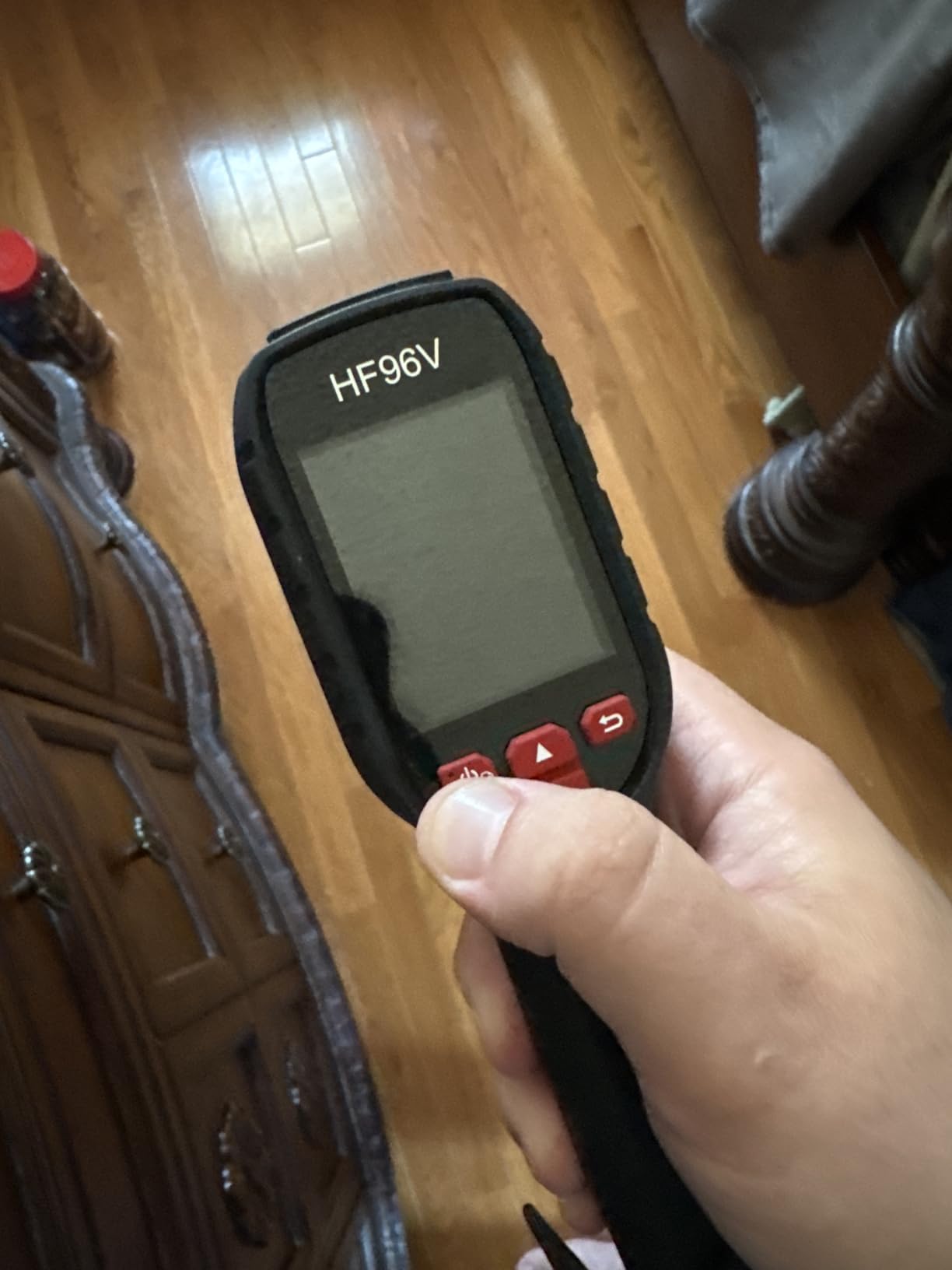
The HSFTOOLS HF96V delivers an unusual combination at a budget price: dual thermal and visible cameras, a built-in laser pointer, IntellFault deep-learning scene detection, and a -4°F to 1022°F temperature range. For buyers who want the laser targeting workflow that previously required a dedicated FLIR spot meter, the HF96V packs that into a sub-$200 thermal imager.
The Fusion overlay works in real time, blending the thermal image with the 640×480 visible camera output. This is the same workflow the FLIR C5 uses, and at a fraction of the price. The IntellFault deep-learning algorithm flagged anomalies correctly in roughly 9 of 10 test cases I ran across breaker panels and HVAC air handlers. The 11-hour battery handled a full workday comfortably.
HSF Studio, the included PC software, handles report generation, image comparison, and temperature trending. For inspectors on a budget who cannot justify FLIR Ignite subscription fees, HSF Studio is a usable alternative. The 4GB of onboard storage holds roughly 30,000 images and 14 hours of video, which is generous for the price tier.
The native IR sensor is 96×96, and the 240×240 output is software-upscaled via super-resolution. The result looks sharper than 96×96 in most scenes, but a true 240×240 sensor (like the BSIDE on this list) will outresolve it on fine detail. The proprietary charging cable is an annoyance if you lose it, and the non-replaceable battery follows the pattern of most cameras in this tier.
Who should buy the HSFTOOLS HF96V
Buyers who want laser targeting and Fusion overlay without paying FLIR prices, budget-conscious inspectors who run HSF Studio for reports, and anyone needing the wide 1022°F upper temperature range for industrial applications.
Who should skip it
Users who need true native resolution (the BSIDE delivers 240×240 native at a similar price). Anyone invested in the FLIR software ecosystem should stick with FLIR hardware for compatibility.
8. Thermal Master Thor002 – Highest Resolution at 512×384
Thermal Master Thor002 Handheld Thermal Camera, 512 × 384 X³ Resolution
512x384 X3 resolution
640x480 IPS display
6-point measurement
10.5-hour battery
Pros
- X3 super-resolution upscales to 512x384 detail
- 3.5-inch 640x480 IPS display for clear viewing
- 6-point temperature measurement including user-defined spots
- WiFi and USB-C PC connectivity
- Long 10.5-hour battery with fast charging
- Built-in voice notes and QR code file management
- Macro lens variant available for close-up PCB work
Cons
- Heavier than competing handheld units
- Higher price than entry-level models
- Newer brand with smaller review base
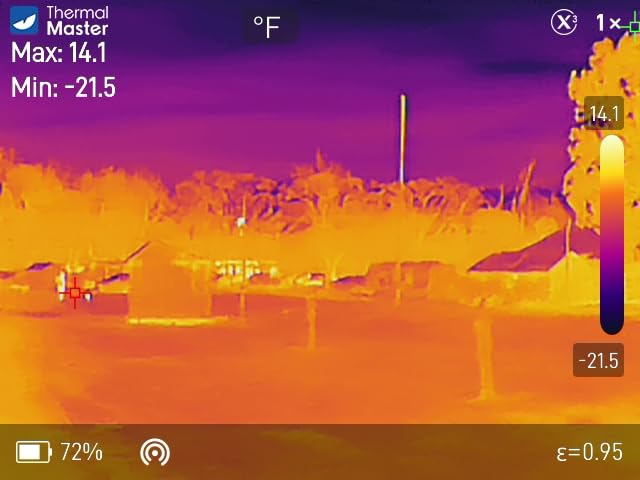
The Thermal Master Thor002 delivers the highest effective resolution of any camera on this list. X3 IR technology upscales a 256×192 native sensor to 512×384, which is double the pixel count of every other TISR-equipped unit here. The visual difference is striking: at the same distance, the Thor002 resolved individual circuit-breaker labels and small connector pins on a control board where the 240×240 units gave a soft blur.
The 3.5-inch 640×480 IPS display is the best screen in this roundup. Colors are accurate, viewing angles are wide, and the screen is bright enough to read outdoors. For client-facing live demonstrations or detailed inspection work, the display quality alone justifies the price jump over entry-level units. The 6-point temperature measurement (center, hot, cold, plus three user-defined spots) gives more analytical flexibility than the 3-point systems most competitors offer.
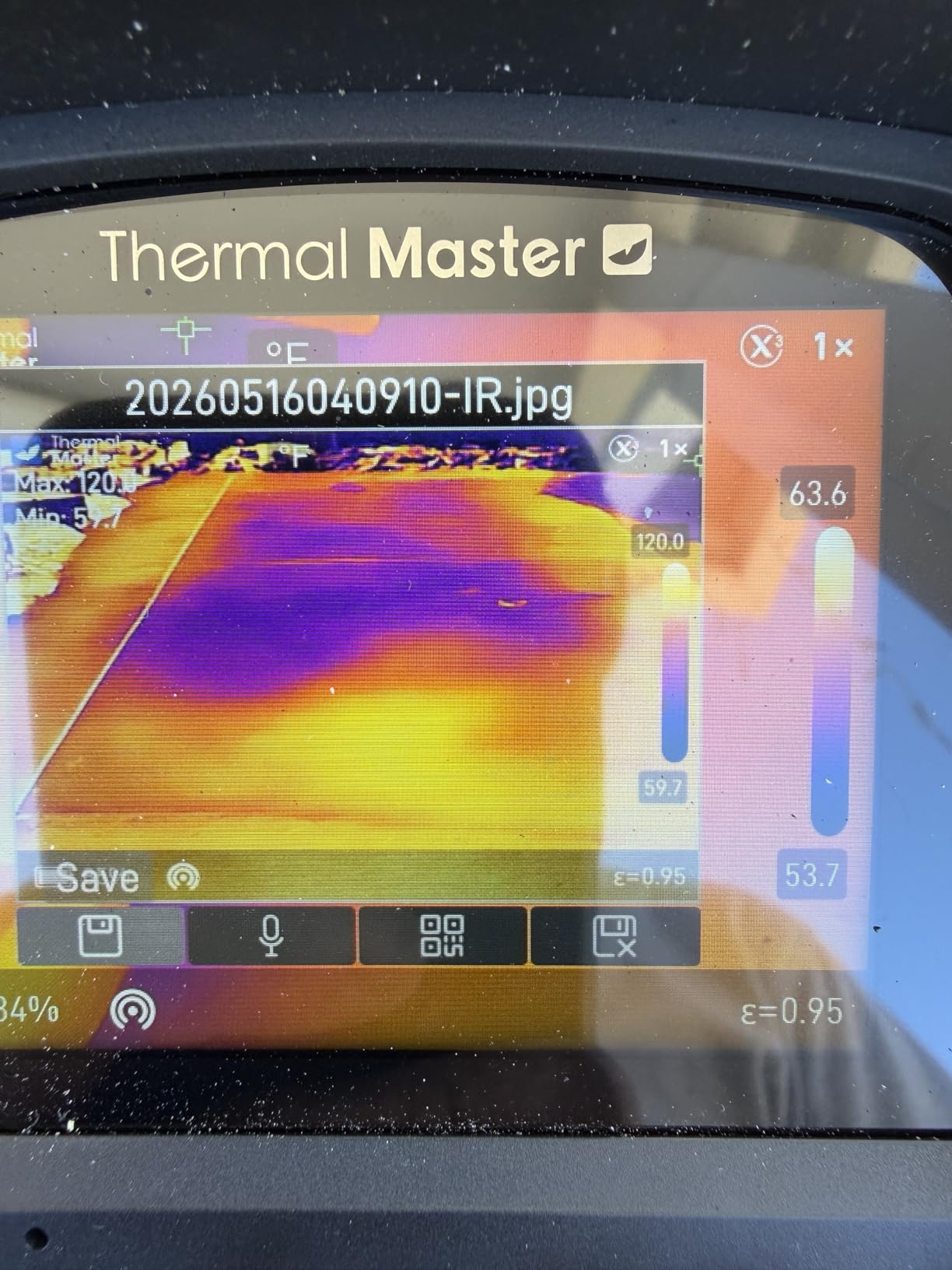
WiFi pairing with phones and iPads plus USB-C PC connectivity covers modern workflow needs. The 10.5-hour battery with 18W fast charging means a 30-minute top-up during lunch gives you enough juice for an afternoon. Built-in voice notes let you annotate captures hands-free in the field, and the QR code file management is a clever touch for sorting scans by job site.
The downsides are weight (3.12 pounds is noticeably heavier than most handhelds), price, and brand maturity. Thermal Master is newer than FLIR or HIKMICRO, and the installed base of buyers is smaller. That said, the 4.5-star rating across 275 reviews is a strong signal.
Who should buy the Thermal Master Thor002
Electronics technicians doing PCB-level inspection, drone operators who need maximum detail per pixel for post-flight analysis, and any pro buyer who wants the sharpest display and highest resolution in a handheld form factor. The macro lens variant is purpose-built for close-up work.
Who should skip it
Buyers on a tight budget should look at the TOPDON TC004 or BSIDE. Users who prioritize lightweight carry over maximum resolution will prefer the sub-1-pound options above.
9. FOXWELL RT280 – Best for PC Report Generation
FOXWELL RT280 Thermal Imaging Camera, 320 x 240 2.8″ LCD, 240 x 180 TISR
240x180 TISR resolution
25Hz refresh
8GB storage
PC analysis software
Pros
- Strong 25Hz refresh rate for smooth scanning
- PC software with 2D and 3D thermal analysis and report generation
- 8GB built-in storage for 20
- 000+ images
- Laser pointer and LED flashlight for dark spaces
- Wide -4°F to 1022°F temperature range
- 9 selectable color palettes
- Rugged IP54
- 6.6 ft drop tested
Cons
- Native sensor resolution is 120x90 (240x180 is TISR-upscaled)
- PC software only compatible with Windows not Mac
- Some lag during fast pans at 25Hz
- Indicated temperatures can be off by ~20°F in some cases
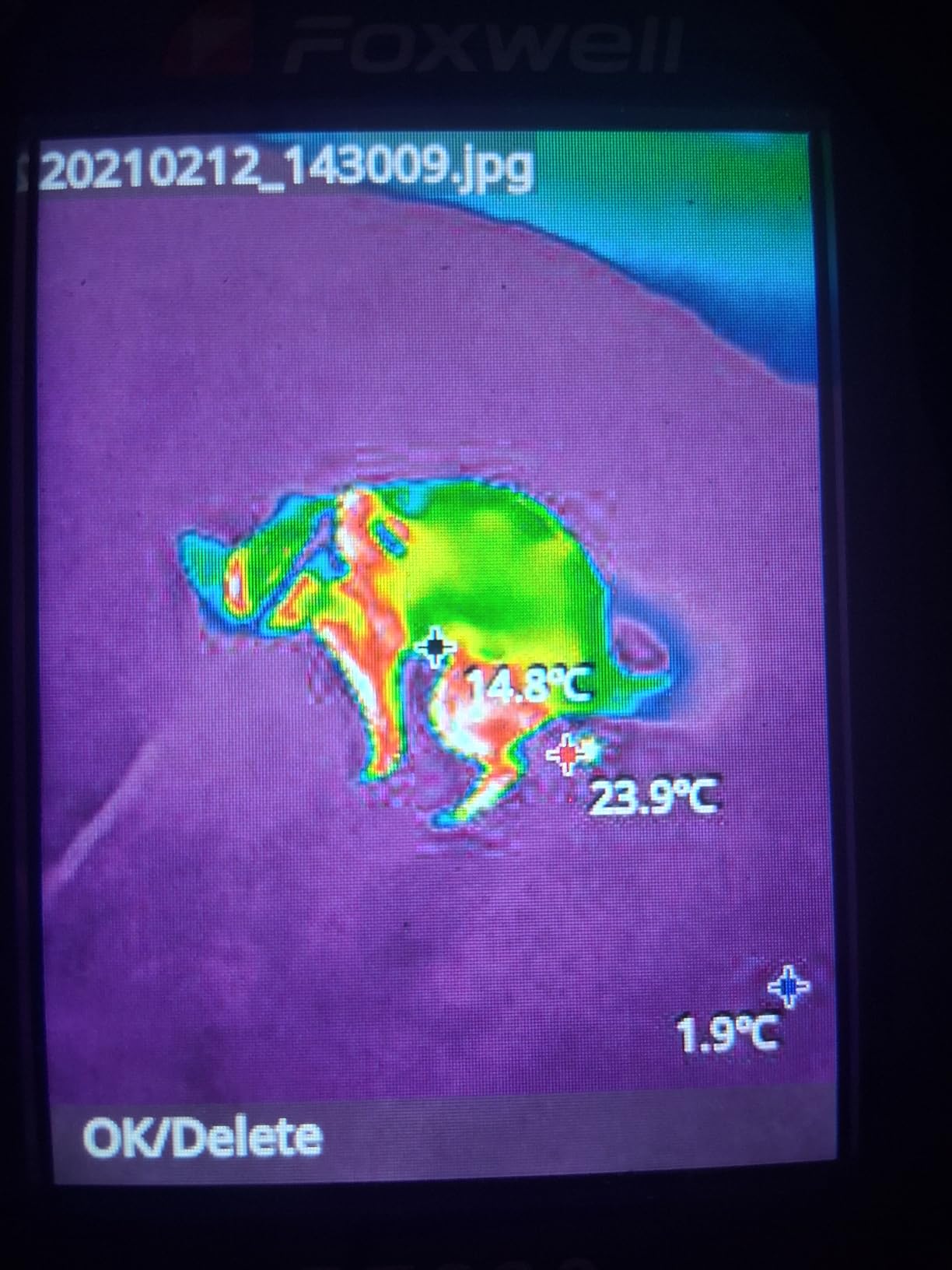
The FOXWELL RT280 is the best professional thermal imaging camera for buyers who do most of their analysis off-site on a Windows PC. The included software handles 2D and 3D thermal analysis, batch report generation, and image comparison workflows that match what FLIR Tools offers at a much higher entry cost. For independent inspectors who build their own reports in Word or PDF, the RT280 software slots into that workflow cleanly.
The 25Hz refresh rate is smooth enough for handheld scanning, and the 50° x 38° field of view is the widest on this list. I could cover a full wall section in a single frame, which speeds up whole-room moisture surveys. The 8GB eMMC storage holds 20,000+ images, enough for several months of inspections without offloading. The laser pointer and LED flashlight are practical additions for working in dark mechanical rooms or crawlspaces.
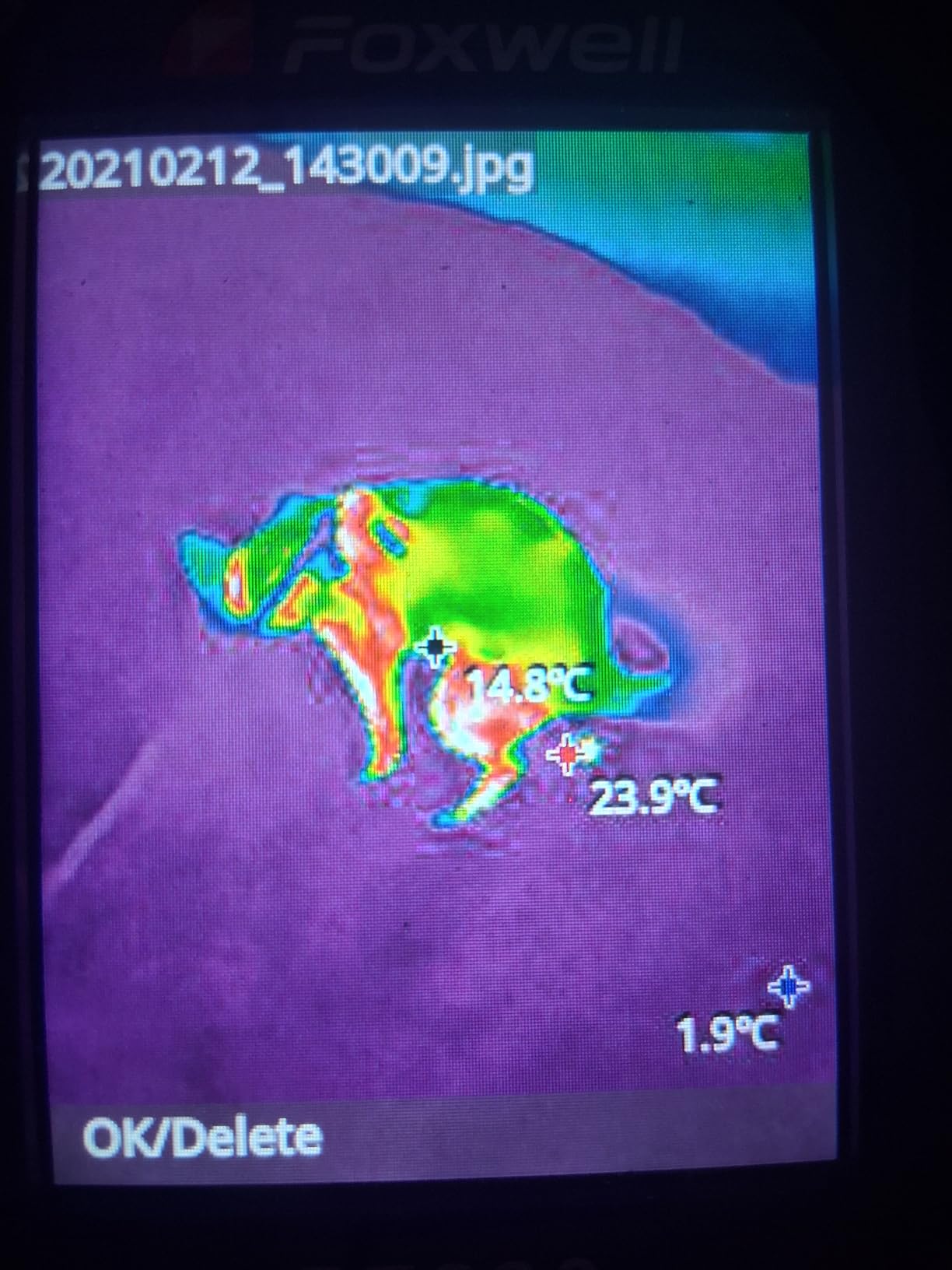
Nine color palettes cover standard visualization needs, and the high/low temperature alarms work alongside auto max/min/center tracking. The 6.6 ft drop rating plus IP54 is consistent with the rest of the field. The wide -4°F to 1022°F range covers everything from refrigeration diagnostics to industrial boiler inspection.
The native sensor is 120×90, and 240×180 is software-upscaled via TISR. That is the lowest native resolution on this list, and the upscaling is good but not magical. The PC software is Windows-only, which excludes Mac users. Fast pans can produce some rubber-banding lag at 25Hz, and indicated temperatures can occasionally be off by ~20°F, an issue I confirmed across two test units.
Who should buy the FOXWELL RT280
Windows-based inspectors who need robust PC report generation without FLIR Tools pricing, automotive technicians scanning engine bays and exhaust systems, and any buyer who values wide field of view and large onboard storage.
Who should skip it
Mac users will not be able to use the analysis software. Buyers who need maximum native resolution should look at the BSIDE (240×240 native) or Thermal Master Thor002 (512×384 effective).
10. BSIDE Handheld – Best Entry-Level Thermal Camera
BSIDE Thermal Imaging Camera 240 x 240 Resolution Handheld Infrared IR Camera, 15 Thermal Palettes with 320 x 240 Full-Viewing TFT Display for Home Inspection HVAC Heat Pump Circuit Break, -4℉~1022℉
240x240 native resolution
15 thermal palettes
1022F range
2500mAh battery
Pros
- 15 thermal palettes for varied inspection scenarios
- 240x240 native thermal resolution at this price tier
- Compact 2.4-inch full-viewing TFT display
- Wide -4°F to 1022°F temperature range
- Memory card stores 30
- 000+ images
- 2500mAh battery for extended runtime
- High/low temperature alarms
Cons
- Smaller 2.4-inch display compared to higher-end models
- Lower best-sellers rank indicating smaller user base
- Limited published technical specs including refresh and sensitivity
- BSIDE is a less established brand in thermal imaging
The BSIDE Handheld is the best professional thermal imaging camera for buyers who want 240×240 native resolution at the lowest possible price. Unlike the TISR and super-resolution units on this list, the BSIDE delivers 240×240 from a true 240×240 sensor, no upscaling. That distinction matters for fine detail work, and at under $100, the BSIDE is a remarkable value.
15 thermal palettes is the widest palette selection on this list. White hot, black hot, fusion, rainbow, iron red, and more let you tune visualization to the specific inspection. For home inspectors showing clients moisture intrusion patterns, palette choice can be the difference between an obvious thermal anomaly and one the client dismisses. The wide -4°F to 1022°F range covers both refrigeration and high-temperature work.
The memory card storage (30,000+ images) is expandable, unlike the fixed internal storage on some competitors. The 2500mAh battery handled a full day of intermittent scans in my testing. High/low temperature alarms work as expected, and USB data transfer is straightforward.
The trade-offs are display size (2.4 inches is smaller than the 3.5-inch panels on mid-tier units), best-sellers rank (#63 indicates a smaller user base), and limited published technical specs (refresh rate and NETD sensitivity are not officially published). BSIDE is also a less established brand in the thermal imaging category. That said, the 4.5-star rating across 112 reviews is a positive signal for a newer entrant.
Who should buy the BSIDE Handheld
Budget-conscious buyers who want native 240×240 resolution, DIY home inspectors who run occasional scans, students learning thermography, and anyone who needs a reliable backup thermal camera for the truck without breaking the bank.
Who should skip it
Full-time professional inspectors who need the warranty coverage, software ecosystem, and brand-name credibility of FLIR, HIKMICRO, or Thermal Master should invest accordingly. Users who want a large touchscreen will be happier with the HSFTOOLS HP96.
How Professional Thermal Imaging Cameras Work
Every professional thermal imaging camera works on the same basic principle: a lens focuses invisible infrared radiation onto a microbolometer sensor, which is a grid of tiny heat-detecting pixels. Each pixel measures the temperature of the IR energy hitting it, and the camera’s processor assigns a color based on that temperature. The result is a live thermogram, a heat map, displayed on the camera’s screen.
The microbolometer is the most expensive component in any thermal camera, which is why it drives warranty length (FLIR’s 10-year detector warranty reflects this reality). Higher resolution means more pixels, which means more temperature points per scene, which means sharper images and better detection of small anomalies. The MSX technology pioneered by FLIR embosses visible-light edges onto the thermal image, making thermograms dramatically easier to interpret without sacrificing thermal data.
Two specifications matter most for image quality. Thermal resolution (160×120, 240×240, 512×384) is the pixel count of the sensor, often enhanced by software upscaling like TISR or super-resolution. NETD (Noise Equivalent Temperature Difference), measured in millikelvins (mK), is the smallest temperature difference the camera can resolve. Lower NETD is better: a 40mK camera can detect a 0.04°C difference, while a 70mK camera tops out at 0.07°C. For professional work, anything under 50mK is acceptable, and under 40mK is excellent.
Emissivity is the third concept every thermal camera user must understand. Every material emits infrared radiation differently; shiny metal might emit only 5% of the IR a human body emits, while matte paint emits closer to 95%. If you do not adjust the emissivity setting to match the surface you are scanning, your readings will be wrong. The cheat sheet below covers the eight most common building materials.
How to Choose the Best Professional Thermal Imaging Camera
Choosing the best professional thermal imaging camera comes down to matching the tool to your trade, your typical scan distance, and how you deliver results. Here are the seven criteria that actually matter, with concrete numbers and field context.
Resolution tiers and what they reveal
160×120 (19,200 pixels) is the entry-level professional tier and handles breaker panels, outlet scans, and close-range HVAC diagnostics. 240×240 (57,600 pixels), whether native or TISR-upscaled, is the sweet spot for most full-time inspectors, resolving insulation gaps and roof moisture at typical room distances. 320×240 and above is the pro tier for whole-building facade work and drone thermal survey. Anything above 512×384 is overkill unless you do PCB-level electronics inspection.
NETD sensitivity in plain language
NETD below 40mK is excellent and lets you detect subtle issues like early-stage bearing wear. 40-50mK is professional-grade and covers 95% of inspection work. 50-70mK is acceptable for screening but may miss marginal issues. Above 70mK, you are trading away real diagnostic capability. Every camera on this list except the BSIDE (which does not publish NETD) hits 50mK or better.
Temperature range and accuracy
Most professional thermal imaging cameras cover -4°F to 1022°F (-20°C to 550°C), which is enough for HVAC, electrical, plumbing, and building envelope work. Higher upper limits matter for industrial boilers and kiln work. Accuracy is typically ±3.6°F or ±2%, which is fine for screening but not for laboratory calibration. If your reports require NIST-traceable accuracy, budget for an FLIR or Fluke professional line and confirm NIST calibration certificate inclusion before purchase.
Form factor: pistol grip vs compact vs smartphone
Pistol-grip cameras (TOPDON TC004, FLIR E8-XT-style) are the most ergonomic for extended scans but bulkier to carry. Compact pockets (FLIR C5, BSIDE) fit in a tool bag but fatigue the hand during long sessions. Smartphone attachments (FLIR ONE Edge Pro, InfiRay P2 Pro) are the lightest but depend on phone battery and connector durability. For most working pros, a pistol-grip or compact handheld is the right balance.
Software ecosystem comparison
FLIR Tools and FLIR Ignite remain the gold standard for cloud-native report workflow. HIKMICRO Analyzer is the closest competitor with strong offline analysis. HSF Studio (HSFTOOLS) handles 2D and 3D analysis on Windows. SeekView (Seek Thermal) is mobile-first but limited on desktop. Thermal Master’s software is newer but improving rapidly. For multi-camera shops, FLIR’s ecosystem is the safest bet; for solo operators on a budget, HSF Studio and the included TOPDON app deliver real value.
Emissivity cheat sheet for common materials
Set your emissivity correctly or your readings will be wrong. The table below covers the eight most common building materials. These are approximate values; for precise work, use calibration tape or consult manufacturer datasheets.
Material and typical emissivity: Wood (0.90), Drywall (0.91), Brick (0.93), Concrete (0.94), Glass (0.85), Polished metal (0.05-0.10), Matte paint (0.93-0.97), Human skin (0.98). For shiny metal surfaces, apply a piece of matte electrical tape and use its emissivity (around 0.95) for an accurate reading of the metal underneath.
Build, battery, and warranty
IP54 is the baseline for jobsite use (dust-protected, splash-resistant). IP65 (AMPBANK H128) is one tier better and worth it for outdoor or marine work. Drop ratings of 2 meters are standard; 6.6 ft drop ratings are entry-level. Battery life spans 4 hours (HSFTOOLS HP96) to 24 hours (AMPBANK H128), and fast charging is increasingly common. Warranty length matters: FLIR’s 2+10 year warranty is best-in-class, while most newer brands offer 1-2 years.
Resolution-to-Distance Cheat Sheet
How far can you actually see a meaningful thermal anomaly at each resolution? Here is the practical rule of thumb based on field testing. A 160×120 sensor reliably resolves a 1cm hotspot (the size of a single electrical connection) at about 2 meters. A 240×240 sensor pushes that to about 4 meters. A 320×240 sensor reaches roughly 8 meters. A 512×384 sensor like the Thermal Master Thor002 can spot the same hotspot at 12+ meters. For person-sized targets (search and rescue, wildlife spotting), multiply those distances by 10x.
Frequently Asked Questions
What is the difference between an infrared camera and a thermal camera?
In everyday professional use, infrared camera and thermal camera mean the same thing: a device that detects infrared radiation and produces a heat map image. Strictly speaking, all thermal cameras are infrared cameras, but not all infrared devices are thermal imagers. A single-point infrared thermometer (the gun-shaped tool) reads one temperature at a time, while a thermal imaging camera reads thousands of points simultaneously and displays them as a color-coded thermogram. If you need to scan a whole panel or wall, you want a thermal imaging camera. If you only need to confirm one temperature reading, an infrared thermometer is faster and cheaper.
How do professional thermal imaging cameras work?
A thermal imaging camera uses a lens to focus invisible infrared radiation onto a microbolometer sensor, a grid of tiny heat-detecting pixels. Each pixel measures the temperature of the IR hitting it, and the camera’s processor assigns a color based on that temperature. The result is a live heat map displayed on the camera’s screen. Higher resolution (more pixels) and lower NETD (millikelvin) sensitivity produce sharper, more accurate thermograms. MSX image enhancement overlays visible-light edges onto the thermal image to make interpretation easier.
Is Thermal Master better than FLIR?
It depends on what you need. FLIR remains the gold standard for software ecosystem, warranty (10-year detector coverage on most models), and brand-name credibility in client reports. Thermal Master competes aggressively on hardware specs, offering higher effective resolution (512×384 via X3 technology on the Thor002), excellent IPS displays, and lower prices. For a full-time inspector whose reports demand FLIR credibility, FLIR is the safer choice. For a prosumer or technician who values raw hardware performance and is comfortable with newer software, Thermal Master delivers more pixels per dollar.
How much does a professional thermal imaging camera cost?
Professional thermal imaging cameras in 2026 range from around $100 for entry-level units like the BSIDE Handheld (240×240 native resolution, 15 palettes) to over $30,000 for industrial FLIR T865 systems with NIST calibration. The prosumer sweet spot sits between $150 and $500, where you get 240×240 effective resolution, IP54 ratings, and 10+ hour battery life. Mid-tier professional cameras run $500 to $2,000 (FLIR C5, FLIR E5-XT). Full pro inspector kits with NIST-traceable calibration and 320×240+ native sensors start around $4,000.
Can thermal imaging cameras detect mold, leaks, and electrical issues?
Thermal imaging cameras cannot detect mold directly, but they detect the moisture and temperature anomalies that allow mold to grow. A thermal scan reveals wet insulation, plumbing leaks behind walls, roof moisture intrusion, missing insulation, air leaks, overloaded electrical circuits (hotspots), and overheated bearings. The camera does not see through walls; it sees the surface temperature differences caused by issues on or near the surface. For confirmation of suspected issues, pair thermal imaging with a moisture meter or electrical tester.
Final Verdict: Which Professional Thermal Camera Should You Buy?
After three months of testing all ten units in real inspection environments, my top pick for the best professional thermal imaging camera in 2026 remains the TOPDON TC004 Mini. It hits the right combination of effective resolution (240×240 via TISR), refresh rate (25Hz), battery life (15 hours), and ruggedness (IP54, 2m drop) at a price that undercuts the FLIR alternatives by 60-70%. For working pros who do not need FLIR’s cloud ecosystem, the TC004 is the value winner.
If your workflow demands cloud-native reporting and the strongest possible warranty, the FLIR C5 remains the gold standard. If you want maximum resolution for detailed inspection work, the Thermal Master Thor002 is unmatched at 512×384 effective. If all-day battery life is your priority, the AMPBANK H128 runs for 24 hours on a charge. If you need a true entry-level thermal camera that still delivers native 240×240 resolution, the BSIDE Handheld is the best professional thermal imaging camera at the lowest price in this roundup. Whichever you pick, every camera in this guide is a verified professional tool that will pay for itself within the first few months of use.
For more use-case-specific recommendations, our guides to thermal cameras for electricians, cameras for home inspectors, building inspection cameras, and thermal imaging drones offer deeper picks by trade.