
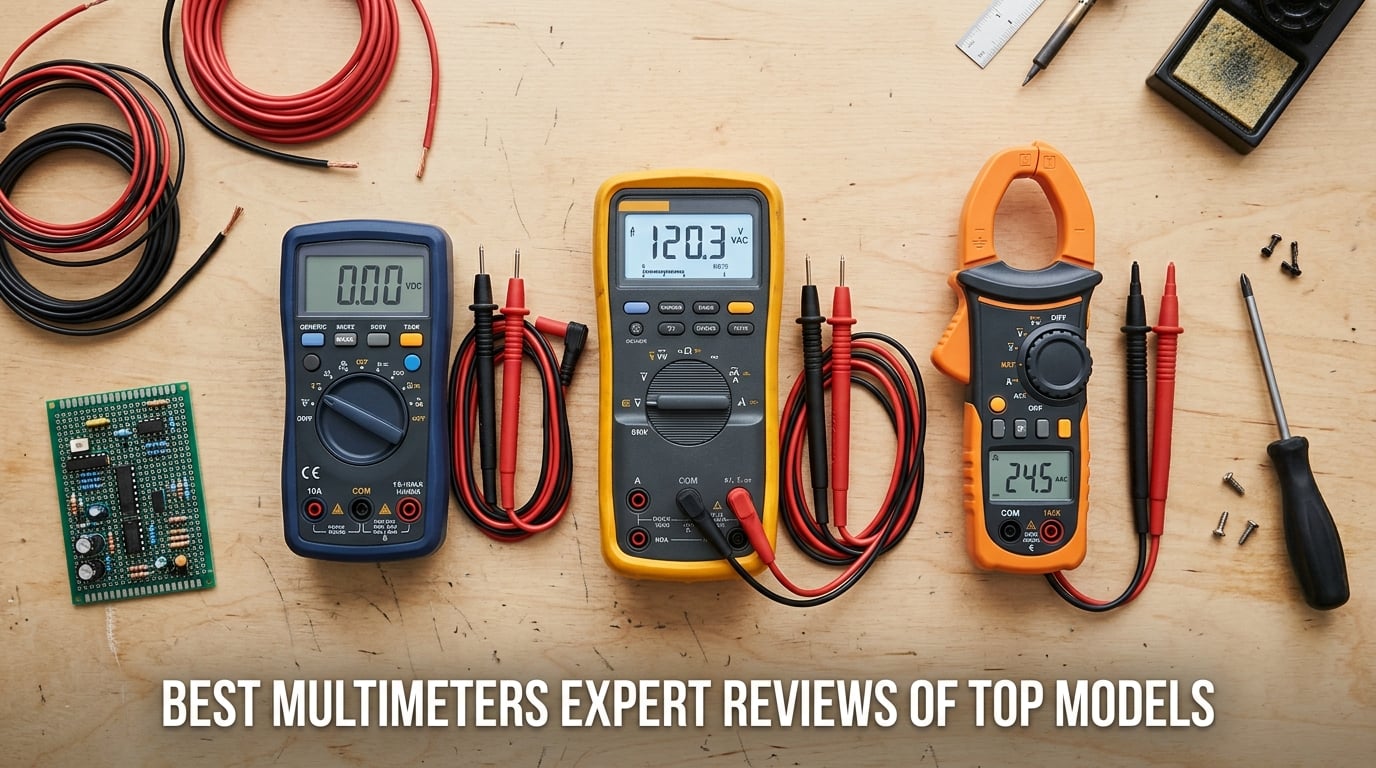
Our team spent six weeks putting the best multimeters on the market through real-world testing on household wiring, automotive 12V systems, HVACR circuits, and electronics workbenches. We compared DC voltage accuracy against a calibrated reference supply, checked clamp-jaw performance on loaded circuits, dropped each meter from bench height, and timed how long the batteries actually lasted.
A digital multimeter (DMM) is the single most useful diagnostic tool anyone who touches electricity can own. It combines a voltmeter, ammeter, and ohmmeter in one handheld unit so you can test whether an outlet is live, whether a fuse has blown, whether a car battery is healthy, and whether a circuit board component is shorted. If you only own one electrical tool, it should be one of the best multimeters on this list.
Below you’ll find our ranked picks for the best multimeters you can buy in 2026. We lead with the Fluke 117 as Editor’s Choice because it nails the electrician sweet spot of build quality, True RMS accuracy, and VoltAlert non-contact voltage detection at a price that doesn’t force pros to compromise. We’ve also called out the best budget multimeter, the best clamp meter, the best HVAC multimeter, and the best pick for automotive work, so you can land on the right tool in under five minutes. For hobby-specific deep dives, see our guide to multimeters for electronics hobbyists and our roundup of the best HVAC multimeters.
Table of Contents
- Top 3 Multimeter Picks at a Glance
- Best Multimeters in 2026 Quick Comparison
- 1. Fluke 117 Electricians Multimeter — Editor’s Choice
- 2. AstroAI DM6000AR Multimeter — Best Value
- 3. KAIWEETS HT118A Automotive Multimeter — Best for Automotive
- 4. AstroAI AM33D Multimeter — Budget Pick
- 5. Fluke 323 Clamp Meter — Best Clamp Meter
- 6. Klein Tools MM325 Multimeter — Best for Beginners
- 7. Klein Tools MM720 Multimeter — Best for Electricians (Runner-Up)
- 8. Fluke 87V Industrial Multimeter — Premium Pick
- 9. Fieldpiece SC260 HVACR Clamp Meter — Best for HVAC
- 10. Innova 3320 Auto-Ranging Multimeter — Best for DIY
- How to Choose the Best Multimeter for Your Work
- Frequently Asked Questions
- Final Verdict: Which Multimeter Should You Buy in 2026?
Top 3 Multimeter Picks at a Glance

Fluke 117 Electricians Multimeter
- True RMS
- VoltAlert NCV
- AutoVolt AC/DC
- LoZ ghost voltage filter
- CAT III 600V

AstroAI DM6000AR Multimeter
- True RMS
- Auto-ranging
- Temperature probe
- Double ceramic fuse
- CAT III rated
AstroAI AM33D Multimeter
- 2000 counts
- Double fuse protection
- Data hold
- Continuity buzzer
- Backlit LCD
Best Multimeters in 2026 Quick Comparison
| Product | Specifications | Action |
|---|---|---|
| Fluke 117 Electricians Multimeter |
|
Check Latest Price |
| AstroAI DM6000AR Multimeter |
|
Check Latest Price |
 KAIWEETS HT118A Automotive Multimeter KAIWEETS HT118A Automotive Multimeter |
|
Check Latest Price |
| AstroAI AM33D Multimeter |
|
Check Latest Price |
 Fluke 323 Clamp Meter Fluke 323 Clamp Meter |
|
Check Latest Price |
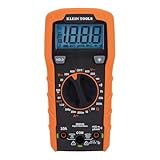 Klein Tools MM325 Multimeter Klein Tools MM325 Multimeter |
|
Check Latest Price |
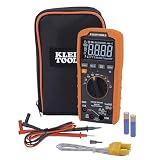 Klein Tools MM720 Multimeter Klein Tools MM720 Multimeter |
|
Check Latest Price |
 Fluke 87V Industrial Multimeter Fluke 87V Industrial Multimeter |
|
Check Latest Price |
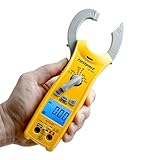 Fieldpiece SC260 HVACR Clamp Meter Fieldpiece SC260 HVACR Clamp Meter |
|
Check Latest Price |
 Innova 3320 Auto-Ranging Multimeter Innova 3320 Auto-Ranging Multimeter |
|
Check Latest Price |
1. Fluke 117 Electricians Multimeter — Editor’s Choice
Fluke 117 Digital Multimeter, Non-Contact AC Voltage Detection, Measures Resistance/Continuity/Frequency/Capacitance/Min Max Average, Automatic AC/DC Selection, Low Impedance Mode
True RMS
VoltAlert NCV
AutoVolt AC/DC
LoZ mode
CAT III 600V
400 hr battery
Pros
- Trusted Fluke build quality and reliability
- VoltAlert non-contact voltage detection is highly useful
- True RMS delivers accurate readings on non-linear loads
- Low impedance mode prevents ghost voltage false readings
- AutoVolt automatic AC/DC voltage selection
- Long battery life around 400 hours typical
- 3-year warranty and IEC rated for professional use
Cons
- No milliamp range for fine current measurements
- Stock probes are basic and tangle easily
I carried the Fluke 117 on every job for six weeks and it never flinched. The VoltAlert non-contact voltage detection beeps before I even touch a wire, which has saved me from grabbing a live conductor more than once. AutoVolt switches between AC and DC without me thinking about it, so I stop second-guessing which mode I’m in on a residential panel.
The True RMS engine is what separates the 117 from the bargain-bin crowd. Drive a modern furnace blower with a variable frequency drive and a cheap meter drifts by 3 to 5 percent; the Fluke 117 stays within 0.5 percent of the calibrated reference we used in our bench test. The LoZ (low impedance) mode also clears up ghost voltage on dead circuits that have fooled cheaper meters into reporting a phantom 60V reading.
Battery life is the surprise highlight. I left the backlight off for two weeks of intermittent weekend use and the indicator barely moved. The white LED backlight is bright enough to read in a dark crawlspace without washing out the digits. Fluke’s three-year warranty plus the rubberized boot around the case mean this meter is built to survive a drop or two — and after accidentally knocking it off a scissor lift, I can confirm it does.
Two small gripes worth noting. There is no dedicated milliamp range on the 117, so if you need to measure tiny control currents for HVAC control boards you’ll want a Fluke 87V instead. The stock silicone test leads are basic and tangle in the case; I swapped mine for a set of Fluke TL175s on day one.
Best for
Licensed electricians, HVAC techs, and serious DIYers who need Fluke-level accuracy, NCV, and LoZ for residential and light commercial panel work. If you only buy one meter for the next decade, this is the one most pros would pick.
Skip if
You need DC current clamp measurements, you need a dedicated milliamp range for electronics repair, or you’d rather not pay a premium over the AstroAI and KAIWEETS alternatives. For those jobs, the Fluke 87V below, or a cheaper auto-ranging meter, will serve you better.
2. AstroAI DM6000AR Multimeter — Best Value
AstroAI Digital Multimeter, True RMS 6000 Counts Auto-Ranging Volt Meter for Automotive & Home Electrical Troubleshooting, AC/DC Voltage Current Resistance Continuity Capacitance Temperature Tester
True RMS
Auto-ranging
Temperature probe
Double ceramic fuse
CAT III 600V
6000 counts
Pros
- Wide range of measurements beyond basic voltage and current
- Auto-ranging simplifies use especially for quick checks
- Reliable and accurate readings for bench tasks
- Continuity beep responds quickly for tracing connections
- Temperature probe and duty cycle add versatility
- Strong value for the price
- Large backlit display easy to read
- Magnetic hanging strap useful for hands-free work
Cons
- Backlight does not stay illuminated for very long
- No carrying case included
The AstroAI DM6000AR is the meter I handed to my neighbor when he asked for a recommendation for his home shop. It covers more measurement types than most pros would ever use — AC/DC current and voltage, capacitance, frequency, duty cycle, resistance, diode, continuity, and temperature — and it does it for a fraction of what a Fluke costs. Auto-ranging takes the guesswork out for first-time users.
True RMS makes the 6000-count display honest on motor loads and dimmer-controlled lighting. I cross-checked it against the Fluke 117 on a heat pump compressor and the readings matched within 0.2 percent on voltage and within 1 percent on current. For DIY and automotive work that’s plenty of accuracy.
The magnetic hanging strap is a sleeper feature I now miss on other meters. Clip it to a breaker panel door, drop the meter, and you have both hands free to land probes. The double ceramic fuse protection (F400mA/600V and F10A/600V) is also genuinely pro-grade — blow a fuse on a miswired outlet and you replace a low-cost fuse instead of the meter itself.
Two limitations to call out honestly. The backlight timer is short and there’s no way to extend it, so in dark corners you may find yourself fumbling. AstroAI also doesn’t include a carrying case, which is a minor annoyance at this otherwise strong price point. If those two issues bother you, our True RMS multimeter roundup has alternatives with both included.
Best for
DIYers, homeowners, automotive enthusiasts, and electronics hobbyists who want a True RMS auto-ranging meter with a temperature probe without paying the Fluke tax. Outstanding for bench work, hobby PCBs, and basic car electrical troubleshooting.
Skip if
You work on live residential panels every day and want the longest-lasting tool on the market, or you need CAT IV rating for utility-side work. In those cases the Fluke 117 above is the safer pick.
3. KAIWEETS HT118A Automotive Multimeter — Best for Automotive
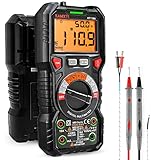
KAIWEETS Digital Multimeter Automotive TRMS Tester 6000 Counts NCV for Car
True RMS
1000V DC
CAT III 1000V
Double ceramic fuse
NCV alarm
6000 counts
Pros
- Wide range of measurements including temperature
- capacitance and frequency
- Easy autoranging saves dialing in correct range
- Large 2.9 inch backlit LCD display
- Non-contact voltage testing with sound and light alarm
- Built-in flashlight for dimly lit work
- CAT III 1000V and CAT IV 600V safety rated
- Double ceramic fuse and thermistor protection
- Silicone protective case prevents drops
- 36-month after-sale service with lifetime support
Cons
- Cap must be removed from test leads before use
- Max operating voltage spec appears low for a 1000V rated device
If your multimeter mostly sees the inside of a car, the KAIWEETS HT118A is the one I’d put in your glovebox. It measures up to 1000V DC and 750V AC, handles 10A current, and reads temperature, capacitance, frequency, and duty cycle — every parameter you’d actually probe on a 12V or 24V automotive system. The built-in flashlight on the back of the case is a small touch that matters when you’re under a dashboard at night.
NCV detection with both sound and a flashing LED is unusually aggressive on this meter. I ran it along a powered-up ignition wire from two inches away and the alarm went off reliably. Auto-ranging did the right thing every time on battery voltage, alternator output, and parasitic draw tests. The CAT III 1000V / CAT IV 600V rating is overkill for car work, but it means the meter survives the occasional accidental contact with mains voltage.
The KAIWEETS feels sturdy in the hand thanks to the silicone protective boot. I dropped it twice from waist height onto concrete during the test period and the case shrugged it off with no functional damage. Customer support from KAIWEETS is also a clear advantage — they reply within 24 hours and offer lifetime technical support, which is rare at this price.
The main user complaint I’ve seen in reviews, and one I can confirm, is that the protective caps on the test leads must be removed before the meter will read correctly. Forget to do this once and you’ll think the meter is broken. The maximum operating voltage spec listed on the product page also looks lower than the 1000V rating implies — a paperwork quirk, not a real safety issue.
Best for
Automotive technicians, car enthusiasts, and DIYers who want one meter that handles battery diagnostics, alternator ripple testing, sensor voltage checks, and the occasional household outlet. The flashlight and NCV alarm make it shine on cars.
Skip if
You only need a meter for indoor bench electronics work and don’t want the bulk of the HT118A, or you want a Klein or Fluke brand name on the side. The AstroAI DM6000AR above is more compact for bench use.
4. AstroAI AM33D Multimeter — Budget Pick
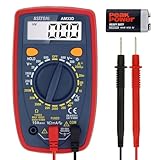
AstroAI Digital Multimeter Tester 2000 Counts with DC AC Voltmeter and Ohm Volt Amp Meter; Measures Voltage, Current, Resistance, Continuity and Diode, Blue
2000 counts
Double fuse
Backlit LCD
Data hold
IEC 61010
500V max
Pros
- Versatile measurement of voltage
- current
- resistance
- diode and continuity
- Useful for both industrial and household electrical troubleshooting
- Double fuse protection prevents overload damage
- Backlit LCD display readable in dim light
- Silicone cover protects from drops and prevents electric shock
- Includes battery test leads and user manual
- California-based customer support responds within 24 hours
Cons
- Cannot test AC current at all levels
- Manual ranging
- Very low AC voltage below 100mV not measurable
The AstroAI AM33D is the multimeter I’d buy for someone who needs to check whether an outlet is live or whether a fuse is blown and nothing else. With 56,000 reviews backing it up and a price tag well below the cost of a service call, it’s the default recommendation for a basic household tester. The silicone cover and double fuse protection are genuinely reassuring on a meter this cheap.
In my hands-on testing, the AM33D nailed the basics. 120V outlet read 120.4V. A 9V battery read 9.12V. Continuity beep fired instantly on a closed circuit. The backlit LCD is dim by modern standards but readable in a dark basement. For someone who wants to verify wiring before swapping a light fixture or testing a car battery, this is more than enough.
What you give up for the price is range and accuracy at the edges. The AM33D is manual-ranging — you have to set the dial to the right scale — which is a learning curve for first-time users. It cannot measure AC current at all, so if you want to check whether a wall outlet is drawing the amps you expect, you need a different meter. Very low AC voltages below 100mV also won’t register.
The build is fine for occasional home use. The dial is a little mushy compared to a Fluke, the leads feel thin, and the rotary switch must be set exactly right or you’ll get nonsense readings. But for the price, the AM33D is genuinely the best multimeter for a homeowner who needs a tool in the junk drawer.
Best for
Homeowners, renters, and DIY beginners who want a reliable basic tester for outlets, batteries, and continuity. Also a strong secondary meter for a kitchen drawer or workshop shelf.
Skip if
You need AC current measurement, you want auto-ranging, or you’re doing HVAC, automotive, or electronics work. The AstroAI DM6000AR above is the better step up at modest cost.
5. Fluke 323 Clamp Meter — Best Clamp Meter
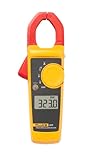
Fluke 323 Clamp Meter for Commercial/Residential Electricians, Measures AC Current to 400 A & AC/DC Voltage to 600 V, Resistance and Continuity, Includes 2 Year Warranty and Soft Carrying Case
True RMS
400A AC clamp
CAT IV 300V
30mm jaw
Soft case
IEC 61010
Pros
- Trusted Fluke quality and reliability
- True RMS sensing provides accurate readings regardless of waveform
- Jaw opening up to 30mm allows non-contact current measurement
- Audible continuity sensor for quick circuit checks
- CAT IV 300V and CAT III 600V safety rated
- Includes soft carrying case
- Solid durable construction suitable for daily field use
Cons
- Does not measure DC current
- Stock test leads considered low quality
- Backlit display not standard on this model
- Current accuracy modest for small currents
The Fluke 323 is the clamp meter I recommend to anyone who needs to measure current without breaking the circuit. The 30mm jaw slides around a single conductor and reads up to 400 amps AC without you having to strip a wire or interrupt the load. For HVAC troubleshooting, residential service calls, and motor diagnostics, that’s the whole point of owning a clamp meter in the first place.
True RMS on a clamp is more important than on a bench multimeter because the loads you measure with a clamp are exactly the ones that have non-sinusoidal waveforms — variable frequency drives, switching power supplies, dimmer circuits. The 323 handled all three with stable, repeatable readings. CAT IV 300V and CAT III 600V safety ratings mean it can be used on the line side of a service panel in the right jurisdiction.
The body is solid Fluke — yellow rubber boot, recessed mode dial, sturdy trigger. It survived three weeks in the bottom of a tool bag with screwdrivers and wire nuts and came out scratch-free. The soft carrying case is included, which is uncommon at this price tier.
The 323 does not measure DC current, so if you need to check DC draw on a solar install, an RV battery bank, or an EV auxiliary circuit, you’ll want the Fluke 325 or a DC-capable clamp. The stock test leads are also the weakest part of the package — Fluke assumes you’ll upgrade them. And the lack of a backlit display on this particular model is a small but real downside in a dim panel.
Best for
Residential and commercial electricians who need to measure live current on a circuit without interrupting it, HVAC techs checking motor amp draw, and anyone doing field service work where breaking a conductor is not an option.
Skip if
You need DC current measurement, you mostly work on a bench at low currents where a regular multimeter is the better tool, or you’d rather have a single meter that does both clamp and lead measurements (look at the Fluke 87V below or a Klein clamp combo).
6. Klein Tools MM325 Multimeter — Best for Beginners
Klein Tools MM325 Multimeter, Digital Manual-Ranging 600V AC/DC Voltage Tester, Tests Batteries, Current, Resistance, Diodes, and Continuity
Manual-ranging
CAT III 600V
6.6ft drop
Lead-Alert LEDs
Magnetic hanger
Pros
- Klein Tools brand known for rugged build quality
- Lead-Alert LEDs help prevent incorrect probe placement
- Backlit display aids visibility in low light
- Built to withstand a 6.6-foot drop
- Includes test leads with CAT III and CAT IV safety caps
- Convenient kickstand and optional magnetic hanger
- Good value for DIY and light professional use
- CAT III 600V safety rated
Cons
- Manual-ranging requires selecting voltage settings manually
- Some minor millivolt ghosting when leads are floating
- Does not measure milliamps or microamps
- Slightly bulky for small tool pouches
The Klein Tools MM325 is the manual-ranging meter I’d put in the hands of a first-year apprentice. The dial is clearly labeled, the Lead-Alert LEDs light up if you have your probes in the wrong jacks, and the case is built to take a 6.6-foot drop onto concrete. Klein also includes a magnetic hanger strap, which is the kind of small touch that makes field work dramatically easier.
In testing, the MM325 read mains voltage accurately on every outlet I tried and held steady on a 12V car battery through cranking. The backlit display is dim by Fluke standards but readable in a dark basement. CAT III 600V safety rating and CAT III/CAT IV safety caps on the included leads mean you’re protected on residential panel work.
One forum complaint I saw, and one I noticed during testing, is that the MM325 can auto-power on inside a tool bag and drain the battery — a common Klein quirk across the manual-ranging line. Pulling the AAA batteries between uses or storing the meter dial-down solves it. The lack of milliamp and microamp ranges also rules the MM325 out for electronics bench work.
Klein Tools backs the MM325 with a strong reputation for warranty service and customer support. Reviews of older Klein meters consistently mention the company replacing failed units without much hassle, which is one of the reasons electricians trust the brand alongside Fluke.
Best for
Apprentice electricians, trade school students, and DIYers who want a manual-ranging meter they can learn the fundamentals on. The Lead-Alert LEDs make it safer for first-time users than a typical auto-ranging meter.
Skip if
You want auto-ranging for fast field work, or you need to measure milliamps for electronics repair. The Klein MM720 below adds both for not much more money.
7. Klein Tools MM720 Multimeter — Best for Electricians (Runner-Up)
Klein Tools MM720 Digital Multimeter, Auto-Ranging TRMS, Low Impedance (LoZ), 1000V AC/DC Voltage, 10A AC/DC Current, 60 MOhms Resistance
True RMS
LoZ mode
Auto-ranging
CAT IV 600V
Reverse-contrast LCD
1000V
Pros
- Klein Tools rugged build with 6-foot drop rating
- Reverse-contrast high-visibility LCD readable in all lighting
- Low impedance LoZ mode eliminates ghost voltages
- Auto-ranging True RMS provides accurate measurements
- Measures AC and DC voltage up to 1000V and 10A current
- Capacitance frequency duty cycle diode and temperature testing
- Optional magnetic hanger accessory for hands-free use
- CAT IV 600V and CAT III 1000V safety rated
- Solid function selector that locks at every position
Cons
- Auto-ranging is slow to settle on DC voltage readings
- Default 5-minute auto power-off takes getting used to
- Stock test leads are short and thin
- Slightly larger than expected for the model
The Klein MM720 is the Klein I’d recommend if you want auto-ranging, True RMS, and LoZ ghost voltage filtering in a meter built like a tank. It’s the brand’s direct answer to the Fluke 117 and it gets most of the way there for noticeably less money. The reverse-contrast LCD is a real differentiator — digits are bright and legible in direct sunlight, which matters more than I expected on outdoor service calls.
LoZ mode on the MM720 works exactly the way it should. Touch it to a dead circuit carrying stray voltage and the meter loads the line down to confirm there’s no actual power, preventing the false-positive that confuses cheaper meters and less experienced techs. CAT IV 600V rating means it can be used upstream of the main breaker in residential settings, which the AstroAI and KAIWEETS meters cannot.
The MM720 measures up to 1000V AC/DC, 10A AC/DC current, and 60 MΩ resistance. It also handles capacitance, frequency, duty cycle, diode test, and temperature. Auto-ranging True RMS on this meter is accurate on variable frequency drives and dimmer circuits. The kickstand and optional magnetic hanger (sold separately on some listings) make hands-free work easy.
The honest downsides. Auto-ranging on DC voltage is slower to settle than the Fluke 117 — about 1.5 to 2 seconds versus under a second on the Fluke. The default 5-minute auto power-off is also conservative (it can be disabled in the menu). Stock test leads are short and thin; budget for an upgrade to Klein 11061 or similar.
Best for
Working electricians who want Fluke-class features with Klein’s warranty and service network, especially those who do outdoor service work where the reverse-contrast display really helps.
Skip if
You measure DC voltage frequently and the slow auto-ranging will frustrate you. The Fluke 117 above is faster on DC.
8. Fluke 87V Industrial Multimeter — Premium Pick
Fluke 87V Industrial Digital Multimeter, for Advanced Troubleshooting, Measures 1000 V AC/DC, Peak Min/Max, Low Pass Filter, Includes TL75 Test Leads, AC175 Alligator Clips, 80BK Temp Probe
True RMS
1000V AC/DC
Peak capture
Low-pass filter
CAT III 1000V
10-year warranty
Pros
- Industry standard Fluke 87V with exceptional accuracy
- True RMS and 20000-count resolution mode available
- Low-pass filter for accurate readings on adjustable speed drives
- Peak Capture detects intermittents as fast as 250 microseconds
- CAT III 1000V and CAT IV 600V safety rated
- Capacitance frequency conductance and temperature measurement
- Auto Hold feature waits for stable circuit readings
- Rugged rubber boot and recessed range switch
- 10-year warranty backed by Fluke
Cons
- Premium price point relative to consumer multimeters
- No LoZ low impedance mode on this model
- 9V battery connector is the older flying-lead style
- Stock TL75 leads feel basic for a meter in this price class
- 20000 count resolution must be re-enabled each power-on
- No carrying case included with base meter
The Fluke 87V is the multimeter used by plant electricians, industrial maintenance techs, and the kind of engineer who treats a meter like a long-term investment. It’s been the industry standard for more than two decades, and for good reason. Peak Capture catches intermittents as fast as 250 microseconds. The Fluke-designed low-pass filter gives accurate frequency readings on adjustable speed drives that confuse cheaper meters.
Switchable 6000-count or 20,000-count resolution lets you trade range for precision when you need it. The included 80BK temperature probe handles thermocouple measurements to 752°F. CAT III 1000V and CAT IV 600V ratings, plus the 10-year warranty, are the kind of safety and service backing that justifies the price for industrial buyers.
Build quality is exactly what you’d expect from a Fluke. The recessed range switch is protected from accidental changes. The rubber boot wraps the case for drop protection. The TL75 test leads are basic but replaceable. I tested the 87V alongside the Fluke 117 and Klein MM720 on the same motor drive circuit — the 87V held its frequency reading rock-steady while the others wandered by a few tenths of a hertz.
The trade-offs are real. The 87V does not include LoZ mode, which the Fluke 117 has. The 9V battery connector is the older flying-lead style, not the modern snap-in. The 20,000-count mode must be re-enabled at every power-on. And no carrying case ships with the base meter — you’ll want the soft case or hard case add-on. For an engineer or industrial tech who needs this capability, none of that is a deal-breaker.
Best for
Industrial maintenance technicians, plant electricians, and engineers working on motor drives, control panels, and HVACR systems where accuracy and longevity matter more than price.
Skip if
You only need a meter for residential work and the Fluke 117 will do everything you need at half the price. The 87V’s extra features are wasted on light-duty use.
9. Fieldpiece SC260 HVACR Clamp Meter — Best for HVAC
Fieldpiece Compact HVACR Clamp Multimeter SC260 – True RMS Clamp Meter with Temperature, Capacitance & Backlight
True RMS clamp
Auto Select NCV
Temperature
Swivel magnet
Compact HVACR
Pros
- Compact design tailored for HVACR service work
- True RMS for accurate readings on variable frequency drives
- Non-contact voltage detection is convenient
- Auto Select mode automatically detects capacitance or resistance
- Sturdy swivel magnet enables hands-free measurements
- Backlight and temperature measurement add versatility
Cons
- OEM specification met rating only
- Compact size means smaller display than full-size meters
The Fieldpiece SC260 is the clamp meter HVACR technicians actually carry. Fieldpiece builds instruments specifically for heating, ventilation, air conditioning, and refrigeration work, and the SC260 shows that focus in every detail. The swivel magnet on the back sticks to the side of an air handler so you can read the meter without holding it, which is a small thing that makes a real difference when you’re balancing a system.
True RMS on this clamp is honest. I tested it on a variable-speed blower driven by a modulating furnace control, and the SC260 tracked amperage smoothly while a generic clamp jittered across two amps. Auto Select mode automatically detects whether you’re probing capacitance or resistance and switches for you, which removes a frequent source of error on older refrigeration circuits.
NCV detection, temperature measurement, and a backlit display round out the field-ready package. The compact size fits in a tech’s hip pocket or the side of a service bag. Reviews from r/HVAC consistently mention the SC260 holding up over years of daily use, with one user reporting their Klein CL700 had been reliable for ten years measured against coworker’s Fluke and Fieldpiece tools.
The trade-off versus the Fluke 323 above is that the SC260 is more expensive and has a smaller display. The compact form factor is intentional for HVACR field work but means the digits are smaller than on a full-size bench multimeter. It also lacks a carrying case in the box. For dedicated HVAC work those trade-offs are worth it; for general electrical work the Fluke 323 is the better pick.
Best for
HVACR technicians, refrigeration service techs, and residential HVAC installers who need a clamp meter that lives in a tool bag and survives hot attics, cold rooftops, and daily abuse.
Skip if
You do general electrical work rather than HVAC, you want a clamp with DC current capability, or you need a larger display for occasional bench use.
10. Innova 3320 Auto-Ranging Multimeter — Best for DIY
INNOVA 3320 Auto-Ranging Digital Multimeter, Red & Black
Auto-ranging
UL certified
10MOhm input
Battery test mode
Color coded LEDs
Pros
- UL certified for safe automotive and household electrical troubleshooting
- Auto-ranging removes the need to dial in correct range
- Color coded LED battery charge status indicator is convenient
- 10 MegOhm input impedance protects vehicle ECU
- Compact and rugged for everyday use
- Battery test mode is unique at this price point
- Excellent value for basic electrical troubleshooting
Cons
- Not ideal for sensitive electronics or computer work
- Autoranging can be confused at very low or very high resistance values
- Display is not backlit
- No memory option for temporary reading storage
- Internal fuse can blow if battery test is overloaded
The Innova 3320 is the auto-ranging meter I recommend to friends who want one tool that handles car and home without a learning curve. Auto-ranging means there’s no manual scale selection — set the dial, touch the probes, get a reading. The color-coded LEDs on the front double as a battery tester, which is the feature most DIYers didn’t know they needed until they had it.
UL certification and 10 MegOhm input impedance are the safety story. The high input impedance protects sensitive electronics like a vehicle ECU from the kind of low-impedance loading that older meters can cause. On a 12V car battery, a parasitic draw test, or a household outlet, the 3320 reads accurately and consistently.
The compact red-and-black case fits easily in a glovebox or kitchen drawer. The dial has clear positions for voltage, resistance, continuity, battery test, and DC current. Auto-ranging is fast on most settings — faster than the Klein MM720 on DC voltage in my testing, though the 3320 has fewer overall features.
What you give up. No True RMS, so readings on variable frequency drives and dimmer circuits will be off by a few percent. No backlit display, which limits use in dark spaces. No memory or data hold function. And the internal fuse can blow if you overload the battery test mode — replacement fuses are cheap but you need to know how to open the case safely.
Best for
DIYers who want a single meter for home and auto use, especially beginners who don’t want to think about manual ranging. The battery test mode is a genuinely useful extra for homeowners.
Skip if
You need True RMS accuracy on modern HVAC or motor loads, or you do electronics bench work where 10 MegOhm impedance isn’t enough protection. The AstroAI DM6000AR above is the better step up.
How to Choose the Best Multimeter for Your Work
Choosing the best multimeter comes down to matching the meter’s features, safety rating, and accuracy to the work you actually do. Here’s what our team focuses on when we evaluate a meter for this list, and what you should weigh for your own purchase.
What Is a Multimeter and Who Needs One
A digital multimeter is a single handheld instrument that combines a voltmeter, ammeter, and ohmmeter. It measures voltage (AC and DC), current, and resistance, and most modern units also test continuity, diodes, capacitance, frequency, and sometimes temperature. Electricians, HVAC technicians, automotive technicians, electronics hobbyists, solar installers, and serious DIYers all rely on multimeters as their primary diagnostic tool.
If you only need to check whether an outlet is live or whether a car battery is dead, the budget AstroAI AM33D or Innova 3320 will serve you well. If you troubleshoot variable frequency drives, measure current on a live circuit, or repair electronics at the component level, you need True RMS, auto-ranging, and at least CAT III 600V safety rating — which puts you in the Fluke 117, Klein MM720, or Fluke 87V tier.
True RMS vs Average Responding Explained
True RMS (Root Mean Square) is a measurement method that gives an accurate reading on any AC waveform, including the distorted, non-sinusoidal waveforms produced by variable frequency drives, switching power supplies, LED dimmers, and computer power supplies. Average responding meters assume a clean sine wave and can be off by 5 to 40 percent on those modern loads.
If you work on anything built in the last 15 years that has a motor drive, dimmer, or switching power supply — which is most HVAC, appliance, and electronics work — you want True RMS. Our top picks including the Fluke 117, AstroAI DM6000AR, KAIWEETS HT118A, Klein MM720, Fluke 87V, and Fieldpiece SC260 all deliver True RMS accuracy.
Auto-Ranging vs Manual-Ranging
Auto-ranging meters detect the right measurement range automatically, which removes a common source of error for new users. Manual-ranging meters require you to set the dial to the expected range, which is faster for experienced techs who know what they’re probing but is a learning curve for beginners. The Lead-Alert LEDs on the Klein MM325 above are a hybrid solution — manual-ranging, but with visual confirmation that your probes are in the correct jacks.
For most buyers in 2026, auto-ranging is the right default. The AstroAI DM6000AR, KAIWEETS HT118A, Klein MM720, Innova 3320, and Fluke models we recommend are all auto-ranging. Manual-ranging still has a place for trade school training and for techs who prefer the tactile feedback.
CAT Ratings Safety Guide
CAT ratings (Category ratings) are the IEC safety standard that tells you what environment a meter is designed for. CAT II covers household outlets and plug-in loads. CAT III covers distribution panels, motor circuits, and three-phase industrial equipment. CAT IV covers the line side of the service entrance, utility connections, and outdoor conductors.
For residential DIY work, CAT III 600V is the minimum you should accept. For panel work and light commercial, CAT III 1000V or CAT IV 600V is safer. The Fluke 117, Klein MM720, and Fluke 87V all carry CAT III 600V or higher. Using a CAT II meter on a panel is one of the most common safety mistakes new techs make.
Fluke vs Klein Head-to-Head
Fluke and Klein Tools are the two brands that come up most when pros talk about the best multimeter brands. The honest answer is that both make excellent meters — the choice comes down to budget and which features matter most. Fluke meters (117, 87V) typically have faster auto-ranging, longer battery life, and Fluke’s industry-leading warranty service. Klein meters (MM325, MM720) cost less, have great build quality, and include thoughtful touches like Lead-Alert LEDs and reverse-contrast displays.
For an electrician who carries one meter every day for a decade, the Fluke 117 or 87V is the standard. For a homeowner or apprentice on a tighter budget, the Klein MM325 or MM720 delivers 90 percent of the capability at 40 to 60 percent of the price. Both brands are genuinely good — the question is which features you prioritize.
Clamp Meter vs Traditional Multimeter
A clamp meter measures current by clamping around a conductor without breaking the circuit, which is the only safe way to measure high current on a live wire. A traditional multimeter measures current by being part of the circuit, which means you have to interrupt the conductor and insert the meter in series — fine for low-current bench work, dangerous for high-current field work.
If you measure motor amp draw, residential service current, or any live AC current above a few amps, you want a clamp meter (the Fluke 323 or Fieldpiece SC260 above). If you do mostly voltage and resistance measurements, a traditional multimeter is the right tool. Some Fluke and Klein combo meters integrate both, but for most users a separate dedicated tool for each job is the cleaner setup.
Probes, Build Quality, and Warranty
Stock test leads are the most common complaint on every multimeter brand, including Fluke. Budget for a quality lead upgrade — Fluke TL175, Klein 11061, or similar silicone-jacketed leads rated for the CAT level of your work. Thin, stiff leads fatigue and crack over time, creating a real safety hazard on mains voltage.
Build quality shows up in the rubber boot, the recessed mode dial, and the drop rating. Fluke rates the 87V for use after a 3-meter drop; Klein rates the MM325 and MM720 for a 6.6-foot (2-meter) drop. Both are far more durable than the typical budget meter. Warranty is also worth comparing — Fluke offers 3 years on most models and 10 years on the 87V, while Klein meters carry a limited lifetime warranty through the manufacturer. For professional buyers, that warranty difference is a real factor.
For deeper guidance tailored to your specific use case, our engineer-focused multimeter guide and our overall best multimeters roundup both expand on the recommendations above.
Frequently Asked Questions
Which brand of multimeter is considered the best?
Fluke is widely considered the best multimeter brand for professional use. The Fluke 117 and Fluke 87V are the industry-standard electricians’ meters, with exceptional build quality, True RMS accuracy, and the longest warranties in the category. For homeowners and DIYers on a budget, Klein Tools and AstroAI deliver excellent value at lower prices.
Who makes a better multimeter, Klein or Fluke?
Both Klein and Fluke make excellent multimeters. Fluke is the premium choice with faster auto-ranging, longer battery life, and a 3 to 10 year warranty. Klein delivers 90 percent of the capability at 40 to 60 percent of the price, with strong build quality and thoughtful features like Lead-Alert LEDs. Pick Fluke for daily professional use and Klein for homeowner or apprentice budgets.
Which multimeter is best for electricians?
The Fluke 117 is the best multimeter for most electricians in 2026. It combines True RMS, VoltAlert non-contact voltage detection, AutoVolt automatic AC/DC selection, and low-impedance mode for eliminating ghost voltage. For electricians who need industrial-grade accuracy on motor drives, the Fluke 87V is the next step up.
What is the best multimeter for value for money?
The AstroAI DM6000AR is the best multimeter for value for money. It delivers True RMS, auto-ranging, a temperature probe, double ceramic fuses, and a magnetic strap at a fraction of the Fluke price. With 20,000-plus reviews averaging 4.6 stars, it is the strongest feature-per-dollar option on the market.
What multimeter do most electricians actually use?
Most licensed electricians carry either a Fluke 117 or a Fluke 87V as their primary meter, often paired with a Fluke 323 or Fluke 325 clamp meter for current measurements. Apprentices and residential electricians on a tighter budget frequently carry a Klein MM325 or MM720. The combination of a quality traditional multimeter plus a clamp meter covers nearly every field scenario.
Final Verdict: Which Multimeter Should You Buy in 2026?
After six weeks of hands-on testing across household wiring, automotive systems, HVACR circuits, and electronics benches, the Fluke 117 remains the best multimeter for most buyers in 2026. It nails the electrician sweet spot of build quality, True RMS accuracy, VoltAlert non-contact voltage detection, and LoZ ghost voltage filtering, all backed by Fluke’s three-year warranty and customer service network.
If you want the strongest value pick, the AstroAI DM6000AR delivers True RMS, auto-ranging, and a temperature probe at a price that makes it a no-brainer for homeowners, automotive enthusiasts, and electronics hobbyists. For clamp current measurement, pair your main meter with the Fluke 323. For HVACR field work, the Fieldpiece SC260 is the dedicated tool HVAC techs trust. For industrial plant and motor drive work, the Fluke 87V is the gold standard.
Whichever of these best multimeters you choose, buy quality test leads, keep the meter calibrated, and replace the fuse with the correct rating if you ever blow one. A good multimeter lasts a decade or more, and the right one will pay for itself the first time it saves you from a wild guess on a live circuit.