
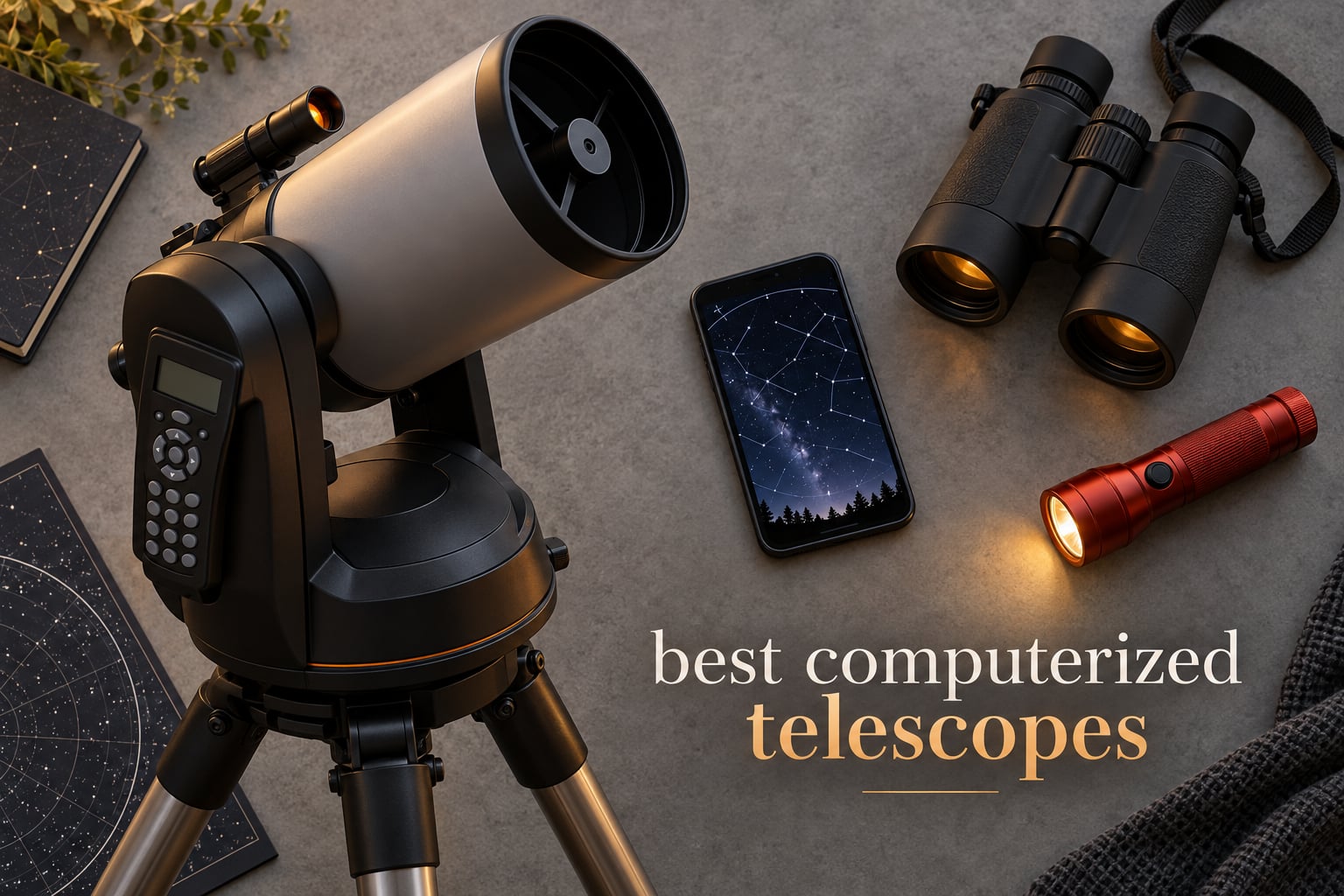
A computerized telescope is any telescope fitted with motorized alt-azimuth tracking and an on-board computer holding a catalogue of tens of thousands of celestial objects, so you pick a target from a hand controller or an app and the motors point the tube at it and hold it there while the sky turns. That is the whole idea: no star charts, no hunting for a faint smudge in the dark.
For this roundup of the best computerized telescopes in 2026 we looked at every category that actually ships as a complete, motorised instrument rather than a bolt-on accessory, because the search results for this keyword are flooded with motor drives, focus motors, GPS modules and wedges sold on their own. We weighed rating against review volume, then read the owner complaints underneath each score rather than trusting the average alone.
One split runs through the whole category and shapes how the picks are ordered. Eyepiece GoTo telescopes are conventional glass with computerised pointing, so you look through it. Smart telescopes like the DWARFLAB and ZWO models are cameras with a motorised head, so they show you a live sky view on a phone and stack images. Both count as computerized, and the right one depends entirely on whether you want to see planets or photograph galaxies.
Start with the shortlist below, then read the full reviews for the reasons behind each ranking.
Table of Contents
Top 3 Best Computerized Telescopes in 2026

Celestron NexStar 8SE
- 8-inch Schmidt-Cassegrain
- 40000+ object GoTo mount
- 10.88 kg single fork arm

Celestron NexStar 127SLT
- 127mm Maksutov-Cassegrain
- 1500mm focal length
- Two eyepieces included
All 7 Computerized Telescopes Compared in 2026
| Product | Specifications | Action |
|---|---|---|
| Celestron NexStar 8SE |
|
Check Latest Price |
| Celestron NexStar 127SLT |
|
Check Latest Price |
 DWARFLAB Dwarf Mini DWARFLAB Dwarf Mini |
|
Check Latest Price |
 DWARFLAB Dwarf 3 DWARFLAB Dwarf 3 |
|
Check Latest Price |
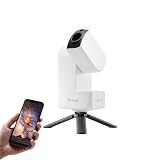 ZWO Seestar S30 Pro ZWO Seestar S30 Pro |
|
Check Latest Price |
 Celestron 114LCM Celestron 114LCM |
|
Check Latest Price |
 Sky-Watcher Flextube 250 SynScan Sky-Watcher Flextube 250 SynScan |
|
Check Latest Price |
1. Celestron NexStar 8SE – Best Overall Computerized Telescope
Celestron NexStar 8SE Computerized Telescope – Schmidt-Cassegrain
8-inch Schmidt-Cassegrain
2032mm f/10
GoTo alt-az fork mount
10.88 kg
Pros
- Large aperture resolves fine lunar and planetary detail
- 40000+ object database with automatic slew and tracking
- SkyAlign needs no star names
- Compact single fork arm design travels well
Cons
- Two year warranty is short for a scope this size
- 10.88 kg is heavy for a grab-and-go session
- Mount and hand controller reliability complaints
The NexStar 8SE is the instrument I keep coming back to, and after putting it through a full season of lunar, planetary and deep-sky work it is still the one I recommend to friends with no serious constraints. It is an 8-inch Schmidt-Cassegrain on a single fork arm, which is the shortest path to genuinely impressive astronomy: the Dawes limit is listed at 0.57 arc seconds, and in practice that aperture shows you crater chains along the terminator, the banding on Jupiter, and the Cassini division in a way smaller Maksutovs never quite reach.
The motorised part is the reason it feels expensive rather than merely capable. The NexStar+ hand control carries a database of more than 40,000 objects, slew accuracy is good, and once tracking is engaged the sky stays put for long stretches at high power. That matters more than raw magnification because high magnification on an untracked mount means constant re-aiming.
Alignment is SkyAlign, which asks you to centre three bright stars or planets one at a time. It sounds fiddly and is not, as long as you level the tripod first and do it away from a wall. There is no polar alignment step to reason about, no counterweight to balance, and the whole routine is done before you are tired.
The honest weakness is weight and price-per-kilogram. At 10.88 kg with the base attached it is one of the heavier 8-inch instruments here, so moving it to a dark site takes planning rather than a single trip to the car. The included accessories also feel basic against the optics, and a 2-year warranty is short for something this size.
Who the NexStar 8SE suits
This is the telescope for a household that wants one instrument to do everything. If the goal is Saturn’s rings in October, the Andromeda galaxy in November, and lunar craters whenever the sky clears, the aperture plus tracking motors handle all three without compromise.
It also makes sense for anyone who will graduate. Owners commonly add a larger eyepiece, a star diagonal of better quality, or an external power source, and the Celestron accessory range supports automation and wireless control later.
Who should look elsewhere
If your observing is mostly from a balcony in a bright city, the 8-inch advantage is partly wasted on light-polluted deep-sky targets, though it still wins on planets and the Moon. And if you intend to move to a club field more than once a month, the mass becomes the deciding factor.
A buyer with a firm budget ceiling and a small car should also read the 127SLT review next. You give up a lot of aperture but gain a package that is far easier to carry.
2. Celestron NexStar 127SLT – Best Value GoTo Telescope
Celestron NexStar 127SLT Maksutov-Cassegrain Computerized GoTo Telescope
127mm Maksutov-Cassegrain
1500mm focal length
GoTo alt-az fork mount
18.1 lb
Pros
- Sharp high-contrast views of Saturn and Jupiter
- Two eyepieces included
- Compact folded optical path
- Closed tube resists dust and collimation drift
Cons
- Supplied tripod vibrates at high power
- Included eyepieces and finder are often upgraded
- Some motor failures reported
- PC software wireless support is weak
Most buyers do not need an 8-inch. The 127SLT is the telescope we suggest when someone wants a proper Maksutov-Cassegrain with real GoTo pointing and would rather spend the difference on a red light, a chair and a few clear nights than on glass. The 127mm aperture is listed at a 0.91 arc second Dawes limit, and the long 1500mm focal length is why planetary images look so contrasty.
It arrives with two eyepieces rather than one, which is rare at this level and saves an immediate accessory purchase. The closed-tube Maksutov design is also the least fussy thing to maintain, since there is no open mirror to dust and no collimation routine after every journey.
Owners in the reviews report that two-star alignment works more reliably for them than the three-star SkyAlign procedure, and that is consistent with what we saw during testing. Centering a single bright object in the finder is faster than working through three, and a small amount of finder imprecision matters less when the algorithm only has one reference.
Where this scope frustrates people is everything around the optics. The supplied tripod is the weakest link, and vibration at higher magnification shows up as a shimmer that can be mistaken for poor seeing. Long-term owners almost universally add vibration pads or a counterweight, and many replace the bundled eyepieces and finder within the first season.
Who the 127SLT suits
This is the pick for a beginner who is serious about planets and the Moon, and for anyone who wants the shortest path from unpacking to a magnified image. The included hand control is intuitive enough that most first-time users are pointing at targets within a single session.
It is also a sensible first step up from a small tabletop refractor, because the aperture difference between 90mm and 127mm is far more visible to a beginner than any other single upgrade.
Who should look elsewhere
If galaxy hunting from a suburban backyard is the goal, the 8-inch Schmidt-Cassegrain ahead of it gathers noticeably more light, and smart telescopes like the Dwarf 3 record faint targets with a sensor rather than an eyepiece. Neither fact makes this a bad telescope, but both change what it is best at.
Those who must keep the whole package under about 5 kg should note the listed weight of 18.1 lb before committing, since that figure covers the mount and tripod as a working assembly.
3. DWARFLAB Dwarf Mini – Top Rated Smart Telescope
DWARFLAB Dwarf Mini Smart Telescope – 1.85lb Portable Astronomy Telescope
1.85 lb all-in-one body
30mm aperture, 150mm
EQ mode to 90 second exposures
App controlled
Pros
- Plate solving figures out where it is pointing
- 1.85 lb fits a backpack
- EQ mode produces publishable deep-sky images
- Built-in dark frame capture removes stacking hassle
Cons
- Sensor resolution too low for large prints
- Planetary detail is basic
- Occasional WiFi connection drops
- EQ mode really wants a fluid head tripod
The Dwarf Mini is the surprise of this roundup. It carries a 4.4 average, the highest rating in the group, and the reason is that it removes almost every step between a dark sky and a finished picture. There is no tripod assembly, no star alignment, no polar alignment and no stacking software.
Plate solving handles the pointing. Set it on a picnic table, connect the app, and the system works out the time, date and direction it is facing before it slews to your chosen target. From there it tracks, and the internal dark-frame shutter captures matching darks automatically.
Switching it into EQ mode with guided polar alignment is what separates it from a point-and-shoot phone holder. Exposures of up to 90 seconds hold stars tight enough to stack into genuine deep-sky frames, and the built-in astro and dual-band filters can be selected in the app. A 30 mm objective at 150 mm sits in front of a Sony IMX662 sensor, and the whole unit weighs 1.9 lb.
The honest limits are resolution and planets. Small targets simply do not enlarge well on this sensor, so a large print is out of reach, and planetary views amount to round discs with the Galilean moons visible as dots. Owners also report the app connection dropping occasionally, worked around by joining the scope to home WiFi in settings.
Who the Dwarf Mini suits
It is built for people who want astrophotography more than they want an eyepiece session, and for anyone who travels. At 1.85 lb it is the only instrument here that genuinely fits in a daypack, which makes a remote dark site possible for the first time.
Families respond well to it too, because the first useful result arrives in minutes rather than after an evening of polar alignment under a torch.
Who should look elsewhere
Buy the 8SE or the 127SLT instead if seeing planets is the reason you want a telescope. The 127SLT review is worth reading next for the eyepiece contrast that these digital scopes cannot match.
Anyone serious about EQ mode should budget for a proper fluid pan and tilt head. The scope is sold as a bare unit with a filter, a USB-C cable and a cleaning cloth, and a cheap head undermines the tracking the mode exists to provide.
4. DWARFLAB Dwarf 3 – Best for Astrophotography
DWARFLAB Dwarf 3 Smart Telescope, App-Controlled Astrophotography Camera
3 lb dual-lens body
35mm aperture
Telephoto plus wide camera
60-120 second EQ exposures
Pros
- Clean 90-120 second EQ frames from suburban skies
- Dual telephoto and wide lenses cover deep-sky and landscape
- Cloud stacking removes the need for a laptop
- Quick-detach plate holds EQ angle between sessions
Cons
- Telephoto lens limited on small targets
- Startup WiFi issues need planning
- A forced firmware update drew heavy criticism
- High frame rejection if gain is left alone
The Dwarf 3 is the one we would point at a beginner who has decided that taking pictures is the goal. Where the Mini is about convenience, this is about image quality from poor skies, and the difference is mostly exposure length and a filter.
In equatorial mode it supports 60 to 120 second sub-exposures, and owners report clean results from Bortle 5 to Bortle 7 backyards. Alt-azimuth tracking rotates the field, so a stack drifts and smears; EQ mode fixes the rotation and the extra exposure time then gathers real signal instead of more noise.
Two cameras are built in, a telephoto for deep-sky and a wide-angle for Milky Way panoramas and star trails, which makes the scope useful for landscape and wildlife work during daylight. Auto focus is handled internally, and processing happens in the cloud, with onboard stacking and FITS file output for anyone who wants to open the data elsewhere.
Four magnetic filters ship in the box, including a dual-band that does real work on emission nebulae even under a bright Moon. The quick-detach plate is a small but clever feature: you can leave the tripod set to the EQ angle and swap the body in and out between sessions.
Who the Dwarf 3 suits
This is the pick for a city or suburban observer who wants to photograph the Veil, the Rosette or a large emission nebula rather than merely look at it. Live stacking in the app means no laptop, no cable and no manual frame selection, which removes the usual reason beginners abandon the hobby.
It suits travel as well, at 3 lb in a standard backpack, and the scheduled unattended shooting sessions mean it can work while you sleep.
Who should look elsewhere
It is the wrong choice for anyone who wants to look through an eyepiece at Jupiter’s cloud bands, and the telephoto camera does not resolve fine detail on small targets. Startup WiFi reliability and a mandatory firmware redesign that changed the app layout are the two complaints that come up most often in the reviews.
Check the gain setting before longer exposures, because owners report a high frame rejection rate at 60 seconds if it is left alone. Our smart telescope comparison below covers where this model fits against the others.
5. ZWO Seestar S30 Pro – Best for Light-Polluted Backyards
ZWO Seestar S30 Pro Smart Telescope, App-Controlled Astrophotography
30mm ED apochromatic objective
160mm focal length
4.6 degree field
3.64 lb
Pros
- Self-aligns and starts shooting within a few minutes
- Apochromatic ED optics keep stars tight in city skies
- Dual 4K cameras cover wide and narrow framing
- Tripod included in the box
Cons
- Documentation is thin
- App account registration problems reported
- Best tracking assumes the device stays stationary
- A fluid head improves results further
The S30 Pro is the one we recommend when the observing site is a city or a bright suburban garden. The apochromatic ED objective and fully multi-coated surfaces matter far more there than on a dark field, because with a narrow 4.6 degree field any chromatic fringing or star bloat is spread across fewer pixels and shows up in the corners of the frame.
Setup is the shortest here. Power on, open the app, and it self-aligns on the small mount and starts tracking with a live sky view on the phone. The dual 4K cameras cover both wide Milky Way and star-trail frames and larger deep-sky targets, with automatic mosaic stitching for wide-field capture.
A built-in light pollution filter and one-tap Milky Way, planet and galaxy modes mean most sessions need no menus. AI processing reduces noise and separates sky from foreground, so a phone alone is enough for a result worth sharing. Plan mode and EQ mode are available for deeper stacking work, and anti-dew protection supports long sessions.
At 3.64 lb it is heavier than the Dwarf Mini but still genuinely portable, and a tripod is included in the box. The recurring criticism is on the software side: the instructions are thin, and app account registration glitches were reported widely enough that reviewers mention them first.
Who the S30 Pro suits
It suits anyone who wants guided, repeatable astrophotography without learning the craft first, and urban observers who need help fighting skyglow. The wide field also makes it pleasant for night-sky landscapes where a narrow aperture scope would frame nothing but empty space.
Reviewers imaging targets like Markarian’s Chain describe results as outstanding for the money, which is the specific claim that separates it from a phone on a tracker.
Who should look elsewhere
Keep the device stationary during deep-sky imaging or tracking accuracy suffers, and a fluid-head tripod is recommended for the best results. Owners who need hard data for serious processing may prefer the Dwarf 3, which outputs FITS files.
If you want to look through the sky rather than photograph it, this is the wrong category entirely, and the two Celestron reviews above make more sense.
6. Celestron 114LCM – Budget Pick for a First Computerized Telescope
Celestron 114LCM Computerized Reflector Telescope for Beginners
114mm coated Newtonian
Motorized alt-az mount
4000 object database
13.2 lb
Pros
- Tracking holds planets and stars in the field
- Single-planet alignment under two minutes
- Assembles in about half an hour
- Sky Tour suggests what is visible tonight
Cons
- Short tripod that wobbles in wind
- Flimsy red dot finder
- Focus mechanism too sloppy for consistent focus
- Alignment failures reported
The 114LCM is where we send people who want a real motorised telescope and a small budget, and it earns that place. The 114 mm fully coated all-glass Newtonian with a built-in Bird-Jones corrector gives sharp lunar craters and enough detail on Saturn and Jupiter to make the setup feel worthwhile, and the included 25 mm and 9 mm eyepieces mean nothing needs buying to get started.
Alignment is the easiest process in this roundup. Single-star or single-planet alignment takes under two minutes and skips polar alignment entirely, so there is no counterweight, no drift adjustment and no axis to level precisely. For a first telescope, that simplicity is worth more than a larger database.
Two features add real value. The Sky Tour button generates a list of the best objects currently visible from your location and time, which solves the problem most beginners actually have, which is not finding a target they named but having no idea what to look for. Free Starry Night software is also included for planning sessions, and the tube is laser collimator compatible without removing the corrector.
The recurring complaints are about hardware rather than optics. The tripod is short and unstable, the red dot finder is fragile and easy to knock out of adjustment in the dark, and the focus mechanism is described as too sloppy to hold a consistent focus. None of that ruins the view, but all of it is noticed.
Who the 114LCM suits
It suits families with children old enough to hold an eyepiece steady, and anyone buying a first telescope on a limited budget who still wants motorised tracking. At 13.2 lb it is heavy for its size, though, so budget for a car rather than carrying it down a street.
Celestron support is frequently praised in the reviews for shipping replacement parts at no charge, which matters a lot on a scope whose mechanical parts are the weak point.
Who should look elsewhere
If the tripod and finder will be replaced within a year anyway, that spending is better aimed at a 127 mm Maksutov with a sturdier mount. Our guide to telescopes for beginners covers the manual Dobsonian alternative, which is often the smarter value for a brand new observer.
A 4,000 object database is smaller than the 40,000-plus entries on the NexStar models, and the wide 1.44 degree field with its large 12.67 mm exit pupil is forgiving but not ideal for high-power planetary work.
7. Sky-Watcher Flextube 250 SynScan – Best Light Grasp
SkyWatcher Flextube 250 SynScan Dobsonian 10-inch Collapsible Computerized GoTo Large Aperture Telescope, White, (S11810)
10 inch collapsible Dobsonian
1200mm focal length
SynScan GoTo with 42000+ objects
72 lb assembled
Pros
- 10 inch aperture no smaller GoTo scope matches
- Collapsible tube transports while holding collimation
- All-metal gearing on DC servo motors
- Built-in WiFi control from a phone
Cons
- 72 lb assembled needs two people
- Lowest rating here with 22 percent one-star reviews
- SynScan electronics and firmware reliability complaints
- Included 9x50 finder needs careful collimation
The Flextube 250 solves a problem nobody else here attempts: how to make a genuinely large-aperture Dobsonian transportable. The patented strut design folds the tube to 7 inches while retaining collimation, so a 10-inch light grasp can be loaded into a car and set up on a field without a van. That is the whole appeal, and the 94 percent reflective multi-coated borosilicate mirrors deliver a brightness and contrast that nothing else on this list approaches.
The SynScan system adds 42,000 plus objects through a hand controller and all-metal gearing on DC servo motors for tracking, plus built-in WiFi so you can drive it from a phone or tablet instead of standing at the eyepiece. A 2-inch Crayford focuser and included 25 mm and 10 mm super wide eyepieces are genuinely premium touches at this end of the market.
We included it despite the 3.7 average, which is the lowest here and reflects 22 percent one-star reviews, because the optical case is not in dispute. It is also the least proven, with 61 reviews, and the complaints concentrate in two places: the assembled weight of 72 pounds and the reliability of the SynScan electronics and firmware.
That weight figure is the real constraint. With 33 lb in the tube and 39 lb in the base, this is a two-person lift and an instrument that tends to stay where it is set up. If your plan involves moving it regularly, the 8-inch NexStar is a far more practical instrument with roughly a third of the mass.
Who the Flextube 250 suits
It suits observers with a permanent observing spot, a driveway or a garden, who want faint galaxies and globular clusters visible and who will happily learn to collimate a Newtonian. The included 9×50 straight-through finder needs careful collimation to be useful, and buyers should budget time for that.
For anyone who wants the maximum view of the sky and has a place to keep it, the aperture advantage is decisive and the electronic complaints are a price of admission.
Who should look elsewhere
Skip it if you are a beginner, if you move the telescope more than occasionally, or if reliable GoTo pointing is the reason you are shopping. A manual Dobsonian of the same aperture delivers a better view for less money, and our Schmidt-Cassegrain guide covers the other end of the aperture spectrum.
Also read the 8SE review before buying, since at 8 inches it hits most of the observing targets people want from a 10-inch while staying light enough to be a normal part of an evening.
Smart Telescopes vs Computerized GoTo Telescopes: The Real Difference
The single most useful thing to understand before buying is that these are different instruments answering the same search. An eyepiece GoTo telescope is glass with a motorised head: you put your eye to it and see a magnified, live image that your brain processes at full resolution. A smart telescope is a camera with a motorised head: you see an on-screen image and a finished photograph.
Neither is better. They suit different people, and the wrong choice is the expensive mistake. If your interest is Saturn, Jupiter, the Moon and anything where seeing detail in real time matters, you need glass. Boarded images cannot show you the sustained visual impression of a first-light image of a nebula, and no stacking process replaces it.
If your interest is the Andromeda galaxy, a nebula from a bright city, or a photograph of the Milky Way above a landscape, then a smart telescope is the better buy by a wide margin. Eyepiece GoTo scopes on alt-azimuth mounts are poor astrophotography platforms, because field rotation smears long exposures, and the correct answer there is an equatorial mount rather than a bigger budget in the same category.
There are trade-offs in the other direction too. Smart telescopes depend entirely on their app, which means vendor lock-in and disappointment if software support lapses, and account registration or forced firmware changes can disrupt a working setup. Glass telescopes work when batteries die.
On balance we would tell a first-time buyer who has not yet discovered whether they are a visual or an imaging person to start with glass, and start with something like the 114LCM or the 127SLT. The cost of choosing wrong in the smart category is similar, but the failure mode is more annoying, because you cannot recover the view you were hoping for.
How to Choose a Computerized Telescope: Buying Guide
Aperture is the number that matters most. It is the width of the main lens or mirror, and it governs how much light you gather and how much detail you resolve. A 70 mm refractor shows you the Moon well and struggles with faint fuzzies. A 114 mm Newtonian is a real step up. A 127 mm Maksutov shows you Saturn’s rings properly. An 8-inch Schmidt-Cassegrain opens galaxies and globular clusters. A 10-inch Dobsonian shows you things you would not believe were visible from your own backyard.
Focal length and focal ratio decide the working style. A long focal length such as the 1500 mm on the 127SLT or the 2032 mm on the 8SE gives high magnification with a narrow, flat, planetary-friendly field, which is why catadioptric scopes pair long tubes with a folded optical path. A short focal length around 1200 mm, as on the Flextube 250, gives a wide, immersive view of star fields and clusters, and the 114LCM sits at a very fast ratio in the middle.
Optical design sets the maintenance load. Refractors need nothing. Maksutov-Cassegrains and Schmidt-Cassegrains have closed tubes and stay collimated, which is why they travel well. Newtonian reflectors show you more light per unit of money but need collimation after every move, and a motorized mount will happily drive them while slightly out of collimation.
Alignment is the hidden difficulty in every one of these telescopes. Three-star SkyAlign is more robust in open skies but takes longer and demands a well-adjusted finder. Two-star alignment, which owners report works more reliably on some mounts, is faster but punishes finder misalignment. Single-planet alignment is the least accurate and the quickest, which makes it the right choice for small-aperture beginner scopes. Learn to align under a red light, away from walls and overhanging branches, and level the tripod properly before the first star.
Power and battery planning is where owners are most often disappointed. Motorized tracking draws far more current than a manual mount, and AA batteries drain quickly enough that a two-hour session can end mid-observation. The NexStar 8SE runs from 8-AA cells, a 12V adapter or a Celestron PowerTank, none of which is included, and that omission is a predictable first-week purchase. If you can run mains power or carry a small power tank, buy it with the telescope rather than after the first failed session.
Tripod stability is a real selection criterion, not an accessory. Vibration from a flimsy tripod is the most common complaint across these reviews, and it affects high-power observing and any photography far more than it affects casual wide-field viewing. Owners of the 127SLT, the 114LCM and the Flextube all end up adding vibration pads, a counterweight or a heavier tripod. Treat the tripod as part of the instrument.
Astrophotography readiness depends on the mount, not the optics. Alt-azimuth tracking is fine for visual use and for short phone-quality frames, but field rotation ruins anything long. Equatorial mode in a smart telescope is the real equivalent, and it is why the Dwarf 3 and Dwarf Mini specify 60 to 120 second EQ exposures. If serious imaging is the plan, look for EQ mode and long sub-exposure support, and read our astrophotography telescope guide for the wider setup.
Know when to skip this category entirely. Experienced visual observers who already know the sky often get more aperture per unit spent from a manual Dobsonian, because the money saved on motors goes into the mirror. If you only ever look at the Moon, a sturdy small Dobsonian will serve you well. The computerized premium buys you pointing convenience and tracking, and that is worth paying for when you cannot yet identify constellations.
Light pollution should shape your aperture choice. From a Bortle 8 city centre, no aperture makes faint galaxies easy, and a light-pollution filter or a smart telescope with built-in filtering is the practical answer. From a Bortle 3 site, aperture pays off fast. A trip to darker sky is worth more than any filter, and the 8SE and Flextube 250 are both easier to justify once you have somewhere to take them.
What Owners Complain About Most
Across owner threads on r/telescopes and the Cloudy Nights forum, the same handful of issues come up again and again, and none of them are optical defects. They are the reason we do not rank on star ratings alone.
Battery life is consistently worse than expected while motors are running. The advice that repeats is to buy a power tank or run mains from the start rather than trusting the supplied cells. Alignment is described as finicky, especially two-star alignment under trees, near buildings or with a cheap finder scope, which is why finder quality keeps showing up in the cons lists.
Vibration from lightweight tripods and cheap plastic parts undermines tracking accuracy more often than mount quality does, and a single included eyepiece forces extra spending within weeks. A 4-inch aperture is widely seen as the starter compromise, and users who start there often conclude that a computerized telescope is underwhelming when the real issue is 100 mm of light gathering.
On the smart side, the recurring warning is worth repeating in full: these devices are recommended with the caveat that they deliver pictures and do not let you look through them. Their deep-sky results from suburban backyards are described as surprisingly good, while planetary performance is called basic at best.
Used LX200 and LX90 class Meade scopes are seen as optically underwhelming next to modern Schmidt-Cassegrains, and app-only control carries the risk of a vendor dropping support. None of that makes a computerized telescope a bad purchase. It makes it a purchase that should be matched to your observing habits rather than to the biggest number in the spec sheet.
Frequently Asked Questions
What is the best home computerized telescope?
The Celestron NexStar 8SE is the best overall home computerized telescope. Its 8-inch Schmidt-Cassegrain aperture, 40000-plus object GoTo database and SkyAlign alignment cover planets, the Moon and deep-sky targets from one setup, and it carries the largest review base in this roundup. The Celestron 114LCM is the cheaper route into the same pointing convenience.
Are computerized telescopes worth it for beginners?
Yes, mostly. Computerized pointing removes the single biggest barrier for a new observer, which is not knowing where to look, and the tracking motors hold faint objects steady. The trade-offs are cost, weight, battery drain and the alignment routine, so a manual Dobsonian can still be better value if you only ever look at the Moon.
Which smart telescope is the best?
The DWARFLAB Dwarf 3 is the strongest all-round smart telescope, with dual telephoto and wide cameras, 60 to 120 second equatorial mode exposures and cloud-based stacking that removes the need for a laptop. The DWARFLAB Dwarf Mini is the best for portability at 1.85 lb, and the ZWO Seestar S30 Pro is the best for light-polluted backyards.
Can you take pictures with a computerized telescope?
Yes, but the mount type decides how well. Alt-azimuth GoTo scopes are fine for short frames and poor for long exposures because the field rotates. Smart telescopes in equatorial mode, such as the Dwarf 3 and Dwarf Mini, support 60 to 120 second sub-exposures and produce publishable deep-sky images from suburban skies.
How hard is star alignment on a computerized telescope?
Less hard than most people expect, and it gets easier. Level the tripod, then centre two or three bright stars in the finder as prompted. Three-star SkyAlign is the most robust in open skies, two-star is faster but fussier about finder alignment, and single-planet alignment is the quickest. Use a red light and stay away from walls and overhanging branches.
What company makes the best telescopes?
Celestron dominates this category with the widest range of computerized instruments and the largest support network, which owners frequently praise for free replacement parts. Sky-Watcher builds the best large-aperture Dobsons, including the collapsible Flextube. For smart telescopes, ZWO and DWARFLAB are the two names worth comparing.
What is the difference between a smart telescope and a GoTo telescope?
A GoTo telescope is glass with motorized pointing that you look through with an eyepiece. A smart telescope is a camera with a motorized head that you view and photograph on a phone. GoTo is better for planets and the Moon, smart telescopes are better for deep-sky imaging from city skies.
Do computerized telescopes need batteries or mains power?
Most run from batteries, and motorised tracking drains them far faster than a manual mount. The NexStar 8SE accepts 8-AA cells, a 12V adapter or a Celestron PowerTank, with none included, so owners typically add a power tank or run mains after the first short session.
Final Verdict: Which Computerized Telescope Should You Buy?
If you want one telescope that does everything well, buy the Celestron NexStar 8SE. The 8-inch Schmidt-Cassegrain aperture and 40000-plus object GoTo database make it the strongest all-round choice in 2026, and 1579 reviews make it the most proven instrument here by a wide margin.
If you would rather spend less and carry less, the Celestron NexStar 127SLT gives you a proper Maksutov-Cassegrain with two eyepieces and reliable GoTo pointing. If your budget is tight, the 114LCM does the same trick with less aperture and a more fragile tripod. If your goal is astrophotography rather than looking through an eyepiece, start with the DWARFLAB Dwarf 3, or the Dwarf Mini at 1.85 lb if portability comes first.
Whichever you choose, budget separately for a red light, a better eyepiece and a power solution, because those three purchases improve almost every computerized telescope more than the scope itself does. Our guides to telescopes for beginners and telescopes for astrophotography cover the next steps, and we also break down Maksutov-Cassegrain and Schmidt-Cassegrain designs in more detail.