
The best CPUs for data science are the ones that pair enough cores for parallel work with fast single-thread performance, because a data science stack constantly moves between the two. Short answer if you want it now: look for 8 cores or more, a boost clock of 4.5GHz or higher, 32GB of RAM as a realistic floor, and a platform with room to grow. Our pick for most people is the AMD Ryzen 7 5700G, which pairs 8 cores and 16 threads with a 65W envelope and a bundled cooler; if you are building new and want a longer upgrade path, the Ryzen 7 9800X3D is the faster modern option.
That recommendation is deliberately less exotic than the hardware advice floating around the forums. A top-ranking r/buildapc thread titled “CPU for data science and multitasking” is mostly people debating silicon generations with no budget, workload or form factor attached, and the highest-rated answer there reaches for an older high-core-count AMD part rather than the newest flagship. That is a useful signal: the binding constraint in a data science box is usually cores, memory capacity and sustained throughput, not peak gaming frames.
We worked through six processors that are on shelves right now and compared them on the axes that actually move analysis runtime – core count, cache, clock behaviour, integrated graphics, memory support and socket life. Every number below comes from the manufacturer’s own specifications and from owner reviews, not from benchmark charts we did not run. If you also need a portable machine, our guide to the best laptops for data science and financial analysis covers the form factor separately.
Table of Contents
Top 3 Best CPUs for Data Science in 2026
AMD Ryzen 7 5700G
- 8 cores and 16 threads
- 4.6 GHz max boost
- 65W TDP
- Wraith Stealth cooler included

AMD Ryzen 7 9800X3D
- Zen5 with 3D V-Cache
- 8 cores and 16 threads
- 96MB L3 cache
- Socket AM5 upgrade path

Quick Picks: Every CPU We Reviewed in 2026
| Product | Specifications | Action |
|---|---|---|
| AMD Ryzen 7 5700G |
|
Check Latest Price |
| AMD Ryzen 7 9800X3D |
|
Check Latest Price |
 Intel Core i9-13900K Intel Core i9-13900K |
|
Check Latest Price |
| AMD Ryzen 5 7600X |
|
Check Latest Price |
 Intel Core i9-12900K Intel Core i9-12900K |
|
Check Latest Price |
 Intel Core i9-14900K Intel Core i9-14900K |
|
Check Latest Price |
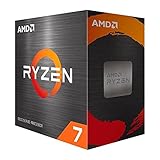
1. AMD Ryzen 7 5700G – the balanced pick for most analysis setups
AMD Ryzen™ 7 5700G 8-Core, 16-Thread Desktop Processor with Radeon™ Graphics
8 cores and 16 threads
4.6 GHz max boost
65W TDP
20 MB cache
Cooler included
Pros
- 8 cores and 16 threads handle containers
- VMs and moderate analysis workloads well
- 65W TDP keeps sustained jobs cool and quiet
- Bundled Wraith Stealth cooler removes one line item from the build
- Integrated Radeon graphics means no discrete GPU for debugging or headless display output
Cons
- Locked to PCIe 3.0 with no Gen4 NVMe or x8 Gen4 GPU support
- Only 16MB L3 cache which is half of the 5700X
- AM4 platform is end-of-life with no CPU upgrade path
The Ryzen 7 5700G is the part we keep coming back to because it clears the bar most data science work actually sets. Eight cores and 16 threads is the point where pandas merges, R data frames and container-based workflows stop feeling cramped, and owner reviews consistently describe it handling that class of work without complaint. It is a Zen 3 part at 4.6 GHz max boost, which is fast enough that notebook launches and single-threaded scripts do not stall behind the multi-core work.
What surprised us is how little friction there is around it. The Wraith Stealth cooler is in the box, so the build does not start with a thermal shopping list, and at 65W the sustained temperatures stay modest even on a long overnight job. Owners also report clean behaviour on both Windows and Linux, which matters if your pandas stack is containerised.
The catch is the platform underneath it. Socket AM4 is finished as an upgrade path, so this is the last generation you can buy into on that board, and the G-series APU caps PCIe at Gen 3.0. That Gen 3.0 limit is the part to think hardest about: an x8 Gen 4 GPU runs at reduced link speed, and there is no Gen 4 NVMe support, so a machine heavy on dataset streaming from fast storage will leave throughput unused.
The 20 MB of total cache is the other limitation. Repeated analytical queries that would otherwise hit a large L3 have to reach DDR4-3200 memory instead, and DDR4-3200 is the officially supported speed, with 3600-4000 achievable through memory overclocking. For a four-year workstation, that is a fair trade for the low power draw and the included cooler, but it is a trade.
Check the memory speed before you commit to this board
Because the APU is limited to the older memory generation, the kit you pair with it matters more than usual. A DDR4-3200 kit running at its rated speed gives the CPU the headroom it was designed for, and a faster kit that the board can overclock to 3600-4000 gives it a little more. Either way, populate all four DIMM slots for the widest memory bus the board offers.
If your workflow is dominated by large DataFrames that comfortably fit in 32GB, the single-channel versus dual-channel question is not where your runtime goes. If you routinely exceed system memory and lean on disk, the older platform hurts you twice – once at the PCIe link and once at the capacity ceiling.
How this holds up for a three to four year workstation
For a machine that mostly runs analysis notebooks, SQL, R and classical ML models on data that fits in memory, this is the most straightforward answer in the group and the one that ages most gracefully. The monolithic die also has better memory latency than the chiplet-based AM4 parts that sit below it, which shows up in mixed read-heavy workloads.
Where it stops being the right answer is deep learning training on a discrete GPU, or any workflow where you will want a Gen 4 or Gen 5 link to the card. The r/buildapc build pattern that shows up repeatedly for data science pairs a modern eight-core CPU with 64GB of DDR5 and a current discrete GPU – that pairing needs a newer platform than AM4 offers.
2. AMD Ryzen 7 9800X3D – the fastest single-threaded option here
AMD RYZEN 7 9800X3D 8-Core, 16-Thread Desktop Processor
Zen5 with 3D V-Cache
8 cores and 16 threads
Up to 5.2 GHz
96MB L3
140W TDP
Pros
- Zen5 delivers strong instructions-per-clock and single-threaded responsiveness
- 96MB L3 helps cache-heavy and repeated-query workloads
- AM5 platform leaves a clear upgrade path to future Ryzen silicon
- Efficient 140W-class envelope for an eight-core part
Cons
- No cooler included so an aftermarket cooler is required
- Only 8 cores limits throughput on heavily parallel multi-threaded jobs
- Needs an AM5 board with DDR5
The 9800X3D is the chip to buy when your day is spent waiting on code. Zen 5 lifts instructions-per-clock noticeably over the previous generation, and owner reviews put the emphasis on responsiveness rather than raw throughput. For a data scientist whose inner loop is edit, run cell, read traceback, edit again, that responsiveness is the metric that matters.
The cache is the headline number and it is a real one: 96MB of L3 on an eight-core part. If you are repeatedly querying the same medium-sized tables, or running a model where the working set fits in that cache, the difference between hitting cache and going to DDR5 is the difference between a snappy notebook and a sluggish one. Boost clocks reach 5.2GHz on this listing, above every other part we looked at except the 14900K.
The design trade is written in the name. 3D V-Cache was built for latency, so this chip gives up some sustained all-core throughput to a conventional eight-core part of the same generation. In a purely parallel job – a large Monte Carlo sweep, a heavy ETL over many files – you would rather have twelve to sixteen flat cores than eight cores with a large cache. The chip also runs without a cooler in the box, and AM5 means DDR5 memory and a new motherboard.
Reviews with 6,200 ratings averaging 4.8 stars describe the same pattern repeatedly: fast, efficient, and built for a new platform rather than for sustained multi-threaded professional work. The upgrade path on AM5 is the quiet advantage – the socket is drop-in compatible with existing AM5 infrastructure, so a later silicon upgrade is a board swap away.
Check whether your workload is latency-bound or throughput-bound
Latency-bound means the CPU spends most of its time waiting on one chain of dependent operations – a sequential pandas transform, a decision tree fit, an interpreted R loop, compiling a package from source. That profile rewards instructions-per-clock and large cache, and this chip is built for it.
Throughput-bound means many independent tasks running at once – parallel feature engineering, grid searches across many estimators, batch inference where the GPU is doing the heavy lifting and the CPU is feeding it. That profile rewards core count, and eight cores is a modest number in 2026. Neither profile is wrong; they just need different silicon.
What a 140W part means for a room full of overnight jobs
At 140W this sits in a manageable power class for a workstation that runs overnight, and the 3D V-Cache stack is reported to run cooler than the previous generation’s equivalent. Cooling still needs to be aftermarket, but it is not the demanding liquid-cooled setup the 14900K demands.
Because AM5 boards are widely available with four memory slots and Gen 4 or Gen 5 PCIe, this is also the easiest of the modern parts here to pair with a current discrete GPU. That matters if a future upgrade adds deep learning training to the workload list.
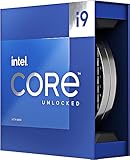
3. Intel Core i9-13900K – the most cores you can get without a workstation board
Intel Core i9-13900K Desktop Processor 24 cores (8 P-cores + 16 E-cores) 36M Cache, up to 5.8 GHz
24 cores and 32 threads
Up to 5.8 GHz unlocked
36MB cache
125W base power
Pros
- 24 cores and 32 threads give strong multi-threaded throughput
- Hybrid P-core and E-core design handles background tasks alongside foreground work
- Unlocked multiplier allows tuning on compatible boards
- Integrated UHD 770 lets you boot and troubleshoot without a discrete GPU
- Owners report it running data science and heavy multitasking with ease
Cons
- Draws heavy power under load and requires a quality cooler
- Some units show instability at high power limits and warranty handling has been slow
- Requires a 600-series or 700-series board and some 600-series boards need a BIOS update
Twenty-four cores across 8 P-cores and 16 E-cores, thirty-two threads, and a 5.8GHz unlocked ceiling – on paper this is the highest core count in the group that still fits a normal ATX board. If your work is embarrassingly parallel and CPU-bound, nothing else here gets you more threads without moving to a Threadripper-class platform. The hybrid design is also genuinely useful: E-cores handle background jobs while P-cores stay responsive to whatever you are typing.
Owners running data science on this part report good results, and the memory support is the other reason to look at it – DDR5-5600 with 128GB configurations confirmed in reviews, plus PCIe 5.0 for current and next-generation accelerators. The integrated UHD 770 is a small but real convenience for a headless box that occasionally needs a monitor.
Now the part you should read twice. Reviews averaging 4.4 stars from 2,001 ratings put 11% of one-star feedback on degradation and instability at high power limits, and on slow, costly warranty replacement. That is a documented characteristic of this generation, not a one-off, and the mitigation is to cap the power limits and let the boost behaviour do the work rather than pushing sustained clocks.
Thermally it is a heavy part. Several owners needed AIO liquid cooling or contact frames to keep temperatures in check, which means your build budget should include a quality cooler. It also draws more power per unit of useful work than the AMD options here, and that matters if the machine runs unattended for days.
Check your power limit settings before the first long job
The performance difference between a well-configured i9-13900K and a badly configured one is large, because the silicon will happily draw past what a modest cooler can dissipate. Setting a sensible long-duration power limit, updating the BIOS microcode, and giving the package adequate cooling are the three things that separate a good experience from a bad one.
If you are not comfortable tuning firmware settings, be honest about that. The AMD parts in this list do not ask for the same level of intervention, and their behaviour is more predictable out of the box. That difference in effort is a legitimate reason to choose the other way.
How the 24-core count compares to a workstation part
This is the last core count on a consumer socket. Memory channels on consumer boards are typically dual-channel, so a Threadripper-class platform with quad or octa channels will feed this kind of parallel workload from memory noticeably faster. If your parallel job is data-bound rather than compute-bound, that gap is the one that shows up in wall-clock time.
For most people, twenty-four cores on a consumer board covers the parallel ceiling. The r/comp_chem recommendation of a sixteen-core Threadripper on a server-grade board was made because memory capacity was the binding constraint for that user’s workflow, which tells you what to look at if you are in the same position – core count is only half the story once your dataset stops fitting.
4. AMD Ryzen 5 7600X – the best value entry point for a new build
AMD Ryzen 5 7600X 6-Core, 12-Thread Unlocked Desktop Processor
6 cores and 12 threads
5.3 GHz boost
6 MB L2 plus 32 MB L3
105W TDP
Pros
- Excellent price-to-performance for a modern AM5 part
- 5.3 GHz boost gives strong single-threaded responsiveness
- Integrated Radeon graphics provides a fallback display path
- AM5 platform with B650 and B850 boards leaves a long upgrade path
- Easy first-boot install on both Linux and Windows
Cons
- No cooler included and it runs warm under sustained load
- Only 6 cores and 12 threads for parallel or professional work
- Poor headroom for pairing with the highest-end GPUs
Six cores and twelve threads is below our stated floor, and we would not pretend otherwise – so buy this one for a specific reason. If your data science work is exploratory analysis, SQL, statistics coursework and model prototypes on data that fits in memory, the 5.3GHz boost clock is doing more for your daily experience than extra cores would. In 6,013 reviews averaging 4.8 stars, owners describe it as a snappy, easy first AM5 build.
The platform argument is the real one. A B650 or B850 board gives you DDR5, modern PCIe lanes and a socket with several more generations of silicon behind it. Starting here means the CPU is the cheapest part of a chassis you can keep for years rather than the one that dates the whole machine.
The ceiling arrives quickly. Six cores means parallel work has nowhere to go, and owners doing professional or data-heavy parallel work consistently recommend at least twelve cores or twenty-four threads. The integrated Radeon graphics are a fallback for display, not a compute path – if you plan to run any real model training, you are adding a discrete GPU and giving up most of the value proposition.
It also runs warm, and the review pattern is consistent: no bundled cooler, sustained-load temperatures that want a decent aftermarket cooler, and a general sense of being outclassed by the newer Ryzen 5 9600X when the two cost similar. Nothing here is disqualifying, but nothing here is headroom either.
Check whether you are buying a processor or a platform
At this tier, the motherboard and memory are the durable assets. Ask whether you will still want this board in three years – and whether the answer changes if the same money went into a higher core count at the low end of the range instead. A 5700G on a mature board and a 7600X on a new one cost very differently once the platform is included.
For a learner or a self-taught user, this is the honest answer to “is my current machine good enough”. A machine that feels slow is usually limited by RAM, storage or thermal throttling, not by six modern cores at 5.3GHz. Adding memory and a fast NVMe drive often changes more than changing silicon does.
Which of these two AM5 builds makes more sense
Both of our AMD entries target the same socket, and they serve opposite ends of the workload range. The 7600X wins on raw clock speed per unit of spend and on newer silicon; the 5700G wins on core count, included cooling and lower power draw.
If your heaviest job is a parallel sweep, take the core count. If your heaviest job is a notebook you run ten times an hour, take the clock. Everything else on the page is a bigger cost for one of those two advantages.
5. Intel Core i9-12900K – sixteen cores where the money stretches
Intel Core i9-12900K Gaming Desktop Processor with Integrated Graphics and 16 (8P+8E) Cores up to 5.2 GHz Unlocked LGA1700 600 Series Chipset 125W
16 cores and 24 threads
Up to 5.2 GHz boost
30MB L3 cache
125W base power
Pros
- 16 cores and 24 threads deliver strong multi-threaded throughput for analysis tasks
- Unlocked and responds well when tuned
- Runs noticeably cooler than earlier i9 generations under load
- Good value against newer 13th and 14th generation i9 parts
- Intel UHD 770 provides a troubleshooting fallback
Cons
- LGA 1700 is end-of-life with no upgrade path beyond this generation
- Still draws significant power and needs serious cooling for sustained loads
- Some chips arrived with pre-opened or resealed packaging
Sixteen cores, eight P-cores plus eight E-cores, twenty-four threads and a 5.2GHz boost. In reviews averaging 4.6 stars from 2,396 ratings, owners describe it as a fast, cooler-running and well-priced step up from 9th and 10th generation parts, with strong throughput on compilation, video processing and analysis work. For a parallel analytics job, sixteen cores is a genuinely capable amount of silicon.
The memory support is flexible in a way later Intel parts are not – DDR5-4800 or DDR4-3200 depending on the board, with PCIe 5.0 either way. That gives you a choice about platform cost that the newer i9 parts take away, and it is the reason this chip still makes sense in a mixed build.
The decisive weakness is the socket. LGA 1700 is finished, so this is the last processor that board will ever take, and a workstation that should last four or five years starts life with no upgrade path. That is a structural cost rather than a performance one, and it is the reason this part sits below the 13900K despite a better rating and a longer review history.
Cooling and power are the practical concerns. Sustained loads want a 240mm AIO or a large air tower, and the sustained power draw is higher than newer Intel silicon. A few owners received chips with pre-opened or resealed packaging, so buy from a seller with a straightforward return policy.
Check the platform ceiling before you buy the chip
Buy a processor and you are really buying a socket, a memory generation and a set of PCIe lanes. This one scores well on the chip and badly on everything around it, because LGA 1700 has no forward path. If the plan is a machine that stays useful past three years, the money belongs on a current platform.
If the plan is a fixed project machine with a defined end date, an end-of-life socket is not a real cost. Sixteen cores at a lower entry point, with the flexibility to run DDR4 or DDR5, can be the more sensible purchase for that kind of build.
How it compares to the 13900K on the same board
The newer part on the same socket adds eight more E-cores, a 5.8GHz ceiling instead of 5.2GHz, and DDR5-5600 instead of DDR5-4800. It also brings the higher power draw and the stability questions we covered earlier. Twenty-four cores versus sixteen is the headline, and it is a real difference for parallel work.
Neither part escapes the socket problem, though. If you are already committed to LGA 1700, the 13900K is the obvious choice on cores. If you are not committed, the honest comparison is against an AM5 board with a current eight-core part.
6. Intel Core i9-14900K – the highest clocks, and the most to manage
Intel® Core™ i9-14900K Desktop Processor
24 cores and 32 threads
Up to 6.0 GHz turbo
36MB L3 cache
125W base up to 253W turbo
Pros
- Strong multi-threaded throughput for heavy parallel workloads
- Highest boost clock in this group for single-thread and real-time responsiveness
- Supports both DDR4 and DDR5 platforms for motherboard flexibility
- Runs heavy all-core work at lower temperatures once stable BIOS microcode is applied
Cons
- Well-documented instability and degradation on early silicon at high power limits
- Requires power-limit and undervolt management plus a 360mm AIO or large air tower
- Several reviewers report CPU failures and a slow costly warranty process
Six point zero GHz. That is the fastest boost clock of anything on this page, and it shows in work that is single-threaded or latency-sensitive – interpreted analysis loops, package compilation, anything where one chain of dependent instructions runs at full speed. Combined with 24 cores and 32 threads, the raw spec sheet is the most capable consumer part here.
The catch is that this is the lowest-rated chip in our set: 4.2 stars from 1,610 reviews, with a 14% one-star share, by far the highest negative rate of the group. That is a real signal, not noise, and it clusters around instability and degradation on early silicon at high power limits rather than around dissatisfaction with speed.
The owners who get the best results are the ones who treat it as a tunable part. Managing PL1 and PL2, applying a modest undervolt, and locking core clocks produce Cinebench-class multi-core results that rival much larger parts, and microcode updates have brought sustained all-core temperatures down noticeably from the first batch of chips.
Run at default settings and maximum power, the same chip delivers roughly 13th-generation performance while drawing up to about 253W in turbo. That is the whole story of this product: the hardware is excellent and the software configuration is mandatory. A 360mm AIO or a large air tower belongs in the build budget.
Check whether you will actually tune it
This is the only part in the roundup where the manual is a required part of the purchase. If you enjoy firmware settings, power limits and stable clock locking, the upside is real and measurable. If you want a machine that boots and runs a long training job without intervention, the same silicon with an aggressive default power limit is an unnecessary risk.
There is also a platform cost. Supporting both DDR4 and DDR5 lets you choose the cheaper board option, but the 600-series boards that pair with LGA 1700 may need a BIOS update before first boot, and the socket still has no path beyond this generation.
How much does single-thread speed actually change your work
For code that is interpreted rather than compiled, and for anything that hops between tasks quickly, higher clocks translate into less waiting. Six point zero GHz against five point two is a difference you feel in a notebook cell that takes four seconds instead of four and a half, repeated hundreds of times a day.
For anything that runs for hours – a full-grid hyperparameter sweep, a large ETL, a model fit over millions of rows – the gap narrows to almost nothing, because the workload is bound by core count, memory bandwidth and disk rather than by the speed of a single core. In that case the cheaper eight or sixteen-core option finishes the job at a fraction of the power draw.
How to Choose a CPU for Data Science in 2026
Every processor above is a good computer chip. The differences that matter show up in four places: how many cores you can throw at a parallel job, how fast one core runs, how much memory the platform can hold, and how long the socket lasts. Decide those four things first and the model list narrows quickly.
How many cores do data science workloads actually need?
Set your minimum at 8 cores and 16 threads for anything past coursework. That is the threshold HP’s widely quoted workstation guidance points at, and it is the point at which parallel feature engineering, container-based workflows and virtualised notebooks stop fighting over cores. The 80/20 rule that circulates in data science discussions is often misread as a hardware rule, and it is not – it is a claim about where value comes from, and it applies equally well to your model design and your processor choice.
Below that floor you will still work, you will just be waiting. Six cores is a prototype machine. Twelve to sixteen cores is the comfortable professional range. Twenty-four cores and above is for people running parallel sweeps as a matter of routine rather than as an occasional weekend. Remember that core count is half the story once your working set exceeds system memory, because then memory channels and capacity decide the time.
Single-thread or multi-thread: which one matters more?
Both, and the ratio depends on your day. Preprocessing, exploratory analysis, SQL, pandas reshaping, R and classical estimators like scikit-learn and XGBoost are largely single-threaded or lightly threaded, so instructions-per-clock and cache decide how fast your inner loop feels. Deep learning training is GPU-bound, and the CPU’s job is to feed it, which makes cores, memory bandwidth and PCIe lanes the deciding factors.
The two positions you will find arguing online are not actually in conflict. One camp says single-thread matters most because everyday analysis is serial; the other says cores matter most because the parallel work is what takes hours. Both are describing their own workload. The honest summary is that a machine needs a fast single core to keep you productive between runs and enough cores to keep a parallel job from taking all afternoon.
Intel or AMD for data science?
For this workload, AMD’s current-generation parts make the easier recommendation. The 9800X3D and 5700G pair strong single-thread performance with modest power draw, and the 9800X3D’s 96MB L3 is unusually useful for repeated analytical queries. The Intel parts on this page offer more cores on a consumer socket, and the 14900K offers the highest clocks, but both come with power draw to manage and stability questions that the AMD parts do not raise.
Two Intel-specific advantages are worth naming. The 13900K and 12900K support higher DDR5 speeds than the AMD parts, which matters when your job is memory-bandwidth bound. And Intel’s integrated graphics are more consistently useful as a display fallback on a headless machine. If you rely on oneAPI, AMX and AVX-512 acceleration on Intel CPUs specifically, that narrows the field further and the Intel parts become the correct answer on tooling grounds rather than performance grounds.
Do you need AMX, AVX-512 or an NPU?
AMX is Intel’s Advanced Matrix Extensions, and it is the one worth knowing about. It is what makes oneAPI’s AI Analytics Toolkit, RAPIDS on Intel and Modin-based workflows meaningfully faster on supported silicon, because the matrix operations are handled by dedicated hardware rather than by the general-purpose cores. If your pipeline is built around RAPIDS or oneAPI, the choice of CPU is a tooling decision, not a benchmark decision.
AVX-512 and AVX-512 VNNI help vectorised maths, and the NPU is a low-power inference block that is largely irrelevant for a machine plugged into a wall running analysis. Treat NPU marketing as a laptop battery feature rather than a data science one. Deep learning training is GPU work; CPU acceleration blocks matter most for preprocessing and for libraries that fall back to the CPU.
Pairing your CPU with a GPU for ML and deep learning
The CPU answers one question for a GPU build: can it feed the card fast enough? Data preprocessing, augmentation and host-to-device transfers all run on the CPU, and a starved accelerator wastes hours per experiment. That makes memory bandwidth, core count and PCIe lanes the parts of the CPU spec that matter for deep learning, rather than peak clock speed.
Match the tier sensibly. A six-core part feeds a mid-range card acceptably and a flagship card poorly. A sixteen to twenty-four core part with DDR5 feeds a high-end card without becoming the bottleneck. The r/buildapc build pattern that recurs for data science and machine learning – an eight-core CPU with 64GB of DDR5 and a current mid-to-high GPU – is a sound balance, and it is worth copying rather than over-buying the processor side.
RAM, PCIe lanes and platform longevity
Put 32GB as your floor and 64GB as the target if your datasets are anything beyond toy examples. Memory capacity, not cores, is what forces people onto workstation platforms, which is exactly why the r/comp_chem recommendation of a sixteen-core Threadripper on a server-grade board was made – that user needed more RAM, not more compute. Software-defined storage and a NAS for staging large raw files is a cheaper answer than a bigger board; our guide to NAS systems for data storage covers that side.
Then think in years, not months. AM5 supports DDR5 and has multiple future silicon generations behind it. LGA 1700, which three of the parts here use, is finished – buying into it today means replacing the motherboard and memory at the end of the platform’s life. For a workstation expected to last four or five years, that is often the single most expensive decision in the build. Backing up your work matters just as much as the hardware, and our external drive backup guide covers the storage side of that.
Frequently Asked Questions
Which processor is best for data science?
The best CPUs for data science pair at least 8 cores with a boost clock of 4.5GHz or higher and a platform that can carry 32GB to 64GB of RAM. Our top pick is the AMD Ryzen 7 5700G for its 8 cores, 16 threads and 65W power envelope. For a new build, the Ryzen 7 9800X3D is faster single-threaded and sits on a socket with a longer upgrade path.
How many cores do I need for data science?
Eight cores and 16 threads is the practical minimum for serious data science work, and it is the threshold most workstation guidance points to. Six cores suits coursework and prototyping. Twelve to sixteen cores covers professional analysis and parallel model sweeps, while 24 cores and above is for sustained parallel jobs or heavy virtualisation. Core count stops being the limit once your data exceeds system memory.
Is Ryzen or Intel better for data science?
AMD’s current generation is the easier recommendation for analysis work because it pairs strong single-thread speed with lower power draw and no stability caveats. Intel offers more cores on a consumer socket, higher supported DDR5 speeds, and the AMX and AVX-512 acceleration that RAPIDS, oneAPI and Modin workflows rely on. If your pipeline is built on Intel tooling, Intel wins on support rather than on benchmarks.
Do I need a GPU for data science?
It depends on the workload. Exploratory analysis, SQL, statistics and classical machine learning run fine on a CPU. Deep learning training, large-scale inference and anything using RAPIDS-style GPU pipelines need an accelerator. Either way the CPU still matters, because it preprocesses data and feeds the card, and a starved GPU wastes hours per experiment.
What is the best CPU for machine learning and AI development?
For CPU-bound machine learning, an eight-core part with a fast single core such as the Ryzen 7 5700G or Ryzen 7 9800X3D is enough. For AI development that includes model training on a discrete GPU, move up to 16 or 24 cores with DDR5 memory and current PCIe lanes, so the processor can keep the accelerator fed. If you run RAPIDS, Modin or oneAPI, choose the Intel parts for AMX and AVX-512 support.
What is the most future proof CPU?
Future proofing is mostly a socket question. AM5 supports DDR5 and has several generations of Ryzen silicon behind it, so a board bought today still accepts faster processors later. LGA 1700 is finished, as is AM4, so processors on those platforms have no upgrade path. Memory capacity and PCIe lane count matter more than peak clock speed for a four to five year workstation.
Our Verdict on the Best CPUs for Data Science in 2026
Six chips, one clear winner. The Ryzen 7 5700G is our pick for the best CPUs for data science because eight cores, 16 threads, a 4.6GHz boost and a 65W envelope cover the real range of analysis work without asking you to tune anything, and 10,166 owner ratings averaging 4.8 stars make it the most proven part here.
Buy the Ryzen 7 9800X3D instead if you are starting a fresh AM5 build and your work is latency-bound, and buy the Ryzen 5 7600X if a new platform matters more than core count. Move up to the Core i9-13900K for parallel work that needs 24 cores on a consumer board, and treat the 12900K and 14900K as socket-limited options that make sense on a fixed project timeline. Check the current price, pick the tier that matches your heaviest job, and pair it with 32GB to 64GB of memory.