
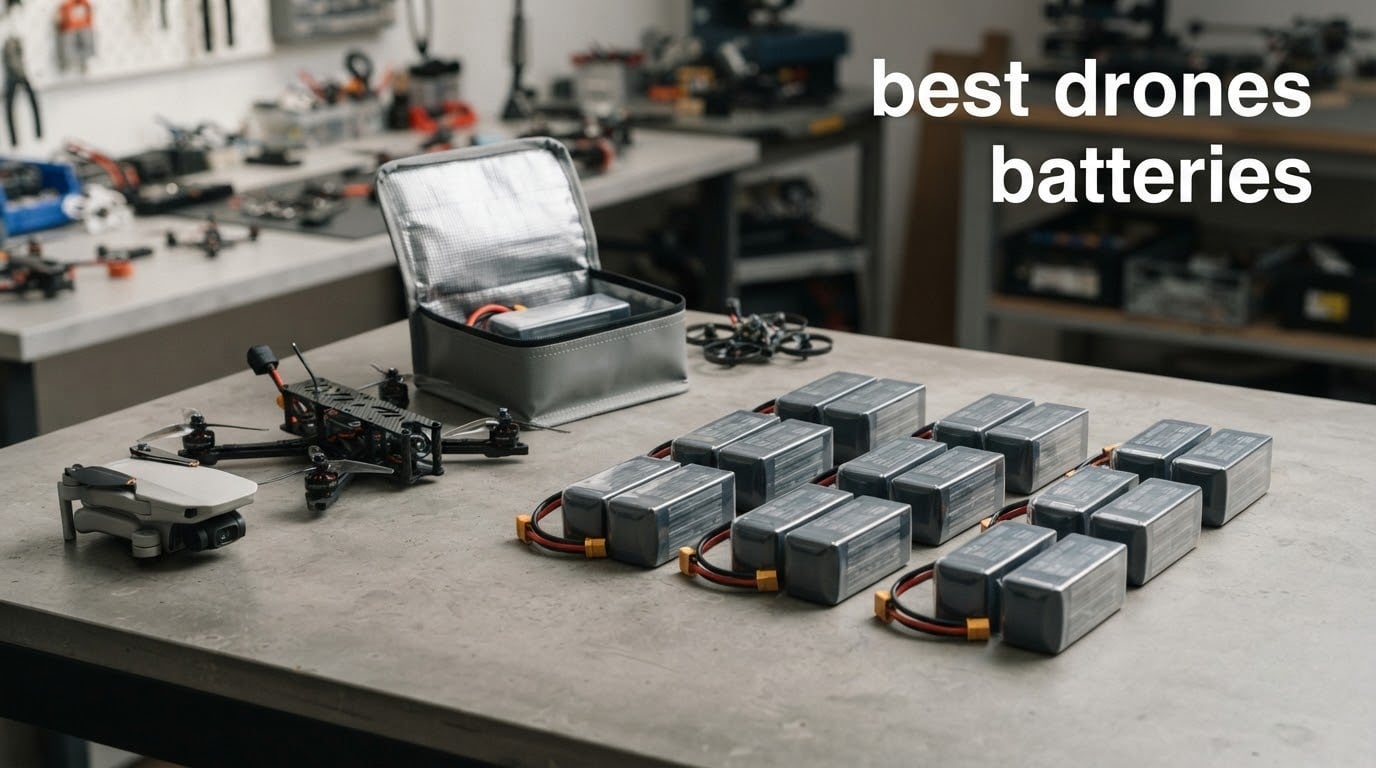
The best drone battery is the one your airframe was designed around, and that single sentence settles most of the buying decision before you read a single spec. DJI and Autel aircraft need the matching genuine intelligent flight battery because the firmware handshake, cell deviation checks and app telemetry only work with the original pack. FPV pilots on a 3-inch or 5-inch quad want a LiPo with a high C-rating and the right S-count, and micro whoop builders want the lightest 2S pack that will fit the frame.
We spent weeks reading spec sheets, forum threads and thousands of buyer reviews to put this roundup together, and we grouped the 12 packs by the job they actually do rather than by brand. Every product below carries its own verified capacity, weight, cell chemistry and connector so you can match it to your drone in a couple of minutes. Where buyers report a specific weakness, like swelling, a missing balance lead or a firmware compatibility limit, we say so instead of letting the marketing copy speak for itself.
One more thing before we start. Real flight time almost never matches the number on the box, and the gap is usually weight, not capacity. A larger pack adds mass to a drone that then burns more power, which is why a 2590 mAh battery and a 2453 mAh battery can deliver nearly identical minutes in the air. We explain the arithmetic in the buying guide at the end, so you can calculate your own numbers before you commit.
As a starting point, if you are still narrowing the field, our [8 Best FPV Drones Batteries 4S Tested Picks](https://www.comstock-interactivedata.com/best-fpv-drones-batteries-4s/) and [10 Best FPV Drone Batteries 6S Tested](https://www.comstock-interactivedata.com/best-fpv-drones-batteries-6s/) guides go deeper on the racing side of the market, while our [15 Best Marine Batteries Expert Picks](https://www.comstock-interactivedata.com/best-marine-batteries/) roundup covers the chemistry and storage habits that apply to any large lithium pack.
Table of Contents
Top 3 Best Drones Batteries (October 2026)

DJI Mini 3 Series Battery
- 2453 mAh Li-ion
- 34 min max flight
- Fits Mini 4 Pro and Mini 3
- 80.5 g
Our top three cover three completely different jobs, and picking between them takes about five seconds once you know what you fly. The DJI Mini 3 Series pack is the safe all-rounder for the largest installed base of consumer drones. The DJI Neo pack is the choice if you want the lightest genuine smart battery on a sub-250 g aircraft. The Zeee 3S two-pack is the one to buy when you build or repair your own quad and want two packs plus a real XT60 plug.
The Best Drone Batteries at a Glance in 2026
| Product | Specifications | Action |
|---|---|---|
| DJI Mini 3 Series Intelligent Flight Battery |
|
Check Latest Price |
 DJI Neo Intelligent Flight Battery DJI Neo Intelligent Flight Battery |
|
Check Latest Price |
 Zeee 3S 2200mAh 50C Shorty LiPo 2-Pack Zeee 3S 2200mAh 50C Shorty LiPo 2-Pack |
|
Check Latest Price |
 OVONIC 4S 1300mAh 100C LiPo OVONIC 4S 1300mAh 100C LiPo |
|
Check Latest Price |
 DJI Mini 4 Pro Intelligent Flight Battery DJI Mini 4 Pro Intelligent Flight Battery |
|
Check Latest Price |
 Blomiky 3S 2500mAh Li-po Drone Battery Blomiky 3S 2500mAh Li-po Drone Battery |
|
Check Latest Price |
 HOOVO 6S 6200mAh 120C LiPo HOOVO 6S 6200mAh 120C LiPo |
|
Check Latest Price |
 TATTU 2S 300mAh 45C LiPo 4-Pack TATTU 2S 300mAh 45C LiPo 4-Pack |
|
Check Latest Price |
 Holy Stone Modular Battery for HS360S Holy Stone Modular Battery for HS360S |
|
Check Latest Price |
 Autel Robotics EVO 2 Battery 7100mAh Autel Robotics EVO 2 Battery 7100mAh |
|
Check Latest Price |
 Zeee 2S 2200mAh 50C Shorty LiPo 2-Pack Zeee 2S 2200mAh 50C Shorty LiPo 2-Pack |
|
Check Latest Price |
 VICMILE 450mAh LiPo 5-Pack with USB Charger VICMILE 450mAh LiPo 5-Pack with USB Charger |
|
Check Latest Price |
Two patterns jump out of that table. First, every genuine smart battery is lithium-ion, not lithium polymer, because DJI and Autel pack their cells in a rigid enclosure with a management board rather than a soft pouch. Second, the hobby packs are almost all LiPo, because burst discharge matters more than energy density when the throttle is slammed to full in a corner.
1. DJI Mini 3 Series Intelligent Flight Battery — The All-Rounder for the Biggest Drone Fleet
DJI Mini 3 Series Intelligent Flight Battery, Compatibility Mini 4 Pro, Mini 3 Pro, Mini 3
2453 mAh
Lithium Ion
80.5 g
8.6 V class
34 min max flight
Pros
- Genuine DJI cell pack
- Works across Mini 4 Pro Mini 3 Pro and Mini 3
- 30-plus minute real-world flights
- Overcharge protection built in
- Reviewers report three years of service
Cons
- Cannot charge away from a hub or the aircraft
- Costs more than third-party alternatives
This is the pack most Mini owners end up buying, and the reason is compatibility rather than headline capacity. It is listed for the DJI Mini 4 Pro, Mini 3 Pro and Mini 3, so one battery covers the whole current Mini lineup instead of locking you into a single generation. At 2453 mAh and 80.5 g, the weight is almost invisible on a sub-250 g aircraft.
The intelligent management system is the part third-party clones cannot copy. It reports remaining cycles, cell health and temperature back to the DJI Fly app, and it refuses to arm the aircraft if the pack is too cold, too unbalanced or deeply discharged. That protection is why owners report packs still working after three or more years of regular flying.
Real flight time lands somewhere between 30 and 34 minutes for most pilots, and the battery itself reports 34 minutes of max flight on the Mini 3 Pro. Wind, altitude and how aggressively you push the sticks all move that number, but the gap between the printed spec and actual experience is unusually small on DJI packs.
One limitation shows up in the reviews more than any other: this pack will not charge on a generic USB wall plug. It needs the DJI charging hub or the aircraft itself, which adds friction if you want to top up a pack while the drone is still being packed away.
Check the app-reported cycle count before you buy used
Every genuine DJI intelligent battery logs its own cycle history, and that log is the single most useful thing a seller can show you. Ask for a screenshot of the battery health screen rather than a photo of the label, because a pack that has been flown hard every weekend for two years will still look perfect on the outside. A low cycle count with high remaining capacity is the combination you want.
Also confirm the firmware version matches what your aircraft expects. DJI pushes cell and firmware updates through the app, and a pack that has been sitting unpowered for a year can need one flight with the aircraft before it accepts full charge current.
Who should skip it?
If you fly a Mini series aircraft strictly on a budget, this pack is not the cheapest way to get airborne, and the savings on a third-party pack evaporate fast when the clone does not report accurate battery levels to the app. It is also the wrong choice if you own a DJI aircraft from a different generation, since the connector and cell density differ between families. Check your aircraft model number against the compatibility list before ordering anything.
Buy at least two. With roughly half an hour of usable flight per pack, a two-pack rotation is the minimum for any real flying session, and the [10 Best FPV Drone Batteries 6S Tested](https://www.comstock-interactivedata.com/best-fpv-drones-batteries-6s/) roundup covers the same rotation logic for the hobby side of the market.
2. DJI Neo Intelligent Flight Battery — Lightest Genuine Pack for Sub-250 g Drones
Pros
- Only 46 g so weight never becomes an issue
- Real-time voltage and temperature monitoring
- LED charge status indicators
- Reliable across many cycles
Cons
- Roughly 12 to 18 minutes of flight per pack
- Works only with the DJI Neo
At 46 g, this is the lightest genuine smart battery in the roundup by a wide margin, and on a drone the size of the Neo that matters. Capacity is a modest 1435 mAh at 8.6 V, but the aircraft is small enough that the pack barely registers on the all-up weight. The management board still tracks voltage, current and temperature in real time and reports into the DJI Fly app.
That telemetry matters more than usual here. The aircraft is light enough that a sagging pack changes the flight feel noticeably, and having the app flag a weak cell before you arm is a genuine convenience rather than a gimmick.
The catch is flight time. DJI quotes 18 minutes under controlled conditions, and owners report closer to 12 minutes when they fly the way they actually want to fly, with the camera active and obstacle sensing on. Most of the reviews we read make the same point in different words: you will need several of these to enjoy a session.
That is not really a flaw. It is the nature of an aircraft this light, and it is also the reason the pack stays cool and lasts. Packs on small drones are rarely worked hard enough to degrade quickly.
Plan the rotation before the first flight
At 12 to 18 minutes per pack, the maths is simple. For an hour of actual flying you want six or more packs in the bag, plus a charging hub that can refill them while the batteries cool. Charge in a sequence rather than all at once, because a pack that has just been flown is warm and charging warm cells to full is the fastest way to shorten their life.
Buy a small fire-resistant bag and keep it in the vehicle with the packs rather than in the house. Even a pack that has never over-discharged can fail if left in a hot car, and that scenario is far more common than an actual overcharge.
Who should look elsewhere?
This battery fits the DJI Neo and nothing else, so it is not a spare for a Mini or an Air series aircraft even though the form factor looks similar. If you already own a larger DJI drone, spending this on a single-aircraft pack is a hard sell when a battery covering three models would serve you better. It also makes little sense for anyone who wants long single-sortie flight time, because nothing about this pack is built for that.
3. Zeee 3S 2200mAh 50C Shorty LiPo 2-Pack — Best Value Two-Pack for Custom Quads
Pros
- Two packs in the box at once
- Shorty profile fits tight frame bays
- 11.1V suits 3S FPV and RC builds
- Works across cars planes boats and quads
- Twelve-month warranty
Cons
- Needs a LiPo balance charger
- Not a smart pack so no telemetry
- Isolated reports of swelling after limited use
Two 3S packs at 2200 mAh with a real XT60 plug, and that combination is what makes this one so useful. A 3S pack at 11.1 V nominal is the sweet spot for a huge number of small and medium FPV quads as well as RC cars, boats and fixed-wing models, so the same purchase covers several hobbies. Getting two is the point, since a rotation with a single pack is a rotation that ends early.
The shorty profile measures 75 by 34 by 26.5 mm, which is the detail that decides whether it fits at all. Standard-length packs are often too long for a tight battery bay between the arms, and the shorty form factor exists precisely to solve that.
On the discharge side, a 50C rating on 2200 mAh means the pack is rated for around 110 amps continuous, which is far more than most 3S builds pull. That headroom is what keeps voltage from collapsing when you punch the throttle out of a corner.
Buyers report good runtime in ground vehicles where the load is sustained rather than bursty, and the 137 g weight is easy to carry in a pack of four or more. A few owners mention swelling after limited use, which almost always traces back to storage voltage or heat rather than the cells themselves.
Confirm your bay dimensions and connector
Measure the battery bay before you order. At 75 mm long this is already a compact pack, but frames vary a lot, and a bay designed for a 2S shorty will not take a 3S one. The XT60 plug is the most common connector in the hobby world, so it will almost certainly match what you have, but check the polarity too because reversed leads are the classic mistake on a first build.
You will also need a genuine balance charger. A pack charged without balancing drifts out of alignment cell by cell, the weakest cell sags first under load, and the pack swells sooner than it should. A single-cell balance lead is not optional here.
Who should skip it?
Skip this if you fly a DJI or Autel aircraft, because a bare LiPo pack has no management board, no telemetry and no way to talk to the flight controller. Skip it if you need a genuine smart pack for cold-weather operations, and skip it for long-range work, where the lower energy density of LiPo loses to 21700 lithium-ion cells on a pack-for-pack basis.
For a hobby pilot building or maintaining a 3S quad, though, two of these in the bag is a genuinely practical setup. Our [8 Best FPV Drones Batteries 4S Tested Picks](https://www.comstock-interactivedata.com/best-fpv-drones-batteries-4s/) guide covers the next step up if your build is 4S rather than 3S.
4. OVONIC 4S 1300mAh 100C LiPo — Budget Race Pack for 3 to 4 Inch Quads
OVONIC 4s Lipo Battery 100C 1300mAh 14.8V Lipo Battery with XT60 Connector for RC FPV Racing Drone Quadcopter
4S 14.8V
1300mAh
100C
XT60
156 g
Pros
- Very high C-rating for the money
- Low internal resistance gives clean punch
- Soft case fits most micro frames
- Customer service replaces defective units
- ISO certified LiCoO2 cells
Cons
- Needs LiPo-specific charging discipline
- Some early units had quality control issues
- Internal resistance varies between units
A 4S pack at 14.8 V is the default configuration for a 3-inch or 4-inch racing quad, and 100C is far more discharge capability than those builds need at cruise. That overspec is deliberate. In racing, the pack spends its life at full throttle, and the C-rating is what stops the voltage from collapsing when you load up a corner.
At 1300 mAh and 156 g, the weight is right in the middle of what a 4S micro build expects. The XT60 discharge plug and JST-XHR-5P balance lead are both standard, so wiring is straightforward.
Reviewers with years of FPV experience compare the performance favourably to premium race packs at a fraction of the cost, which is the recurring theme across the reviews. They also report cycle counts that vary with how you charge. Pushing to 4.30 V per cell shortens life noticeably compared with staying at 4.20 V.
Customer service comes up more than you would expect. Owners who received units with swelling or venting issues report replacements sent quickly, which is worth knowing for a component that occasionally arrives faulty.
Match the C-rating to the build, not to the marketing
Most pilots buy a 100C pack for a quad that cruises at 25 amps. That is fine, and it is also money you do not need to spend. The practical question is whether your build can pull peak bursts well above cruise, which happens in racing and rarely in cruising. For a 4S freestyle or cinematic quad, a 60C to 100C pack is more than sufficient, and the difference shows up in internal resistance rather than in the sticker.
Check the sag under load rather than trusting the label. A healthy 1300 mAh 4S pack should hold a reasonable voltage at full throttle. If it drops sharply, that unit is worn or out of balance and should be retired rather than flown.
Who should skip it?
Skip this pack for sustained high-amp draws, where cell consistency across a pack matters more than the headline C number. Long-duration multi-rotor work is the classic case, because a pack that reads 100C on the label can still vary from cell to cell, and the weakest cell determines when the whole pack gives up. It is also the wrong chemistry for long-range, where lithium-ion wins on energy density.
For short, aggressive sessions on a small quad, it remains a sensible entry point. The chemistry basics are covered in more depth in our buying guide below.
5. DJI Mini 4 Pro Intelligent Flight Battery — Higher Capacity for the Current Mini Flagship
Pros
- Largest capacity in the Mini range
- Fits both Mini 4 Pro and Mini 3 Pro
- App integration for battery health
- Reliable in cold temperatures
- Fast charging on the DJI hub
Cons
- ActiveTrack cuts flight time noticeably
- Costs more than lower-capacity alternatives
- Low battery warning can come early
This pack carries 2590 mAh, the highest capacity in the DJI range covered here, while weighing essentially the same 80 g as the smaller Mini 3 pack. That is the entire argument for it. The Mini 4 Pro and the Mini 3 Pro share the battery slot, so if you own either aircraft, this is the pack with the most endurance per gram.
Like every genuine DJI intelligent battery, it reports to the app and enforces its own limits. The aircraft will not arm if the pack is cold, unbalanced or too deeply discharged, which is exactly the failure mode that strands people in a field.
Owners report real-world flights of roughly 20 to 27 minutes depending on mode, and the gap between the 34-minute published figure and that range is mostly feature usage. ActiveTrack and other tracking modes draw meaningfully more power because the obstacle sensors and processing stay active.
Cold weather performance comes up positively in reviews, though a warm pack is still a warm pack. Keeping a pack close to your body in cold conditions helps it hold a usable voltage on the first pack of the day.
Do the mAh maths before you buy extra packs?
Going from 2453 mAh to 2590 mAh is a gain of a little over 5 percent in stored energy, and the weight difference is effectively zero. That is a real but modest improvement, and it is not a reason to discard a perfectly healthy lower-capacity pack. If you already own compatible batteries, the case for upgrading is about spares and rotation rather than endurance.
What actually moves flight time is the power draw from the flight mode. If you shoot most of your footage in a mode that keeps sensors running, buying a second pack and swapping mid-shoot will give you more usable footage than chasing a slightly larger cell.
Who should skip it?
Skip it if your aircraft is not a Mini 4 Pro or Mini 3 Pro. The connector and cell layout differ across DJI families, and a pack that looks physically similar will not seat properly. Owners of earlier Mini generations should also note that DJI has changed pin layouts and cell density between series at points, which is exactly the compatibility trap that catches people buying a cheaper pack.
For genuine DJI aircraft, though, there is no third-party substitute that gives you the firmware handshake, the app telemetry and the thermal protection. That is the real reason this pack earns its place.
6. Blomiky 3S 2500mAh Li-po Battery — Third-Party Replacement for Budget Camera Drones
Pros
- Replaces several budget drone models directly
- Reports remaining level to the drone app
- Flight time close to the original pack
- Charges quickly
- Long-term owners report no swelling
Cons
- Compatibility is limited to specific models
- Slightly less flight time than some originals
- White colour version will not fit
Consumer camera drones from SJRC, RUKO, DEERC and Contixo use simple 3S LiPo packs with a two-pin connector and no smart management board, and that is exactly what this is. At 2500 mAh and 27.75 Wh it is a direct dimensional and electrical replacement for the original pack on those airframes, and the on-board level reporting works as expected in the drone app.
Because the original packs on these drones tend to be the component that dies first, a replacement like this often extends the life of an otherwise perfectly good aircraft. The airframe, motors and camera outlive the battery by a wide margin.
Flight time is the honest caveat. A few owners report slightly less endurance than the original pack, and most report they cannot tell the difference. If you were getting the maximum from the factory battery, expect a small step down rather than parity.
On swelling, long-term owners in the reviews are the reassuring voice. They report no bloating issues, which matters because a swelling pack in an enclosed plastic airframe is a genuine hazard, not an inconvenience.
Verify the connector and the colour variant
Compatibility here is model-specific and the listing is explicit about the airframes covered, so read it before ordering. The most common failure is not electrical but physical: a replacement that is a few millimetres different will not seat, and you end up returning a perfectly good pack.
Pay attention to the colour note in the listing. The white version is not compatible with every shell, and buying the wrong colour is the single most common reason a buyer ends up with a pack that does not fit. Measure the original pack and compare it against the 103.5 by 48 by 43 mm dimensions.
Who should skip it?
Skip it for any drone with a smart battery system, because there is no management board, no telemetry and no cell balancing beyond what your charger does. Skip it for FPV work, where the discharge rate needed is far higher than a pack specified mainly for endurance. And skip it if you fly in cold conditions, since a bare pack has no self-heating to fall back on.
For a budget camera drone that no longer flies because the original pack is dead, this is a practical and well-reviewed way to get back in the air.
7. HOOVO 6S 6200mAh 120C LiPo — High-Capacity Pack for Large Multirotors
HOOVO 6S LiPo Battery 22.2V 6200mAh 120C with EC5 Plug Softcase RC Battery
6S 22.2V
6200mAh
120C
EC5
837 g
Pros
- 6200 mAh gives real endurance
- 120C handles large sustained draws
- Low internal resistance of 3 to 5 milliohms
- Fits 1/8 scale trucks and large multirotors
- Steady discharge curve
Cons
- Cell balance drifts and needs balance charging
- Some reports of early cell failure
- Reviews are polarised at both ends
At 6200 mAh and 120C this is a pack built for large airframes with big motors and honest power demands. The 6S configuration at 22.2 V suits 600-class and larger helicopters, large fixed-wing models, EDF jets and heavy multirotors, and the EC5 plug is the connector those builds use.
Internal resistance in the 3 to 5 milliohm range is the figure worth paying attention to. Low internal resistance means the pack holds voltage under load, which is the difference between a drone that climbs briskly and one that bogs down.
Owners report the pack running 10 months or more of heavy use, and the advertised energy density of up to 300 Wh/kg is plausible for this class. Recommended charging is 0.5C to 1C, and storage at 3.8 V to 3.85 V per cell, which is the standard long-term target for LiPo.
The reviews are genuinely polarised, and you should read them that way. Around 11 percent are one star, with cell failures inside a year as the recurring complaint, while the rest describe good value for the capacity. Balance drift needing occasional correction shows up in both camps.
Inspect cells and balance more often than you think
On a pack this large, the cells have more opportunity to drift apart over time, and the reviews confirm it. Check cell balance before every flight session, not once a month, and treat any pack that needs repeated balance correction as a pack in the last third of its life. A sagging cell under load is the mechanism that leads to puffing.
At 837 g, weight is the other decision point. A 6S 6200 mAh pack changes the centre of gravity and the power budget of the aircraft, so check what the airframe was designed to carry before committing. If the frame was built for smaller packs, a large one changes the thrust-to-weight ratio dramatically.
Who should skip it?
Skip it for racing. Consistency between units is what competitive flying depends on, and a brand with this spread of reported outcomes is a poor match when you need every pack to behave identically. Skip it for any long-duration mission where a mid-air voltage drop is unacceptable, since the balance reports give you a reason to be cautious about the pack.
For bashing, heavy lifting and large multirotors where the cell cost per flight matters, the capacity-to-cost ratio is hard to argue with. Just balance it regularly and retire it on schedule.
8. TATTU 2S 300mAh 45C LiPo 4-Pack — Lightest Option for Micro FPV Builds
TATTU 4PCS 7.4V 300mAh 2S 45C LiPo Battery Pack with XT30 Plug for Emax Babyhawk Micro FPV Quad Racing Drone
2S 7.4V
300mAh
45C
XT30
20 g each
Pros
- Only 20 g per pack so weight barely registers
- Four packs give a usable rotation
- 45C is ample for 80 to 150 size builds
- Sixty-day money-back window
- Eighteen-month warranty
Cons
- 300mAh is small so flight time is short
- XT30 only and needs an adapter for other plugs
On a micro build, every gram changes how the quad flies, and 20 g per pack is about as light as a 2S pack gets. At 7.4 V with 300 mAh and a 45C rating, this is the classic whoop and toothpick configuration, and the XT30 plug is the connector those frames use.
Getting four in the box is the reason this is worth buying over a single pack. Micro FPV flying is short bursts, but you burn through packs quickly, and four is the minimum that lets you keep flying while others charge and cool.
Reviewers consistently point to the same positives: a 45C discharge rate that is more than adequate for an 80 to 150 size quad, straightforward reliability, and responsive customer service. The warranty and the sixty-day return window reduce the risk on a component you will be hard on.
The 46 by 16 by 14 mm dimensions are worth checking against your frame, because ultra-tight builds sometimes cannot accommodate even a short 2S pack without modifying the tray.
Size the pack to the frame, not to the marketing
Micro pilots argue about this constantly, and the answer depends on the frame. If your build has room and you fly freestyle, a larger pack gives noticeably more hang time. If you race or fly tight lines, the lighter pack is faster and the extra grams show up immediately in acceleration and in how the quad handles a fast descent.
Check two things before ordering: the tray dimensions and the connector type. XT30 is standard here, but a build with a different lead needs an adapter, and adapters add weight at exactly the point where every gram counts.
Who should skip it?
Skip it if you need endurance more than lightness, because 300 mAh is a genuinely small amount of energy and a four-minute flight is a realistic expectation on a whoop. Skip it for anything bigger than a micro quad, where the pack will not supply the current needed. And skip it for long-range work, where the case for lithium-ion cells is made purely by weight and energy density.
For a lightweight toothpick or whoop build, it is a sensible, well-supported starting point. Our [8 Best FPV Drones Batteries 4S Tested Picks](https://www.comstock-interactivedata.com/best-fpv-drones-batteries-4s/) roundup covers the 4S options for larger micro quads.
9. Holy Stone Modular Battery for HS360S — Drop-In Pack for the HS360S
Holy Stone Intelligent Modular Drone Battery for HS360S Drones with Camera for Adults 4K, GPS 4K Drone, Accessory HS360S
3.7V LiPo
74.4 g
1.5 A
Single-cell
Pros
- Made specifically for the HS360S
- Overcharge and over-discharge protection
- Low temperature protection built in
- Quick-swap modular design
- Weighs 74.4 g
Cons
- Only works on the HS360S
- One pack in the box
- Costs more than generic alternatives
This is the narrowest recommendation in the roundup, and that is fine. If you fly the Holy Stone HS360S, this is the battery designed for it, with the correct connector, the correct bay fit and the built-in protections the aircraft expects.
The protection set is the real value here. Overcharge, over-discharge and low-temperature protection are all present, which matters most for beginners who will leave a pack sitting on a charger or fly it in conditions it does not like.
At 74.4 g it is not a heavy pack, and the modular design means swapping takes seconds rather than requiring tools. For a drone class where the pack comes out every few minutes, that convenience compounds quickly across a whole season of flying.
Owners highlight the perfect fit and the safety features as the two things they notice most. The single-pack format is the main drawback, since there is no rotation without buying more than one.
Buy two and treat the low-temp protection as a real limit
Buy at least two. The low-temperature protection is a genuine safeguard that will refuse to charge a cold pack, which prevents damage but also means a pack left in a cold car can be unusable until it warms up. Two packs let you rotate while one warms and one cools, which removes the wait entirely.
Storage still applies. Keep the packs at roughly 3.8 V per cell for anything longer than a couple of days, and avoid leaving them in a vehicle in summer heat, where the low-temperature protection will not help you at all.
Who should skip it?
Skip it for anything other than the HS360S. There is no cross-compatibility here and no third-party alternative worth considering for a different airframe, since a battery that does not match the connector will not do anything useful. It is also not the right pick if you are already happy with a functioning original pack, because the improvement is durability rather than capability.
If you have reached the point where the original pack no longer holds charge, this is the clean fix.
10. Autel Robotics EVO 2 Battery 7100mAh — Longest Published Flight Time in the Roundup
Pros
- Up to 40 minutes of published flight time
- Covers most of the Autel EVO II range
- LED level indicators on the pack
- Quick release finger grips
- 30-day replacement and 12-month warranty
Cons
- Works only with the Autel EVO II family
- Costs more than hobby packs
- Overkill for casual flying
The Autel EVO II series is the endurance champion of the consumer drone world, and this pack is why. At 7100 mAh it carries roughly three times the energy of a Mini series battery, and Autel publishes a flight time of up to 40 minutes on an aircraft designed around it.
The compatibility list is unusually broad for an OEM pack. It covers the EVO II 8K, the EVO II Pro 6K in V2 and V3, the Enterprise V3, the Pro RTK V3, and the Dual 640T RTK variants, which means one pack can cover a lot of a mixed fleet.
Owners confirm the endurance in practice and rate the pack at 4.7 out of 5 across more than 200 reviews. The build details are sensible: LED charge indicators on the pack itself, short-circuit, overcharge and balance protection, and finger grips that make install and removal quick when you are working in the field.
Warranty coverage is worth noting too. Thirty days for replacement or refund, plus twelve months against defects, which is a stronger position than most third-party packs offer.
Check the variant before you order, not after
The listing is explicit that this pack does not fit the original Autel EVO. Older EVO airframes use a different pack, and the mistake is easy to make if you own an early model. The V2 and V3 suffix on an EVO II Pro also matters, because firmware differences came with those revisions.
Also plan the charging side. A 7100 mAh pack at 11.55 V needs a proper charger with real current capability, and the charge time is meaningful. If you are building a rotation, budget for the time it takes to refill each pack rather than assuming overnight turnaround.
Who should skip it?
Skip it for a casual weekend flyer who will never use 40 minutes of flight time in a single sortie. The capacity is only useful if you fly long routes, do real mapping work, or need fewer battery swaps to cover a large site. Skip it for any other drone brand, since this is a closed system with no cross-compatibility.
For operators who genuinely need long single-sortie flights on Autel hardware, this remains the pack that delivers.
11. Zeee 2S 2200mAh 50C Shorty LiPo 2-Pack — Compact Two-Pack for 1/16 Scale Builds
Zeee 2S Shorty Lipo Battery 2200mAh 7.4V 50C with XT60 Connector (2 Pack)
2S 7.4V
2200mAh
50C
XT60
98 g each
Pros
- Two packs at 98 g each
- 50C is ample for small 2S builds
- XT60 connector is widely compatible
- Shorty profile for tight bays
- Twelve-month warranty
Cons
- Needs a LiPo balance charger
- Shorty length may not suit every bay
- Requires LiPo safety discipline
This is the 2S counterpart to the Zeee 3S two-pack, and it covers the other half of the small-build market. At 7.4 V and 2200 mAh it suits 1/16 scale trucks, small RC cars, boats, light fixed-wing models and 2S micro quads, and the XT60 connector means it will almost certainly match your existing leads.
Weight is the headline figure here. At 98 g per pack you get a 2200 mAh pack for less mass than a 4S 1300 mAh pack, which is the trade that makes 2S builds feel so different in the air. The 50C rating is more than a small build will pull.
Reviews highlight the two-pack format, the connector compatibility and consistent performance across several RC disciplines rather than just FPV. The twelve-month warranty is a reasonable baseline for a hobby pack.
Two limitations come up consistently. A LiPo-specific balance charger is required, and the shorty length of 73 by 34 by 18.5 mm will not suit every battery bay, so check before you commit.
Do the weight maths against a 4S alternative?
If you are choosing between a 2S 2200 mAh and a 4S 1300 mAh pack, compare stored energy rather than capacity. The 2S pack holds marginally more energy at a much lower voltage, which is why light builds run 2S and heavier frames run 4S or 6S. Motor KV, propeller size and the ESC voltage rating all have to agree with the choice, and changing the S-count means changing at least two of those.
Check the bay length, the connector and the polarity before ordering. The 2S and 3S versions of this pack look similar in the hand and it is easy to order the wrong one.
Who should skip it?
Skip it for anything that draws serious current. A 50C 2200 mAh 2S pack is a light-aircraft pack, and putting it in a heavy RC truck or a large multirotor will leave it sagging under load. Skip it for DJI or Autel aircraft for the same reasons as the 3S version, since there is no management board and no telemetry.
For small 2S builds, the two-pack format and the low mass make it a practical default.
12. VICMILE 450mAh 5-Pack with 5-in-1 USB Charger — Cheapest Way to Extend a Micro Drone Fleet
Pros
- Five packs plus a 5-in-1 USB charger in one box
- 450mAh beats the 300mAh packs most toy drones ship with
- Charger refills all five at once
- Claimed 500+ cycle life
- One-year warranty included
Cons
- 25C is low for anything demanding
- Molex plug limits which drones it fits
- Tiny packs are easy to lose
This bundle solves a problem most first-time drone owners hit within a month. Toy-grade drones usually ship with a 300 mAh pack that gives you barely enough time to get off the ground, and these 450 mAh packs are a straightforward capacity upgrade that slots into the same Molex connector.
The 5-in-1 USB charger is the detail that makes the bundle work. It refills all five packs at once from a single USB source in around half an hour, which turns a frustrating trickle of one-pack-at-a-time charging into a workable rotation.
Compatibility is broad across the micro drone market, with more than a dozen models named on the listing, and users report a clean fit on the models they tried. The 12 g weight per pack is negligible on a drone this size, so the capacity increase is essentially free flight time.
The 25C discharge rating is the honest limit. It is fine for the gentle hovering and slow flights these drones are designed for, and it is not enough for anything aggressive.
Count how many micro drones you actually own first
Five packs plus a charger is generous if you own one or two micro drones and more than you need if you own a fleet. Before ordering, check the connector on the existing packs. Molex is common in this segment but not universal, and a pack that does not plug in is dead weight.
Check the model list as well as the connector, because the shell dimensions vary between these drones. The listed models cover the common SYMA, Holy Stone and similar entries, and if your drone is not named it is worth confirming the bay dimensions first.
Who should skip it?
Skip it for FPV work, where a 25C pack and a Molex plug are both disqualifying. Skip it for any drone with a smart battery system. And skip it if you already have a healthy pack, because the one thing this bundle cannot do is extend the range of an aircraft that is limited by more than its battery.
For extending the flying time of a compatible micro drone, it is a straightforward, well-reviewed package that also handles charging.
How to Choose a Drone Battery in 2026: Chemistry, Specs, Care and Safety?
Everything above sits on top of four decisions: which chemistry, which voltage, which capacity, and how you treat the pack afterwards. Get those right and the product choice becomes much easier. Here is the reasoning we use when a pilot asks us to narrow it down.
LiPo versus Li-ion versus LiFePO4, in plain language
Lithium polymer is the default for anything that needs to punch. It delivers high burst current for its mass, which is why every racing, freestyle and hobby pack in this roundup uses it. The trade is energy density and safety margin. LiPo cells are more tolerant of being pushed hard, but they swell when abused.
Lithium-ion trades that burst capability for energy density, which is why every genuine smart battery from DJI and Autel uses lithium-ion in a rigid enclosure. The same chemistry in 21700 cylindrical form is what long-range FPV pilots build packs from, because the cells pack more watt-hours per kilogram. If your priority is minutes in the air rather than throttle response, lithium-ion is the right side of that trade.
Lithium iron phosphate is the safety-first option, with far better thermal stability and a much longer cycle life than either of the others. The cost is weight and a lower nominal voltage, which means more cells for the same voltage. You will not find one of these in this roundup because drone applications rarely justify the extra mass, but it is the right chemistry for a fixed installation where safety outranks endurance.
What mAh, S-count, C-rating and Wh/kg actually mean?
Capacity in mAh tells you how much charge the pack holds. A 2590 mAh pack stores more than a 2453 mAh pack, though the difference is smaller than the numbers suggest. The S-count is the number of cells in series, and each cell sits at 3.7 V nominal, so 3S is 11.1 V, 4S is 14.8 V and 6S is 22.2 V. Match the S-count to your flight controller or you simply will not arm.
The C-rating is a multiplier on capacity that describes how fast the pack can be discharged. A 100C 1300 mAh 4S pack is rated for 130 amps. It is a maximum capability figure rather than a promise of sustained output, and internal resistance is what actually determines how well the pack holds voltage under load. Wh/kg is energy density, the number that decides how far a long-range build can go.
The P-count tells you how many parallel groups of cells sit in the pack. A 6S2P 21700 lithium-ion pack holds far more energy than a 6S1P of the same chemistry, which is how long-range pilots trade weight against duration one decision at a time.
Flight time maths: why bigger mAh is not always more minutes?
Flight time comes from stored energy divided by power draw, adjusted for efficiency. Stored energy is roughly capacity in amp-hours multiplied by nominal voltage, so a 7100 mAh pack at 11.55 V stores about 82 Wh while a 2590 mAh pack at 8.6 V stores about 22 Wh. That is a real difference, and it is why the Autel pack flies roughly twice as long.
Now add the weight penalty. A heavier pack needs more power to lift the aircraft, and the extra power is drawn from the same pack. This is why a 2590 mAh Mini pack and a 2453 mAh Mini pack deliver nearly identical minutes in practice despite the capacity gap. To genuinely extend flight time on a small aircraft, add a second pack and rotate rather than upgrading to a marginally larger cell.
Leave a reserve in your figures. Pilots routinely plan around the usable portion of a pack rather than the nominal number, because landing with a pack at zero voltage is how cells get damaged.
Storage, charging and cycle life habits
Store lithium packs at roughly 3.8 V per cell for anything beyond a couple of days. A pack stored at full charge ages faster than one stored near mid-voltage, and heat accelerates that ageing more than anything else. If you are away from a flying site, leave the packs in a fire-resistant bag somewhere cool and dry.
Charge at 1C or below on a balance charger, and let a pack cool before you plug it in. Charging a warm pack to full is the single most common cause of early failure. If you only have one charger, the pattern that protects your investment is simple: fly a pack, put it in the cooling bag, charge the pack you were not just flying.
For long-term storage, check the packs every couple of months and top any that have dropped below storage voltage. Consumer packs commonly last 300 to 500 cycles, and industrial-grade cells are quoted well beyond that. Retire a pack when its capacity visibly drops or when it will no longer hold a charge, because a weak pack causes fly-aways.
Swelling, fire risk and taking packs on a plane
Swelling or puffing means a cell has gone into thermal runaway internally. Do not charge it, do not puncture it, and do not put it in your household bin. Move it to a fire-resistant bag or a metal container outdoors and take it to a proper collection point. Swelling is nearly always traceable to over-discharge, heat or storage at the wrong voltage.
Never charge a lithium pack unattended and never on a surface that cannot take heat. Keep a metal tin or a fire-resistant bag near your charging setup, and charge outdoors when the weather allows.
Air travel rules are the part people get wrong. Spare lithium batteries go in carry-on baggage only, never checked, and are limited to a maximum of 100 Wh per battery for passenger flights. A pack above that limit needs approval. Batteries must also carry UN38.3 certification for transport, which is the mark to look for when you are buying packs that will travel with you. Our [10 Best E Bike Replacement Batteries Tested](https://www.comstock-interactivedata.com/best-e-bike-replacements-batteries/) roundup covers the same storage and transport principles for a different set of lithium packs.
OEM versus third-party: how to decide?
Buy the genuine pack when your aircraft has a smart battery system, because the firmware handshake, cell deviation checks, app telemetry and thermal protection are part of the safety case. A third-party clone on a DJI or Autel aircraft can leave you with a battery the app does not recognise or a cell deviation warning you cannot clear.
Third-party packs make sense when the battery is a simple two-pin LiPo with no management board, because at that point you are buying the same cells with no software layer involved. The Blomiky pack in this roundup is a good example of a sensible third-party replacement.
The forum consensus on OEM batteries is mixed, and honestly so. Some pilots on Mavic and Autel platforms report better results with aftermarket packs, while others have been locked out as firmware updates tightened the handshake. If you go third-party on a smart-battery aircraft, keep a genuine pack in the bag as a fallback, because a rejected battery ends your flight day.
Frequently Asked Questions
What is the best battery for drones?
The best drone battery depends on the airframe. DJI and Autel aircraft need the matching genuine intelligent flight battery for firmware handshake and app telemetry. FPV and racing quads want a high C-rating LiPo in the correct S-count, 2S for micro builds, 4S for 3 to 4 inch quads and 6S for larger frames. Long-range pilots favour 21700 lithium-ion cells for energy density, and micro toy drones are best served by a higher capacity single-cell pack.
What type of battery is best for an FPV drone?
Lithium polymer is the standard for FPV because it delivers high burst current for its mass, which is what produces throttle punch. Match the S-count to your flight controller, 2S for whoops and toothpicks, 4S for 3 to 4 inch quads and 6S for 5 to 7 inch builds. The C-rating should comfortably exceed your peak burst current, and you always need a balance charger.
Is LiPo better than Li-ion for drones?
Neither is better overall, they suit different jobs. LiPo wins on burst power and is the usual choice for racing, freestyle and hobby packs. Li-ion wins on energy density and cycle life, which is why DJI and Autel smart batteries use it and why long-range pilots build 21700 lithium-ion packs. The usual complaint about lithium-ion is lower burst capability, and the usual complaint about LiPo is swelling under abuse.
How do I store drone batteries long term?
Store them at about 3.8 V per cell, which for a 4S pack is roughly 15.2 V. Keep them cool, dry and away from direct sunlight, ideally in a fire-resistant bag, and never in a hot vehicle. Check them every couple of months and top up any pack that has dropped below storage voltage. A pack stored at full charge ages considerably faster than one stored near mid-voltage.
Can I take spare drone batteries on a plane?
Spare lithium drone batteries must go in carry-on baggage and never in checked luggage. Passenger flights limit each battery to 100 Wh unless you obtain approval in advance, and batteries need UN38.3 certification for transport. Terminal protection matters too, so cover the connectors or use a fire-resistant bag. Never pack a swollen or damaged battery for travel at all.
Final Verdict on the Best Drone Batteries in 2026
If you fly a DJI Mini, the DJI Mini 3 Series Intelligent Flight Battery is the pick that covers the widest range of Mini aircraft with the best review history in this roundup. For the DJI Neo, the matching 46 g pack is the only real option. Autel EVO II operators should take the 7100 mAh pack, which delivers by far the longest published flight time here.
For FPV and hobby builds, the Zeee 3S 2200mAh two-pack is the strongest general choice, the OVONIC 4S 100C pack is the budget race option, and the TATTU 2S 300mAh four-pack covers micro flying. Whichever one you pick, buy a rotation rather than a single battery, store at 3.8 V per cell, and replace any pack that starts to swell. Our [12 Best Home Solar Batteries Expert Reviews](https://www.comstock-interactivedata.com/best-home-solar-batteries/) guide covers the same long-term storage discipline for fixed battery systems.