
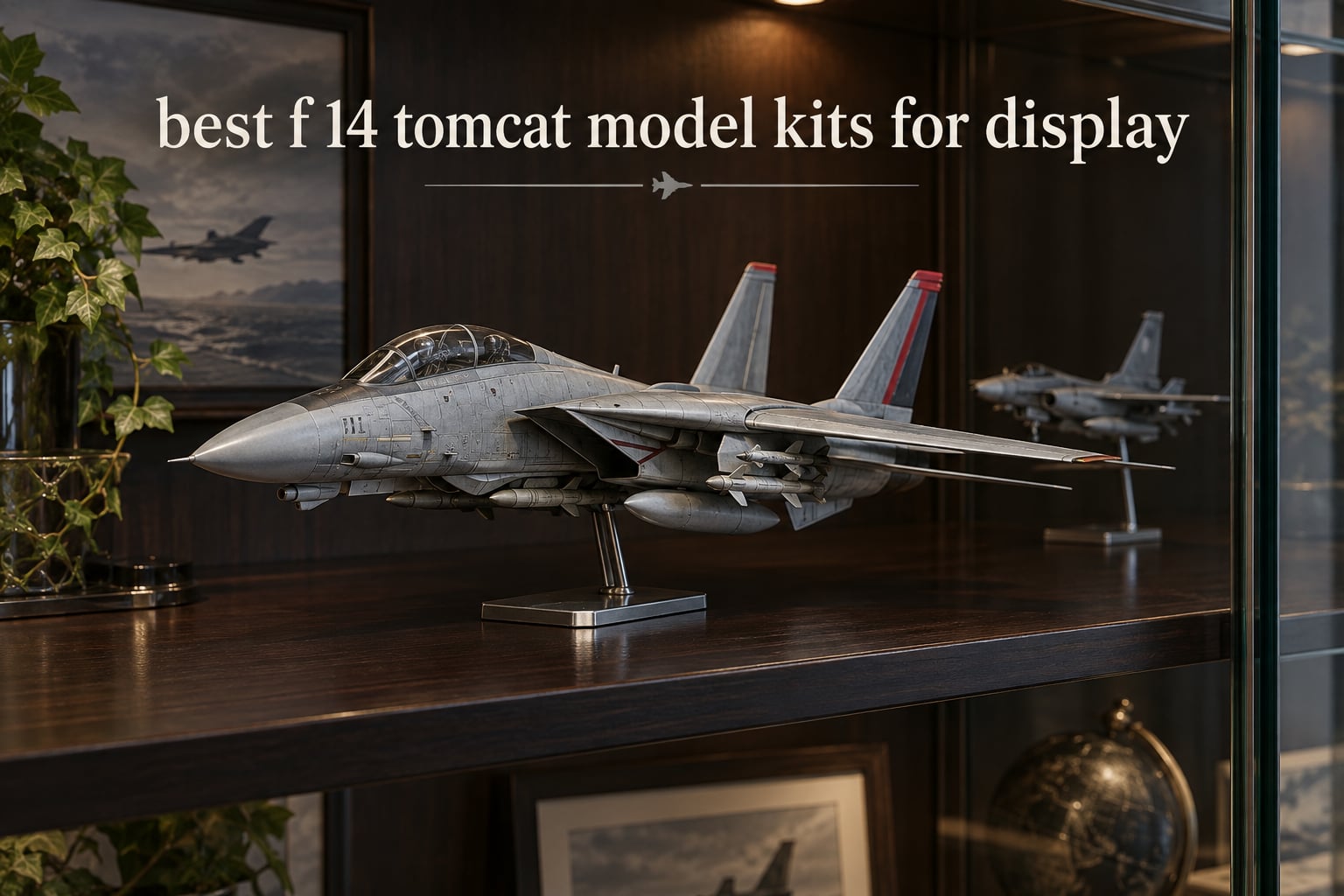
The best F-14 Tomcat model kits for display are the ones whose finished shape, markings and pose survive a lit shelf at arm’s length. Accuracy matters, but a kit that needs forty hours of filler and rescribing will never get there, and neither will one whose decals silver under clear coat. I compared ten F-14 Tomcat model kits from 1/144 up to 1/32, checked the moulding and fit data behind each one, and ranked them purely on how good they look once they are behind glass.
The F-14 Tomcat is a two-seat, twin-engine, variable-sweep-wing fighter that served the US Navy from 1974 to 2006, famous for its AWG-9 radar, the AIM-54 Phoenix missile and a starring role in Top Gun. What makes it such a good modelling subject is also what makes it confusing: dozens of liveries, four airframe variants and a bombcat modification mean two kits of the same aircraft can look nothing alike on a shelf.
That is why I built this guide differently from a typical kit list. Every entry here tells you the moulded detail you get, the fix-up work the kit demands, the decal situation and the actual shelf footprint of the finished model. I have also included a buyer-friendly set of kits alongside the collector-grade options, so you can see the whole field in 2026 before you commit to a build.
If you are just starting out, our broader [F-14 Tomcat model kit guide](https://www.comstock-interactivedata.com/best-f-14-tomcat-model-kits/) covers entry-level picks in more depth. This page is the display-first shortlist.
Table of Contents
Top 3 Best F 14 Tomcat Model Kits For Display (October 2026)
Three kits rise above the rest once display quality, not build hours, sets the score.

Tamiya 1/48 Grumman F-14A
- Crisp recessed panel lines
- Parts that fit with minimal cleanup
- Large aftermarket support

Italeri 1/48 F-14A Tomcat
- Three different air detachments in one box
- Complete 1:48 airframe
- Well executed ordnance and drop tanks

Tamiya 1/48 Grumman F-14D
- Movable sweep wings
- Full Phoenix Sparrow and Sidewinder load
- Advanced detail throughout
All 10 F-14 Tomcat Model Kits Compared for 2026
Every kit in this roundup, with the details that decide how it looks on a shelf.
| Product | Specifications | Action |
|---|---|---|
| Tamiya 1/48 Grumman F-14A Tomcat |
|
Check Latest Price |
 COBI Top Gun F-14A Tomcat 1:48 Brick Set COBI Top Gun F-14A Tomcat 1:48 Brick Set |
|
Check Latest Price |
 Revell F-14D Super Tomcat 1:72 Revell F-14D Super Tomcat 1:72 |
|
Check Latest Price |
 Revell Maverick’s F-14A Tomcat 1:48 Top Gun Revell Maverick’s F-14A Tomcat 1:48 Top Gun |
|
Check Latest Price |
| Tamiya 1/48 Grumman F-14D Tomcat |
|
Check Latest Price |
| Italeri 1/48 F-14A Tomcat |
|
Check Latest Price |
 Tamiya 1/32 F-14A Tomcat Black Knights Tamiya 1/32 F-14A Tomcat Black Knights |
|
Check Latest Price |
 Guillow’s F-14 Tomcat 1:40 Balsa Kit Guillow’s F-14 Tomcat 1:40 Balsa Kit |
|
Check Latest Price |
 Academy 1/72 F-14B VF-103 Jolly Rogers Academy 1/72 F-14B VF-103 Jolly Rogers |
|
Check Latest Price |
 Revell Grumman F-14A Tomcat 1:144 Revell Grumman F-14A Tomcat 1:144 |
|
Check Latest Price |
How We Picked the Best F-14 Tomcat Model Kits for Display?
Display quality is not the same as build quality, so I scored every kit against seven criteria drawn from what modellers actually argue about online.
Shape accuracy at a glance. Does the finished silhouette read correctly from across a room, or are the intakes and glove vanes wrong enough to notice.
Fit and cleanup burden. How much filler, sanding and rescribing stands between the sprue and a good gloss coat.
Surface detail quality. Whether panel lines are recessed and in scale, since raised lines read as cheap under display lighting.
Decal thickness and opacity. Thin, print-style decals sit flat; thick carrier film silver and need wet sanding at 1500 grit.
Markings range. How many liveries the box supports, which decides whether one kit or a squadron fills the shelf.
Pose options. Working sweep wings, gear-down or airborne presentation, and whether a stand is supplied.
Display footprint and weight. The finished dimensions and whether the base can actually carry the model.
Expert builders check cockpit accuracy before anything else, and I weighted moulding quality heavily because that is the one thing no amount of painting can fix.
1. Tamiya 1/48 Grumman F-14A Tomcat: The Best All-Rounder for Display
1:48 Tamiya Grumman F-14A Tomcat Model Kit
Scale: 1/48
Kit number 61114
Skill: intermediate to advanced
Made in Japan
Pros
- Crisp recessed panel lines and rivet detail
- Parts fit with very little corrective work
- Clear illustrated instructions
- Strong aftermarket decal and photo-etch support
Cons
- Too choice-heavy for a first aircraft build
- Decals are thick and may need sanding after glossing
- Tools and paint sold separately
This is the kit I recommend to anyone who wants one F-14 on a shelf that still looks good a year later. Owners consistently describe flawless manufacturing, parts that fit together with little work, and impressed surface detail with crisp recessed panel lines. At 1/48 the Tomcat is roughly 40cm long, so it reads clearly on a standard shelf rather than disappearing into the back of a cabinet.
The cockpit is a genuine 1/48 tub with two ejection seats, and the instructions are the ones Tamiya still uses as a benchmark. For a display build you can follow the sheet, complete the airframe in sections, and paint each section separately, which suits a builder who does not want to hold a fully assembled Tomcat while spraying it.
Two caveats sit alongside that praise. Builders report that the kit is choice-heavy and a poor choice for a first or second aircraft build, and that the decals are thicker than professionals like and may need wet sanding after a gloss coat. Neither issue is visible on a finished shelf once the sanding is done.
The aftermarket path here is the deepest of any kit in this roundup: correction decals, photo-etched brass sets, resin nozzles and seats, and a large range of Tomcat decal sheets. If you want to fine-tune an F-14A further, this is the mould you can fine-tune.
Is it worth building for a first big aircraft model?
Only if you have built at least one smaller kit and are comfortable reading a long instruction booklet. Experienced modellers call it close to faultless out of the box, and the difficulty is choice density rather than difficult assembly. A first-time builder who wants a clean result should start smaller.
How much shelf space should you plan for?
Allow roughly 40cm of length plus a few centimetres for the nose and tail overhang, and a stand or base underneath. That footprint fits a standard bookcase shelf comfortably, unlike the 1/32 kits. Depth matters too, because gear-down poses and open airbrakes add a few centimetres behind the tail.
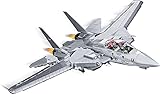
2. COBI Top Gun F-14A Tomcat 1:48 Brick Set: The Fastest Route to a Finished Display Piece
COBI TOP Gun™ F-14A Tomcat, 1:48 Scale, 757 Pieces, 2 Figures
Scale: 1/48
757 elements
Ages 8 and up
Display stand included
Pros
- Very accurate shape and proportions
- Pieces snap together cleanly
- Printed Maverick and Goose figures
- Moving wings and retractable gear
- No decals to apply or lose
Cons
- Missiles and wheels detach easily
- Wobbly display stand under the weight
- Canopy is hard to close with figures seated
This is not a styrene kit and I want to be clear about that. It is a 757-element brick set built under official Top Gun and Northrop Grumman licence, and it has by far the largest review base of anything in this roundup at nearly 1,700 ratings. For a display shelf it delivers a recognisable F-14A with working sweep wings, retracting gear and detailed underwing weaponry in an afternoon.
The proportions are the surprise. Reviewers single out the accuracy of the shape, including the canted twin engine intakes, and the Maverick and Goose figures are full size with printed helmets. Markings are pad-printed directly onto the elements, so there is no decal film to silver, wrinkle or lose, which is the single biggest display risk with traditional kits.
The recurring complaints are structural rather than cosmetic. Missiles and wheels detach easily and need model cement, the nose cone can pop off when the model is moved, the wing sweep panels move independently instead of being geared together, and the included stand is wobbly under the weight. The canopy is also difficult to latch with both figures seated.
Owners treat it as a display object rather than a play set, and the consensus advice is to cement the small parts and handle it gently. Cementing the loose ordnance in place takes ten minutes and removes the main fragility complaint.
Is it a real scale model or a toy?
It is a licensed brick replica at 1:48 proportions, measuring 38.5 by 27 by 10.5cm, so it sits in the same footprint as a styrene 1/48. It will not satisfy anyone who wants recessed panel lines or a detailed cockpit tub, and it is not paintable, but as a shelf object it is accurate in silhouette and proportions.
Who is this actually for?
Gift buyers, younger builders and anyone who wants a Top Gun F-14 in the cabinet without picking up a cement bottle. It is also a sensible companion piece if you already own a detailed styrene Tomcat and want a matching brick-built model of the same airframe.
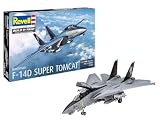
3. Revell F-14D Super Tomcat 1:72: The Best Weekend Build
Revell F-14d Super Tomcat 03960 1:72 Scale
Scale: 1/72
Kit number 03960
111 pieces
Ages 10-18
Pros
- Accurate surface detail for the scale
- Fine panel lines that read without extra work
- Off-white plastic close to the real scheme
- Small and light enough for a weekend
Cons
- Smaller than photos suggest
- Paint and glue sold separately
- A few tricky assembly steps
The Revell 03960 is the fastest route to a properly finished D-model on a crowded shelf. At 1/72 it comes in at 260mm long with a 268mm wingspan, and the finished piece sits comfortably alongside 1/144 kits in a small cabinet while still holding its shape under display lighting.
What stands out in the reviews is the moulded surface quality. Reviewers praise accurate surface detail and fine panel lines that read well without extra work, and several note that the kit ships in cream or off-white plastic close to the real Navy F-14D scheme, which cuts paint time on the underside and radome.
The most common note is that the finished model is more compact than expected from the box art, and a few assembly steps are fiddly. Several people describe it as a good mid-range project rather than a first-timer’s kit, and it is rated for ages 10 to 18.
It is also the easiest recommendation in this roundup for a squadron display. A four-aircraft VF-103 or Wolfpack line-up fits on a single shelf, and the kit stays comfortable to handle while you work on it.
Will it hold up next to a 1/48 kit?
It will, as long as you set the scale deliberately. A 1:72 Tomcat is physically smaller but has finer panel lines relative to its size, and the two sit together acceptably when both are on stands with a little spacing. Mixing a 1:48 next to a 1/144 on the same shelf is where the mismatch becomes obvious.
Is it suitable for a first kit build?
It is approachable for an adult beginner who has some experience with cement and paint, but it is not a snap kit. A few steps need care, and you will still need your own paint and glue. If you want something that builds with no tools at all, the Revell 1/144 later in this guide is the safer starting point.
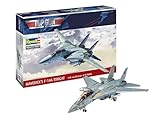
4. Revell Maverick’s F-14A Tomcat 1:48 Top Gun: The Movie Scheme on a Shelf
Revell 03865 Maverick’s F-14A Tomcat Top Gun 1:48 Scale Unbuilt/Unpainted Plastic Model Kit
Scale: 1/48
Kit number 03865
97 pieces
Skill level 4, ages 12 and up
Pros
- Recognisable 1:48 film scheme
- Cockpit with two pilot seats and flight sticks
- Articulating wings
- Includes a Maverick pilot figure
Cons
- Thin fragile waterslide decals with many tiny markings
- Only the front pilot figure is included
- Multi-piece canopy does not articulate properly
If your display shelf is organised around the film rather than around squadrons, this is the kit. The 1:48 Maverick scheme is the one most people picture when they think of the F-14A, and this Revell kit renders it with articulating wings and a cockpit tub carrying both pilot seats and flight sticks.
At 40cm long and 96 to 97 pieces, it is a manageable size for a cabinet, and the included Maverick pilot figure gives the open cockpit something to look at. It is rated as a level 4 detailed kit for advanced model builders, ages 12 and up.
The movie scheme is also the least demanding paint job in this roundup, because the bright overall finish hides thin areas and small errors better than a low-visibility grey. That partly offsets the decal difficulty. Set the decal sheet aside and work with a setting solution, and expect to do the many tiny cockpit markings in several small batches rather than one pass.
It also attracts more criticism than the Tamiya kits here. The dominant complaint is the waterslide decal sheet, which reviewers describe as thin, fragile and hard to apply, with a large number of tiny cockpit markings that stretch rather than settle. Canopy fit is the second issue, and swept wings are hard to fit and can bind when fully opened.
Only the front pilot figure is supplied, so the rear seat where Goose sits is empty, which is an odd omission for a kit sold on the film scheme. Several long-form reviews also note that the instruction paint callouts do not match the real aircraft or the film colours, so plan on choosing your own shades.
Is the film scheme the same as the real aircraft scheme?
No, and this matters if accuracy is your goal. The movie Tomcat is brighter and cleaner than a real Navy grey, and builders report the callout colours in the booklet do not match either the film or the real aircraft. If you want a historically accurate F-14A on display, pick the Tamiya or Italeri 1/48 instead.
How should I handle the decal sheet?
Set it aside and work with a setting solution, and expect to do the cockpit markings in several small batches rather than one sheet. Reviewers flag the tiny items as the real problem, not the large markings. If decal work is a weak point for you, budget extra time or source an aftermarket film for the scheme.
5. Tamiya 1/48 Grumman F-14D Tomcat: The Most Complete D-Model You Can Build
Tamiya 61118 1/48 Grumman F-14D Tomcat Plastic Model Airplane Kit
Scale: 1/48
Kit number 61118
Skill: advanced
F-14D weapons load included
Pros
- Very little sanding and no putty required
- Sharp panel lines sized for 1/48
- Full Phoenix Sparrow and Sidewinder load
- Four crew figure options
Cons
- Wing assembly is the most involved part of the build
- Gear bays not designed to be shown open
- Occasional small moulding nicks
The D is the most technically interesting Tomcat and this is the kit that captures it. Reviewers describe the engineering as excellent, with parts fitting so precisely that sections can be built, painted and finished separately before final assembly, and very little sanding and no putty required to complete the build.
The headline feature is the wing. Tamiya supplies two sets of interchangeable position parts and sealing plates so the wings can sit fully swept or fully forward, with honeycomb inserts that give the sweep a satisfying action, and poly caps that let the horizontal stabilisers move. For a display model that is the difference between a static shell and something you can pose.
The ordnance list is the most complete in this roundup, with late-variant Phoenix, Sparrow and Sidewinder missiles, drop tanks, laser and GPS guided bombs, a LANTIRN targeting pod, a TARPS reconnaissance pod and a jamming pod. Four crew figure options and a detailed cockpit with ejection seats let you stage a two-seat crew or a deck crew.
The trade-offs are practical. Wing assembly is the most involved part of the build and takes patience, the kit is not designed to be finished in gear-down mode without modifying the bay doors, and small moulding nicks occasionally need sanding before painting. It is an advanced-level kit and treats you like an adult modeller.
Should I build it with wings swept or spread?
Spread wings over a gear-down parking pose is the most readable display configuration because it fills shelf space and shows the planform. A swept airborne pose is more dramatic and more accurate to how the aircraft actually flew. Both are supported out of the box thanks to the two sets of position parts, so the choice is purely aesthetic.
Is it worth the effort over the F-14A version?
If you want one Tomcat, the A is the easier and safer build. If you want the aircraft that carried the APG-71 radar, the F110 engines and the full pod and missile options, this is the kit, and the gear-down limitation is the only real reason to pause. A closed-gear airborne pose removes that concern entirely.
6. Italeri 1/48 F-14A Tomcat: The Best Value in the Mid Scale
Pros
- Excellent value in the 1/48 band
- Decal options for three different air detachments
- Well executed ordnance and drop tanks
- Acceptable landing gear fit
Cons
- Nose to fuselage fit needs filling and sanding
- Panel lines less crisp than Tamiya's
- Cockpit missing a few interior details
The Italeri 2667 is the one to buy when you want two or three 1/48 Tomcats on the same shelf without doubling your budget. Buyers present it as the budget option in its scale, accepting dated techniques and slightly soft panel lines in exchange for a complete, well-moulded aircraft at a fraction of the Tamiya cost, and it is the kit most often recommended when price pushes a modeller toward a second airframe.
The standout feature is the decal option set. One kit supports three different F-14A air detachments, which means you can display a trio of grey Tomcats in three liveries without buying three boxes, or finish one in one scheme and keep the other options for later.
External ordnance and drop tanks are well executed, cockpit detail is adequate, and the landing gear fits acceptably. Model length is approximately 39.3cm, essentially the same shelf footprint as the Tamiya 1/48, so this is a straight swap on an existing display.
The complaints are consistent and easy to plan around. Fit of the nose to the fuselage is marginal and needs filling and sanding, panel line detail is not as crisp as Tamiya’s, some techniques are dated compared with newer kits, the cockpit is missing a few interior details, and the instructions could be clearer.
Is the panel line softness visible on a display shelf?
Under a display cabinet at normal viewing distance, no. It becomes visible when you put the model next to a kit with recessed in-scale panel lines, or when raking light crosses the surface. If your shelf already holds a Tamiya or fine-detail 1/48, that comparison will happen, so keep this one on a different shelf or accept the mismatch.
Who should skip this kit?
Skip it if crisp recessed detail is the point of your build, or if you are not prepared to do filler and sanding on the nose joint. It is a level 3 kit aimed at adult modellers, and the dated instruction style can be frustrating if you are used to modern Tamiya or Academy walkthroughs.
7. Tamiya 1/32 F-14A Tomcat Black Knights: The Centerpiece That Fills a Cabinet
Tamiya F-14A Tomcat Black Knights 1/32 Aircraft (TAM60313)
Scale: 1/32
Kit number 60313
598mm length, 612mm width
Three crew figures included
Pros
- Commanding size and accurate airframe rendering
- Metal parts and screws make the wing genuinely move
- Large full armament range
- Decals for five aircraft
Cons
- Very large footprint needs substantial display space
- Advanced build with many parts
- Heavy enough to demand a sturdy stand
Nothing else in this roundup changes a room the way a 1/32 Tomcat does. Overall length is 598mm and overall width 612mm, so this is roughly a 60cm object with wings spread, and owners consistently describe it as a commanding display piece. If your cabinet can take it, this is the kit that becomes the centrepiece.
The engineering justifies the scale in one specific way: the kit employs metallic parts and screws to make the wing genuinely movable, rather than relying on friction. Reviewers single that out because it is the mechanism that toy-grade and injection kits at smaller scales cannot match.
The contents are extensive. A full range of armament is provided including Phoenix missiles, GBU-16 and GBU-24 laser guided bombs, plus an AN/AAQ-14 LANTIRN targeting pod, and the box carries three figures, two pilots and a catapult officer, with decals for five aircraft. That combination makes it easy to stage a carrier scene rather than a single parked model.
The costs are size, weight and build time. It is an advanced build with a significant number of parts, and once complete the model is heavy enough that it requires a sturdy display stand. Measure the cabinet opening before you start, not after.
How much display space do I actually need?
Plan for a footprint of roughly 62cm by 62cm plus a few centimetres of clearance for the nose and a stand underneath. Depth needs to accommodate the gear and ordnance. It fits a deep single shelf or a two-tier stand, and it should not sit on a standard bookcase with a 30cm depth.
Is the 1/32 worth it if I already own a 1/48?
If your existing 1/48 looks small in the cabinet, yes, and the difference is dramatic at that scale. If your display is already satisfying at 1/48, the 1/32 buys you mechanism quality and detail rather than a new subject, and the storage and handling demands grow sharply. Many builders buy it as a one-off long-term project.
8. Guillow’s F-14 Tomcat 1:40 Balsa Kit: The No-Paint Display Route
Guillow’s F-14 Tomcat Model Kit
Scale: 1/40
Kit number 1402
Balsa skeleton construction
Made in the USA
Pros
- High quality die-cut balsa and molded plastic parts
- Tissue covered and pre-decorated with insignia
- Light rigid display piece
- Arrives close to finished
Cons
- Limited long-term build feedback from few reviews
- Pre-applied covering limits re-decorating
- Not a paintable styrene kit
Not every F-14 on a shelf has to come out of a spray booth. The Guillow’s 1402 is a balsa skeleton build at 1/40, constructed from die-cut balsa wood with molded plastic parts and covered in tissue, and it arrives already decorated with decal insignia. Reviewers describe it as an eye-catching replica that is close to finished out of the box.
The construction is genuinely useful for display. Balsa skeleton framing makes a light, rigid model that is far less likely to be damaged by handling or by a shelf edge than a large injection-moulded airframe, and the 1/40 scale sits between 1/48 and 1/32 in apparent size.
Review volume is low, which is the honest caveat here. There are 35 ratings on record, so there is limited long-term build feedback compared with the styrene kits here, and you are committing on thinner evidence. The second limitation is that the pre-applied tissue and decals cannot really be undone if you want to re-decorate the aircraft.
Can I paint or re-decorate it?
Not realistically. The tissue covering and factory-applied insignia are the finished surface, and the balsa frame underneath is structural. If your display is a single coordinated scheme, this works well as a filler piece. If you want to match liveries across the shelf, choose a styrene kit instead so you control the finish.
How does it look beside an injection-moulded kit?
Very different, and that is the point. The Guillow’s is a polished, factory-decorated presentation piece, while a styrene model carries your own paint and decal work. Mixing the two on one shelf is fine if you want the balsa model to read as a separate display object, and obvious if you are aiming for a uniform squadron line-up.
9. Academy 1/72 F-14B VF-103 Jolly Rogers: The Most Accurate 1/72 Mould
Academy 1/72 US Navy F-14B Tomcat VF-103 Jolly Rogers Plastic Model 12578
Scale: 1/72
Kit number 12578
262mm length, 271.5mm wingspan
Weapons molded on the sprue
Pros
- Crisp recessed panel lines that take washes well
- Excellent part fit and fuselage joints
- Strong silk-screen printed decals
- Working sweep wings and open intake tunnels
Cons
- Sweep wings are not linked between sides
- Airbrake and boarding ladder are fixed position
- Small moulding nicks and a nose step to clean up
The Academy 12578 is the kit expert builders point to in the 1/72 band. Reviewers, including professional modellers, single it out as a standout for its recessed detail, part fit, positioning accuracy and unusually good silk-screen decals, and one rates it in the low nineties out of a hundred and recommends it over more expensive options.
That decal quality is the headline. Silk-screen printed decals are thinner and more opaque than waterslide film of the same nominal quality, so they conform without silvering and need no wet sanding, which is the single most common complaint aimed at other kits in this roundup.
The full weapon set is molded on the sprue rather than sold separately, including AIM-9, AIM-7, AIM-54A, GBU-12 and a LANTIRN pod, plus spares. The wings sweep and the intake tunnels open, and the kit can be finished in high or low visibility Jolly Rogers schemes.
The limitations are mechanical rather than cosmetic. The variable sweep wings do not move in a linked fashion, so one side leads the other, and the boarding ladder, airbrake and some gear bay doors can only be built in one fixed position. There are also small moulding nicks including one in the middle of the windshield, a slight step between the nose sections, and a canopy frame that can interfere when closed.
Is it worth switching from a Revell 1/72 to this one?
Yes, and the decals are the reason most builders do. Revell’s F-14D 03960 is the easier weekend kit, while the Academy gives you recessed panel lines, better part fit and markings that do not need sanding. Build the Academy if display quality is your priority and you have time to clean up a handful of nicks before painting.
Keep the Revell as well if you want the D variant, because this Academy box is the F-14B. One covers the accuracy and marking quality gap, the other covers the D-specific rear cockpit and engine differences, and together they make a clean matched pair at the same scale.
Should I build it in high-vis or low-vis Jolly Rogers?
If you have other grey Tomcats on the shelf already, low-vis keeps the line-up coherent. If this is your only 1/72 and you want the scheme people recognise instantly, the high-vis Jolly Rogers is the stronger display statement. The decal quality is good enough that either looks sharp under cabinet lighting.
One practical note: the weapons are molded on the sprue rather than supplied as separate options, so a clean gear-up launch pose is simpler than a loaded parking pose. Decide the pose before you cement the ordnance in, because the sprue is shared.
What needs fixing before painting?
Three things. Fill and sand the slight step at the nose-to-fuselage and radome-to-nose joints, scrape the small moulding nicks including the one in the middle of the windshield, and trim the canopy internal frame so it clears when closed. That is a short evening of work for a model that then needs almost nothing else.
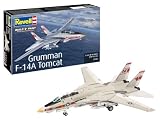
10. Revell Grumman F-14A Tomcat 1:144: The Smallest and Simplest Display Option
Revell Modellbau Grumman F-14A Tomcat Set – 1:144 Scale – Swivel Wings & Movable Control Surfaces – VF-1 Wolfpack Decals – US Navy Fighter Plane – Perfect for Jet & Top Gun Fans
Scale: 1/144
Kit number 03782
13 x 13.4 x 4.3 cm assembled
Younger builders
Pros
- Very easy to assemble for a child around eight
- Good detail for the scale
- Movable wings elevators and rudders
- VF-1 Wolfpack decals included
Cons
- Small size disappoints buyers expecting a larger model
- Fiddly small parts such as the wheels
- Less refinement than the 1/48 and 1/72 kits
At 1/144 the Revell 03782 measures 13 by 13.4 by 4.3cm assembled, which makes it the most practical kit here for a crowded desk, a small cabinet or a gift. Owners treat it as a simple, beginner-friendly shelf model, and the small parts count is low enough that a child can complete it.
You still get some articulation. The swivel wings, elevators and rudders can all be moved to represent different flight phases, and the decals cover VF-1 Wolfpack markings from Operation Frequent Wind aboard USS Enterprise in 1975, which is a nice historical touch for a small model.
The main complaint is simply size. Buyers expecting a larger model are disappointed, and that is the inherent trade-off of 1/144 rather than a fault in the kit. Small parts such as the wheels are fiddly, though owners note they are not essential to the build.
Is it too small to display well?
It depends on the shelf. On a desk or in a small glass cabinet it reads clearly, especially with wings spread, and a group of them makes a convincing carrier deck scene. On a large display shelf with 1/48 models beside it, it will look lost, so keep it on its own shelf or in its own case.
Is it a good first model kit?
It is one of the friendliest first builds in this roundup, with an age guide that suits younger builders and simple enough assembly steps. It is also a good second purchase for an adult who already owns a detailed Tomcat and wants a shelf filler or a companion piece rather than a project.
Buying Guide: Picking the Right F-14 Tomcat Kit for Your Shelf
Scale is the decision that matters most, because it fixes the shelf footprint, the build hours and the level of detail on offer.
How big is the model at each scale?
At 1/72 the Revell F-14D is 260mm long with a 268mm wingspan, and the Academy F-14B is 262mm long with a 271.5mm wingspan. At 1/48 both the Revell and the Italeri are around 39 to 40cm, and at 1/32 the Tamiya Black Knights measures 598mm by 612mm. The Revell 1:144 is 13 by 13.4cm, and the Guillow’s 1/40 sits between 1/48 and 1/32 in apparent size.
Measure your shelf opening before choosing, and remember that a stand, a base and a gear-down pose all add depth behind the tail. For our broader thoughts on cabinets and lighting, our [diecast model display case roundup](https://www.comstock-interactivedata.com/best-diecast-model-display-cases/) covers the case and dust-protection side of things, and the same principles apply to injection-moulded kits.
Which F-14 variant should you pick?
The A is the baseline airframe with TF30 engines and the AWG-9 radar, and it is the most widely produced kit. The B and the D carry F110 engines, and the D adds the APG-71 radar in the rear cockpit plus the LANTIRN pod and updated Phoenix missile, so a D kit gives you more optional parts to work with. The bombcat is the anti-submarine modification with bomb pylons fitted instead of the standard arrangement.
Accurate modellers check the rear cockpit and the engine nozzles first, because those are the features that separate an A from a B or a D on the model. If you want a D and your kit is an A, the substitution is visible in the exhaust and the rear cockpit instrument panel, and the Tamiya 1/48 D is the kit that avoids the problem entirely.
What do you need beyond the kit?
Every styrene kit here needs cement and paint, and none of them include it. Beyond that, a sharp scalpel, a sanding stick or file, panel lining wash, a good cutting mat and a hobby knife cover the majority of finishing work. Decal setting solution is worth having for the kits with thin waterslide sheets, and wet sanding at 1500 grit is what makes thick Tamiya or Revell decals disappear into the surface.
For mounting, removable mounting putty or a small acrylic riser is safer than a permanent adhesive, and a metal or acrylic stand is a better answer for the heavier 1/32 and 1/48 models than a plastic display base. If you also build rockets, our [scale model rocket kit roundup](https://www.comstock-interactivedata.com/best-scale-model-rocket-kits-for-display/) covers the display hardware in more detail.
How do you protect a finished model?
Keep it inside a closed cabinet or acrylic case, away from direct daylight, because UV exposure fades grey schemes and grey plastics over time. Dust is the bigger everyday risk on a shelf, and a closed case solves it. Keep paint and thinner in a separate sealed box, not in the display area, and handle a large model from the base rather than the wings.
What if you want a whole squadron?
Build at 1/72 and buy multiple kits. A 1:72 Tomcat builds in a fraction of the time of one 1/48 model, so a four-aircraft shelf is a realistic weekend project rather than a season. The Academy box supports multiple Jolly Rogers schemes on its own, and the Italeri 1/48 gives you three air detachment decal options from a single kit, which is the cheapest way to get variety at a larger scale.
If you want to compare how different brands handle the same aircraft, our [Lindberg model kit reviews](https://www.comstock-interactivedata.com/best-lindberg-model-kits/) cover the same fit-and-finish questions on airliner kits, and our [ISS kit buying guide](https://www.comstock-interactivedata.com/best-iss-international-space-station-model-kits/) does the same for a very different kind of build.
Frequently Asked Questions
Which F-14 Tomcat model kit is considered the best?
For most display builders the Tamiya 1/48 Grumman F-14A is the best overall choice, because its recessed panel lines are crisp, the parts fit with very little corrective work, and the aftermarket support for decals, photo-etch and resin is the deepest of any F-14 kit. If you want the F-14D with its full weapons load and movable sweep wings, the Tamiya 1/48 D is the premium pick, and the Academy 1/72 VF-103 Jolly Rogers is the standout if you want accuracy at a smaller scale.
What model F-14 was in Top Gun?
The aircraft in Top Gun is the F-14A Tomcat, the first production version of the type, recognisable by its twin engine nacelles under the wing roots, its two-seat cockpit and its variable-sweep wings. An F-14A is what you see in the film, which is why the Revell 1/48 Maverick’s F-14A and the COBI Top Gun set both depict that specific variant. Later A, B and D models look similar in silhouette but differ in engines, rear cockpit radar and tail markings.
Are any F-14 Tomcats still flying?
The F-14 Tomcat left US Navy service in 2006 and no operational squadron flies it today. Several air museums and private owners keep airframes in flyable condition, and the type is still flown at airshows and on display flights in a few countries. That limited remaining use is a large part of why collectors value Tomcat kits, since the markings options span three decades of real Navy schemes.
What is an F-14 Tomcat model kit?
An F-14 Tomcat model kit is a multi-part plastic assembly set that reproduces the US Navy variable-sweep-wing fighter at a stated scale such as 1:72, 1:48 or 1/32. You cut the parts from sprues, cement and detail them, paint and weather them, then apply decals for squadron markings before finishing with clear coats. For display you then mount the finished model on a stand or base inside a dust-protected cabinet.
What scale F-14 Tomcat model is best for a display case?
The 1/48 scale is the best all-round choice for a standard display case, because the model lands at roughly 40cm long, fits an ordinary shelf and still carries enough panel line and cockpit detail to look right under display lighting. Choose 1/72 if your shelf is small or you want a multi-aircraft squadron, and choose 1/32 only if you have a cabinet with at least 62cm of clear footprint for a single model.
Conclusion: The Best F-14 Tomcat Model Kits to Build in 2026
The Tamiya 1/48 F-14A remains the best F-14 Tomcat model kit for display overall, because it combines crisp recessed detail, minimal cleanup and the widest aftermarket support in the field, and it lands at a size that fits an ordinary shelf. For the D-variant detail and the full weapons load, the Tamiya 1/48 F-14D is the premium choice, and it is the only kit here with metal-fitted wing movement at a manageable size.
Below that, the Academy 1/72 VF-103 Jolly Rogers wins on accuracy and decal quality, the Italeri 1/48 wins on value and markings variety, the Revell 1/72 F-14D is the easiest weekend build, and the Tamiya 1/32 Black Knights is the choice if your cabinet can take a 60cm centrepiece. Measure the shelf, pick your variant, and then let the mouldings decide.