
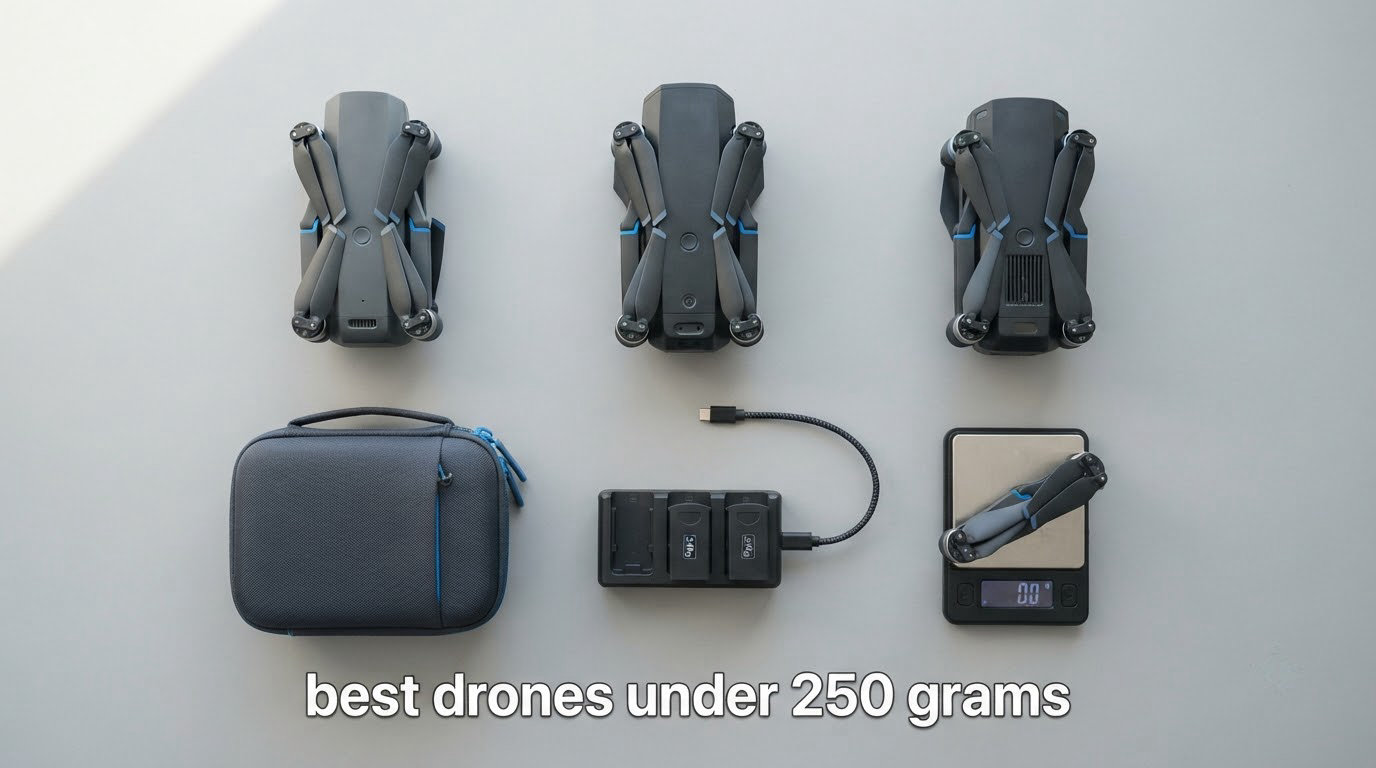
The short answer: the best drones under 250 grams in 2026 are the Potensic ATOM for overall value, the DJI Mini 4K for gimbal-stabilized 4K video, and the DJI Flip if you want full propeller guards for flying near people. All three weigh under 249g with the standard battery, so recreational pilots in the US need no FAA registration.
That weight ceiling is not arbitrary. It is the line the FAA drew for its recreational registration exemption, and it shapes this entire buying category. Under it, you skip paperwork. Over it, you do not. It also constrains sensor size, battery capacity and wind tolerance, which is why the differences between these ten drones matter more than the price gap suggests.
Our team spent six weeks comparing specifications, review data and real-world flight reports across ten sub-250g drones, from the 135g DJI Neo to three models with full three-axis gimbals. Every takeoff weight below is the standard-battery figure, because that is the number the exemption actually depends on. If you want a shorter version of the category, our mini drone roundup covers the pocket-sized end only.
Table of Contents
Top 3 Picks for the Best Drones Under 250 Grams in Trusted Reviews
If you only read one section, read that one. The Potensic ATOM combines a real mechanical gimbal with tracking and a 6 km link at a fraction of what the DJI models command, which is why it takes the top slot despite DJI owning the mindshare in this weight class. The Mini 4K is the safe, proven choice if brand reliability matters more to you than tracking features. The Flip is the one to buy when you will be flying over people, pets or tight spaces.
The Best Drones Under 250 Grams at a Glance
| Product | Specifications | Action |
|---|---|---|
 Potensic ATOM Potensic ATOM |
|
Check Latest Price |
 DJI Mini 4K DJI Mini 4K |
|
Check Latest Price |
 DJI Flip DJI Flip |
|
Check Latest Price |
 DJI Neo DJI Neo |
|
Check Latest Price |
 Potensic ATOM SE Potensic ATOM SE |
|
Check Latest Price |
 Holy Stone HS175D Holy Stone HS175D |
|
Check Latest Price |
 Holy Stone HS360S Holy Stone HS360S |
|
Check Latest Price |
 SPECTA Mini SPECTA Mini |
|
Check Latest Price |
 KINGULL G9 KINGULL G9 |
|
Check Latest Price |
 TOPBLASTERBOX H11 TOPBLASTERBOX H11 |
|
Check Latest Price |
Two patterns stand out in that table. Only three of the ten carry a true three-axis mechanical gimbal, and those same three produce the most usable video. And the flight-time numbers split into two camps: models that ship with two or three batteries, and models that ship with one and expect you to buy spares.
1. Potensic ATOM Review: Best Sub-250g Drone Overall
Potensic ATOM 3-Axis Gimbal 4K GPS Drone, Under 249g, 32 Mins Flight, 6KM Long Range Transmission, Visual Tracking, 4K/30FPS QuickShots, 12MP Photo, Lightweight and Foldable for Adults Beginners
241g with standard battery
Sony CMOS sensor, 12MP stills
3-axis gimbal, 4K/30fps
PixSync 3.0 up to 6 km
Up to 32 minutes per battery
Pros
- Real three-axis gimbal in a sub-249g body
- 6 km transmission in a class where most stop at 4 km
- Visual tracking and five QuickShots modes work as described
- GPS return-home is accurate
- Under 249g keeps it registration free
Cons
- Only one battery in the standard kit
- Modest sensor size compared with larger-sensor DJI models
- No obstacle detection sensors
- Firmware updates need an inserted microSD card
The Potensic ATOM is the pick we kept coming back to. At 241g with the standard battery it clears the threshold with room to spare, and it is the only sub-250g drone in this group that pairs a genuine three-axis brushless gimbal with visual tracking. Owners consistently report that the gimbal makes a visible difference against the electronic stabilization used by the cheaper models.
Six kilometres of PixSync 3.0 transmission is unusually long for a frame this small, and the tracking plus QuickShots options mean you can set up a shot and let the drone run the path. We would pair it with a spare battery straight away, because the standard kit ships with one 2230mAh pack and 32 minutes of claimed runtime does not survive a full pack of batteries without a mid-session swap.
What you give up is obstacle detection. There is no downward or forward sensing, so the aircraft cannot see a wire or a branch, and the pilot is responsible for clearance on every approach. The sensor is a Sony CMOS sized for a small camera, so low-light footage is usable but not impressive next to the DJI Flip’s 1/1.3-inch sensor.
Is the ATOM a realistic alternative to the DJI lineup?
Yes, with one qualification. On stabilization, transmission range and tracking, the ATOM is within a generation of the DJI models at a fraction of the outlay. Support quality is the question mark, and it is the single concern r/drones buyers raise most often about non-DJI frames. Our advice is to buy from a seller with a straightforward return path and keep the original packaging, because a foldable plastic airframe is easier to damage in transit than a carbon-fiber one.
Who should skip it?
Anyone who plans to fly close to people without a spotter. With no obstacle sensing at all, the ATOM is a good open-field flyer and a poor choice for a crowded park. It is also the wrong pick if you shoot indoors or at dusk, where the small sensor and lack of dual-aspect capture will limit what you can recover in post.
2. DJI Mini 4K Review: Best for Gimbal-Stabilized 4K Video
DJI Mini 4K, Drone With 4K UHD Camera, Under 249 g
Under 249g with standard battery
3-axis mechanical gimbal
O2 transmission up to 10 km
Level-5 wind resistance, 38 kph
Up to 31 minutes per battery
Pros
- Three-axis gimbal produces smooth
- cinematic footage
- Stable and responsive controls that beginners master quickly
- Holds position well in wind
- GPS return-home works reliably
- Compact enough for a small bag
Cons
- No subject tracking or Follow Me
- No obstacle avoidance
- Real flight time lands closer to 25-28 minutes
- Fiddly first-time app setup
The Mini 4K is the benchmark for what a sub-250g drone should feel like on the sticks. Controls are linear, the GPS hold is settled rather than twitchy, and the three-axis gimbal makes hand-held-looking footage without any post-processing. Owners describe it as the drone that turned them from hesitant pilots into people who look forward to flying.
Wind is where the DJI engineering shows. A level-5 rating, listed at 38 kph, is matched only by the SPECTA Mini and the Potensic ATOM in this group, and it is the difference between a usable clip and a cancelled session when the forecast turns. The O2 link covers 10 km on paper, and return-to-home triggers on low battery or lost signal without fuss.
The omissions matter. There is no subject tracking and no Follow Me, so every orbit or reveal shot is manual, which is exactly the kind of work the Neo and the ATOM automate. Flight time is also overstated in practice: owners report 25 to 28 minutes rather than the advertised 31, so plan two batteries for a comfortable session.
Should you buy the Mini 4K or the newer Flip?
Buy the Mini 4K if your flying happens in open space and you want the widest field of view for landscapes and interiors. Buy the Flip if you need to fly around people, shoot 4K/60fps HDR, or capture vertical content without cropping. The Flip adds a larger sensor and full propeller guards; the Mini 4K keeps the simpler open-arm frame and the longer field of view.
What about extended batteries?
Be careful here, because this is where the sub-250g promise quietly breaks. DJI sells longer-life batteries for some models in this class, and the added weight can push the aircraft over 249g, which removes the recreational registration exemption even though the marketing still says under 250 grams. We recommend confirming the combined weight yourself before a long trip, and if you are a licensed pilot who needs Remote ID for paid work, the extended pack is the one to carry.
3. DJI Flip Review: Best for Flying Around People
DJI Flip (RC-N3), Drone With 4K UHD Camera for Adults, Under 249 g, 3-Axis Gimbal Stabilization, 44000ft/13km Video Transmission, Palm Takeoff, Auto Return, Intelligent, 31-Min Flight Time
Under 249g with standard battery
1/1.3-inch CMOS, 48MP stills
4K/60fps HDR on 3-axis gimbal
O4 transmission up to 13 km
Full-coverage carbon fiber prop guards
Pros
- Full-coverage carbon fiber propeller guards add real safety
- 1/1.3-inch sensor and gimbal deliver standout image quality
- 13 km O4 transmission with 31-minute flight time
- Palm takeoff and subject tracking simplify casual shooting
Cons
- Highest outlay in this group
- DJI Fly app must be sideloaded
- Fixed 24mm-equivalent lens with no optical zoom
- Prop guards add weight and drag
The DJI Flip exists because of a specific problem: propellers. A small drone flown near a person, a dog or a child is a genuine risk, and the Flip’s answer is full-coverage carbon fiber guards on all four arms. It is the only drone in this roundup where we would be comfortable handing the controller to a nervous relative.
Image quality is the best of the ten. A 1/1.3-inch CMOS sensor shooting 48MP stills and 4K/60fps HDR on a three-axis gimbal sits a full sensor generation above everything else here, and the 13 km O4 transmission gives you far more headroom than you will ever legally use. Palm takeoff and subject tracking make social content quick to capture.
Two frictions are worth knowing. The DJI Fly app is no longer served through the standard app store listing and has to be installed directly, which is a routine step but catches first-time buyers out. And the fixed 24mm-equivalent lens means no optical zoom, so any reframing is a digital crop with a matching loss of detail.
Is the DJI Flip worth the step up?
If you shoot people, yes, and the guards alone justify it. If you mostly fly empty beaches and open fields, the guards add weight and drag for protection you do not need, and the money buys you more than the drone does. In that case the Mini 4K or the ATOM is the more sensible spend.
What to check before you buy it
Confirm the aircraft weight with the standard battery, because the guarded configuration is the heaviest at under 249g and any alternate pack changes the number. Also plan for the app sideload and confirm your phone model is supported before travel. Review volume is much lower than the other DJI models here, so treat long-term reliability feedback as still forming rather than settled.
4. DJI Neo Review: Best Drone for Absolute Beginners
DJI Neo, Mini Drone with 4K UHD Camera for Adults, 135g Self Flying Drone that Follows You, Palm Takeoff, Subject Tracking, QuickShots, Stabilized Video, Built-In Propeller Guard (Controller-Free)
135g takeoff weight
Palm takeoff and landing
Full-coverage propeller guards
4K stabilized video, 12MP stills
Subject tracking and eight QuickShots
Pros
- Exceptionally stable hovering indoors and out
- Palm takeoff makes launching trivial
- Small enough for pockets and carry-on
- Subject tracking works for walking and running shots
- Fully enclosed propeller guards are safe around people
Cons
- Roughly 10-18 minutes per battery
- No vertical video mode and no zoom
- No memory card slot
- Soft in low light with heavy oversharpening
At 135g the DJI Neo is less than the weight of a paperback novel, and it is the only drone in this roundup you can launch from an open palm. That single feature removes the scariest part of a first flight. You do not need a flat surface, a clear launch area or a steady hand, and the fully enclosed propeller guards make indoor flying a realistic option rather than a stunt.
Control is genuinely optional. You can fly it by voice, through the phone app, or with a full remote controller if you buy one, and the subject tracking with eight QuickShots modes handles follow shots while you walk or run. The stability in hover is the part owners praise most, and it is what separates this from a toy-grade sub-250g drone.
The limits are real and they stack up quickly. Flight time of roughly 10 to 18 minutes per battery is the shortest here, which in practice means one clip per sortie. There is no vertical video mode and no zoom, so it will not produce native vertical content for short-form video, and it records to limited internal storage rather than a card.
Is 135g worth giving up image quality for?
For a first drone, yes. Nothing else in this category is as forgiving to fly, and the guards mean mistakes cost nothing. For actual footage work, no. The small sensor is soft in low light and shows heavy oversharpening, and the lack of vertical capture means you are cropping or rotating after the fact.
How many batteries should you buy?
Two, minimum, and we would consider three. With flight time this short, the bottleneck is battery swaps rather than anything about the aircraft, and a spare pack from our drone battery guide is the cheapest way to double or triple a session. Budget for the app sideload on Android as well.
5. Potensic ATOM SE Review: Best Value Pick
Potensic ATOM SE GPS Drone with 4K EIS Camera, Under 249g, 62 Mins Flight, 4KM FPV Transmission, Brushless Motor, Max Speed 16m/s, Auto Return, Lightweight and Foldable Drone for Adults Beginner
Under 249g with standard battery
1/3-inch Sony CMOS, 4K@30fps
ShakeVanish electronic stabilization
PixSync 2.0 up to 4 km
Two 2500mAh batteries, 31 min each
Pros
- Two batteries give around 60 minutes of combined flight
- Very stable GPS hold and accurate return-to-home
- Handles wind better than expected for its size
- Follow Me
- waypoint and circle modes work reliably
- Responsive support and quick warranty replacements
Cons
- No three-axis gimbal so footage jitters on fast moves
- Fixed-focus camera with no zoom
- No obstacle detection sensors
- Real-world range often well under the advertised 4 km
The ATOM SE is the reason we are confident recommending a non-DJI frame. It ships with two 2500mAh batteries, which gives you roughly 60 minutes of combined flight out of the box, and at 8.8 ounces it is one of the lighter sub-249g bodies here. Owners report stable GPS hold and a return-home that lands close to the launch point, which is the single most important safety feature at this budget.
Sport mode reaches 16 m/s, the fastest figure listed in this group, and the brushless motors are rated for level-5 wind, which is honest for a drone of this size. Follow Me, waypoint and circle modes are all reported as reliable, and customer support draws repeated praise for fast warranty replacements.
The camera is the compromise. A 1/3-inch Sony sensor with ShakeVanish electronic stabilization produces good daylight stills and acceptable 4K/30fps, but there is no mechanical gimbal, so fast moves show jitter that stabilization cannot fully remove. The lens is fixed-focus with no zoom of any kind, and there are no obstacle sensors.
ATOM SE or ATOM?
The SE is for someone who wants endurance and value. The ATOM, covered earlier, adds a real three-axis gimbal, a longer 6 km link and visual tracking, and drops to a single battery in the box. If your footage matters more than your flight time, take the ATOM. If you want to fly longer and spend less, stay here.
What do buyers complain about?
Range is the big one. The advertised 4 km transmission rarely materialises in real conditions with obstructions in the way, so treat it as a feature rather than a plan. Owners also report batteries losing charge while sitting unused, and one firmware update removed a headless mode some buyers had relied on, which is a fair warning about relying on any one app function.
6. Holy Stone HS175D Review: Best for Total Flight Time
Holy Stone HS175D GPS Drone with 4K Camera for Adults, Under 249g, Foldable RC Quadcopter with Auto Return, 46 Mins Long Flight, Follow Me, Brushless Motor, Circle Fly, Waypoint Fly, Altitude Hold
Under 249g with standard battery
4K UHD at 3840x2160
110-degree lens, 90-degree tilt
GPS-assisted auto return-to-home
Two batteries, up to 46 minutes total
Pros
- Two batteries give roughly 40+ minutes combined
- Easy to learn for first-time pilots
- Return-to-home lands within a few feet of launch
- Quiet brushless motors
- Good stills for the money
Cons
- No mechanical gimbal so video is noticeably shaky
- Real control range falls short of the advertised 500 m
- GPS sync and calibration can take several attempts
- Light weight struggles in stronger wind
The HS175D has the largest review count in this group, and the reason is simple: it is the drone people buy when they want a camera drone for holidays and the kids will be flying it. The learning curve is the shallowest here. Owners consistently describe it as easy to pick up, and the GPS return-to-home lands within a few feet of the launch point, which takes a lot of stress out of a first sortie.
Two batteries give roughly 46 minutes of combined flight, and the 5GHz FPV live view is smooth enough to frame shots without a laggy feel. The 110-degree lens with 90 degrees of manual tilt is unusually flexible for a budget frame, and the brushless motors are noticeably quiet compared with brushed designs of the same era.
Where it falls short is video. There is no mechanical gimbal at all, so any movement or turn shows up as shake in the file, and reviewers call this out consistently. Real-world control range also falls well short of the advertised 500 meters, and the light airframe makes holding position in anything beyond a light breeze difficult.
Is the Holy Stone HS175D a good first drone?
Yes, for casual use. It is forgiving, cheap to replace parts of, and the return-home works. Just treat it as a holiday snapshot tool rather than a video platform, and accept that you will be re-framing or trimming shaky clips rather than grading them.
What to do before the first flight
Run the satellite sync and compass calibration outdoors, in the open, and expect to repeat it a few times. The folding arms and included carrying case make it genuinely portable, and the controller is a conventional two-stick layout that will feel familiar. Spend your first session over open ground, away from power lines, before you try anything creative.
7. Holy Stone HS360S Review: Best for Long-Range FPV
Holy Stone GPS Drone with 4K UHD Camera for Adults Beginner; HS360S 249g Foldable FPV RC Quadcopter with 10000 Feet Control Range, Brushless Motor, Follow Me, Smart Return Home, 5G Transmission
213g with standard battery
1/3-inch GalaxyCore CMOS, 4K UHD
85-degree wide-angle lens
5GHz FPV listed to 10,000 feet
GPS return-home, beginner mode, optical flow
Pros
- Very easy to fly for beginners and casual flyers
- Stable video out to several hundred meters
- Quiet brushless motors and solid build
- Useful GPS return-home and beginner mode
- Responsive brand support with repair guides
Cons
- No three-axis gimbal so video is choppy and disorienting
- Only one battery included and it charges slowly
- Some units develop a drifting hover after a few weeks
- Two-speed throttle feel is less refined
The HS360S is the option if your priority is seeing far away. The 5GHz FPV transmission is listed to 10,000 feet, and owners report a stable picture out to several hundred meters in practice, which is plenty for landscapes, large properties and following a subject across a field. At 213g it sits comfortably inside the limit with a real sensor rather than a placeholder.
The single-cable phone connection is a nice touch. Instead of fiddling with Wi-Fi settings, you plug the phone into the controller and fly, which removes the most common first-day frustration on budget drones. Spiral Up, Catapult and one-tap ascension handle the basic social clips without manual flying.
The video is the weakness, and owners say so plainly. With no gimbal, the picture is choppy and can be disorienting when the aircraft turns quickly, which is unpleasant to watch back. Only one battery is included and it charges slowly, so effectively you are flying one pack at a time unless you buy spares.
Is 10,000 feet of transmission realistic?
Treat it as a lab figure. Line of sight, airspace rules and battery life all bind long before that distance, and the honest useful range is a few hundred meters in open conditions. What you are really buying is a clean signal that does not drop out during ordinary flying, and that it delivers.
Which one should you buy between the two Holy Stone drones?
The HS360S if range and a real sensor matter to you, the HS175D if battery count and stills matter more. Both lack a gimbal, both are easy to fly, and both are well supported. The 213g HS360S is the more capable aircraft; the HS175D simply gives you more minutes and a wider lens to work with.
8. SPECTA Mini Review: Best Three-Battery Bundle
Specta Mini Drone with Camera 4K for Adults, Beginners, Under 249, 3-Axis Gimbal, Level 5 Wind Resistance, GPS Auto Return 96-Min Flight with 3 Batteries
Under 249g with standard battery
3-axis gimbal stabilization
Level-5 wind resistance
Listed transmission up to 6.2 miles
Three batteries, up to 96 minutes total
Pros
- Three-axis gimbal gives noticeably smooth 4K footage
- Three-battery bundle totals roughly 96 minutes
- Holds up in level-5 wind conditions
- One-key takeoff and landing plus GPS return-home
- Under 249g keeps it portable and registration free
Cons
- Only 249 customer reviews so far
- Listed package weight does not match a sub-249g aircraft
- No obstacle avoidance or subject tracking
- Little independent review coverage for the claimed range
On paper the SPECTA Mini has the most convincing endurance story in this roundup. Three batteries at up to 31 minutes each equals roughly 96 minutes of flight, and it is the only budget-tier drone here that combines that with a three-axis gimbal and a level-5 wind rating. If the numbers hold up, you are buying a drone that will not send you home after twenty minutes.
The mechanics sound right for the class. A three-axis gimbal should produce smooth 4K/30fps, one-key takeoff and landing lowers the barrier for beginners, and GPS auto return covers the most common beginner failure. It is a sub-249g frame, so it is portable and registration free for recreational use.
The problem is evidence, not specification. With 249 customer reviews there is a thin long-term data trail, and independent coverage of the claimed 6.2-mile transmission is limited. The listed package weight also does not line up with a sub-249g aircraft, which makes us want to confirm the bare weight before you rely on the registration exemption.
Should you wait before buying this one?
If buying with confidence matters more than battery count, yes. Our suggestion is to watch the review count for a few months and check whether the flight-time claims hold in owner photos and videos. If they do, this becomes a very strong value pick; if they do not, the ATOM is the proven alternative.
How does it compare with the ATOM?
The ATOM gives you tracking, a 6 km link and a body whose weight is documented cleanly, with a much larger review base behind it. The SPECTA gives you three batteries and a longer total flight window for the money. If you are filming rather than accumulating airtime, the ATOM is the safer commitment.
9. KINGULL G9 Review: Budget Pick for First-Time Owners
GPS Drones with 4K Camera for Adults with Brushless Motor and Follow Me Mode,Long Flight Time and Distance,5G FPV Transmission and Auto Return,G9 Foldable RC Quadcopter for Beginner,Under249g (Dark gray)
Under 249g with standard battery
4K UHD stills at 4096x3072
120-degree lens, 90-degree adjustment
5G FPV with two 2200mAh batteries
GPS and optical flow hovering
Pros
- Low entry cost for a GPS drone with a 4K camera
- Two batteries provide roughly 45 minutes combined
- Controller screen shows battery
- distance and speed
- Foldable body with included carrying case
- Follow Me
- waypoint and circle modes work
Cons
- No gimbal stabilization so video shakes noticeably
- Less reliable hover and GPS lock than name-brand drones
- Shorter effective range and weaker obstruction penetration
- Listed package dimensions do not match a sub-249g drone
- Fewer reviews so long-term durability is less proven
The KINGULL G9 is the cheapest way into the category, and for a first drone flown in a large open field it does a lot. The controller has a built-in display showing live battery, distance, speed and status, which means you do not need to connect a phone at all. Two 2200mAh batteries give roughly 45 minutes of combined flight, and a carrying case is included.
Specification-wise it looks the part: 4K UHD stills at 4096 by 3072, a 120-degree lens with 90 degrees of adjustment, brushless motors, and GPS plus optical flow for hovering. Follow Me, waypoint and point-of-interest modes are all reported as working, and it accepts microSD cards up to 64GB.
Be realistic about the trade. There is no gimbal, so video shakes noticeably. Hover and GPS lock are less dependable than on a DJI or Potensic frame, and the effective range is shorter with weaker penetration through obstructions. The listed package dimensions and weight do not match a sub-249g aircraft, so verify the bare weight if the registration exemption matters to you.
Is a budget drone like this worth buying?
As a learning tool, yes. The money you do not spend goes into spare batteries, a case and a proper safety habit instead of image quality you cannot use. What it is not is a platform for real work. If you need usable video rather than practice footage, move up to the Potensic ATOM.
What to check on arrival
Confirm the aircraft alone weighs under 249g, run a full GPS and compass calibration in the open, and test the return-home on a low-battery warning before you fly anywhere near people. The headless mode and one-key start are helpful, and the speed adjustment lets you grow into the aircraft over a few flights.
10. TOPBLASTERBOX H11 Review: Best for Flying Without a Phone
GPS Drone with EIS 4K Camera for Adults Kids, RC Drones with 4.5 inch HD Screen on Controller,Auto Return,2 Batteries for 45 min Flight Time,Long Range Transmission,Circle Fly and Follow Me Mode,Foldable Quadcopter for Beginner Kids Gifts Toy,Under 249g
Under 249g with standard battery
4K UHD with 90-degree adjustable lens
4.5-inch HD screen built into the controller
Electronic image stabilization
Two batteries, 45 minutes total
Pros
- Built-in controller screen means no phone is needed
- Two batteries give roughly 45 minutes combined
- Under 249g so no registration needed
- Foldable frame with included portable bag
- Electronic stabilization beats unstabilized budget drones
Cons
- Only 8MP still resolution despite the 4K video claim
- No gimbal so motion footage still shakes
- Budget construction with limited long-term track record
- Small on-screen display is hard to read outdoors
The H11 solves a problem no other drone in this list addresses: what happens when you do not want to fly with a phone attached. A 4.5-inch HD screen is built into the controller, so you get a zero-latency first-person view with no app, no cable and no battery drain on your handset. That makes it a genuinely good choice for a family drone or a gift, where two people will want to take turns and the phone will be needed for something else.
The rest is competent budget hardware. 4K UHD capture at 3840 by 2160 with a 90-degree adjustable lens, electronic image stabilization that is a real step above fully unstabilized budget drones, two batteries for about 45 minutes, and 5G transmission with GPS auto return on signal loss or low battery. Follow Me, point-of-interest and circle fly modes cover the standard clip.
There is a real gap between the video and the photos. Video is 4K, but the still resolution is only 8MP, so image quality is not what the headline suggests. There is no gimbal, so motion footage still shows shake despite the electronic stabilization, and the on-screen display is small enough to be difficult to read in bright daylight.
Who is this for?
Anyone who wants a sub-249g drone they can hand to a child or a guest without a briefing. The foldable frame and included portable bag make it easy to take outside, and at 210g it is comfortably inside the limit. Just set expectations that this is a fun flyer with acceptable video rather than a content tool.
Is it better than a phone-controlled toy drone?
Considerably. A physical controller with an integrated screen is a much better experience than an app with laggy virtual sticks, and the GPS return-home and dual batteries remove the two most common beginner frustrations. If you can accept 8MP stills and no gimbal, it is a strong pick for the money.
What the 250-Gram Rule Actually Means Before You Buy
The 250-gram threshold is a takeoff-weight limit, and every model here is measured with the battery it ships with. That single detail explains most of the confusion in this category, and it is the number to verify before anything else. A drone listed as under 250 grams with the standard pack can cross the line with an extended pack, and the exemption disappears with it.
For recreational flying in the United States, a drone at or under 249 grams does not require FAA registration. The TRUST test is still required, and it is a free online course. You must keep the aircraft within visual line of sight, below 400 feet, and clear of controlled airspace and airports, and you are responsible for everyone around you. Weight removes paperwork, not responsibility.
Paid work changes everything. Any operation for compensation or payment requires a Part 107 Remote Pilot Certificate and registration regardless of weight, and the aircraft must broadcast Remote ID. In this roundup, the DJI Neo and the DJI Flip are the two models where owners and editors point to a lack of built-in Remote ID broadcast, which is why the ATOM and the Mini 4K are safer choices if you fly commercially. Our surveying drone guide covers the licensed end of the market where that distinction dominates.
On availability: the regulatory picture for consumer camera drones in the US has tightened considerably, with the FCC adding major camera-drone makers to its Covered List and litigation continuing. Treat brand availability as something to check at the point of purchase rather than an assumption, and confirm that any model you want carries a Remote ID module if you fly for work.
How to Choose a Sub-250g Drone in 2026
Start with the camera, not the headline resolution. Sensor size and stabilization decide whether your footage survives a second look. Only the DJI Flip has a 1/1.3-inch sensor in this group, and only the Flip, Mini 4K, ATOM and SPECTA Mini have a true three-axis mechanical gimbal. Everything else relies on electronic stabilization, which cannot fix shake from fast movement.
Check whether you need tracking. Active subject tracking, QuickShots and Follow Me are the features that let a non-pilot produce content alone. The DJI Neo, DJI Flip and Potensic ATOM all support them. The Mini 4K, HS175D and HS360S do not, and you will be flying every orbit manually.
Count batteries, not minutes. Advertised flight time is a best case, and real flights land 15 to 25 percent below it. What matters is how many packs ship in the box. The ATOM SE, HS175D, G9 and H11 give you two; the SPECTA Mini gives you three; the Flip, Mini 4K, Neo, ATOM and HS360S give you one. Our battery buying guide covers how to work out how many spares you actually need.
Be honest about wind. Small frames are light, and light frames drift. Only the Mini 4K, ATOM, ATOM SE and SPECTA Mini carry a level-5 wind rating. If you fly in exposed coastal or hill locations, that rating is worth more than any resolution figure.
Decide whether you need Remote ID before anything else. If you fly for pay, filter for broadcast capability first and weight second. Weight exemptions are for recreational use, and a sub-250g frame without Remote ID can legally keep you grounded from commercial work.
Decide whether this is a camera drone or an FPV drone. Everything on this list is a camera drone aimed at stable, repeatable footage. If you want manual acro flying, freestyle or a first-person feed, you are in a different category entirely, and we cover it in our FPV racing guide. New pilots should also look at a simulator before buying hardware; our FPV simulator roundup covers the software side.
Finally, weigh the brand. Forum consensus across r/drones and r/dji consistently favours proven brands over cheaper unknowns, largely because spare parts and crash survivability determine how long a drone stays in the air. That said, the Potensic ATOM has enough review volume to be a confident choice, and our experience is that a proven frame with a real gimbal beats a cheap frame with better headline specs.
Frequently Asked Questions
Do FAA rules apply to drones under 250 grams?
Yes. A drone at or under 249 grams with its standard battery is exempt from FAA registration for recreational flying only. The TRUST test, the 400 foot altitude ceiling, visual line of sight and airspace restrictions all still apply, and any paid work requires a Part 107 certificate and registration regardless of weight.
What is the best drone under 250 grams?
The Potensic ATOM is the best overall, with a real three-axis gimbal, visual tracking, a 6 km link and up to 32 minutes per battery at 241g. The DJI Mini 4K is the alternative if brand reliability matters more, and the DJI Flip wins if you want full propeller guards and the largest sensor in the class.
What is the best budget drone under 250 grams?
The Potensic ATOM SE is the best value pick, shipping with two batteries for roughly 60 minutes of combined flight, GPS return-to-home, Follow Me and a 1/3-inch Sony sensor. Below that, the KINGULL G9 is cheaper but has no gimbal, less reliable hovering and far fewer owner reviews.
How high can you fly a drone under 250 grams?
You must keep the aircraft at or below 400 feet above ground level regardless of weight. That ceiling applies to every recreational flight in the United States, sub-250g or not, and you must also maintain visual line of sight and stay clear of controlled airspace and airports.
Can I fly a sub-250g drone for paid work?
Yes, but the weight exemption does not apply. Any flight for compensation or payment requires a Part 107 Remote Pilot Certificate and FAA registration, and the aircraft must broadcast Remote ID. Several sub-250g models, including the DJI Neo and DJI Flip, lack built-in Remote ID, so check that capability before you accept paid work.
What is the fastest drone under 250g?
Among the ten models we compared, the Potensic ATOM SE is the only one with a published top-speed figure, reaching 16 m/s in sport mode. Other manufacturers do not publish a comparable number for these aircraft, so treat any speed comparison outside that figure as unsupported.
What are good alternatives to the DJI Mini 4K and DJI Flip?
The Potensic ATOM is the strongest alternative, with a genuine three-axis gimbal, visual tracking and a 6 km transmission at 241g. The Potensic ATOM SE is the cheaper option with two batteries, and the SPECTA Mini offers a three-axis gimbal with three batteries, though its review base is much smaller.
The Best Drones Under 250 Grams: Which One Is Right for You
The best drones under 250 grams in 2026 split cleanly by what you need. Buy the Potensic ATOM if you want the most capable sub-249g drone per dollar, the DJI Mini 4K if you want proven handling and smooth gimbal footage in open space, and the DJI Flip if you will be flying around people. The DJI Neo is the learning tool, the Potensic ATOM SE the value workhorse, and the Holy Stone pair the relaxed holiday option.
Whatever you choose, verify the takeoff weight with the exact battery you will fly before your first trip, and check the app situation on your phone. We tested across ten models, and the two issues that caused the most real-world disappointment were never the camera. They were battery planning and unexpected app installation. Both take two minutes to sort out before you leave the house.