
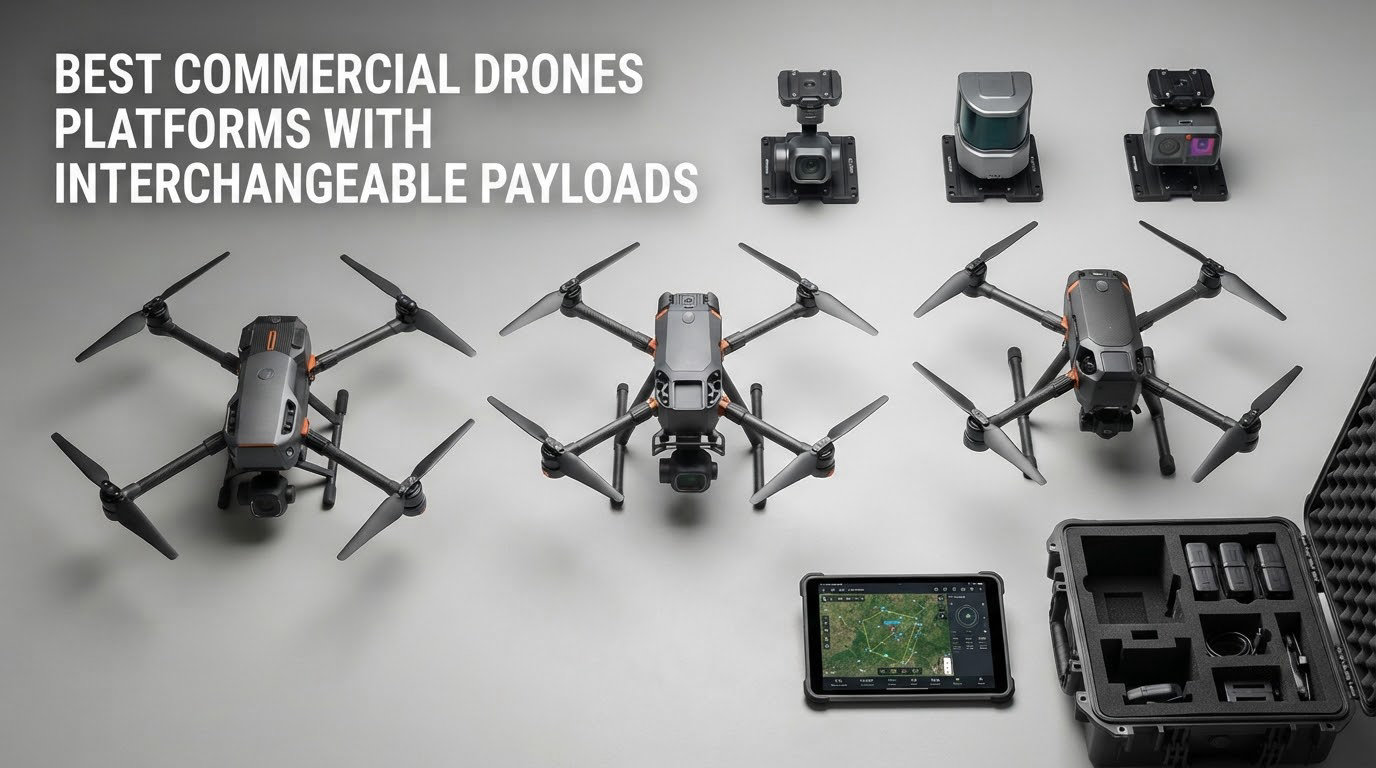
An interchangeable payload commercial drone is an airframe whose sensor mount accepts more than one certified payload, so thermal cameras, zoom optics, multispectral heads, spotlights, loudspeakers and cargo modules can be swapped between missions without changing aircraft. That single idea is the whole buying case: one airframe covering thermal inspection, mapping, public safety and delivery instead of three airframes and three battery inventories.
It is also the idea most roundups in this category get wrong. Several platforms sold as modular are actually multi-sensor integrated gimbals, where thermal, zoom and wide lenses sit behind one fixed housing and cannot be detached. Our ranking of the best commercial drone platforms with interchangeable payloads separates those two things before it compares anything else, because buying a fixed four-sensor gimbal when you needed a rail is a mistake you only discover after the aircraft is delivered.
We evaluated the platforms below on three axes. First, the payload mount standard and whether third-party vendors actually build for it. Second, what a payload costs you in flight time, since loaded endurance rather than the unloaded spec sheet decides how many passes you get per battery. Third, how many owners have documented the platform in writing, because enterprise airframes move through dealer channels and review volume is thin on exactly the models you would shortlist for professional work.
One caveat before the picks. The lineup we could verify sits on a narrow slice of the commercial market, and specifications come from manufacturer documentation and owner review sentiment rather than from flying all six aircraft ourselves. Where a platform’s review base is thin we say so in that section instead of dressing it up.
For the wider regulatory and cost context, our related platform roundups cover portable staging platforms and weightlifting platforms if you are comparing how equipment platforms are evaluated for durability rather than electronics.
Table of Contents
Top 3 Picks for Commercial Drone Platforms With Interchangeable Payloads in 2026
Our top three balance documented ownership experience against payload flexibility. The first is the most proven airframe in the group by owner volume, the second is the best thermal value in the lineup, and the third is the platform most survey firms end up buying first.


Best Commercial Drone Platforms With Interchangeable Payloads at a Glance in 2026
Every platform below appears with its own ASIN and the features that actually drive mission planning. Read the mount column first, because that is the difference between a rail you can build on and a gimbal you cannot open up.
| Product | Specifications | Action |
|---|---|---|
| Parrot ANAFI |
|
Check Latest Price |
| Autel EVO II Dual 640T V3 |
|
Check Latest Price |
| Autel EVO II PRO RTK V3 |
|
Check Latest Price |
 Autel EVO II Dual 640T Enterprise V3 Autel EVO II Dual 640T Enterprise V3 |
|
Check Latest Price |
 DJI Matrice 4TD DJI Matrice 4TD |
|
Check Latest Price |
 DJI Inspire 2 DJI Inspire 2 |
|
Check Latest Price |
1. Parrot ANAFI – Editor’s Choice and Most Portable Airframe in the Group
Parrot PF728000 ANAFI Drone, Foldable Quadcopter Drone with 4K HDR Camera, Compact, Silent & Autonomous, Realize your shots with a 180° vertical swivel camera, Dark Grey
21MP stills
4K HDR video
180-degree swivel camera
Up to 25 min flight time
Pros
- Quiet operation that suits discreet site work
- Carbon frame folds small and deploys in under three seconds
- Swiveling camera reaches high and low without repositioning
- FreeFlight 6 app is stable and easy to navigate
Cons
- No obstacle avoidance sensors
- Range suffers in congested Wi-Fi
- 19 percent of reviews are one star
The ANAFI is the only airframe in this roundup with a review base large enough to tell you how it behaves after a year of ordinary use. Owners consistently report around 25 minutes of real flight time per battery, reliable GPS hold and return-home behavior, and a camera head that owners rarely see matched at this weight.
The 180-degree vertical swivel is the feature that separates it from a fixed-tilt gimbal. On a building facade inspection you tilt up to the parapet and down to the ground floor without flying the aircraft to an awkward hover angle, which cuts the number of passes per wall noticeably.
Silence is the other quiet advantage. Owners describe subjects frequently not noticing the aircraft, which matters for property surveys, film work on occupied streets and any inspection where a loud multirotor changes behaviour on site.
Being straight with you about the payload question: the ANAFI is not a modular platform. There is no rail, no Payload SDK and no certified third-party sensor mount. What it offers instead is a family, with Base, Thermal and FPV variants built on the same chassis, so you can own thermal capability without a second airframe program.
The reliability picture has a visible soft spot. Nineteen percent of the 1133 reviews are one star, and those reviews cluster around motor burnout, vertical-camera errors and Wi-Fi loss in urban areas. Support is the other weak point, with warranty handling widely criticised as slow.
When the ANAFI earns its place on a commercial crew
It earns its place when the job is observation, documentation or discreet imaging at short range, and when the crew values deploy speed over sensor modularity. A two-person team can have it airborne in the time a larger enterprise aircraft spends completing a pre-flight checklist.
It also suits operators who work in built-up areas where a heavier airframe is a liability on rooftops, between parked vehicles or on narrow terraces. At 320 grams the airframe is the least likely to damage property on a mishap.
When to skip it for a payload platform
Skip it if your mission list includes thermal at range, LiDAR, multispectral or any non-camera module, because none of those mount to this airframe. It also sits at the wrong end for any job where obstacle avoidance is the difference between a clean flight and an incident.
Buyers moving to this platform from a DJI workflow should know the control link is Wi-Fi dependent rather than a dedicated radio link. Range varies with local congestion, which is exactly where you need certainty.
2. Autel EVO II Dual 640T V3 – Best Thermal Value With a 50MP Visible Sensor
Autel Robotics EVO II Dual 640T V3, 640×512 Thermal Imaging Drone, RemoteID
640x512 thermal sensor
50MP visible camera
15 km SkyLink 2.0
38 min flight time
Pros
- Thermal and 50MP visible sensors in one airframe
- 15 km tri-band transmission with 2.7K video
- 360 degree obstacle avoidance from 12 visual sensors
- 38 min flight time with a 7.9 inch controller
Cons
- No modular accessory rail on this airframe
- Some owners report early thermal sensor failure
- Warranty coverage needs paid support plans
This is the most documented thermal platform in the group, with 53 owners writing in detail about how it performs. Review sentiment is unusually specific: people switching from DJI say the menus and controls feel familiar, which shortens the adjustment period considerably.
The thermal channel is a 640×512 sensor running at 30 fps with a 13mm lens and 16 times digital zoom, and owners use the detection, recognition and identification ranges to frame evidence from a fixed standoff distance. The visible channel is a 0.8 inch CMOS at 50MP with 8K RYYB output and 4 times lossless zoom.
Flight behaviour is the quiet story here. Owners describe stable hover, accurate landing point accuracy and a 360-degree obstacle avoidance system built on 19 sensor groups that also feed real-time 3D mapping for path planning. SkyLink 2.0 transmission reaches 15 km on tri-band 2.4GHz, 5.8GHz and 900MHz with automatic frequency hopping.
The critical limitation appears in more than one review: this is the non-Enterprise airframe, so it does not accept Autel modular attachments. The payload rail lives on the Enterprise version. If you need a spotlight, strobe or loudspeaker, this is the wrong listing even though the sensors are otherwise comparable.
Reliability reports are mixed. A minority of owners report thermal sensor failure inside a year, and several note that warranty coverage is narrow unless a paid support plan is added. Autel’s app settings also draw repeated criticism for organization.
What this platform does well for inspectors
The combination of a thermal channel and a high-resolution visible channel in one gimbal is what makes it useful for power, refinery and rooftop inspection. You capture the anomaly thermally, then zoom the visible camera optically for the evidence image without swapping anything.
Thirty-eight minutes of flight time and 15 km transmission give you room to work a long line asset or a large site per battery. Remote ID support is present, which matters for Part 107 operators documenting compliance.
Where it falls short
It falls short the moment the mission requires an accessory beyond cameras. Public safety work that needs a loudspeaker or a spotlight forces a move up to the Enterprise airframe, which is a second purchase rather than a module.
Buyers who need survey-grade output should look past this one to the RTK variant, since there is no positioning module here beyond standard GNSS.
3. Autel EVO II PRO RTK V3 – Survey-Grade Positioning Without Ground Control Points
Autel Robotics EVO II PRO RTK V3 w/Real-time Centimeter-Level Positioning
RTK 1 cm + 1 ppm
1 inch 6K HDR sensor
15 km transmission
38 min flight time
Pros
- Centimeter RTK accuracy with PPK fallback
- No ground control points needed for most survey work
- Stable in wind that grounds smaller airframes
- Large bright controller screen readable in sunlight
Cons
- App settings sit in non-obvious places
- Learning curve on RTK and RAW workflows
- Firmware update required before first flight
The review base here is mapping and photogrammetry buyers, and it is the most concentrated positive signal in the roundup: 78 percent of reviews are five star. Owners report dependable RTK performance with VRS networks and workflows that carry straight through to orthomosaic output.
Positioning accuracy is 1 cm plus 1 ppm horizontally and 1.5 cm plus 1 ppm vertically, and the platform supports both an RTK base station and an RTK network alongside PPK and time synchronization. That last part matters more than it sounds, because PPK recovery means a mission survives a link or network dropout without losing georeferencing.
Repeatability is the feature photogrammetry firms actually buy. Waypoint, rectangle, polygon and oblique photography missions record the flight profile and reproduce gimbal and camera positions, so a second pass over the same site produces consistent geometry rather than a fresh random orientation.
The camera is a 1 inch Sony sensor shooting 6K at 30 fps with HDR, and owners single out low-light performance and wind stability. One licensed pilot reports flying in 22 mph conditions that barely registered in the airframe. The 7.9 inch Smart Controller V3 screen is described as readable in direct sunlight, which matters on a full survey day.
Compatibility is broad on the software side. The platform works with Autel Mapper on Windows, plus Carlson PhotoCapture and Carlson Point Cloud, so it drops into an existing processing chain rather than forcing a new one.
Why survey firms choose this airframe
The reason is the elimination of ground control points. Independent RTK base station or network coverage plus PPK removes the field half-day spent shooting and measuring control, which is the single largest labor cost in small survey jobs.
Repeatable autonomous profiles also mean a second operator can fly the same mission to the same standard after handover, which simplifies training and quality control across a team.
Where buyers report friction
The friction is software, not hardware. Owners consistently describe the Autel app as less intuitive than DJI’s, with settings in non-obvious places and a learning curve around RTK functions and RAW processing. First-party tutorial material for advanced features is limited.
Two practical warnings. Firmware needs updating before the first flight, and one review describes a total power loss on a second flight followed by an unresolved warranty dispute. At 19 reviews, that is a single report, but it is the kind of failure that ends a contract.
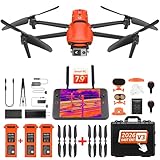
4. Autel EVO II Dual 640T Enterprise V3 – The Only Airframe Here With a Certified Payload Rail
Autel Robotics EVO II Dual 640T Enterprise V3, 640 * 512 T~hermal Imaging
Modular payload rail
640x512 thermal
50MP visible with 8K
42 min flight time
Pros
- Payload rail accepts spotlight loudspeaker and beacon modules
- 42 min flight time on the enterprise airframe
- 15 km tri-band transmission with 2.7K video
- Very bright 7.9 inch touch controller
Cons
- RTK module sold separately
- Only 11 reviews so reliability data is thin
- Heavier airframe than the standard model
This is the platform in the roundup that genuinely answers the keyword. The modular payload rail accepts strobe or beacon, spotlight and loudspeaker modules that bolt straight onto the airframe, which is the physical interchangeability the category is named for.
Sensors are close to the standard model: a 640×512 thermal array at 30 fps with a 13mm lens, 16 times digital zoom and extended thermal vents for heat dissipation, paired with a 50MP visible camera at 0.8 inch CMOS producing 8K output. D-RI ranges are supported for evidence framing.
The enterprise airframe is physically different, not just a badge. Larger propellers and longer carbon fiber arms give 42 minutes of flight time, up from 38 on the standard body, and add rigidity for repeated mount and unmount cycles.
Operating temperature runs from -10 to 40 degrees Celsius. With the modules fitted, the documented use cases cover public safety, search and rescue, power inspection, firefighting, disaster response and mapping.
Why the rail changes the buying decision
Because the accessories ship in the bundle, a new crew can run a public safety response with a loudspeaker and a searchlight on day one, then add an RTK module later when the survey work arrives. The mission list expands without a second airframe purchase.
For utility and renewable asset inspection specifically, the combination of thermal plus a beam module plus beacon is the working configuration. You find the anomaly thermally, light it for the operator on the ground, and mark the position for a crew.
What the thin review base hides
Eleven reviews, all four stars or better, is a small sample. It reflects the dealer-channel nature of enterprise sales rather than weak satisfaction, but it means we have no long-horizon reliability picture for this airframe.
The RTK module is not included and has to be added separately, which is the most common surprise buyers report on this tier. Budget for it before the aircraft arrives rather than after the first survey job.
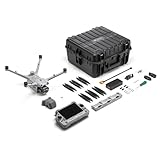
5. DJI Matrice 4TD – All-Weather Multi-Sensor Airframe With Dock Support
DJI Matrice 4TD Quadcopter with RC Plus 2 Enterprise, Thermal, Wide & Tele Lenses, Laser Range Finder, Low-Noise Anti-Ice Propellers, IP55
Triple-lens visual array
Thermal plus NIR
Laser range finder
IP55 weatherproofing
Pros
- IP55 airframe with low-noise anti-ice propellers
- Built-in laser range finder for target distance
- Dock 3 and FlightHub 2 integration for automated programs
- Owners report roughly 30 to 35 minutes per pack in wind
Cons
- AL1 spotlight can block object detection
- Only 2 reviews so the reliability picture is thin
- Bundle includes a single flight battery
The Matrice 4TD is the platform where weather rather than payload defines the purchase. IP55 weatherproofing and low-noise anti-ice propellers mean the aircraft keeps flying in rain, dust and freezing conditions where consumer and prosumer bodies get grounded.
The sensor suite is a triple-lens visual array paired with a high-resolution thermal sensor and a near-infrared auxiliary light, plus a built-in laser range finder for locating and measuring targets. The RC Plus 2 Enterprise smart controller and a flight battery are included.
Owners describe gimbal and flight stability as exceptionally smooth, praise the thermal sensor’s independent zoom for inspecting solar panels, and report enormous optical reach, with one owner reading a water tower from ten miles away. Real battery endurance lands around 30 to 35 minutes per pack in windy conditions.
When the Matrice 4TD is the right buy
It is the right buy when the work calendar runs year-round and weather windows, not battery budgets, decide the schedule. A roofing, utility or construction contractor loses fewer days to a forecast than to an airframe that grounds itself in light rain.
It is also the right platform for fixed remote operations. Compatibility with DJI Dock 3 and FlightHub 2 is the route into automated, repeatable inspection programs where an aircraft launches, runs a route and returns without an operator standing in a field.
Where the setup gets in the way
One review reports that the AL1 spotlight accessory interferes with front and side object detection. That is the classic modular-payload problem: adding hardware can cost you a safety system, so it is worth testing the exact configuration you plan to fly.
With two reviews on record, treat the five-star rating as a signal about the hardware rather than a reliability dataset. Both reviews also note that authorized enterprise dealers handle service and pricing support better than marketplace channels, which matters for a platform like this.
6. DJI Inspire 2 – Interchangeable Zenmuse Gimbals for Professional Video Work
DJI Inspire 2 Drone
Zenmuse X5S and X5R support at 5.2K
Dual-operator control
Spotlight Pro
4K video and DNG stills
Pros
- Interchangeable Zenmuse X5S and X5R gimbal cameras
- Two-operator design separates pilot and camera operator
- Carbon fiber and aluminum build with a transformable frame
- Spotlight Pro supports lighting and subject tracking
Cons
- Obstacle sensing limited to 0 to 5 m
- 16 lb weight and an 18 x 12 x 21 inch footprint
- Older smart-flight automation than current airframes
The Inspire 2 is the clearest example of genuine payload interchangeability in the category, even though its ecosystem is cinema rather than industrial. The Zenmuse X5S and X5R gimbal cameras detach from the mount, so you can carry a different sensor to a different shoot without a second aircraft.
The transformable frame folds for transport and opens into a stable shooting configuration, built from carbon fiber and aluminum. The dual-operator design separates flying from camera work, which is how most professional crews run a complex shoot.
Spotlight Pro adds a steerable light for night work and subject tracking, and obstacle sensing is present for set safety. Video captures at 4K with DNG still capture, and the bundle includes two TB50 intelligent batteries, a charger, a charging hub, a 16 GB microSD card and a carrying case.
Where interchangeability pays off on set
It pays off across multi-day productions where sensor choices differ by unit. A thermal take on a documentary location and a 5.2K take on a narrative scene can both be flown from one aircraft, which removes a rental line item.
Operating temperature runs from -20 to 40 degrees Celsius, wider than the enterprise airframes here, which suits winter location work in cold climates.
Where it has aged out
Obstacle sensing is limited to a 0 to 5 m range, which is short enough that it should not be treated as an inspection-grade safety system. The platform is also heavy and bulky at 16 pounds with an 18 x 12 x 21 inch footprint, so field deployment needs two hands.
Smart-flight automation trails current enterprise airframes. If your business is inspection or survey rather than production, the sensor ecosystem you actually need will be on an industrial mount, not a Zenmuse one.
How to Choose a Commercial Drone Platform With Interchangeable Payloads
Start from the mission list, not the spec sheet. Write down every sensor class you will fly in a year, then count how many of them have a certified mount on the airframe you are considering. An airframe with one fixed four-sensor gimbal covers a narrower list than an aircraft with a rail and two sensor modules, even when the gimbal sounds more capable.
Payload mount standards explained
Four mount families cover most of what you will encounter. DJI’s SkyPort 2 pairs with the Payload SDK, so third-party gimbals inherit power, data and control without proprietary wiring. Autel’s Enterprise series uses a modular accessory rail that accepts the vendor’s spotlight, strobe and loudspeaker modules. MAVLink is an open protocol that lets development teams command a payload over the same link the aircraft uses. Universal industrial rails are the simplest to fabricate against, and they appear on frames built for industrial work rather than inspection.
The practical test is whether the vendor publishes a payload interface. A platform without a documented mount has no third-party ecosystem by definition, and that is where the interchangeability promise quietly ends.
The payload-to-flight-time exchange rate
Flight time is the number operators ask about most and manufacturers publish least. Unloaded figures describe a light aircraft with a light payload; add a thermal gimbal, a spotlight or a cargo module and the same airframe flies materially shorter sorties. Heavy-lift operators report flight time scaling predictably with load, with endurance falling from an unloaded figure to roughly half of it at full rated capacity.
The planning rule that follows from this is simple. Estimate your passes per mission using loaded endurance, then derate that estimate for the operating margin you need on return. A survey planned on unloaded flight time overruns the schedule on the first battery, and the schedule is what clients actually pay for.
Payload ecosystem breadth
Count certified third-party payloads per platform before you commit. The Autel Enterprise rail already ships with a spotlight, a loudspeaker and a beacon in the bundle, which means the ecosystem exists on day one. Zenmuse mounts have deep cinema support but little industrial coverage. Open rails are flexible but leave the integration work to you.
The underrated question is who services the payload. A module with no local repair path becomes a single point of failure the first time it is dropped. If your operations also depend on ground-mounted equipment carrying heavy instrument mass, our guide to motorized equatorial mounts for heavy payloads covers the same load-rating discipline from the telescope side.
NDAA, Blue UAS and government procurement
Federal and federally funded buyers face a procurement gate that commercial buyers do not. Section 848 of the National Defense Authorization Act restricts federal procurement of covered components, and contracting officers increasingly flow that restriction down to primes and sub-contractors. If any revenue on your side of the ledger comes from public funds, confirm procurement status before you buy, not after.
Two clarifications matter. There is no blanket US ban on any drone manufacturer, so commercial purchase and flight remain lawful. And a compliant airframe is not automatically a compliant platform: payload ecosystem depth and support channels often lag behind the airframe’s certification status, so ask about the modules too.
FAA Part 107 rules that constrain your payload choice
Part 107 sets a 400 foot altitude ceiling, which is what the rule often called the 1:1 refers to. Remote ID is required for most operations, and aircraft above 55 pounds at takeoff weight require registration and a waiver, so a heavy payload module can push an airframe across that threshold unexpectedly. Plan the loaded takeoff weight before you plan the route.
Transmission range is not flight range. A platform that links at 15 km does not grant permission to operate beyond visual line of sight, and geofencing and unlock procedures can slow a time-critical response down to the point of failure.
Hot-swap versus cold-swap payloads
Cold swap means powering down, removing the payload, fitting the next one and rebooting. Hot swap means the airframe detects a new payload and trims flight parameters for the new mass automatically. Enterprise platforms generally handle detection themselves; industrial frames often require manual configuration of payload weight in flight settings, which is a step you do not want to skip.
Budget for the time either way. A cold swap with cabling runs to minutes, and on a job where a battery change is thirty seconds, swap time is the slowest part of the cycle. Some crews carry two aircraft specifically to avoid it.
Camera payloads versus sensor payloads
Camera payloads cover visible, zoom and thermal work, and they share power, data and calibration handling. Sensor payloads cover multispectral arrays, LiDAR units, gas detection and acoustics, and they impose different constraints: calibration certificates, data volume per flight and processing pipelines downstream.
Match the payload class to the deliverable. A thermal anomaly report needs radiometric capability and a reporting workflow. An orthomosaic needs RTK accuracy and repeatable profiles. A LiDAR scan needs its own processing chain, which is where budgets quietly expand.
Indoor and GPS-denied operation
Substations, tunnels, warehouses and rooftops near steel structures are where GPS-denied operation and visual odometry decide whether a platform is usable at all. Confirm how the aircraft behaves without a satellite fix before you commit, because indoor work is not a special feature request, it is a different flight mode with different failure modes.
Multi-aircraft operation and dock compatibility
Fleet scale changes the payload question. Drone-to-drone mesh networking lets several aircraft share one controller and hold a link over a site, and dock integration removes the operator from the loop entirely for repeatable inspection routes. The Matrice 4TD is the platform here documented against that dock path.
Before buying fleet software, check whether it drives the payloads you intend to carry, or only the cameras. Software that assumes a camera gimbal will not drive a loudspeaker or a cargo module.
Total cost of ownership over five years
Compare platforms on the full stack, not the aircraft line. Include spare batteries and chargers, the controller, every payload module you will own, training, insurance, maintenance and certification. Reporters consistently flag batteries as a hidden capital and logistics cost, including bundles where the charger is sold separately.
Factor in vendor lock-in too. Proprietary accessories and authorized service centre repairs raise ownership cost, and switching manufacturers later means re-buying software, controllers, batteries, spares and training. That re-investment is the real reason fleets rarely move once settled.
Frequently Asked Questions
What is the best commercial drone on the market?
There is no single best commercial drone, because the answer depends on the payload list. For survey and mapping work the Autel EVO II PRO RTK V3 is the strongest fit with centimeter RTK and PPK. For public safety and utility inspection the Autel EVO II Dual 640T Enterprise V3 leads on payload rail access. For discreet short-range work the Parrot ANAFI remains the most portable option.
Why did the US ban DJI drones?
The US has not issued a blanket ban on DJI drones. Three separate actions are often conflated: a 2017 Department of Defense restriction on DJI supply, a 2020 Commerce Department Entity List addition, and Section 848 of the National Defense Authorization Act, which restricts federal funding for the purchase and operation of covered components. Commercial purchase and flight remain lawful.
Is DJI blocked by the US?
No blanket block exists for commercial operators. The practical effect of the Entity List and Section 848 is on federal procurement and federally funded projects rather than on general sales. Buyers who touch public funds should confirm procurement status in writing with the contracting officer before purchasing, and check the status of payloads as well as airframes.
What is the 1:1 rule for drones?
The 1:1 rule refers to the 400 foot, or 120 metre, maximum altitude limit that applies to most drone operations under 14 CFR 91.141. It is frequently confused with a separate horizontal distance limit that applies to aircraft operating without Remote ID. Both exist, and they are different rules with different exceptions.
What drones can carry 500 pounds of payload?
500 pounds is 227 kilograms, which exceeds both the 55 pound Part 107 registration threshold and the payload ceiling of any enterprise inspection airframe in this roundup. Aircraft that reach that capacity are certified heavy-lift platforms that require additional waivers, qualified crews and airspace authorization. Treat 500 pound marketing as a different product category from commercial drone platforms.
What does interchangeable payload mean on a commercial drone?
It means the airframe has a standardized mount that accepts more than one certified payload, so a thermal gimbal, a zoom camera, a multispectral head, a spotlight or a cargo module can be exchanged between missions without changing aircraft. It is not the same as a fixed multi-sensor gimbal, where several lenses sit behind one housing and none of them detach.
How long does it take to swap a drone payload in the field?
A cold payload swap with cabling runs to several minutes, and you must re-enter the payload weight in flight settings on frames that do not auto-detect. Enterprise platforms generally detect the payload and trim flight parameters automatically, which cuts the process substantially. Battery changes are far quicker, often thirty to sixty seconds, so swap time is usually the slowest part of a field cycle.
Conclusion: Our Picks for Commercial Drone Platforms With Interchangeable Payloads in 2026
The Parrot ANAFI takes our Editor’s Choice for one reason: it is the only airframe here with enough documented owners to tell you how it holds up, and it remains the fastest to deploy and the quietest to fly. If your requirement is a certified swappable payload rail rather than portability, move to the Autel EVO II Dual 640T Enterprise V3, which is the platform that truly answers the interchangeable payload promise.
For survey and mapping budgets, the Autel EVO II PRO RTK V3 removes ground control points and holds position in wind. For thermal work without accessory modules, the Autel EVO II Dual 640T V3 is the value pick. For year-round weather and dock-based fleet programs, the DJI Matrice 4TD. For film and video with detachable gimbals, the DJI Inspire 2.
Whichever you choose, plan flight time around the loaded figure rather than the unloaded one, and confirm that your required sensor has a certified mount before the aircraft arrives.