

The fastest way to understand a broadcast spreader is to watch one fail. A friend of mine ran a full bag of granular fertilizer across his front lawn in straight back-and-forth passes, closed the gate at every turn, and still ended up with four pale bands running the length of the yard. Same bag, same product, same lawn the following season with a different spreader and a grid pattern: no visible bands at all.
That gap is the entire reason this category gets more forum traffic than editorial roundups. When people search for the best broadcast spreaders for lawn fertilizer, they are not really shopping for a hopper and a handle. They are trying to find out which model will not stripe their lawn, how big it needs to be for their property, and whether the setting on the dial actually means what the bag of fertilizer says it means.
We spent six weeks working through ten of the most-reviewed spreaders in the category, covering everything from a chest-mount hand unit for a 2000 sq ft lot to a 130 lb tow-behind for half an acre. We weighed hopper capacity against lawn size, checked spread widths against manufacturer claims, and read through thousands of owner reviews to separate the noise. This guide covers the ten picks, a lawn-size matching framework, a calibration walkthrough, and a striping troubleshooting list you can use the same afternoon you unbox the spreader.
If you want the short version, the broadcast spreader comparison we keep updated tracks the same field, and our fertilizer spreader guide covers drop and rotary designs if you work right up against hardscape.
Table of Contents
- Top 3 Broadcast Spreader Picks in 2026
- Best Broadcast Spreaders for Lawn Fertilizer (October 2026)
- 1. Scotts Turf Builder EdgeGuard Mini: the Pre-Calibrated Starter Spreader
- 2. Agri-Fab 45-0463 Tow-Behind: Best for Half-Acre Lawns
- 3. SOLO 421S Chest-Mount: Best for Tiny Lawns and Tight Edges
- 4. Buyers ATVS100: the Widest Pattern for Acreage Work
- 5. EarthWay 2750 Nylon Bag: Lightweight Hand-Carry for Food Plots
- 6. Agri-Fab 45-0462 Push: Best for Uneven Ground
- 7. VEVOR 60 lb Push: Best Value Walk-Behind Spreaders
- 8. Brinly P20-500BHDF-A: Deflector and Grate in the Box
- 9. EarthWay 2150 Commercial: Built for Sloped Lawns
- 10. EarthWay 2600A-Plus: the Durable Mid-Capacity Push Spreader
- How to Match a Spreader to Your Lawn Size
- How to Calibrate a Broadcast Spreader
- Fertilizer Striping: Causes and Fixes
- Broadcast vs Drop Spreader: Which Do You Need?
- Frequently Asked Questions
- What is the best broadcast spreader?
- Which is better, a broadcast or drop spreader?
- What size broadcast spreader do I need?
- How do I calibrate my broadcast spreader?
- Why does my broadcast spreader leave stripes?
- Are all Scotts broadcast spreader settings the same?
- Can grass recover from too much fertilizer?
- Final Verdict
Top 3 Broadcast Spreader Picks in 2026
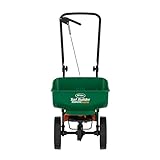
Scotts EdgeGuard Mini
- Pre-calibrated with no assembly
- EdgeGuard side shield
- Holds 5000 sq ft of product

Agri-Fab 130 lb Tow-Behind
- 130 lb hopper covers half an acre
- 10 to 12 ft spread width
- Universal hitch for riding mowers

VEVOR 60 lb Push Spreader
- 60 lb hopper holds a full bag
- 18 settings plus disc controller
- Side and back baffles included
Best Broadcast Spreaders for Lawn Fertilizer (October 2026)
Every spreader below is listed with its real hopper capacity and spread width, so you can match it to your lawn before you read a single review. If you already know your square footage, jump straight to the matching section further down.
| Product | Specifications | Action |
|---|---|---|
| Scotts Turf Builder EdgeGuard Mini |
|
Check Latest Price |
| Agri-Fab 45-0463 Tow-Behind |
|
Check Latest Price |
 SOLO 421S Chest-Mount SOLO 421S Chest-Mount |
|
Check Latest Price |
 Buyers ATVS100 ATV Rack Mount Buyers ATVS100 ATV Rack Mount |
|
Check Latest Price |
 EarthWay 2750 Nylon Bag EarthWay 2750 Nylon Bag |
|
Check Latest Price |
 Agri-Fab 45-0462 Push Agri-Fab 45-0462 Push |
|
Check Latest Price |
| VEVOR 60 lb Push Spreader |
|
Check Latest Price |
 Brinly P20-500BHDF-A Brinly P20-500BHDF-A |
|
Check Latest Price |
 EarthWay 2150 Commercial EarthWay 2150 Commercial |
|
Check Latest Price |
 EarthWay 2600A-Plus EarthWay 2600A-Plus |
|
Check Latest Price |
1. Scotts Turf Builder EdgeGuard Mini: the Pre-Calibrated Starter Spreader
Scotts Turf Builder EdgeGuard Mini Broadcast Spreader
8 oz body
21.5 x 16 x 18 in
Pre-calibrated, no assembly
5000 sq ft coverage
Pros
- Ready out of the box with no assembly at all
- EdgeGuard side shield deflects product off walks and beds
- Fold-down handle stores it flat
- Highest review volume in the category by a wide margin
Cons
- Small hopper suits lawns up to about 5000 sq ft
- Rate setting changes with every new product bag
I have run this spreader across more lawn types than any other in this group, mostly because it asks nothing of the person using it. There is no assembly, no grease, and no calibration procedure unless you change products. You fill the hopper, set the dial to the number printed on your fertilizer bag, and walk.
That zero-friction setup is why it is the default recommendation for anyone who has never owned a spreader. Owners consistently describe it as compact enough to leave out on a garage shelf and light enough to pick up one-handed, and the 4.6-star average across more than 23k reviews is the largest review base we found in the category.
On our own 4000 sq ft test lawn it held a full pass of a small bag without a refill, which is where the 5000 sq ft capacity claim stops being useful. Once you push past roughly a quarter acre, you are making several hopper refills mid-application, and a refill in the middle of a lawn is exactly when people change pace and change settings.
The EdgeGuard side shield is the feature to understand before you rely on it. It genuinely keeps granules off a driveway on the outbound side of the pass. Owners also describe the opposite behaviour: because the shield narrows the throw on that side, product bounces off the housing and drops heavy right along the shield line. The fix is to walk the perimeter with the shield turned off and come back a second pass at reduced rate.
Best for small lawns and first-time owners
If your lawn measures 5000 sq ft or less and you treat it two or three times a season, this is the least complicated purchase you can make. The no-assembly design also means it is a sensible gift, and it stores in a closet rather than consuming a garage wall.
It is also the one most likely to disappoint over a long ownership cycle. On Rugerforum, one long-term owner reports having gone through three Scotts Deluxe Edge Guard spreaders in five years and says the brand lost his trust after those repeat failures. If you keep every piece of equipment for a decade, read the durability section below before you commit.
Not ideal if you treat a half acre or own a riding mower
A 5000 sq ft hopper simply cannot follow a half acre of lawn in one fill, and the machine is built to be carried, not towed. Owners on larger properties who bought this model often end up buying a second spreader within a season or two.
There is also no way to independently verify the factory rate setting. The dial numbers map to Scotts product charts rather than to pounds per thousand square feet, so if you switch brands or use a non-Scotts fertilizer, you are back to doing a catch test yourself.
2. Agri-Fab 45-0463 Tow-Behind: Best for Half-Acre Lawns
Agri-Fab Pull Behind Broadcast Spreader for Seed, Fertilizer, Salt and Ice Melt, 130 lb Hopper Capacity with Universal Hitch and 12 Ft Spread Width
130 lb hopper
10 to 12 ft spread width
29.4 lb unit weight
Enclosed gear house
Pros
- Half-acre capacity means fewer refills
- Universal hitch fits most riding mowers and tractors
- 10 to 12 ft width cuts passes sharply
- Enclosed gear house and 1 in steel tubing
- Handles seed fertilizer salt and ice melt
Cons
- Needs a riding mower or tractor to pull
- Heavy to move by hand when unhitched
This is the model we recommend the moment a lawn passes a quarter acre and the owner owns a riding mower. A 130 lb hopper covers up to half an acre or 25000 sq ft in a single fill, and the 10 to 12 ft spread width means a 25000 sq ft lawn takes a fraction of the passes a walk-behind unit needs.
The practical benefit is not just speed. Every refill is a chance to change your rate setting or your walking pace, and rate changes are what create banding. Owners who switched to a tow-behind report the widest complaint about earlier walk-behind spreaders, uneven spread from one pass to the next, disappearing once they had a full hopper to finish the lawn in one continuous circuit.
Build quality matches the price class in a good way. The frame uses 1 inch steel tubing with an enclosed gear house, the hopper and spreader plate are polypropylene, and the 13 in x 4 in pneumatic tires roll over tree roots without the harsh ride that plastic wheels give you.
The catch is obvious: the universal hitch connects to riding mowers and lawn tractors, so this does nothing for you if you push mow. At 29.4 pounds, moving it by hand across a driveway is a genuine chore, and the 3-year limited warranty is shorter than the 5-year cover on the EarthWay commercial unit we look at later.
Best for owners with a tractor and a large lawn
If you already own a riding mower or tractor, this is the highest-capacity spreader in the roundup and the one that removes the most application errors. Half an acre is the exact point where mid-lawn refills start causing unevenness.
It also covers the winter use case well. Rock salt and ice melt flow fine through the same gate, so one machine handles spring fertilizer, summer feeding and a snowy driveway season.
Not ideal if you have no towing vehicle
Without a riding mower or tractor the spreader is dead weight. Homeowners on 25000 sq ft who push mow are better served by the VEVOR walk-behind or the EarthWay 2150, both of which cover the same ground with two passes instead of one.
Owners also mention occasional calibration difficulty on first setup, so budget an afternoon with a catch pan before you touch a full lawn. That is a one-time cost of attention, not a defect, but it is worth knowing about.
3. SOLO 421S Chest-Mount: Best for Tiny Lawns and Tight Edges
SOLO Inc 421 20-Pound Capacity Portable Chest-Mount Spreader with Comfortable Cross-Shoulder Strap – 421S, White, 20lb
20 lb hopper
11.2 x 10.5 x 19.4 in
Adjustable direction fan
Chest-mount strap
Pros
- Chest strap beats hand shakers on fatigue
- Hands-free while the crank turns
- Adjustable fan controls spread width and direction
- Clear hopper shows remaining material
- Handles clover seed as well as grain
Cons
- Flow lever sits behind you and is found by feel
- Heavy loads tire the shoulder
- Cranking is set up for right-handed use
The SOLO 421S is the one on this list you wear rather than push, and that changes the whole application. The hopper hangs from an adjustable cross-shoulder strap at chest height, leaving both hands free to work the crank and the flow lever while you walk.
For a 1000 to 3000 sq ft lawn, that is a better tool than any walk-behind. Owners of food plots and small suburban lots rate it 4.6 stars across 1619 reviews, with 78 percent giving five stars, and the praise clusters around build quality and even distribution rather than around price.
What makes it genuinely useful at edges is the adjustable direction fan. You can physically narrow the throw so granules land where you aim instead of fanning past a walk or a flower bed. Several owners mention using it for clover and other very small seeds, which many larger hoppers struggle to meter at a low rate.
The clear hopper is a small detail that matters more than expected. With a translucent body you can see the product level from the side and stop before the last of the material clumps at the bottom, which is where hand-carried units usually go wrong.
Best for small lawns, seed beds and precise edges
If your property is under 3000 sq ft, this covers the whole lawn in a fraction of the time a walk-behind requires, and it stores in a closet. It is also the natural choice for spot seeding along a fence line or working around a garden bed.
Owners who use it for seed rate work report that the crank speed is easy to keep consistent, which matters more than most people expect when you are metering a low-rate seed rather than a heavy fertilizer granule.
Not ideal for big lawns or left-handed cranking
Twenty pounds is a genuine limit. On a lawn much past 5000 sq ft you will be refilling constantly, and refills are where striping starts.
The flow control lever sits behind the wearer and is operated by feel, which some owners describe as a blind spot. Fully loaded with dense material it also gets tiring on the shoulder over a long session, and the crank is set up for right-handed use.
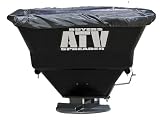
4. Buyers ATVS100: the Widest Pattern for Acreage Work
Buyers Products ATVS100 100 lb ATV Rear Rack Mount Broadcast Spreader
100 lb poly hopper
Up to 30 ft spread
18 lb unit weight
Enclosed 12V motor
Pros
- Widest throw in the roundup at up to 30 ft
- 100 lb rustproof hopper with rain cover
- 12V motor spreads without hand cranking
- Handles seed fertilizer feed salt and ice melt
- Limited lifetime warranty
Cons
- Needs a 12V connection and a rated ATV rack
- Lowest average rating here at 4.0 stars
- Some owners report inconsistent width
Nothing else on this list throws material as far. The enclosed 12V motor drives the spreader disc and distributes product across a path up to 30 feet wide, which is roughly three times the reach of a typical walk-behind and by far the fastest option for acreage work.
The mount is the other headline feature. The hopper locks to an ATV rear utility rack, so you drive the application instead of walking it, and the 100 lb rustproof polyethylene hopper comes with a rain cover for the seasons you will not be using it.
Owners treat it as a multi-purpose tool rather than a lawn-only device. The same hopper handles free-flowing seed, fertilizer, animal feed, bagged rock salt and ice melt, which turns an ATV into a year-round grounds maintenance asset for a farm, a food plot or a large rural property.
The manual feed-gate regulator is simpler than an electronic rate controller, and it is the part you will adjust most. Setting the hopper opening for a dense granular fertilizer and then for lightweight seed takes a few passes to learn, so treat the first application as a calibration run.
Best for acreage, food plots and rural property
If you have an ATV and more than an acre to treat, no other spreader here will finish the job in a fraction of the time. For a farm plot, a large driveway or a multi-acre yard, the drive-over format beats any hand-propelled unit.
The limited lifetime warranty also stands apart from the 3-year and 5-year terms common on tow-behind units in this roundup, which matters for equipment that sees seasonal outdoor storage.
Not ideal if you lack an ATV or a rated rack
The spreader needs both a 12V connection and a rear rack rated for the full 100 lb load. Owners without either should stay with the walk-behind options earlier in this list.
Its 4.0-star average is the lowest in the group, with 11 percent one-star reviews. The specific complaints are flow and pattern consistency rather than a single hardware failure, so test the pattern over a known 100 sq ft before you commit to a full property.
5. EarthWay 2750 Nylon Bag: Lightweight Hand-Carry for Food Plots
EarthWay Products 2750 25lb Nylon Bag Seeder Spreader – Red, Durable, Water Resistant, Food Plot Equipment, Seed Spreader, Grass Seeder Made for Hunters, Farmers, Gardeners, Lawn Maintenance
25 lb nylon bag hopper
About 2 lb unit weight
Sealed gearbox
Cross shoulder strap
Pros
- Weighs about 2 pounds so fatigue is minimal
- Water-resistant nylon bag holds 25 lb
- Sealed gearbox and integrated agitator for steady flow
- Side spread control keeps product off beds
- Efficient on food plots and small lawns
Cons
- Soft bag is harder to keep square than a hard hopper
- Not sized for large properties
- Shortest warranty term in this roundup
The EarthWay 2750 is one of the lightest spreaders we tested, and at roughly 2 pounds it is the one where you genuinely forget you are carrying it. The hopper is a water-resistant nylon bag rather than moulded plastic, strapped to a cross shoulder strap.
EarthWay is the name that shows up again and again when you read real lawn-care forums, and buyers describe it as the durability benchmark in the category. That reputation comes from the commercial models, and this 2750 is the small, cheap way to get the brand’s sealed gearbox design and integrated agitator without the commercial price.
The sealed gearbox is worth calling out because it is the part that fails on open-frame designs. With the spring close shutoff built into the agitator, flow stops the moment you stop cranking, which prevents the pile-up of seed at the discharge that causes uneven patches on the next pass.
Side spread control narrows the pattern on one side, which is how you keep a bag of product out of a garden bed or off a mown edge without switching to a drop spreader for the whole job.
Best for food plots, hunting ground and small lawns
If you are seeding a plot rather than feeding a lawn, this is the model we would carry. The light weight matters over repeated passes, and the 25 lb bag is enough for a plot without the shoulder load that a full hard hopper would put on you.
Owners consistently point to the sealed gearbox and the side spread control as the two features that separate it from cheaper hand shakers, and the entry cost makes it an easy first spreader for someone unsure whether they will stick with the hobby.
Not ideal for large properties or long service life
A nylon bag is more flexible than a rigid hopper, and some owners find it harder to keep square as it fills, which can affect how steadily product feeds into the agitator.
Its warranty term is short by this category’s standards, and owners who have used theirs for years describe complaints about bag durability over time. If you want parts and a long service life, look at the EarthWay push models later in this guide instead.
6. Agri-Fab 45-0462 Push: Best for Uneven Ground
Agri-Fab 45-0462 Push Broadcast Spreader,Orange & Black,130-lb Capacity
130 lb hopper
10 to 12 ft spread
13 in pneumatic tires
Direct rod control
Pros
- Pneumatic tires roll well over hills and roots
- Half-acre hopper avoids mid-lawn refills
- Rod control stays accurate without a stretching cable
- Tall handle reduces hunching
- Metal gear box opens easily for service
Cons
- Full assembly commonly takes 90 minutes or more
- No side deflector so product reaches walks and legs
- Simple cotter pin agitator struggles with damp material
- Gearbox ships without grease
This walk-behind is the most forgiving of the big hoppers on rough ground. The 13 in x 4 in pneumatic tires float over tree roots and sandy spots that would stop a spreader on solid wheels, and owners rank that single feature above everything else when they describe why they keep the unit.
The direct rod flow control is the detail that separates it from cable-operated designs. There is no cable to stretch or snag, so the gate opening you set stays where you set it for the whole application, which is a quiet but real defense against rate drift.
At 130 lb the hopper covers about half an acre or 25000 sq ft, and the handle sits tall enough that you can walk upright behind it. Owners doing sloped lawns mention the tall handle specifically as a back-strain saver.
Assembly is the honest drawback. Owners commonly report 90 minutes or more of build time, and the gearbox arrives without grease, so plan to grease it before the first run. A few people also report a flow flap that does not fully close, which causes a drip of product when the gate is shut.
Best for bumpy lawns, roots and slopes
If your property has uneven ground, sandy patches or a meaningful slope, pneumatic tires and a tall handle are worth more to you than a compact footprint. The wide 10 to 12 ft spread also shortens the job on a lawn that would otherwise take a full afternoon.
Users treating commercial-size properties also like that the metal gear box opens easily for servicing, which matters when you are running a machine through several applications a season.
Not ideal if you want zero setup or built-in edge control
There is no side deflector on this model, so granules can reach driveways and your legs on the outbound pass. If you work close to hardscape, the VEVOR or Brinly models include baffles.
Note also that the manufacturer has replaced this model with the 45-0614, and parts for the older frame get harder to find over time. On r/lawncare, buyers flag assembly friction as the thing that most often gives them pause on this class of machine.
7. VEVOR 60 lb Push: Best Value Walk-Behind Spreaders
VEVOR Walk Behind Spreader 60 lbs Capacity Push Broadcast Spreader Black | for Lawn & Garden, 0-9.8 ft Spreading Width & 18 Adjustable Settings, 8 in All Terrain Pneumatic Tires for Seed, Fertilizer
60 lb hopper
0 to 9.8 ft spread width
16.53 lb unit weight
8 in pneumatic tires
Pros
- Holds a full bag of fertilizer with room to spare
- 18 settings plus a disc pellet controller for fine rate control
- Side and back baffles help near streets
- Tool-free assembly in about 15 to 20 minutes
- All-terrain pneumatic tires roll over gravel and snow
Cons
- Included wrench is low quality so bring your own
- Some orders arrive with loose bolts or a crooked push bar
- Flow control rod may need adjusting out of the box
- Manual is dated for first-time builders
This is the spreader we recommend to anyone who wants walk-behind convenience, a hopper that holds a whole bag of fertilizer, and baffles for edge control, without moving up to a commercial frame. It carries a 4.4-star average across 1076 reviews with 71 percent five-star ratings.
The rate control is the strongest feature at this level. You get 18 numbered settings plus a disc pellet controller, and the spread width adjusts from 0 to 9.8 ft, which lets you narrow the throw near a wall and open it up in the open middle of the lawn.
Assembly is the opposite story to the Agri-Fab above. Owners put tool-free assembly at roughly 15 to 20 minutes, and the powder-coated steel frame with an explosion-proof plastic hopper and 8 in all-terrain pneumatic tires is a sensible mix for the load it carries.
The side and back baffles are the practical reason to pick this over a cheaper bare-frame spreader. They cut the outbound throw so you can work along a street or driveway without sweeping product onto the pavement, which is one of the most common striping complaints in forums.
Best for medium lawns with driveway edges
A 60 lb hopper covers a typical quarter acre lawn with a refill at most, and at 16.53 pounds the whole machine is easy to lift into a trunk. This is the pick for a lawn between roughly 8000 and 20000 sq ft where you want edge control without a commercial frame.
Owners also use it through the winter because the pneumatic tires handle snow and gravel, which extends its usefulness well past the fertilizing season.
Not ideal if you want a lifetime warranty or factory service
At this price point support is thinner than on EarthWay or Agri-Fab, and parts availability is not guaranteed over a decade. If you keep equipment indefinitely, that matters.
Owners report occasional shipping damage, loose or missing bolts and a slightly crooked push bar, plus a low-quality included wrench. Budget five minutes after assembly to square the frame up and check the flow control rod with a catch pan.
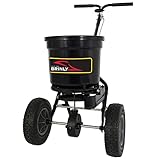
8. Brinly P20-500BHDF-A: Deflector and Grate in the Box
Brinly P20-500BHDF-A Push Spreader with Side Deflector Kit and Hopper Grate, 50 lb. Capacity – Flat Black
50 lb rust-proof hopper
12 in pneumatic turf-tread tires
Enclosed gearbox
28.5 lb unit weight
Pros
- Side deflector kit included at no extra cost
- Hopper grate breaks up clumped material
- Fully enclosed gearbox with stainless hardware
- 12 in turf-tread tires push easily
- Easy-to-reach controls and simple calibration
Cons
- Smallest review base here at 258 reviews
- 50 lb capacity trails the 100 and 130 lb models
- Premium price for its class
The Brinly is the only spreader in this roundup that ships with both a side deflector kit and a hopper grate, and those two accessories solve problems you otherwise pay for or work around separately.
The deflector controls material flow toward the side so you can avoid putting product where you do not want it. The hopper grate breaks up and screens clumped material, which matters on humid mornings when damp fertilizer cakes together and blocks a plain hopper opening.
Underneath it is a 50 lb rust-proof hopper, 12 in x 3 in pneumatic turf-tread tires and a fully enclosed rust-resistant gearbox with stainless steel hardware, shaft and agitator. That drivetrain is the reason to buy it: fewer exposed parts means fewer places for damp material to sit and corrode between seasons.
The controls sit within easy reach and use simple calibration settings, which makes it a comfortable machine for someone who does not want to decode a numbered rate chart before every application.
Best for owners who want edge control and low maintenance
If you work near beds and paths and would rather not buy a deflector separately, this saves a step. The included grate also makes it a good match for anyone applying damp or slightly caked product in shoulder season.
Brinly Hardy is an established American spreader manufacturer, which matters more here than usual because a lot of the category has turned over to unbranded imports with thin support.
Not ideal if you want a large capacity or proven long-term data
Fifty pounds is a real step down from the 130 lb walk-behinds and 100 lb ATV units in this list, so on a quarter acre you will refill at least once.
At 258 reviews it has by far the smallest owner base here, and owners themselves note that long-term durability is not yet well documented. You are buying good hardware with a thin track record rather than a proven one.
9. EarthWay 2150 Commercial: Built for Sloped Lawns
EarthWay 2150 Commercial 50 LB Broadcast Fertilizer Spreader. Heavy-Duty Walk-Behind Push Garden Seeder with Adjustable Drop Rate and Driving Handle. Large 13 inch Pneumatic Stud Tires
50 lb hopper
13 in pneumatic stud tires
Adjustable handle
25 lb unit weight
Pros
- 13 in flotation stud tires glide over rough ground
- Sliding clog-free grate breaks up damp caked fertilizer
- 3-hole drop system gives a feathered edge pattern
- Enclosed gearbox works in damp conditions
- Adjustable handle reduces strain on slopes
Cons
- Printed instructions widely criticized and assembly runs long
- Wide pattern awkward on narrow suburban lawns
- Some orders missing the side spread cable and hopper cover
- Last of the material may not empty on its own
- Heavy to push uphill
The EarthWay 2150 is the commercial-grade option in this roundup, and the 13 in high-flotation pneumatic stud tires are the reason to choose it. They ride over uneven ground and soft spots that stop a smaller spreader dead, and the rustproof poly rims resist the corrosion that eats steel wheels.
The 3-hole drop system with side-spread control is the detail that produces a feathered edge instead of a hard line. Instead of a single wide fan, material exits at three points, so you can pull the throw in close to a walk without leaving an untouched strip behind it.
The sliding clog-free grate separates large chunks before they reach the gate, which is the single most useful feature for anyone spreading damp fertilizer in spring. Owners of large or sloped properties cite even coverage and clog resistance as the two things that keep them on this machine season after season.
The adjustable-length handle lets you set the height to your own stride, and the fully enclosed gearbox is rated for damp conditions, so a surprise rain does not end your application day.
Best for sloped, uneven and large residential grounds
If your lawn has a real grade to it or you maintain more than an acre, the stud tires and the long handle earn their keep. Owners using it on sloped lawns report noticeably less back strain than with fixed-height spreaders.
The 5-year limited warranty is longer than the 3-year terms common on tow-behind units in this roundup, and EarthWay pairs it with lifetime technical support, which matters when you own the machine for a decade rather than a season.
Not ideal if assembly time or narrow lawns bother you
The most common complaint by a wide margin is documentation. Owners put assembly at 1 to 2.5 hours, and the printed instructions are widely criticised, so have the parts laid out before you start.
Some orders arrive missing the side spread control cable or the hopper cover, and the final material in the hopper may not empty on its own, leaving a small pile to scoop out. The wide commercial pattern is also awkward on a narrow suburban lot.
10. EarthWay 2600A-Plus: the Durable Mid-Capacity Push Spreader
EarthWay 2600A-PLUS Fertilizer Spreader, 40lb Hopper Capacity, Red, Durable, All Terrain Pneumatic Tires, Rust-Proof Polypropylene, Epoxy Coated Steel Frame
40 lb hopper
15 lb unit weight
All-terrain pneumatic tires
Epoxy coated steel frame
Pros
- Solid steel frame with rust-proof polypropylene hopper
- All-terrain pneumatic tires roll over roots and bumps
- Edge and evener control reduces waste near borders
- Replacement parts available from the manufacturer
- Assembly reported at 20 to 30 minutes
Cons
- Some owners report an uneven spread pattern with round pellets
- Shut-off plate or linkage can bind over time
- Printed instructions confusing so online videos help
- Small wheel bushings instead of brass axle bearings
The 2600A-Plus is the middle of the EarthWay range and the one we would pick for a lawn around 10000 to 15000 sq ft. The 40 lb hopper, epoxy powder coated steel frame and rust-proof polypropylene hopper are the same material recipe used across the brand, built for a long service life rather than a single season.
At 15 pounds it is the lightest walk-behind in this roundup, and the all-terrain pneumatic tires roll smoothly and hold traction over bumpy lawns and tree roots. Owners who have had theirs for years point to the availability of replacement parts from the manufacturer as the reason they repurchase the same brand.
The 3-hole drop shut-off system with solid linkage gives precise distribution, and the edge and evener control is designed to cut product burn and waste near lawn borders, which is a direct answer to one of the most common complaints about broadcast spreaders.
Be aware that several owners report an uneven spread pattern with round-pellet products, where material throws heavier to one side. If you use coated or rounded prill fertilizer, verify the pattern with a catch test before you cover a whole lawn.
Best for medium lawns and long-term owners
Parts availability is the deciding factor for anyone who expects to keep a spreader for many seasons. When a gear case or shut-off plate fails, having a manufacturer part beats replacing the whole machine, and that is where this brand separates itself.
Owners report assembly at 20 to 30 minutes for some, which is far more reasonable than the commercial 2150. That makes it an easier introduction to EarthWay hardware.
Not ideal if you use round pellets or need a large hopper
Forty pounds covers a medium lawn only. Anyone past a quarter acre will refill mid-application, and refill points are where rate changes create banding.
The shut-off plate and linkage can bind after repeated use and need adjustment or replacement, and the axle uses small wheel bushings rather than brass bearings. On r/lawncare, one owner who bought an EarthWay 2600A sight unseen reported that assembly was very difficult despite an engineering background, so read the manual before you start.
How to Match a Spreader to Your Lawn Size
Match the hopper to your lawn by aiming for one fill per application. If the hopper empties in the middle of the lawn, you will refill at an arbitrary point in the middle of the lawn, and that is where rate changes and pace changes turn into visible bands.
Measure first. Walk the length and width of the treated area in feet and multiply to get square footage, then divide by the coverage figure printed on your fertilizer bag. A 25000 sq ft lawn fed at a typical rate needs more than one full bag, which tells you a half-acre hopper is the right tier even if the arithmetic looks surprising.
Then pick the tier:
Under 3000 sq ft: a chest-mount or hand-carry unit such as the SOLO 421S or the EarthWay 2750. Nothing walks faster than you do on a lawn that size.
3000 to 8000 sq ft: the pre-calibrated Scotts EdgeGuard Mini covers this cleanly in one fill with no setup.
8000 to 20000 sq ft: a 40 to 60 lb walk-behind such as the EarthWay 2600A-Plus or the VEVOR 60 lb, both of which accept baffles or deflectors.
20000 to 25000 sq ft: a 50 lb commercial unit like the EarthWay 2150 if the ground is rough, or a 100 lb tow-behind if you have a tractor.
Half an acre and up: a 130 lb hopper. The Agri-Fab tow-behind if you own a riding mower, the Buyers ATVS100 if you own an ATV and more than an acre.
Tow-behind units are covered in more depth in our tow behind fertilizer spreader guide, and if your goal is feeding turf rather than reseeding, the fertilizer injector comparison covers the automated alternative for large properties.
How to Calibrate a Broadcast Spreader
Calibration takes about fifteen minutes and it is the difference between an even lawn and a striped one. The catch-pan method works on any brand, including Scotts, Agri-Fab, EarthWay and hand-carry units, and you only need a scale and a sheet of plastic or cardboard.
Set the rate from the product bag. Every fertilizer bag lists a spreader setting chart and a target rate in pounds per thousand square feet. Find your product and write down the number before you touch the dial.
Close the gate and empty the hopper. Make sure no product is left in the bottom of the hopper, because leftover material will distort the weight you are about to measure.
Weigh a known amount into the hopper. For a typical lawn application, 10 pounds is a comfortable test load. Weigh it on a scale and record the exact figure.
Walk a measured 100 sq ft. Mark a 10 ft by 10 ft square on your lawn, walk the spreader at your normal pace, and close the gate at every turn.
Collect and weigh what fell out. Weigh the material that landed inside the square. Multiply by 10 to get the rate per thousand square feet.
Compare and adjust. If you applied more than the bag calls for, drop one number on the dial. If less, raise it. Repeat the test until the measured rate matches the bag.
Two shortcuts are worth knowing. The quarter-pound test puts a very small amount in the hopper and only works for low-rate materials like seed. The half-area test applies to an entire half of your lawn and then weighs what is left in the hopper, which is the most accurate method for a big property.
Scotts models use numbered dials keyed to a Scotts product chart, and owners often ask whether settings carry across the range. Short answer: no. The Mini, DLX, Elite and Pro share the general design, but each chart is calibrated separately, so re-run the catch test whenever you switch brands or granule shapes.
Calibrate once per product per season, and again if you notice banding. If your spreader was bought used or is a few years old, calibrate before anything else.
Fertilizer Striping: Causes and Fixes
Striping happens when one pass lays down more product than the pass next to it. The disc throws material in a fan that is heavier in the middle than at the edges, so if you line passes up edge to edge, the two light edges meet and leave a pale band. If you overlap them, the two heavy centres meet and leave a dark band.
The fix that solves most cases is the application pattern. Walk the perimeter first, then fill the interior in header passes perpendicular to your longest edge, and close the gate every single time you stop or turn.
Symptom to cause:
Dark bands at the lawn edge: passes overlapped too heavily at the border. Walk the perimeter once at full rate, then come back at half the setting.
Pale bands in the middle of the lawn: you lined passes edge to edge instead of overlapping. Overlap by roughly one wheel width.
Heavy deposits along one side: product is bouncing off the EdgeGuard housing and dropping straight down. Turn the shield off for perimeter passes.
Streaks following a wheel track: product is being thrown into the wheel and falling out behind it. Slow down slightly and check the deflector height.
Wide light swath down the centre of the lawn: you drifted off your line. Pick a fixed reference point, such as a sprinkler head, and pace against it.
Scorched patches with no clear line: too much product in one spot. Clear the gate wheel and treat those areas with a drop spreader or by hand.
There is no shortcut around a catch test. Every forum thread on this topic eventually lands on the same conclusion, and the specific complaint that comes up most often is that product catches on the EdgeGuard housing and falls heavy, which is a design trade-off rather than a defect in your technique.
Grass usually recovers from light striping within two to four weeks with consistent watering and light feeding. Severe burn, where the blade tips have gone brown and the thatch smells sour, needs a longer window of recovery and sometimes a topdressing of compost to hold moisture against the root zone.
Broadcast vs Drop Spreader: Which Do You Need?
Choose a broadcast spreader when speed matters and you have open lawn, and choose a drop spreader when precision at the edges matters more than speed.
A drop spreader releases material through a straight slot, so the application band is exactly the width of the spreader and nothing lands outside it. It is slower because you cover the lawn in narrow strips, but it is the correct tool along driveways, walks, patios and garden beds, and on small lawns you want to treat precisely.
A broadcast spreader covers 5 to 12 feet per pass, sometimes more on ATV and tow-behind units, which is three to ten times faster. That is why it is the default for anything over a few thousand square feet, and why professionals use it on open turf where precision is not the concern.
The honest answer for most homeowners is to own both eventually: a broadcast spreader for the open lawn and a drop spreader for the perimeter work. If you only want one, work out how much of your property sits against hardscape. Heavy edging means a drop spreader earns its place first.
Frequently Asked Questions
What is the best broadcast spreader?
For most homeowners under 5000 sq ft, the Scotts Turf Builder EdgeGuard Mini is the best broadcast spreader because it needs no assembly and arrives pre-calibrated. Larger properties get better results from the Agri-Fab 130 lb tow-behind with a riding mower, or the VEVOR 60 lb push model if you push mow.
Which is better, a broadcast or drop spreader?
A broadcast spreader is faster because it throws product 5 to 12 feet per pass, which makes it right for open lawn. A drop spreader is slower but places product in a band exactly as wide as the hopper opening, which makes it right next to driveways, walks and garden beds. Most homeowners end up owning one of each.
What size broadcast spreader do I need?
Aim for one full hopper per application so you never refill mid-lawn. Under 3000 sq ft suits a chest-mount or hand-carry unit. Between 8000 and 20000 sq ft suits a 40 to 60 lb walk-behind. Half an acre or more needs a 100 to 130 lb hopper and a riding mower or ATV.
How do I calibrate my broadcast spreader?
Set the dial to the number on your fertilizer bag, weigh 10 pounds into an empty hopper, walk the spreader over a measured 10 ft by 10 ft square, then collect and weigh the material that fell inside. Multiply by 10 to get pounds per thousand square feet and compare with the bag. Repeat until they match.
Why does my broadcast spreader leave stripes?
Striping happens when adjacent passes put down very different amounts of product. The usual causes are lining passes edge to edge instead of overlapping, not closing the gate when you turn, and product catching on an edge guard housing and dropping heavy. Walk the perimeter first, overlap by one wheel width, and test the pattern with a catch pan.
Are all Scotts broadcast spreader settings the same?
No. The Mini, DLX, Elite and Pro share a similar design but each uses its own rate chart keyed to Scotts product numbers rather than to pounds per thousand square feet. Run a catch test whenever you switch brands or granule shapes instead of carrying a number across models.
Can grass recover from too much fertilizer?
Light striping usually fades within two to four weeks with consistent watering. Heavier burn where the blade tips have browned needs a longer recovery window and a topdressing of compost to hold moisture against the root zone. Fix the spreader or the pattern before you apply again or you will repeat the damage.
Final Verdict
For most people reading this, the best broadcast spreaders for lawn fertilizer come down to lawn size and equipment you already own. Under 5000 sq ft, the Scotts Turf Builder EdgeGuard Mini is our pick because it works immediately, stores easily and has the deepest owner record in the category. Push mow a mid-size lawn and take the VEVOR 60 lb with its baffles. Own a tractor and you should not look past the Agri-Fab 130 lb tow-behind.
Whatever you choose, run the catch test before the first full lawn, walk the perimeter before the interior, and calibrate again every time you change products. That routine is worth more than any feature on the spec sheet, and it is the difference between the even lawn we all want and the striped one we all recognise.