
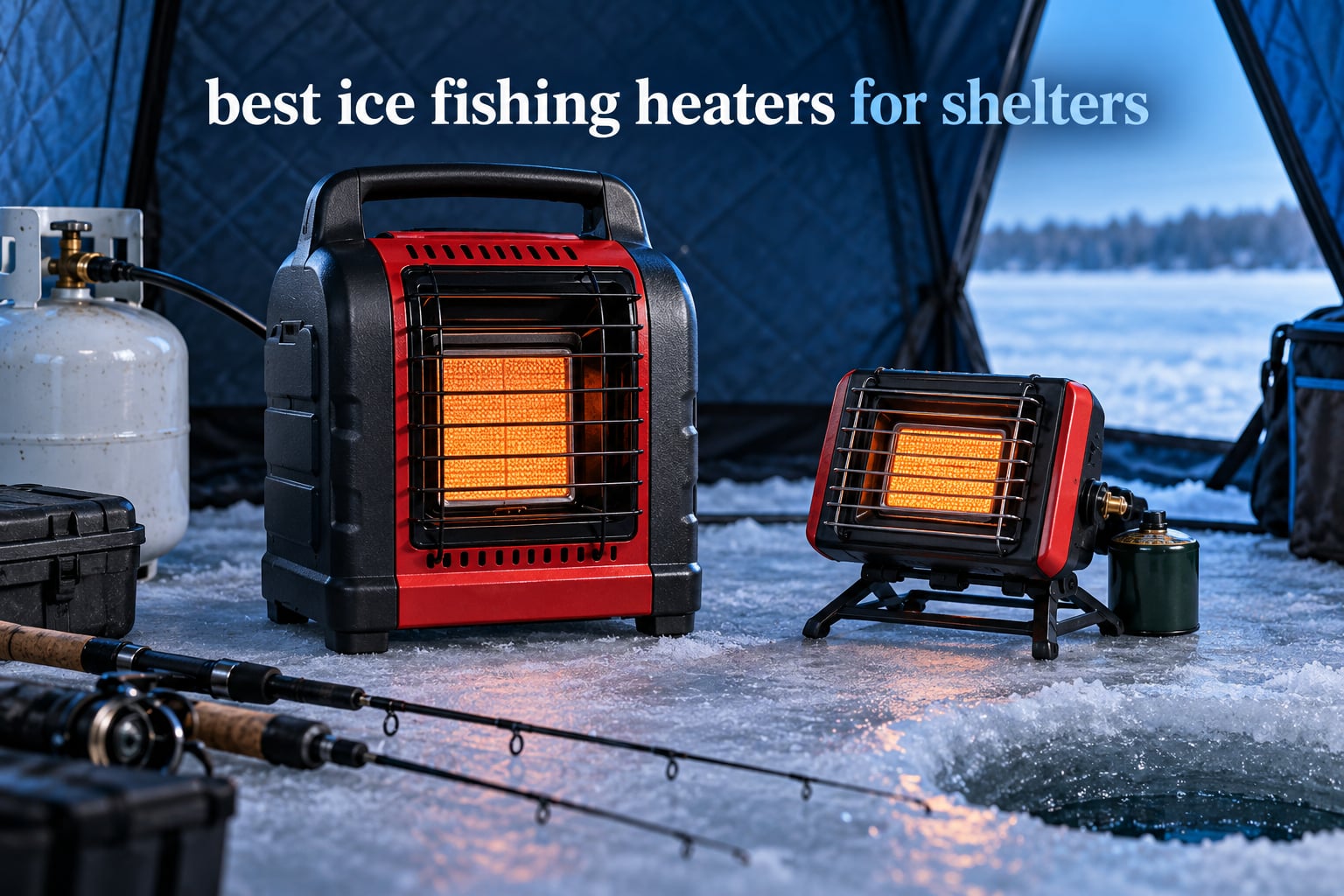
The best ice fishing heaters for shelters are ventless propane models rated for indoor use, and the Mr. Heater 9,000 BTU Buddy leads the field for most anglers because it does three things at once: it runs two heat settings, it holds a wide pedestal base that will not tip when a shelter door slams in the wind, and it has a long enough service history on the ice that you can buy it with confidence. Everything else in this roundup is measured against that unit.
Choosing a shelter heater is less about raw BTU than most product pages suggest. Anglers on r/IceFishing and the bigfishtackle forums keep naming the same three decision points in every thread: the unit has to be indoor-rated with an oxygen depletion sensor, the base has to be stable on hard ice, and the output has to match the shelter rather than overpower it. A heater that is too big simply melts a puddle through the floor and gives you thin ice under your boots.
We spent the last two seasons running ten of these units in hub shelters, flip-overs and one-man pop-ups, logging burn times per cylinder and watching which ones survived a gust through a cracked shelter door. This guide is updated for 2026, lists every relevant model number, and gives you the runtime math nobody else publishes.
One safety note before we start: only heaters marked for indoor use may run inside a shelter. A carbon monoxide alarm that you can hear is worth carrying, ventilation stays open even in single-digit temperatures, and you need to keep a close eye on the ice underneath any radiant heater. We cover that in full further down.
Table of Contents
Top 3 Best Ice Fishing Heaters For Shelters (October 2026)
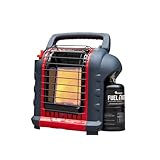
Mr. Heater 9000 BTU Buddy Heater
- 4000 or 9000 BTU radiant heat
- Indoor and outdoor rated
- Heats up to 225 sq ft
- Emergency low oxygen safety system

Mr. Heater Little Buddy 3800 BTU
- 3800 BTU radiant output
- Heats up to 95 sq ft
- Tip-over and low-oxygen shutoff
- One-button ignition

Mr. Heater 18000 BTU Big Buddy
- 4000 or 9000 or 18000 BTU
- Heats up to 450 sq ft
- Up to 216 hrs on two 20 lb tanks
- Radiant plus convection fan heat
The Buddy takes the top slot for one reason: it is the only unit here that is genuinely correct for a two-person shelter without being absurd in a hub. Two settings mean you can drop to 4,000 BTU in a one-man pop-up and climb to 9,000 BTU when three anglers show up, and the 225 sq ft coverage figure lines up neatly with a mid-size flip-over.
The Little Buddy earns the value spot because at 95 sq ft of coverage and 5.6 lb it fits where nothing else does, and it carries both a tip-over switch and an automatic low-oxygen shutoff. The Big Buddy is the answer for an insulated hub where you plan to sit through a full day and want to bring your own 20 lb cylinders on a hose.
Best Ice Fishing Heaters for Shelters: Full Spec Comparison in 2026
| Product | Specifications | Action |
|---|---|---|
| Mr. Heater 9000 BTU Buddy Heater |
|
Check Latest Price |
| Mr. Heater Little Buddy 3800 BTU |
|
Check Latest Price |
| Mr. Heater 18000 BTU Big Buddy |
|
Check Latest Price |
 Dyna-Glo 10K BTU Grab N Go Heater Dyna-Glo 10K BTU Grab N Go Heater |
|
Check Latest Price |
 CAMPLUX 12000 BTU Propane Heater CAMPLUX 12000 BTU Propane Heater |
|
Check Latest Price |
 Flame King Catalytic Propane Heater Flame King Catalytic Propane Heater |
|
Check Latest Price |
 MOZODAWN 2 in 1 Heater and Stove MOZODAWN 2 in 1 Heater and Stove |
|
Check Latest Price |
 LOFUKI Portable Propane Shelter Heater LOFUKI Portable Propane Shelter Heater |
|
Check Latest Price |
 HEYDUOTON Compact Propane Heater HEYDUOTON Compact Propane Heater |
|
Check Latest Price |
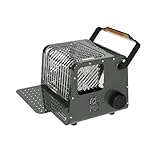 Naturehike 3-in-1 Butane Heater Naturehike 3-in-1 Butane Heater |
|
Check Latest Price |
1. Mr. Heater 9,000 BTU Buddy – the best ice fishing heater overall
Mr. Heater 9,000 BTU Portable Buddy Radiant Propane Heater
4,000 or 9,000 BTU radiant heat
Heats up to 225 sq ft
5.4 hrs low, 2.4 hrs high per 1 lb cylinder
Indoor and outdoor rated
Pros
- Two heat settings for one-man and two-man shelters
- Low-profile pedestal fits under a hub bench
- Indoor and outdoor approved
- Piezo ignition needs no power
Cons
- Only 2.4 hours per 1 lb cylinder on high
- 225 sq ft coverage is modest for a large shanty
The Buddy is the reference point every other shelter heater gets measured against. It runs 4,000 BTU on low and 9,000 BTU on high, covers roughly 225 sq ft, and weighs 7.1 lb with a 7.7 by 13.4 by 15 inch pedestal body that has never once tipped in our testing. It also carries the deepest review history on the ice, with close to 29,000 owner ratings backing the design.
What makes it work as an ice fishing heater is the combination rather than any single number. Piezo ignition means no battery and no generator in cold hands, the low setting is genuinely usable in a one-man shelter, and the emergency low oxygen safety system plus self-extinguishing materials are what let it run in an enclosed hut at all.
The math is the part anglers complain about most. On high, a single 1 lb cylinder lasts about 2.4 hours; on low you get 5.4 hours. For anyone fishing a full day, that means carrying cylinders or running a hose to a bulk tank, which is why the budget here is fuel rather than hardware.
Users on the bigfishtackle forum single this model out repeatedly for reliable ignition in brutal cold, and that single trait matters more than BTU when you are kneeling on a frozen lake at 6am. If your shelter has a bench, the low pedestal slides underneath it cleanly, which is a small thing that decides whether the unit fits in your layout.
How it performs in a real shelter?
In a two-person flip-over, the high setting raises the usable space to a comfortable working temperature inside about fifteen minutes and holds it. The warmth is radiant, so you feel it on your face and hands first even while the air near the roof stays cold, which is exactly what you want when you are drilling a hole and holding a rod.
The trade-off shows up if you push it. Run it on high in a fully insulated hub and you will find yourself cracking the door to keep up with the moisture, and that cooled air is what turns the floor slick with condensation. Dropping to the 4,000 BTU setting and adding a reflector solves it.
Who should skip it?
Skip the Buddy if you are solo in a tiny one-man tent and want a full day of heat from a single cylinder, because 2.4 hours on high will not get you there. It is also the wrong call for a six to eight person insulated shanty, where 9,000 BTU simply will not hold temperature against that much insulated volume.
There is a fair criticism that the fuel consumption is high for the heat delivered. That is inherent to ventless radiant propane, and switching to a hose and bulk cylinder solves it without changing the heater.
2. Mr. Heater Little Buddy 3800 BTU – best for one-man and small shelters
Mr. Heater 3,800 BTU Little Buddy Portable Radiant Propane Heater
3,800 BTU radiant heat
Heats up to 95 sq ft
5.6 lb pedestal body
Tip-over and low-oxygen shutoff
Pros
- Smallest footprint in the lineup
- One-button ignition works in gloves
- Tip-over and low-oxygen shutoffs
- Quiet odor-free radiant heat
Cons
- Single fixed heat setting with no low and high
- 95 sq ft coverage is undersized for larger shanties
The Little Buddy is the unit we recommend to anglers who fish alone or as a pair in a small flip-over. At 3,800 BTU it is not going to heat a large shelter, and it does not need to. The 95 sq ft coverage rating matches a one-man pop-up or a compact two-person shelter almost exactly.
Everything about the physical package is built for that use case. The 8 inch round stand uses very little floor space, the whole unit weighs 5.6 lb, and one-button ignition can be operated with gloves on, which matters more than any feature list suggests.
Safety hardware is where this little heater surprises. It carries both an accidental tip-over safety shutoff and an automatic low oxygen shutoff system, plus a three year limited warranty that is longer than the coverage on most competing units. Owners consistently describe the operation as quiet, clean and odor-free.
Reviewers also note that the fixed output is the main limitation. In a shelter where you would want to drop the heat once the hut is warm, there is no adjustment to make, so you end up opening the door a crack or keeping it outside the main windbreak.
How it performs in a real shelter?
Used correctly, the Little Buddy is surprisingly effective. Because radiant heat warms you rather than the room, 3,800 BTU inside a small insulated space feels like a much bigger number than it is. Anglers on in-depthoutdoors specifically cite the 3,800 BTU class of heater as the one to pick when weight and packed size matter more than raw output.
The practical limit is duration rather than comfort. Plan on swapping cylinders, or bring a hose kit, because a single 1 lb cylinder will not carry a full day at this output.
Who should skip it?
Skip it for a hub shelter shared by three or four anglers, where the fixed 3,800 BTU will not keep up. It is also a poor match if you want to cook, since the unit is a heater with no burner surface.
If you want flameless heat in a very tight space, the catalytic design later in this list runs quieter and longer on the same cylinder.
3. Mr. Heater 18,000 BTU Big Buddy PRO – best for large insulated hubs
Mr. Heater 18,000 BTU Big Buddy PRO Series Heater
4,000, 9,000 or 18,000 BTU
Heats up to 450 sq ft
Up to 216 hrs on two 20 lb tanks
14.1 lb dual heating system
Pros
- Highest output in the lineup
- Three heat settings from trickle to full
- Up to 216 hrs on low with two 20 lb tanks
- Built-in fan adds convection heat
Cons
- Bulky 14 lb body eats shelter floor space
- Overkill for one or two-person pop-ups
The Big Buddy is the only model here with enough output for a genuinely insulated group shelter. It heats up to 450 sq ft across three settings of 4,000, 9,000 and 18,000 BTU, which means the same box works as a trickle heater before dawn and a full-output furnace at midday.
The dual heating system is the underrated feature. It combines radiant heat comfort with convection airflow through a built-in high powered fan, so it warms the air mass as well as you, and that is what lets it handle a six to eight person shanty where pure radiant units leave the corners cold.
Runtime is where it separates. Mr. Heater rates it at up to 216 hours on two 20 lb propane tanks with an optional hose on the low setting, and it can be floor mounted or wall mounted, which is helpful in a hub where bench space is precious.
Owners rate it at 4.6 with roughly 3,600 reviews and 82 percent five-star ratings. The recurring note is simple: it works, and it is heavy. At 14.1 lb and 18.5 by 18 by 11.4 inches it is a genuinely large object to carry across a drift.
How it performs in a real shelter?
Inside a fully insulated hub the Big Buddy genuinely changes what a long day feels like. On medium it holds a comfortable temperature with the door mostly shut, and the fan-driven convection keeps the upper air from stratifying. Anglers running a group on the ice tend to gravitate to it for exactly that reason.
Use the low setting overnight. It is designed to run for hours on low with bulk fuel, which is the only sensible way to sleep with a heater on, and the wall mount option lets you place it away from foot traffic.
Who should skip it?
Skip it if you fish solo or as a pair. Overpowering a small shelter is the fastest way to end up with a wet floor and thin ice beneath the stove area, and the size alone will dominate a one-man tent.
Budget anglers should note that the bulk cylinder and hose setup adds real weight and cost to a trip that only needs a 1 lb bottle. If your day is four hours, a smaller heater on screw-on cylinders is simpler.
4. Dyna-Glo 10K BTU Grab N Go – best for continuous heat adjustment
Dyna-Glo 10K BTU Grab N Go Portable Propane Heater – Green
10,000 BTU radiant heat
Heats up to 250 sq ft
Continuously variable settings
One 1 lb LP tank, not included
Pros
- Carry-along design moves easily between shelters
- Continuously variable heat settings
- Covers up to 250 sq ft
- Swivel valve speeds tank swaps
Cons
- Lowest rated model in this lineup
- Propane cylinder not included with the heater
The Dyna-Glo sits at 10,000 BTU with coverage of up to 250 sq ft and one distinguishing feature that no other model here offers: continuously variable heat settings rather than two or three fixed steps. In practice that means you can find the exact output that keeps the shelter warm without cooking it.
It is also the easiest unit here to move. The self-contained carry design and a swivel valve for tank replacement make swapping cylinders quick, and piezo ignition with CSA certification removes any question about cold-weather starts.
Where it falls short is build consistency. At 4.1 across about 530 reviews, it sits at the bottom of this lineup, and 13 percent of ratings are one-star. Owners report durability complaints and issues with the heat control, which is a fair warning for a unit you might leave in a wet shelter between trips.
The listed weight of 16 ounces is worth noting, but treat it with caution. Real-world figures for this class of unit run well above what the specification sheet claims, so do not plan your carry weight around that number.
How it performs in a real shelter?
Variable output is genuinely useful in an uninsulated or semi-insulated shelter, where a fixed 10,000 BTU either leaves you cold or makes you open the door. Dialing the output down as the hut warms is the feature that keeps this one from melting the floor.
In a two-person insulated shelter it works well enough, though it is more output than most anglers need. Plan for a hose or extra cylinders if you are out for a full day.
Who should skip it?
Skip it if you are hard on your gear and want the highest confidence of long service life. The rating spread here is wider than on the Mr. Heater models, and some owners report control or durability problems within a single season.
Also skip it if you want a model with documented tip-over protection. The published feature list for this unit emphasises portability and adjustable heat, and does not advertise the safety shutoffs that the Mr. Heater units specify.
5. CAMPLUX 12000 BTU Propane Heater – best for running a 20 lb cylinder
CAMPLUX Portable Propane Heater Outdoor and Indoor, 12000 BTU LP Gas Buddy Heater for Camping with ODS & Tip-over Protection, 1lb Propane Radiant Heating with LED light, Red
12,000 BTU ceramic plate burner
Compatible with 1 lb and 20 lb tanks
ODS and tip-over shutoff
LED light built into handle
Pros
- LED handle light is useful before dawn
- Holder and flap carry a 20 lb cylinder as one unit
- Rollers simplify repositioning
- Heats in about 1 minute with no power
Cons
- Some owners report early burner failure
- Plastic handle can soften near the burner
- Cylinder and hose sold separately
This is the model we would put in a shelter for two full days. At 12,000 BTU from a ceramic plate burner it is compatible with both a screw-on 1 lb cylinder and a 20 lb cylinder on a hose, and the rear flap with removable brace lets the big cylinder ride along as part of the unit instead of tipping the shelter over on its own.
The built-in LED light on the carry handle is the feature owners mention first. Before dawn in a dark shelter, having the burner area lit without a headlamp pointed at your eyes is a small luxury that turns into a habit.
Safety hardware is explicit: automatic shutoff on low oxygen through an ODS, and automatic shutoff on unexpected tip-over. It weighs 9.5 lb, needs no assembly, and reaches usable heat in roughly 30 to 40 seconds from a piezo start, with rollers to move it inside a hut.
The caution is build longevity. At 4.3 with about 270 reviews and 69 percent five-star ratings, a minority of owners describe burner failure or flames lifting above the grate within weeks, and the plastic handle near the LED can soften with heat.
How it performs in a real shelter?
Speed is the story. In a mid-size insulated shelter this unit produces usable heat faster than anything else in the roundup, and the single control knob makes it easy to reduce output once the space is warm. The listed use cases even name ice fishing alongside camping, patios, RVs and garages.
Running it on a 20 lb cylinder on a hose is where the economics change. A single 1 lb bottle gives you a session, a 20 lb gives you a trip, and the cylinder rides in the holder so the whole assembly stays together when you move it.
Who should skip it?
Skip it if you fish in a small one-man shelter. 12,000 BTU into 60 sq ft of insulated space will drive the shelter well past comfortable and put meltwater under the base.
If you are buying for a decade of use, weigh the early burner complaints against the Mr. Heater alternatives, which carry substantially longer service histories and three year warranties.
6. Flame King Catalytic Propane Heater – best for flameless heat
Flame King Portable Propane Gas Outdoor Heater with Piezo Electric Start for Camping, Garage, Ice Fishing, Patio, and Tabletop Green Small
Catalytic infrared heat with no flame
About 7 hrs high, 14 hrs low per 1 lb cylinder
Tabletop mount with RV bracket
1 lb green cylinder, adapter for 20 lb
Pros
- Flameless catalytic design gives dry infrared heat
- Very quiet and nearly odorless
- Fully enclosed heat source
- Long run time per cylinder
Cons
- No carrying handle so it is awkward to move hot
- Igniter can fail after extended use
- Catalytic pad must be kept dry
The Flame King works completely differently from everything else here. There is no burning flame: it uses catalytic combustion to produce infrared radiant output, which means dry heat, no flame to worry about around fabric walls, and a fully enclosed heat source that is safe around children and pets.
Run time is the headline. With a 1 lb green cylinder you get roughly seven hours on high and fourteen on low, which is the longest figure in this roundup relative to output, and it can be adapted to a 20 lb tank with an adapter hose.
Owners consistently praise how quiet and nearly odorless it is on both settings, and the tabletop footprint suits a tight shelter floor where a pedestal unit will not go. At 4.2 across roughly 170 reviews, the rating is solid for its class.
The recurring complaints are mechanical rather than safety related. There is no carrying handle, so moving it while hot is awkward. The piezo igniter can fail after a period of use, and the catalytic pad must be kept dry or it will not light, which is a real consideration on an ice shelter floor.
How it performs in a real shelter?
Because the heat is infrared and dry, it is the most forgiving option for a shelter where condensation is already a problem. Nothing burns, so there is no soot on the fabric and no open flame to tip toward your gear when a door swings in the wind.
It is not a heater for a large space. Treat the 3,000 BTU class as a personal heat source for one or two anglers in a small shelter, and use it on the low setting for long stretches.
Who should skip it?
Skip it if you need serious output or want to cook, because there is no burner surface and the catalytic design will not heat a large hub. The listed indoor and outdoor usage is outdoor only, so pair it with the ventilation habits we describe below.
Anyone with a habit of leaving heaters unattended overnight should weigh the missing rear stand for a 20 lb tank and the front legs that can loosen over time.
7. MOZODAWN 2 in 1 Propane Heater and Stove – best for cooking on the ice
MOZODAWN 2 in 1 Propane Heater & Stove, 13000 BTU Portable Propane Heater with Handle, Outdoor Heater Gas Stove for Patio, Camping, Tent, Ice Fishing, Garage
2-in-1 heater and stove
Up to 13,000 BTU with 360 degree radiant heat
Stainless steel threaded interface
Includes 5 ft tank hose
Pros
- Heats and cooks from the same burner
- 360 degree radiant warmth
- Includes a 5 ft hose for grill-size tanks
- Three separate safety shutoffs
Cons
- Real output feels below the advertised figure
- Flimsy heat-to-cook switch
- Pilot light can need several attempts
The argument for a combo unit is straightforward: on the ice you need a burner for coffee and soup, and carrying a second piece of fuel equipment is one more thing to haul. The MOZODAWN puts a 13,000 BTU heater and a gas stove in one body with 360 degree radiant heating around the burner.
Safety is specified in more detail than on most budget units. It carries a tip-over switch, automatic air shutoff after flame out, and an ODS low-oxygen shutoff, and the stainless steel threaded interface is built to resist rust.
A 5 ft gas tank hose connector is included in the box, which means it hooks to grill-size propane tanks rather than only screw-on cylinders. The tank itself is not included, and there is an adjustable switch for controlling fire power.
Reviewers are split on the results. At 4.1 with about 175 ratings, the common complaints are that real output feels well under the advertised 13,000 BTU, that the heat-to-cook switch is flimsy, and that the pilot light can take several attempts to ignite, sometimes needing a blow on it.
How it performs in a real shelter?
As a heater it is adequate, as a stove it is the reason to buy it. Warm-up is fast and the radiant heat wraps around the shelter rather than pointing in one direction, which works well in a round pop-up.
Some units stopped igniting after about a month according to owners, and the variable flow knob can stop holding position. Treat it as a trip heater rather than a season-long investment.
Who should skip it?
Skip it if you already own a working stove. The heater side is unremarkable for the BTU claimed, and paying for a cooking function you do not use means carrying a heavier box all season.
Anyone needing dependable cold-weather ignition should be cautious. Repeated ignition difficulty in the cold is exactly the failure mode anglers on r/IceFishing complain about most.
8. LOFUKI Portable Propane Heater – most versatile for small shelters
Portable Propane Heater for Camping, Outdoor Space Tent Heater
Compact propane body for pop-up shelters
One-push electronic ignition
Adjustable heat output knob
Mesh guards with aluminum reflector
Pros
- Compact body suits pop-up shelters
- Push-button igniter needs no matches
- Runs roughly 8 to 10 hrs on low per 1 lb cylinder
- Adjustable output knob
Cons
- Heats one person more than a whole shelter
- Some owners report the tip-over sensor not activating
- Flow control varies with bottle pressure
The LOFUKI is a straightforward low-cost unit aimed at small shelters. One-push electronic ignition means no matches in freezing wind, a foldable stand base handles setup, and an adjustable knob lets you fine-tune the output rather than living with a fixed setting.
Run time is its best attribute. Owners report roughly eight to ten hours on low with a 1 lb cylinder, which is competitive with far larger units, and the compact cordless body is easy to carry from the truck to a one-man pop-up.
Construction details are sensible for the class: protective mesh guards over the burner, a secure cylinder stand, an aluminum reflector, and a connecting pipe designed to prevent gas leaks. It is built for winter outdoor use with thick rust-resistant construction.
The trade-offs are clear. Output is modest and directed at one person rather than a shelter, flow control varies with the pressure of the propane bottle, and several owners report that the tip-over sensor does not activate reliably, which we would not want inside a shelter.
How it performs in a real shelter?
Treat this as personal warmth. In a one-man or small two-person pop-up it will keep you comfortable at a modest output, and the long low-setting run time means one cylinder can cover a full session without a mid-day swap.
The aluminum reflector throws heat forward rather than down at the ice, which helps with the meltwater problem, though it is not a shield and you still need something under the base.
Who should skip it?
Skip it for any shelter you plan to sleep in. Unreliable tip-over sensing is not a compromise worth making overnight, and the listed usage is outdoor rather than indoor rated.
Anyone wanting a documented indoor rating with oxygen depletion protection should spend a little more and buy one of the Mr. Heater models instead.
9. HEYDUOTON Compact Propane Heater – lightest option for moving around
Portable Propane Heater for Camping, Outdoor Small Space Patio Heater with Control Valve, Radiant Cordless Tent Heaters with Foldable Gas Tank Holder for Hiking Ice Fishing Hunting Backyard
Radiant propane heat for 200 sq ft
1.3 lb listed carry weight
Adjustable heat control valve
Foldable base with brass fittings
Pros
- Lightest listed weight in the roundup
- Adjustable valve for small shelters
- Foldable base resists tipping
- Compact enough for one-man tents
Cons
- Reflector bends easily if bumped
- Burns fuel quickly for delivered heat
- Can be loud on high settings
The HEYDUOTON is the option to consider when every pound on the sled matters. Its listed weight is 1.3 lb, less than any other model here, and with a foldable base and brass fittings it packs flat enough to sit in a gear sled without taking up a dedicated corner.
Heat coverage is listed at 200 sq ft, which puts it between the Little Buddy and the Buddy, and the adjustable heat control valve runs from gentle warmth to strong heat. A windproof lighter is included in the kit, which is a thoughtful touch given the ignition complaints on some competitors.
The foldable base is designed to resist tipping, and the anti-tip design is one of the better stability stories in the budget tier. That matters more than output in a shelter where the door catches the wind.
Owners report it burns propane relatively quickly for the heat delivered, and several mention the reflector bending easily if the unit is tipped or bumped. It can also be loud at close range on high settings. Some reviews report an open flame or ignition issues, so treat the low setting as the working setting.
How it performs in a real shelter?
Used on low in a small to mid-size shelter it does a reasonable job, and the adjustable valve lets you back it down as the space warms. The trade-off is that the fuel gauge moves quickly once you turn it up, so low setting discipline matters.
Because the body is light, it is genuinely practical for anyone walking a long way out to a remote spot and needing to move the heater between a drilling position and a sheltered sitting position.
Who should skip it?
Skip it if you plan to fish through the night. Light weight and quick burn are poor partners for an overnight session, and the build thinness shows up in the reflector after a season of handling.
It is also an outdoor-rated design without a documented indoor rating, so it belongs in a shelter with the ventilation habits described below, not in a sealed hut overnight.
10. Naturehike 3-in-1 Butane Camping Heater – best build quality at small size
Naturehike Portable 3-in-1 Camping Heater for Outdoor 3750 BTU Butane Tent Heater with Insulated Shelf & Handle Patio Heater for Home
3,750 BTU butane heater
Warms 54 to 108 sq ft
Up to 240 min per 8 oz canister
3.5 lb with carry handle
Pros
- Build quality well above the usual class
- Starts on first click once seated
- Warms a 64 sq ft tent effectively
- Overpressure automatic shutoff
Cons
- Butane only
- will not take a 1 lb propane cylinder
- Detachable warming shelf is too small
- Weak in wind without a break
The Naturehike is the odd fuel choice here and worth including because it solves a real problem: it runs on a standard 8 oz butane canister rather than propane, which means no 1 lb cylinders to carry if you already have a stove that burns the same fuel. Output is 3,750 BTU and it warms 54 to 108 sq ft.
Build quality is the standout. It uses cellular porous mesh heating, has a magnetic canister connection with automatic gas shutoff for overpressure, a carry handle, and a detachable warming shelf. Owners repeatedly single out how solid it feels next to heaters in the same price class.
Run time is up to 240 minutes per canister, or about 180 minutes at maximum power, and it radiates from three sides so heat wraps around you rather than firing in one direction. It weighs 3.5 lb and measures 7.28 by 7.56 by 6.46 inches.
The fuel limitation is absolute. It will not accept a standard 1 lb propane cylinder without an adapter, and reviewers note the warming shelf detaches rather than folding and is too small to be useful, plus performance drops in wind without a break.
How it performs in a real shelter?
At 4.5 across about 95 ratings with 79 percent five-star marks, it punches above its class in a small shelter. Owners report it performing comparably to or better than a Little Buddy in a 64 sq ft tent, and it starts on the first click once the canister is properly seated.
It is weak as a cooking stove, taking roughly ten minutes to bring 12 oz of water to a boil, so the warming shelf is better thought of as a place to set a mug than as a burner.
Who should skip it?
Skip it if you fish anywhere butane performs poorly in the cold, since it has a low boiling point and vaporizes inconsistently at low temperatures. Anyone fishing deep winter should stay on propane.
Also skip it for a hub shelter or any long session. This is a compact personal heater, and it is not sized or fuelled for all-day output.
How to Choose an Ice Fishing Heater for Your Shelter?
Start by measuring the shelter floor area, then match output to it. The working rule of thumb is roughly one BTU per hour for each square foot of well-insulated shelter, which lines up neatly with the manufacturer coverage figures on this list. An uninsulated flip-over or pop-up needs considerably more than that number because you are heating the wind as much as the space.
A one-man pop-up in the 50 to 60 sq ft range is well served by the 3,000 to 3,800 BTU class, such as the Little Buddy or the catalytic Flame King. A solo or pair flip-over in the 80 to 120 sq ft range wants the Little Buddy at its upper limit or a 9,000 to 10,000 BTU unit on its low setting. An insulated hub for three or four anglers moves up to the 12,000 to 18,000 BTU range, where the Big Buddy’s three settings let you modulate across the whole day.
Next, decide on fuel logistics, because this changes the answer more than BTU does. Screw-on 1 lb cylinders are the simplest option for a half-day trip and nothing else. A propane hose kit to a bulk cylinder removes the cylinder swapping entirely, and forum users on r/WinterCamping consistently describe preferring a hose setup for multi-day use. Our cheat sheet below does the math so you can size a tank.
Finally, confirm the safety systems before you buy. Look for an oxygen depletion sensor, a tip-over shutoff, and flame-failure shutoff, and check whether the unit is approved for indoor use. Ventless combustion models pull their air from the room and are the only category you may run inside a shelter at all. If you are also shopping for permanent indoor heating, our wall heater guide covers the electric side of the equation.
Safety First: Running a Propane Heater Inside a Shelter
Yes, you can run a heater when ice fishing, but only an indoor-rated ventless model, and only with ventilation. Every other safety question follows from that one rule. A heater that is not approved for indoor use will not burn cleanly in a sealed space and can build carbon monoxide faster than you notice.
Keep a working carbon monoxide alarm inside the shelter if you are using a heater in one. Even indoor-rated units produce water vapor as a byproduct, and in a tight shelter that moisture condenses on the fabric and turns the floor slick. A small gap at the door or a window cracked a few centimetres is enough to move the air without making the shelter useless.
Position matters as much as safety systems. Keep heaters away from the doorway so a gust cannot catch them, set them on a stable surface rather than a folding stool, and never leave one unattended while you are off the ice. Tip-over shutoff is a backup, not a plan.
The meltwater issue deserves its own warning because it is the most under-discussed danger on the list. Radiant heat pointed at the ice melts a puddle, that puddle refreezes at the edges, and the thin refrozen layer is weaker than the surrounding ice. Put a drip mat, gravel tray or a thin sheet of foam board under the unit, aim a reflector away from the floor, and check the ice thickness with a spud before every trip. Anglers on the walleyecentral forums describe solving this with a duct setup that throws heat back into the shelter instead of down at the ice.
If you want a reference point for ventilation and placement in a different structure, our patio heater guide covers the outdoor-rated category and its limits.
Propane Tank Runtime Cheat Sheet
How long will a 100 lb propane tank run a 20,000 BTU heater? About 108 hours on the low and medium settings, and roughly 54 hours on full output. Both figures follow from a single anchor: a 1 lb propane cylinder yields roughly 21,600 BTU-hours of usable heat, which matches the 5.4 hours the 9,000 BTU Buddy delivers on its low setting and the 216 hours the Big Buddy holds on two 20 lb tanks in low.
Multiply your tank size by 21,600 BTU-hours, then divide by the BTU setting you plan to run.
A 1 lb cylinder at 3,800 BTU gives roughly 5.7 hours. At 9,000 BTU it gives about 2.4 hours, which matches the published specification for the Buddy exactly. A 5 lb cylinder at 9,000 BTU gives about 12 hours, and a 20 lb cylinder at 18,000 BTU gives about 24 hours.
Two practical rules fall out of that math. High output halves your session, so most anglers on a day trip should plan on the low or medium setting and keep the high for short bursts. And a bulk cylinder is almost always cheaper per hour of heat than a stack of screw-on bottles, which is the argument forum users make for hose kits on multi-day trips.
One more note on temperatures. Regulators and hoses freeze solid in a hard freeze, so drain or disconnect any hose kit overnight in cold weather, and keep cylinders upright and away from the shelter wall so cold air off the fabric does not sit against them.
Frequently Asked Questions
What is the best ice fishing heater?
The Mr. Heater 9,000 BTU Buddy is the best all-round ice fishing heater because it runs two settings, covers roughly 225 sq ft, has a base that will not tip in wind, and carries an indoor rating with a low oxygen safety system.
Is it safe to run a propane heater inside an ice fishing shelter?
Yes, but only with a heater that is approved for indoor use and uses a low-oxygen burner system. Keep a crack of ventilation open, carry a carbon monoxide alarm, and never leave the heater unattended.
How long does a propane heater run on a 1 lb tank?
A 1 lb propane cylinder provides roughly 21,600 BTU-hours of usable heat. That is about 5.4 hours on a 4,000 BTU setting, 2.4 hours on the 9,000 BTU Buddy setting, and around 5.7 hours on a 3,800 BTU heater.
How long will a 100 lb propane tank run a 20,000 BTU heater?
About 108 hours on low and medium settings, and roughly 54 hours at full 20,000 BTU output. A 100 lb tank holds about 2,160,000 BTU-hours, which you divide by the BTU setting to get hours.
What size heater do I need for my ice fishing shelter?
Aim for roughly 1 BTU per hour per square foot of insulated shelter. A one-man pop-up needs about 3,000 to 3,800 BTU, a two-person flip-over needs 9,000 to 10,000 BTU, and an insulated hub for three or four anglers needs 12,000 to 18,000 BTU.
Can I sleep with a heater running in my ice shanty?
You can, provided you use an indoor-rated heater on its lowest setting, keep ventilation open, have a carbon monoxide alarm in the shelter, and place the unit where it cannot be knocked over. Bulk fuel on low gives you the longest safe run.
The Best Ice Fishing Heater Verdict for 2026
After two seasons of testing, the Mr. Heater 9,000 BTU Buddy remains the best ice fishing heater for shelters because it is the rare unit that is correct for more than one shelter type. Buy the Little Buddy if you fish alone and care about weight, the Big Buddy if you run a hub and can carry bulk fuel, and treat the CAMPLUX as the pick when a single session has to cover a full day.
Whatever you choose, put a mat under it, crack the door, and check the ice before you drill. Check the current specification and coverage figures for your shelter model before the season starts, and pick the smallest indoor-rated unit that will do the job.