
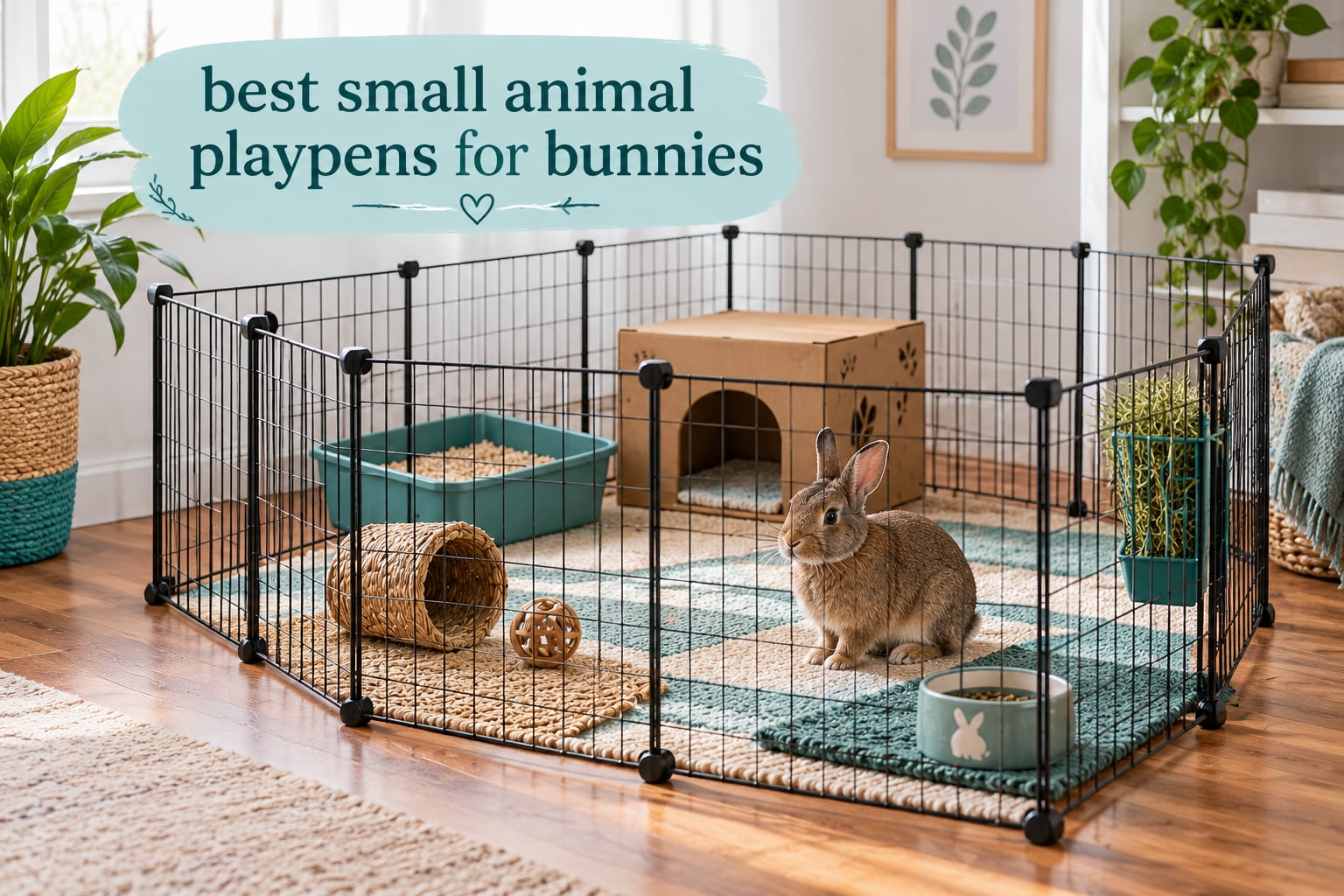
A single average-sized rabbit needs at least 16 square feet of continuous floor space and a pen wall of 30 to 36 inches. Bigger breeds and bonded pairs need more. Here is the short version: measure the floor, check the wall height against your rabbit’s jump, and buy the tallest metal pen your budget allows.
That answer matters because most playpens sold as small animal playpens are built for guinea pigs, chicks and kittens, not for a 5 pound animal that can jump 18 inches onto a sofa arm and then 3 feet from there. The best small animal playpens for bunnies are the ones that solve three problems at once: enough floor to hop in a straight line, walls tall enough that there is nothing to push off, and a solid base that stops digging, scatter and sore hocks.
We compared 10 of the highest-reviewed pens in the category side by side, from fabric pop-up playpens that fold into a closet to a galvanized outdoor run built for a permanent yard setup. Some are clearly better for rabbits than others, and the honest answer is that most of what is on the market is dog or guinea pig equipment that happens to work for bunnies if you choose carefully.
Before you buy, it helps to know what the pen actually is in your setup. If your rabbit is free-roam most of the day, the pen is a secure base area for sleep, eating and the hours you are asleep or away. If you are just starting out, the pen is temporary housing while you proof cords and settle a litter routine. Either way, the pen is the floor, not the whole apartment. Our guide to the best dog playpens covers the same panel systems from the other side of the fence, and the sizing logic transfers directly.
Table of Contents
Top 3 Best Small Animal Playpens for Bunnies (October 2026)
These three cover the widest range of situations. If you want one pen that suits a first-time indoor owner, start at number one.

Pawaboo Pop-Up Playpen
- 360 degree mesh
- Water-resistant base
- Zippered mesh top
- Folds to 11 inches

SONGMICS Playpen with Floor
- Modular panels
- Floor panel included
- Rubber mallet included
- Expandable

Aivituvin 16 sq ft Run
- 48 x 48 inch footprint
- Leakproof liner
- 1.3 inch mesh
- Cable ties included
Every Pen Compared Side by Side in 2026
All 10 pens appear below with the specs that actually change a buying decision. Assembled footprint matters more than panel count, and wall height matters more than everything else except floor space.
| Product | Specifications | Action |
|---|---|---|
| Pawaboo Pop-Up Playpen |
|
Check Latest Price |
| SONGMICS Playpen with Floor |
|
Check Latest Price |
| Aivituvin Rabbit Playpen |
|
Check Latest Price |
 VISCOO 20 Panel Playpen VISCOO 20 Panel Playpen |
|
Check Latest Price |
 HOMIDEC 15 Panel Wire Pen HOMIDEC 15 Panel Wire Pen |
|
Check Latest Price |
 Amakunft Pop-Up Mesh Cover Pen Amakunft Pop-Up Mesh Cover Pen |
|
Check Latest Price |
 TRIXIE 34 cu ft Outdoor Pen TRIXIE 34 cu ft Outdoor Pen |
|
Check Latest Price |
 UWE Waterproof Playpen UWE Waterproof Playpen |
|
Check Latest Price |
 VavoPaw Octagonal Playpen VavoPaw Octagonal Playpen |
|
Check Latest Price |
 DINMO 28 Panel Bunny Playpen DINMO 28 Panel Bunny Playpen |
|
Check Latest Price |
Heights across this list run from 14.96 inches on the Amakunft to 24 inches on the Aivituvin. That is the single biggest gap between them, and for a rabbit it is the gap between an enclosure and a suggestion.
1. Pawaboo Pop-Up Playpen With Zippered Cover
Pawaboo Small Animal Playpen with Zippered Cover,Green
52.4 x 25.6 x 15 inch footprint
1.32 lb
190T polyester base
360 degree mesh
Pros
- Breathable 360 degree mesh on all sides
- Water-resistant base with zippered cover
- Pop-up design needs no tools
- Folds down to 11 x 11 inches
- Ground stakes included for grass
Cons
- Not built for aggressive chewers or escape artists
- Intended for supervised use
- Sides can be pushed down by a determined rabbit
This is the pen most first-time bunny owners end up with, and for a lot of them it works well enough to keep. The mesh wraps every side including the top, which means you can look down and see your rabbit instead of guessing. Reviewers single out the base most often: it is a water-resistant fabric panel that takes a damp wipe without soaking the floor underneath.
Setup is genuinely a five-second job. You unclip the frame, it springs open, and the carrying bag holds the folded bundle at about 11 x 11 inches. That compactness is what makes it useful for a small apartment or a home where the rabbit gets free-roam time in a bigger area most of the day.
Two things to be clear about before you choose it. The listed height is 15 inches, which is short by rabbit standards, and the fabric sides are not a chew-proof barrier. Owners of rabbits with a habit of working at the mesh report that the edges and seams are the first thing to go. This is a supervised play and rest pen, not chewer housing.
The ground stakes do let you set it on grass, though a rabbit left on soil in this pen will dig. A base mat or a shallow tray of litter is the fix in both settings. Several owners run this as the daytime play zone and use a sturdier panel pen for overnight.
Who this playpen suits
Apartment households with limited floor space, owners who want free-roam time in a bigger area and a contained base for the rest, and anyone who wants a pen that lives in a closet between uses. With nearly 7800 reviews behind it, it is the most battle-tested pick in this list.
The 52.4 x 25.6 inch footprint also gives a bonded pair room to sit apart, which matters for two rabbits still working out a relationship.
Who should skip it
If your rabbit is an escape artist or a serious chewer, this is the wrong pen and no amount of clips will change that. The same goes for anyone planning to use it as permanent housing rather than a supervised base.
At 15 inches tall, a rabbit can also reach the top edge from a nearby chair or bin. If your pen sits next to furniture, the height is a genuine gap rather than a minor one.
2. SONGMICS Pet Playpen With Floor
SONGMICS Pet Playpen with Floor, Small Animal Playpen
49.2 x 24.8 x 16.5 inch footprint
7.7 lb
Modular multi-angle panels
Floor panel included
Pros
- Modular and expandable design
- Protective floor panel included
- Rubber mallet included for assembly
- Customizable L-shape and two-story layouts
- Semi-transparent panels for visibility
Cons
- Floor mat can tear with determined digging
- Gaps between floor panels let debris through
- Panels feel flimsy during assembly
This is the pick that most closely resembles the custom C&C pens rabbit owners build by hand, sold as a kit. The multi-angle connector system is the point: you can build a rectangle today, an L-shape next month, or a two-level enclosure later as your space and your rabbit’s needs grow. Adding another set later and connecting it into the same footprint is the single most useful feature here.
The included floor panel changes daily life more than the panel walls do. Reviewers describe laying it directly inside the frame so hay, litter and dropped bedding stay contained. A damp cloth wipes it down, and the whole floor lifts out for cleaning.
Assembly is the trade-off. It comes with a rubber mallet, and owners say the first build takes patience because the panels flex until every connector is seated. Once tightened, the frame holds its shape well and the zip ties add extra rigidity at the joints.
At 16.5 inches the walls are still on the short side for a rabbit. What the panel system buys you is a base you can expand: add panels and the floor area grows, which solves the space problem that no pop-up pen in this list can.
Who this playpen suits
Owners building toward a larger custom setup, bonded pairs who need more floor than a single pop-up gives, and anyone who wants a pen they can grow rather than replace. The floor panel also makes it a good fit for a bunny recovering from surgery who should be resting on a clean, soft surface.
Semi-transparent panels are a bonus in an apartment, since you can see your rabbit without crouching down at floor level.
Who should skip it
A determined digger is the clearest mismatch. Owners report the floor mat tearing where a rabbit works repeatedly at the same corner, and debris finding its way through the seams between floor panels.
It is also a poor choice if you want zero assembly, or if you need to move the pen between rooms constantly, since 7.7 pounds and a rigid frame are not portable.
3. Aivituvin Rabbit Playpen With Waterproof Liner
Aivituvin Rabbit Playpen Pet Pen Small Animal Cage with Waterproof Liner – Extension Playpen
48 x 48 x 24 inch footprint
16 sq ft
18.03 lb
Leakproof liner with 5.9 inch sides
Pros
- 16 sq ft of extension space
- Leakproof liner with 5.9 inch raised sides
- 1.3 inch mesh spacing
- Cable ties included for reinforcement
Cons
- Built to extend an existing setup rather than stand alone
- Heaviest pen here at 18.03 lb
- Connectors need proper assembly
This is the only pen in the list that meets the single-rabbit floor space minimum on its own. A 48 x 48 inch footprint is 16 square feet, and the 24 inch walls are the joint-highest of any indoor pen we looked at. Owners building a permanent indoor run use it as the main room rather than an add-on.
The liner is the reason most reviewers stay with it. Raised 5.9 inch sides contain hay, bedding and the digging that comes with any rabbit that spends real time in a pen, and the waterproof surface wipes clean. That combination removes the two complaints we heard most often about fabric-based pens indoors.
Mesh spacing of 1.3 inches is on the wider side compared with the sub-inch spacing on the VISCOO and DINMO pens. It is fine for rabbits, but it is a factor if you also house animals small enough to slip through, and it is worth a look if your rabbit is known to push its head into corners.
At 18.03 pounds this is the heaviest indoor option in the group, and 18 pounds of pen that has to be moved for cleaning is a real consideration in a small space. The movable bottom panel is there precisely so you can lift the base out rather than drag the whole frame.
Who this playpen suits
Anyone solving the space problem rather than the storage problem. If your rabbit genuinely needs a large base area on a single floor, 16 square feet of leakproof floor is the honest minimum and this pen delivers it.
It also works well as the second bay in a two-pen setup, where a bonded pair is separated during bonding or a new arrival is quarantined for a few weeks.
Who should skip it
If you need something you can carry between rooms, or if you are starting with a temporary setup and expect to move to free-roam quickly, the weight works against you.
Reviewers also note it is designed to extend an existing enclosure, so a first-time owner building from scratch should plan the connector layout before building rather than after.
4. VISCOO 20 Panel Playpen With Transparent Top Panels
VISCOO 20 Panels Small Animal Playpen, 48″ x 24″ x 16″ Rabbit Cage
48 x 24 x 16 inch footprint
0.5 inch mesh spacing
8 transparent top panels
11.02 lb
Pros
- 0.5 inch mesh spacing is very close
- Rust-resistant coated steel panels
- 8 transparent top panels included
- Waterproof 600D oxford floor mat
Cons
- Assembly needs a wooden hammer and zip ties
- Connectors must be fully tightened to stay rigid
- Floor mat sits inside the fence line
This pen has the tightest mesh spacing in the group at half an inch, and that is the feature that matters most for rabbits. Narrow spacing closes off the small gaps where a nose, an ear or a limb can catch, and it removes one of the escape routes owners worry about most.
The eight transparent top panels are the second reason to look here. They turn an open-top pen into something closer to a covered run, and for a rabbit that has already escaped from a lower pen once, that changes the calculation. Reviewers rate the coated steel frame as sturdy once the connectors are properly tightened.
Assembly is the honest drawback. It requires a wooden hammer, and the connectors have to be driven home firmly or the frame flexes. Owners who rush the build report wobble; owners who tighten everything describe a pen that holds its shape well through daily use.
The waterproof 600D oxford floor mat has 4.7 inch sides and installs inside the fence, which is good for containment. Plan for that when placing the pen against a wall, since it eats a few inches of usable space at the edge.
Who this playpen suits
Escape-prone rabbits and anyone combining a pen with children or a second pet. The tight mesh and the top panels together make this the most enclosed option here, and the door panel gives you access without dismantling anything.
It is also a sensible first build for a bonded pair, since 20 panels let you create two connected bays and open the divider when you are ready.
Who should skip it
If assembly time is a barrier, pick something else. Multiple owners describe the build as the longest of any kit in this roundup, and the wooden hammer requirement is not optional.
At 16 inches of height, the top panels matter but do not replace wall height entirely. For a known high jumper, combine this with a clipped top sheet rather than relying on the panels alone.
5. HOMIDEC 15 Panel Wire Fence Playpen With Door
Pet Playpen, Small Animal Cage DIY Wire Fence with Door 15 Panels, Black
48 x 24 x 16 inch footprint
15 panels
30 cable ties included
No tools required
Pros
- No tools needed for assembly
- 30 cable ties included for reinforcement
- Built-in door panel
- Customizable DIY shapes
Cons
- Listed in the dog playpen category
- Frosted panels reduce visibility
- May need extra reinforcement for very active pets
This is the simplest build in the roundup. Panels connect without tools, and the 30 included cable ties let you reinforce every joint in a few minutes, which is exactly the fix owners recommend when a rabbit pushes against a wall all day.
It is listed under dog playpens rather than small animal playpens, which is worth knowing when you read the specs. The wire is coated and the door panel is built in, so there is no separate gate to latch, which removes a common escape route.
Two things keep it from being a top pick. The panels are frosted rather than clear, so visibility into the pen is reduced, and several reviewers suggest adding reinforcement for animals that lean and climb on the frame.
No floor is included, so you need a mat or a litter tray underneath. That is not a downside if you already plan a solid base, but it is one more step for a first-time owner.
Who this playpen suits
First-time owners who want a real panel pen without a complex build, and anyone working in a tight budget who still wants metal rather than fabric. It is a sensible starting bay that you can grow with more panel sets later.
It is also a good choice for a temporary pen, such as a quarantine space for a new arrival or a recovery area, where you need something up and down the same day.
Who should skip it
Owners who want to watch their rabbit from standing height should look elsewhere, since frosted panels cut visibility noticeably compared with the clear and semi-transparent options here.
It is also not a fit for a rabbit that climbs frames as a habit, unless you add the cable ties and a solid base as standard rather than optional.
6. Amakunft Pop-Up Playpen With Mesh Cover
Amakunft Small Animal Pop-Up Playpen with Mesh Cover, 47” x 23.6” x 15” Chicken Brooder Box, Play Pen Indoor Outdoor for Guinea Pigs, Bunny, Rabbits, Ferrets, Chinchillas, Kittens
47.24 x 23.62 x 14.96 inch footprint
0.8 lb
5 second pop-up
Waterproof coated bottom
Pros
- Instant 5 second pop-up setup
- 150 percent expanded top opening
- Half-mesh half-textile sides
- Carry bag included
Cons
- Zipper durability reported as an issue
- Seams can tear under heavy chewing
- Folds back into a bag with difficulty
At just over 10 ounces, this is the pen you put in the car when you take your rabbit to the vet or to a rabbit show. It is also the easiest to set up and break down, since it opens into shape in about five seconds and folds flat into the included bag.
The expanded top opening is a practical touch for daily use. A wider roof means you can reach in to grab your rabbit without lifting the whole unit, which matters when a rabbit is stressed and needs handling.
The half-mesh, half-textile side design is described by owners as more chew-resistant than a fully fabric pen, but it is still not metal. Reviewers flag zipper quality and seam strength as the two components that give first under heavy use, and several note the frame can stay slightly warped after folding.
Treated as a travel, show and temporary holding pen, the fabric weaknesses make sense. Treated as the home base for a rabbit with time to chew, they do not.
Who this playpen suits
Anyone who needs a second pen for car rides, vet visits and short-term holding, plus owners who want a supervised play pen that sets up in seconds with no assembly step at all.
It works well as a daytime play zone for a litter-trained rabbit, and the low weight makes it easy to move between rooms for free-roam sessions.
Who should skip it
Chewers. Seams and zippers are the weak points, and they are the parts a rabbit with time to work will find first.
At under 15 inches of height, this should not be used for a rabbit that jumps, even supervised, because the walls are within reach of a determined hop from any low perch.
7. TRIXIE 34 cu ft Outdoor Rabbit Pen And Run
Trixie Rabbit Cage – 34 cu. ft., Outdoor Pen Extends Rabbit Hutch and Chicken Coops, Ideal for Small Animals, Bunny, Guinea Pigs, Chickens
56.7 x 45.7 x 22.8 inch footprint
34 cubic feet
Galvanized metal
29.54 lb
Pros
- 34 cubic feet of enclosed run space
- Galvanized metal resists rust
- Multiple entry points with two trap doors
- Connects to TRIXIE hutches
Cons
- Requires outdoor space
- Heavy at nearly 30 lb
- Fixed shape with no panel expansion
This is the only genuinely outdoor-rated run in the roundup, and it behaves nothing like an indoor panel pen. At 34 cubic feet it is a permanent structure rather than a movable enclosure, built from galvanized metal that is designed to sit outside through weather.
The access points are unusually thorough: a large front door, a side door and two trap doors. That matters for a yard setup, because you can reach every part of the run without dismantling a panel and because the trap doors let you collect a rabbit from a section you are not standing in front of.
It also connects to TRIXIE hutch models 62390 and 62391, so if you already own a hutch, the pen bolts alongside it to give your rabbit a much larger area than the hutch alone. A larger 55 cubic foot variant is offered too.
The honest limitation is weight. Just under 30 pounds means this is not something you reposition weekly, and the covered top is part of the fixed structure, so it is not designed to be a dog pen with a lid added later.
Who this playpen suits
Owners with garden space who want a rabbit to live outside rather than visit the lawn for an hour. The 34 cubic feet of volume is a jump, pun aside, from any indoor pen in this list, and the galvanized build suits a structure that will not move.
It is also a strong choice for anyone already committed to a hutch, since the two units interlock rather than sitting side by side.
Who should skip it
Apartment and small-space owners, and anyone whose plan changes often. The size, weight and fixed shape make this a purchase you make once.
Outdoor placement also needs thought about shade, ground anchoring and predator protection, none of which the pen itself provides.
8. UWE Waterproof Foldable Pet Playpen
UWE Small Animal Playpen, Waterproof Foldable Pet Playpen, Black
Auto pop-up design
190T waterproof polyester taffeta
Top zipper entry
15.2 oz
Pros
- Top zipper entry resists escape
- Waterproof 190T polyester taffeta
- Auto pop-up with no assembly
- Folds to about 9 x 9 x 3 inches
Cons
- May not sit perfectly flat when open
- Seam durability reported as an issue
- Fabric base is not for moving with an animal inside
UWE has the highest average rating among the fabric pens here, and the reason is a top zipper entry rather than an open roof. The zipper is the detail that stops a supervised rabbit simply climbing out during the ten minutes you are making coffee.
Storage is the other strength. It folds to roughly 9 x 9 x 3 inches into the included bag, which is the smallest folded package of any pop-up pen in this list and makes it easy to keep set up only when you need it.
Reviewers do raise fair criticisms. The pen can sit slightly uneven once opened, seams are the component most likely to fail with chewing, and the fabric base is not built to move while an animal is inside it. Lift the animal out before you move the pen.
Its 4.4 rating comes from a broad user base spanning chicks, kittens and guinea pigs, so treat that number as a general quality signal rather than a rabbit-specific verdict.
Who this playpen suits
Small homes and renters who want a pen that disappears into a closet between sessions, and anyone who needs a second zone for a supervised rabbit while the main run is being cleaned.
It also suits households where a rabbit is still young and not yet a determined chewer, since you can grow into a metal pen later without wasting the investment.
Who should skip it
Any rabbit with a chewing habit. Fabric taffeta is a supervised-use material, and no zipper design changes that.
It is also the wrong tool for overnight or unsupervised housing, since the walls are short and the structure is soft.
9. VavoPaw Octagonal Small Animal Playpen
VavoPaw Small Animal Playpen, Chicken Brooder Box with Cover Top, Black
38.98 x 19.29 x 17.32 inch footprint
Octagonal shape
Heightened escape-proof frame
1.83 lb
Pros
- Highest average rating in this roundup
- Octagonal shape gives even standing room
- Heightened escape-resistant frame
- Breathable mesh with insect protection
Cons
- Difficult to fold back into the storage bag
- Mesh may arrive with small pinholes
- Newer design with a shorter review history
The octagonal shape is the idea worth understanding. A rectangular pen gives a rabbit more length in two directions and very little in the corners, so a rabbit circling the edge has nowhere to turn. An octagon smooths that turning circle, which is where a lot of frantic running actually happens.
At 4.5 stars this carries the highest average rating in the roundup, backed by 801 reviews. The frame is described as heightened and escape-resistant, the front door has a smooth zipper, and the breathable mesh keeps insects out, which matters for a pen set up near an open door in summer.
Two practical notes. Owners find the fold-back into the storage bag is the fiddliest part of the design, so expect a few attempts the first time. And some reviewers have found small pinholes in the mesh on arrival, which is worth checking before you put a rabbit in it.
This design launched more recently than the long-running picks here, so its 4.5 rating rests on a shorter history. That is a fair reason to check the mesh, not a reason to skip it.
Who this playpen suits
First-time owners who want a straightforward, good-looking pen for a single rabbit, and anyone who values a smooth, continuous running space more than maximum length.
It is a solid choice as a young rabbit pen, since the heightened frame and octagonal floor hold up well for the stage before you need a full-size run.
Who should skip it
Chewers, for the same reason as the other fabric pens. And anyone who needs a large floor area, since the listed footprint is smaller than the two panel pens above it.
If you already know you want a bonded pair in a proper enclosure, this is a starting pen rather than a destination.
10. DINMO 28 Panel Bunny Playpen With Iron Net Bottom
DINMO 28 Panels Bunny Playpen, Iron Net Bottom, 61.4″ L x 25.4″ W x 22.3″ H
61.4 x 25.4 x 22.3 inch footprint
28 panels
Iron net bottom at 0.7 inch spacing
10.32 lb
Pros
- Iron net bottom resists chewing and digging
- 0.7 inch mesh spacing
- Transparent PP observation panels
- Stackable for multi-level builds
Cons
- Assembly required with tools
- Large footprint for small rooms
- Heavier than fabric pens
The DINMO is the one to look at if your rabbit chews. The iron net bottom is the differentiator: it cannot be gnawed through the way a fabric base can, and it stops the digging instinct from becoming a project aimed at the floor of your living room.
Mesh spacing of 0.7 inches is tighter than most of the panel pens here, and the transparent PP observation panels let you check on your rabbit without opening the pen. The footprint at 61.4 x 25.4 inches is also the longest available, which suits an open-plan room.
One caution. A metal mesh floor, even with 0.7 inch spacing, is not a comfortable surface for a rabbit to spend all day on, and bare mesh is linked with sore hocks. Lay a solid mat, rug or non-slip mat over the entire bottom before use. The kit includes non-slip mats for this reason.
At 22.3 inches this is the second-tallest indoor pen in the roundup, which makes it a better match for a rabbit that tries to jump. It stacks for multi-level builds too, though that is a project rather than a first-day setup.
Who this playpen suits
Owners of rabbits that chew, dig and generally test their enclosure, which is most of them at some point. The iron base and the tighter spacing address the two behaviours that destroy fabric and plastic pens.
It also works for a bonded pair given the length, and the transparent panels are a genuine help when you are watching for a subtle change in behaviour.
Who should skip it
Small rooms. At 61.4 inches long, this is the biggest indoor footprint here and it will dominate a compact living space.
It is also a build rather than a pop-up, so it suits a setup you intend to keep rather than a pen you want set up in five seconds.
How Big Should a Rabbit Playpen Be?
The short answer: at least 16 square feet of continuous single-level floor for one average rabbit, and enough wall height that your rabbit cannot reach the top edge from anything nearby. The behavioural test is simple and worth doing in a pet store. Your rabbit should be able to take three full hops in a straight line and then stand upright on its hind legs without touching the ceiling.
Three hops matters because rabbits are built to run in a straight line, not to turn in tight circles. If a pen is too short, the rabbit runs a lap or two and then stops, and a rabbit that stops running is a rabbit that is not getting what it needs.
Larger breeds need more. A giant or Flemish Giant should have roughly 1.5 x 2 metres of usable floor, and two bonded rabbits need about double the space of one, with enough room for them to sit apart, eat apart and settle their differences without cornering each other.
This sits behind the 3-3-3 guideline, a welfare benchmark suggesting roughly 3 hours of daily exercise, 3 square metres of usable enclosure space and 3 hours of daily interaction. It is a guideline rather than a rule, but it explains where the 16 square foot minimum comes from and why the small cage section at the back of a pet shop is never the right answer.
The pen does not have to be the whole life. Owners overwhelmingly use a secure pen as the base area, then open it or add free-roam time in a safe room. The pen is where your rabbit sleeps, eats and is safe while you are out; the rest of the day is theirs.
Pen Height Tiers: 24 vs 30 vs 36 vs 42 Inches
Height tiers tell you which rabbit a pen will hold. At under 16 inches, a pen is a supervised play pen for young or small rabbits. At 24 inches, you are at the workable indoor minimum for an average adult, which is where the Aivituvin and TRIXIE sit. At 30 to 36 inches, you are in the band most experienced rabbit owners treat as the practical standard for indoor housing, and it is the range that stops the routine escapes.
For a confirmed escape artist or a larger breed, go to 42 to 48 inches, or use a 24 to 36 inch pen and clip a sheet across the top. Height alone is not the whole answer, because a rabbit that can reach the top edge can usually find something nearby to reach it from.
Most of the pens in this roundup sit at or below 24 inches, which is why the top-sheet technique matters more than any single product on the list.
How to Keep a Rabbit From Jumping Out of a Pen
Escaping is nearly always a height or a foothold problem rather than a rabbit being determined for no reason. Work through these in order.
Buy taller. 36 inches is a sensible floor for an adult rabbit, and 42 to 48 inches for a known jumper. Anything under 24 inches is a supervised play pen, not housing.
Remove the launch point. Move the sofa, chair, storage bin and any bin or table the rabbit could hop from to within reach of the pen edge. A 15 inch wall becomes a 30 inch wall if a rabbit starts from a chair arm.
Remove the flat top surface. A rabbit pushes off a level edge. Drape a sheet, a large piece of fleece or a fitted top cover across the top and hold it down with bull clips or binder clips along every side.
Check the hardware every single time. Confirm each gate latch is fully closed, and block the gap under the pen with the lip of your base mat so your rabbit cannot nose underneath.
Switch to metal if the chewing starts. Rabbits gnaw plastic connectors and squeeze through gaps they open. Steel panels cannot be chewed open, which is the honest argument for spending more.
Make the pen worth returning to. Put hay, treats and the litter box inside so coming back is rewarded. A rabbit with a good reason to be in the pen is also a rabbit you are not chasing at 7am.
If your rabbit is unaltered, that plays a role too. Neutering or spaying reduces the urge to mark territory and stray, and most owners notice the difference within a few weeks of the procedure. Talk to your vet about timing.
Metal vs Plastic vs Fabric: Chew Resistance
Material decides how long a pen lasts with a rabbit in it, and it is the clearest difference between the three groups in this roundup. Metal wire and coated steel are the only chewer-proof options, and they are what most experienced owners settle on. Plastic panels can be gnawed and deformed over months, and they hold a bend once a rabbit works at a connector. Fabric is the least durable of the three: a rabbit given hours will work through mesh and seams, and a chewed pop-up pen is a pop-up pen with an exit.
The compromise most buyers make is a mixed setup. Use a fabric pop-up pen for supervised play, transport and a second zone, then run a metal panel pen as the home base. That gives you the pop-up convenience without asking fabric to do a job it cannot do. If you are weighing the metal options specifically, we reviewed the standard panel systems in our dog playpen roundup, and the same mesh-spacing rules apply to both animals.
Whatever the material, put something solid on the floor. Wire and mesh floors are linked with sore hocks, and a mat or rug costs very little compared with treating a rabbit’s feet.
Indoor vs Outdoor: What Actually Differs
Indoor pens need height, a solid base and containment against furniture. Outdoor runs need weather resistance, shade, ground anchoring and predator protection, and the two requirements barely overlap.
The TRIXIE 34 cubic foot run is the only outdoor-rated pen here, and the difference shows in the details: galvanized metal instead of coated steel panels, fixed construction instead of connectors, and multiple access points for reaching a rabbit outdoors. A pop-up fabric pen is not an outdoor pen, whatever the packaging suggests.
A middle option does exist: a metal panel pen on a balcony or covered patio with the base mat secured and the pen anchored. Owners report that the top sheet method that works indoors also blocks the jumping that makes people nervous about an outdoor-adjacent setup.
Setting Up a Playpen: What Goes Inside
Work through this order and a new pen is usable the same day. Lay a waterproof base mat or solid liner first, sized to sit inside the fence line. Add a litter box in one corner, with a hay rack positioned above it so hay does not fall into the tray. Place a hideaway with two exits, because a hide with a single entrance is a trap rather than a shelter.
Add water, unlimited hay, and a separate food zone away from the toilet corner. Then add enrichment: a digging box filled with play sand, cardboard tunnels, a wooden chew and a couple of safe toys. The digging box is the single most effective item for stopping a rabbit from targeting your base mat instead.
On maintenance, change litter every one to two days and scrub the tray weekly. Hay should be unlimited and fresh rather than rationed. Wipe fabric bases with a damp cloth and wash them periodically, and wipe hard panels as needed.
If you have cats, keep the pen in a room the cats cannot reach, and never rely on the pen to survive an unsupervised introduction. Owners in multi-pet homes report far better results from a closed-door room than from a pen standing in a shared space.
Frequently Asked Questions
How do I stop my rabbit from jumping out of its pen?
Buy a taller pen first, at least 36 inches for an adult and 42 to 48 inches for a known escape artist. Then remove furniture near the pen that the rabbit can jump from, and drape a sheet or fleece across the top secured with bull clips so there is no flat edge to push off. Check every gate latch each time you close the pen.
What size playpen does a rabbit need?
A single average rabbit needs at least 16 square feet of continuous single-level floor, plus enough height to take three hops in a row and stand fully upright on the hind legs. Larger breeds need roughly 1.5 x 2 metres, and a bonded pair needs about double the space of one rabbit with room to sit apart.
What is the 3-3-3 rule for rabbits?
The 3-3-3 guideline is a welfare benchmark suggesting about 3 hours of exercise, 3 square metres of usable enclosure space and 3 hours of daily interaction each day. It is the standard behind the 16 square foot minimum for a single average rabbit and the larger space recommended for giant breeds and bonded pairs.
Are fabric playpens safe for rabbits?
Fabric pens are fine for supervised play, travel and temporary holding, but they are not chewer-proof. A rabbit given hours will work through mesh and seams, and fabric walls are short. Metal wire or coated steel panels are the only chewer-resistant option, which is why experienced owners use a fabric pen for play and a metal pen as the home base.
Is a wire exercise pen okay for a rabbit?
A dog exercise pen is the standard indoor home base for most rabbit owners, provided the mesh spacing is narrow enough that a limb cannot catch and the floor is solid. Always put a mat, rug or non-slip flooring over the base, since bare wire flooring is associated with sore hocks in rabbits.
Do I need a playpen if I free roam my rabbit?
Most owners use both. The pen is a secure base area for sleep, eating and the hours you are asleep or away, while the rest of the day is spent free-roaming. If you are just starting out, the pen is temporary housing while you proof cords and establish a litter routine, and you can expand or replace it as the setup grows.
Final Verdict on the Best Small Animal Playpens for Bunnies
For most people, start with the Pawaboo pop-up playpen. It has the largest review history in this roundup, the mesh wraps every side, and it folds small enough to live in a closet between free-roam sessions. Pair it with a top sheet the moment your rabbit shows any interest in the edge.
If you want one purchase that solves the space problem rather than the storage problem, the Aivituvin is the answer, because 16 square feet of leakproof floor is the honest minimum for a single adult rabbit. If you have already decided on a panel system, the VISCOO wins on 0.5 inch mesh spacing and transparent top panels, and the DINMO is the one built for a chewer.
Whichever you pick, buy the tallest wall your space allows, cover the floor with something solid, and treat the pen as the base of a free-roam life rather than the whole of it.