
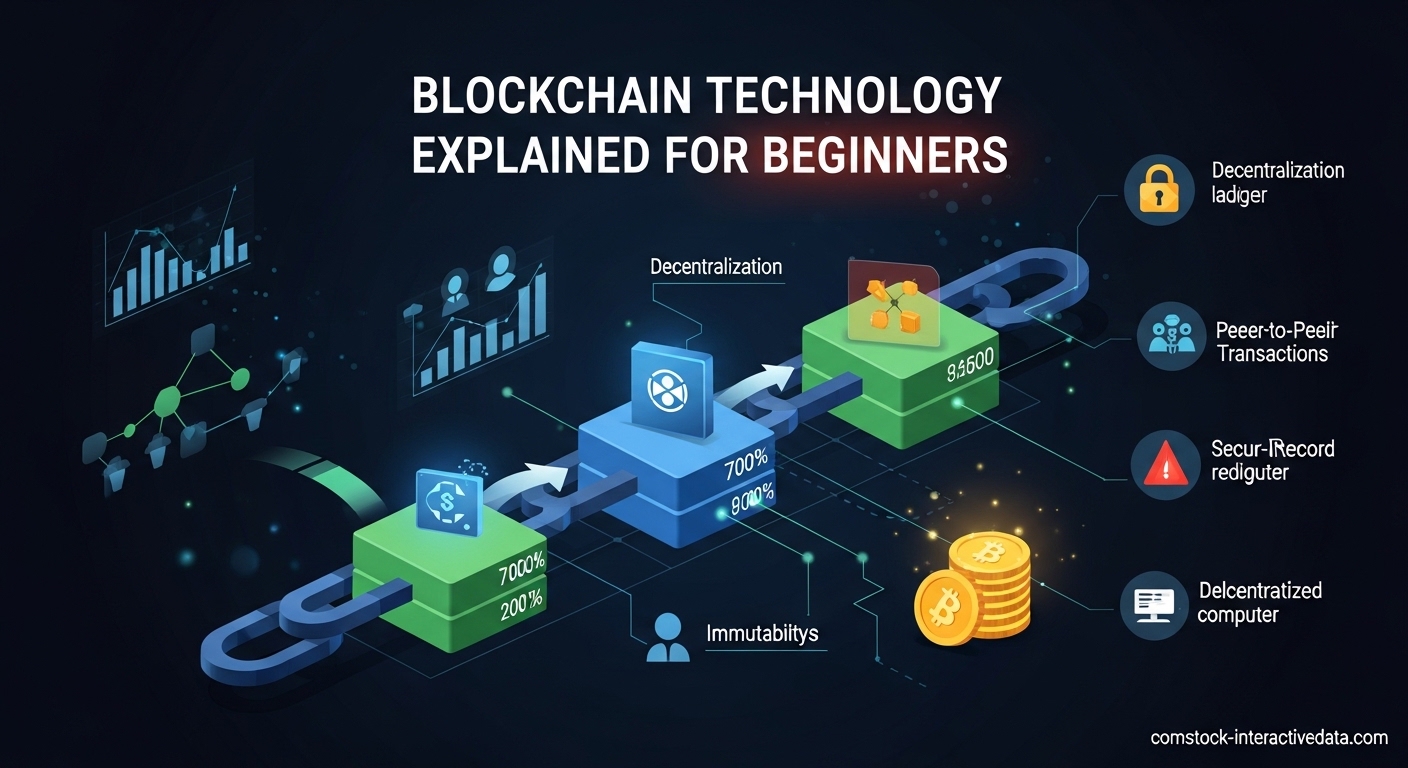
Blockchain is a decentralized digital ledger that records transactions across many computers in a way that makes the records virtually impossible to alter, hack, or manipulate. Think of it like a shared Google Doc that everyone can see and verify, but nobody can secretly edit without every other participant noticing the change. This is the foundation of blockchain technology explained for beginners — a concept that sounds complex but becomes clear once you understand the basic principles.
In this guide, I will walk you through everything you need to understand about blockchain without requiring a computer science degree. You will learn how blockchain works step by step, why it matters in 2026, what makes it different from traditional databases, and how it relates to Bitcoin and other cryptocurrencies. By the end, you will have a solid grasp of blockchain basics and understand why this technology continues to reshape industries from finance to healthcare.
Whether you are curious about cryptocurrency, considering a career in tech, or simply want to understand what everyone is talking about, this guide breaks down blockchain into simple, digestible concepts with real-world examples you can relate to.
Table of Contents
What Is Blockchain?
At its core, a blockchain is a distributed ledger — a digital record-keeping system spread across many computers rather than stored in one central location. The name itself gives you a clue about how it works: “block” refers to groups of data, and “chain” describes how those groups link together in a specific order.
Imagine a library where instead of one librarian controlling all the books, every visitor keeps an identical copy of the entire catalog. When someone wants to add a new book, every copy must update simultaneously, and everyone can see exactly what changed. If anyone tries to sneak in a fake entry, the other copies reveal the discrepancy immediately. This is essentially how a decentralized network operates.
Each “block” in a blockchain contains three key elements: the actual transaction data (who sent what to whom), a timestamp showing exactly when it happened, and a unique code called a hash that identifies that block. The hash also references the previous block, creating an unbreakable chain of records. Change one character in an old block, and every subsequent block becomes invalid — making the system tamper-proof by design.
The technology emerged in 1991 when researchers Stuart Haber and W. Scott Stornetta first described a cryptographically secured chain of blocks. However, blockchain remained largely theoretical until 2008, when an individual or group using the pseudonym Satoshi Nakamoto published the Bitcoin whitepaper. This application brought blockchain into practical use and sparked the revolution we see continuing in 2026.
Four characteristics define every blockchain system:
- Decentralization: No single entity controls the network
- Transparency: All participants can view transaction history
- Immutability: Once recorded, data cannot be altered
- Consensus: The network agrees on valid transactions
These features combine to create a peer-to-peer network where strangers can trust each other without intermediaries like banks, lawyers, or clearinghouses. This trustless system removes the need for central authorities while maintaining security through mathematics and collective verification.
How Does Blockchain Work?
Understanding how blockchain works becomes straightforward when you break it down into six sequential steps. Each step builds on the previous one to create a secure, verifiable record of transactions that the entire network agrees upon.
Step 1: Someone Requests a Transaction
The process begins when someone initiates a transaction. This could involve sending cryptocurrency to another person, recording a property deed, updating a supply chain record, or executing any digital exchange that needs permanent documentation. The user creates a request containing the essential details: who they are, who receives the transfer, what is being transferred, and when it occurs.
Step 2: The Transaction Is Broadcast to the Network
Once created, the transaction spreads across the entire blockchain nodes network. Nodes are individual computers participating in the blockchain that maintain copies of the entire ledger. Instead of going to a central server, the transaction floods outward to thousands or millions of machines simultaneously. Each node receives the pending transaction and holds it in a temporary waiting area called the mempool.
Step 3: Nodes Validate the Transaction
Network participants verify the transaction using established rules and consensus mechanism protocols. They check several critical elements: Does the sender actually own what they are trying to transfer? Is the transaction properly formatted? Has this asset already been spent elsewhere? This validation prevents double spending — the digital equivalent of writing the same check twice.
Different blockchains use different consensus methods. The two most common are proof of work (where computers solve complex math puzzles to validate) and proof of stake (where validators lock up cryptocurrency as collateral to earn the right to confirm transactions). Both methods ensure that only legitimate transactions proceed while making it extremely expensive and difficult for bad actors to manipulate the system.
Step 4: Validated Transactions Are Grouped Into a Block
Once enough valid transactions accumulate — typically several hundred to several thousand depending on the blockchain — they bundle together into a proposed block. This block contains a header with metadata including the previous block’s hash, a timestamp, and the cryptographic hash representing all transactions inside. The hash functions like a digital fingerprint; change even one character in any transaction, and the entire hash changes dramatically.
Step 5: The Block Is Added to the Chain
Before the new block joins the permanent chain, the network must reach consensus that it is valid. Miners or validators compete or are selected (depending on the consensus mechanism) to create the next block. Once a valid block emerges, other nodes verify it independently. When the majority agrees the block follows all rules, it officially attaches to the chain. The new block’s hash includes a reference to the previous block’s hash, cementing the chronological order and creating the unbreakable “chain” structure.
Step 6: The Transaction Is Complete
With the block now part of the chain, the transaction validation process concludes. The transfer becomes permanent and visible to all network participants. The receiving party now has verifiable proof of ownership recorded on thousands of computers worldwide. At this point, the transaction achieves immutable records status — it cannot be reversed, deleted, or modified by anyone, including the original sender or network administrators.
Blockchain vs Traditional Database
Understanding the differences between blockchain and traditional databases helps clarify when each technology makes sense. While both store data, their architectures create fundamentally different strengths and weaknesses.
A traditional database — like those powering your bank account, social media profiles, or e-commerce orders — uses a centralized model. One organization owns the servers, controls access, maintains the data, and decides what gets recorded. If that central authority makes a mistake, suffers a cyberattack, or acts maliciously, the entire dataset becomes compromised. You must trust the central party completely.
Blockchain flips this model entirely. Instead of one controller, thousands of independent participants share responsibility. Instead of trusting an institution, you trust mathematics and collective verification. Instead of data that administrators can edit, you get immutable records that persist forever.
| Feature | Blockchain | Traditional Database |
|---|---|---|
| Control/Ownership | Decentralized — no single owner | Centralized — owned by one entity |
| Transparency | All transactions visible to participants | Limited visibility, controlled by owner |
| Security | Cryptographic and distributed | Firewall and access control dependent |
| Speed | Slower (seconds to minutes per transaction) | Faster (milliseconds per transaction) |
| Cost | Higher (requires network fees and computing power) | Lower (maintained by single organization) |
| Data Modification | Cannot be altered once recorded | Can be edited or deleted by administrators |
| Trust Model | Trustless — no intermediaries needed | Requires trust in central authority |
| Best Use Case | Asset tracking, verification, transparency | High-volume processing, frequent updates |
Traditional databases remain superior for applications requiring high-speed processing and frequent data modifications. A retail website processing thousands of orders per minute needs the speed and flexibility that centralized databases provide. However, for applications where trust, transparency, and permanence matter more than raw speed — such as financial settlements, property records, or supply chain verification — blockchain offers unique advantages that centralized systems cannot replicate.
Blockchain vs Bitcoin: Understanding the Difference
One of the most persistent misconceptions I encounter when teaching blockchain basics involves confusing the technology with its most famous application. Blockchain and Bitcoin are not the same thing — understanding this distinction is fundamental to grasping the broader potential of distributed ledger technology.
Blockchain is the underlying technology — the digital ledger system that enables secure, decentralized record-keeping. Bitcoin is simply one application built on top of that technology. Think of blockchain as the internet and Bitcoin as a specific website like Google. The internet enables countless services beyond just search engines; similarly, blockchain supports thousands of applications beyond just digital currency.
Bitcoin launched in 2009 as the first practical implementation of blockchain technology. It demonstrated that strangers could exchange value directly without banks or payment processors. This proof-of-concept succeeded spectacularly, spawning an entire cryptocurrency industry worth trillions of dollars. However, limiting blockchain discussion to Bitcoin misses the vast landscape of other possibilities.
Ethereum, launched in 2015, expanded blockchain capabilities by introducing smart contracts — self-executing agreements written in code. These contracts automatically enforce terms when predetermined conditions occur, enabling everything from decentralized finance (DeFi) applications to automated supply chain payments.
Hyperledger Fabric serves enterprise needs with permissioned blockchains that restrict participation to approved organizations. VeChain tracks physical products through supply chains. Medicalchain secures healthcare records. Each uses blockchain technology differently, solving problems that have nothing to do with digital money.
The relationship resembles how electricity powers both a light bulb and a supercomputer. Same underlying technology, completely different applications. When someone asks about blockchain, they often mean Bitcoin specifically. Clarifying this distinction opens the door to understanding why major corporations, governments, and institutions invest billions in blockchain research despite having no interest in cryptocurrency speculation.
Types of Blockchain Networks
Not all blockchains function identically. Different use cases demand different access levels, privacy requirements, and governance structures. Understanding the three primary types helps explain why various industries adopt blockchain in different ways.
Public Blockchains
Public blockchains offer completely open participation. Anyone can join the network, view all transactions, submit transactions, and participate in the consensus process. Bitcoin and Ethereum represent the most prominent public blockchains. These networks prioritize censorship resistance and maximum decentralization — no organization can block transactions or exclude participants.
Public blockchains achieve security through sheer scale. With millions of nodes worldwide, attacking the network becomes economically impossible. However, this openness comes with trade-offs. Transaction speeds remain relatively slow, energy consumption can be high (especially with proof of work systems), and complete transparency means sensitive business data becomes permanently visible. Public blockchains work best for applications where trustlessness and universal access matter more than speed or privacy.
Private Blockchains
Private blockchains restrict participation to approved entities. Often called permissioned blockchains, these networks function more like traditional corporate databases with blockchain architecture layered on top. Organizations use private blockchains when they want the efficiency benefits of distributed consensus without exposing sensitive data to the public.
A pharmaceutical company might use a private blockchain to track medications from factory to pharmacy, sharing data only with verified supply chain partners. Unlike public blockchains where unknown miners validate transactions, private blockchains rely on known, trusted validators — often the participating organizations themselves. This structure sacrifices some decentralization for dramatically improved speed and privacy.
Consortium Blockchains
Consortium blockchains occupy the middle ground between fully public and fully private systems. Multiple organizations jointly operate the network, sharing control rather than ceding it to a single entity or leaving it completely open. This hybrid approach suits industry-wide collaborations where competitors need shared infrastructure without trusting any one company to manage it.
TradeLens, a supply chain blockchain developed by IBM and Maersk, exemplifies the consortium model. Major shipping companies, ports, and customs authorities participate jointly, sharing logistics data that benefits everyone while preventing any single company from dominating the platform. R3 Corda serves banking consortiums with similar shared governance structures.
Choosing between these types depends on specific requirements. Public blockchains suit cryptocurrency and open financial systems. Private blockchains work for internal enterprise optimization. Consortium blockchains enable industry standards and shared platforms among business partners. Each leverages the core blockchain benefits of immutability and consensus while adjusting accessibility to match practical constraints.
Key Benefits of Blockchain Technology
Organizations and developers continue adopting blockchain because it delivers tangible advantages that traditional systems struggle to provide. These benefits extend far beyond cryptocurrency speculation into practical business and social applications.
Transparency stands as blockchain’s most immediately visible advantage. Every transaction remains permanently visible to all network participants. In supply chain applications, this means consumers can verify that “organic” produce actually came from certified farms. In government spending, it means citizens can track exactly how tax dollars get distributed. This auditability occurs automatically without requiring trust in any reporting authority.
Immutability ensures once data enters the blockchain, no one can alter or delete it — not hackers, not administrators, not government officials. This permanence proves invaluable for legal records, academic credentials, and property ownership documentation. When a university issues a degree on blockchain, employers can verify its authenticity instantly and forever without contacting the school.
Security in blockchain systems operates fundamentally differently than traditional cybersecurity. Rather than building walls around a central database, blockchain distributes encrypted copies across thousands of computers. Breaching one node reveals nothing useful. Altering the ledger requires simultaneously controlling the majority of the network — an achievement that would cost billions of dollars on major blockchains like Bitcoin or Ethereum.
Decentralization removes single points of failure. Traditional banks can suffer outages, freeze accounts, or fail entirely. Centralized social media platforms can ban users arbitrarily. Blockchain applications continue operating as long as the network maintains participants, resistant to censorship, shutdowns, or corporate policy changes.
Traceability allows complete lineage tracking for any asset recorded on blockchain. Diamonds move from mine to retail with documented custody changes preventing conflict stones from entering supply chains. Pharmaceuticals travel from manufacturer to patient with temperature and handling conditions logged at every step. This granular tracking was previously impossible or prohibitively expensive.
Efficiency emerges from removing intermediaries and automating verification. Cross-border payments that required three to five business days through correspondent banking networks now settle in minutes. Smart contracts automatically release payments when IoT sensors confirm delivery, eliminating invoice processing delays and disputes.
Real-World Use Cases and Applications
Blockchain technology moves beyond theory into practical applications across dozens of industries. These real implementations demonstrate how distributed ledgers solve concrete problems rather than merely serving as speculative investment vehicles.
Cryptocurrency and Digital Payments
Digital currency remains blockchain’s most visible application. Bitcoin enables peer-to-peer value transfer without intermediaries. Stablecoins pegged to national currencies provide blockchain efficiency with price stability. Remittance corridors between countries reduce fees from 7% averages to under 1%, saving migrant workers billions annually. Major payment processors now integrate cryptocurrency support, bridging traditional and blockchain-based finance.
Supply Chain Management
Supply chain management represents one of blockchain’s most promising enterprise applications. Walmart uses blockchain to track leafy greens from farm to store, reducing traceability time from seven days to 2.2 seconds. This capability proved crucial during food safety recalls, enabling precise identification of contaminated batches rather than discarding entire harvests. Luxury brands like LVMH authenticate high-end products, combating the $500 billion counterfeit goods market.
Healthcare Records
Healthcare records on blockchain give patients control over their medical data while enabling secure sharing with providers. Estonia’s national health system stores medical records on blockchain, allowing citizens to grant temporary access to specialists while maintaining permanent ownership. This approach eliminates the fragmentation where each hospital maintains separate records, improving care coordination and reducing dangerous medication interactions.
Voting Systems
Blockchain voting experiments occur worldwide, addressing concerns about election integrity. West Virginia piloted blockchain voting for overseas military personnel in 2018. Voatz conducted municipal elections in several jurisdictions. These systems provide cryptographic proof that votes were cast and counted correctly without revealing individual choices. While scaling challenges remain, the potential for verifiable, auditable elections drives continued research.
Smart Contracts
Smart contracts automate agreement execution without lawyers or courts. Insurance policies automatically pay when weather stations report qualifying conditions. Music streaming platforms instantly distribute royalties to artists based on play counts. Escrow services release funds only when shipment tracking confirms delivery. These self-executing contracts reduce costs, eliminate delays, and remove the need to trust counterparties.
Additional applications continue emerging rapidly. Digital identity systems give individuals portable, verifiable credentials they control rather than relying on government-issued documents. Real estate transactions record property transfers immediately without months of title searches. Intellectual property registration timestamps creative works for copyright protection. DeFi (decentralized finance) applications replicate banking services — lending, borrowing, trading — without traditional financial institutions.
Pros and Cons of Blockchain
Like any technology, blockchain presents trade-offs between advantages and limitations. Honest evaluation requires acknowledging both sides rather than treating blockchain as either a miracle solution or worthless hype.
Pros
- Security — Cryptographic protection makes fraud and hacking extremely difficult
- Transparency — All participants can verify transactions independently
- Decentralization — No single point of failure or control
- Immutability — Records cannot be altered or deleted after creation
- Efficiency — Removes intermediaries, reducing costs and delays
- Trustless operation — Strangers can transact without mutual trust
Cons
- Energy consumption — Proof of work systems require significant electricity
- Scalability — Limited transactions per second compared to traditional databases
- Complexity — Technical barriers make development and maintenance challenging
- Regulatory uncertainty — Legal frameworks remain inconsistent globally
- Irreversibility — Mistakes cannot be undone once recorded
- Storage requirements — Full nodes must store ever-growing data volumes
Environmental concerns deserve particular attention. Early blockchain implementations using proof of work consumed enormous electricity — Bitcoin’s annual energy use exceeds that of some medium-sized countries. However, the industry actively addresses this issue. Ethereum transitioned to proof of stake in 2022, reducing energy consumption by 99.95%. Newer blockchains launch with energy-efficient consensus mechanisms from inception. The technology evolves rapidly, and 2026‘s blockchain landscape looks significantly different than 2020’s.
Scalability limitations also challenge widespread adoption. Bitcoin processes approximately seven transactions per second. Visa handles 65,000. This gap matters for consumer payment applications but matters less for high-value settlement transactions where security and finality outweigh speed requirements. Layer 2 solutions, sidechains, and newer blockchain architectures continue pushing these boundaries outward.
Common Misconceptions About Blockchain
Blockchain suffers from mythology and misunderstanding that obscures its actual capabilities and limitations. Addressing these misconceptions directly helps beginners develop realistic expectations about what the technology can and cannot accomplish.
Misconception 1: Blockchain and Bitcoin are the same thing. As discussed earlier, Bitcoin merely represents one application of blockchain technology. Confusing the two limits understanding of blockchain’s broader potential across industries from healthcare to supply chain management.
Misconception 2: Blockchain is 100% unhackable. While blockchain’s cryptographic structure makes hacking extraordinarily difficult, no technology achieves absolute security. Theoretical 51% attacks could compromise smaller blockchains if malicious actors controlled majority computing power. Smart contract bugs have enabled exploits stealing millions. Human error — losing private keys, falling for phishing attacks — remains the most common security failure. Blockchain provides strong security guarantees, not perfect invulnerability.
Misconception 3: Blockchain is only for illegal activities. Early cryptocurrency adoption included criminal use on darknet markets, creating lasting stigma. Today, blockchain analysis tools help law enforcement track illicit transactions more effectively than cash. Major financial institutions, Fortune 500 companies, and national governments operate blockchain systems legally and transparently. The technology has grown far beyond its controversial origins.
Misconception 4: All blockchains are public and transparent. Private and consortium blockchains restrict visibility to approved participants. Enterprises use these permissioned systems for sensitive business data that should not become public knowledge. Blockchain’s architecture adapts to various privacy requirements.
Misconception 5: Blockchain transactions are completely anonymous. Most public blockchains operate pseudonymously — wallet addresses replace names, but transaction histories remain permanently visible. Sophisticated analysis can often link addresses to real-world identities. Privacy-focused blockchains exist, but mainstream options provide pseudonymity rather than true anonymity.
Misconception 6: You need to be a programmer to understand blockchain. This guide exists specifically to disprove that notion. While developing blockchain applications requires technical skills, understanding the fundamental concepts demands only basic computer literacy and curiosity. The underlying principles — shared record-keeping, cryptographic linking, consensus agreement — are accessible to anyone willing to learn.
Frequently Asked Questions
How do you explain blockchain to dummies?
Think of blockchain like a magical notebook that everyone shares. When someone writes something in it, the writing appears in every copy of the notebook instantly. Once written, nobody can erase or change it — not even the person who wrote it. Everyone can see what was written, so cheating becomes impossible. This shared, permanent notebook allows people who do not trust each other to agree on what is true without needing a referee.
How do you get your money off of blockchain?
Blockchain itself is not a bank account where you store money. If you hold cryptocurrency on blockchain, you access it through a digital wallet using your private key. To convert to traditional currency, you use a cryptocurrency exchange that sells your crypto and deposits dollars or other fiat currency to your bank account. The process involves creating an exchange account, transferring your cryptocurrency there, placing a sell order, and withdrawing the resulting cash to your linked bank account.
How much is 1 dollar in blockchain?
This question reflects a common misunderstanding. Blockchain is not a currency itself — it is the technology that records transactions. One dollar remains one dollar. If you are asking about cryptocurrency, the exchange rate between dollars and any specific cryptocurrency fluctuates constantly based on market conditions. Check any reputable cryptocurrency exchange for current rates between dollars and specific digital assets like Bitcoin or Ethereum.
Will AI replace blockchain?
AI and blockchain serve fundamentally different purposes and complement rather than replace each other. AI analyzes data, makes predictions, and automates decisions. Blockchain provides trusted, immutable record-keeping and enables decentralized consensus. Many emerging applications combine both technologies — AI makes decisions while blockchain ensures those decisions are recorded transparently and executed automatically through smart contracts. Both technologies continue evolving together in 2026 and beyond.
Is blockchain safe?
Blockchain provides strong security guarantees through cryptography and distributed consensus. For storing value and recording transactions, major blockchains like Bitcoin and Ethereum have operated securely for years without successful systemic attacks. However, safety depends on how you use it. Losing your private keys means losing access permanently with no recovery option. Scams and fraudulent projects exist in the cryptocurrency space. The technology itself is secure, but users must practice good security habits and exercise caution with unfamiliar applications.
Who invented blockchain?
Researchers Stuart Haber and W. Scott Stornetta first described cryptographic chain structures in 1991. However, blockchain as we know it emerged in 2008 when an individual or group using the pseudonym Satoshi Nakamoto published the Bitcoin whitepaper, solving the double-spending problem that had prevented prior digital currency attempts. Satoshi’s identity remains unknown, and they disappeared from public communication in 2011, leaving the technology to develop through community effort.
Do I need to be a programmer to understand blockchain?
Absolutely not. Understanding blockchain concepts requires only basic computer literacy and curiosity, not coding skills. Many professionals working in blockchain strategy, consulting, legal compliance, and project management have no programming background. While developers create blockchain applications, the fundamental principles — decentralization, immutability, transparency — are conceptual rather than technical. This guide exists specifically to make blockchain accessible to beginners from any background.
Conclusion
Blockchain technology represents more than cryptocurrency speculation — it offers a fundamentally new approach to recording, verifying, and sharing information without requiring trust in central authorities. This guide has walked you through blockchain technology explained for beginners: from the basic definition of a decentralized digital ledger to the step-by-step process of how transactions become immutable records, from the distinction between blockchain and Bitcoin to the real-world applications transforming industries in 2026.
The technology continues evolving rapidly. Energy-efficient consensus mechanisms replace power-hungry predecessors. Scalability solutions handle ever-increasing transaction volumes. Enterprise adoption moves from experimental pilots to production systems handling billions in value. Understanding these fundamentals positions you to follow these developments intelligently and evaluate new blockchain applications critically.
Your next step depends on your goals. If you want hands-on experience, consider setting up a cryptocurrency wallet with a small amount to understand how transactions work practically. If you are interested in career opportunities, explore blockchain certifications from reputable platforms. If you are evaluating business applications, examine case studies from your industry to see how competitors leverage distributed ledger technology. Whatever path you choose, the foundation you have built here will serve you well as blockchain technology continues reshaping how we establish trust and verify truth in the digital age.