
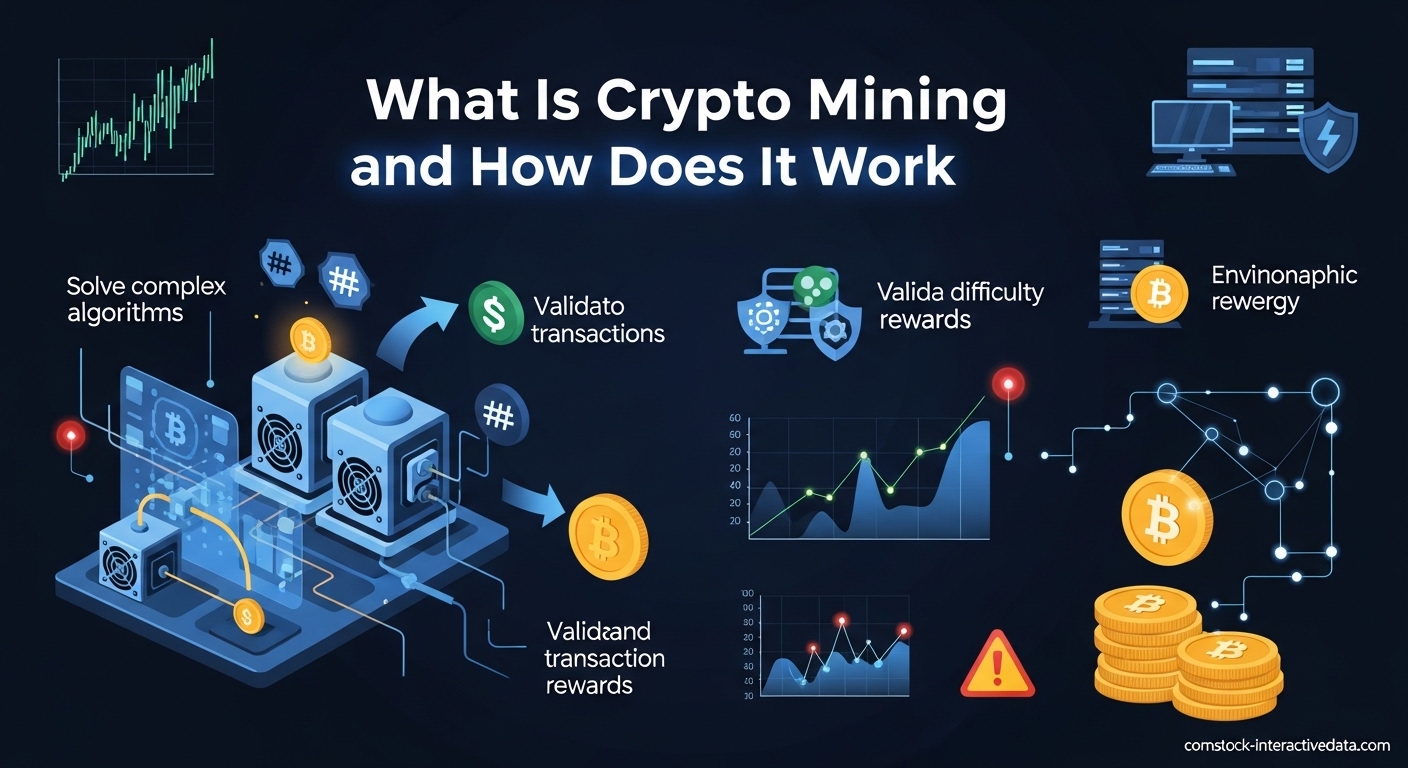
Crypto mining is the process of validating cryptocurrency transactions and adding them to a blockchain using specialized computers that solve complex mathematical puzzles. It is called mining because this process also releases new coins into circulation, similar to how mining gold brings new metal into the economy. I have spent years researching blockchain technology, and understanding mining is essential for anyone looking to grasp how cryptocurrencies function without central authorities.
In this guide, I will explain what crypto mining actually is, how the technical process works step-by-step, what equipment you need, and whether mining is worth your time and money in 2026. By the end, you will have a clear understanding of proof of work, block rewards, and the economics that keep networks like Bitcoin running securely.
Table of Contents
What Is Crypto Mining?
Crypto mining is the mechanism blockchain networks use to validate transactions, secure the network, and create new cryptocurrency units. When you hear about Bitcoin mining, you are hearing about computers competing to solve cryptographic puzzles that verify groups of transactions called blocks.
The term mining draws an analogy to precious metals. Just as gold miners expend effort and resources to extract gold from the earth, crypto miners expend computational power and electricity to extract digital currency from the network. This effort serves a critical purpose: it prevents anyone from spending the same cryptocurrency twice, a problem known as double-spending.
Why Mining Exists
Mining solves a fundamental problem in decentralized systems. Without a bank or central authority to verify transactions, how do strangers trust each other when exchanging digital money? The answer is a clever combination of cryptography, economic incentives, and distributed consensus.
Miners act as the transaction validators for the network. They bundle pending transactions into blocks, verify that each transaction is legitimate, and then race to solve a mathematical puzzle that proves they did the work required to earn the right to add that block to the blockchain. This proof of work mechanism ensures that no single entity can control the network or manipulate transaction history.
The Connection to Blockchain
Blockchain is the underlying technology that makes cryptocurrency possible. It is essentially a public ledger distributed across thousands of computers worldwide, recording every transaction in a way that is transparent and impossible to alter retroactively.
Each block in the chain contains a group of transactions, a reference to the previous block, and a unique solution to the cryptographic puzzle. When a miner successfully adds a block, they create an immutable record that becomes part of the permanent history of the network. This chain of blocks, each linked to the one before it, is where blockchain gets its name.
How Does Crypto Mining Work?
The mining process combines cryptography, distributed systems, and economic game theory into a system that secures billions of dollars in value. Understanding how it actually works requires breaking down the technical steps that happen every time a new block is added to the blockchain.
The Mining Process Step-by-Step
Step 1: Transactions are broadcast to the network. When someone sends Bitcoin or another cryptocurrency, that transaction is announced to the entire network of nodes. These transactions sit in a waiting area called the mempool until a miner includes them in a block.
Step 2: Miners select and verify transactions. Miners choose which transactions to include based on factors like transaction fees and size. They verify that the sender actually owns the coins being spent and that the transaction follows all network rules.
Step 3: Transactions are bundled into a candidate block. The selected transactions are organized into a block along with a reference to the previous block’s hash and a special number called a nonce. This candidate block is what miners will attempt to add to the chain.
Step 4: The hash puzzle begins. Miners must find a hash of the block header that meets specific criteria set by the network. A hash is a fixed-length string of numbers and letters produced by running data through a cryptographic function called SHA-256. The hash must be below a certain target value, which means it must start with a specific number of zeros.
Step 5: Miners race to find the correct nonce. The only way to find a valid hash is to repeatedly change the nonce and recalculate the hash until the result meets the target. This process requires enormous computational power because there is no formula to predict which nonce will work. Miners typically try billions or trillions of nonce values per second.
Step 6: The winning miner broadcasts the solution. When a miner finds a valid hash, they immediately broadcast the block to the entire network. Other miners verify that the hash is correct and that all transactions in the block are valid.
Step 7: The block is added and rewards are distributed. Once verified, the new block becomes part of the blockchain, and the winning miner receives the block reward plus any transaction fees from the included transactions. The race then begins again for the next block.
Understanding Hash Functions
A hash function is a mathematical algorithm that takes any amount of input data and produces a fixed-size output called a hash. The SHA-256 algorithm used by Bitcoin produces a 64-character hexadecimal string that looks completely random but is deterministically generated from the input.
The crucial property of cryptographic hash functions is that they are one-way. You can easily calculate the hash from the input, but it is computationally impossible to reverse-engineer the input from the hash. Additionally, changing even a single character in the input produces a completely different output hash, making it easy to detect tampering.
What Is Proof of Work?
Proof of work is the consensus mechanism that requires miners to perform computationally intensive work to earn the right to add blocks. It serves two critical functions: it makes attacking the network prohibitively expensive, and it determines which miner gets to add the next block in a fair, decentralized way.
The work itself has no purpose beyond securing the network. Miners are not solving useful mathematical problems or processing data for science. They are simply racing to find a number that produces a hash with the right properties. This seemingly wasteful process is what gives Bitcoin its security properties.
| Feature | Proof of Work | Proof of Stake |
|---|---|---|
| Consensus Method | Solving computational puzzles | Locking up cryptocurrency as collateral |
| Energy Consumption | High (electricity intensive) | Low (minimal energy use) |
| Hardware Required | Specialized mining equipment | Standard computer or server |
| Security Model | 51% attack requires 51% of hash power | 51% attack requires 51% of staked coins |
| Examples | Bitcoin, Dogecoin, Litecoin | Ethereum 2026, Cardano, Solana |
Mining Hardware: From CPUs to ASICs
The history of crypto mining is essentially the history of increasing specialization. As mining became more competitive and profitable, miners invested in increasingly powerful hardware to gain an edge. This arms race transformed mining from something anyone could do on their home computer into an industrial operation requiring specialized equipment.
The CPU Era (2009-2010)
When Bitcoin launched in 2009, anyone could mine using a standard laptop or desktop computer. The mining software ran on the central processing unit (CPU), the general-purpose chip that handles most computing tasks. Early miners including Satoshi Nakamoto used regular computers to mine thousands of bitcoins.
CPU mining became obsolete quickly because CPUs are designed for general-purpose tasks, not the specific mathematical operations required for mining. A typical CPU could perform only a few million hash calculations per second, making it impractical once competition increased.
The GPU Revolution (2010-2013)
Miners discovered that graphics processing units (GPUs) designed for video games were thousands of times more efficient at mining than CPUs. GPUs contain hundreds or thousands of small processing cores optimized for parallel mathematical operations, making them ideal for the repetitive hash calculations mining requires.
GPU mining democratized the process for several years. Hobbyists built mining rigs with multiple graphics cards running continuously. However, GPUs also consume significant electricity and generate substantial heat, requiring cooling solutions and increasing operational costs.
The ASIC Era (2013-Present)
Application-specific integrated circuits (ASICs) changed everything. These chips are designed for one purpose only: mining cryptocurrency. An ASIC miner can perform the specific SHA-256 calculations required for Bitcoin mining exponentially faster than a GPU while using less electricity per calculation.
Modern Bitcoin ASIC miners measure their performance in terahashes per second (TH/s), meaning trillions of hash attempts every second. The most efficient machines in 2026 achieve over 300 TH/s while consuming around 3,500 watts of electricity.
| Hardware Type | Performance (Bitcoin) | Availability | Efficiency |
|---|---|---|---|
| CPU | 0.00001 TH/s | Any computer | Not viable |
| GPU | 0.1-0.2 TH/s | Gaming stores | Poor for Bitcoin |
| ASIC | 100-300+ TH/s | Specialized retailers | High efficiency |
Mining Pools and Shared Rewards
As mining difficulty increased, individual miners found it nearly impossible to consistently earn block rewards. A small miner might run equipment for months or years without ever successfully mining a block. Mining pools emerged to solve this problem by allowing miners to combine their computational power.
In a mining pool, thousands of miners contribute their hash power to a central coordinator. When the pool successfully mines a block, the reward is distributed among participants based on their contributed work. This creates more predictable, steady income for individual miners, though pool operators typically charge fees of 1-4%.
Mining Rewards, Halving, and Economics
The economic incentives that drive mining are carefully programmed into the protocol. Understanding these rewards, how they change over time, and what happens when they eventually stop is essential for grasping the long-term sustainability of proof-of-work cryptocurrencies.
Block Rewards and Transaction Fees
Miners earn revenue from two sources. The block reward is newly created cryptocurrency that the protocol generates with each block. For Bitcoin, this started at 50 BTC per block in 2009. Transaction fees are payments from users who want their transactions prioritized and included in the next block.
Currently, the Bitcoin block reward is 3.125 BTC per block, following the most recent halving in April 2024. Combined with transaction fees, this typically amounts to 3.5-4 BTC per block, worth hundreds of thousands of dollars at current prices. Miners compete for these substantial rewards, which is why they invest millions in equipment and electricity.
The Halving Cycle
Every 210,000 blocks, or approximately every four years, the block reward is cut in half. This event, called the halving, is programmed into Bitcoin’s code and will continue until the reward reaches zero around the year 2140. The halving creates artificial scarcity and is one reason Bitcoin has a fixed supply of 21 million coins.
The halving significantly impacts mining economics. When the reward drops, miners with the highest operating costs become unprofitable and shut down. This reduces network hash rate temporarily until difficulty adjusts. Historically, Bitcoin’s price has risen following halvings, offsetting the reduced block reward for remaining miners.
How Long to Mine One Bitcoin?
The time required to mine one Bitcoin depends entirely on your hash power relative to the total network. With 100 TH/s of mining power, representing one modern ASIC machine, you might earn approximately 0.0001 BTC per day at current difficulty levels. This means it would take roughly 10,000 days or 27 years to mine a full Bitcoin solo.
Mining pools change this calculation significantly. By joining a pool with that same 100 TH/s machine, you would earn a small, steady amount of Bitcoin every day based on your contribution. At current rates and assuming average electricity costs, such a setup might generate $5-8 worth of Bitcoin daily before electricity expenses.
What Happens When All Bitcoins Are Mined?
Approximately in 2140, the final Bitcoin will be mined and the block reward will drop to zero. However, mining will not stop. Miners will continue earning transaction fees, which are expected to become the primary incentive for securing the network by that time.
Transaction fees have already become significant. During periods of high network activity, total fees in a single block have exceeded the block reward. As Bitcoin adoption grows, proponents argue that transaction volume will provide sufficient fees to sustain mining operations. Critics question whether fees alone will provide enough security, a debate that will not be settled for over a century.
Risks, Legal Considerations, and Should You Mine?
Before investing in mining equipment, you need to understand the significant risks, costs, and legal landscape. I have analyzed countless mining setups and profitability calculators, and the reality is that home mining is rarely profitable for most people in 2026.
Profitability Reality Check
Home mining profitability depends on three factors: electricity cost, hardware efficiency, and cryptocurrency price. Electricity is the critical variable. With average US electricity rates of $0.14 per kWh, most ASIC miners operate at a loss or thin margins. Successful home miners typically have access to electricity under $0.08 per kWh.
Hardware depreciation is another major cost. ASIC miners become obsolete as newer, more efficient models are released. A machine profitable today may become a money-losing heater within 12-18 months. Used mining equipment has minimal resale value because it has no purpose other than mining specific algorithms.
Environmental and Practical Concerns
Crypto mining consumes enormous amounts of electricity. The Bitcoin network alone uses more electricity than many countries. This has drawn criticism from environmental groups and led to mining bans in regions dependent on fossil fuels.
Practical concerns extend beyond electricity. Mining equipment generates significant heat and noise. A single ASIC miner produces noise levels comparable to a vacuum cleaner running continuously and heat equivalent to several space heaters. Residential setups require cooling solutions and sound insulation, adding to costs.
Legal Status by Country
Bitcoin mining is legal in most countries including the United States, Canada, European Union nations, and Japan. However, several countries have banned or restricted mining due to energy concerns, financial regulations, or capital controls.
China, once home to over 70% of global mining, banned cryptocurrency mining entirely in 2021. Algeria, Bangladesh, Egypt, Iraq, Morocco, Nepal, Qatar, and Tunisia have also banned mining. Russia has imposed restrictions in certain regions with energy shortages. Always verify current regulations in your jurisdiction before investing in mining equipment.
Cloud Mining Scams
Cloud mining services promise to let you rent mining power without owning hardware. The vast majority are scams or economically unfavorable schemes. Legitimate cloud mining rarely generates returns exceeding what you would earn simply buying and holding the cryptocurrency directly.
If a cloud mining service guarantees returns, accepts only cryptocurrency payments, or offers referral bonuses for recruiting others, it is likely a Ponzi scheme. Established cloud mining operations with verifiable facilities charge rates that make profitability nearly impossible for customers.
Should You Mine Crypto?
For most individuals in 2026, the answer is no. The combination of high electricity costs, expensive hardware, noise, heat, and technical complexity makes home mining impractical. You will likely lose money compared to simply buying cryptocurrency directly.
Exceptions exist. If you have access to very cheap electricity (under $0.05 per kWh), live in a cold climate where waste heat is useful, or want to mine as a learning experience rather than for profit, mining can make sense. Some people also mine alternative cryptocurrencies that require less specialized hardware, though these carry additional risk due to price volatility.
Frequently Asked Questions
How long will it take to mine 1 BTC?
With a typical home mining setup using one ASIC machine with 100-150 TH/s hash power, it would take approximately 27-40 years to mine one full Bitcoin solo. Most miners join pools to earn smaller, consistent daily rewards instead. At current difficulty levels and pool participation, a single machine might earn 0.00008-0.00012 BTC per day.
How does crypto mining actually work?
Crypto mining works by having specialized computers compete to solve cryptographic puzzles. Miners bundle transactions into blocks and repeatedly calculate hashes by changing a number called a nonce until finding a hash that meets the network’s difficulty target. The first miner to find the solution broadcasts it to the network, earns the block reward, and adds the block to the blockchain. This process secures the network and processes transactions without a central authority.
What happens when all 21 million BTC are mined?
When all 21 million Bitcoin are mined around the year 2140, miners will no longer receive block rewards. However, mining will continue because miners earn transaction fees from users who want their transactions processed. These fees are expected to provide sufficient incentive to maintain network security. Already during high network activity periods, transaction fees sometimes exceed the block reward in value.
Why is it illegal to mine Bitcoin?
Bitcoin mining is not illegal in most countries. It is banned or restricted in certain nations including China, Algeria, Bangladesh, Egypt, Iraq, Morocco, Nepal, Qatar, and Tunisia. Reasons for bans include excessive energy consumption straining power grids, concerns about financial stability, evasion of capital controls, and environmental regulations. In countries where it is legal, miners may still need to comply with electricity usage regulations, business licensing, and tax reporting requirements.
Can a normal person do Bitcoin mining?
A normal person can technically mine Bitcoin, but it is rarely profitable or practical for individuals in 2026. Home mining requires expensive ASIC equipment ($3,000-15,000), cheap electricity (under $0.08 per kWh), technical knowledge for setup and maintenance, and tolerance for noise and heat. Most home miners lose money compared to simply buying Bitcoin directly. Some people mine as a hobby for educational purposes or as a way to acquire cryptocurrency without using exchanges.
Is it illegal to mine Bitcoin?
Bitcoin mining is legal in most countries including the United States, Canada, the European Union, Japan, and many others. However, several countries have banned it entirely, most notably China in 2021. Other countries with mining bans include Algeria, Bangladesh, Egypt, Iraq, Morocco, Nepal, Qatar, and Tunisia. In legal jurisdictions, miners must typically report earnings as income and may face business licensing or electricity usage restrictions depending on scale.
Can Bitcoin mining be traced?
Bitcoin mining itself can be traced to some extent. Mining pools and large operations often operate publicly. The IP addresses of miners can potentially be logged by network observers. However, once mined coins are transferred to personal wallets and potentially mixed or exchanged, tracing becomes more difficult. Some privacy-focused cryptocurrencies offer mining with enhanced anonymity features, though these represent a small portion of the mining market.
What actually happens when you mine crypto?
When you mine crypto, your computer runs software that connects to the blockchain network, receives pending transactions, bundles them into candidate blocks, and performs billions of hash calculations per second trying to find a number that produces a valid block hash. If successful, your block is broadcast to the network, verified by other nodes, and added to the blockchain. You then receive the block reward plus transaction fees directly to your specified wallet address.
Can you make $100 a day with crypto?
Making $100 per day consistently from crypto mining in 2026 requires significant investment. You would need approximately 30-50 modern ASIC miners running continuously, representing $150,000-500,000 in hardware plus facility costs, electricity, and cooling. For most individuals, earning $100 per day is not achievable. Some traders or investors might achieve such returns through cryptocurrency price appreciation, but this involves different risks than mining and is not guaranteed income.
Conclusion
Crypto mining is the process that validates transactions, secures blockchain networks, and introduces new cryptocurrency into circulation through computational work. Understanding what crypto mining is and how it works reveals the elegant combination of cryptography, economic incentives, and distributed consensus that makes decentralized digital currencies possible.
The mining process has evolved dramatically from CPU mining on laptops to industrial-scale ASIC operations consuming megawatts of electricity. While the technical fundamentals remain constant, the economics have shifted to favor large operations with cheap electricity. For most individuals in 2026, mining is not a practical path to profit but remains fascinating as the mechanism that keeps networks like Bitcoin secure and functional.
Whether you are exploring cryptocurrency as an investment, technology, or curiosity, understanding mining provides essential context for how this revolutionary financial system operates without central control. The miners running specialized equipment worldwide are not just generating digital coins. They are maintaining the infrastructure of a new financial paradigm.