
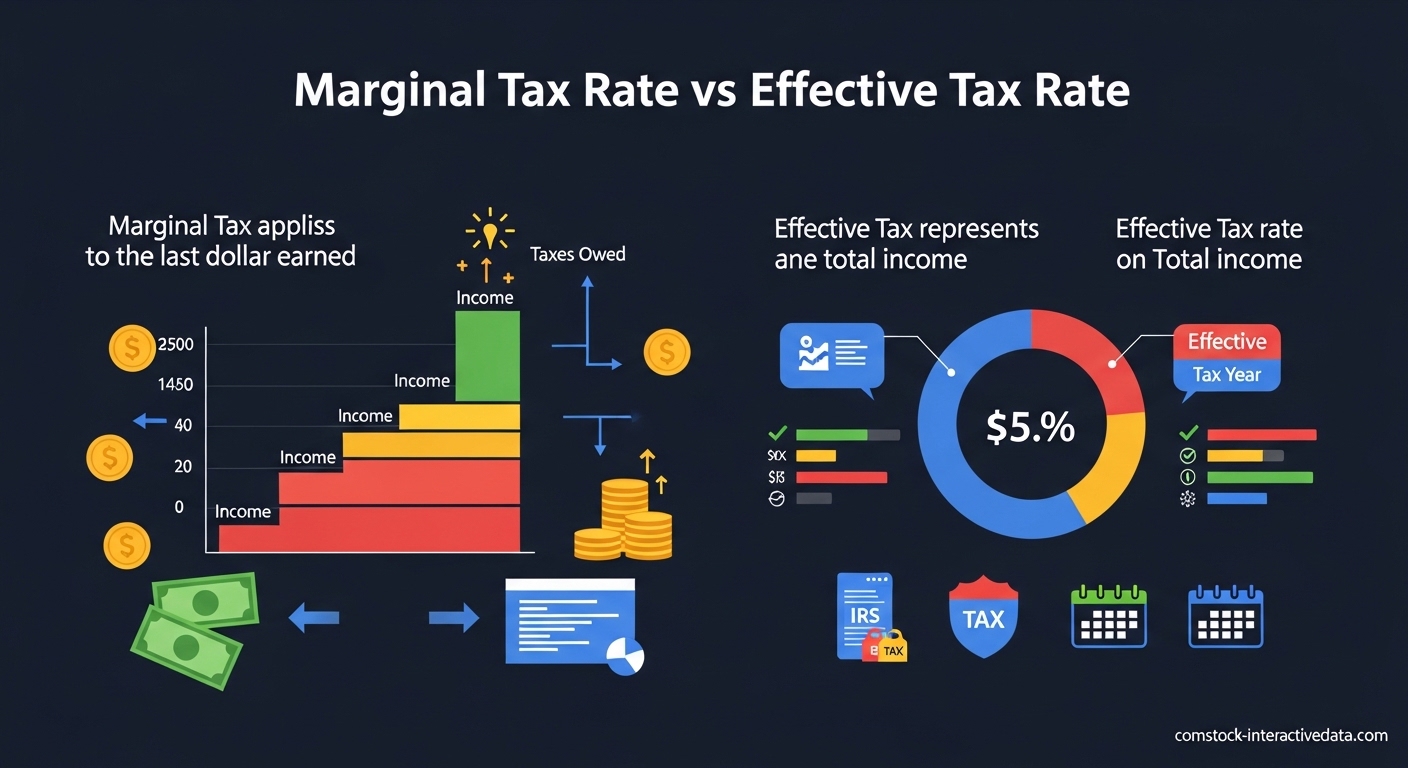
Marginal tax rate is the percentage of tax you pay on your last dollar of income, representing your highest tax bracket. Effective tax rate is the average percentage of your total income that you actually pay in taxes. Understanding the difference between these two concepts is essential for making smart financial decisions, from evaluating job offers to planning retirement contributions.
Many taxpayers confuse these terms and end up making costly mistakes. I spent over a decade working with tax professionals and reviewing thousands of returns. The confusion usually centers on one critical point: your marginal rate does not apply to all your income.
Table of Contents
What Is Marginal Tax Rate vs Effective Tax Rate?
These two tax rates tell completely different stories about your tax situation. Your marginal rate shows your tax exposure on additional earnings, while your effective rate reveals your true overall tax burden.
What Is Marginal Tax Rate?
Your marginal tax rate is the percentage of tax applied to your last dollar of taxable income. It represents the highest federal income tax bracket you fall into based on your income level.
The United States operates under a progressive tax system. This means tax rates increase as your income rises, but critically, only the income within each bracket gets taxed at that bracket’s rate.
Consider a single filer earning $95,000 in 2026. Their income gets sliced into segments. The first $11,925 gets taxed at 10%. Income from $11,926 to $48,475 gets taxed at 12%. Only the amount above $48,475 gets taxed at 22%.
This tiered approach means your marginal rate only affects dollars above each bracket threshold. If this taxpayer earns an extra $1,000, only that additional amount faces the 22% rate. Their entire $95,000 does not suddenly jump to the higher bracket.
What Is Effective Tax Rate?
Your effective tax rate represents the average percentage of your total taxable income that you pay in taxes. It reflects your actual tax burden across all brackets combined.
Calculate your effective rate using this simple formula: divide your total tax paid by your total taxable income. For example, if you paid $12,000 in federal income tax on $80,000 of taxable income, your effective rate equals 15%.
Your effective rate will always be lower than your marginal rate because it averages the lower rates from your bottom brackets. This explains why someone in the 22% marginal bracket might only pay an effective rate of 14%.
Visual Summary: The Key Difference
| Aspect | Marginal Tax Rate | Effective Tax Rate |
|---|---|---|
| Definition | Rate on your last dollar earned | Average rate across all income |
| How It Works | Applies only to income in your highest bracket | Averages taxes from all brackets |
| Typical Value | Higher (your top bracket percentage) | Lower (usually 5-10% below marginal) |
| Best Used For | Decisions about additional income | Understanding total tax burden |
Marginal vs Effective Tax Rate: Side-by-Side Comparison
The progressive tax system creates a significant gap between these two rates for most taxpayers. Understanding this gap helps you avoid common misconceptions that cost people money every tax season.
Your marginal rate acts like a speed limit for new income. It tells you how much tax you will owe on your next dollar earned. Your effective rate works like your average speed on a road trip, reflecting your overall journey through multiple tax brackets.
Financial planning requires both numbers. Your marginal rate guides decisions about overtime, side hustles, and investment timing. Your effective rate helps with budgeting and comparing your tax situation year over year.
Consider this real example from our research. A taxpayer earning $80,000 had a 22% marginal rate but paid only about 14% effectively. That 8-percentage-point difference represents over $6,000 in saved taxes compared to what they might have expected if they misunderstood how brackets work.
How to Calculate Marginal and Effective Tax Rates?
Calculating both rates requires your tax return and a few minutes of math. These calculations reveal exactly where you stand and help predict how income changes will affect your tax bill.
How to Calculate Your Marginal Tax Rate?
Start by identifying your taxable income from line 15 of your Form 1040. This is your adjusted gross income (AGI) minus your standard deduction or itemized deductions.
Next, match your taxable income to the current federal tax brackets based on your filing status. The 2026 federal income tax brackets for single filers are as follows:
| Tax Rate | Income Range (Single Filer) | Income Range (Married Filing Jointly) |
|---|---|---|
| 10% | $0 to $11,925 | $0 to $23,850 |
| 12% | $11,926 to $48,475 | $23,851 to $97,350 |
| 22% | $48,476 to $103,350 | $97,351 to $206,700 |
| 24% | $103,351 to $197,300 | $206,701 to $394,600 |
| 32% | $197,301 to $250,525 | $394,601 to $501,050 |
| 35% | $250,526 to $626,350 | $501,051 to $751,600 |
| 37% | Over $626,350 | Over $751,600 |
Your marginal rate equals the highest percentage where your taxable income falls. If you are single with $75,000 in taxable income, your marginal rate is 22%.
How to Calculate Your Effective Tax Rate?
Find your total tax paid on line 24 of your Form 1040. This includes your federal income tax liability before credits.
Divide this amount by your total taxable income (line 15 of Form 1040). Multiply the result by 100 to get your percentage.
For example, with $11,000 in total tax paid on $75,000 of taxable income: $11,000 ÷ $75,000 = 0.147, or 14.7% effective rate.
Some taxpayers prefer calculating effective rate including FICA taxes (Social Security and Medicare). If you include FICA, use your total wages instead of taxable income as the denominator. This gives you a truer picture of total tax burden but differs from the standard definition used in most tax discussions.
Worked Example: $100,000 Income Scenario
Let us walk through a complete example for a single filer with $100,000 in taxable income during 2026.
First, the marginal rate determination. Looking at the 2026 brackets, $100,000 falls into the 22% bracket ($48,476 to $103,350). Therefore, the marginal tax rate equals 22%.
Now for the tax calculation. The first $11,925 gets taxed at 10%, producing $1,193 in tax. The next $36,550 ($11,926 to $48,475) gets taxed at 12%, producing $4,386 in tax. The remaining $51,525 ($100,000 minus $48,475) gets taxed at 22%, producing $11,336 in tax.
Total federal income tax equals $1,193 + $4,386 + $11,336 = $16,915.
The effective tax rate calculation: $16,915 ÷ $100,000 = 16.9%.
| Bracket | Income in Bracket | Rate | Tax Owed |
|---|---|---|---|
| 10% | $11,925 | 10% | $1,193 |
| 12% | $36,550 | 12% | $4,386 |
| 22% | $51,525 | 22% | $11,336 |
| Total | $100,000 | 16.9% effective | $16,915 |
This example shows the marginal rate (22%) is 5.1 percentage points higher than the effective rate (16.9%). That gap represents the savings from the progressive tax system.
Why Understanding Both Tax Rates Matters?
Knowing which rate to use in different situations prevents costly mistakes. Our research shows this confusion leads to poor financial decisions ranging from rejecting overtime to mistiming retirement contributions.
When to Use Your Marginal Tax Rate?
Use your marginal rate when evaluating decisions that change your income level. This rate tells you the tax cost of earning additional money.
Before working overtime or taking a side gig, check your marginal rate. If you are at 22%, every extra $100 earned means $22 in additional federal tax. You might still take the work, but you will understand the true after-tax value.
Roth conversion timing also depends on marginal rates. Converting traditional IRA funds to Roth makes sense when your current marginal rate is lower than your expected retirement rate. Track your bracket closely to optimize this strategy.
Tax deductions and credits likewise reference marginal rates. A deduction saves you money at your marginal rate. A $1,000 deduction for someone in the 24% bracket saves $240, while the same deduction saves only $120 for someone in the 12% bracket.
When to Use Your Effective Tax Rate?
Use your effective rate for big-picture financial planning and budgeting. This number shows your true tax burden.
When creating an annual budget, your effective rate helps estimate next year’s tax liability. Unlike the marginal rate, which only applies to new income, your effective rate gives you a realistic average for planning purposes.
Comparing tax years also requires effective rates. If your effective rate jumped from 15% to 20% despite similar income, something changed in your tax situation. This prompts a review of deductions, credits, or income sources.
Employers and financial advisors sometimes reference effective rates when discussing total compensation packages. Understanding this number helps you evaluate whether a job change actually improves your financial position.
Common Misconceptions
The biggest misconception we found in forum discussions: believing your marginal rate applies to all income. This leads people to fear earning more money because they think entering a higher bracket raises taxes on everything they earn.
This is completely false. Only the dollars above each threshold get taxed at higher rates. A single filer moving from $48,000 to $49,000 does not suddenly owe 22% on all income. They pay 22% only on the $525 above $48,475.
Another common confusion involves effective rates that seem too low. Many taxpayers expect their effective rate to match their marginal bracket. When they see 14% on a tax return while knowing they are in the 22% bracket, they worry about errors.
This concern usually reflects misunderstanding the progressive system. The gap between marginal and effective rates is normal and expected. It demonstrates the system working as designed.
Some taxpayers also wonder why their tax software shows different rates than manual calculations. Tax software often includes FICA taxes in effective rate displays while excluding them from marginal rate calculations. Always check which taxes each figure includes.
Frequently Asked Questions
Do I use marginal or effective tax rate?
Use your marginal tax rate when making decisions about additional income, Roth conversions, or tax deductions. Use your effective tax rate to understand your overall tax burden and for budgeting purposes. Your marginal rate helps with decisions at the margin, while your effective rate shows your average tax position.
What is the effective tax rate on $100,000?
For a single filer with $100,000 in taxable income in 2026, the effective federal income tax rate is approximately 16.9%. This equals about $16,915 in federal tax after applying the progressive brackets: 10% on the first $11,925, 12% on the next $36,550, and 22% on the remaining $51,525.
Why is my effective tax rate lower than my marginal rate?
Your effective rate is lower because the United States uses a progressive tax system where only income within each bracket gets taxed at that rate. Lower brackets are taxed at 10% and 12%, while your marginal rate only applies to income above each threshold. This averaging produces an effective rate significantly below your top marginal bracket.
Should I include FICA taxes in my effective tax rate?
For federal income tax analysis, exclude FICA taxes. For your total tax burden calculation, include Social Security tax (6.2% on the first $168,600 of wages in 2026) and Medicare tax (1.45% on all wages, plus an additional 0.9% for high earners). Including FICA typically adds 7.65% to your effective rate for most wage earners.
Conclusion
Marginal tax rate vs effective tax rate represents one of the most important distinctions in personal finance. Your marginal rate guides decisions about earning additional income, while your effective rate reveals your true tax burden.
Understanding this difference saves money and reduces stress. You will no longer fear entering higher brackets or worry when your effective rate seems lower than expected. Use both rates strategically to optimize your financial decisions in 2026 and beyond.