
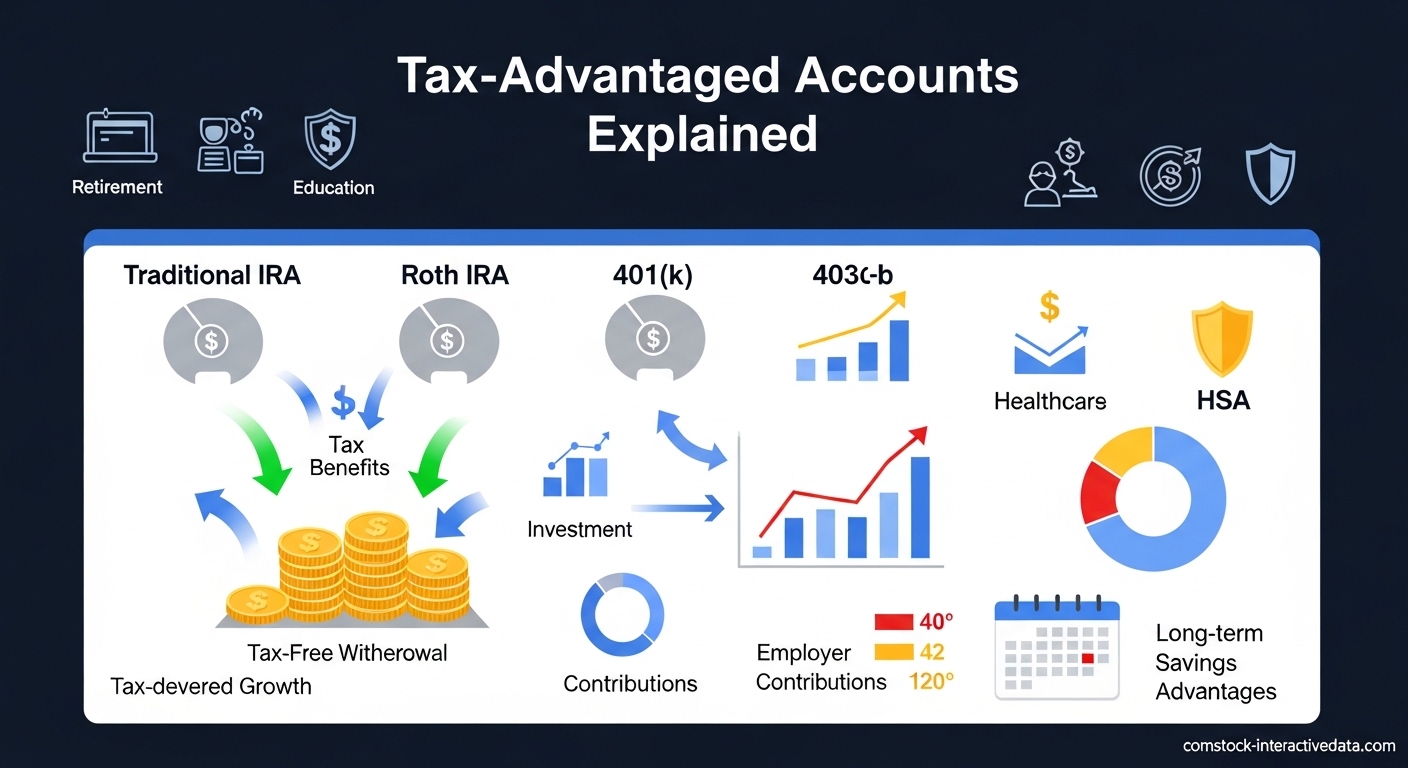
A tax-advantaged account is a savings or investment account that offers special tax benefits to encourage long-term financial planning. The 401(k) stands as one of the most powerful tools available to American workers, offering three distinct tax advantages that can save you thousands of dollars over your career. In this guide, I will explain exactly how Tax-Advantaged Accounts 401(k) work, why they matter for your financial future, and how to maximize every benefit available to you.
I have spent over a decade helping employees understand their retirement options, and I consistently see the same pattern. Those who grasp how 401(k) tax benefits work build significantly more wealth than those who delay contributing. The math is simple: when you combine pre-tax contributions, tax-deferred growth, and potential employer matching, you create a compounding machine that works in your favor year after year.
By the end of this article, you will understand the mechanics of 401(k) accounts, the difference between Traditional and Roth options, current contribution limits, and common mistakes that cost people money. Whether you are just starting your first job or reviewing your retirement strategy mid-career, this information will help you make confident decisions about your financial future.
Table of Contents
What Is a 401(k)?
A 401(k) is an employer-sponsored retirement plan that allows employees to contribute a portion of their salary toward retirement savings. The name comes from section 401(k) of the Internal Revenue Code, which Congress established in 1978 to give Americans a tax-advantaged way to save for their later years.
Your contributions are automatically deducted from your paycheck, making saving effortless and consistent. Many employers offer matching contributions, essentially providing free money that instantly boosts your savings rate. This combination of tax benefits and employer incentives makes the 401(k) one of the most effective wealth-building tools available to working Americans.
How Employer 401(k) Plans Work?
When you enroll in your company 401(k), you decide what percentage of each paycheck to contribute. Your employer automatically withholds this amount before taxes are calculated, reducing your immediate taxable income. The money then flows into your personal 401(k) account, where you select investments from a menu of options provided by your plan.
Most plans offer a range of mutual funds and target-date funds that automatically adjust their asset allocation as you approach retirement age. Your contributions and any employer match grow within this account without triggering annual taxes on dividends, interest, or capital gains. You only pay taxes when you eventually withdraw the money in retirement, typically at a lower tax rate than during your working years.
Who Can Participate in a 401(k)?
Eligibility varies by employer, but federal law allows companies to require up to one year of service before you can enroll. Many employers now offer immediate eligibility to attract talent in competitive job markets. Part-time employees who work at least 500 hours per year for three consecutive years must be allowed to participate starting in 2026, thanks to recent legislative changes.
Unlike Individual Retirement Accounts (IRAs), 401(k) plans have no income restrictions. High earners who exceed Roth IRA contribution limits can still contribute to a Traditional 401(k) regardless of income. This makes the 401(k) particularly valuable for those in higher tax brackets who want to reduce their current taxable income.
How 401(k) Tax Benefits Work?
Tax-Advantaged Accounts 401(k) provide three distinct tax benefits that work together to accelerate your wealth building. Understanding each advantage helps you appreciate why financial advisors consistently recommend maximizing 401(k) contributions before investing in taxable accounts.
The first benefit comes from pre-tax contributions. When you put money into a Traditional 401(k), that amount is deducted from your income before taxes are calculated. If you earn $75,000 and contribute $10,000 to your 401(k), you only pay income tax on $65,000. This immediate tax reduction can save you thousands of dollars each year depending on your tax bracket.
The second benefit is tax-deferred growth. Any dividends, interest, or capital gains generated within your 401(k) account do not trigger taxes in the year they occur. This allows your entire balance to compound without the drag of annual tax payments. Over decades, this tax deferral can add hundreds of thousands of dollars to your retirement balance compared to a taxable investment account.
The third benefit occurs in retirement when you withdraw funds. If your tax rate in retirement is lower than during your working years, you pay less tax on that money than you would have paid when you earned it. Most people find themselves in a lower tax bracket after they stop working, making this timing advantage significant.
Real Tax Savings Example
Let me show you exactly how much a 401(k) can save you in real dollars. Imagine you earn $80,000 per year and contribute $8,000 to your Traditional 401(k). If you are in the 22% federal tax bracket, that $8,000 contribution saves you $1,760 in federal taxes for the current year.
Your state taxes may offer additional savings. In a state with a 5% income tax rate, you save another $400, bringing your total tax savings to $2,160 on an $8,000 contribution. This means your $8,000 contribution only reduces your take-home pay by about $5,840, yet you have the full $8,000 working for you in your retirement account.
If your employer offers a 50% match on contributions up to 6% of salary, and you contribute that full 6% ($4,800), your employer adds another $2,400. Your account receives $7,200 total, but your out-of-pocket cost after tax savings is closer to $3,700. This is why I always tell people: not contributing enough to get the full employer match is like turning down a raise.
Tax-Deferred Growth Power
The tax-deferred nature of 401(k) accounts creates a compounding effect that grows more powerful over time. When you invest in a taxable brokerage account, you pay taxes on dividends and capital gains each year, reducing the amount that can compound. In a 401(k), every dollar of growth stays in the account and continues generating returns.
Over a 30-year career, this difference becomes substantial. A $10,000 annual investment earning 7% annually grows to about $944,000 in a taxable account assuming a 15% tax drag on gains. In a tax-deferred 401(k), that same investment grows to approximately $1,010,000. The $66,000 difference comes entirely from avoiding taxes during the accumulation phase.
Types of Tax-Advantaged Accounts
While this guide focuses on 401(k) plans, understanding where they fit in the broader landscape of Tax-Advantaged Accounts helps you build a comprehensive savings strategy. Different accounts serve different purposes, and many people benefit from using multiple account types simultaneously.
The 401(k) is an employer-sponsored plan with high contribution limits, making it ideal for those who want to save significant amounts. Traditional and Roth IRAs offer more investment flexibility but lower contribution limits. Health Savings Accounts (HSAs) provide triple tax advantages for medical expenses, while 529 plans help families save for education costs.
401(k) vs IRA: Key Differences
Both 401(k) and IRA accounts offer tax advantages for retirement savings, but they operate differently. A 401(k) is tied to your employer, who selects the available investment options and may contribute matching funds. An IRA is an individual account you open independently at a brokerage of your choice, giving you access to virtually any stock, bond, or fund.
Contribution limits favor the 401(k) significantly. In 2026, you can contribute up to $23,000 to a 401(k) versus $7,000 to an IRA. If you have both available, most financial planners recommend contributing enough to your 401(k) to capture any employer match, then considering whether additional money should go to the 401(k) or an IRA based on fees and investment options.
Health Savings Accounts as Tax-Advantaged Tools
HSAs deserve mention because they offer triple tax advantages that even 401(k) accounts cannot match. Contributions reduce your taxable income, growth is tax-free, and withdrawals for qualified medical expenses are also tax-free. If you have a high-deductible health plan, maxing out your HSA before increasing 401(k) contributions beyond the match can be a smart strategy.
After age 65, HSA funds can be used for any purpose without penalty, though non-medical withdrawals are taxed like a Traditional IRA. This flexibility makes the HSA a unique hybrid between a medical savings account and a supplemental retirement account. Many people do not realize that some HSAs allow you to invest contributions in mutual funds, not just hold them in cash.
Traditional 401(k) vs Roth 401(k)
Many employers now offer both Traditional and Roth 401(k) options, giving you a critical choice that affects your tax situation both now and in retirement. Understanding the difference helps you make the optimal decision for your specific circumstances.
A Traditional 401(k) provides immediate tax benefits. Your contributions reduce your taxable income today, and you pay taxes on withdrawals in retirement. A Roth 401(k) works in reverse: you contribute after-tax dollars now, but withdrawals in retirement are completely tax-free, including all the growth your investments have generated.
The fundamental question comes down to your current tax rate versus your expected retirement tax rate. If you are in a high tax bracket now and expect to be in a lower bracket later, Traditional contributions make sense. If you are early in your career with lower current earnings, or if you believe tax rates will rise significantly, Roth contributions may be the better choice.
Traditional 401(k) Benefits and Drawbacks
Traditional 401(k) contributions excel when you want to reduce your current tax burden. For high earners in the 32%, 35%, or 37% federal tax brackets, the immediate deduction can save substantial money that can be redirected to other financial goals. This approach assumes you will be in a lower bracket when you withdraw the funds.
The drawbacks include required minimum distributions (RMDs) starting at age 73, which force you to withdraw and pay taxes on a certain percentage each year whether you need the money or not. Traditional 401(k) withdrawals also count as ordinary income, which can affect how much of your Social Security benefits become taxable and potentially impact Medicare premiums.
Roth 401(k) Benefits and Drawbacks
Roth 401(k) accounts shine when you expect your tax rate to be higher in retirement than it is today. Young professionals in lower tax brackets should strongly consider Roth contributions. Paying taxes now at a 12% or 22% rate beats paying taxes later at a potentially higher rate, especially if you expect decades of investment growth.
Roth 401(k)s also eliminate uncertainty about future tax rates. No matter what Congress does with tax brackets over the next several decades, your Roth withdrawals remain tax-free. This can provide peace of mind and simplify retirement planning. However, you give up the immediate tax deduction, which can be painful if you are in a high bracket now.
One often overlooked benefit: Roth 401(k)s are not subject to RMDs during your lifetime if rolled over to a Roth IRA. This allows you to keep money growing tax-free for as long as you live, leaving more for heirs or covering late-in-life expenses without forced withdrawals.
Comparison: Traditional vs Roth 401(k)
| Feature | Traditional 401(k) | Roth 401(k) |
|---|---|---|
| Contribution Type | Pre-tax dollars | After-tax dollars |
| Immediate Tax Benefit | Reduces taxable income now | No immediate tax benefit |
| Withdrawal Taxation | Taxed as ordinary income | Completely tax-free |
| Best For | High earners expecting lower retirement taxes | Lower earners expecting higher future taxes |
| RMDs at Age 73 | Required | Required (but can avoid via Roth IRA rollover) |
| Contribution Limit 2026 | $23,000 ($30,500 if 50+) | $23,000 ($30,500 if 50+) |
401(k) Contribution Limits for 2026
Each year the IRS sets limits on how much you can contribute to your 401(k), with adjustments made for inflation. Understanding these limits helps you maximize your tax advantages while staying compliant with federal regulations.
For 2026, the employee contribution limit is $23,000. This represents the maximum you can contribute from your own salary, not including any employer matching funds. If you are age 50 or older, you can make additional catch-up contributions of $7,500, bringing your total employee contribution limit to $30,500.
There is also a total contribution limit that includes both employee and employer contributions. In 2026, this combined limit is $69,000 for those under 50 and $76,500 for those 50 and older. Most people never hit this ceiling, but high earners with generous employer matches should be aware of it.
Understanding Employer Matching Rules
Employer matching represents the closest thing to free money in personal finance, yet many employees fail to capture the full benefit. A typical match formula is 50% of your contributions up to 6% of salary. This means if you earn $60,000 and contribute at least $3,600 (6%), your employer adds $1,800.
Some employers offer dollar-for-dollar matches up to a certain percentage, while others use more complex formulas. The key is understanding your specific plan and contributing enough to receive every available dollar. I have seen too many people contribute 4% when their employer matches up to 6%, leaving thousands of dollars on the table annually.
Be aware of vesting schedules, which determine when employer contributions truly belong to you. Immediate vesting means the money is yours right away. Graded vesting gradually gives you ownership over several years. Cliff vesting makes you wait a specific period before you own any employer contributions. Always know your vesting status before changing jobs.
Catch-Up Contributions Explained
Once you turn 50, the IRS allows additional catch-up contributions to help you boost retirement savings in your final working years. The catch-up amount is $7,500 in 2026, applied on top of the standard $23,000 limit. This recognizes that many people have more disposable income as mortgages are paid off and children become financially independent.
Catch-up contributions provide significant tax benefits for older workers. A 55-year-old in the 24% tax bracket who contributes the full $30,500 saves over $7,300 in federal taxes alone. This makes maximizing contributions in your 50s and early 60s one of the most tax-efficient moves you can make.
Common 401(k) Mistakes to Avoid
Even with the best intentions, many people make costly errors with their 401(k) accounts. Avoiding these common pitfalls can save you thousands of dollars and put you on a stronger path toward retirement security.
The most expensive mistake is failing to contribute enough to receive the full employer match. This literally means giving up free money that could compound for decades. Calculate the exact percentage needed to maximize your match and treat that as your minimum contribution, not your target.
Early Withdrawal Penalties and Pitfalls
Withdrawing money from your 401(k) before age 59.5 typically triggers a 10% early withdrawal penalty on top of regular income taxes. A $10,000 withdrawal could cost you $1,000 in penalties plus $2,200 or more in taxes depending on your bracket. This easily erases years of careful saving and tax-deferred growth.
Some exceptions exist, including withdrawals for certain medical expenses, first-time home purchases (up to $10,000), and substantially equal periodic payments. However, these exceptions are narrow, and the rules are complex. Before considering any early withdrawal, explore alternatives like 401(k) loans, which let you borrow from yourself and pay interest back to your own account.
Ignoring Investment Fees
Not all 401(k) plans are created equal when it comes to fees. Some plans charge administrative fees of 1% or more annually, while others keep costs below 0.5%. Over a 30-year career, a 1% difference in fees can reduce your final balance by tens of thousands of dollars.
Review your plan’s fee disclosure statement, which employers are required to provide annually. Look for low-cost index fund options that often charge less than 0.1% annually compared to actively managed funds charging 0.5% to 1.0%. If your plan offers target-date funds, check their expense ratios, as some are significantly more expensive than others.
Setting and Forgetting Your Contributions
Many people set their 401(k) contribution percentage when they first start a job and never adjust it. This is a missed opportunity to gradually increase savings as your income grows. Consider setting an annual reminder to raise your contribution by 1% each year or whenever you receive a raise.
Similarly, neglecting to rebalance your investment allocation can lead to unintended risk exposure. If stocks perform well for several years, your portfolio may become more aggressive than intended. Most plans offer automatic rebalancing features that maintain your desired allocation without requiring manual intervention.
Frequently Asked Questions
What does tax-advantaged mean in a 401k?
Tax-advantaged means the account provides special tax benefits that reduce your tax burden. In a 401(k), this includes pre-tax contributions that lower your taxable income, tax-deferred growth that allows compounding without annual taxes, and potentially lower tax rates on withdrawals in retirement.
How do 401k tax benefits work?
401(k) tax benefits work through three mechanisms. First, pre-tax contributions reduce your current taxable income. Second, all investment growth occurs tax-deferred, meaning dividends and capital gains are not taxed annually. Third, you pay taxes only when withdrawing in retirement, typically at a lower rate than during your working years.
Why is a 401k tax advantaged?
Congress created 401(k) plans to encourage Americans to save for retirement. The tax advantages serve as incentives: by deferring taxes until retirement, the government helps workers build larger nest eggs while collecting taxes later when people are often in lower brackets. This policy goal of increasing retirement security justifies the tax revenue the government postpones receiving.
How much does 401k contribution reduce taxes?
Your tax savings equal your contribution multiplied by your marginal tax rate. For example, a $10,000 contribution saves $2,200 for someone in the 22% federal bracket, plus any state tax savings. Someone in the 32% bracket saves $3,200 federal on that same $10,000 contribution. The higher your tax bracket, the greater the immediate tax benefit.
How to avoid paying taxes on 401k withdrawal?
Roth 401(k) withdrawals are tax-free in retirement if the account has been open at least five years and you are over 59.5. For Traditional 401(k)s, taxes cannot be completely avoided, but you can minimize them by withdrawing in years when your income is lower, spreading withdrawals across tax years, and considering Roth conversions during low-income periods.
Do 401k withdrawals affect SSDI?
401(k) withdrawals do not affect Social Security Disability Insurance (SSDI) benefits because SSDI is not means-tested. However, 401(k) withdrawals can affect Supplemental Security Income (SSI), which is needs-based. Additionally, 401(k) income may make a portion of your Social Security retirement benefits taxable depending on your total income level.
Conclusion
Tax-Advantaged Accounts 401(k) represent one of the most powerful tools available for building long-term wealth. The combination of immediate tax savings, tax-deferred growth, and potential employer matching creates a savings environment that simply cannot be replicated in standard taxable accounts.
If you are not currently contributing to your 401(k), start today with whatever amount you can afford. If you are contributing but not maximizing the employer match, increase your percentage immediately to capture that free money. Every dollar you contribute now has decades to compound and grow, turning small sacrifices today into significant financial security tomorrow.
Take a moment this week to review your 401(k) plan. Check your contribution rate, understand your employer match formula, and verify that your investments align with your risk tolerance and timeline. Small adjustments made now can add hundreds of thousands of dollars to your retirement balance. The tax advantages are available to you; the only question is whether you will use them.