
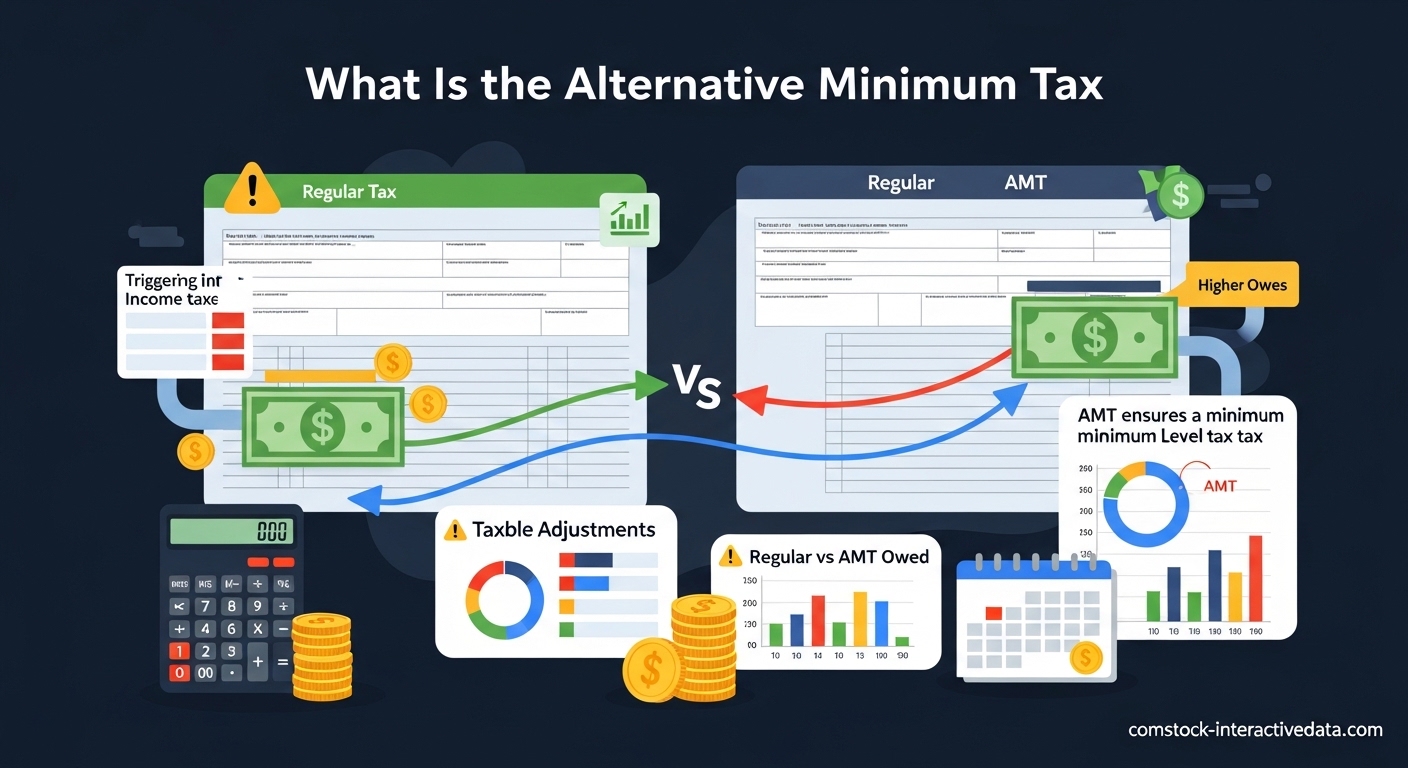
The alternative minimum tax is a parallel tax system designed to ensure that high-income taxpayers pay at least a minimum amount of federal income tax, regardless of deductions and credits. Originally created in 1969, the AMT operates alongside the regular tax system and requires certain taxpayers to calculate their liability twice. You may be wondering whether this parallel system affects you and what steps you should take if it does.
In this guide, I will break down exactly what the AMT is, how it works, and who actually needs to worry about it. Only about 0.1% of taxpayers currently pay the AMT, but for those who do, the financial impact can be significant. Understanding the triggers and exemption thresholds will help you determine your risk and plan accordingly.
Table of Contents
What Is the Alternative Minimum Tax?
The Alternative Minimum Tax (AMT) is a separate tax calculation that runs parallel to the regular federal income tax system. It was originally enacted in 1969 after Congress discovered that 155 high-income households had paid zero federal income tax by using various deductions and loopholes. The system requires qualifying taxpayers to compute their tax liability under both regular rules and AMT rules, then pay whichever amount is higher.
Think of the AMT as a floor on your tax liability. Even if you qualify for numerous deductions, credits, and exclusions under the regular tax system, the AMT adds back many of these tax breaks and calculates what you would owe under a simplified system with fewer deductions. The calculation applies two flat tax rates, 26% and 28%, to your alternative minimum taxable income after accounting for exemption amounts.
The Tax Cuts and Jobs Act of 2017 significantly reduced the number of taxpayers affected by the AMT. Before TCJA, approximately 5 million taxpayers paid the AMT annually. Today, that number has dropped to roughly 200,000 households out of 150 million total returns. However, these provisions are scheduled to sunset after 2025, which could dramatically increase AMT exposure unless Congress takes action.
How Does AMT Work?
The AMT operates as a two-track system where every qualifying taxpayer must run both calculations. First, you calculate your tax under the regular system with all your familiar deductions and credits. Then you calculate your tax under the AMT system, which adds back certain deductions and applies different rules. You pay the higher of the two amounts.
The AMT Calculation Process
The process begins with your regular taxable income and then makes specific adjustments to arrive at your alternative minimum taxable income (AMTI). You add back certain deductions that are not allowed under AMT rules, such as state and local tax deductions, miscellaneous itemized deductions, and interest from private activity bonds. These additions increase your taxable base for AMT purposes.
Once you have calculated your AMTI, you subtract the applicable exemption amount based on your filing status. The result is your AMT base, which gets taxed at either 26% or 28% depending on your income level. For 2025, the 26% rate applies to AMTI up to $232,600, while amounts above that threshold face the 28% rate. This calculation produces your tentative minimum tax.
Finally, you compare your tentative minimum tax to your regular tax liability. If your tentative minimum tax exceeds your regular tax, you pay the difference as your AMT. This difference is what actually gets reported as your alternative minimum tax on your tax return. Form 6251 is the IRS form used to perform these calculations and report your AMT liability.
Tax Breaks Lost Under AMT
Several popular tax benefits are disallowed or reduced when calculating AMT. The most significant for many taxpayers is the state and local tax deduction (SALT), which includes state income taxes and property taxes. While the regular tax system allows up to $10,000 in SALT deductions, the AMT eliminates this deduction entirely.
Other deductions and exclusions that get added back include miscellaneous itemized deductions, certain mortgage interest on home equity loans, and the standard deduction. Tax-exempt interest from private activity bonds becomes taxable under AMT rules. Additionally, depreciation deductions may be calculated differently, and certain business expense deductions face limitations.
AMT Exemption Amounts and Phase-Out Thresholds
The AMT exemption is a critical component that determines how much income remains shielded from the parallel tax system. These exemption amounts are adjusted annually for inflation, and they vary based on your filing status. Understanding these numbers helps you quickly assess whether you might face AMT exposure.
2025 AMT Exemption Amounts
| Filing Status | 2025 Exemption Amount | Phase-Out Begins | Phase-Out Complete |
|---|---|---|---|
| Single | $62,350 | $626,350 | $890,350 |
| Married Filing Jointly | $124,700 | $1,252,700 | $1,780,700 |
| Married Filing Separately | $62,350 | $626,350 | $890,350 |
| Head of Household | $62,350 | $626,350 | $890,350 |
2026 AMT Exemption Amounts
For 2026, the AMT exemption amounts are scheduled to change due to the TCJA sunset provision. Unless Congress extends the current rules, exemptions will revert to pre-2018 levels adjusted for inflation. This would significantly increase AMT exposure for middle and upper-middle-income taxpayers.
| Filing Status | 2026 Exemption Amount (Projected) | Phase-Out Begins |
|---|---|---|
| Single | $57,300 (estimated) | $420,000 (estimated) |
| Married Filing Jointly | $86,600 (estimated) | $630,000 (estimated) |
| Married Filing Separately | $43,300 (estimated) | $315,000 (estimated) |
The phase-out mechanics work by reducing your exemption amount by 25 cents for every dollar of AMTI above the threshold. Once your income reaches the phase-out completion point, your exemption drops to zero. This creates a higher effective marginal tax rate in the phase-out range, sometimes approaching 35% when combined with the 28% AMT rate.
What Triggers the Alternative Minimum Tax?
Most taxpayers never encounter the AMT because their income falls below exemption thresholds and they lack the specific types of income or deductions that trigger it. However, certain financial situations can push you into AMT territory even with moderate income levels. Understanding these triggers helps you plan and potentially avoid surprises.
1. Incentive Stock Options (ISOs)
Exercising incentive stock options is the single most common trigger for the AMT among middle-to-upper-income taxpayers. When you exercise ISOs, the difference between the exercise price and the fair market value of the stock becomes a tax preference item for AMT purposes, even though you have not sold the stock and may have no cash to pay the tax.
This creates a classic phantom income problem. You might exercise options at $10 per share when the stock trades at $50, generating $40 of paper gain per share for AMT calculation. If you have significant ISO exercises in a given year, this phantom income alone can trigger thousands or even tens of thousands in AMT liability.
2. Large State and Local Tax Deductions
Taxpayers in high-tax states like California, New York, and New Jersey face elevated AMT risk because of the SALT deduction limitation. While the regular tax system caps SALT deductions at $10,000, the AMT disallows them completely. If you pay $30,000 or more in state income and property taxes, this deduction difference alone can create AMT exposure when combined with other factors.
3. Significant Capital Gains
While capital gains themselves are taxed at the same rates under both systems, large capital gains can push your overall income into the AMT exemption phase-out range. When your exemption phases out, your AMT liability increases. A taxpayer with $200,000 in salary and $300,000 in capital gains might face AMT even though the capital gains are not preference items.
4. Tax-Exempt Private Activity Bonds
Interest from private activity bonds is tax-exempt under the regular tax system but taxable under AMT. If you hold significant amounts of these bonds and your income is already near AMT thresholds, the added interest income can trigger the parallel tax calculation.
5. High Itemized Deductions Relative to Income
Any combination of large deductions relative to your income level can create AMT exposure. The AMT is designed precisely to catch situations where deductions appear disproportionate. If your itemized deductions exceed 35% to 40% of your adjusted gross income, you should run the AMT calculation to assess your risk.
How to Calculate Alternative Minimum Tax?
Understanding the actual mechanics of AMT calculation helps demystify the process. While most taxpayers use tax software or professional preparers to handle Form 6251, knowing the steps helps you estimate your exposure and make informed financial decisions throughout the year.
Step-by-Step Calculation Process
Step 1: Start with your regular taxable income from Form 1040.
Step 2: Add back tax preference items and adjustments. Common additions include state and local taxes, certain mortgage interest, miscellaneous deductions, and the spread on exercised ISOs.
Step 3: Subtract the applicable AMT exemption amount based on your filing status and income level.
Step 4: Apply the AMT tax rates. For 2025, the 26% rate applies to the first $232,600 of AMTI, and 28% applies to amounts above that threshold.
Step 5: Compare your tentative minimum tax to your regular tax liability. The excess, if any, is your AMT.
Real Calculation Example
Consider a married couple filing jointly with $350,000 in regular taxable income. They claimed $25,000 in state income taxes and $15,000 in property taxes, all disallowed under AMT. They also exercised ISOs with a paper gain of $75,000.
Their AMTI calculation would be: $350,000 plus $40,000 (SALT) plus $75,000 (ISO spread) equals $465,000. Subtracting the $124,700 exemption leaves an AMT base of $340,300. At 26%, their tentative minimum tax would be approximately $88,478.
If their regular tax liability was $75,000, they would owe $13,478 in AMT on top of their regular tax. This brings their total federal tax liability to $88,478. The additional AMT credit can potentially be recovered in future years when their regular tax exceeds their tentative minimum tax.
Who Has to Pay Alternative Minimum Tax?
The reality is that very few taxpayers actually pay the AMT under current law. With the high exemption amounts established by the Tax Cuts and Jobs Act, only about 0.1% of households face this parallel tax system. However, knowing the specific income thresholds helps you determine whether you need to worry.
Income Thresholds for AMT Risk
For 2025, single taxpayers generally do not face AMT exposure unless their income exceeds approximately $500,000, assuming typical deduction patterns. Married couples filing jointly can often earn $1 million or more before AMT becomes a concern, provided they have no unusual tax preference items.
However, these thresholds drop significantly if you have AMT trigger items. A single taxpayer with $250,000 in salary who exercises ISOs with $100,000 in paper gains could easily trigger AMT even though their total income is well below the exemption phase-out threshold.
Who Does Not Need to Worry?
If your household income is below $300,000 and you have no ISO exercises, private activity bond interest, or unusually high itemized deductions, you almost certainly do not need to worry about AMT. The exemption amounts provide substantial breathing room for middle-income taxpayers.
Similarly, if you take the standard deduction and have ordinary wage income without significant capital gains, your AMT risk is negligible. The parallel tax system is specifically designed to capture high-income households or those with specific types of tax-advantaged income and deductions.
AMT Planning Strategies and Tips
Proactive tax planning can help minimize or avoid AMT liability. The key is understanding your exposure early in the tax year so you can make strategic decisions about timing income and deductions.
ISO Exercise Timing
If you hold incentive stock options, consider spreading exercises across multiple years rather than concentrating them in a single tax year. This keeps your AMTI below exemption phase-out thresholds. Some taxpayers exercise ISOs in January rather than December to give themselves a full year to plan and potentially sell shares to cover the AMT if needed.
Bunching Deductions Strategically
Since state and local tax deductions are disallowed under AMT, bunching other itemized deductions into years when you are not in AMT can maximize their value. However, this strategy requires careful multi-year planning and projection of your tax situation.
When to Consult a Professional
If your income exceeds $400,000 as a single filer or $800,000 as a married couple, or if you plan to exercise ISOs, consulting a CPA or tax professional is wise. The complexity of Form 6251 and the potential for significant AMT liability make professional guidance valuable. Tax software can handle AMT calculations, but strategic planning benefits from human expertise.
The 2025 TCJA Sunset Warning
Be aware that the Tax Cuts and Jobs Act provisions affecting AMT expire at the end of 2025. Unless Congress extends the current rules, AMT exemptions will drop significantly in 2026 and affect many more taxpayers. If you are currently near the exemption thresholds, your AMT risk could increase substantially starting in 2026.
Frequently Asked Questions
Does the alternative minimum tax apply to me?
The AMT likely does not apply if your income is below $300,000 and you have no special tax situations like ISO exercises or large capital gains. For 2025, single filers generally need income above $626,350 before exemptions phase out, while married couples filing jointly have a threshold of $1,252,700.
Why do I owe alternative minimum tax?
You owe AMT when your tentative minimum tax exceeds your regular tax liability. Common triggers include exercising incentive stock options, claiming large state and local tax deductions, realizing significant capital gains, or holding private activity bonds. The AMT system disallows certain deductions that reduce your regular taxable income.
Who is required to file alternative minimum taxes?
There is no separate filing requirement for AMT. If you owe AMT, it is calculated on Form 6251 and the liability flows to your Form 1040. About 0.1% of taxpayers currently owe AMT under the Tax Cuts and Jobs Act provisions in effect for 2025.
Do I need to worry about alternative minimum tax?
Most taxpayers do not need to worry about AMT. If your household income is under $500,000 and you have no ISO exercises or unusual deductions, your risk is minimal. High-income earners in states with high taxes should run the calculation to confirm.
How many people pay alternative minimum tax?
Approximately 200,000 taxpayers out of 150 million total returns pay AMT annually under current law. This represents about 0.1% of all filers. Before the Tax Cuts and Jobs Act, roughly 5 million taxpayers paid AMT. The number could increase significantly if TCJA provisions expire after 2025.
What is the difference between tentative minimum tax and alternative minimum tax?
The tentative minimum tax is the total tax calculated under AMT rules before comparing it to your regular tax. The alternative minimum tax is the actual amount you pay, which equals your tentative minimum tax minus your regular tax liability. You only pay AMT if the tentative minimum tax exceeds your regular tax.
Conclusion
The alternative minimum tax is a parallel system designed to ensure high-income taxpayers pay at least a minimum amount of tax. While it affects only about 0.1% of households under current law, understanding how it works helps you assess your risk and plan accordingly.
If you have high income, exercise incentive stock options, or live in a high-tax state, running the AMT calculation using Form 6251 or tax software will tell you definitively whether you owe. For most taxpayers, the generous exemption amounts established by the Tax Cuts and Jobs Act provide sufficient protection. However, watch for the TCJA sunset provisions at the end of 2025, which could significantly change who faces AMT in future years.