
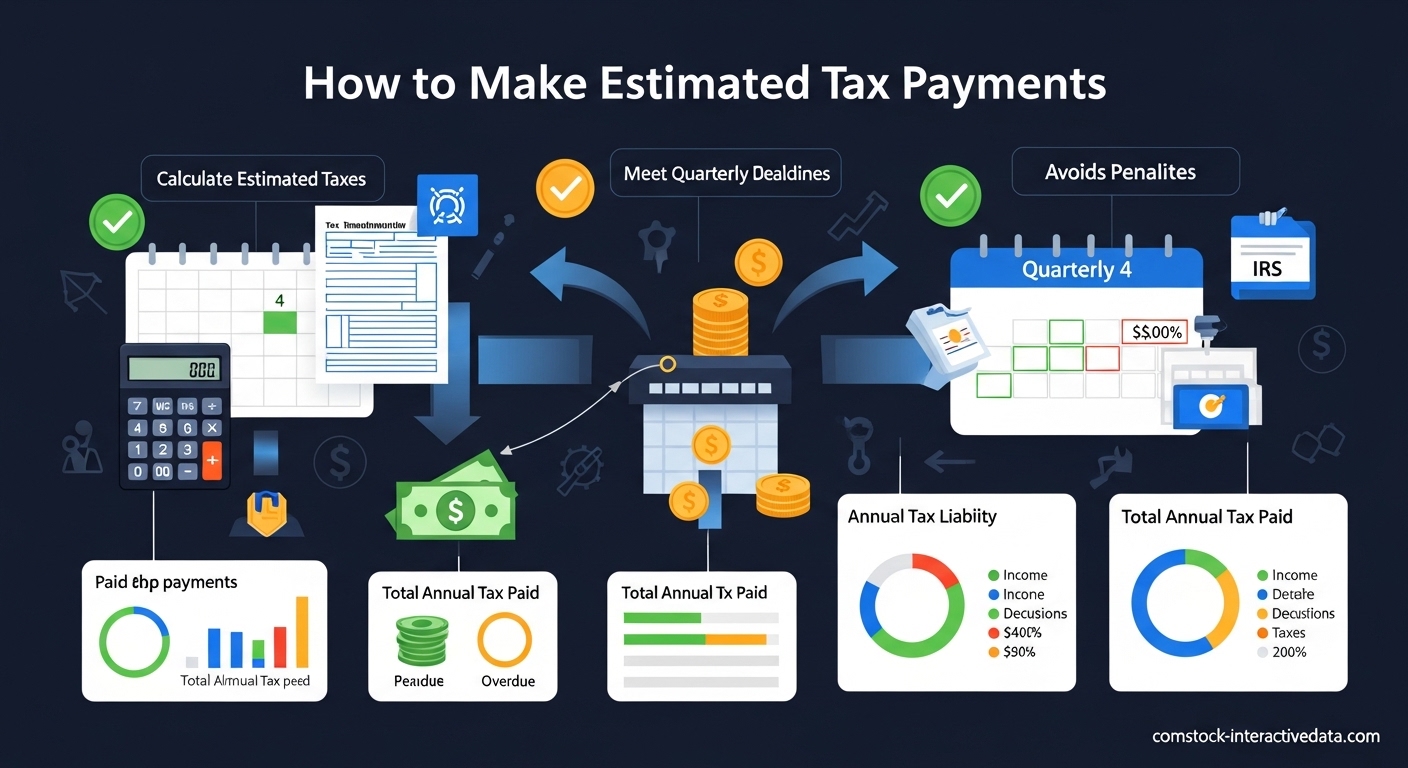
Making estimated tax payments is one of the most important responsibilities for self-employed individuals, freelancers, and small business owners. Unlike employees who have taxes automatically withheld from their paychecks, self-employed workers must calculate and pay their taxes quarterly throughout the year. This guide will walk you through exactly how to make estimated tax payments, from determining if you need to pay to choosing the best payment method for your situation.
Our team has helped hundreds of self-employed clients navigate the quarterly tax system. We have seen firsthand the confusion that surrounds Form 1040-ES, the anxiety about potential penalties, and the relief that comes from understanding how the system actually works. Whether you are a first-time freelancer or an experienced independent contractor looking to optimize your tax strategy, this guide covers everything you need to know about making estimated tax payments in 2026.
Table of Contents
Who Must Pay Estimated Taxes?
You must make estimated tax payments if you expect to owe at least $1,000 in tax for 2026 after subtracting your withholding and refundable credits. This threshold applies to most self-employed individuals, including freelancers, independent contractors, sole proprietors, and small business owners who receive income without tax withholding.
The IRS requires quarterly estimated tax payments from anyone who does not have enough taxes withheld from their income. If you earn money as a 1099 worker, run your own business, or receive rental income, investment income, or other earnings without automatic withholding, you likely need to make these payments.
However, not everyone with self-employment income needs to pay quarterly taxes. You can skip estimated payments if you had zero tax liability for the full prior tax year, or if your total tax for 2026 will be less than $1,000. Employees with side gigs might also avoid quarterly payments if they increase their W-2 withholding enough to cover their additional tax liability.
Common Self-Employment Situations Requiring Quarterly Payments
Freelance writers, graphic designers, web developers, and consultants typically need to make estimated tax payments. Independent contractors in construction, transportation, and professional services fall into this category as well. If you drive for a rideshare company, deliver food, or work as a gig economy worker, you are responsible for your own tax payments.
Small business owners operating as sole proprietors, single-member LLCs, or partners in partnerships must also pay quarterly taxes. Even if your business is part-time, you still need to make estimated payments on that income. S corporation shareholders who receive distributions beyond their salary may also need to make quarterly payments on that pass-through income.
When to Pay Estimated Taxes: Quarterly Deadlines for 2026
The IRS operates on a pay-as-you-go tax system, which means you need to spread your tax payments throughout the year rather than paying everything at once in April. For 2026, the quarterly estimated tax deadlines follow a specific schedule that you must remember to avoid penalties.
The quarterly payment schedule is not evenly spaced. While payments are traditionally called quarterly, the actual intervals vary. The first payment covers January through March, the second covers April and May, the third covers June through August, and the fourth covers September through December.
2026 Estimated Tax Payment Deadlines
For tax year 2026, mark these four critical dates on your calendar:
- 1st Quarter: April 15, 2026 (covers January 1 – March 31)
- 2nd Quarter: June 15, 2026 (covers April 1 – May 31)
- 3rd Quarter: September 15, 2026 (covers June 1 – August 31)
- 4th Quarter: January 15, 2026 (covers September 1 – December 31)
If any deadline falls on a weekend or federal holiday, your payment is due the next business day. This usually happens with the January deadline, which occasionally moves to January 16 or 17. The IRS does not send reminders, so setting your own calendar alerts is essential for staying compliant.
For the fourth quarter, you have an alternative to the January deadline. If you file your annual tax return by January 31 and pay all your remaining taxes with that return, you can skip the January estimated payment entirely. This works well for taxpayers who prefer to handle everything at once rather than making a separate January payment.
How to Calculate Your Estimated Tax Payments?
Calculating your estimated tax payments requires projecting your income, deductions, and credits for the entire year. While this sounds complicated, the IRS provides a worksheet with Form 1040-ES that walks you through the calculation step by step. You can also use tax software or consult a tax professional if your situation is complex.
Your estimated tax payment covers two components: income tax on your business earnings and self-employment tax covering Social Security and Medicare contributions. Self-employment tax adds 15.3% to your tax calculation, which surprises many first-time freelancers who only expect to pay income tax.
Step-by-Step Calculation Process
Step 1: Estimate your adjusted gross income. Start with your projected business revenue for the year. Subtract your expected business deductions, including home office expenses, mileage, equipment, supplies, professional development, and health insurance premiums if you are self-employed.
Step 2: Calculate your self-employment tax. Multiply your net business income by 92.35%, then apply the 15.3% self-employment tax rate. This covers both the employer and employee portions of Social Security and Medicare taxes. You can deduct half of this amount from your income, which reduces your overall tax burden.
Step 3: Determine your taxable income. Take your adjusted gross income and subtract your standard deduction or itemized deductions. For 2026, the standard deduction is $14,600 for single filers and $29,200 for married couples filing jointly. Also subtract the qualified business income deduction if you qualify for this 20% deduction on pass-through income.
Step 4: Apply tax brackets to calculate income tax. Use the 2026 federal tax brackets to calculate your income tax liability. Remember that tax brackets are marginal, meaning different portions of your income are taxed at different rates.
Step 5: Add self-employment tax to income tax. Combine your calculated income tax with your self-employment tax from Step 2. This gives you your total estimated tax liability before credits.
Step 6: Subtract any tax credits. Account for credits like the Child Tax Credit, Earned Income Credit, or education credits that reduce your tax dollar for dollar.
Step 7: Divide by four. Take your final estimated tax liability and divide by four to get your quarterly payment amount. If your income fluctuates significantly throughout the year, you can use the annualized income installment method to calculate different amounts for each quarter.
The Safe Harbor Shortcut
If you prefer not to do complex projections, the safe harbor rule offers a simpler calculation method. Pay 100% of your prior year total tax liability (110% if your prior year adjusted gross income exceeded $150,000), divided into four equal payments. This guarantees you will not face underpayment penalties regardless of how much you earn in 2026.
Payment Methods: How to Pay Estimated Taxes to the IRS
The IRS offers multiple ways to make your quarterly estimated tax payments. Each method has different processing times, fees, and convenience levels. We recommend choosing the option that best fits your banking setup and technical comfort level.
IRS Direct Pay (Recommended for Most Taxpayers)
IRS Direct Pay is the simplest and most popular option for making estimated tax payments. This free service pulls funds directly from your checking or savings account without any processing fees. You can schedule payments in advance or pay on the due date.
To use Direct Pay, visit the IRS website and select “Make a Payment.” Choose “Estimated Tax” as your payment reason, and select the appropriate tax year and form (1040-ES). Enter your bank account information, confirm the details, and submit your payment. You will receive a confirmation number immediately. Keep this number for your records.
Direct Pay processes your payment within 1-2 business days. The system stores your bank information securely for future payments, though you will need to re-enter your identity verification each time. You can schedule payments up to 30 days in advance, which helps if you want to set up all four quarterly payments at once.
EFTPS: Electronic Federal Tax Payment System
EFTPS is the IRS business payment system that also accepts individual estimated tax payments. While it requires an initial enrollment that takes about a week, it offers robust scheduling capabilities and detailed payment history tracking.
To enroll in EFTPS, visit eftps.gov and complete the registration process. The IRS will mail you a PIN within 5-7 business days. Once activated, you can schedule payments up to 365 days in advance, view 15 months of payment history, and cancel or modify scheduled payments until 11:59 PM ET two business days before the scheduled date.
EFTPS is free to use and processes payments from your bank account directly. We recommend this option for taxpayers who want maximum control and scheduling flexibility, especially if you run a business with multiple tax obligations beyond just estimated taxes.
IRS2Go Mobile App
The IRS2Go app brings tax payment capabilities to your smartphone. Available for iOS and Android devices, this free app lets you make estimated tax payments directly from your mobile device. The app connects to IRS Direct Pay and offers the same bank transfer functionality.
Download the IRS2Go app from your device app store. Create an account or sign in, select “Make a Payment,” choose the estimated tax option, and enter your bank details. The app saves your information for future payments and sends confirmation notifications to your device.
This option works well for taxpayers who prefer mobile banking and want to handle tax payments on the go. The app also provides refund status tracking and free tax help resources.
Debit or Credit Card Payments
You can pay estimated taxes using debit cards, credit cards, or digital wallets like PayPal and Venmo. However, these payments incur processing fees ranging from 1.82% to 1.98% of your payment amount. On a $5,000 quarterly payment, this adds approximately $90-$100 in fees.
Three IRS-authorized payment processors handle card payments: ACI Payments, Inc., Link2Gov Corporation, and PayUSAtax. Each charges slightly different fees, so compare them before paying. Visit the IRS website and select “Pay by Card” to access these processors.
Credit card payments process immediately, which helps if you are paying close to the deadline. Some taxpayers use credit cards to earn rewards points, though the processing fees usually exceed the value of typical rewards. Debit card fees are lower than credit card fees, making them a slightly more economical choice if you must pay by card.
Traditional Payment Methods
If you prefer paper-based payments, you can mail a check or money order with Form 1040-ES vouchers to the IRS. Make your check payable to “United States Treasury” and write your Social Security number and “2026 Form 1040-ES” on the memo line.
Mail your payment to the address listed on your Form 1040-ES voucher, which varies based on your state of residence. The IRS must receive your payment by the deadline, not just postmarked by that date. We recommend mailing payments at least 5-7 business days before the due date to ensure timely delivery.
Same-day wire transfers offer another option for last-minute payments, though your bank may charge a wire fee. Contact your bank to arrange an IRS tax payment wire transfer.
Cash payments are accepted at participating retail locations through the IRS Cash Payment option. You must first register online and receive a payment code, then take that code to a participating store within 7 days. Retailers charge a fee of $3.99 per payment.
Payment Method Comparison
| Method | Cost | Processing Time | Best For |
|---|---|---|---|
| IRS Direct Pay | Free | 1-2 days | Most individual taxpayers |
| EFTPS | Free | 1-2 days | Business owners, frequent payers |
| IRS2Go App | Free | 1-2 days | Mobile users |
| Debit Card | $2-4 flat fee | Same day | Last-minute payments |
| Credit Card | 1.82-1.98% | Same day | Rewards points seekers |
| Check by Mail | Postage only | 5-10 days | Traditional filers |
| Same-Day Wire | Bank fee ($15-30) | Same day | Emergency payments |
| Cash at Retail | $3.99 | Same day | Unbanked individuals |
Penalties and How to Avoid Them: The Safe Harbor Rule
The IRS charges penalties when you underpay your estimated taxes or miss quarterly deadlines. Understanding the safe harbor rules helps you avoid these penalties even if your income projections are not perfect.
What Triggers Underpayment Penalties?
The IRS assesses an underpayment penalty when you do not pay enough tax throughout the year through withholding and estimated payments. The penalty is essentially interest charged on the amount you should have paid but did not. The rate adjusts quarterly based on federal interest rates.
To avoid penalties, you must meet one of three safe harbor thresholds. First, pay at least 90% of your current year tax liability through withholding and estimated payments combined. Second, pay 100% of your prior year tax liability (110% if your prior year adjusted gross income exceeded $150,000). Third, owe less than $1,000 in tax for the current year after subtracting withholding and credits.
How the Safe Harbor Rule Works?
The 100% or 110% prior year safe harbor is the most reliable option for avoiding penalties. Calculate your total tax liability from last year return line 24. If your prior year AGI was $150,000 or less, divide that tax amount by four and pay that amount each quarter. If your prior year AGI exceeded $150,000 ($75,000 if married filing separately), multiply your prior year tax by 110%, then divide by four.
Using the safe harbor method protects you from penalties even if you earn significantly more this year than last year. You will still owe the additional tax when you file your annual return, but you will not face penalty charges on the underpaid amount.
Special rules apply to first-year filers who had no tax liability in the prior year. If you owed zero tax last year or were not required to file a return, you will not face underpayment penalties for your first year of self-employment, regardless of how much you earn this year.
Requesting Penalty Relief
If you receive an underpayment penalty notice, you may qualify for penalty relief under certain circumstances. The IRS waives penalties for taxpayers who miss payments due to casualty, disaster, or other unusual circumstances. You can also avoid penalties if you retired after reaching age 62 or became disabled during the tax year.
To request a waiver, complete Form 2210, Underpayment of Estimated Tax by Individuals, Estates, and Trusts. Attach a statement explaining your reasonable cause for underpayment. The IRS reviews these requests on a case-by-case basis.
Common Mistakes to Avoid When Paying Quarterly Taxes
After helping hundreds of self-employed clients with their estimated tax payments, we have seen the same mistakes repeated year after year. Avoiding these errors saves you money, reduces stress, and keeps you compliant with IRS requirements.
Forgetting Self-Employment Tax
The most expensive mistake first-time freelancers make is forgetting to include self-employment tax in their quarterly calculations. Self-employment tax adds 15.3% to your tax burden on top of regular income tax. If you only set aside money for income tax, you will face a shortfall of thousands of dollars when you file your annual return.
Remember that self-employment tax covers both the employee and employer portions of Social Security and Medicare. When you work for an employer, they pay half and you pay half. When you are self-employed, you pay both halves.
Missing Quarterly Deadlines
Another common error is forgetting one or more quarterly deadlines. The uneven spacing of due dates trips up many taxpayers. January through March is one quarter, but April through May is only two months for the second payment. June through August covers three months for the third payment, then September through December is four months for the final payment.
Set calendar reminders for all four deadlines at the beginning of each year. Many tax software programs and accounting apps offer deadline alerts. Some taxpayers prefer to pay early or set up automatic payments to avoid missing dates entirely.
Underestimating Income
Underestimating your annual income leads to underpayment penalties and a large tax bill at year-end. While optimism about business growth is natural, your estimated tax calculations should use conservative income projections. You can always adjust upward if business exceeds expectations, but catching up on underpayments is harder.
Track your income monthly and recalculate your estimated tax obligations quarterly. If you earn significantly more than projected, increase your remaining quarterly payments to catch up. The annualized income installment method allows you to calculate different payment amounts for each quarter based on actual earnings.
Ignoring State Tax Obligations
Federal estimated taxes are only half the equation. Most states that charge income tax also require quarterly estimated payments. California, New York, and other high-tax states have their own estimated tax requirements with different deadlines and calculation methods.
Check with your state tax agency to determine if you need to make state estimated tax payments. Many states follow the federal quarterly schedule, but some have different due dates. Some states also have different threshold amounts for when estimated payments become required.
Keeping Poor Records
Disorganized record-keeping makes accurate estimated tax calculations nearly impossible. Without clear documentation of your income and expenses, you are guessing at your tax liability. This leads to either overpaying and giving the IRS an interest-free loan, or underpaying and facing penalties.
Set up a dedicated system for tracking business income and expenses from day one. Separate personal and business finances using dedicated business bank accounts and credit cards. Save receipts, log mileage, and record income when received rather than waiting until year-end.
Failing to Adjust for Income Changes
Your estimated tax payments should reflect your actual business performance throughout the year. If you land a major client or lose a significant revenue source, recalculate your remaining quarterly payments accordingly. The IRS does not penalize you for adjusting payment amounts as long as you meet one of the safe harbor thresholds or pay based on your actual income using the annualized method.
Review your income and expenses at the end of each quarter. Compare your actual results to your projections and adjust future payments if necessary. This proactive approach prevents both overpayment and underpayment situations.
First-Year Business Guidance
Starting your first year of self-employment brings unique challenges for estimated tax payments. Without prior year tax returns to guide your calculations, determining how much to pay requires extra attention and careful planning.
Do You Need to Pay in Your First Year?
Many first-year business owners wonder if they can skip estimated taxes entirely. The answer depends on your projected tax liability. If you expect to owe $1,000 or more in taxes for your first year of self-employment, you must make quarterly estimated payments. There is no grace period for new businesses.
However, the prior year safe harbor rule offers some protection. If you had no tax liability last year because you were employed and had sufficient withholding, or if you did not need to file a return, you will not face underpayment penalties this year regardless of how much tax you owe. You will still need to pay the full tax amount when you file your annual return, but penalties will not apply.
Conservative Estimation Strategy for New Businesses
Without historical data to project your income, err on the side of caution with your first-year estimates. Set aside 25-30% of every payment you receive for taxes. This percentage typically covers both income tax and self-employment tax for most taxpayers in moderate tax brackets.
Track your income monthly and recalculate your projected annual income each quarter. New businesses often experience volatile income swings, so quarterly recalculations help you stay on track. If your business earns more than expected, increase your remaining quarterly payments. If earnings fall short, you can reduce future payments or even skip one if you have already paid enough to meet your safe harbor threshold.
Monthly Savings Plan to Prepare for Quarterly Payments
Rather than scrambling to find money for quarterly payments, set up a monthly savings system. Divide your estimated annual tax liability by 12 instead of 4, and transfer that amount to a separate savings account each month. This smooths your cash flow and ensures you always have funds available when quarterly deadlines arrive.
For example, if you expect to owe $12,000 in taxes for the year, set aside $1,000 per month rather than $3,000 per quarter. When each quarterly deadline arrives, you will have the full amount ready in your savings account. This approach eliminates the cash flow crunch that many new freelancers experience when their first quarterly payment comes due.
Open a separate high-yield savings account specifically for tax reserves. This keeps your tax money separate from operating funds and earns a small amount of interest while waiting for quarterly deadlines. Many online banks offer savings accounts with no minimum balance requirements and competitive interest rates.
Record Keeping Tips for Estimated Tax Payments
Good records support accurate estimated tax calculations and protect you if the IRS questions your payments. Maintaining organized documentation throughout the year takes minimal time and prevents major headaches at tax filing time.
What Records to Keep
Save documentation of all income received, including invoices, 1099 forms, payment confirmations, and bank statements showing deposits. Keep receipts and documentation for all business expenses, including mileage logs, home office measurements, equipment purchases, professional development costs, and health insurance premiums.
Record your estimated tax payment confirmations with dates, amounts, and confirmation numbers. The IRS occasionally misapplies payments or fails to credit accounts properly. Having your confirmation numbers readily available makes resolving these issues much faster.
Digital Tools and Apps
Cloud-based accounting software simplifies record-keeping for estimated tax purposes. QuickBooks Self-Employed, FreshBooks, Wave, and similar apps track income and expenses automatically when connected to your bank accounts. Many of these programs also calculate your estimated tax liability in real-time.
Mileage tracking apps like MileIQ, Everlance, or Stride automatically log your business miles using your phone GPS. This ensures you capture every deductible mile without manual record-keeping. At the current mileage rate, every business mile you drive reduces your taxable income.
Receipt scanning apps like Expensify or the built-in features in accounting software let you photograph receipts and discard paper copies immediately. The IRS accepts digital copies of receipts, so there is no need to store shoeboxes full of paper.
How Long to Keep Documentation?
The IRS generally has three years from your filing date to audit your return, so keep your tax records for at least that long. However, if you underreported income by more than 25%, the IRS can look back six years. Keep records indefinitely if you file a fraudulent return, though we assume you are not planning to do that.
For estimated tax purposes, we recommend keeping records for at least six years. This covers the standard audit window plus the extended window for significant underreporting. Store digital copies of everything in cloud storage for easy access and backup protection.
State Tax Requirements
While this guide focuses on federal estimated tax payments, most states with income taxes also require quarterly estimated payments. Understanding your state obligations ensures complete compliance and avoids state-level penalties.
States Requiring Estimated Tax Payments
Forty-one states and the District of Columbia charge income taxes and generally require estimated payments following similar rules to the federal system. Only Alaska, Florida, Nevada, South Dakota, Texas, Washington, and Wyoming have no state income tax. Tennessee and New Hampshire only tax investment income, not self-employment earnings.
Each state sets its own threshold for when estimated payments become required, often lower than the federal $1,000 threshold. California, for example, requires estimated payments when you expect to owe $500 or more in state tax. Check with your state tax agency for specific requirements.
Different Deadlines and Calculation Methods
While most states follow the federal quarterly schedule (April, June, September, January), some states have different due dates. Check your state tax agency website for the exact payment schedule in your state. Some states offer different payment options or calculation methods as well.
State estimated tax calculations generally mirror federal calculations but use state tax rates and brackets. If you use tax software for federal estimates, it usually handles state calculations simultaneously. Manual calculation requires obtaining your state estimated tax forms, which are typically available on your state tax agency website.
Visit your state department of revenue website for forms, deadlines, and payment options. Many states now offer online payment systems similar to IRS Direct Pay. Some states participate in the EFTPS system for business tax payments as well.
Frequently Asked Questions
How do self-employed people pay quarterly taxes?
Self-employed individuals pay quarterly taxes by calculating their estimated tax liability and submitting payments using one of several IRS-approved methods. You can pay online through IRS Direct Pay, use the EFTPS system, pay via the IRS2Go mobile app, use a debit or credit card, or mail a check with Form 1040-ES. Online methods process within 1-2 business days and are free when using bank transfers. The key is making payments by the quarterly deadlines: April 15, June 15, September 15, and January 15.
How do I calculate estimated tax payments for self-employed individuals?
Calculate your estimated tax payments by estimating your adjusted gross income, subtracting deductions, and applying tax brackets to determine your income tax. Then add self-employment tax, which is 15.3% of 92.35% of your net business income. Subtract any tax credits, then divide the total by four for your quarterly payment amount. Alternatively, use the safe harbor method: pay 100% of your prior year tax liability (110% if your prior year AGI exceeded $150,000) divided into four equal payments. The IRS provides a worksheet with Form 1040-ES to walk you through the calculation.
How do I make estimated tax payments as an individual?
As an individual, you have several options for making estimated tax payments. The easiest method is IRS Direct Pay on the IRS website, which transfers funds directly from your bank account for free. You can also use the EFTPS system, the IRS2Go mobile app, or pay by debit or credit card through authorized processors. For traditional payment methods, mail a check or money order with Form 1040-ES voucher to the IRS address for your state. Always include your Social Security number and the tax year on your payment.
What is the 90% rule for estimated tax payments?
The 90% rule states that you can avoid underpayment penalties by paying at least 90% of your current year tax liability through withholding and estimated tax payments combined. This is one of three safe harbor rules. The others require paying 100% of your prior year tax (110% if your prior year AGI exceeded $150,000) or owing less than $1,000 in tax after subtracting withholding. The 90% rule helps taxpayers whose income increases significantly from the prior year, allowing them to base payments on current earnings rather than historical amounts.
Why am I being asked to make estimated tax payments?
The IRS requires estimated tax payments from individuals who expect to owe $1,000 or more in tax and do not have enough taxes withheld from other sources. This typically includes self-employed individuals, freelancers, independent contractors, and small business owners who receive income without automatic tax withholding. The pay-as-you-go tax system requires taxes to be paid throughout the year as income is earned, rather than in a single lump sum at year-end. If your W-2 withholding or other credits will not cover at least 90% of your current year tax liability, you must make quarterly estimated payments.
What should I put for my estimated tax payments?
Your estimated tax payment amount should equal approximately one-fourth of your projected annual tax liability. Include both income tax and self-employment tax (15.3% for Social Security and Medicare) in your calculation. If you expect to owe $20,000 in taxes for the year, each quarterly payment should be approximately $5,000. Use Form 1040-ES worksheets to calculate the exact amount based on your projected income, deductions, and credits. If your income fluctuates, you can use the annualized income method to pay different amounts each quarter based on actual earnings.
Do I need to make quarterly payments to the IRS?
You need to make quarterly payments to the IRS if you expect to owe at least $1,000 in tax for 2026 after subtracting your withholding and refundable credits. This requirement applies to most self-employed individuals, freelancers, independent contractors, and small business owners. However, you do not need to make quarterly payments if you had no tax liability for the prior year, were a U.S. citizen or resident for the full year, and your prior tax year covered a 12-month period. Additionally, if your W-2 job withholding covers most of your tax liability, you might increase your withholding there instead of making separate quarterly payments.
Can I pay quarterly taxes all at once?
Technically, you can pay your entire estimated tax liability in one payment at the beginning of the year. The IRS does not prohibit this approach, and doing so satisfies your quarterly payment requirement and avoids underpayment penalties. However, paying all at once creates a cash flow burden and gives the IRS an interest-free loan of your money for months before it is technically due. Most financial advisors recommend spreading payments across the four quarterly deadlines to preserve your cash flow throughout the year. If you prefer simplicity and have sufficient cash reserves, prepaying is an acceptable option.
What if I miss a quarterly estimated tax payment?
If you miss a quarterly estimated tax payment, pay the missed amount as soon as possible to minimize penalties. The IRS calculates underpayment penalties daily from the due date until payment is received. You can make the late payment using any standard IRS payment method. Include the appropriate quarter designation so the IRS applies the payment correctly. If you miss one payment but overpay on subsequent payments, you may offset some penalty charges. You can also avoid penalties if you meet a safe harbor rule based on your total annual payments. In some cases, you may qualify for penalty waiver by filing Form 2210 and demonstrating reasonable cause for the late payment.
Do I have to pay quarterly taxes my first year of self-employment?
Yes, you must pay quarterly taxes during your first year of self-employment if you expect to owe $1,000 or more in taxes. However, if you had no tax liability in the prior year, you will not face underpayment penalties even if you do not make estimated payments. You will still owe the full tax amount when you file your annual return. For your first year, base your estimated payments on your projected income or use the safe harbor method if you had tax liability last year. Many first-year freelancers set aside 25-30% of every payment they receive in a separate savings account to ensure they have funds available for quarterly deadlines.
Conclusion
Understanding how to make estimated tax payments is essential for every self-employed individual. The quarterly tax system ensures you stay compliant with IRS requirements while avoiding the shock of a massive tax bill in April. By calculating your payments correctly, choosing the right payment method, and meeting the quarterly deadlines, you can manage your tax obligations without stress or penalties.
Remember the key principles we covered in this guide. First, determine whether you must pay estimated taxes based on your expected tax liability and withholding situation. Second, calculate your quarterly payments using either the detailed worksheet method or the safe harbor approach. Third, choose a payment method that fits your preferences, whether that is the free IRS Direct Pay system, the flexible EFTPS platform, or the convenient IRS2Go mobile app.
Mark your calendar for the four critical deadlines each year: April 15, June 15, September 15, and January 15. Set up monthly savings transfers to ensure you always have funds available. Keep accurate records of your income and expenses throughout the year. Consider consulting a tax professional for your first year of self-employment or if your situation is particularly complex.
Learning how to make estimated tax payments takes time, but the peace of mind that comes from staying current with your tax obligations is worth the effort. Start implementing these strategies today, and you will build habits that serve you throughout your self-employment journey. The quarterly tax system becomes routine once you establish your process, freeing you to focus on growing your business rather than worrying about tax penalties.