
Last tax season, I discovered a painful lesson about the wash sale rule the hard way. I sold $15,000 worth of tech stocks at a loss in December to offset my capital gains, then bought similar positions in early January. When my CPA reviewed my return, she pointed out that my $4,200 loss deduction was completely disallowed. That mistake cost me over $1,000 in extra taxes.
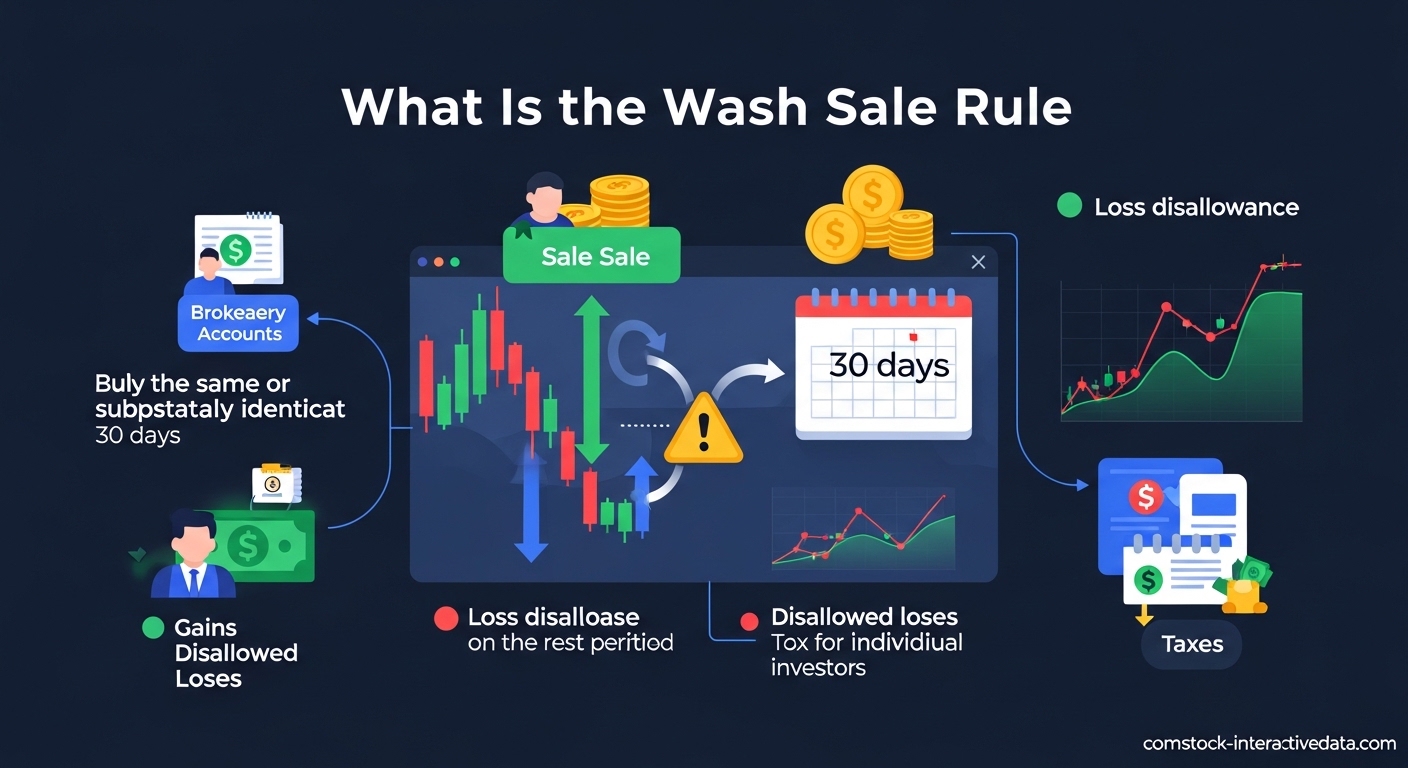
A wash sale is when you sell a security at a loss and purchase the same or substantially identical security within 30 days before or after the sale. The IRS wash sale rule prevents you from claiming a tax deduction for that loss, instead deferring it through a cost basis adjustment to your replacement shares. This rule exists to stop investors from selling investments solely for the tax benefit without actually changing their market position.
Understanding what is the wash sale rule and how does it affect your taxes can save you from unexpected tax bills and failed tax-loss harvesting strategies. Whether you are an active trader or a buy-and-hold investor, this guide will walk you through everything you need to know to stay compliant and optimize your tax situation.
Table of Contents
Key Takeaways
- The wash sale rule disallows tax deductions for losses when you repurchase the same or substantially identical security within 30 days before or after the sale.
- The 61-day window (30 days before + sale day + 30 days after) is what actually matters for compliance.
- Disallowed losses are not lost forever – they are added to the cost basis of replacement shares and recognized when those shares are eventually sold.
- Wash sales apply across all your accounts, including IRAs, and even extend to your spouse’s transactions.
- The rule is not illegal to trigger, but it eliminates the immediate tax benefit you were seeking.
What Is the Wash Sale Rule?
The wash sale rule is an IRS regulation designed to prevent taxpayers from claiming artificial tax losses. The rule applies when you sell a security at a loss and then acquire the same or a substantially identical security within a specific timeframe.
The IRS introduced this rule to close a loophole where investors could sell losing positions to claim tax deductions while maintaining essentially the same economic exposure. Without this rule, wealthy investors could generate unlimited tax deductions without any real change to their portfolio.
The 61-Day Window Explained
The wash sale period is actually 61 days, not 30 days as many investors mistakenly believe. The window includes the 30 days before your sale, the day of the sale itself, and the 30 days after the sale.
If you buy replacement shares at any point during this 61-day window, your loss deduction is disallowed. This means a purchase you made 29 days before selling at a loss can trigger a wash sale just as easily as a purchase 29 days after.
Many forum discussions reveal this is the single most misunderstood aspect of wash sales. Investors frequently ask why their December loss was disallowed when they bought back in January, not realizing the 30-day after rule applied.
What Counts as a Substantially Identical Security?
The IRS does not define substantially identical with absolute precision, which creates some gray areas. Generally, it means securities issued by the same corporation or securities that are virtually identical in all material respects.
Selling Apple stock and buying Apple stock back within 30 days clearly triggers a wash sale. Selling a specific company’s common stock and buying that company’s preferred stock may also trigger a wash sale if the preferred stock is convertible into common stock.
However, selling an S&P 500 index fund from one provider and buying an S&P 500 index fund from a different provider typically does not trigger a wash sale. The IRS has not issued clear guidance on ETF substitutions, so many tax advisors consider this a reasonable strategy for maintaining market exposure while claiming losses.
Options contracts add another layer of complexity. Selling a stock at a loss and then buying call options on that same stock within 30 days can trigger a wash sale. The IRS views call options as essentially equivalent to holding the underlying stock because they give you the right to acquire it.
How Does the Wash Sale Rule Work?
When a wash sale occurs, the IRS does not allow you to deduct the loss on your current year tax return. Instead, the loss is deferred and added to the cost basis of your replacement shares.
Cost Basis Adjustment Mechanism
Let me walk through exactly how the cost basis adjustment works. Suppose you buy 100 shares of XYZ stock at $50 per share, investing $5,000 total. The stock drops to $30 per share, and you sell at a $2,000 loss.
Within 30 days, you repurchase 100 shares of XYZ at $32 per share. You cannot claim the $2,000 loss on this year’s taxes. Instead, your new cost basis becomes $32 per share plus the disallowed loss of $20 per share, giving you an adjusted basis of $52 per share.
When you eventually sell those replacement shares, the disallowed loss is effectively recognized through the adjusted cost basis. If you sell later at $60 per share, your taxable gain is only $8 per share ($60 – $52) rather than $28 per share ($60 – $32).
The holding period of the replacement shares also gets adjusted. Instead of starting fresh when you buy the replacement shares, your holding period includes the time you held the original shares. This can affect whether future gains are taxed as short-term or long-term capital gains.
Spouse and Controlled Corporation Rules
The wash sale rule extends beyond just your individual brokerage account. If your spouse buys substantially identical securities within the 61-day window, the wash sale rule applies to your loss. The IRS views married couples as a single economic unit for this purpose.
Similarly, if a corporation you control purchases the securities, your personal loss is disallowed. A controlled corporation is generally one where you own more than 50% of the stock, either directly or indirectly.
This surprises many investors who think they can avoid wash sales by having their spouse or a separate entity make the purchase. The IRS has closed this loophole thoroughly.
IRA Wash Sale Implications
Here is where many investors get caught off guard. Selling a stock at a loss in your taxable brokerage account and then buying it in your IRA within 30 days triggers a wash sale. But the consequences are worse than a regular wash sale.
Under Revenue Ruling 2008-5, when a wash sale involves an IRA, the cost basis adjustment is made to the IRA shares. However, since IRAs do not track cost basis for tax purposes on sales, the disallowed loss is essentially gone forever. You cannot recover it.
This is one of the most expensive wash sale mistakes you can make. A trader on Reddit shared their nightmare story where their CPA discovered over $1 million in disallowed losses from IRA wash sales. Those losses provided zero tax benefit and could never be recovered.
Partial Wash Sales
Wash sales can also occur on partial lots. If you sell 100 shares at a loss but only buy back 50 shares within the window, the wash sale rule applies to 50 shares worth of loss. The remaining loss on the other 50 shares is deductible.
This becomes complicated when you have multiple tax lots purchased at different prices. Your broker will typically apply the wash sale rule to the most recently acquired shares first, but the exact methodology can vary.
Wash Sale Rule Examples
Real numbers make these concepts much clearer. Let me walk you through three common scenarios I see in my practice.
Example 1: Basic Stock Wash Sale
On March 1, you buy 200 shares of Tesla at $250 per share, investing $50,000. By November 1, Tesla has dropped to $180 per share. You sell your entire position for $36,000, realizing a $14,000 loss.
On November 20, you buy 200 shares of Tesla at $185 per share for $37,000. This purchase falls within the 30-day window after your sale, creating a wash sale.
The result: You cannot deduct the $14,000 loss on this year’s tax return. Your new cost basis in the Tesla shares becomes $51,000 ($37,000 purchase price + $14,000 disallowed loss). Your holding period for the new shares includes the March 1 purchase date.
Example 2: Options Wash Sale
You own 500 shares of NVIDIA purchased at various prices. Your average cost basis is $120 per share. In September, you sell 200 shares at $95 per share, realizing a $5,000 loss.
Two weeks later, you buy 2 NVIDIA call option contracts (each representing 100 shares) with a strike price of $100. Even though these are options rather than shares, the IRS considers them substantially identical securities.
The $5,000 loss is disallowed. The cost basis of the call options is adjusted upward by $5,000. When you eventually sell or exercise those options, the disallowed loss will be factored into your gain or loss calculation.
Example 3: Dividend Reinvestment Plan (DRIP) Wash Sale
This is the accidental wash sale that catches conservative long-term investors. You own 1,000 shares of Coca-Cola stock with a $45 average cost basis. The stock is now at $38, and you decide to harvest the $7,000 loss for tax purposes.
You sell all 1,000 shares on December 15. However, your DRIP plan automatically reinvested your quarterly dividend on December 20, purchasing 15 new shares. Even though this was automatic and unintentional, you have triggered a wash sale on 15 shares.
Your loss deduction is reduced by $105 (15 shares × $7 average loss per share). The remaining $6,895 loss is still deductible. The $7 loss per share is added to the cost basis of your 15 new DRIP shares.
How Does a Wash Sale Affect Your Taxes?
The immediate consequence of a wash sale is the loss of your expected tax deduction. This can significantly impact your tax bill, especially if you were counting on that deduction to offset other gains.
Immediate Tax Consequences
When a wash sale occurs, the loss you planned to deduct is disallowed for the current tax year. If you realized a $10,000 loss and fall in the 22% tax bracket, a wash sale could cost you $2,200 in additional taxes.
This is particularly painful for investors doing year-end tax-loss harvesting. You might sell losing positions in late December specifically to reduce your tax bill, then accidentally trigger a wash sale in early January. The deduction you were counting on disappears.
Your broker will report wash sales on Form 1099-B, typically in Box 1g labeled as Wash sale loss disallowed. This adjustment flows through to your Form 8949 and Schedule D, reducing your deductible losses.
Long-Term Impact on Cost Basis
The disallowed loss is not permanently lost, but it is deferred. By increasing the cost basis of your replacement shares, the IRS ensures you will eventually get the tax benefit when you sell those shares.
However, this deferral can work against you if your replacement shares continue to appreciate. You might end up with a larger taxable gain when you eventually sell, potentially at a higher capital gains rate.
Suppose you have a $5,000 disallowed loss that gets added to replacement shares. Those shares later appreciate significantly, and you sell them at a $50,000 gain. You will pay capital gains tax on the full $50,000 rather than $45,000. Your $5,000 loss deduction has been transformed into a higher taxable gain.
Short-Term vs Long-Term Capital Gains Impact
Wash sales can also affect the character of your future gains. Short-term capital gains are taxed at ordinary income rates, which can be as high as 37%. Long-term capital gains have preferential rates of 0%, 15%, or 20%.
When a wash sale occurs, the holding period of your original shares carries over to your replacement shares. If you held the original shares for 8 months, your replacement shares immediately have an 8-month holding period rather than starting fresh.
This can be beneficial if it pushes you over the one-year mark for long-term treatment. However, if your original holding period was short-term and you hold the replacement shares long enough to exceed one year total, the original short-term loss gets converted into a potential long-term gain.
Tax-Loss Harvesting Disruption
Tax-loss harvesting is a popular strategy where investors deliberately sell losing investments to claim tax deductions, then reinvest in similar (but not substantially identical) positions. Wash sales completely disrupt this strategy.
A proper tax-loss harvest requires purchasing a different but correlated investment. For example, selling an S&P 500 index fund and buying a total stock market index fund. This maintains similar market exposure while avoiding the substantially identical security trigger.
Many robo-advisors and automated tax-loss harvesting services build this logic into their algorithms. They maintain lists of acceptable substitute investments to prevent accidental wash sales.
Net Capital Loss Limitations
Even without wash sales, the IRS limits how much capital loss you can deduct against ordinary income. You can only deduct up to $3,000 of net capital losses against other types of income per year ($1,500 if married filing separately).
Excess losses carry forward to future years. Wash sales reduce the amount of loss available to deduct, potentially extending how many years it takes to fully utilize your capital losses.
How to Avoid the Wash Sale Rule?
Prevention is far better than dealing with the consequences of a wash sale. Here are the strategies I recommend to clients who want to harvest tax losses without triggering these rules.
Wait the Full 61 Days
The simplest approach is to wait. After selling at a loss, do not purchase the same or substantially identical security for 31 days. If you bought shares within 30 days before the sale, wait 31 days after that earlier purchase before selling.
This requires patience and market risk tolerance. If you believe the stock will rebound during your waiting period, you might miss the recovery. Some investors choose to accept the wash sale rather than risk missing a market move.
Use ETF Substitution
The most common professional strategy is selling a specific security and immediately buying a similar but not identical ETF or mutual fund. This maintains your market exposure while avoiding the wash sale trigger.
Selling an individual tech stock and buying a technology sector ETF is generally safe. The ETF contains dozens of companies, making it not substantially identical to any single stock. Selling one S&P 500 index fund and buying another from a different provider is also typically acceptable.
Be careful with sector-specific ETFs. Selling one semiconductor ETF and buying another semiconductor ETF might trigger scrutiny, especially if they have nearly identical holdings.
Beware of Multiple Accounts
Wash sales apply across all your accounts, even at different brokers. Selling at a loss in your Fidelity account and buying in your Schwab account within 30 days still triggers a wash sale.
Many investors do not realize their brokers cannot see transactions at other firms. Your 1099-B from each broker will not show wash sales triggered by activity elsewhere. You must track this yourself or risk reporting errors.
If you use automated dividend reinvestment plans, make sure to suspend them before tax-loss harvesting in that security. An automatic DRIP purchase can accidentally trigger a wash sale.
Year-End Planning Considerations
December is the most dangerous month for accidental wash sales. You sell for a loss on December 20 to claim the deduction for the current tax year, but your January 10 purchase falls within the 30-day window.
To avoid this, either complete your tax-loss harvesting by early November or wait until late January to repurchase. If you sell in early December, any purchase before late January triggers the wash sale.
Remember that purchases made in late November also trigger the before portion of the 61-day window. A November 25 purchase and December 20 sale is a wash sale because the purchase occurred within 30 days before the sale.
Software and Tracking Tools
Several portfolio tracking tools can help identify potential wash sales before they occur. Some popular options include:
Portfolio management software like Quicken or Empower (formerly Personal Capital) can track purchase dates and flag potential conflicts. Specialized tax software like TradeLog is designed specifically for active traders with complex wash sale situations.
Your broker may also provide wash sale alerts. Fidelity, Schwab, and other major brokers now show potential wash sale warnings before you complete trades. However, these warnings typically only cover activity within that specific account.
How to Report Wash Sales on Your Tax Return?
Properly reporting wash sales is essential to avoid IRS scrutiny. Your broker will report wash sales on Form 1099-B, but the responsibility for accurate tax filing ultimately rests with you.
Understanding Your Form 1099-B
Brokers report securities transactions on Form 1099-B. When wash sales occur, Box 1g shows the amount of loss disallowed. This is the amount you cannot deduct on your current year return.
Box 1e shows your cost basis, which should already be adjusted for wash sales. However, brokers sometimes make errors with cost basis calculations for complex wash sale scenarios involving multiple lots.
Review your 1099-B carefully. If the wash sale adjustment looks incorrect, contact your broker for a corrected form before filing your return.
Form 8949 Reporting Process
Form 8949 is where you report individual securities transactions. Each transaction gets listed with dates, proceeds, cost basis, and gain or loss.
For wash sale transactions, Column (f) is where you enter the code W to indicate a wash sale. Column (g) is where you enter the amount of the disallowed loss. This reduces your reported loss to reflect the wash sale adjustment.
If your broker has already adjusted the cost basis on your 1099-B, you generally report the adjusted numbers directly. If they have not adjusted the basis, you must make the adjustment yourself on Form 8949.
Schedule D Aggregation
Schedule D aggregates your short-term and long-term capital gains and losses from Form 8949. The wash sale adjustments ultimately flow through to your net capital gain or loss calculation.
If you have wash sales involving short-term positions, they stay in the short-term category. The disallowed loss does not convert a short-term loss into a long-term loss.
Correcting Mistakes on Filed Returns
If you discover wash sales after filing your return, you may need to file an amended return. Use Form 1040-X to correct the error and claim any additional deductions or report additional income.
For wash sales you missed that reduced your deductions, amending could result in additional tax owed plus interest and potential penalties. If you over-reported losses due to missing wash sales, amending could result in a refund.
The statute of limitations for amending returns is generally three years from the original filing date. However, if you owe additional tax due to underreporting, the IRS can assess that tax for up to six years in some cases.
Special Situations and Common Questions
Certain investor types face unique wash sale challenges. Here is what you need to know about these special situations.
Day Traders and Wash Sales
Active day traders are wash sale magnets. Frequent buying and selling of the same securities almost guarantees wash sale triggers throughout the year.
Day traders should consider electing mark-to-market accounting status with the IRS. This election treats all trading positions as sold at year-end for tax purposes, eliminating wash sale concerns entirely. However, this election must be made by the tax return due date for the prior year and has other significant tax implications.
Without mark-to-market status, day traders must track wash sales across thousands of transactions. Professional tax software is essential for managing this complexity accurately.
Cryptocurrency and Wash Sales
As of 2026, cryptocurrency exists in a regulatory gray area regarding wash sales. The IRS currently treats cryptocurrency as property rather than securities for tax purposes.
Wash sale rules under Section 1091 specifically apply to stocks and securities. Since cryptocurrency is classified as property, many tax professionals argue that wash sale rules do not currently apply to crypto transactions.
However, this could change. Legislation has been proposed multiple times to extend wash sale rules to cryptocurrency. Any investor considering crypto tax-loss harvesting should monitor regulatory developments closely.
I recommend consulting with a crypto-savvy CPA before implementing aggressive tax-loss harvesting strategies with digital assets. The rules could change retroactively or be interpreted differently by the IRS.
Wash Sales Across Multiple Brokers
Brokers only report wash sales based on transactions within that specific account. They cannot see your activity at other firms.
If you trigger a wash sale by selling at Broker A and buying at Broker B, neither 1099-B will show the wash sale. You must identify these cross-account wash sales yourself and make the proper adjustments on Form 8949.
Maintain a master spreadsheet of all your securities transactions across all accounts. Track purchase dates, sale dates, and wash sale windows manually to ensure accurate reporting.
Foreign Securities and International Accounts
Wash sale rules apply to securities traded on foreign exchanges if they are otherwise subject to U.S. tax jurisdiction. However, foreign brokers may not provide Form 1099-B or track wash sales according to U.S. rules.
If you trade through international accounts, you bear full responsibility for identifying and reporting wash sales. Keep detailed records of all transactions including dates, amounts, and exchange rates.
Frequently Asked Questions About Wash Sales
How does wash sale affect tax returns?
A wash sale reduces or eliminates your capital loss deduction for the tax year. Instead of claiming the loss immediately, the disallowed amount is added to the cost basis of your replacement shares. This deferral means you cannot offset other gains or income with that loss in the current year, potentially increasing your tax bill. The loss is eventually recognized when you sell the replacement shares.
How does IRS know about wash sales?
Your broker reports wash sales on Form 1099-B in Box 1g when they occur within the same account. However, the IRS relies primarily on taxpayer self-reporting for wash sales that occur across different accounts or brokers. The IRS can detect inconsistencies through automated matching of 1099-B data against your reported tax return, potentially flagging discrepancies for audit.
How to avoid wash sale tax?
To avoid triggering a wash sale, wait at least 31 days before repurchasing the same or substantially identical security after selling at a loss. Alternatively, use ETF substitution by buying a similar but not identical investment immediately after selling. Be sure to suspend automatic dividend reinvestment plans before tax-loss harvesting, and track all your accounts including your spouse’s transactions and IRAs.
How many days do I have to wait to avoid a wash sale?
You must wait 31 days after selling at a loss to avoid a wash sale. The complete wash sale window is 61 days total: 30 days before the sale, the day of the sale, and 30 days after the sale. Purchases made at any point during this 61-day window trigger the wash sale rule. Many investors mistakenly believe only the 30 days after matter, but purchases before the sale can also trigger wash sales.
Is a wash sale illegal?
No, a wash sale is not illegal. Triggering a wash sale does not violate any law and will not result in penalties or criminal consequences. The wash sale rule simply disallows your tax deduction for the loss in the current year. However, intentional manipulation of wash sales to create tax advantages could potentially raise concerns under general tax anti-abuse rules if done systematically.
Do wash sale rules apply to gains?
No, wash sale rules only apply to losses. If you sell a security at a gain and repurchase it within 30 days, there are no wash sale consequences. You must still report and pay taxes on the gain. The wash sale rule was specifically designed to prevent the artificial creation of tax losses, not to regulate gains. However, the repurchased shares will have a stepped-up cost basis equal to your purchase price.
Bottom Line
The wash sale rule is one of the most commonly misunderstood tax regulations among investors. It is not illegal to trigger a wash sale, but doing so eliminates the immediate tax benefit you were seeking and creates additional record-keeping complexity.
Understanding the full 61-day window, tracking transactions across all accounts, and using proper ETF substitution strategies can help you harvest tax losses effectively without running afoul of IRS rules. The cost basis adjustment mechanism means your losses are not permanently gone, but the deferral can still hurt your current year tax situation.
If you are unsure whether a transaction will trigger a wash sale, consult with a qualified tax professional before executing trades. The tax savings from proper planning far outweigh the cost of professional advice. For active traders, specialized tax software is essential to track these complex rules across hundreds or thousands of transactions.
Remember that tax laws change regularly. What is true in 2026 may evolve, particularly regarding cryptocurrency and other emerging asset classes. Stay informed, keep detailed records, and never hesitate to seek professional guidance when your hard-earned money is at stake.