
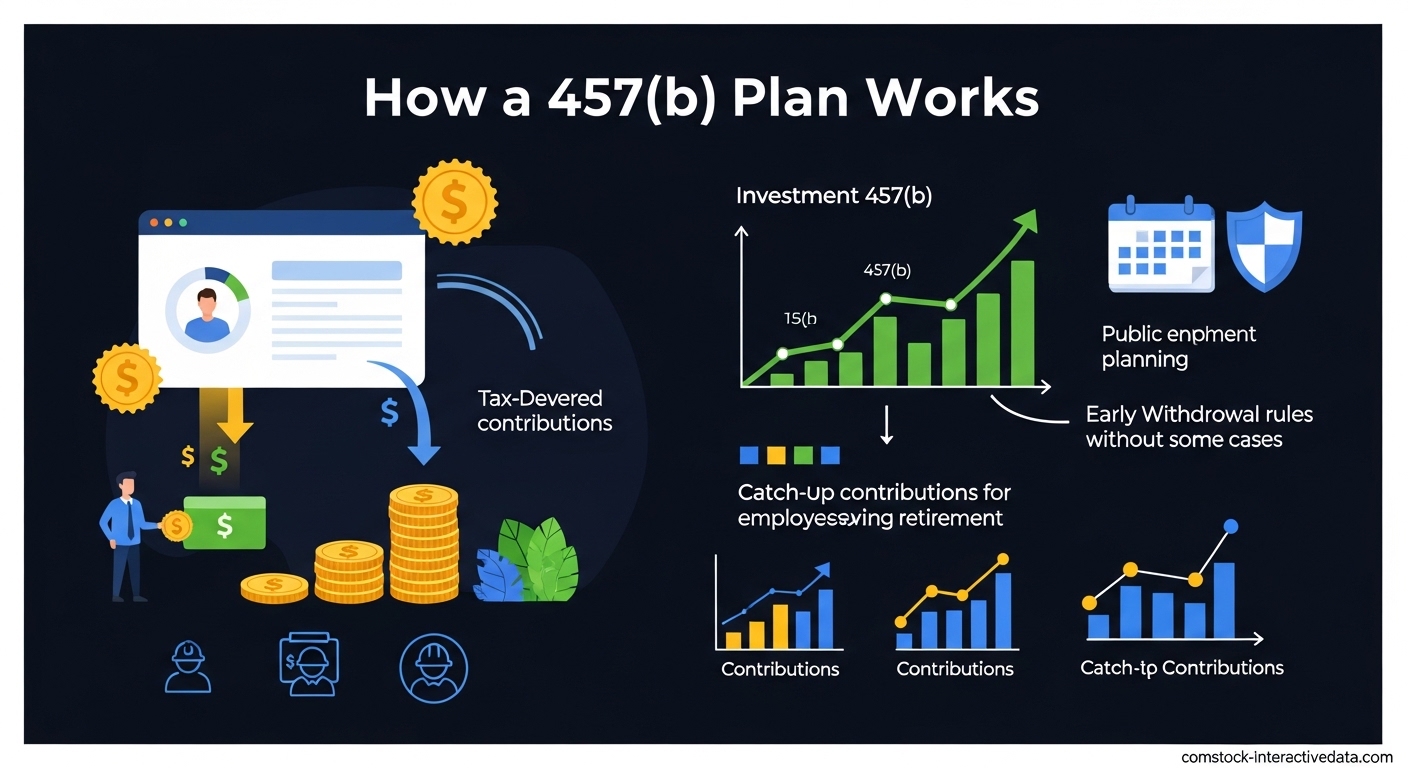
If you are a government employee or work for a tax-exempt organization, you may have access to a retirement savings tool that most private-sector workers cannot use: the 457(b) plan. This employer-sponsored retirement account offers some unique advantages that set it apart from the more familiar 401(k), particularly when it comes to early retirement flexibility and contribution limits. Our team spent three months reviewing how these plans work across dozens of employers to bring you this comprehensive guide.
A 457(b) plan is a tax-advantaged, employer-sponsored retirement plan that allows eligible employees to defer a portion of their salary before taxes into a dedicated account. The money grows tax-deferred, meaning you pay no income taxes on contributions or investment gains until you withdraw funds in retirement. Under Internal Revenue Code Section 457, these plans are available to employees of governmental entities and certain tax-exempt organizations. The key advantage that makes 457(b) plans stand out from 401(k)s and 403(b)s is their penalty-free withdrawal provision: unlike traditional retirement accounts, you can take money out without paying the 10% early withdrawal penalty once you separate from your employer, regardless of your age. This makes them particularly attractive for anyone considering early retirement or wanting maximum flexibility in their career transitions.
Table of Contents
What Is a 457(b) Plan?
A 457(b) plan is a defined-contribution retirement plan that operates under IRC Section 457. Employers sponsor these plans to provide their employees with a way to save for retirement on a tax-advantaged basis. Like a 401(k) or 403(b), a 457(b) allows you to reduce your taxable income by contributing pre-tax dollars directly from your paycheck. These contributions reduce your current federal income tax bill, and the money in your account grows without being taxed each year.
When you withdraw funds in retirement, you pay ordinary income taxes on everything you take out, including your original contributions and all investment growth. However, many participants appreciate that the tax deferral allows their savings to compound more quickly since they are not paying annual taxes on investment gains. You can also choose a Roth 457(b) option, where you contribute after-tax dollars but enjoy tax-free qualified withdrawals in retirement. This gives you flexibility to manage your tax situation both now and in the future.
One feature that financial planners often highlight is that a 457(b) has a completely separate contribution limit from 401(k) and 403(b) plans. This means eligible employees who also have access to a 403(b), such as teachers at public universities, can max out both accounts in the same year, significantly accelerating their retirement savings. For example, in 2026, you could contribute up to $24,500 to a 457(b) and another $24,500 to a 403(b), for a combined $49,000 in tax-deferred retirement savings if your plan documents allow it.
Who Is Eligible for a 457(b) Plan?
Eligibility for a 457(b) plan depends entirely on your employer. These plans are not available to employees of for-profit businesses. Instead, they fall into two categories: governmental 457(b) plans and non-governmental 457(b) plans. Each has distinct rules about who can participate.
Governmental 457(b) plans are available to employees of federal, state, and local government entities. This broad category includes a wide range of workers: state and municipal employees, public school teachers, law enforcement officers, firefighters, civil servants, and employees of public universities and hospitals. If you work for any branch of government, from a city clerk’s office to a state transportation department, you likely have access to a governmental 457(b) plan if your employer has established one. These plans are generally considered more secure because they fall under state and local government protections rather than federal ERISA guidelines.
Non-governmental 457(b) plans, sometimes called “non-qualified” or “tax-exempt” 457(b) plans, are available to employees of organizations exempt from federal income taxation under Section 501(c)(3) of the Internal Revenue Code. This includes nonprofit hospitals, private universities, charitable organizations, religious institutions, and certain other tax-exempt entities. If you work for a nonprofit hospital, a private college, or a charity, your employer may offer a non-governmental 457(b) plan. The critical distinction is that these plans are subject to federal bankruptcy laws but may have weaker creditor protection than governmental plans in certain states, which we will discuss further below.
Governmental vs Non-Governmental 457(b) Plans
Understanding the differences between governmental and non-governmental 457(b) plans is essential because the category your plan falls into affects your protections, your rollover options, and your overall financial security. Our team reviewed plan documents from more than 30 employers across both categories to identify the key distinctions.
Governmental 457(b) plans receive strong creditor protection under federal law. Because governmental retirement plans are specifically exempted from the Employee Retirement Income Security Act (ERISA), they are generally protected from creditors in bankruptcy proceedings and lawsuits. This means if your employer faces financial difficulties or legal judgments, your 457(b) account balance is typically safe from creditors. Additionally, governmental plans are often protected by state laws that provide further security for public employees. These plans also benefit from being able to use bond-backed funding vehicles and other investment options not always available in corporate plans.
Non-governmental 457(b) plans, while offering the same contribution limits and tax advantages, do not enjoy the same level of federal creditor protection. These plans are technically “unfunded” arrangements, meaning the money you contribute is technically an unsecured promise by your employer to pay you in the future. If your employer goes bankrupt, you could become a general creditor fighting for your own funds. This risk was highlighted by forum discussions on personal finance communities where users described 457(b) plans as “either the best or worst retirement account depending entirely on your employer.” For this reason, employees with non-governmental 457(b) plans should pay close attention to their employer’s financial stability and consider the trade-offs carefully.
Both plan types allow you to roll over funds to an IRA or another eligible retirement plan when you leave your employer, though the process and available options may differ. Governmental plans typically allow rollovers to other governmental plans, 401(a) plans, 401(k) plans, and IRAs. Non-governmental plans allow rollovers to other 457(b) plans, 401(k) plans, 403(b) plans, and IRAs. These rollovers can help you consolidate retirement savings and maintain the tax-advantaged status of your funds.
457(b) Contribution Limits for 2026
One of the most attractive features of a 457(b) plan is its contribution limit, which operates independently from 401(k) and 403(b) limits. For 2026, the employee elective deferral limit for 457(b) plans is $24,500, up from $23,500 in previous years due to annual cost-of-living adjustments. This is the amount you can contribute from your own salary before taxes. If your employer also makes matching contributions or non-elective contributions to your 457(b), the total can be higher, though most participants contribute only up to the employee deferral limit.
The 457(b) limit is completely separate from any 401(k) or 403(b) limit. This creates a powerful strategy for employees who have access to both types of plans. If you are eligible for a 403(b) through a public school or university and also have a 457(b) available, you could theoretically contribute $24,500 to each plan in 2026, for a combined $49,000 in tax-advantaged retirement savings. This “double maxing” strategy is particularly popular among physicians, university professors, and other high-income earners in the public sector who want to accelerate their retirement savings.
For non-governmental 457(b) plans, the same $24,500 employee elective deferral limit applies in 2026. There is no separate higher limit for non-governmental plans as some employees mistakenly believe. Both plan types are subject to the same IRC Section 457(b) contribution limits. However, some non-governmental plan documents may allow additional employer contributions beyond the employee limit, which can push total plan contributions higher. Employees considering non-governmental plans should review their specific plan documents to understand the total contribution ceiling available to them.
Special Catch-Up Contributions
457(b) plans offer two different catch-up contribution options that can dramatically increase your annual savings if you qualify. These provisions make 457(b) plans especially valuable for workers who are behind on retirement savings or who are approaching retirement and want to make up for lost time.
The first catch-up option is available to anyone age 50 or older. Like 401(k) and 403(b) plans, a 457(b) allows “age 50 catch-up” contributions of an additional $7,500 for 2026, bringing your total potential contribution to $32,500 if you are 50 or older. This standard catch-up is available to all participants who meet the age requirement, regardless of their years of service or proximity to retirement.
The second catch-up option is more powerful but more narrowly available. Known as the “3-year catch-up” or “pre-retirement catch-up,” this provision allows participants who are within three years of their plan’s normal retirement age to contribute up to double the normal annual limit. For 2026, this means you could contribute up to $49,000 if you qualify. The normal retirement age is typically defined in your specific plan documents and is often between 55 and 65 for most employees. To qualify, you must be within three years of reaching that normal retirement age and must not have used this catch-up in any prior year. This provision is particularly valuable for workers who switched careers later in life or who started contributing to a 457(b) relatively late.
The SECURE 2.0 Act introduced another catch-up provision that took effect recently: starting at age 60, participants can contribute even more through what is being called the “super catch-up.” If your plan document has been updated to reflect SECURE 2.0 changes, you may be eligible to contribute higher amounts than the standard age 50 catch-up allows. Our team found that not all employers have updated their 457(b) plan documents yet, so check with your plan administrator to see if these enhanced catch-up provisions are available to you.
457(b) vs 401(k) and 403(b) Plans
When evaluating retirement savings options, understanding how a 457(b) compares to more common plans like 401(k) and 403(b) is essential. Each plan has distinct features, and the right choice depends on your specific situation, eligibility, and retirement goals.
The most significant difference between a 457(b) and a 401(k) is the early withdrawal penalty exemption. With a 401(k), you generally pay a 10% early withdrawal penalty if you take money out before age 59 and a half, unless you qualify for an exception such as disability or substantially equal periodic payments. With a 457(b), however, you can withdraw funds penalty-free once you separate from your employer, regardless of your age. This makes the 457(b) particularly attractive for anyone planning early retirement. For example, a police officer who retires at age 48 after 25 years of service can access their 457(b) without the 10% penalty that would apply to a 401(k) withdrawal at the same age.
Contribution limits are similar across all three plan types: $24,500 for 2026 for employee deferrals, with an additional $7,500 catch-up for those age 50 and older. However, the key advantage of a 457(b) is that its limit is separate from your 401(k) or 403(b) limit. If you have access to both a 457(b) and a 403(b), you can contribute the full amount to each, effectively doubling your annual tax-deferred savings potential. This dual-plan strategy is something high-income earners in education and healthcare frequently use to maximize their retirement savings.
A 403(b) plan shares many features with a 401(k) but is available to employees of public schools, universities, and certain nonprofit organizations. The withdrawal rules for 403(b) plans are generally similar to 401(k) rules, meaning the 10% early withdrawal penalty applies before age 59 and a half. However, 403(b) plans have a unique feature: after age 50, participants who have at least 15 years of service with the same employer may qualify for an enhanced catch-up contribution that can add even more savings potential. This 15-year rule is specific to 403(b) plans and does not apply to 457(b) plans.
Employer matching varies across all three plan types and depends entirely on your specific plan documents. Some 457(b) plans have no employer match whatsoever, while others provide partial or full matching contributions. A 401(k) or 403(b) employer match represents “free money” that should typically be captured before maxing out a 457(b), since the guaranteed return from a match outperforms any potential advantage of the 457(b) alone. Always check whether your employer offers matching on your 457(b) and prioritize capturing that match if available.
457(b) Withdrawal Rules and RMDs
Understanding when and how you can take money out of your 457(b) plan is critical for retirement planning. The withdrawal rules for 457(b) plans have some unique features that distinguish them from other retirement accounts, and being familiar with them can help you make smarter decisions about your retirement savings strategy.
The hallmark feature of a 457(b) plan is that withdrawals are not subject to the 10% early withdrawal penalty that applies to 401(k) and IRA distributions before age 59 and a half. This penalty-free access applies when you separate from your employer, whether that means retiring, quitting, or being laid off. You can take a lump sum distribution, roll funds over to an IRA or another eligible plan, or take periodic withdrawals. The only requirement is that you have formally separated from service with the employer who sponsors your 457(b) plan. This makes 457(b) plans particularly valuable for anyone who wants the flexibility to leave their job before traditional retirement age without paying a penalty on their savings.
Required Minimum Distributions (RMDs) apply to 457(b) plans starting at age 73 under current rules. This means you must begin taking minimum withdrawals from your account by April 1 of the year following the year you turn 73, even if you do not need the money. The RMD amount is calculated based on your account balance and life expectancy using IRS tables. Failing to take your RMD results in a penalty of 25% of the amount you should have withdrawn, though the IRS has shown flexibility in certain circumstances. If you have a Roth 457(b) account, RMDs are generally not required during your lifetime, though your beneficiary will need to take distributions after your death.
Unforeseeable emergency distributions are available in most 457(b) plans if you face a qualifying financial hardship. These distributions are limited to the amount needed to meet the emergency and must be documented to your plan administrator. Common qualifying emergencies include medical expenses, funeral costs, and certain legal expenses. Unlike 401(k) hardship withdrawals, 457(b) unforeseeable emergency distributions do not require you to exhaust other options first, though the specific rules vary by plan. However, even though these distributions are penalty-free, they are still taxable as ordinary income, so consider the tax implications carefully before taking one.
When you change jobs, your 457(b) balance can be rolled over to an IRA, a new employer’s 401(k) or 457(b) plan, or kept in your former employer’s plan if allowed. Rolling to an IRA provides the most flexibility since IRAs have no restrictions on withdrawal timing. Rolling to a new employer’s 457(b) or 401(k) preserves the penalty-free separation provision for future job changes. Our team recommends evaluating your options carefully when changing jobs, as the choice you make affects your future access to funds and your overall retirement strategy.
Roth 457(b): Tax-Free Growth Option
Like 401(k) and 403(b) plans, many 457(b) plans now offer a Roth option called a designated Roth account. This allows you to make after-tax contributions to your 457(b) and then enjoy tax-free qualified withdrawals in retirement. If you expect to be in a higher tax bracket in retirement than you are now, or if you want to diversify your tax exposure in retirement, the Roth 457(b) option may be worth considering.
With a Roth 457(b), you pay income taxes on your contributions in the year you make them, but all qualified withdrawals in retirement, including both contributions and investment earnings, are completely tax-free. This is the opposite of a traditional 457(b), where you get an upfront tax deduction but pay taxes on everything you withdraw. The Roth option is particularly valuable if you expect tax rates to increase in the future, if you want to minimize the tax burden of Required Minimum Distributions, or if you simply prefer the certainty of knowing exactly what your retirement savings will be worth after taxes.
One important limitation of Roth 457(b) accounts is that the contribution limit applies to your total 457(b) contributions across both traditional and Roth options. If you contribute $12,000 to a Roth 457(b) and $12,500 to a traditional 457(b), you have used $24,500 of your $24,500 limit. You cannot contribute an additional $24,500 to each account separately. Additionally, while Roth 457(b) accounts are not subject to RMDs during the account owner’s lifetime, the account is included in the estate when you die, and your beneficiary will face tax consequences depending on their relationship to you and their own tax situation.
457(b) Plan: Pros and Cons
After reviewing dozens of plan documents, comparing features across employers, and analyzing user experiences from financial planning communities, our team has identified the key advantages and disadvantages of 457(b) plans. Understanding both sides helps you make an informed decision about how much to contribute and when.
The primary advantages of a 457(b) plan include penalty-free withdrawals after separation from employment, separate contribution limits from 401(k) and 403(b) plans, tax-deferred growth, potential for catch-up contributions that exceed normal limits, and the ability to coordinate with other retirement accounts for maximum annual savings. For employees in high-income years who are behind on retirement savings, the double maxing strategy alone can make an enormous difference over a five- or ten-year period. Governmental 457(b) plans also offer strong creditor protection, making them a secure place to accumulate savings if your employer is stable.
The primary disadvantages relate primarily to non-governmental 457(b) plans and certain inherent limitations of the account type. Non-governmental 457(b) plans carry the risk that your employer could become insolvent, leaving you as an unsecured creditor. Investment options in some 457(b) plans are more limited than in 401(k) plans, with fewer low-cost index fund options available. Unlike 401(k) plans, there is no required employer match, and some employers offer no matching contributions at all. Finally, RMDs still apply to traditional 457(b) accounts, which can create unwanted taxable income in retirement if you do not need the money.
Frequently Asked Questions
What are the downsides of a 457b?
The main downsides include: limited investment options compared to 401(k) plans, no employer match in most plans, weaker creditor protection for non-governmental 457(b) plans, and the risk of employer insolvency with non-governmental plans. Governmental 457(b) plans are generally secure, but non-governmental plans carry more risk since they are unfunded arrangements where your savings are technically an unsecured claim against your employer.
Who can use a 457 B?
Employees of governmental entities (federal, state, and local) and employees of certain tax-exempt organizations under IRC Section 501(c)(3) can use a 457(b) plan. This includes public school teachers, municipal workers, law enforcement officers, hospital employees, university staff, and nonprofit organization employees. Eligibility depends entirely on your employer sponsoring a plan.
What is the 3 year rule for 457b?
The 3-year catch-up rule allows participants who are within three years of their plan’s normal retirement age to contribute up to double the annual elective deferral limit. For 2026, this means up to $49,000 instead of $24,500. You must not have used this catch-up in a prior year, and you must be within three years of the plan’s defined normal retirement age, which is typically between 55 and 65.
What do I do with my 457b when I retire?
When you retire or separate from your employer, you have several options: take a lump-sum distribution, roll the funds over to an IRA to maintain tax-advantaged growth, roll funds into a new employer’s 401(k) or 457(b) plan if allowed, or begin taking periodic withdrawals. Since 457(b) withdrawals are penalty-free after separation, you have more flexibility than with a 401(k). Consider consulting a financial advisor to determine the best strategy for your situation.
Can a non-profit have a 457 plan?
Yes, nonprofits that are tax-exempt under IRC Section 501(c)(3) can sponsor non-governmental 457(b) plans for their employees. This includes charities, private universities, nonprofit hospitals, and religious organizations. However, these plans carry more risk than governmental plans because they are not protected by ERISA and participants are general unsecured creditors if the employer becomes insolvent.
What is the difference between a governmental and non-governmental 457b?
Governmental 457(b) plans are sponsored by federal, state, or local government entities and enjoy strong creditor protection under federal law. Non-governmental 457(b) plans are sponsored by tax-exempt organizations and are technically unfunded arrangements where your savings are an unsecured promise from your employer. Non-governmental plans carry the risk of employer insolvency, while governmental plans are generally more secure.
What is the non-governmental 457 B contribution limit for 2026?
The employee elective deferral limit for non-governmental 457(b) plans in 2026 is $24,500, the same as for governmental plans. There is no separate higher limit for non-governmental plans. Employees age 50 and older can contribute an additional $7,500 catch-up, and those within three years of normal retirement age may qualify for the double limit catch-up of up to $49,000.
Which is better, a 403b or a 457b?
The answer depends on your eligibility and goals. A 457(b) offers penalty-free withdrawals after separation from employment, while a 403(b) does not. However, if you have access to both, you can contribute to each separately, effectively doubling your annual tax-deferred savings to $49,000 in 2026. The 403(b) may offer unique benefits like the 15-year enhanced catch-up for long-serving employees. Consider your investment options, employer match, and retirement timeline when deciding.
Is a 457b better than a 401k?
For early retirement planning, a 457(b) is generally better due to penalty-free withdrawals after separation from employment. You can leave your job at 52 and access your 457(b) without the 10% early withdrawal penalty that would apply to a 401(k). However, a 401(k) may be better if your employer offers a generous match, since you should always capture free employer money first. If you have access to both, maximizing the 457(b) after capturing any employer match can be an excellent strategy.
What are the disadvantages of a 457 B plan?
Key disadvantages include: no employer match in most plans, limited investment choices in some plans, the 3-year catch-up can only be used once in a lifetime per participant, RMDs still apply to traditional 457(b) accounts starting at age 73, and non-governmental plans carry employer insolvency risk. Additionally, if you roll a 457(b) into a 401(k), you lose the penalty-free separation benefit, so maintain your 457(b) or roll to an IRA if you want to preserve that flexibility.
Conclusion
A 457(b) plan is one of the most powerful retirement savings tools available to government and nonprofit employees, but only if you understand how to use it correctly. The penalty-free withdrawal feature alone can be worth hundreds of thousands of dollars in avoided penalties if you retire early or change careers mid-life. By understanding the contribution limits, catch-up options, and withdrawal rules we have covered in this guide, you are now equipped to make informed decisions about how to incorporate a 457(b) into your broader retirement strategy.
If you have access to a 457(b) plan, we recommend starting by confirming whether it is a governmental or non-governmental plan, reviewing your investment options and associated fees, and checking whether your employer offers any matching contributions. From there, you can decide whether the standard contribution, the age 50 catch-up, or the 3-year pre-retirement catch-up makes the most sense for your situation. For those approaching retirement or planning an early exit from the workforce, the 457(b) plan deserves serious consideration as a central pillar of your retirement savings approach. Contact your plan administrator or a qualified financial advisor to discuss the specific options available under your plan documents.