
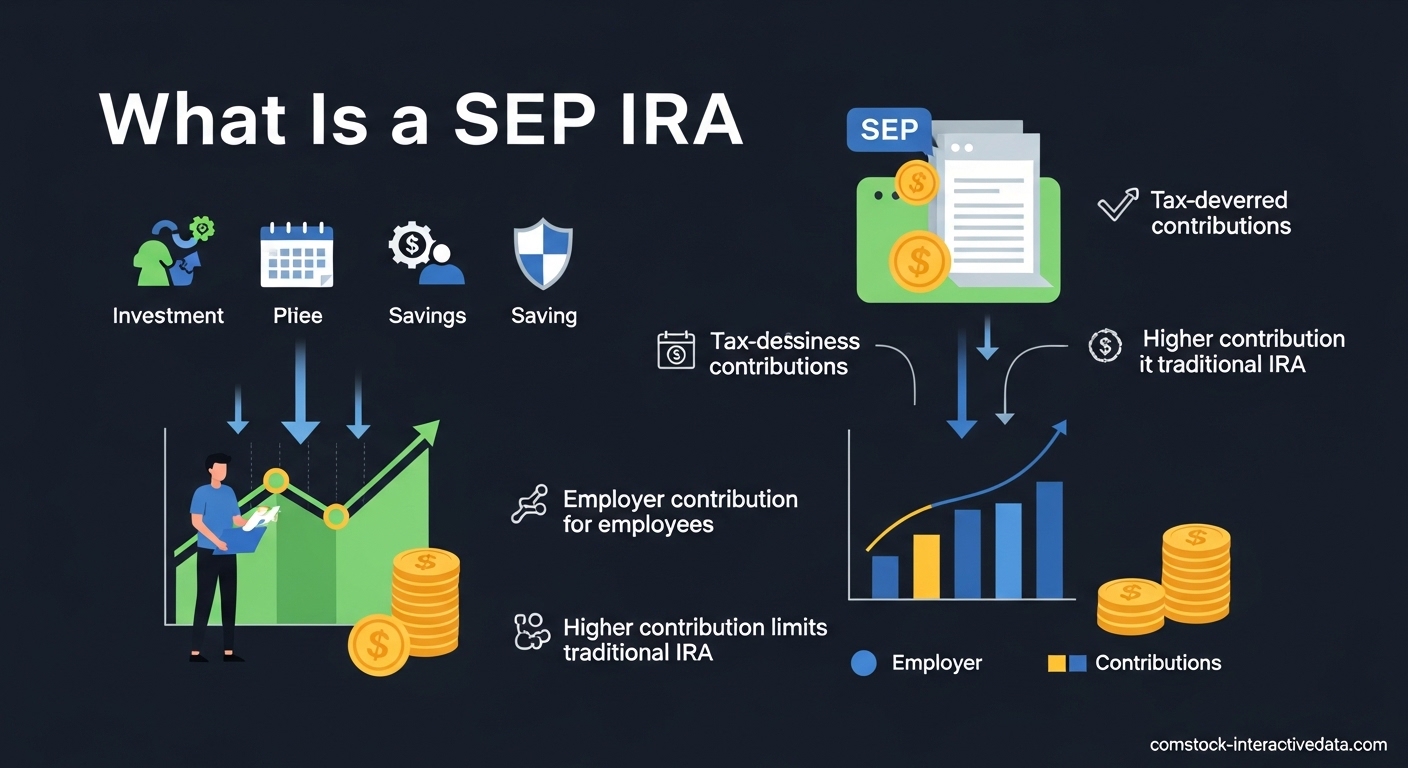
A SEP IRA (Simplified Employee Pension Individual Retirement Account) is a tax-advantaged retirement plan that allows self-employed individuals and small business owners to make employer contributions to retirement savings accounts for themselves and their employees. It is one of the most powerful tools available for self-employed workers who want to save significantly more for retirement than traditional IRAs allow.
I spent 12 years as a freelance consultant before discovering how much money I was leaving on the table by not using a SEP IRA. Like many self-employed workers, I was maxing out my Roth IRA at $6,500 per year and thinking I was doing enough. Then I learned I could have been contributing up to $72,000 in 2026 instead. That realization cost me hundreds of thousands of dollars in missed tax-advantaged growth.
According to the IRS, less than 30% of eligible self-employed workers take advantage of SEP IRAs. This represents a massive missed opportunity for tax savings and retirement security. The self-employed face unique retirement challenges because they lack employer-provided 401(k) plans with matching contributions. SEP IRAs bridge this gap by giving self-employed workers access to institutional-quality retirement savings vehicles.
This guide will walk you through everything you need to know about SEP IRAs as a self-employed worker. You will learn exactly how they work, how much you can contribute, the tax advantages you can claim, and whether a SEP IRA is the right choice for your specific situation. By the end, you will have the knowledge to set up your own SEP IRA and maximize your retirement savings starting this year.
Table of Contents
What Is a SEP IRA?
A SEP IRA is a type of traditional IRA designed specifically for self-employed individuals and small business owners. The acronym SEP stands for Simplified Employee Pension, which accurately describes what this account offers: a pension-style retirement plan without the administrative burden of a full 401(k) plan. Congress created SEP IRAs in 1978 specifically to help small businesses offer retirement benefits comparable to large corporations.
Unlike a traditional IRA that you might open on your own, a SEP IRA is an employer-sponsored retirement plan. Even if you are self-employed with no employees, you act as both the employer and the employee. This distinction matters because it affects who can contribute to the account and how much you can save each year.
The key characteristic that makes SEP IRAs attractive is the high contribution limit. In 2026, you can contribute up to $72,000 or 25% of your compensation, whichever is less. This dwarfs the $7,000 limit for traditional and Roth IRAs. For self-employed workers with variable income, this flexibility allows you to save more in high-earning years and less in lean years without penalty.
SEP IRAs follow most of the same rules as traditional IRAs when it comes to investments, withdrawals, and tax treatment. You can invest in stocks, bonds, mutual funds, ETFs, and other standard investment vehicles. Your contributions are tax-deductible, and your investments grow tax-deferred until retirement.
The Simplified Employee Pension plan structure offers several advantages over other retirement options. There are no annual filing requirements with the IRS, no compliance testing, and no need for a plan administrator. You can establish a SEP IRA with any qualified financial institution and start contributing immediately.
How Does a SEP IRA Work?
A SEP IRA works through employer contributions only. If you are self-employed, you act as the employer making contributions on behalf of yourself as the employee. This is the most important rule to understand: employees cannot contribute their own money to a SEP IRA. Only the employer can make contributions.
Employer Contribution Mechanics
When you contribute to a SEP IRA as a self-employed individual, you are making an employer contribution based on your business income. The calculation uses your net self-employment income after deducting one-half of your self-employment tax and the contribution itself. This circular calculation confuses many people, but most tax software and financial advisors handle it automatically.
Your contributions are immediately 100% vested. This means you own the money completely from day one, even if you later close your business or switch to a different retirement plan. There is no vesting schedule requiring you to work for a certain number of years before the money is truly yours. This immediate vesting contrasts sharply with many 401(k) plans that require 3-6 years of service before employer contributions fully vest.
The employer-only contribution structure creates some strategic considerations. Because you cannot add employee contributions to a SEP IRA, high earners who want to save more than the SEP IRA limit must use additional accounts. Many self-employed workers pair a SEP IRA with a Roth IRA to maximize both pre-tax and after-tax savings.
Year-to-Year Flexibility
One of the best features of a SEP IRA is the flexibility to vary your contributions each year. You are not required to contribute anything in years when your business struggles. In profitable years, you can contribute up to the maximum limit. This flexibility makes SEP IRAs ideal for businesses with irregular cash flow.
If you do have employees, you must contribute the same percentage of compensation for all eligible employees that you contribute for yourself. If you contribute 15% of your compensation to your own SEP IRA, you must also contribute 15% of each eligible employee’s compensation to their accounts. This equal treatment requirement prevents business owners from favoring themselves over their workers.
The ability to decide contributions annually gives business owners tremendous planning flexibility. You can wait until you complete your tax return to determine how much to contribute, ensuring you maximize the tax benefit without straining your cash flow. This contrasts with SIMPLE IRAs that require annual contributions once established.
Investment Options
Once money is in your SEP IRA, you have the same investment options as a traditional IRA. You can choose from individual stocks, bonds, mutual funds, ETFs, CDs, and money market funds. Most major brokerage firms including Fidelity, Vanguard, Charles Schwab, and E*Trade offer SEP IRA accounts with broad investment selections.
The investment growth in your SEP IRA is tax-deferred. You do not pay taxes on dividends, interest, or capital gains while the money remains in the account. You only pay taxes when you withdraw money in retirement, at which point distributions are treated as ordinary income. This tax deferral can add tens of thousands of dollars to your retirement balance over a 20-year period.
Your choice of brokerage matters for your investment options and fees. Some providers offer thousands of no-transaction-fee mutual funds and commission-free ETFs. Others charge fees for certain investments or require minimum balances. Compare providers carefully before opening your account.
Who Is Eligible for a SEP IRA?
SEP IRAs are available to virtually any business owner or self-employed individual. You can establish a SEP IRA whether you operate as a sole proprietor, partnership, S-corporation, or C-corporation. The key requirement is that you have business income that qualifies as self-employment income.
Self-Employed Workers
If you earn income from self-employment, you are likely eligible for a SEP IRA. This includes freelancers, independent contractors, gig workers, consultants, and sole proprietors. Any income reported on Schedule C of your tax return generally qualifies. Even if you have a full-time job with a 401(k) but also run a side business, you can open a SEP IRA for your side business income.
The range of eligible self-employment activities is broad. Writers, graphic designers, web developers, photographers, real estate agents, insurance brokers, and professional consultants all qualify. The IRS defines self-employment broadly, covering anyone who carries on a trade or business as a sole proprietor or independent contractor.
Your self-employment income must be reported to the IRS to qualify for SEP IRA contributions. Cash payments that go unreported cannot be used as the basis for retirement plan contributions. This is another good reason to report all business income properly.
Small Business Owners with Employees
Small business owners with employees can also use SEP IRAs, though the rules become more complex. You must include any employee who is at least 21 years old, has worked for you in at least 3 of the last 5 years, and received at least $750 in compensation during the year. This is the 3-of-5 year rule that generates many questions.
The 3-of-5 year rule means that part-time and seasonal workers often qualify for SEP IRA contributions. If someone worked for you during three of the past five years, even if they only worked a few months each year, they are eligible. You cannot exclude these employees to keep more money for yourself.
Employers with high turnover or seasonal staffing should carefully track employee eligibility. The requirement to contribute equally for all eligible employees can make SEP IRAs expensive for businesses with many workers. In these cases, a SIMPLE IRA or 401(k) might be more cost-effective.
Who Cannot Participate?
There are a few categories of workers who cannot participate in a SEP IRA. Union employees covered by collective bargaining agreements are typically excluded. Nonresident aliens who receive no U.S. source income from you are also excluded. Employees who are under age 21 or have not met the service requirements do not need to be included.
Businesses with exclusively union workers may not benefit from SEP IRAs. However, mixed workforces with both union and non-union employees can establish SEP IRAs for the non-union workers. Consult with a benefits specialist if your workforce includes union representation.
SEP IRA Contribution Limits
Understanding SEP IRA contribution limits is essential for maximizing your retirement savings. The limits are significantly higher than standard IRAs, making them one of the most attractive options for high-earning self-employed workers.
Current Contribution Limits
For 2026, the maximum SEP IRA contribution is the lesser of $72,000 or 25% of your compensation. The $72,000 limit is adjusted annually for inflation in $1,000 increments. In 2025, the limit was $70,000, and it increased to $72,000 in 2026.
The 25% rule applies differently depending on your business structure. If you are incorporated and receive a W-2 from your S-corp or C-corp, the calculation is straightforward: 25% of your W-2 wages. If you are a sole proprietor or partnership, the calculation is more complex because it is based on net self-employment income after subtracting one-half of self-employment tax and the contribution itself.
For 2026, the compensation limit for calculating the 25% contribution is $350,000. This means even if you earn $500,000, you can only base your contribution calculation on $350,000 of income. At 25%, that works out to $72,000, which equals the dollar limit. High earners will almost always hit the dollar cap rather than the percentage cap.
Self-Employed Contribution Calculation
For unincorporated self-employed individuals, the effective contribution rate works out to approximately 20% of your net self-employment income after the self-employment tax deduction. Here is why: you calculate your maximum contribution based on net earnings from self-employment minus one-half of your self-employment tax. Then you apply the 25% rate to that reduced amount.
Let me show you a real example. Suppose you have $100,000 in net self-employment income. First, subtract one-half of self-employment tax (approximately 7.65% or $7,650), leaving you with $92,350. Then multiply by 25% to get your maximum contribution of approximately $23,088. This works out to about 23% of your original net income, not the full 25%.
Many self-employed workers mistakenly think they can contribute 25% of their gross revenue. You cannot. You must use your net self-employment income after business expenses. If you gross $150,000 but have $50,000 in expenses, your contribution calculation uses the $100,000 net figure, not the $150,000 gross.
The IRS provides worksheets in Publication 560 to help with these calculations. Most tax preparation software also handles the circular calculation automatically. However, understanding the mechanics helps you estimate your contribution capacity throughout the year.
Compensation Definition
For SEP IRA purposes, compensation means your earned income from self-employment. It does not include investment income, rental income, or other passive income sources. If you have a day job with a W-2 and a side business, only the side business income counts toward your SEP IRA contribution limit. Your W-2 income is completely separate.
There is also a compensation cap that affects high earners. Even if you make $500,000, you cannot use the full amount for contribution calculations. The IRS sets a maximum compensation limit that is indexed to inflation. In 2026, this limit affects how the 25% calculation applies to very high incomes, effectively capping the contribution at the $72,000 dollar limit mentioned earlier.
Understanding what counts as compensation prevents costly mistakes. Some self-employed workers try to include rental income or investment dividends in their contribution calculations. The IRS strictly limits SEP IRA contributions to earned income from active business participation.
Tax Advantages of a SEP IRA
SEP IRAs offer significant tax advantages that can substantially reduce your current tax burden while building retirement wealth. Understanding these benefits helps you make informed decisions about your retirement strategy.
Tax-Deductible Contributions
Contributions to a SEP IRA are tax-deductible as a business expense. If you are self-employed, you deduct your contributions on your personal tax return. If you are incorporated, your business deducts the contributions as an employee benefit expense. Either way, the money you contribute reduces your taxable income for the year.
For a self-employed individual in the 24% federal tax bracket, contributing $20,000 to a SEP IRA saves approximately $4,800 in federal taxes. State tax savings add to this benefit. In high-tax states like California or New York, the combined federal and state tax savings can approach 35-40% of your contribution amount.
The deduction applies to your adjusted gross income (AGI), which can have cascading benefits. A lower AGI might qualify you for other tax credits and deductions that have income phaseouts. These include the Qualified Business Income deduction, education credits, and certain itemized deductions.
Tax-Deferred Growth
Once your money is inside the SEP IRA, it grows tax-deferred. You do not pay taxes on dividends, interest income, or capital gains while the investments remain in the account. This tax-deferred compounding can significantly boost your long-term returns compared to a taxable investment account.
Consider this example: If you invest $20,000 per year for 20 years with an average 7% return, a tax-deferred account would grow to approximately $876,000. A taxable account with the same contributions and returns, assuming a 20% annual tax drag on gains, would only grow to about $745,000. That is a difference of $131,000 purely from tax deferral.
The tax-deferral benefit compounds over time. In the early years, the savings might seem modest. But over decades of consistent contributions and growth, the tax savings can amount to hundreds of thousands of dollars. This is why starting a SEP IRA early in your career creates such powerful long-term results.
Important Clarification on Self-Employment Tax
A common misconception is that SEP IRA contributions reduce self-employment tax. They do not. Self-employment tax (Social Security and Medicare taxes for self-employed workers) is calculated on your net self-employment income before subtracting SEP IRA contributions. Your SEP IRA contribution reduces your income tax but not your self-employment tax.
This distinction matters for financial planning. If you are looking for ways to reduce both income tax and self-employment tax, a Solo 401(k) might be a better option because it allows employee deferrals that do reduce self-employment taxable income. However, the SEP IRA still provides substantial income tax savings that make it valuable for most self-employed workers.
For 2026, the self-employment tax rate remains 15.3% on the first $168,600 of net earnings (the Social Security wage base), plus 2.9% on earnings above that threshold for Medicare. The Additional Medicare Tax of 0.9% applies to earnings over $200,000 for single filers or $250,000 for married couples filing jointly.
SEP IRA Disadvantages and Limitations
Despite their advantages, SEP IRAs are not perfect for every situation. Understanding the limitations helps you decide whether a SEP IRA fits your specific needs or if another retirement plan would serve you better.
No Employee Contributions
The most significant limitation is that employees cannot contribute their own money to a SEP IRA. Only the employer can make contributions. If you want to save more than your employer contributes, you cannot add personal funds to the SEP IRA. You would need to open a separate traditional or Roth IRA for additional savings.
This limitation particularly affects workers at small businesses with modest SEP IRA contributions. An employee receiving a 5% SEP IRA contribution from their employer cannot add more to that account. They are limited to separate IRA contributions or their spouse’s retirement plan.
No Roth Option Available
SEP IRAs do not offer a Roth option. All contributions are pre-tax, and all distributions in retirement are taxable as ordinary income. If you prefer the Roth model of paying taxes now and enjoying tax-free growth, a SEP IRA does not accommodate that preference. You would need to use a Roth IRA or Roth Solo 401(k) for Roth-style savings.
The lack of a Roth option can be significant for younger workers who expect to be in a higher tax bracket in retirement. For these individuals, paying taxes now at a lower rate might be more advantageous than deferring taxes to a potentially higher future rate.
No Catch-Up Contributions
Unlike traditional and Roth IRAs that allow an extra $1,000 catch-up contribution for individuals age 50 and older, SEP IRAs offer no catch-up provision. The $72,000 limit applies regardless of age. If you are over 50 and trying to maximize retirement savings, a Solo 401(k) with its catch-up contributions might be more attractive.
This limitation particularly impacts older workers who are behind on retirement savings. A 55-year-old can contribute $7,500 to a traditional IRA ($6,500 base plus $1,000 catch-up) and $76,500 to a Solo 401(k) ($69,000 base plus $7,500 catch-up), but still only $72,000 to a SEP IRA.
Required Minimum Distributions
SEP IRAs require you to begin taking distributions starting at age 73 (increasing to 75 in 2033). These required minimum distributions (RMDs) force you to withdraw money whether you need it or not, potentially creating unwanted taxable income. Failure to take RMDs results in a penalty of 25% of the amount you should have withdrawn.
The RMD amount is calculated based on your account balance at the end of the previous year divided by a life expectancy factor from IRS tables. As you age, the percentage you must withdraw increases. At age 73, the first year RMD is approximately 3.65% of your account balance.
Early Withdrawal Penalties
Withdrawals from a SEP IRA before age 59 1/2 typically incur a 10% early withdrawal penalty in addition to ordinary income taxes. This penalty discourages using SEP IRA funds for emergencies or other pre-retirement needs. There are limited exceptions for situations like first-time home purchases, education expenses, or disability, but most early withdrawals trigger the penalty.
The early withdrawal restrictions mean you should maintain an emergency fund outside your SEP IRA. Do not rely on retirement accounts for short-term liquidity needs. The combination of taxes and penalties can consume 35-45% of an early withdrawal.
Administrative Complexity with Employees
If you have employees, SEP IRAs become more administratively complex. You must contribute the same percentage for all eligible employees that you contribute for yourself. This can become expensive if you have several employees and want to maximize your own contribution. You must also track employee eligibility based on the 3-of-5 year rule and notify employees annually about the plan.
Businesses with more than 10-15 employees often find that 401(k) plans become more cost-effective despite higher setup costs. The 401(k) structure allows employee contributions, Roth options, and more flexible employer contribution formulas.
SEP IRA vs Other Retirement Plans
Choosing the right retirement plan requires comparing your options. Here is how SEP IRAs stack up against the two most common alternatives for self-employed workers: Roth IRAs and Solo 401(k)s.
SEP IRA vs Roth IRA
The primary difference between a SEP IRA and a Roth IRA is the contribution limit. A SEP IRA allows contributions up to $72,000 in 2026, while a Roth IRA only allows $7,000 (or $8,000 if age 50+). For high-earning self-employed workers, the SEP IRA enables dramatically more retirement savings.
However, Roth IRAs offer tax-free growth and withdrawals in retirement, while SEP IRA withdrawals are taxable. Roth IRAs also have income limits that may exclude high earners from direct contributions, though backdoor Roth strategies remain available. SEP IRAs have no income limits for contributions.
Importantly, you can have both a SEP IRA and a Roth IRA. They are not mutually exclusive. Many self-employed workers max out their Roth IRA first, then contribute additional amounts to a SEP IRA for the bulk of their retirement savings. This hybrid approach provides both tax diversification and maximum contribution capacity.
Roth IRAs also offer more flexible withdrawal rules. You can withdraw your contributions (but not earnings) at any time without taxes or penalties. This flexibility makes Roth IRAs partially function as emergency funds, though this is not recommended as a primary strategy.
SEP IRA vs Solo 401(k)
The Solo 401(k) is the main competitor to the SEP IRA for self-employed workers without employees. Both offer high contribution limits, but the Solo 401(k) structure allows potentially higher total contributions for some individuals.
A Solo 401(k) has two components: employee deferrals and employer contributions. As the employee, you can defer up to $23,500 (in 2026) of your compensation. As the employer, you can contribute up to 25% of your compensation. This dual structure often allows higher total contributions than a SEP IRA alone, especially for those under age 50.
Solo 401(k)s also offer Roth options for employee deferrals, loan provisions that let you borrow from your own account, and catch-up contributions for those over 50. However, Solo 401(k)s require more paperwork including annual Form 5500-EZ filings once the account exceeds $250,000. SEP IRAs have no annual filing requirements regardless of account size.
SEP IRAs are generally simpler to set up and maintain. You can establish a SEP IRA in minutes with any major brokerage firm. Solo 401(k)s require more initial paperwork and ongoing administrative attention. For self-employed workers who value simplicity and do not need the extra features, SEP IRAs often win.
The choice often comes down to your income level and age. Younger workers with lower incomes may not benefit enough from the Solo 401(k) employee deferral to justify the complexity. High earners over 50 almost always benefit from the Solo 401(k) catch-up contributions.
Quick Comparison Summary
For self-employed workers earning under $50,000 annually, a Roth IRA might be sufficient and offers tax-free growth. For those earning $50,000 to $200,000, a SEP IRA provides excellent contribution capacity with minimal administrative burden. For high earners over $200,000 who want maximum contributions, a Solo 401(k) might allow slightly higher total annual contributions despite the extra complexity.
Many financial advisors recommend starting with a SEP IRA for simplicity, then graduating to a Solo 401(k) as your income grows and retirement savings becomes more urgent. The best plan is the one you will actually use consistently.
How to Set Up a SEP IRA?
Setting up a SEP IRA is straightforward and can be completed in a single day. Here is the step-by-step process.
Step 1: Choose a Financial Institution
Select a brokerage firm or bank to serve as the trustee for your SEP IRA. Most major providers including Fidelity, Vanguard, Charles Schwab, E*Trade, and TD Ameritrade offer SEP IRA accounts with no setup fees and minimal ongoing costs. Compare investment options, account fees, and customer service before choosing.
Consider whether you want access to specific investments. Some providers offer better selections of low-cost index funds, while others provide more robust trading platforms for active investors. If you prefer hands-off investing, look for providers with good target-date fund or robo-advisor options.
Step 2: Execute a Written Agreement
You must establish a written agreement to provide benefits under your SEP IRA. The easiest way is using IRS Form 5305-SEP, a standard prototype agreement that satisfies all legal requirements. Your chosen financial institution typically provides this form during the account opening process.
If you have employees, you must give them certain information about the SEP IRA including a copy of Form 5305-SEP or other plan documents. You must also notify them annually about the contribution percentage if you make contributions for the year. This notification requirement ensures transparency in employee benefits.
Step 3: Set Up Individual Accounts
If you are self-employed with no employees, you only need to set up one account for yourself. If you have employees, you must establish a separate SEP IRA for each eligible employee or ensure each employee sets up their own account at your chosen institution.
Each employee owns their SEP IRA account individually. They can choose their own investments and maintain the account even if they leave your employment. This portability is a significant advantage over some employer-managed retirement plans.
Step 4: Make Contributions
You can make contributions at any time during the year and up to the tax filing deadline including extensions. For most self-employed workers, this means you can contribute until April 15 of the following year, or October 15 if you file for an extension. This extended deadline gives you time to calculate your exact self-employment income and maximize your contribution.
When making contributions, keep careful records of the amounts and dates. Your contributions should be clearly designated as SEP IRA contributions for the appropriate tax year. Most brokers provide online tools to specify which tax year a contribution applies to.
Consider setting up automatic monthly contributions if your income is relatively steady. Regular contributions dollar-cost average your investments and make budgeting easier. You can always adjust the amount or make a lump-sum adjustment at year-end to reach your maximum allowed contribution.
SEP IRA Withdrawal Rules
Understanding when and how you can access your SEP IRA funds is crucial for retirement planning. The rules follow traditional IRA guidelines with specific penalties and requirements.
Age 59 1/2 Rule
You can begin taking distributions from your SEP IRA at age 59 1/2 without penalties. Before this age, withdrawals generally incur a 10% early withdrawal penalty in addition to ordinary income taxes. This penalty is designed to discourage using retirement funds for non-retirement purposes.
The age 59 1/2 rule applies to the entire distribution. If you withdraw $50,000 before reaching this age, the entire amount is subject to the 10% penalty unless an exception applies. The penalty is calculated on the taxable amount of the distribution.
Required Minimum Distributions
Starting at age 73 (increasing to 75 for those born in 1960 or later), you must begin taking required minimum distributions from your SEP IRA. The RMD amount is calculated based on your account balance and life expectancy factors from IRS tables. Failure to take your full RMD results in a penalty of 25% of the amount you should have withdrawn.
You can take your first RMD by December 31 of the year you turn 73, or delay it until April 1 of the following year. However, delaying means you will take two distributions in that following year, which might push you into a higher tax bracket. Most retirees take their first RMD in the year they turn 73 to spread the tax impact.
Exceptions to Early Withdrawal Penalties
The IRS provides several exceptions to the 10% early withdrawal penalty. These include distributions used for first-time home purchases (up to $10,000), qualified education expenses, certain medical expenses exceeding 7.5% of adjusted gross income, health insurance premiums while unemployed, and substantially equal periodic payments. Death and disability also exempt withdrawals from penalties.
Substantially equal periodic payments (SEPP or 72(t) payments) allow you to take regular distributions before age 59 1/2 without penalty if you commit to a specific withdrawal schedule for at least 5 years or until age 59 1/2, whichever is longer. This option is complex and requires careful calculation.
Rollovers and Transfers
You can roll over SEP IRA funds to other traditional IRAs or employer 401(k) plans without tax consequences. You can also convert SEP IRA funds to a Roth IRA through a Roth conversion, though you will owe taxes on the converted amount in the year of conversion. Direct rollovers between institutions avoid mandatory tax withholding.
Roth conversions can be strategic in years when your income is temporarily low. By converting SEP IRA funds to Roth during a low-income year, you pay taxes at a lower rate and enjoy tax-free growth thereafter. This strategy works well for self-employed workers with variable income.
Common SEP IRA Mistakes to Avoid
After consulting with hundreds of self-employed workers about their retirement strategies, I have seen the same mistakes repeated over and over. Here are the most common errors and how to avoid them.
Mistake 1: Incorrect Contribution Calculations
Many self-employed workers miscalculate their maximum contribution by using gross income instead of net self-employment income. Remember, you must subtract business expenses before calculating your 25% contribution rate. Using accounting software or working with a tax professional helps ensure accurate calculations.
The most common error is forgetting to subtract one-half of self-employment tax before applying the 25% rate. This mistake leads to over-contributions, which trigger excise taxes and complex correction procedures. When in doubt, contribute slightly less than your calculated maximum to stay safe.
Mistake 2: Missing Contribution Deadlines
While SEP IRAs have a generous deadline extending to your tax filing date including extensions, some people still miss it. Mark your calendar with both the regular April 15 deadline and your extension deadline if applicable. Missing the deadline means losing that year’s contribution opportunity forever.
If you file for an extension, your contribution deadline extends to October 15. However, the extension must be filed by April 15 to be valid. Do not assume you have until October without actually filing Form 4868 for an extension.
Mistake 3: Not Considering Solo 401(k) Options
Some self-employed workers automatically choose a SEP IRA without comparing it to a Solo 401(k). If you are under 50 and want to maximize contributions, a Solo 401(k) often allows higher total annual contributions. If you are over 50 and value catch-up contributions, the Solo 401(k) is almost always better.
The decision between SEP IRA and Solo 401(k) depends on your income, age, and priorities. Run the numbers for both options before committing. Many providers offer free calculators to compare contribution limits based on your specific situation.
Mistake 4: Excluding Eligible Employees
Business owners with employees sometimes misunderstand eligibility rules. The 3-of-5 year rule means many part-time workers qualify for contributions. Excluding eligible employees can result in IRS penalties and plan disqualification. Review eligibility carefully each year.
Maintain records of employee service dates and hours worked. You need this documentation to prove compliance if the IRS ever questions your plan. Good recordkeeping prevents costly problems down the road.
Mistake 5: Not Coordinating with Other Retirement Accounts
Some people mistakenly think a SEP IRA prevents them from contributing to a traditional or Roth IRA. You can contribute to both. However, having a SEP IRA can complicate backdoor Roth IRA strategies due to the pro-rata rule. Consult a tax advisor if you plan to use both strategies.
The pro-rata rule requires you to consider all traditional IRA balances (including SEP IRAs and SIMPLE IRAs) when calculating the taxable portion of a Roth conversion. A large SEP IRA balance can make backdoor Roth contributions partially taxable, defeating the purpose of the strategy.
Frequently Asked Questions
Is a SEP IRA good for self-employed?
Yes, a SEP IRA is excellent for self-employed workers because it allows contributions up to $72,000 in 2026, significantly higher than the $7,000 limit for traditional IRAs. The tax deduction reduces your current taxable income, and the tax-deferred growth helps your investments compound faster. The plan is also simple to set up with no annual filing requirements, making it ideal for busy entrepreneurs who want powerful retirement savings without administrative complexity.
What is the downside of SEP IRA?
The main downsides are that only employers can contribute (employees cannot add their own money), there is no Roth option available, there are no catch-up contributions for those over 50, and you must take required minimum distributions starting at age 73. Additionally, if you have employees, you must contribute the same percentage for them that you contribute for yourself, which can become expensive. Early withdrawals before age 59 1/2 also incur a 10% penalty plus taxes.
How much money can a self-employed person put in a SEP IRA?
In 2026, a self-employed person can contribute up to the lesser of $72,000 or 25% of their compensation. For unincorporated self-employed individuals, this works out to approximately 20% of net self-employment income after subtracting one-half of self-employment tax. For example, with $100,000 in net self-employment income, you could contribute approximately $23,000. High earners can reach the full $72,000 cap.
How much will a SEP IRA reduce my taxes?
Your tax savings depend on your tax bracket and contribution amount. If you contribute $20,000 and are in the 24% federal tax bracket, you would save $4,800 in federal taxes. State tax savings add to this benefit. For a self-employed person in California with a combined 35% federal and state tax rate, a $20,000 contribution would save $7,000 in taxes. The deduction also reduces your adjusted gross income, potentially qualifying you for other tax benefits.
What is the 3 of 5 year rule for SEP IRAs?
The 3-of-5 year rule determines which employees must be included in your SEP IRA plan. Employees who are at least 21 years old and have worked for you in at least 3 of the immediately preceding 5 years must be included if you contribute to a SEP IRA. This includes part-time and seasonal workers. The rule ensures long-term employees benefit from your retirement plan contributions. If you contribute 15% for yourself, you must also contribute 15% for every eligible employee.
Does a SEP IRA reduce self-employment tax?
No, a SEP IRA does not reduce self-employment tax. Self-employment tax (Social Security and Medicare taxes for self-employed individuals) is calculated on your net self-employment income before subtracting SEP IRA contributions. While SEP IRA contributions reduce your income tax, they do not reduce the 15.3% self-employment tax on your business earnings. If reducing self-employment tax is important to you, consider a Solo 401(k) instead, which allows employee deferrals that do reduce self-employment taxable income.
Final Thoughts
A SEP IRA is one of the most powerful retirement savings tools available for self-employed workers. With contribution limits reaching $72,000 in 2026, you can save significantly more than with traditional or Roth IRAs alone. The tax deduction provides immediate relief on your current year’s taxes, while the tax-deferred growth helps your investments compound more efficiently over time.
The simplicity of SEP IRAs makes them particularly attractive for busy entrepreneurs who do not want to deal with complex plan administration or annual filing requirements. You can set up a SEP IRA in minutes with any major brokerage firm and start contributing immediately. The flexibility to vary contributions year-to-year based on your business performance is perfect for self-employed workers with variable income.
However, SEP IRAs are not ideal for everyone. If you are over 50 and want catch-up contributions, a Solo 401(k) might serve you better. If you prefer Roth-style tax-free growth, you will need to pair your SEP IRA with a Roth IRA or choose a different plan entirely. And if you have employees, the requirement to contribute equally for all eligible workers can make SEP IRAs expensive.
My recommendation: If you are self-employed with no employees and want a simple way to maximize your retirement savings, open a SEP IRA today. Contribute as much as you can afford each year, keeping in mind the extended deadline gives you until your tax filing date to make contributions for the previous year. Your future self will thank you for taking action now.