
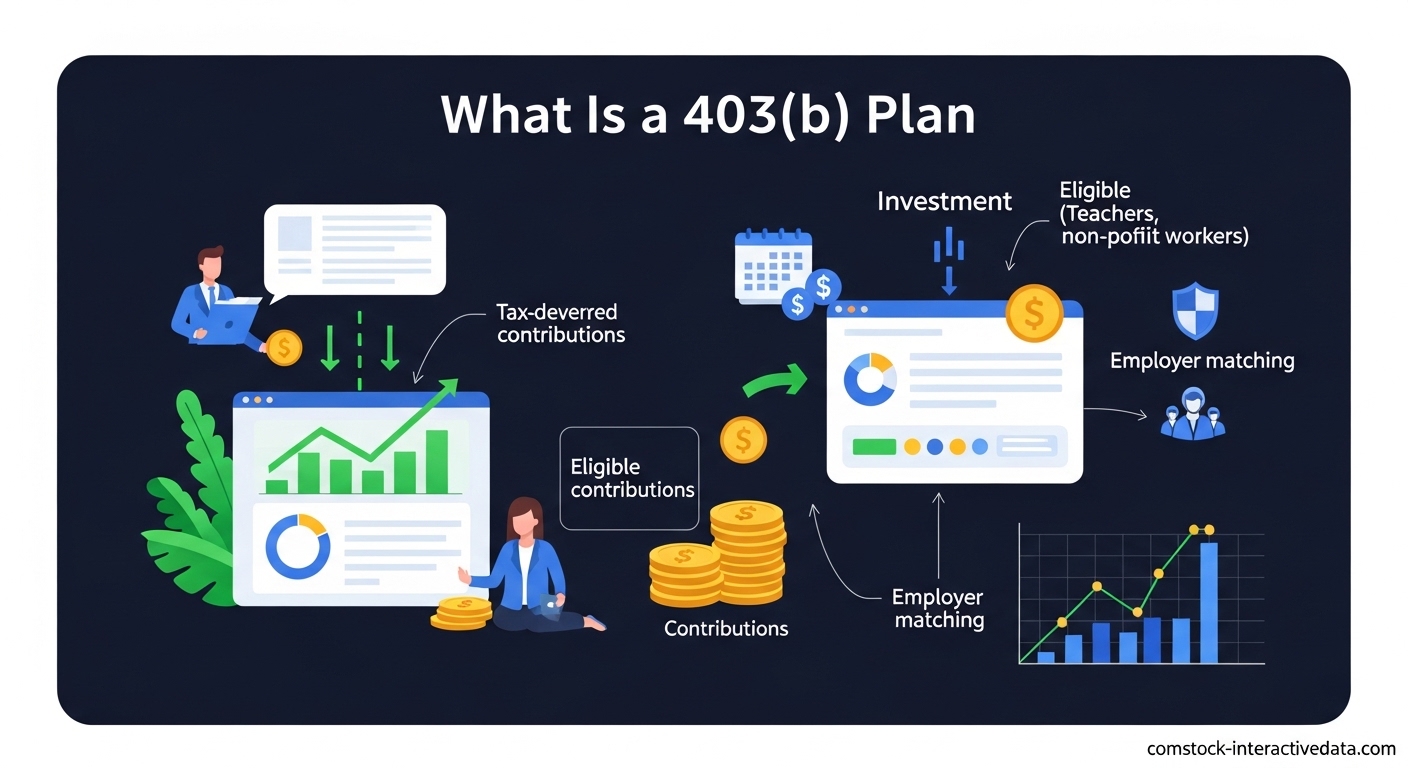
The main difference between a 403(b) and 401(k) is eligibility: 401(k) plans are offered by for-profit companies, while 403(b) plans are for employees of nonprofit organizations, public schools, and certain government agencies. Both are tax-advantaged retirement plans with similar contribution limits and tax benefits, but 403(b) plans may have more limited investment options and include a unique 15-year service catch-up provision.
I spent 15 years working in both the private sector and higher education, giving me firsthand experience navigating both types of plans. When I switched from a Fortune 500 company to a university position, the differences became immediately apparent. This guide breaks down everything you need to know about 403(b) plan vs 401k options so you can make informed decisions about your retirement savings.
Table of Contents
Key Takeaways
- 401(k) plans are for for-profit companies; 403(b) plans are for nonprofits, schools, and government employees
- Both plans offer the same contribution limits: $23,500 for 2026 (plus catch-up contributions if age 50+)
- 403(b) plans may have limited investment options, often restricted to annuities and mutual funds from specific providers
- The 15-year service catch-up provision allows some 403(b) participants to contribute an extra $3,000-$15,000 annually
- Your employer type determines which plan you can use – you typically cannot choose between them
What Is a 403(b) Plan?
A 403(b) plan is a tax-advantaged retirement savings plan specifically designed for employees of nonprofit organizations, public schools, and certain government agencies. Named after Section 403(b) of the Internal Revenue Code, this employer-sponsored retirement account allows workers to save for retirement with significant tax benefits.
Who Can Participate in a 403(b) Plan?
Eligibility for a 403(b) plan is restricted to specific employer types. You can contribute to a 403(b) if you work for:
- Public schools, colleges, and universities
- 501(c)(3) tax-exempt organizations (charities, religious organizations)
- Certain government agencies and public hospitals
- Cooperative hospital service organizations
- Ministers employed by section 501(c)(3) organizations
Teachers, nurses, professors, and nonprofit workers make up the majority of 403(b) participants. If you work in any of these sectors, your employer likely offers a 403(b) as their primary workplace retirement plan option.
How 403(b) Plans Work?
A 403(b) plan works through payroll deductions that go directly into your retirement account before taxes are calculated. You can choose between pre-tax contributions (traditional) or after-tax contributions (Roth), depending on what your plan offers.
Your contributions grow tax-deferred in a traditional 403(b), meaning you pay no taxes on investment gains until withdrawal. With a Roth 403(b), contributions are made with after-tax dollars, but qualified withdrawals in retirement are completely tax-free.
403(b) Investment Options
Historically, 403(b) plans were limited to tax-sheltered annuity contracts offered by insurance companies. While modern 403(b) plans have expanded, many still offer limited investment options compared to 401(k) plans. Common investment choices include:
- Mutual funds (including target-date funds)
- Variable annuity contracts
- Fixed annuity contracts
- Some plans now offer brokerage window options
Many 403(b) participants report frustration with high-fee annuity products and limited fund selections. Unlike 401(k) plans which typically offer a broad range of mutual funds from various providers, some 403(b) plans restrict participants to specific insurance company products with higher expense ratios.
What Is a 401(k) Plan?
A 401(k) plan is the most common type of employer-sponsored retirement account in the United States, offered primarily by for-profit companies. Named after Section 401(k) of the Internal Revenue Code, this defined contribution plan allows employees to save a portion of their salary toward retirement with tax advantages.
Who Can Participate in a 401(k) Plan?
401(k) plans are available to employees of for-profit companies across all industries. This includes:
- Corporations and private businesses
- Small businesses and startups
- Self-employed individuals (solo 401(k) options)
- Partnerships and LLCs
Unlike 403(b) plans which have strict eligibility requirements based on employer type, 401(k) plans are broadly available across the private sector. Most full-time employees at companies with 401(k) plans can participate, often starting immediately or after a brief waiting period.
How 401(k) Plans Work?
401(k) plans function similarly to 403(b) plans in terms of contribution mechanics. You elect to defer a percentage of your salary into the plan through automatic payroll deductions. These contributions reduce your taxable income for the year if you choose the traditional option.
Most 401(k) plans now offer both traditional (pre-tax) and Roth contribution options. The Roth 401(k) option has grown increasingly popular since its introduction, allowing participants to pay taxes now and enjoy tax-free growth and withdrawals in retirement.
401(k) Investment Options
401(k) plans typically offer a broader range of investment options compared to 403(b) plans. A typical 401(k) menu includes:
- Target-date funds (lifecycle funds)
- Index funds tracking major markets
- Actively managed mutual funds
- Company stock (in some plans)
- Stable value funds
- Brokerage window options (in some plans)
The variety of investment choices in 401(k) plans often allows for better diversification and lower-cost index fund options compared to some 403(b) plans that are limited to insurance company products.
Key Similarities Between 403(b) and 401(k)
Despite their different target audiences, 403(b) and 401(k) plans share many fundamental characteristics. Understanding these similarities helps clarify that both plans serve the same core purpose: helping workers save for retirement with tax advantages.
Both Are Tax-Advantaged Retirement Plans
Both 403(b) and 401(k) plans offer significant tax benefits that help your retirement savings grow faster. Traditional contributions to either plan reduce your current taxable income, and investment gains grow tax-deferred until withdrawal. Both plans also offer Roth options that allow for tax-free growth and qualified withdrawals.
Identical Contribution Limits
For 2026, the IRS sets the same contribution limits for both 403(b) and 401(k) plans. You can contribute up to $23,500 to either plan type. Both plans also offer identical catch-up contribution provisions for older workers.
If you are age 50 or older, you can make additional catch-up contributions of $7,500, bringing your total potential contribution to $31,000. The SECURE Act also introduced a “super catch-up” provision for workers ages 60-63 that takes effect in 2025, allowing even higher contributions for this age group.
Employer Matching Potential
Both plan types can include employer matching contributions, though 403(b) plans at nonprofits and schools are less likely to offer matches due to budget constraints. When available, employer matches work the same way in both plans: your employer contributes additional money based on your contribution rate, up to certain limits.
Same Early Withdrawal Rules
Early withdrawal rules are identical for both plans. Generally, withdrawals before age 59.5 trigger a 10% early withdrawal penalty plus ordinary income taxes on the amount withdrawn. Both plans offer the same exceptions to this penalty, including:
- Disability
- Death
- Substantially equal periodic payments
- Qualified domestic relations orders
- Medical expenses exceeding 7.5% of adjusted gross income
Required Minimum Distributions
Both 403(b) and 401(k) plans require you to begin taking distributions at age 73 (as of 2026). These Required Minimum Distributions (RMDs) are calculated based on your account balance and life expectancy. Failure to take RMDs results in significant tax penalties.
Key Differences Between 403(b) and 401(k)
While the similarities are significant, several important differences distinguish these two types of retirement plans. These differences can impact your investment choices, contribution opportunities, and overall retirement strategy.
Employer Type Eligibility
The fundamental difference between 403(b) and 401(k) plans is who can offer them. This eligibility requirement is set by law and cannot be changed by employers.
| Plan Type | Eligible Employers |
|---|---|
| 401(k) | For-profit companies, corporations, private businesses |
| 403(b) | Public schools, nonprofits (501c3), certain government agencies, religious organizations |
You cannot choose which plan type to use. Your employer determines whether you have access to a 401(k) or 403(b) based on their organizational structure.
The 15-Year Service Catch-Up Provision
This unique feature of 403(b) plans allows long-term employees of certain organizations to contribute beyond the standard limits. If you have at least 15 years of service with your current employer, you may be eligible for additional catch-up contributions of up to $3,000 per year, with a lifetime maximum of $15,000.
This catch-up is separate from and in addition to the age 50+ catch-up contribution. It is only available to employees of public schools, colleges, universities, hospitals, and certain other tax-exempt organizations – not all 403(b) participants qualify.
Investment Option Limitations
One significant difference that forum discussions consistently highlight is the quality of investment options. 403(b) plans, particularly those offered through school districts and smaller nonprofits, often have limited fund selections.
Common complaints from 403(b) participants include:
- High-fee annuity products as the only options
- Lack of low-cost index funds
- Insurance company providers with poor investment menus
- No self-directed brokerage options
While many 403(b) plans have improved their offerings in recent years, participants at smaller organizations may still face limited choices compared to typical 401(k) plans.
ERISA Compliance Differences
401(k) plans are governed by the Employee Retirement Income Security Act (ERISA), which provides significant protections for participants. ERISA requires fiduciary standards, reporting requirements, and certain participant rights.
Some 403(b) plans are exempt from ERISA requirements, particularly those at government entities and certain religious organizations. While this does not mean these plans offer less protection necessarily, it does mean they operate under different regulatory frameworks with different reporting and compliance requirements.
Universal Availability and Nondiscrimination Testing
403(b) plans must meet “universal availability” requirements, meaning they must be offered to all employees rather than just specific groups. This differs from 401(k) plans which undergo nondiscrimination testing to ensure highly compensated employees do not benefit disproportionately.
Contribution Limits and Catch-Up Provisions for 2026
Understanding current contribution limits helps you maximize your retirement savings. The IRS adjusts these limits annually for inflation, so staying current with 2026 figures is important for your planning.
Standard Contribution Limits
For 2026, the maximum you can contribute to either a 403(b) or 401(k) plan is $23,500. This limit applies to your personal elective deferrals, not including any employer matching contributions.
Age 50+ Catch-Up Contributions
Participants who are age 50 or older by the end of the calendar year can contribute an additional $7,500. This brings the total possible contribution to $31,000 for 2026.
Super Catch-Up (Ages 60-63)
The SECURE Act 2.0 introduced a “super catch-up” provision for workers ages 60-63 starting in 2025. This allows eligible participants to contribute even more than the standard catch-up amount. The specific limit is the greater of $10,000 or 150% of the standard catch-up limit, adjusted for inflation.
The 15-Year Service Catch-Up (403b Only)
This unique 403(b) provision allows eligible employees with 15+ years of service to contribute up to $3,000 per year beyond the standard limit. The lifetime maximum under this provision is $15,000. If you qualify for both the age 50+ catch-up and the 15-year service catch-up, you can use both in the same year.
| Contribution Type | 401(k) | 403(b) |
|---|---|---|
| Standard Limit (2026) | $23,500 | $23,500 |
| Age 50+ Catch-Up | $7,500 | $7,500 |
| Super Catch-Up (60-63) | Yes | Yes |
| 15-Year Service Catch-Up | No | Up to $3,000/year ($15,000 lifetime max) |
Which Plan Should You Choose?
Here is the straightforward answer: you typically cannot choose between a 403(b) and 401(k). Your employer type determines which plan is available to you. If you work for a for-profit company, you get a 401(k). If you work for a nonprofit, school, or certain government agency, you get a 403(b).
However, the question becomes relevant when you are comparing job offers between sectors or considering a career change. In these situations, the type of retirement plan offered should factor into your decision alongside salary, benefits, and other considerations.
Decision Factors to Consider
When evaluating a 403(b) versus a 401(k) in the context of job offers, consider these factors:
- Employer Match: Does the employer offer matching contributions? A 401(k) with a generous match may be more valuable than a 403(b) without one.
- Investment Options: Review the specific funds available. A 403(b) with excellent low-cost index funds may be better than a 401(k) with high-fee actively managed funds.
- Plan Fees: Compare the administrative fees and expense ratios. High fees can significantly erode returns over time.
- Vesting Schedule: How long until employer contributions become fully yours? A shorter vesting period provides more security.
- Catch-Up Opportunities: If you are a long-tenured employee nearing retirement, the 403(b) 15-year catch-up could be a significant advantage.
Scenarios Where One Plan May Be Better
A 403(b) with the 15-year service catch-up provision may be superior if you have long tenure with a qualifying employer and want to maximize late-career savings. This unique feature allows for contributions that no 401(k) can match.
A 401(k) may be preferable if you prioritize investment flexibility and lower fees. The private sector competition for talent has driven many companies to offer excellent 401(k) plans with broad fund selections and institutional share classes with low expense ratios.
Frequently Asked Questions
Is it better to have a 403b or 401k?
Neither plan is inherently better. Both offer the same tax advantages and contribution limits. The better plan is the one with better investment options, lower fees, and employer matching. A high-quality 401(k) with low-cost index funds and a generous match is ideal. A 403(b) with the 15-year service catch-up provision offers unique advantages for long-tenured employees.
What are the disadvantages of a 403b plan?
Common disadvantages include: limited investment options (often restricted to annuities or high-fee funds), higher expense ratios compared to 401(k) plans, less frequent employer matching, insurance company providers with poor fund selections, and complex rules around the 15-year service catch-up provision that many participants do not fully understand.
What is the 10 year rule for 403b?
The 10-year rule refers to the separation from service exception for public safety employees. If you separate from service in the calendar year you turn 50 or later, and you have at least 10 years of service, you can take penalty-free withdrawals from a 403(b). This differs from the standard age 59.5 requirement and provides flexibility for early retirees in certain professions.
Is a 401 or 403 better?
The terms 401 and 403 refer to different sections of the Internal Revenue Code governing these plans. Neither is objectively better. A 401(k) typically offers more investment flexibility while a 403(b) offers the unique 15-year service catch-up. The quality of either plan depends on the specific employer’s plan design, fees, and investment options.
Can you contribute to both 401k and 403b?
Generally no. The total contribution limit applies across all employer-sponsored plans. If you have access to both (rare), your combined contributions cannot exceed the annual limit ($23,500 for 2026). The only exception is if you work two separate jobs with different employers, each offering a different plan type. Even then, your total employee contribution across both plans cannot exceed the limit.
Can I roll over a 403b to a 401k?
Yes, you can roll over a 403(b) to a 401(k) if the 401(k) plan accepts incoming rollovers. This is common when changing jobs from a nonprofit to a for-profit company. You can also roll over to a traditional IRA or Roth IRA. Direct rollovers between plans are tax-free events if done properly. The receiving plan must specifically allow 403(b) rollovers.
Conclusion
Understanding what a 403(b) plan is and how it differs from a 401(k) helps you make informed decisions about your retirement savings strategy. The key distinction is eligibility: 401(k) plans serve for-profit employees while 403(b) plans serve those in nonprofit, educational, and government sectors.
Both plans offer identical contribution limits, tax advantages, and withdrawal rules. The meaningful differences lie in investment options, where 403(b) plans may have limitations, and the unique 15-year service catch-up provision that benefits long-tenured 403(b) participants.
Your employer type determines which plan you can use. Focus on maximizing contributions to whatever plan is available, paying attention to fund selection, fees, and any employer matching opportunities. Whether you have a 403(b) or 401(k), consistent saving and smart investment choices will build the retirement security you need.