
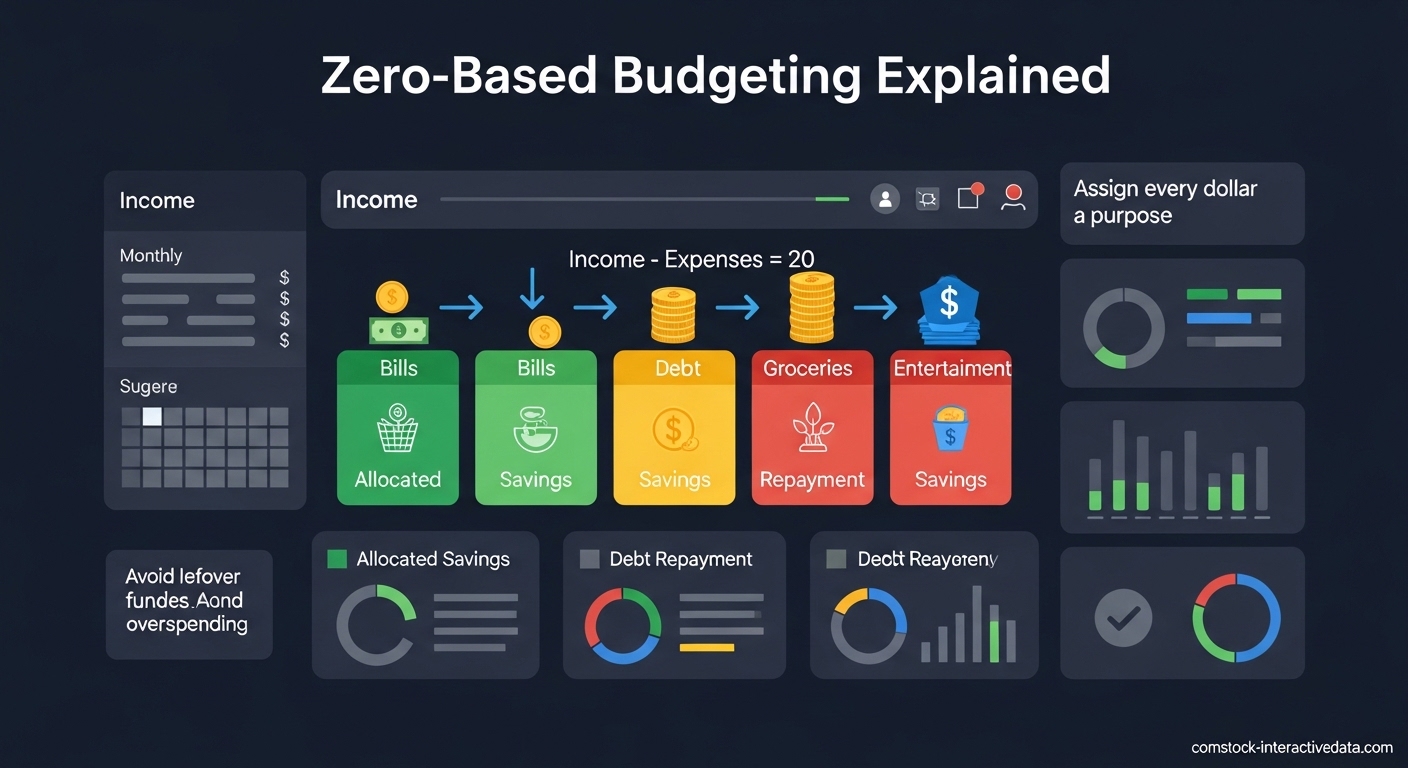
Zero-based budgeting is a method where you assign every dollar of your income to a specific purpose. Whether you are paying bills, building savings, or eliminating debt, this approach ensures your money works exactly as you intend. I have seen people transform their financial lives using this system because it forces intentionality with every spending decision.
In this guide, you will learn how zero-based budgeting works step by step. We will explore who benefits most from this method, examine its advantages and drawbacks, and compare it to popular alternatives like the 50/30/20 rule. By the end, you will know exactly whether this budgeting framework fits your financial situation in 2026.
Table of Contents
What Is Zero-Based Budgeting?
Zero-based budgeting is a framework that assigns a job to every dollar of your take-home pay. Instead of having leftover money sit in your checking account with no purpose, you allocate every penny toward expenses, savings, or debt repayment. The goal is simple: income minus expenses equals zero.
The concept is straightforward. If you earn $4,200 per month after taxes, your budget should account for exactly $4,200 in spending and savings. This does not mean you spend everything. Rather, you decide ahead of time where each dollar goes, including dollars directed to emergency savings or retirement savings.
The phrase “zero-based” comes from business budgeting originally. Companies using this method justify every expense from a “zero base” each period rather than carrying forward previous budgets. Personal finance experts adapted this discipline for household money management, and it has gained popularity through budgeting apps and financial coaching programs.
Key takeaway: Every dollar has a purpose. Nothing is left to chance or impulse spending.
How Zero-Based Budgeting Works?
Zero-based budgeting follows a simple formula that creates complete cash flow visibility. You start with your monthly take-home pay, list every planned expense and savings goal, assign specific dollar amounts to each budget category, then adjust until your remaining balance hits exactly zero.
Let me walk you through a concrete example. Sarah earns $4,200 per month after taxes. Here is how she applies zero-based budgeting to assign every dollar a job:
Income: $4,200
Fixed Expenses:
- Rent: $1,400
- Utilities: $150
- Car Payment: $350
- Insurance: $200
- Phone: $80
- Subscriptions: $50
Variable Expenses:
- Groceries: $500
- Gas: $200
- Dining Out: $200
- Entertainment: $100
- Personal Care: $100
Savings and Debt:
- Emergency Fund: $300
- Retirement Savings: $420
- Extra Debt Payment: $150
Total Outgo: $4,200
Remaining: $0
Notice how Sarah accounts for every dollar including discretionary spending and savings goals. She is not spending her entire paycheck on bills. Instead, she makes conscious decisions about her money before the month begins.
When unexpected expenses arise, she moves money between categories rather than going over budget. If her grocery bill comes in under $500, that surplus might shift to her emergency savings or debt repayment.
Advantages of Zero-Based Budgeting
Zero-based budgeting creates financial clarity that other methods struggle to match. After researching this approach and reading countless experiences from people who use it, I have identified the most significant benefits that keep people committed to this system.
Complete Spending Awareness
You know exactly where every dollar goes. This visibility eliminates the mystery of “where did my money go?” that frustrates so many people. Users report discovering forgotten subscriptions and recurring charges they had stopped noticing.
Intentional Spending Habits
By assigning every dollar a purpose before the month starts, you eliminate impulse spending. When you want to make an unplanned purchase, you must consciously move money from another category. This friction often stops unnecessary spending.
Accelerated Debt Repayment
Zero-based budgeting shines when you are eliminating debt. You can designate specific dollars toward extra debt payments rather than hoping something is left over at month end. Many people report paying off credit cards months or years faster using this method.
Savings Prioritization
Your savings goals receive the same priority as your rent or electric bill. You pay yourself first by allocating dollars to emergency savings and retirement savings at the start of each budget period rather than waiting to see what remains.
Flexibility Within Structure
Unlike rigid budgets that fail when life happens, zero-based budgeting lets you move money between categories. Overspent on groceries? Move funds from your entertainment category. The framework stays intact even when individual categories shift.
Disadvantages and Drawbacks
Zero-based budgeting demands commitment that not everyone can sustain. Based on forum discussions and user experiences, here are the genuine challenges people face with this method.
Time Investment Required
Setting up your first zero-based budget takes several hours. You must track expenses, identify categories, and assign realistic amounts. Each month requires review and adjustment. For busy people, this maintenance feels like a burden.
Difficulty With Variable Income
People with irregular income from freelancing, gig work, or commission sales struggle to predict their monthly take-home pay. Without a stable number to start from, the income minus expenses formula becomes complicated.
Restrictive Feeling
Some users describe zero-based budgeting as “micromanaging your money.” The need to account for every dollar can feel suffocating, especially for people who prefer financial flexibility or have unpredictable expenses.
Monthly Revision Burden
Life changes constantly, and your budget must adapt. Medical bills, car repairs, or seasonal expenses require category adjustments. Some people abandon zero-based budgeting after months of constant revision fatigue.
Buffer Confusion
Many beginners struggle with whether to include a buffer category. Purists insist on true zero with no cushion. Pragmatists add small buffers for peace of mind. This confusion causes frustration for newcomers.
How to Create a Zero-Based Budget: Step-by-Step Guide
Creating your first zero-based budget requires preparation, but the process becomes faster each month. Follow these steps to build a budget that assigns every dollar a purpose.
Step 1: Determine Your Monthly Take-Home Pay
Start with your actual income after taxes and deductions. If you have irregular income, use your lowest earning month from the past year as your baseline. You can always allocate extra dollars if you earn more.
Step 2: List All Fixed Expenses
Write down every recurring bill with exact amounts. Include rent, utilities, loan payments, insurance, subscriptions, and minimum debt payments. These are non-negotiable expenses that repeat monthly.
Step 3: Identify Variable Expense Categories
Create categories for spending that fluctuates. Common groups include groceries, gas, dining out, entertainment, personal care, clothing, and household items. Review bank statements from the past three months to estimate realistic amounts.
Step 4: Set Your Savings Goals
Decide how much to direct toward emergency savings, retirement savings, and other goals. Treat these like bills that must be paid. Even $50 per month builds momentum when allocated intentionally.
Step 5: Assign Every Dollar
Subtract your total expenses and savings from your income. If you have money remaining, allocate it somewhere. Add to debt repayment, increase savings, or expand a variable category. Continue adjusting until the math equals zero.
Step 6: Track and Adjust Weekly
Check your spending twice weekly. When categories run low, move money from discretionary areas before overspending. At month end, review what worked and adjust amounts for next month.
Common Mistakes to Avoid
Based on forum discussions, here are the most frequent errors that derail zero-based budgeting attempts:
Mistake 1: Forgetting Irregular Expenses. Annual insurance premiums, holiday gifts, and car maintenance destroy budgets when ignored. Create sinking funds by dividing annual costs into monthly savings amounts.
Mistake 2: Underestimating Variable Costs. Be realistic about groceries and dining out. If you spent $600 monthly on food last quarter, budgeting $400 sets you up for failure.
Mistake 3: Being Too Rigid. Life happens. Budgets should bend without breaking. Build small flexibility into categories or create a miscellaneous line for genuine surprises.
Mistake 4: Ignoring Small Purchases. Coffee, apps, and convenience store trips add up. Track these carefully or create a “spending money” category for small discretionary purchases.
Mistake 5: Not Budgeting for Fun. Completely eliminating entertainment leads to burnout. Allocate reasonable amounts for enjoyment to maintain long-term sustainability.
Zero-Based Budgeting vs Other Methods
Understanding how zero-based budgeting compares to alternatives helps you choose the right approach. Here is how it stacks against two popular methods:
| Feature | Zero-Based Budgeting | 50/30/20 Rule | Envelope System |
|---|---|---|---|
| Core Principle | Every dollar assigned a job | Percentage allocations | Cash in physical envelopes |
| Structure Level | High detail | Moderate detail | High detail |
| Time Required | 2-3 hours monthly | 30 minutes monthly | 1-2 hours monthly |
| Best For | Detail-oriented planners | Simplicity seekers | Cash-preferred spenders |
| Flexibility | High within categories | Moderate | Low (when envelope empty) |
| Savings Priority | Explicit allocation | Built into 20% | Requires discipline |
The 50/30/20 Rule Explained
This alternative divides take-home pay into three buckets. Fifty percent covers needs like housing and utilities. Thirty percent funds wants including dining out and entertainment. Twenty percent goes toward savings and debt repayment.
The 50/30/20 rule works well for people who want simplicity without tracking dozens of categories. However, it offers less precision than zero-based budgeting for those working toward specific financial goals.
The 70/20/10 Rule
Another variation allocates 70 percent to monthly expenses and bills, 20 percent to savings and investments, and 10 percent to debt repayment or additional giving. This approach suits higher earners with lower fixed costs.
Which Method Should You Choose?
Select zero-based budgeting if you want maximum control and are working toward aggressive debt payoff or savings goals. Choose the 50/30/20 rule if you prefer simplicity and your finances are relatively stable. Consider the envelope method if you struggle with credit card spending and cash helps you control impulses.
Who Is Zero-Based Budgeting For?
Zero-based budgeting suits specific personality types and financial situations better than others. Understanding whether you fit the ideal profile saves time and frustration.
Ideal Candidates for Zero-Based Budgeting
You should consider zero-based budgeting if you identify with these descriptions:
Detail-Oriented Planners: You enjoy organizing and tracking details. Spreadsheets and budgeting apps feel satisfying rather than burdensome.
Debt Elimination Focused: You are committed to paying off credit cards, student loans, or other debts quickly. The precise allocation helps maximize extra payments.
Steady Income Earners: You receive predictable paychecks on regular schedules. Salary employees with consistent hours find this method easiest to implement.
Couples Managing Money Together: Partners who budget jointly benefit from the clarity zero-based budgeting provides. Every dollar is discussed and assigned, reducing financial conflict.
Who Should Consider Alternatives?
Zero-based budgeting may frustrate you if these apply:
Highly Irregular Income: Freelancers, contractors, and commission-based workers often find percentage-based methods easier than predicting exact monthly income.
Time-Constrained Professionals: If you work 60-hour weeks and have children, the monthly maintenance may feel impossible. Simpler methods might sustain better.
Financial Flexibility Lovers: Some people feel controlled by detailed budgets. If you prefer general guidelines over specific allocations, zero-based budgeting could create resistance.
Special Considerations for Families
Zero-based budgeting works for families when implemented thoughtfully. Create separate categories for children’s activities, school expenses, and childcare. Hold monthly family meetings to review the budget together. Consider giving older children their own spending categories to teach budgeting skills early.
Frequently Asked Questions
How to explain zero-based budgeting?
Zero-based budgeting is a method where you allocate every dollar of your income to specific expenses, savings, or debt repayment so that your income minus outgo equals zero. Think of it as giving every dollar a job before the month begins. Instead of having leftover money disappear, you decide exactly where each dollar goes, whether toward bills, groceries, retirement savings, or entertainment.
What are common ZBB mistakes?
The most common zero-based budgeting mistakes include forgetting irregular expenses like annual insurance premiums, underestimating variable costs such as groceries and dining out, being too rigid when life changes occur, ignoring small daily purchases that add up, and not budgeting any money for fun which leads to burnout. Another frequent error is failing to track spending throughout the month and only discovering problems at month end.
What is the 50 30 20 rule zero-based budgeting?
The 50/30/20 rule is actually a different budgeting method, not zero-based budgeting. It divides take-home pay into three categories: 50 percent for needs like housing and utilities, 30 percent for wants including entertainment and dining out, and 20 percent for savings and debt repayment. While zero-based budgeting assigns every single dollar a specific purpose, the 50/30/20 rule uses broader percentage guidelines. Some people combine both approaches by using zero-based budgeting within their 50/30/20 percentage allocations.
Is zero budget really possible?
Yes, zero-based budgeting is absolutely possible and works for millions of people. The name is slightly misleading because it does not mean you have zero money or spend everything. It means your income minus your expenses and savings allocations equals zero on paper. Every dollar has a specific assignment. In practice, many people keep small buffer amounts or sinking funds within their zero-based budget for true emergencies, which keeps the spirit of intentional allocation while adding practical safety.
What is one downside to zero-based budgeting?
The most significant downside to zero-based budgeting is the time and effort required to maintain it. Creating your first budget takes several hours, and each month requires review and adjustment to reflect changing expenses and goals. For people with irregular income, the process becomes even more complicated. Some users also find the detailed tracking restrictive and experience fatigue from constant budget management, leading them to abandon the method after initial enthusiasm fades.
What is the 70/20/10 rule money?
The 70/20/10 rule is a simplified budgeting framework where you allocate 70 percent of take-home pay to monthly expenses and bills, 20 percent to savings and investments, and 10 percent to debt repayment or charitable giving. This method works best for people with stable incomes and lower fixed housing costs. Unlike zero-based budgeting which assigns every dollar a specific category, the 70/20/10 rule provides broader percentage buckets that require less detailed tracking and maintenance.
Conclusion
Zero-based budgeting transforms how you interact with money by assigning every dollar a specific purpose. This method creates complete visibility into your cash flow, eliminates wasteful spending, and accelerates progress toward debt freedom and savings goals. The framework works especially well for detail-oriented people with steady income who want maximum control over their financial lives.
However, zero-based budgeting requires significant time investment and monthly maintenance. People with irregular income or busy schedules might find percentage-based methods like the 50/30/20 rule more sustainable. The best budget is the one you actually follow.
If you are ready to try zero-based budgeting, start by tracking your expenses for one month to understand your current spending patterns. Then follow the step-by-step guide in this article to build your first budget. Remember that perfection is not the goal. Progress comes from consistent attention to where your money goes and intentional decisions about where it should go instead.