
Every time you buy or sell a stock, you pay more than you might realize. The bid-ask spread represents a hidden cost embedded in every transaction, silently eating into your returns with each trade. Understanding this concept can save you hundreds or even thousands of dollars over your investing lifetime.
I learned this lesson the hard way during my first year of active trading. I was tracking my commission costs meticulously but completely ignoring the spread impact. When I finally ran the numbers, I discovered I was paying nearly twice as much in spread costs as I was in broker commissions. This guide will show you exactly what the bid-ask spread is, how to calculate it, and most importantly, how to minimize its impact on your trading results.
Whether you are a long-term investor making occasional trades or an active day trader executing multiple transactions daily, the bid-ask spread affects you. By the end of this article, you will understand who pays this cost, what makes spreads wider or narrower, and practical strategies to reduce your trading expenses.
Table of Contents
What Is the Bid-Ask Spread in Stock Trading?
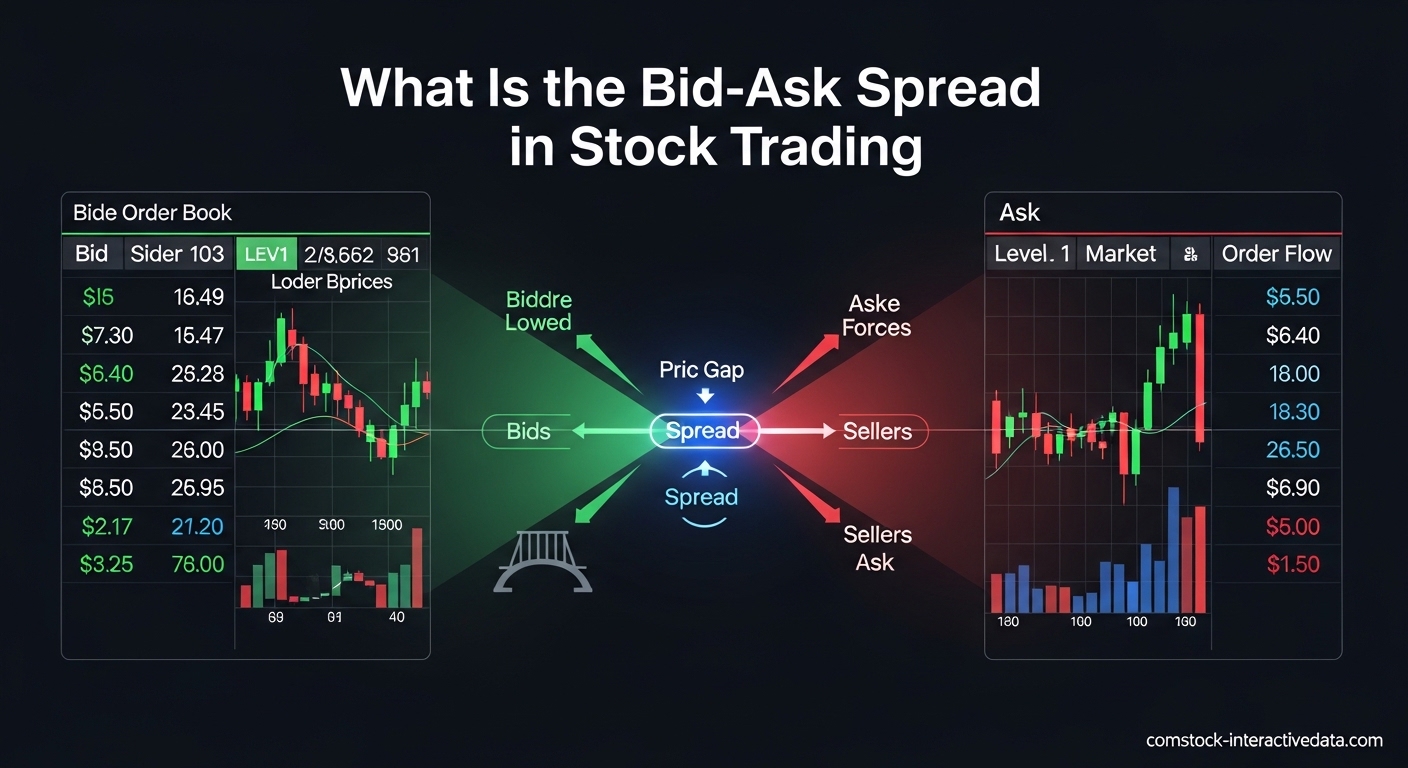
The bid-ask spread is the difference between the highest price a buyer is willing to pay for a security and the lowest price a seller is willing to accept. It represents the gap between what buyers want to pay and what sellers want to receive, essentially functioning as a transaction cost for entering and exiting positions.
To fully grasp this concept, you need to understand two key prices that exist for every stock at any given moment. These prices move constantly during market hours as buyers and sellers interact through the exchange.
The Bid Price Explained
The bid price represents the maximum price that a buyer is willing to pay for a security at any given moment. When you look at a stock quote, the bid shows you what someone is offering to pay right now if you wanted to sell your shares immediately.
Think of the bid as the buyer’s opening offer in a negotiation. Multiple buyers may place bids at different price levels, creating what traders call the bid stack or bid ladder. The highest bid appears as the current bid price you see on trading platforms.
The Ask Price Explained
The ask price, sometimes called the offer price, represents the minimum price that a seller is willing to accept for a security. When you want to buy shares immediately, you pay the ask price rather than the bid price.
Sellers list their shares at various price levels, and the lowest asking price becomes the current ask price displayed in stock quotes. This represents the immediate cost of purchasing shares without waiting for a better price.
Why These Prices Differ?
The bid and ask prices almost never match because buyers want the lowest possible price while sellers want the highest possible price. The spread between these competing interests represents the cost of immediate transaction execution and compensation for market makers who facilitate trades.
Market makers earn their living by buying at the bid price and selling at the ask price, capturing the spread as their profit for providing liquidity. This system ensures that buyers and sellers can always find a counterparty for their trades, even when no natural buyer or seller exists at that exact moment.
How the Bid-Ask Spread Works in Practice?
Understanding the mechanics of the bid-ask spread requires looking at what happens when you place an actual trade. The spread affects both buyers and sellers differently, and recognizing who bears the cost helps you make smarter trading decisions.
Who Pays the Bid-Ask Spread?
Both buyers and sellers effectively pay a portion of the spread when they trade using market orders. When you buy shares using a market order, you pay the ask price, which is higher than what you would receive if you immediately sold those same shares back at the bid price.
The buyer pays the full spread cost upfront by purchasing at the ask. The seller receives the bid price, which is lower than what the buyer just paid. This difference represents the round-trip cost of doing an immediate buy and sell, though most traders only complete one side of this transaction.
Market makers capture the spread as compensation for the risk they take by holding inventory and providing continuous liquidity. Without market makers willing to buy when you want to sell and sell when you want to buy, markets would be far less liquid and efficient.
The Role of Market Makers
Market makers are financial firms that stand ready to buy and sell securities continuously throughout the trading day. They post both bid and ask prices simultaneously, creating the two-sided market that allows instant execution of your trades.
These firms profit from the spread while taking on the risk that prices may move against their inventory position. When you sell shares immediately, you are usually selling to a market maker at their bid price. When you buy shares immediately, you are buying from a market maker at their ask price.
Market makers use sophisticated algorithms and hedging strategies to manage their risk while keeping spreads as tight as possible. Competition among multiple market makers typically results in narrower spreads, which benefits all traders through lower transaction costs.
Crossing the Spread
When you place a market order to buy, you are crossing the spread by accepting the seller’s asking price rather than waiting for the price to come down to your level. This guarantees immediate execution but costs you the spread amount.
Using limit orders allows you to avoid crossing the spread entirely. By placing a buy limit order at or below the current bid price, you wait for sellers to come down to your level rather than paying the premium ask price. This strategy saves money but risks missing the trade if prices move away from your order.
How to Calculate the Bid-Ask Spread?
Calculating the bid-ask spread requires only simple arithmetic, but understanding both dollar and percentage representations helps you compare costs across different securities and price levels.
The Basic Spread Formula
The dollar spread equals the ask price minus the bid price. For example, if a stock has a bid of $50.00 and an ask of $50.05, the spread is $0.05 or 5 cents per share.
The percentage spread provides a more useful comparison metric across stocks with different price levels. Divide the dollar spread by the midpoint price (the average of bid and ask), then multiply by 100 to get the percentage.
Calculation Examples
Let us walk through a practical example with a large-cap stock. Suppose Apple stock shows a bid of $175.50 and an ask of $175.52. The dollar spread equals $0.02 per share. The midpoint is $175.51, making the percentage spread approximately 0.011%.
Now consider a small-cap stock with a bid of $12.30 and an ask of $12.45. The dollar spread is $0.15, which seems larger, but the percentage calculation reveals the true impact. The midpoint is $12.375, creating a percentage spread of about 1.21%.
This comparison demonstrates why percentage spreads matter more than dollar spreads when evaluating trading costs. The small-cap stock costs over 100 times more in percentage terms despite having a smaller dollar spread than some high-priced stocks.
Forex Spread Calculations
Currency traders measure spreads in pips, which represent the smallest price movement in a currency pair. For most major pairs, one pip equals 0.0001 of the quote currency. A EUR/USD spread of 1.2 pips means you pay about $12 on a standard lot of 100,000 units.
Forex markets typically show much tighter spreads than stock markets due to higher liquidity and intense competition among dealers. Major pairs like EUR/USD often trade with spreads under 2 pips during normal market conditions.
What the Spread Tells You About Liquidity?
The width of the bid-ask spread serves as an instant indicator of market liquidity. Understanding this relationship helps you identify trading opportunities and avoid unnecessarily costly transactions.
Tight Spreads Indicate High Liquidity
When the bid and ask prices sit very close together, the market is liquid with many participants willing to trade at nearly the same price. Large-cap stocks like Microsoft or Amazon typically show spreads of just a few cents, representing a tiny fraction of the stock price.
Highly liquid markets attract more traders because transaction costs remain low. This creates a virtuous cycle where liquidity begets more liquidity as active markets draw increasing participation from both retail and institutional investors.
Wide Spreads Signal Low Liquidity
A wide gap between bid and ask prices indicates an illiquid market with few participants or significant uncertainty about fair value. Small-cap stocks, penny stocks, and thinly traded securities often display spreads of 1% to 5% or even higher.
Wide spreads act as a warning sign for traders. They indicate that you will lose a significant portion of your investment value immediately upon purchase due to the high transaction cost. For a stock with a 5% spread, the price must rise more than 5% just for you to break even on a quick sale.
The Spread as a Risk Indicator
Spreads often widen during periods of market volatility or uncertainty. When news events create rapid price movements, market makers increase spreads to protect themselves from being caught on the wrong side of sudden price swings.
Observing spread changes can alert you to shifting market conditions before price movements fully reflect new information. Sudden spread widening may indicate upcoming volatility or reduced confidence among market participants.
Factors That Influence Bid-Ask Spread Width
Several market forces determine how wide or narrow the bid-ask spread becomes at any given moment. Recognizing these factors helps you time your trades to minimize costs.
Trading Volume
High daily trading volume correlates strongly with tight spreads. When thousands or millions of shares change hands daily, market makers face less inventory risk and can afford to narrow their spreads while still making adequate profits.
Low-volume securities force market makers to hold positions longer before finding counterparties. They widen spreads to compensate for this additional risk and the cost of carrying inventory.
Price Volatility
Volatile securities display wider spreads because market makers face greater risk of adverse price movements while holding inventory. When a stock might move several percent in minutes, market makers need larger spreads to justify the risk of buying high and selling low.
Periods around earnings announcements, economic reports, or major news events typically see spread widening across affected securities. Savvy traders often avoid trading during these windows unless absolutely necessary.
Market Capitalization
Large-cap stocks with market values over $10 billion almost always trade with tighter spreads than small-cap stocks. The size and stability of these companies attract more continuous trading interest, reducing market maker risk.
Micro-cap stocks under $300 million market cap often suffer from chronically wide spreads. The limited investor interest and unpredictable price movements make market making in these securities significantly riskier.
Time of Day
Spreads typically narrow during the middle of the trading day when volume peaks and widen at market open and close. The first and last 30 minutes of the trading session often see the widest spreads due to increased volatility and order imbalances.
Trading outside regular hours, including pre-market and after-hours sessions, almost always involves wider spreads. The reduced participation during these periods means fewer market makers and less competition to tighten spreads.
Market Maker Competition
The number of market makers competing for business in a particular security directly affects spread width. When multiple firms compete to provide liquidity, they narrow spreads to attract order flow and gain market share.
Securities with limited market maker participation suffer from wider spreads. This commonly occurs in obscure or complex instruments where few firms possess the expertise or risk appetite to make markets consistently.
Bid-Ask Spread Impact on Trading Costs
The bid-ask spread functions as a hidden transaction cost that most investors overlook when calculating their trading expenses. Unlike explicit commissions that appear on your brokerage statement, spread costs remain invisible but nonetheless real.
The Hidden Cost of Trading
Every time you execute a market order, you pay the spread on top of any brokerage commission. For a stock trading at $50 with a $0.05 spread, you effectively lose 0.1% of your investment value immediately upon purchase.
This cost compounds with each round-trip trade. If you buy and sell the same stock, you pay the spread twice, once on entry and once on exit. Active traders who execute multiple trades daily can accumulate significant spread costs over time.
Cumulative Impact for Active Traders
A day trader executing ten round-trip trades daily in securities with an average 0.1% spread pays 1% of their capital in spread costs each day. Over 250 trading days, this amounts to 250% in annual spread costs relative to the capital deployed.
Even for less active traders making just ten trades monthly, a 0.2% average spread creates a 2% monthly drag on returns. This explains why many day traders fail despite having winning trade percentages, their profits cannot overcome the constant friction of spread costs.
Spread Cost vs Commission Cost
In the modern zero-commission trading environment, spreads often represent your largest explicit trading cost. While brokers advertise free trading, you still pay through the spread on every transaction.
For low-priced stocks with wide spreads, this hidden cost can dwarf any commission you might have paid in the past. A penny stock with a 5% spread costs you $50 per $1,000 invested, far more than any traditional broker commission would have charged.
Bid-Ask Spreads Across Different Asset Classes
Spread characteristics vary dramatically depending on what type of security you are trading. Understanding these differences helps you choose appropriate markets and set realistic cost expectations.
Large-Cap Stocks
Highly liquid large-cap stocks typically trade with spreads under 0.05% during normal market conditions. Companies like Apple, Microsoft, and Amazon often show spreads of just one or two cents, representing a negligible transaction cost for most investors.
These tight spreads make large-cap stocks ideal for active trading strategies. The low friction costs allow traders to enter and exit positions frequently without excessive expense.
Small-Cap and Micro-Cap Stocks
Small-cap stocks with market capitalizations between $300 million and $2 billion typically show spreads ranging from 0.2% to 1%. Micro-cap stocks under $300 million can easily display spreads of 2% to 5% or more.
The wide spreads in small-cap securities make them challenging for short-term trading but less problematic for long-term investors. If you plan to hold for years, a 2% entry cost becomes less significant compared to the potential long-term gains.
Forex Markets
Major currency pairs like EUR/USD, USD/JPY, and GBP/USD trade with extremely tight spreads, often under 0.01% of position value during peak hours. This makes forex one of the most cost-efficient markets for active trading.
Exotic currency pairs involving emerging market currencies show wider spreads due to lower liquidity and higher volatility. These pairs might trade with spreads of 0.1% to 0.5% or more.
Options Markets
Options typically trade with wider percentage spreads than their underlying stocks. Highly liquid options on popular stocks might show spreads of 1% to 3%, while illiquid options can have spreads of 10% or more.
The spread width in options depends on strike price, expiration date, and underlying liquidity. At-the-money options near expiration often show the tightest spreads, while deep out-of-the-money or far-dated options suffer from wider spreads.
Bonds and Fixed Income
Treasury bonds trade with very tight spreads due to high liquidity and government backing. Corporate bonds, especially those from smaller issuers or with lower credit ratings, can trade with spreads of 0.5% to 2% or more.
Municipal bonds and other less frequently traded fixed income instruments often suffer from the widest spreads in the fixed income universe. The lack of standardized pricing and limited secondary market participation contributes to these wider costs.
Spread Comparison Summary
| Asset Class | Typical Spread Range | Example Security |
|---|---|---|
| Large-Cap Stocks | 0.01% – 0.05% | Apple (AAPL) |
| Mid-Cap Stocks | 0.1% – 0.5% | Zillow (Z) |
| Small-Cap Stocks | 0.2% – 2% | Regional Banks |
| Micro-Cap Stocks | 2% – 10%+ | Penny Stocks |
| Major Forex Pairs | 0.005% – 0.02% | EUR/USD |
| Exotic Forex Pairs | 0.1% – 0.5% | USD/TRY |
| Stock Options (Liquid) | 1% – 3% | AAPL Calls |
| Stock Options (Illiquid) | 5% – 20%+ | OTM LEAPS |
| Treasury Bonds | 0.01% – 0.05% | 10-Year Treasury |
| Corporate Bonds | 0.5% – 2% | High-Yield Bonds |
Practical Tips for Minimizing Spread Costs
While you cannot eliminate the bid-ask spread entirely, several strategies can reduce its impact on your trading results. Implementing these practices will help you keep more of your investment returns.
Use Limit Orders Strategically
Limit orders allow you to specify the exact price you are willing to pay or accept, potentially saving the entire spread cost. By placing a buy limit order at the current bid price or slightly higher, you wait for a seller to meet your terms rather than paying the full ask.
The trade-off involves execution risk. Your limit order might not fill if prices move away from your specified level. For securities with tight spreads under 0.1%, the savings may not justify the risk of missing a trade. For wide spreads over 1%, limit orders almost always make sense.
Avoid Trading at Market Open and Close
Spreads typically widen during the first and last 30 minutes of the trading day due to increased volatility and order imbalances. If possible, schedule your trades during the middle hours when spreads narrow and liquidity peaks.
Pre-market and after-hours trading sessions show consistently wider spreads due to reduced participation. Unless you have specific reasons for trading outside regular hours, stick to the 9:30 AM to 4:00 PM EST window for best execution.
Focus on Liquid Securities
Selecting highly liquid securities with tight spreads dramatically reduces your transaction costs. For stock traders, this means focusing on large-cap names with average daily volume exceeding one million shares.
When you must trade less liquid securities, adjust your position sizing to account for higher spread costs. Smaller positions reduce the absolute dollar impact of wide spreads while maintaining your desired market exposure.
Consider Spread Width Before Trading
Always check the bid-ask spread before executing any trade. Most trading platforms display this information prominently in the quote display. Calculate the percentage spread to understand the true cost relative to your position size.
If the spread exceeds 1% of the security price, seriously consider whether the trade makes economic sense. For short-term trades, a 2% spread means you need the price to move at least 2% in your favor just to break even on exit.
Use Level 2 Quotes When Available
Level 2 quotes show the full order book including multiple bid and ask levels beyond the current best prices. This information helps you assess market depth and place limit orders at optimal price points.
Seeing the full depth of market allows you to identify where significant support and resistance levels exist. You can place limit orders just inside these levels for improved fill probability while still capturing spread savings.
Frequently Asked Questions
What is considered a good bid-ask spread?
A good bid-ask spread depends on the asset class, but generally, spreads under 0.1% of the security price are excellent for stocks. For large-cap stocks, spreads of $0.01 to $0.05 are typical and considered good. Small-cap stocks may have acceptable spreads between 0.5% and 1%. Forex traders consider spreads under 2 pips on major pairs to be good. Anything over 1% for stocks or 5 pips for major forex pairs is considered wide and potentially expensive.
Who pays the bid-ask spread?
Both buyers and sellers effectively contribute to the bid-ask spread cost. When you buy using a market order, you pay the ask price, which is higher than the bid price you would receive if you immediately sold. The difference between what buyers pay and sellers receive is captured by market makers as compensation for providing liquidity. While buyers pay the full dollar amount of the spread upfront, sellers receive less than the buyer paid, so both parties bear a portion of the cost.
Should I buy at bid or ask price?
If you want immediate execution, you must buy at the ask price using a market order. However, you can place a limit order at or near the bid price to potentially save the spread cost. The trade-off is that your order may not fill if the price does not reach your specified level. For securities with tight spreads under 0.1%, buying at the ask is often reasonable. For wide spreads over 1%, using a limit order near the bid price usually makes more sense to reduce costs.
How do I interpret bid-ask spread?
The bid-ask spread serves as an indicator of liquidity and transaction cost. Narrow spreads under 0.1% indicate high liquidity with many buyers and sellers actively trading. Wide spreads over 1% suggest low liquidity and higher transaction costs. Spreads also indicate market volatility, widening during uncertain periods and narrowing during stable conditions. When evaluating a trade, calculate the percentage spread to understand what portion of your investment you will lose immediately to transaction costs.
Is bid-ask spread a fee?
The bid-ask spread is not an explicit fee charged by your broker, but rather an implicit cost of trading. Unlike commissions that appear on your brokerage statement, spread costs are embedded in the transaction price. When you buy at the ask and sell at the bid, you receive less than you paid even if the market price has not moved. This difference represents the spread cost you paid for immediate execution. While not technically a fee, the spread functions as a transaction cost that affects your net returns.
How can I avoid paying the bid-ask spread?
You cannot completely avoid the bid-ask spread, but you can minimize its impact. Use limit orders placed at or inside the current bid or ask to potentially capture price improvement. Trade highly liquid securities with tight spreads rather than illiquid ones with wide spreads. Avoid trading during volatile periods when spreads widen, such as market open, market close, or during major news events. Consider holding positions longer to amortize the entry spread cost over time rather than trading frequently.
Why do some stocks have larger spreads than others?
Spread width depends primarily on liquidity and volatility. Stocks with high trading volume and many market participants typically have tight spreads because market makers face less risk holding inventory. Low-volume stocks force market makers to hold positions longer, requiring wider spreads to compensate for the added risk. Volatile stocks also show wider spreads because market makers need protection against rapid price movements. Additionally, lower-priced stocks often have wider percentage spreads because the minimum price increment represents a larger percentage of the stock price.
Conclusion
The bid-ask spread represents one of the most important yet frequently overlooked aspects of trading. This hidden cost affects every transaction you make, from buying your first share to executing complex multi-leg options strategies. Understanding how spreads work empowers you to make smarter decisions about when to trade, what to trade, and how to minimize your transaction costs.
Remember that the bid-ask spread serves as both a cost and a signal. Tight spreads indicate liquid, efficient markets where you can trade with confidence. Wide spreads serve as warning signs of illiquidity, volatility, or limited market participation that should factor into your trading decisions. By calculating percentage spreads and comparing costs across asset classes, you can choose the most efficient markets for your strategies.
Apply the practical tips from this guide to reduce your spread costs. Use limit orders when spreads exceed 1%, focus on liquid securities for active trading, and avoid the volatile opening and closing periods when spreads widen. These simple practices can save you significant money over your investing lifetime, potentially improving your overall returns by several percentage points annually.
What Is the Bid-Ask Spread in Stock Trading is a fundamental concept that separates informed traders from those who bleed money through ignored transaction costs. Now that you understand this essential market mechanism, you can trade with confidence knowing exactly what you pay for immediate execution and how to minimize those costs when appropriate.