
The stock market can feel like a mysterious world when you are just starting out. I remember sitting down for the first time trying to understand how it all worked and feeling overwhelmed by the terminology and complexity. That feeling is completely normal, and it is exactly why guides like this one exist. Whether you are planning for retirement, building wealth, or simply curious about how the financial system works, understanding the stock market is one of the most valuable skills you can develop.
In this guide, we will walk through everything you need to know about how the stock market works. We will break down complex concepts into simple terms, answer the questions beginners ask most often, and give you a solid foundation to start your investing journey with confidence.
Table of Contents
What Is the Stock Market?
The stock market is a network of exchanges where investors buy and sell shares of publicly traded companies. Think of it as a massive marketplace, much like a farmer’s market but for ownership stakes in businesses rather than vegetables. When you purchase a stock, you are buying a small piece of ownership in a company, which makes you a shareholder.
Companies list their shares on these exchanges to raise capital for growth, hiring, research, and expansion. Without the stock market, businesses would have limited options to fund their operations. Investors, in turn, gain the opportunity to grow their wealth by participating in a company’s success over time.
According to forum discussions we analyzed, beginners often describe the stock market as “confusing” or “intimidating” at first. But as many experienced investors will tell you, the basics are far simpler than they appear. Once you understand the core concept of buying and selling ownership shares, the rest falls into place much more easily.
Public companies are businesses that have registered with regulatory bodies and meet specific requirements to have their shares available for public trading. This is different from private companies, whose shares are held by a small group of founders, investors, or family members. When a company “goes public,” it means it has completed the process of listing on a stock exchange for the first time.
How the Stock Market Works?
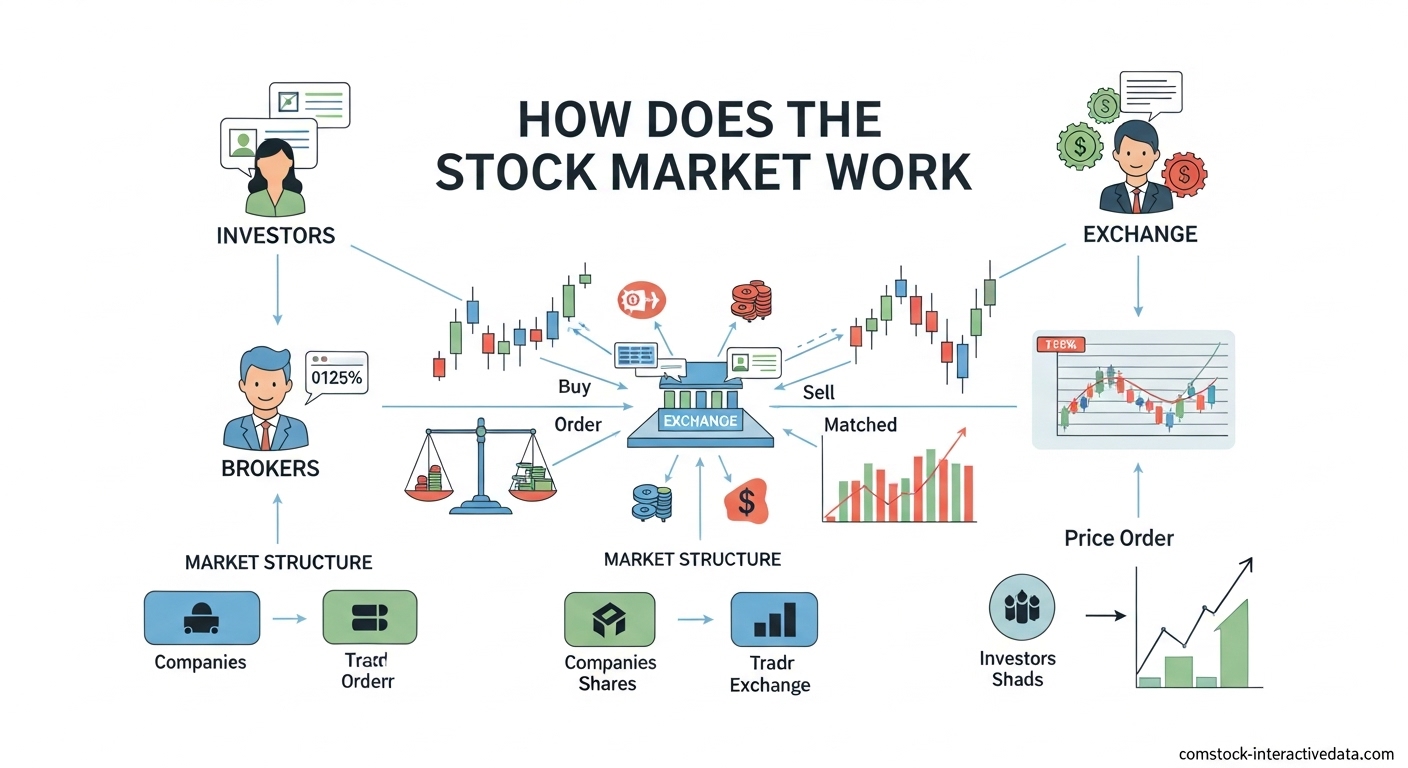
At its core, the stock market works by bringing together buyers and sellers in a centralized location. Instead of you having to find someone personally who wants to sell their Apple shares while you want to buy them, the stock exchange handles this matchmaking automatically. This is why we often call the stock market an auction marketplace.
When you place an order to buy a stock, it travels through the exchange and gets matched with a seller. If you want to buy immediately at the current price, you place a market order. If you want to buy only at a specific price you set, you use a limit order. These orders sit in the exchange’s system until they are filled or expire.
The continuous nature of modern stock trading is remarkable when you think about it. Markets operate during specific hours, and for major US exchanges, that means trading happens from 9:30 AM to 4:00 PM Eastern Time, Monday through Friday, excluding holidays. During these hours, millions of transactions occur every single second as investors around the world participate.
Liquidity is one of the most important concepts in how the stock market works. Highly liquid stocks are those with large trading volumes, meaning you can buy or sell them quickly without significantly affecting their price. Stocks with lower trading volumes can be harder to trade, as your buying or selling activity might move the price more noticeably.
Stock Exchanges Explained: NYSE and Nasdaq
A stock exchange is essentially a regulated marketplace where buyers and sellers come together to trade securities. The two largest stock exchanges in the United States are the New York Stock Exchange (NYSE) and the Nasdaq, and understanding how they differ can help you become a more informed investor.
The NYSE, founded in 1792, is the largest stock exchange in the world by total market capitalization. It operates as an auction market with a physical trading floor located on Wall Street in New York City. Brokers and traders physically gather on the floor to conduct trades, though the vast majority of trading happens electronically today. The NYSE is known for listing many established, large-cap companies including Walmart, Coca-Cola, and Johnson & Johnson.
The Nasdaq, established in 1971, operates as an electronic exchange without a traditional physical trading floor. It became famous for listing many technology companies including Apple, Microsoft, Amazon, and Google. The Nasdaq often attracts growth-oriented companies in the technology, biotechnology, and innovative sectors.
Beyond the major exchanges, there exists the Over-the-Counter (OTC) market where stocks that do not meet the listing requirements of formal exchanges trade directly between dealers. The OTC Markets Group organizes these trades into tiers based on disclosure and financial standards. Beginners should generally stick to stocks listed on major exchanges, as these companies have passed stricter regulatory requirements and oversight.
How Stock Prices Are Determined?
If there is one concept that beginners struggle with most, it is understanding what actually determines stock prices. The short answer is supply and demand, the same economic principle that drives prices for almost everything else in the world. When more investors want to buy a particular stock, its price rises. When more investors want to sell, the price falls.
Think about it this way. If a company releases unexpected positive news, such as quarterly earnings that beat expectations, more investors become interested in buying its stock. This increased demand creates pressure pushing the price higher. Conversely, if a company faces a scandal or reports poor results, investors rush to sell, increasing supply and driving the price down.
Market capitalization represents the total value that investors place on a company. You calculate it by multiplying the current stock price by the total number of outstanding shares. A company with a stock price of $100 and 1 million outstanding shares has a market cap of $100 million. This metric helps investors understand a company’s size and relative value compared to competitors.
Stock prices are quoted in real-time with two key numbers: the bid price (what buyers are willing to pay) and the ask price (what sellers want to receive). The difference between these two numbers is called the bid-ask spread, and it represents the cost of making a trade. Highly liquid stocks on major exchanges typically have very narrow spreads, while less-traded stocks may have wider spreads.
Primary vs Secondary Markets
Understanding the distinction between primary and secondary markets is essential for grasping how the stock market works from end to end. These two markets serve different purposes and operate in different ways, yet both are crucial components of our financial system.
The primary market is where new securities are created and sold for the first time. This happens during an Initial Public Offering (IPO), when a company first offers its shares to the public. In an IPO, the company works with investment banks to determine the initial offering price and sells shares directly to institutional investors and sometimes retail investors. The money from these sales goes directly to the company, providing it with capital for growth.
Once a company has completed its IPO, all subsequent trading happens in the secondary market. When you buy shares of Apple or Microsoft from another investor through a stock exchange, you are participating in the secondary market. The company itself does not receive any money from these transactions. Secondary market trading is what most people mean when they talk about “the stock market” in everyday conversation.
This distinction matters because it helps you understand what drives different types of investment decisions. IPO investments are fundamentally different from buying shares of an established company on the secondary market. In the primary market, you are evaluating a company’s prospects before it becomes publicly traded. In the secondary market, you are trading with other investors who have varying opinions about a company’s value.
How Investors Make Money in the Stock Market?
The stock market offers several ways to build wealth, and understanding these mechanisms helps you develop a clear investment strategy. Most beginners focus on one or two methods before expanding their approach over time.
Price appreciation is the most common way investors make money. If you buy a stock at $50 per share and it rises to $75, your investment has gained 50% in value. This increase in the stock price reflects the market’s assessment that the company is worth more now than when you bought it. Long-term investors often benefit significantly from compounding returns as quality stocks grow steadily over years and decades.
Dividends represent a second income stream from stock ownership. When companies generate profits, they sometimes distribute a portion of those earnings back to shareholders in the form of dividends. These payments typically arrive quarterly and provide regular income regardless of whether the stock price rises. Dividend-paying stocks are particularly popular among investors seeking passive income or building retirement portfolios.
Capital gains occur when you sell a stock for more than you paid for it. If you bought Netflix shares at $300 and sold them at $450, you realized a capital gain of $150 per share. The tax implications of capital gains depend on how long you held the investment and your overall income, with long-term gains typically receiving more favorable tax treatment than short-term gains.
Market Indexes: Understanding the S&P 500 and Dow Jones
When you hear financial news anchors talking about “the market gained 200 points today,” they are referring to stock market indexes. These indexes serve as benchmarks that represent the overall performance of a group of stocks, giving us a quick snapshot of how the market is doing on any given day.
The S&P 500 is the most widely followed index in the world. It includes 500 of the largest publicly traded companies in the United States, selected by a committee based on factors like market capitalization, liquidity, and sector representation. Because it contains such a broad cross-section of the US economy, many investors use the S&P 500 as a benchmark for their own portfolio performance.
The Dow Jones Industrial Average, commonly called “the Dow,” is one of the oldest stock market indexes, created in 1896. It tracks 30 large, well-known US companies. Despite its age and recognition, the Dow is actually a price-weighted index, meaning stocks with higher prices have more influence on the index movement, which some critics argue is not the most intuitive way to measure market performance.
Index funds have become incredibly popular because they offer a way to invest in an entire index with a single purchase. Instead of trying to pick individual winners, you can buy a fund that automatically holds all the stocks in the S&P 500 or another index. This approach dramatically reduces risk through diversification while capturing the overall growth of the market. Many financial experts recommend that beginners start with index funds before exploring individual stock selection.
How to Start Investing in the Stock Market?
Opening your first brokerage account is simpler than ever in 2026. The process takes as little as 15 minutes online, and many brokers now offer commission-free trading for stocks and ETFs. Let me walk you through the exact steps our team recommends for beginners.
First, you need to choose a brokerage firm. Major online brokers like Fidelity, Charles Schwab, TD Ameritrade, and E*TRADE all offer user-friendly platforms suitable for beginners. When selecting a broker, consider factors like account minimums, trading fees, research tools, and the quality of their mobile app. Most reputable brokers now offer $0 account minimums and commission-free trades, making it easy to start with small amounts of money.
Second, complete the application process, which involves providing personal information, linking your bank account, and answering some basic questions about your investing experience and risk tolerance. This process is regulated by the SEC and FINRA to protect investors, so you will need to verify your identity and confirm that you understand the risks involved in investing.
Third, fund your account by transferring money from your bank account. Many beginners start with a few hundred dollars and add to their investment regularly through automatic transfers. This approach, called dollar-cost averaging, helps reduce the impact of short-term volatility by spreading your purchases over time.
Fourth, place your first trade. Start by researching companies you want to own, then decide whether to use a market order (buy immediately at the current price) or a limit order (buy only if the price reaches your target). For your first investment, consider starting with an S&P 500 index fund, which gives you instant diversification across 500 companies.
Common Beginner Mistakes to Avoid
After studying forum discussions and hearing from new investors, we have identified the most common pitfalls that beginners face. Avoiding these mistakes will put you ahead of most people just starting their investing journey.
Emotional decision-making destroys more portfolios than bad companies ever do. When markets drop sharply, fear compels many beginners to sell at the bottom. When markets surge, greed drives them to buy at peaks. Successful investors maintain discipline during volatility, understanding that short-term drops often present buying opportunities rather than reasons to panic.
Attempting to time the market is another mistake that even experienced investors struggle to avoid. Research consistently shows that missing just a few of the best trading days in any given year can dramatically reduce your overall returns. Instead of trying to predict when to be in or out of the market, focus on staying invested and continuing to add to your positions regularly.
Neglecting diversification is surprisingly common among beginners, who often gravitate toward familiar companies in industries they understand. Putting all your money into a handful of tech stocks or a single sector exposes you to unnecessary risk if that industry underperforms. Index funds naturally solve this problem by holding hundreds of different companies across multiple sectors.
Finally, many beginners ignore investment fees and expenses, which can silently erode returns over time. Even small percentage differences in annual fees compound significantly over decades. Always review the expense ratios of mutual funds and ETFs before purchasing, and favor low-cost options whenever possible.
Key Stock Market Terms Every Beginner Should Know
Building your investment vocabulary is one of the most important steps in becoming a confident investor. Here are the essential terms that will help you understand financial news and make informed decisions.
Bull Market: A period when stock prices are rising, typically defined as a 20% or more increase from recent lows. Bull markets can last years and create significant wealth for investors who stay invested throughout.
Bear Market: The opposite of a bull market, characterized by falling prices, usually defined as a 20% or more decline from recent highs. Bear markets often coincide with economic recessions but have historically been followed by recoveries.
Volatility: A measure of how dramatically stock prices fluctuate over time. High volatility means prices change rapidly and unpredictably, which increases risk but also creates opportunities for skilled traders.
Dividend: A payment made by a company to its shareholders, usually from profits. Dividends provide income and signal that a company is financially healthy enough to share its success with investors.
ETF (Exchange-Traded Fund): An investment fund that trades on stock exchanges like individual stocks. ETFs typically track an index, sector, or commodity and offer low costs and tax efficiency compared to mutual funds.
IPO (Initial Public Offering): The first time a company sells its shares to the public. IPOs offer opportunities to invest in young companies but come with higher risk since there is limited historical data on the company’s performance.
Market Order: An instruction to buy or sell a stock immediately at the best available current price. Market orders guarantee execution but not the exact price.
Limit Order: An instruction to buy or sell a stock only at a specific price or better. Limit orders give you control over the price but do not guarantee execution if the market never reaches your target price.
Portfolio: The complete collection of all investments owned by an individual, including stocks, bonds, mutual funds, and other assets. Building a diversified portfolio is key to managing risk while achieving growth.
SEC (Securities and Exchange Commission): The US government agency responsible for regulating securities markets and protecting investors. The SEC enforces laws against fraud, manipulation, and insider trading.
FAQs
What is the stock market and how does it work?
The stock market is a network of exchanges where investors buy and sell shares of publicly traded companies. It works by matching buyers and sellers through regulated exchanges like the NYSE and Nasdaq. When you buy a stock, you become a partial owner of that company, and your investment can grow through price appreciation and dividends.
How do you make money in the stock market?
Investors make money through price appreciation (selling stocks for more than you paid), dividends (regular payments from company profits), and capital gains (profits realized when selling appreciated assets). Long-term investors typically benefit most from compounding returns over time.
What is a stock exchange?
A stock exchange is a regulated marketplace where buyers and sellers trade securities. Major US exchanges include the New York Stock Exchange (NYSE) and the Nasdaq. Exchanges provide liquidity, price transparency, and security for investors while helping companies access capital.
How are stock prices determined?
Stock prices are determined by supply and demand. When more investors want to buy a stock, its price rises. When more want to sell, the price falls. Factors like company earnings, economic conditions, news events, and investor sentiment all influence supply and demand dynamics.
What is the difference between primary and secondary market?
The primary market is where new securities are first sold during IPOs, with proceeds going to the issuing company. The secondary market is where existing shares trade between investors, such as on the NYSE or Nasdaq. Most daily stock trading happens in the secondary market.
How does the stock market affect the economy?
The stock market affects the economy by enabling companies to raise capital for growth and job creation. Rising markets increase household wealth and consumer confidence, while declining markets can reduce spending and investment. Market movements serve as economic indicators for businesses and policymakers.
How do I start investing in the stock market?
To start investing, open a brokerage account with an online broker, fund it with money you can afford to invest long-term, and place trades for diversified investments like index funds. Many brokers offer commission-free trading and require no minimum investment. Focus on consistent contributions rather than trying to time the market.
Conclusion
Understanding how the stock market works is the first step toward building long-term wealth. We have covered the essential concepts: what the stock market is, how exchanges operate, what drives prices, and how you can participate as an investor. The terminology may seem overwhelming at first, but with practice, these concepts will become second nature.
The most important thing to remember is that successful investing does not require predicting short-term market movements or finding the next big stock. It requires patience, discipline, and a long-term perspective. By starting early, investing consistently, and avoiding common beginner mistakes, you give yourself the best chance of building meaningful wealth over time.
Whether you are saving for retirement decades away or building an emergency fund, the stock market offers opportunities for everyone. Take what you have learned here, open a brokerage account, and take that first step. The journey of a thousand miles truly does begin with a single share.