
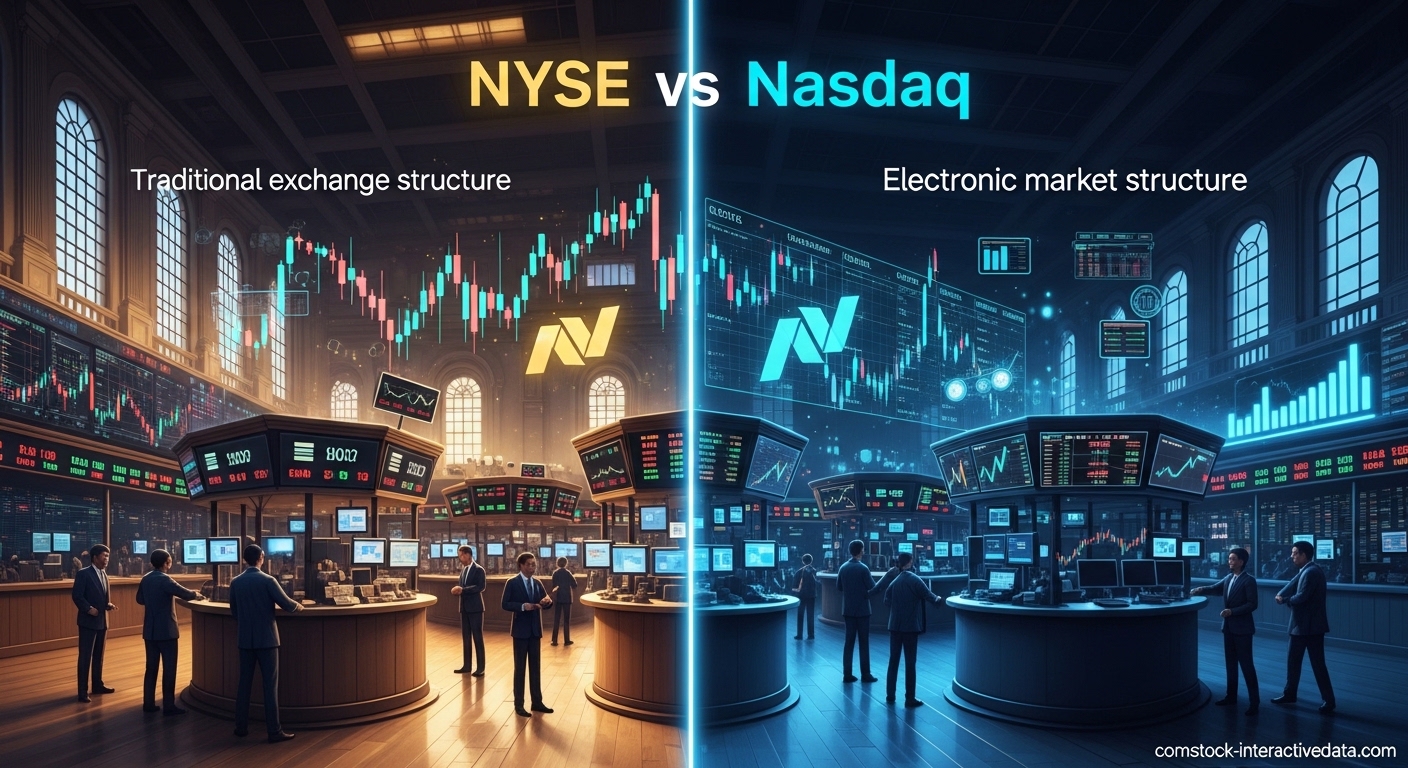
If you have ever bought or considered buying stocks, you have probably encountered two names that come up constantly: NYSE and Nasdaq. These are the two largest stock exchanges in the United States, and understanding the difference between them can help you make smarter investment decisions. The main distinction comes down to how trades are executed: the NYSE operates as an auction market with a physical trading floor, while the Nasdaq functions as an electronic dealer market with no physical floor at all.
Why does this matter for everyday investors? The exchange where a stock trades affects everything from how your order gets filled to the types of companies you can invest in. We spent weeks researching how each exchange operates, reviewing current market data, and examining what the research tells us about investor experiences. This guide breaks down everything you need to know about NYSE vs Nasdaq in plain terms.
Table of Contents
What Is the NYSE?
The New York Stock Exchange, commonly called the NYSE, is the oldest and most well-known stock exchange in the world. Founded in 1792 when 24 stockbrokers signed the famous Buttonwood Agreement under a buttonwood tree on Wall Street, the NYSE has been a cornerstone of American finance for over two centuries. It is located at 11 Wall Street in New York City and is easily recognized by its iconic trading floor where human traders gather to execute orders.
The NYSE operates as an auction market, which means buyers and sellers come together to trade at prices that are determined by supply and demand in real time. When you place an order to buy or sell a stock on the NYSE, your order competes with other orders in an electronic system, and the highest bidder gets matched with the lowest seller. This process happens continuously throughout the trading day, which runs from 9:30 AM to 4:00 PM Eastern Time, Monday through Friday, except holidays.
Companies listed on the NYSE tend to be larger, more established businesses with strong track records. These are often called blue chip stocks, referring to companies that have demonstrated financial stability and consistent performance over many years. Berkshire Hathaway, Disney, and Johnson & Johnson are examples of major companies you will find on the NYSE. As of recent data, the NYSE holds approximately $28 trillion in total market capitalization across its listed companies, making it one of the largest financial markets in the world.
What Is the Nasdaq?
The Nasdaq Stock Market, founded in 1971, is the newest major stock exchange in the United States and the world’s first electronic stock market. Unlike the NYSE, the Nasdaq never had a physical trading floor. From its inception, all trading has been conducted through a sophisticated computer network that connects buyers and sellers across the globe. This modern approach has made the Nasdaq particularly popular among technology companies and newer growth-oriented businesses.
The Nasdaq operates as a dealer market, which means that instead of matching buyers and sellers directly, trades are facilitated by market makers. These market makers are brokerage firms that continuously quote both buy and sell prices for stocks they specialize in. When you want to buy shares on the Nasdaq, you are essentially buying from one of these market makers at their quoted price. This system allows for extremely fast trade execution and has made the Nasdaq synonymous with technology investing.
Many of the most well-known technology companies in the world call the Nasdaq home, including Apple, Microsoft, Amazon, and Google parent company Alphabet. Notably, the Nasdaq reached a historic milestone in (September 2026) when its total U.S. market capitalization reached $28.2 trillion, officially surpassing the NYSE for the first time. This shift reflects the tremendous growth of technology companies and the increasing importance of the Nasdaq in the global financial landscape.
How NYSE Trading Works: The Auction Market Model
The NYSE uses an auction market model where buyers and sellers interact directly through a centralized order-matching system. When you submit an order to buy shares of a company listed on the NYSE, your order enters an electronic queue along with all other buy and sell orders for that stock. The matching system then automatically pairs the highest-priced buy order with the lowest-priced sell order, ensuring that trades occur at the best available prices.
What makes the NYSE unique is its Designated Market Maker system, formerly known as specialist system. Each stock listed on the NYSE is assigned a specific DMM who is responsible for maintaining fair and orderly trading for that security. The DMM has obligations to facilitate trading when there are sudden imbalances between buyers and sellers, helping to prevent extreme price volatility. This human oversight element distinguishes the NYSE from fully electronic exchanges.
The trading process on the NYSE also includes a closing auction at the end of each trading day. During this auction, all orders that have been accumulated throughout the day are matched at a single price that is determined to be the fairest based on supply and demand. Many index funds and institutional investors prefer to execute large trades during the closing auction because it offers better price certainty for large orders. The NYSE handles the vast majority of auction-based trading in the United States.
How Nasdaq Trading Works: The Dealer Market Model
The Nasdaq operates entirely as an electronic dealer market where trades are facilitated by multiple market makers for each stock. A market maker is a brokerage firm that commits to maintaining continuous buy and sell quotes for a particular security. These quotes include both a price at which they are willing to buy (bid) and a price at which they are willing to sell (ask), with the difference between these two prices representing their compensation for facilitating the trade.
When you place an order to buy shares on the Nasdaq, the system automatically routes your order to the market maker offering the best available price. If you want to buy 100 shares of a stock currently quoted at $50.00 ask price, your order will be filled at that price. The market maker then adjust their inventory accordingly and looks to balance their position by finding sellers or other buyers in the market. This continuous cycle of quote updates and order execution happens thousands of times per second across the Nasdaq network.
The dealer market model allows for extremely fast trade execution and provides deep liquidity for heavily traded stocks. Because multiple market makers compete for orders in the same security, spreads between bid and ask prices tend to be competitive, which can benefit retail investors through lower transaction costs. The Nasdaq electronic system operates from 4:00 AM to 8:00 PM Eastern Time, giving investors more hours to react to after-hours news and earnings announcements from Nasdaq-listed companies.
Market Makers vs Designated Market Makers
One of the most significant differences between the NYSE and Nasdaq lies in how each exchange handles market making activities. On the Nasdaq, multiple market makers can operate simultaneously for the same stock. These firms compete with each other to offer the best prices to investors, which theoretically results in tighter spreads and better execution. Any brokerage firm that meets certain financial and operational requirements can become a Nasdaq market maker.
The NYSE takes a different approach through its Designated Market Maker system. Each stock on the NYSE is assigned to a specific DMM who has exclusive responsibility for that security during trading hours. This DMM is obligated to maintain fair and orderly trading conditions and has access to certain privileges and information that help them fulfill this role. The DMM also conducts the opening and closing auctions for stocks in their care, bringing a human element to price discovery that Nasdaq lacks.
For individual investors, these differences have practical implications. Research from financial forums suggests that NYSE-listed stocks may experience less extreme price swings during normal trading conditions due to DMM oversight, while Nasdaq stocks may benefit from more competitive pricing among multiple market makers. Neither system is inherently superior; each has evolved to serve different types of investors and trading strategies. The key takeaway is that your trade execution experience may vary depending on which exchange your stocks trade on.
Listing Requirements: NYSE vs Nasdaq
The NYSE has historically maintained higher listing standards than the Nasdaq, reflecting its focus on established, large-cap companies. To list on the NYSE, a company generally must have at least $4,000 in pretax income in the most recent fiscal year, or $6,000,000 in globally aggregate pre-tax earnings over the prior three years. Additionally, companies need at least 400 shareholders who hold 100 shares or more, a minimum share price of $4.00, and must meet specific corporate governance requirements including audit committee composition and independent director requirements.
The Nasdaq offers multiple listing tiers with different requirements, making it more accessible to smaller and mid-sized companies. The Nasdaq Global Select Market requires the highest standards, similar to the NYSE, while the Nasdaq Global Market has moderate requirements and the Nasdaq Capital Market is designed for smaller companies with more relaxed standards. For example, companies on the Nasdaq Capital Market only need a minimum of $2,500,000 in stockholders’ equity and 300 total shareholders, making it an attractive entry point for growing companies.
These differing requirements help explain why the Nasdaq tends to attract younger, growth-oriented companies while the NYSE is home to more mature enterprises. When a company grows large enough, it may choose to list on the NYSE for the prestige and perceived credibility, or it may remain on the Nasdaq if it values the exchange’s technology focus and lower listing costs. Both exchanges require companies to maintain compliance with ongoing reporting and governance standards, with violations potentially leading to delisting.
Types of Companies on Each Exchange
The NYSE has built its reputation hosting America’s blue chip companies, which are generally defined as large, well-established companies with a history of stable earnings and dividends. Think of household names like Coca-Cola, Procter & Gamble, JPMorgan Chase, and ExxonMobil. These companies typically have market capitalizations in the tens or hundreds of billions of dollars and have been operating for decades or even over a century. The NYSE’s listing requirements help ensure that only companies with proven track records can join this elite group.
The Nasdaq has become synonymous with technology and innovation, though its listed companies span many sectors including biotech, semiconductors, e-commerce, and social media. Major tech giants like Apple, Microsoft, Amazon, Nvidia, and Meta Platforms all trade on the Nasdaq, along with thousands of smaller growth companies. The exchange also lists some well-known non-tech companies like Starbucks and Biogen, but the overall composition skews heavily toward technology and other high-growth sectors.
When investors ask whether Netflix is a Nasdaq or NYSE stock, the answer is Nasdaq. Netflix has traded on the Nasdaq since its 2002 initial public offering and is included in the Nasdaq-100 Index, which tracks the 100 largest non-financial companies on the exchange. This example illustrates how the Nasdaq has become the preferred listing venue for entertainment and media companies alongside technology firms. The exchange’s reputation for hosting innovative companies continues to attract new IPOs from the technology and life sciences sectors.
Market Capitalization Comparison (2026)
As of (September 2026), a significant milestone occurred in the ongoing competition between these two exchanges: the Nasdaq’s total U.S. market capitalization reached $28.2 trillion, officially surpassing the NYSE’s approximately $28 trillion. This shift reflects the tremendous appreciation of technology stocks over the past decade and represents a fundamental change in the structure of American capital markets. For context, the combined value of all stocks traded on both exchanges now exceeds $56 trillion.
Market capitalization is calculated by multiplying a company’s stock price by its total number of outstanding shares, and it represents the total market value that investors have assigned to a company. The fact that the Nasdaq surpassed the NYSE in total market cap does not necessarily mean Nasdaq-listed companies are more valuable individually; rather, it reflects the composition of each exchange. The Nasdaq’s heavy concentration of high-growth tech stocks has resulted in dramatic market cap growth as those companies have expanded.
From an investor’s perspective, this market cap comparison illustrates why both exchanges matter significantly to the broader economy. The NYSE and Nasdaq together account for the vast majority of all U.S. stock trading, and the performance of each exchange influences everything from individual retirement accounts to pension funds and sovereign wealth funds. Understanding the composition and characteristics of each exchange helps investors make more informed decisions about where to allocate their capital.
Fees and Costs: NYSE vs Nasdaq
Listing fees represent an important consideration for companies deciding which exchange to call home. The NYSE charges annual listing fees based on a tiered structure that considers the number of shares outstanding and the company’s total market capitalization. For larger companies, these fees can reach several hundred thousand dollars per year. The Nasdaq also uses a tiered fee structure but generally offers lower rates, particularly for smaller companies listing on its Capital Market tier.
For individual investors, trading costs on both exchanges have become increasingly competitive thanks to technology and regulatory changes. Most online brokers now offer commission-free stock trading, meaning you pay nothing in commissions to buy or sell shares regardless of which exchange your stocks trade on. The more meaningful cost to watch is the bid-ask spread, which represents the difference between the price at which you can buy a stock and the price at which you can sell it. Research suggests that heavily traded Nasdaq stocks often have very tight spreads due to competition among market makers.
Companies considering a listing or switch between exchanges must weigh these ongoing costs against the perceived benefits of each platform. Some companies have moved from the Nasdaq to the NYSE as they grew, attracted by the prestige of NYSE listing and its association with established blue chip companies. Others have made the opposite journey, moving from the NYSE to the Nasdaq to join a community of technology-focused companies or to take advantage of lower costs. These decisions involve careful analysis of shareholder expectations, industry norms, and long-term business strategy.
Which Exchange Is Better for Investors?
The honest answer is that neither the NYSE nor the Nasdaq is inherently better for investors. Each exchange serves different types of companies and supports different investment strategies. If you are interested in investing in established, dividend-paying companies with long operating histories, you will find more options on the NYSE. If you prefer growth-oriented investments in technology and innovation companies, the Nasdaq offers a much larger selection of such opportunities.
For most individual investors, the exchange where a stock trades matters less than the fundamentals of the company itself. A well-run company will create value for shareholders regardless of whether it is listed on the NYSE or Nasdaq, and a poorly run company will destroy value on either exchange. The key is to focus on understanding the businesses you own, their competitive positions, and their growth prospects rather than worrying about which exchange hosts their shares.
That said, there are practical differences worth knowing. NYSE stocks tend to be included in certain major indices like the Dow Jones Industrial Average, which can drive index fund flows to those companies. Nasdaq stocks are heavily represented in technology-focused indices and exchange-traded funds. If you hold index funds or ETFs, you likely own exposure to both exchanges without actively choosing between them. For active investors building individual stock portfolios, considering the exchange characteristics can help you understand the composition and concentration of your holdings.
FAQs
Which stock exchange is better, NYSE or Nasdaq?
Neither exchange is inherently better for investors. The NYSE tends to host larger, more established blue chip companies, while the Nasdaq attracts technology and growth companies. The best choice depends on your investment goals and strategy. For dividend-focused investing, NYSE may offer more options. For growth investing, Nasdaq has a larger selection of tech companies.
Is Netflix a Nasdaq or NYSE?
Netflix trades on the Nasdaq under the ticker NFLX. Netflix has been listed on the Nasdaq since its initial public offering in 2002 and is currently included in the Nasdaq-100 Index. Other well-known Nasdaq tech stocks include Apple, Microsoft, Amazon, and Google parent company Alphabet.
How to tell if a stock is NYSE or Nasdaq?
You can identify which exchange a stock trades on by looking at its ticker symbol prefix or by checking any financial website. Ticker symbols for NYSE-listed stocks typically do not have a specific prefix, while Nasdaq stocks often have four or five letters. The simplest method is to search for the stock on a financial website like Yahoo Finance or your broker’s platform, which will clearly indicate the exchange.
Is it harder to get listed on Nasdaq or NYSE?
The NYSE has higher listing requirements than the Nasdaq, making it generally harder to qualify for listing. The NYSE requires higher earnings thresholds, more shareholders, and stricter corporate governance standards. The Nasdaq offers multiple tiers including its Capital Market, which has more relaxed requirements designed for smaller, growing companies.
Is it better to be on NYSE or Nasdaq?
For companies, the choice depends on their size, industry, and strategic goals. Larger, established companies often prefer NYSE for its prestige and association with blue chip firms. Smaller, growth-oriented companies often choose Nasdaq for its technology focus and lower costs. For investors, neither exchange is better; what matters is the quality of companies you are investing in.
What is the main difference between NYSE and Nasdaq?
The NYSE is an auction market with a physical trading floor in New York City where trades are executed through direct order matching. The Nasdaq is an electronic dealer market with no physical trading floor where trades are facilitated by market makers who maintain inventories and quote prices. These different structures affect how trades are executed and the types of companies each exchange attracts.
Why switch from NYSE to Nasdaq?
Companies may switch from NYSE to Nasdaq to take advantage of lower listing costs, gain exposure to the technology-focused investor community, or align with industry peers. Some companies also find that Nasdaq’s electronic platform better suits their trading volume patterns. The decision involves weighing cost savings, perceived prestige, and strategic positioning against the disruption and expense of switching exchanges.
Understanding the Difference Between NYSE and Nasdaq
The choice between NYSE and Nasdaq ultimately represents two different approaches to organizing financial markets. The NYSE, with its two-century history and physical trading floor, represents the traditional approach where human judgment and auction dynamics play a central role. The Nasdaq, born in the computer age, represents the modern electronic approach where algorithms and market makers facilitate millions of trades per second. Both systems have proven effective at connecting buyers and sellers and enabling the capital formation that drives economic growth.
For everyday investors, the most important takeaway is that understanding how these exchanges work can help you become a more informed participant in the stock market. Whether your portfolio is heavy on Nasdaq-listed technology growth stocks or NYSE-listed dividend aristocrats, knowing where your investments trade and how that trading system operates gives you a fuller picture of your financial exposure. This knowledge becomes particularly valuable when evaluating new investment opportunities or rebalancing existing holdings.
The rivalry between NYSE and Nasdaq has driven innovation in trading technology and reduced costs for investors across both platforms. Competition has led to faster execution, lower transaction costs, and better tools for individual investors. As these exchanges continue to evolve, staying informed about their differences ensures you can navigate the stock market with greater confidence and understanding.