
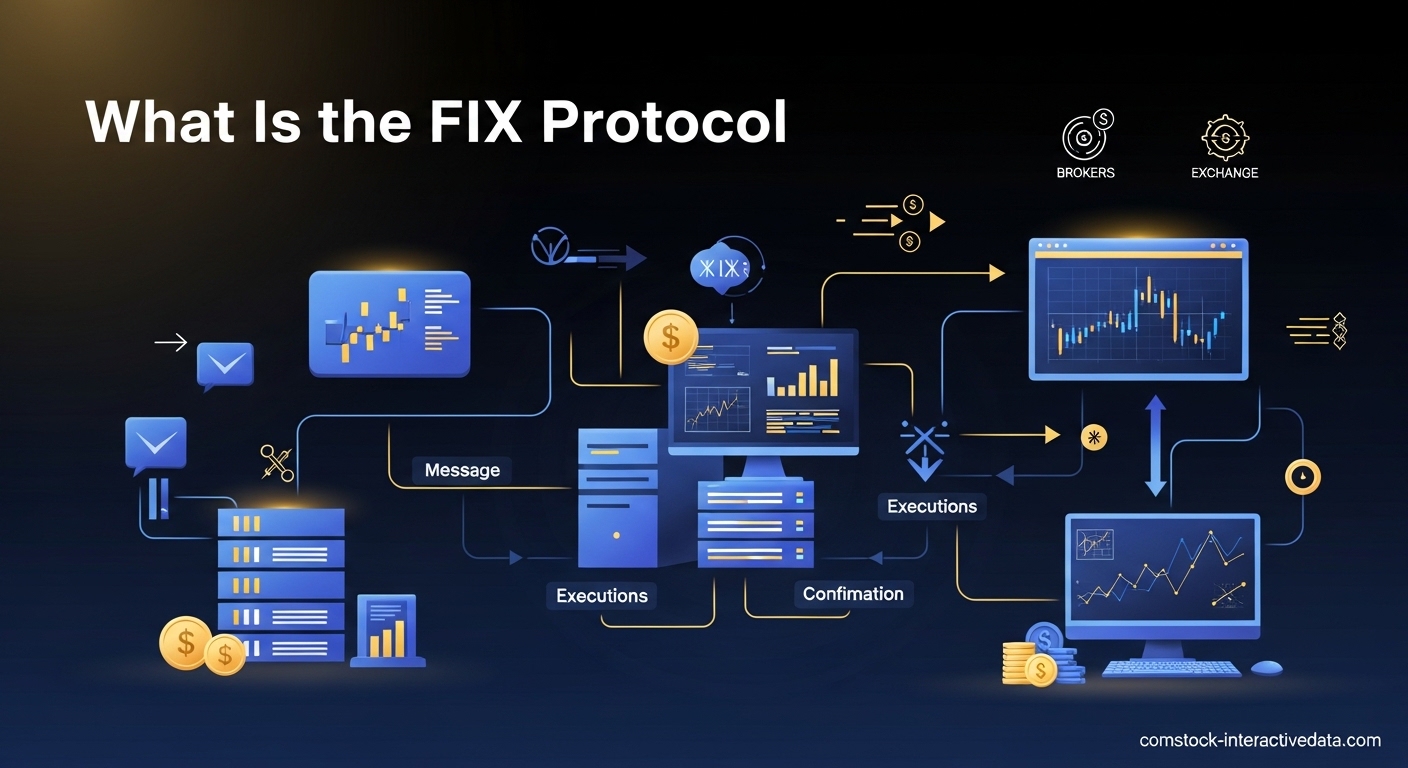
Every day, financial markets process trillions of dollars in transactions across borders, time zones, and asset classes. Behind this constant flow of trades sits a quiet but essential piece of infrastructure that most traders have never seen but absolutely depend on. I am talking about the FIX Protocol, the standardized messaging language that makes modern electronic trading possible.
In this guide, I will explain exactly what the FIX Protocol is, how it works under the hood, and why it earned the title of “the language of trading.” Whether you are a technology professional entering finance, a trader curious about infrastructure, or simply someone who wants to understand how markets actually function, this article will give you a clear, practical understanding of one of fintech’s most important standards.
Table of Contents
What Is the FIX Protocol?
The FIX Protocol (Financial Information eXchange) is an open, non-proprietary electronic messaging standard that enables real-time communication of securities transaction information between financial institutions. It serves as the universal language that trading systems use to talk to each other across the global financial ecosystem.
Think of FIX as the common tongue that connects thousands of different trading systems. Before FIX, every broker-dealer, exchange, and asset manager used their own proprietary communication methods. This created expensive integration headaches and slowed down the entire trading process. FIX solved this by creating a single, standardized format that everyone could adopt.
The protocol covers the entire trade lifecycle. It handles pre-trade activities like sending indications of interest and receiving market data. It manages the trade itself through order entry, execution reporting, and confirmations. And it extends into post-trade processing with allocation messaging and settlement instructions.
FIX started with equities trading but has expanded across virtually every asset class. Today you will find FIX used in fixed income markets, foreign exchange (FX), listed derivatives, and even emerging areas like cryptocurrencies. The FIX Trading Community, the non-profit industry body that maintains the protocol, estimates that over 75% of all equity trades worldwide flow through FIX messages.
Perhaps most importantly, FIX is completely free to use. Unlike proprietary protocols that lock you into vendor relationships, FIX is an open standard. Any firm can implement it without paying licensing fees, which has driven its universal adoption across the industry.
The History and Origin of FIX
The FIX Protocol was born in 1992 out of frustration with the status quo. Two firms, Fidelity Investments and Salomon Brothers, found themselves drowning in the complexity of connecting their trading systems to multiple counterparties. Each connection required custom development because every firm used different proprietary protocols.
A small team from both companies got together and created a simple, standardized messaging format. Their goal was modest: make it easier to trade equities electronically between their two firms. They had no idea they were creating what would become the global standard for financial messaging.
The early versions of FIX were simple text-based messages. Version 2.7, released in 1994, was the first production-ready version and gained traction among major broker-dealers. By 1996, version 3.0 had established the core message structure that persists today.
In 1998, the FIX Protocol Limited (now the FIX Trading Community) was formed as an independent, non-profit entity to govern the standard. This was crucial because it ensured FIX would remain vendor-neutral and freely available. No single company would control it.
The protocol evolved through several major versions. FIX 4.2, released in 2001, became the most widely adopted version and remains common today. FIX 4.4 (2003) added support for more complex asset classes. FIX 5.0 (2006) introduced the Transport Independence framework, separating the application layer from the session layer.
Today the FIX Trading Community includes hundreds of member firms ranging from the world’s largest investment banks to small technology vendors. They continue evolving the protocol through working groups that address modern needs like cloud deployment, high-performance binary encoding, and regulatory reporting requirements.
How FIX Works: A Technical Overview
FIX uses a simple but elegant tag-value pair format that makes messages both human-readable and machine-parseable. Every piece of data in a FIX message is identified by a numeric tag followed by an equals sign and the value.
Here is what an actual FIX message looks like. This is a New Order Single message that an asset manager might send to a broker to buy 100 shares of Apple stock:
8=FIX.4.2|9=137|35=D|34=12|49=BUY_SIDE|52=20260406-14:30:00.000|56=SELL_SIDE|11=ORDER12345|55=AAPL|54=1|38=100|40=2|44=150.50|10=128|
Let me break down what these tags mean. Tag 8 (BeginString) identifies the FIX version. Tag 9 (BodyLength) tells the receiving system how long the message body is. Tag 35 (MsgType) specifies this is a New Order message. Tags 49 and 56 identify the sender and receiver. Tag 55 is the stock symbol. Tag 54 indicates this is a buy order. Tag 38 shows the quantity of 100 shares. Tag 40 specifies order type 2, which means limit order. And tag 44 shows the limit price of $150.50.
Every FIX message follows a three-part structure. The header contains routing and delivery information like version, message type, sender, and timestamp. The body carries the actual business content like order details, execution information, or allocation data. The trailer provides integrity checking, primarily through a checksum that ensures the message was not corrupted in transmission.
FIX operates at two distinct layers. The session layer manages the technical connection between parties. It handles logon and logout sequences, heartbeat messages that verify the connection is alive, message sequencing to ensure nothing is lost, and resend requests if gaps are detected.
The application layer handles the actual business content. This is where orders, executions, cancels, and market data live. The separation means you can change how you transport messages (moving from traditional FIX sessions to FIXP over WebSocket, for example) without changing the business message format.
A FIX engine is the software component that implements the protocol. It handles message formatting, session management, parsing incoming messages, and providing an API that trading applications can use. Most firms either license commercial FIX engines from vendors like Rapid Addition or QuickFIX, or they use open-source options like QuickFIX/J or QuickFIX/n.
Who Uses the FIX Protocol?
FIX is the connective tissue of institutional trading. The protocol serves three main categories of market participants who all rely on it for different but complementary reasons.
Buy-side firms are the institutional investors who manage money on behalf of clients. This includes asset managers running mutual funds, hedge funds executing complex strategies, pension funds managing retirement assets, and insurance companies investing premiums. Buy-side firms use FIX to send orders to their broker-dealers, receive execution reports, and manage the entire order lifecycle through their Order Management Systems (OMS) and Execution Management Systems (EMS).
Sell-side firms provide execution services and liquidity to the buy side. Investment banks and broker-dealers use FIX to receive client orders, route them to exchanges or internal matching engines, and report fills back to clients. They also use FIX for proprietary trading activities and market making. For sell-side firms, FIX is the primary interface they expose to clients.
Trading venues and infrastructure providers form the third major category. Stock exchanges like NYSE and NASDAQ, alternative trading systems, dark pools, and electronic communication networks (ECNs) all accept FIX connections. So do market data providers, clearinghouses, and even regulatory bodies who use FIX for transaction reporting.
Retail traders rarely interact directly with FIX because most retail brokerages provide simpler REST APIs or web interfaces. However, even retail orders often flow through FIX behind the scenes. When you place an order through a retail broker, their backend systems frequently convert your click into FIX messages to interact with exchanges and liquidity providers.
Why FIX Is the Language of Trading?
The nickname “language of trading” is not marketing fluff. FIX earned this title by solving real problems that matter to everyone in the trading ecosystem. Let me break down exactly why this protocol dominates financial markets.
Cost elimination stands as the original and still most compelling benefit. Before FIX, firms spent enormous amounts building and maintaining proprietary connections to each counterparty. Every new trading partner meant custom integration work. FIX turned thousands of one-to-one integrations into a single standardized interface. Our team estimates that standardized messaging saves the industry billions annually in integration and maintenance costs.
Speed and reliability matter enormously in trading. FIX messages transmit in milliseconds, enabling the real-time execution that modern markets require. The protocol includes built-in mechanisms for message acknowledgment, sequence tracking, and automatic reconnection. When a connection drops, FIX engines can recover gracefully without losing messages. This reliability is essential for algorithmic trading and high-frequency trading operations where every microsecond counts.
Global standardization means a trading desk in London can use the exact same message format to trade with counterparties in Tokyo, New York, or Sydney. This cross-border compatibility has enabled the globalization of trading operations. Asset managers can route orders to the best execution venue regardless of location because FIX provides a common language understood everywhere.
Reduced market entry barriers have been transformative. A new broker-dealer or trading venue can enter the market and connect to thousands of potential counterparties simply by implementing FIX. They do not need to convince every potential client to build custom integrations. This has democratized access to trading infrastructure and increased competition.
Straight-through processing (STP) represents another major benefit. FIX enables trades to flow from order entry through execution, confirmation, allocation, and settlement without manual intervention. This reduces errors, cuts operational costs, and accelerates the entire post-trade process. STP has become the expected standard in institutional trading, and FIX makes it possible.
| Benefit | Buy-Side Impact | Sell-Side Impact | Market-Wide Impact |
|---|---|---|---|
| Cost Reduction | Lower broker connectivity costs | Single client integration | Industry saves billions annually |
| Speed | Faster execution for algos | Quicker client onboarding | Tighter spreads, better liquidity |
| Reliability | Confidence in order handling | Reduced operational risk | Stable market infrastructure |
| Global Reach | Access to world markets | Global client base | Integrated global trading |
| STP | Faster settlement cycles | Lower back-office costs | Reduced counterparty risk |
FIX in Modern Trading
Despite being over 30 years old, FIX remains highly relevant in 2026 trading infrastructure. The protocol has continuously evolved to meet modern requirements rather than becoming obsolete.
Asset class coverage has expanded dramatically from its equities origins. Fixed income markets adopted FIX for bond trading as electronic platforms emerged. Foreign exchange markets, the largest financial market by volume, rely heavily on FIX for both spot trading and derivatives. Listed derivatives, commodities, and even newer instruments like crypto derivatives now use FIX messaging.
Algorithmic trading and high-frequency trading (HFT) operations depend on FIX for their core infrastructure. While ultra-HFT firms sometimes use proprietary binary protocols for their most latency-sensitive strategies, FIX handles the vast majority of institutional algorithmic trading. The protocol’s performance characteristics are more than adequate for sub-millisecond execution needs.
Cloud deployment has become a major trend. FIX engines now run natively in AWS, Azure, and Google Cloud environments. This enables firms to deploy trading infrastructure without building data centers. The FIX Trading Community has established working groups addressing cloud-specific considerations like dynamic IP addresses and containerized deployments.
Performance improvements continue through initiatives like Simple Binary Encoding (SBE). While traditional FIX uses ASCII text, SBE provides a binary encoding that maintains FIX semantics while dramatically improving parsing speed and reducing message size. SBE is particularly valuable for market data distribution where message volumes are enormous.
Comparisons with REST APIs and WebSockets naturally arise. REST APIs are simpler and work well for lower-frequency trading applications, which is why retail brokers often expose them. WebSockets provide bidirectional streaming that some modern platforms prefer. However, FIX remains the institutional standard because of its comprehensive session management, reliability features, and universal acceptance. For serious trading operations, FIX is still the protocol of choice.
Frequently Asked Questions
How is FIX protocol used in trading?
FIX protocol enables real-time electronic communication for the entire trade lifecycle. It transmits orders from buy-side firms to sell-side brokers, carries execution reports back to clients, handles order modifications and cancellations, and supports post-trade processes like allocations and confirmations. Trading systems use FIX engines to format, send, receive, and parse these standardized messages.
Is the FIX protocol still used?
Yes, FIX protocol remains essential and widely used in 2026. Over 75% of global equity trades flow through FIX messages, and the protocol continues expanding into fixed income, FX, derivatives, and emerging asset classes. The FIX Trading Community actively maintains and evolves the standard with new versions addressing cloud deployment, binary encoding, and modern performance requirements.
What is the purpose of a FIX?
The purpose of FIX is to provide a standardized, non-proprietary messaging format that enables any trading system to communicate with any other system. This eliminates the need for custom integrations between every counterparty pair, dramatically reducing costs and increasing execution speed across the global financial markets.
What is the FIX protocol language?
The FIX protocol language uses tag-value pairs to structure trading messages. Each data element is identified by a numeric tag followed by an equals sign and a value. Messages follow a Header-Body-Trailer format. The language includes standardized message types for orders, executions, cancels, and other trading activities, making it a complete vocabulary for financial transactions.
Is FIX faster than websockets?
FIX and WebSockets serve different purposes. Raw WebSocket connections can have lower latency because they lack FIX’s built-in session management overhead. However, FIX provides essential reliability features like message sequencing, automatic reconnection, and guaranteed delivery that WebSockets lack natively. For institutional trading where reliability matters, FIXP (the FIX Performance session layer) can run over WebSockets, combining both technologies.
What is the future of FIX protocol?
FIX continues evolving to meet modern trading needs. Key developments include Simple Binary Encoding (SBE) for high-performance messaging, FIXP for modern transport independence, cloud deployment standards, and expanded cryptocurrency support. The protocol remains the institutional standard and will continue adapting to new technologies while maintaining backward compatibility.
What is the difference between FIX and FIXP?
FIX refers to the application-layer messaging protocol that defines how trading information is structured. FIXP (FIX Protocol) is a session-layer specification introduced in FIX 5.0 that separates transport from messaging. FIXP handles connection management, heartbeats, and sequencing, allowing the FIX application layer to run over various transports including TCP, WebSockets, or multicast.
Conclusion
The FIX Protocol stands as one of the most successful technology standards in financial services history. What began as a simple solution between two firms in 1992 has grown into the universal language connecting thousands of institutions handling trillions in daily transactions.
FIX earned its title as the language of trading by solving real problems. It eliminated proprietary protocol chaos, cut integration costs by orders of magnitude, enabled global trading standardization, and provided the reliability that institutional trading demands. The protocol’s open, non-proprietary nature ensured widespread adoption while continuous evolution keeps it relevant decades later.
Understanding FIX matters whether you are building trading systems, managing operations, or simply seeking to comprehend modern market infrastructure. In 2026 and beyond, the FIX Protocol remains the essential connective tissue that makes electronic trading work at scale.