
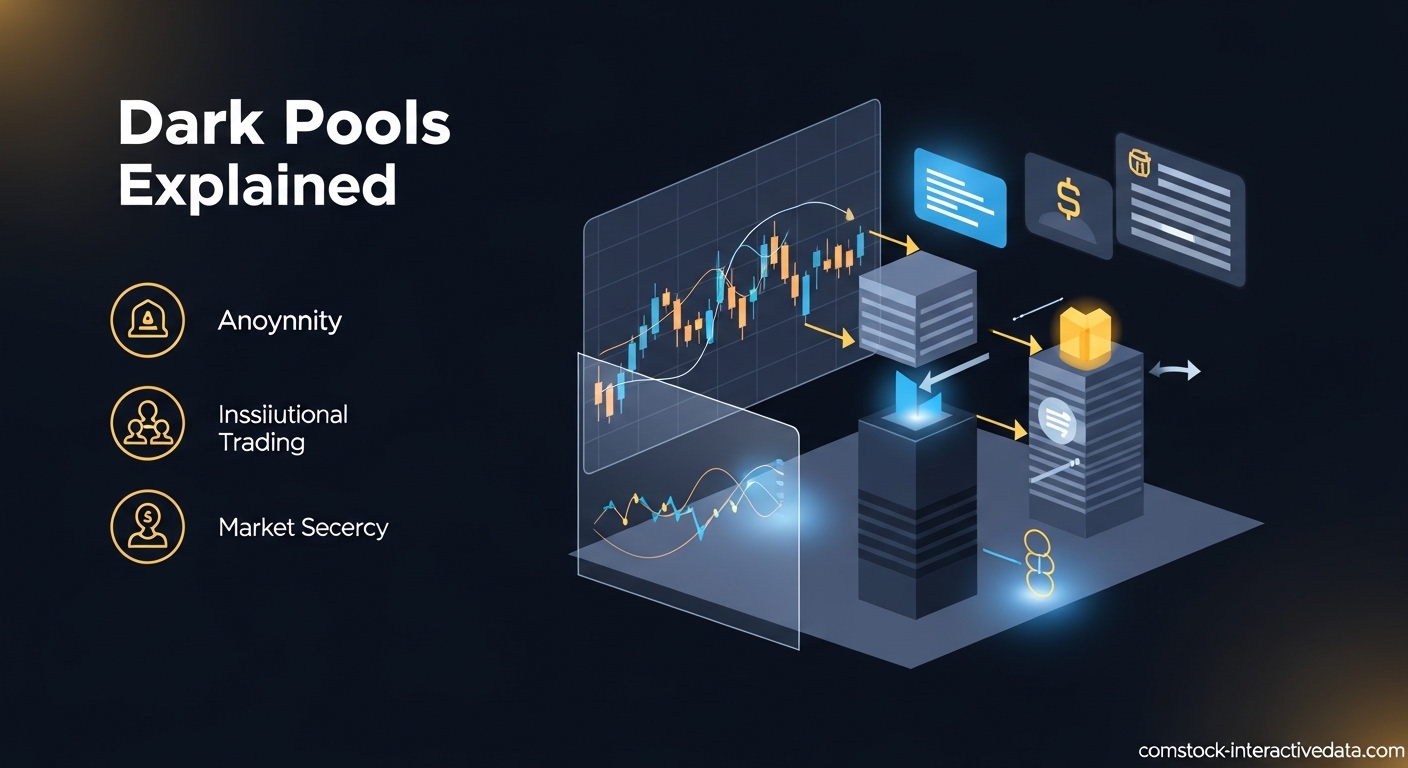
Imagine you are managing a $5 billion pension fund and need to sell 2 million shares of Apple stock. If you placed that entire order on the NYSE, the market would see your massive sell order immediately. The stock price would likely plummet before you could complete the trade, costing your fund millions. This is exactly why dark pools exist. They allow institutional investors to move large blocks of securities without revealing their intentions to the broader market.
Dark pools are private trading venues where institutional investors execute large trades anonymously. Unlike public exchanges such as the NYSE or Nasdaq, these alternative trading systems do not display orders before trades occur. This off-exchange trading mechanism has grown to handle a significant portion of daily equity volume, yet many retail investors remain unaware of how dark pools operate or how they affect market dynamics.
In this guide, I will explain exactly how dark pools work, who uses them, and why they remain a controversial but essential component of modern market structure. By the end, you will understand the mechanics behind these private venues and their impact on price discovery, transparency, and your own trading experience.
Table of Contents
What Are Dark Pools?
Dark pools are private financial exchanges where institutional investors trade large blocks of securities without pre-trade transparency. The term “dark” refers to the lack of displayed orders before execution, not any illegal activity. These venues are formally classified as Alternative Trading Systems (ATS) under SEC Regulation ATS.
An ATS operates as a trading venue but does not function as a traditional stock exchange. Unlike public exchanges that broadcast bid and ask prices to all participants, dark pools keep order information hidden until trades are completed. This anonymity is the defining characteristic that distinguishes dark pools from “lit” venues.
The Origins of Dark Pools
The first dark pools emerged in the 1980s when institutional investors sought ways to execute large trades without moving prices against themselves. The 1998 SEC adoption of Regulation ATS formalized the regulatory framework for these venues, leading to explosive growth in the 2000s.
By 2026, dark pools handle approximately 40-45% of all U.S. equity trading volume. Major platforms include Credit Suisse’s CrossFinder, UBS’s ATS, Goldman Sachs’s Sigma X, and independent operators like Liquidnet and ITG Posit. These venues have become integral to how large institutions manage their trading strategies.
Key Characteristics
Several features define dark pool trading:
Anonymous trading prevents counterparties from knowing each other’s identity until after the trade executes. This stops other market participants from front-running or gaming large orders.
Block trade focus means dark pools specialize in transactions of 10,000 shares or more. The average dark pool trade size is substantially larger than public exchange transactions.
Delayed reporting allows trades to be reported to the consolidated tape seconds or even minutes after execution, further masking trading activity.
Non-displayed liquidity remains hidden from the broader market until matched, preventing information leakage about institutional intentions.
How Dark Pools Work: The Mechanics of Off-Exchange Trading
Understanding the mechanics of dark pools requires examining how orders flow through these private venues. The process differs significantly from trading on public exchanges.
The Dark Pool Trading Process
Step 1: Order Submission
An institutional investor submits a large buy or sell order to a dark pool through their broker-dealer. The order specifies the security, quantity, and any price constraints but remains invisible to other market participants.
Step 2: Order Matching
The dark pool’s matching engine searches for compatible counterparties within the venue. Unlike public exchanges that use continuous auction matching, dark pools employ various algorithms including midpoint pegging, where orders execute at the middle of the National Best Bid and Offer (NBBO).
Step 3: Trade Execution
When a match is found, the trade executes at an agreed price, typically at or better than the NBBO. Both parties remain anonymous throughout this process.
Step 4: Post-Trade Reporting
The completed trade is reported to a trade reporting facility and appears on the consolidated tape, often with a slight delay. This delayed reporting prevents immediate market reaction to the block trade.
Pricing Mechanisms
Dark pools use several pricing methods to match orders. Midpoint pricing is the most common, executing trades at the exact middle point between the current bid and ask prices on public exchanges. This provides price improvement for both buyer and seller compared to taking the displayed quote.
Some dark pools use iceberg orders, displaying only a small portion of a large order while hiding the bulk. As the visible portion fills, new slices appear until the complete order executes.
Volume Weighted Average Price (VWAP) matching seeks to execute orders throughout the day at prices matching the average weighted by volume. This helps institutions benchmark their execution quality against market averages.
Volume Statistics and Market Share
Dark pool volume has grown dramatically over the past two decades. According to FINRA data, ATS volume regularly exceeds 1.5 billion shares daily in U.S. equity markets. As of 2026, approximately 40% of all U.S. equity volume flows through dark pools and other off-exchange venues.
Market fragmentation has increased substantially, with trading now spread across more than 50 dark pools and 13 public exchanges. This fragmentation creates both opportunities for institutions seeking anonymity and challenges for overall market transparency.
Types of Dark Pools
Not all dark pools operate identically. They fall into three primary categories based on ownership structure and participant access.
Broker-Dealer Owned Dark Pools
Major investment banks operate these pools primarily for their institutional clients. Examples include:
Credit Suisse CrossFinder: One of the largest dark pools by volume, offering advanced smart order routing and liquidity-seeking algorithms.
Goldman Sachs Sigma X: Provides execution services for Goldman’s institutional clients with proprietary matching technology.
UBS ATS: Offers both continuous crossing and scheduled auction sessions for block trading.
JP Morgan JPM-X: Combines dark pool access with the bank’s broader trading and research services.
These pools primarily serve the broker’s own clients, often crossing orders internally before routing elsewhere. This internalization can generate profit for the broker-dealer while potentially creating conflicts of interest.
Independent or Standalone Dark Pools
Independent operators run these venues without broker-dealer ownership, offering neutral access to multiple participants:
Liquidnet: Specializes in large block trades between institutional investors, with minimum trade sizes of 5,000 to 50,000 shares depending on liquidity.
ITG Posit: One of the oldest dark pools, offering scheduled crossing networks at specific times throughout the trading day.
Instinet: Provides crossing services and liquidity aggregation across multiple venues.
Independent pools often attract institutions seeking to avoid potential information leakage to broker-owned venues that might share data with proprietary trading desks.
Consortium and Exchange-Owned Dark Pools
These pools are owned by groups of broker-dealers or public exchanges:
BIDS Trading: A consortium-owned ATS backed by multiple broker-dealers, focusing on block-sized natural liquidity.
NYSE Pillar: The New York Stock Exchange’s integrated trading platform includes non-displayed liquidity options.
Nasdaq OMX: Offers various ATS services including the Nasdaq Cross and other off-exchange mechanisms.
IEX: While primarily a public exchange, IEX includes dark pool-like features designed to prevent predatory trading strategies.
Who Uses Dark Pools and Why?
Dark pool participants are predominantly large institutional investors managing substantial portfolios. These include mutual funds, pension funds, hedge funds, and asset managers.
Primary Users
Mutual funds use dark pools when rebalancing portfolios or handling large cash inflows and outflows. A fund managing $10 billion in assets might need to trade hundreds of thousands of shares to adjust a single position.
Pension funds execute block trades when implementing strategic allocation changes. Their long-term investment horizon requires minimizing transaction costs that compound over decades.
Hedge funds utilize dark pools to build or exit positions without revealing their strategies to competitors. A hedge fund accumulating shares in a takeover target needs absolute secrecy.
Asset managers employ dark pools for index reconstitutions, where they must buy or sell thousands of securities simultaneously to match benchmark changes.
Trading Strategies
Institutions use specific execution strategies optimized for dark pool characteristics:
VWAP (Volume Weighted Average Price) strategies seek to execute orders throughout the day proportional to market volume, achieving average execution prices.
Implementation Shortfall strategies balance the trade-off between market impact and timing risk, optimizing execution against a benchmark price.
Dark-only strategies route orders exclusively to dark pools to maximize anonymity, accepting that some orders may not fill if counterparties are unavailable.
Advantages of Dark Pool Trading
Dark pools offer several compelling benefits that explain their popularity among institutional investors.
Reduced Market Impact
The primary advantage is minimizing market impact. When a large order appears on a public exchange, it immediately affects the bid-ask spread and potentially moves the stock price. Dark pools prevent this information leakage, allowing institutions to complete trades closer to prevailing market prices.
Studies suggest that executing large orders in dark pools reduces transaction costs by 10-30 basis points compared to public exchanges. On a $100 million trade, that represents $100,000 to $300,000 in savings.
Price Improvement Opportunities
Midpoint pricing often provides better execution than displayed quotes. If a stock trades at $50.00 bid and $50.02 ask on public exchanges, a dark pool midpoint execution occurs at $50.01. Both buyer and seller receive one cent improvement per share compared to the public market.
For large block trades, this improvement accumulates substantially. A 100,000 share trade saves $1,000 through midpoint execution.
Anonymity Benefits
Anonymity prevents predatory trading strategies. Without knowing who is trading, other market participants cannot:
Front-run orders by anticipating large movements.
Game specific investors by exploiting their known trading patterns.
Signal their own intentions through response to displayed orders.
This anonymity is particularly valuable for active managers whose success depends on keeping their strategies confidential.
Access to Natural Liquidity
Dark pools match natural buyers with natural sellers without intermediary market makers. This peer-to-peer matching can result in better prices than dealer-mediated transactions on public exchanges.
Disadvantages and Criticisms of Dark Pools
Despite their benefits, dark pools face significant criticism from market participants, regulators, and academics.
Reduced Market Transparency
The most common criticism is that dark pools reduce overall market transparency. When significant trading volume occurs away from public view, the consolidated tape no longer reflects true supply and demand. This non-displayed liquidity obscures price discovery for all market participants.
Transparency advocates argue that markets function best when all participants can see available liquidity. Dark pools fragment this visibility, potentially harming price efficiency.
Information Asymmetry
Dark pools create information asymmetry favoring institutional investors over retail traders. While institutions know their own order flow, retail traders see only the diminished public market activity. This imbalance can lead to retail orders executing at worse prices than if all trading occurred on transparent venues.
SEC Chair Gary Gensler has highlighted that 90-95% of retail orders never reach lit exchanges, raising concerns about execution quality for individual investors.
Retail Order Internalization
Many retail brokerages route customer orders to affiliated dark pools or internalize them within the broker’s own trading desk. While brokers claim this produces price improvement, critics argue it often results in worse execution than public markets would provide.
Payment for order flow arrangements, where market makers pay brokers for order access, create potential conflicts of interest. The broker may prioritize payment over best execution for customers.
High-Frequency Trading Concerns
High-frequency trading (HFT) firms have developed sophisticated strategies to detect and exploit dark pool activity. These firms use pattern recognition and rapid data analysis to infer when large orders are present, potentially gaming institutional trades despite anonymity protections.
Some dark pools have been accused of giving preferential access to HFT firms in exchange for liquidity provision, undermining the venue’s neutrality.
Market Fragmentation
The proliferation of dark pools has fragmented liquidity across dozens of venues. This fragmentation makes it harder to find counterparties and can increase overall trading costs as institutions must search multiple pools to complete orders.
Dark Pools vs Public Exchanges: A Detailed Comparison
Understanding the differences between dark pools and public exchanges clarifies their respective roles in market structure.
| Feature | Dark Pools (ATS) | Public Exchanges (Lit) |
|---|---|---|
| Pre-trade transparency | Non-displayed orders | Full order book visible |
| Price discovery | Uses NBBO reference | Primary price formation |
| Participants | Primarily institutional | All market participants |
| Trade size | Large block focus | All sizes welcome |
| Reporting | Delayed to tape | Immediate reporting |
| Anonymity | Counterparties hidden | Participant identities known |
| Pricing | Midpoint or better | Displayed bid/ask |
| Regulation | SEC Regulation ATS | Exchange Act registration |
| Market impact | Minimal information leakage | Orders visible immediately |
Public exchanges remain the primary venues for price discovery, where supply and demand establish fair market values. Dark pools derive their pricing from these lit venues but offer execution benefits for specific use cases. The two systems coexist in modern market structure, with sophisticated trading algorithms routing orders between venues based on order characteristics and market conditions.
Regulatory Oversight and Compliance
Dark pools operate under comprehensive regulatory frameworks designed to balance institutional needs with market integrity.
SEC Regulation ATS
The Securities and Exchange Commission governs dark pools through Regulation ATS, adopted in 1998 and amended in 2018. Key requirements include:
Registration as a broker-dealer and ATS with the SEC.
Compliance with capacity, integrity, and security standards.
Reporting of trading volume and system outages.
Fair access rules preventing discriminatory practices.
2018 amendments strengthened disclosure requirements, mandating that ATSs provide detailed information about operations, fees, and conflicts of interest.
FINRA Oversight
The Financial Industry Regulatory Authority supervises dark pool activity through its trade reporting facility. All ATS trades must be reported to FINRA, which publishes aggregate volume data weekly. FINRA also monitors for manipulative trading and potential abuse.
Reg NMS and Best Execution
Regulation NMS (National Market System) requires that trades occur at the best available price across all venues. Dark pools must provide price improvement or match the NBBO to comply with best execution obligations.
International Regulations
European dark pools operate under MiFID II, which imposes stricter volume caps and transparency requirements than U.S. regulations. The 8% volume cap mechanism limits dark pool trading in any single stock, forcing activity back to public markets when thresholds are exceeded.
How to Monitor Dark Pool Activity?
While individual dark pool orders remain hidden, aggregate activity data is publicly available.
Official Data Sources
FINRA ATS Transparency Data: FINRA publishes weekly volume statistics for all registered ATSs, showing which venues handle the most trading in specific securities.
SEC MIDAS: The Market Information Data Analytics System provides academic and regulatory researchers with detailed market activity data, though retail access is limited.
Commercial Tools
Several platforms offer dark pool monitoring capabilities:
Market Chameleon: Provides dark pool volume analysis and unusual activity alerts.
Cheddar Flow: Offers real-time options flow and dark pool print tracking.
ThinkorSwim: Includes some dark pool volume indicators in its platform.
Practical Monitoring Tips
Look for unusual dark pool volume spikes that may indicate institutional accumulation or distribution. Compare dark pool prints to public exchange activity to gauge institutional sentiment. Monitor late-day block trades, as institutions often execute large positions in the closing minutes.
Frequently Asked Questions
How does off-exchange trading work?
Off-exchange trading occurs directly between two parties without routing through a public exchange like NYSE or Nasdaq. Dark pools are private venues where institutional investors anonymously match large buy and sell orders. When a match occurs, the trade executes at a reference price, typically the midpoint of the National Best Bid and Offer. Trades are reported to the public tape after execution, often with a slight delay.
How does darkpool trading work?
Dark pool trading works through five key steps: 1) Institutional investors submit large orders to a dark pool instead of public exchanges. 2) The dark pool’s matching engine searches for compatible counterparties without displaying order details. 3) When a match is found, the trade executes at a reference price, often the midpoint of NBBO. 4) Both parties remain anonymous throughout the process. 5) The completed trade is reported to the consolidated tape with a slight delay, masking the full size and origin.
What are the disadvantages of dark pool trading?
The main disadvantages of dark pool trading include: reduced market transparency since true supply and demand remains hidden; less efficient price discovery for the broader market; information asymmetry favoring institutional investors over retail traders; potential for predatory high-frequency trading strategies to exploit dark pool mechanics; fragmentation of liquidity across multiple venues making execution more complex; and retail orders may be internalized at worse prices than available on public markets.
Are dark pools legal?
Yes, dark pools are completely legal and regulated financial venues. They operate under SEC Regulation ATS in the United States and similar frameworks internationally. Dark pools must register with regulators, report trading activity, and comply with best execution requirements. The term dark refers to pre-trade transparency only, not illegal activity. However, specific dark pool operators have faced regulatory enforcement for violations such as misleading subscribers about data sharing practices.
Can retail traders use dark pools?
Retail traders generally cannot directly access dark pools. These venues are designed for institutional investors trading large blocks of securities, typically with minimum order sizes of 5,000 to 50,000 shares. However, retail orders are often routed to dark pools indirectly through broker-dealer internalization or payment for order flow arrangements. This means retail trades may execute in dark pool venues without the trader’s knowledge, raising concerns about execution quality.
What percentage of trading happens in dark pools?
As of 2026, approximately 40-45% of all U.S. equity trading volume occurs in dark pools and other off-exchange venues. According to FINRA data, ATS volume regularly exceeds 1.5 billion shares daily. SEC Chair Gary Gensler has reported that 90-95% of retail orders never reach lit exchanges, suggesting an even higher percentage of overall activity occurs away from public markets when including broker internalization.
Conclusion
Dark pools represent a fundamental component of modern market structure, serving a legitimate purpose for institutional investors while raising valid concerns about transparency and fairness. These alternative trading systems enable large block trades with minimal market impact, providing essential liquidity management tools for pension funds, mutual funds, and hedge funds.
However, the growth of dark pools to handle nearly half of all equity volume has created information asymmetries and fragmented liquidity in ways that affect all market participants. Retail traders should understand that their orders may flow through these venues indirectly, and that the prices they receive may differ from what public exchanges would offer.
Regulatory scrutiny of dark pools continues to intensify, with proposals for enhanced disclosure and potential volume limitations under consideration. As market structure evolves in 2026 and beyond, the balance between institutional needs for anonymity and the broader market’s need for transparency remains a central debate in financial regulation. Understanding how dark pools work empowers investors at all levels to navigate markets more effectively and advocate for fair trading practices.