
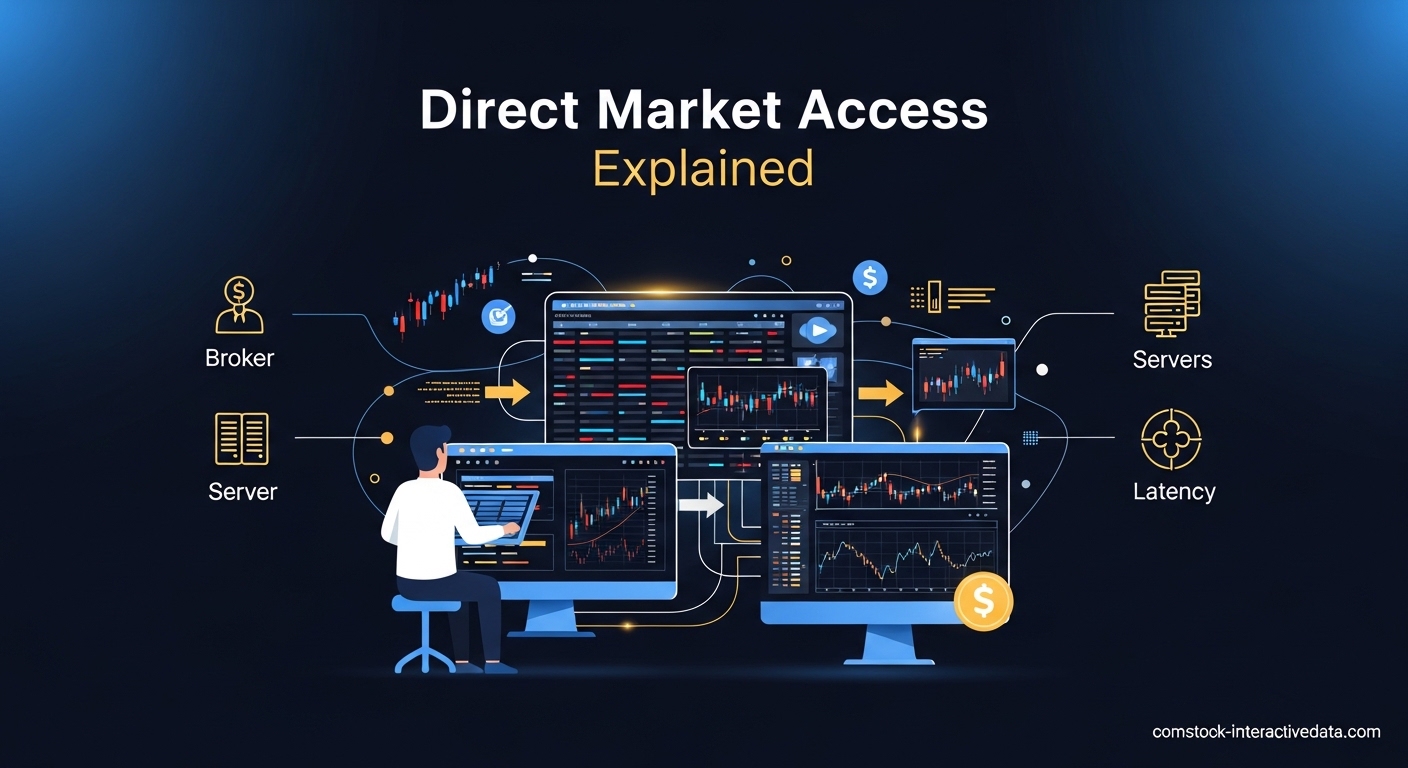
Direct Market Access (DMA) represents one of the most significant technological shifts in modern trading. It allows traders to send buy and sell orders directly to exchange order books, bypassing traditional broker dealing desks entirely. This direct connection offers faster execution speeds, greater transparency, and more control over how orders are routed.
In this guide, I will explain exactly how DMA works, who benefits from it most, and what you need to know before considering this trading approach. Our team has analyzed the technical infrastructure, regulatory requirements, and real-world applications to give you a complete picture.
Table of Contents
Key Takeaways
- DMA allows traders to place orders directly on exchange order books without broker intermediaries
- Primary benefits include faster execution, lower latency, Level II market data visibility, and direct order routing control
- Most commonly used by institutional traders, algorithmic trading firms, hedge funds, and high-volume retail traders
- Requires robust technology infrastructure including FIX protocol connectivity and pre-trade risk controls
- Regulated under FINRA Rule 15c3-5 with strict risk management requirements
What Is Direct Market Access (DMA)?
Direct Market Access (DMA) is an electronic trading method that allows market participants to send orders directly to an exchange’s matching engine. Unlike traditional retail trading where orders pass through a broker’s dealing desk, DMA establishes a direct technological connection between the trader and the exchange.
The defining characteristic of DMA is the elimination of intermediary handling. When you submit an order through DMA infrastructure, it travels directly to the exchange order book without human intervention or dealer desk processing. This creates a straight-through processing pipeline from order generation to execution confirmation.
The Evolution from Pit Trading to Electronic DMA
Before DMA became commonplace, trading occurred primarily through open outcry pits where human brokers physically matched orders. The transition began in the 1980s with electronic communication networks (ECNs) that allowed institutional participants to match orders after hours.
By the late 1990s and early 2000s, exchanges began offering direct connectivity to their matching engines. The FIX protocol (Financial Information eXchange) became the standard messaging format, enabling different trading systems to communicate seamlessly. This technological standardization paved the way for widespread DMA adoption across major exchanges worldwide.
Today, DMA is the dominant execution method for institutional trading. According to industry data, over 80% of institutional equity volume in major markets flows through some form of direct market access infrastructure.
DMA vs Traditional Broker Trading: Key Differences
Understanding how DMA differs from traditional retail trading helps clarify why certain traders prefer this approach. The fundamental distinction lies in the order path and control level.
| Feature | DMA Trading | Traditional Retail Trading |
|---|---|---|
| Order Path | Direct to exchange matching engine | Through broker dealing desk |
| Execution Speed | Milliseconds to microseconds | Seconds |
| Market Data | Full Level II depth of book | Level I (best bid/ask only) |
| Order Routing Control | Trader selects destination | Broker decides routing |
| Commission Structure | Per-share or basis points | Fixed fee per trade |
| Minimum Capital | $25,000 to $100,000+ | $0 to $2,000 |
| Advanced Orders | Iceberg, TWAP, VWAP supported | Basic market/limit orders |
| Counterparty Risk | Exchange is counterparty | Broker may be counterparty |
How DMA Works: The Order Execution Process
Understanding the mechanics of DMA order flow helps traders appreciate both the advantages and responsibilities that come with direct exchange access. The process involves several technical components working in harmony to move orders from initiation to execution.
Step-by-Step Order Flow in DMA Systems
Step 1: Order Generation
The trader creates an order using their DMA platform or algorithm. This includes specifying the symbol, quantity, price, order type, and destination exchange. Advanced traders may include specific routing instructions or time-in-force parameters.
Step 2: Pre-Trade Risk Validation
Before the order leaves the trader’s system, it passes through pre-trade risk controls. These checks validate credit limits, position sizes, and order characteristics against regulatory requirements and firm risk policies. This step is mandatory under FINRA Rule 15c3-5.
Step 3: FIX Protocol Messaging
The validated order is encoded into a FIX message. FIX (Financial Information eXchange) is the industry-standard protocol that standardizes how trading instructions are formatted and transmitted between systems. The message includes all order parameters in a structured format that exchange matching engines can process.
Step 4: Network Transmission
The FIX message travels across dedicated network connections to the target exchange. Many DMA providers use co-location services, placing their servers physically inside exchange data centers to minimize transmission time. This co-location can reduce latency from milliseconds to microseconds.
Step 5: Exchange Matching
The exchange’s matching engine receives the order and attempts to match it against resting orders in the order book. If a match occurs, the trade executes immediately. If no match exists, the order rests in the book until matched or canceled.
Step 6: Execution Confirmation
The exchange sends execution reports back through the same FIX infrastructure. These confirmations include trade details such as price, quantity, time stamp, and counterparty information. The DMA platform updates the trader’s position and order status accordingly.
The FIX Protocol Explained 2026
FIX protocol serves as the universal language of electronic trading. Originally developed in 1992 for equity trading between Fidelity Investments and Salomon Brothers, it has evolved into the global standard for pre-trade communications, trade execution, and post-trade processing.
The protocol uses tag-value pairs to encode information. For example, tag 55 represents the symbol field, while tag 44 contains the price. This standardized format allows any FIX-compliant system to communicate with any other, regardless of the underlying technology platform.
Modern DMA systems typically use FIX version 4.4 or 5.0, which support advanced order types and complex execution scenarios. The protocol handles not only single orders but also baskets, lists, and algorithmic trading instructions.
Order Routing and Destination Choices
One of DMA’s primary advantages is routing control. Traders can direct orders to specific venues based on their execution priorities. Common routing destinations include:
- Primary Exchanges: NYSE, NASDAQ, LSE, and other national exchanges provide the deepest liquidity and most transparent pricing
- Electronic Communication Networks (ECNs): Alternative trading venues that match orders electronically, often offering rebates for liquidity provision
- Alternative Trading Systems (ATS): Dark pools and other private venues that allow large block trades with minimal market impact
- Market Makers: Designated liquidity providers who maintain quoted markets in specific securities
Smart order routing (SOR) algorithms can automate destination selection based on real-time market conditions. These algorithms analyze liquidity, price, and fees across venues to determine optimal execution paths.
Benefits and Advantages of DMA Trading
Traders choose DMA because it offers distinct advantages over traditional retail brokerage services. These benefits primarily appeal to sophisticated traders with specific execution requirements and sufficient trading volume.
Faster Execution Speeds and Lower Latency
Speed represents the most cited advantage of DMA. By eliminating the broker dealing desk, orders reach the exchange faster. For high-frequency trading strategies, this speed difference can mean the difference between profit and loss.
Retail broker routing typically adds 100 to 500 milliseconds to order transmission. DMA connections, especially those using co-location, reduce this to under 1 millisecond. In fast-moving markets, this latency reduction prevents slippage between order submission and execution.
Our team has observed that during volatile market conditions, the execution advantage of DMA becomes even more pronounced. When markets move rapidly, every millisecond of delay increases the probability of receiving a worse fill price.
Enhanced Market Transparency with Level II Data
DMA platforms provide access to Level II market data, showing the full depth of the order book. While retail traders typically see only the best bid and ask prices (Level I), DMA users can see all resting orders at every price level.
This depth-of-book visibility offers significant advantages. Traders can identify support and resistance levels more accurately. They can gauge market sentiment by analyzing order flow imbalances. They can spot large institutional orders disguised as smaller clips.
Level II data also enables more precise order placement. Traders can position their orders at specific price levels based on visible supply and demand, rather than blindly placing market orders that may execute at suboptimal prices.
Direct Control Over Order Routing
When you trade through a retail broker, you typically have little visibility into where your order executes. The broker’s internal routing system makes that decision, often based on factors that may not align with your best execution interests.
DMA puts routing control in the trader’s hands. You can choose to send orders to specific exchanges, ECNs, or market makers based on your priorities. If you value price improvement, you might route to venues offering maker rebates. If you prioritize certainty of execution, you might choose a market maker who guarantees fills.
This control becomes particularly valuable for large orders that might move the market. By selecting appropriate venues and using sophisticated execution strategies, traders can minimize market impact and achieve better average execution prices.
Advanced Order Types and Execution Algorithms
DMA platforms support sophisticated order types rarely available through retail brokers. These advanced tools help traders execute complex strategies and manage large positions more effectively.
- Iceberg Orders: Display only a small portion of the total order size, hiding the true quantity from the market
- TWAP (Time-Weighted Average Price): Execute orders evenly distributed across a specified time period to match the time-weighted average market price
- VWAP (Volume-Weighted Average Price): Execute orders in proportion to market volume to achieve the volume-weighted average price
- Pegged Orders: Automatically adjust price to maintain a specified relationship to the best bid or offer
- Conditional Orders: Trigger based on specified market conditions or other order states
Cost Efficiency for High-Volume Traders
DMA commission structures typically favor high-volume traders. Rather than paying fixed fees per trade, DMA users often pay per-share commissions or basis point fees that decrease with volume.
A trader executing 10,000 shares per day might pay $0.005 per share through DMA, totaling $50 daily. The same volume through a retail broker charging $6.95 per trade could cost $139 if broken into 20 separate orders. The economics clearly favor DMA at higher volumes.
Additionally, DMA allows traders to capture exchange rebates for providing liquidity. Many ECNs and exchanges pay rebates to traders whose resting orders get filled by incoming market orders. These rebates can substantially offset trading costs for market makers and passive execution strategies.
Challenges, Risks, and Limitations
Despite its advantages, DMA is not suitable for every trader. The direct access model comes with significant requirements, costs, and risks that traders must understand before making the transition.
High Capital and Account Requirements
DMA brokers typically impose minimum capital requirements far exceeding retail standards. Most require $25,000 to $100,000 in account equity to qualify for direct market access. Some institutional-grade providers demand substantially higher minimums.
Beyond capital minimums, traders must demonstrate trading experience and knowledge. Many DMA providers require clients to pass assessments or document their trading history before approving access. This screening helps ensure traders understand the risks of direct exchange interaction.
Complexity and Learning Curve
DMA platforms offer more features and controls than standard retail interfaces, but this sophistication comes with complexity. New users face a significant learning curve in understanding order entry, routing options, and risk controls.
Forum discussions reveal this challenge as a common pain point. Traders transitioning to DMA report spending weeks or months becoming comfortable with platform operation. The wealth of available data and options can overwhelm traders accustomed to simplified retail interfaces.
Mistakes on DMA platforms can have immediate financial consequences. Entering the wrong quantity, selecting the wrong route, or misunderstanding order type behavior can result in substantial losses. The margin for error is smaller without a broker dealing desk acting as a safety net.
Increased Risk of Fat-Finger Errors
Without broker intermediaries, there is no one to catch obvious errors before they reach the market. Fat-finger mistakes, where a trader accidentally enters incorrect parameters, can execute immediately and cause significant losses.
While pre-trade risk controls help prevent some errors, they cannot catch every mistake. A trader entering an order for 10,000 shares instead of 1,000 shares might not trigger risk limits if their position sizing allows that quantity. Only the trader’s attention to detail prevents such costly errors.
Real-world examples from trading forums illustrate this risk. Traders have shared stories of accidentally sending orders to wrong symbols, entering prices decimal points off, or submitting market orders during volatile sessions with devastating results.
Higher Costs for Low-Volume Traders
The per-share commission structure that benefits high-volume traders works against low-volume participants. A trader executing 100 shares per day at $0.005 per share pays $0.50 in commissions. Platform fees, market data subscriptions, and connectivity costs add additional monthly expenses.
DMA platforms typically charge monthly fees for software access, market data feeds, and routing services. These fixed costs must be spread across trading volume to achieve competitive per-trade economics. Low-volume traders may find that retail commission structures offer better value despite higher per-trade fees.
Market data costs represent another expense consideration. Real-time Level II data for multiple exchanges can cost hundreds or thousands of dollars monthly depending on the provider and exchange coverage. These costs must be factored into the trading economics calculation.
Technical Infrastructure Behind DMA
Successful DMA implementation requires robust technology infrastructure. Understanding the components helps traders evaluate providers and optimize their trading setup for performance and reliability.
Order Management Systems (OMS)
The Order Management System serves as the central hub for DMA trading. It handles order entry, validation, routing decisions, position tracking, and reporting. Quality OMS platforms integrate with multiple exchanges, provide real-time position monitoring, and support complex order workflows.
Modern OMS solutions offer API connectivity that allows algorithmic trading systems to interact directly with the order infrastructure. This enables automated trading strategies, custom algorithm deployment, and integration with portfolio management systems.
Popular DMA platforms include DAS Trader, Sterling Trader Pro, Interactive Brokers Trader Workstation, and various institutional solutions from Bloomberg, Fidessa, and TradingScreen. Each offers different feature sets, exchange connectivity options, and pricing structures.
Co-Location and Low-Latency Hosting
Co-location services place trading servers physically within exchange data centers. This proximity minimizes network distance and reduces latency to the absolute minimum possible. For latency-sensitive strategies, co-location is essentially mandatory.
The physical distance between a trader’s server and the exchange matching engine directly impacts order transmission time. Co-located servers achieve sub-millisecond latency, while servers located miles away might experience 5 to 50 milliseconds of delay depending on network infrastructure.
Specialized hosting providers like QuantVPS, OrionX, and major cloud providers offer DMA-optimized hosting solutions. These services combine high-performance hardware, dedicated network connections, and exchange co-location options specifically designed for electronic trading.
Market Data Feeds and Level II Integration
Real-time market data feeds power DMA trading decisions. These feeds deliver price quotes, order book updates, trade reports, and reference data necessary for informed trading. Quality market data infrastructure is essential for accurate analysis and timely execution.
Consolidated tape feeds aggregate data from multiple exchanges into a single stream. However, many DMA traders prefer direct exchange feeds to minimize latency and ensure data completeness. Direct feeds provide unfiltered, unconsolidated data straight from each exchange’s matching engine.
Level II data integration allows traders to visualize the full order book depth. Quality DMA platforms provide sophisticated book visualization tools that aggregate data across multiple venues and present it in actionable formats. This includes time and sales data, order flow analytics, and real-time volume profiles.
Connectivity and Network Infrastructure
Reliable network connectivity forms the backbone of DMA operations. Dedicated lines, redundant connections, and high-bandwidth infrastructure ensure that orders flow reliably and market data arrives without interruption.
Most DMA providers offer redundant connectivity options to prevent single points of failure. This includes multiple internet connections, dedicated private lines, and backup data feeds. For professional traders, this redundancy is essential to maintain operations during network disruptions.
Network security also receives significant attention in DMA infrastructure. Encrypted connections, firewall protection, and intrusion detection systems protect trading systems from unauthorized access and cyber threats. Security breaches in trading systems can result in catastrophic financial losses.
Who Uses Direct Market Access?
DMA serves specific market participants whose trading needs justify the infrastructure investment and complexity. Understanding who benefits most helps individual traders determine whether DMA aligns with their goals and capabilities.
Institutional Trading Desks
Asset managers, mutual funds, and pension funds use DMA to execute large orders with minimal market impact. These institutions require the control and transparency that DMA provides to meet best execution obligations to their clients.
Institutional traders often combine DMA with algorithmic execution strategies. They use TWAP and VWAP algorithms to break large orders into smaller pieces, reducing the market impact of their trading activity while achieving benchmark pricing.
Hedge Funds and Proprietary Trading Firms
Hedge funds and prop trading firms represent heavy DMA users. These sophisticated participants employ complex strategies that demand the speed, control, and advanced order types that DMA platforms offer.
Many hedge funds operate high-frequency trading strategies that would be impossible without DMA infrastructure. The microsecond-level execution speeds and direct market access enable strategies that profit from tiny price discrepancies across venues.
Algorithmic and Quantitative Traders
Traders using automated systems and quantitative models rely on DMA for API access and reliable execution. Algorithmic trading requires the programmatic order entry and high-speed execution that only DMA infrastructure provides.
These traders often build custom trading applications that integrate directly with DMA APIs. They use programming languages like Python, C++, or Java to create automated strategies that analyze market data and generate orders without human intervention.
High-Volume Retail Day Traders
Individual traders who trade significant volume sometimes graduate to DMA platforms. Professional day traders, scalpers, and active traders find that DMA execution quality and cost structure better support their trading style than retail broker services.
These traders typically have years of experience, substantial capital, and well-defined trading strategies. They value the Level II visibility, execution speed, and routing control that DMA provides over the simplicity of retail platforms.
Based on forum insights and industry data, DMA is generally only worth the investment for traders executing at least 1,000 to 2,000 shares daily on average. Below this volume, the platform costs and complexity outweigh the execution benefits.
Regulatory Compliance and Risk Controls
DMA operates within a strict regulatory framework designed to protect market integrity and prevent systemic risks. Understanding these requirements helps traders appreciate the compliance obligations that accompany direct exchange access.
FINRA Rule 15c3-5: The Market Access Rule
FINRA Rule 15c3-5, known as the Market Access Rule, establishes mandatory risk management controls for broker-dealers providing DMA to customers. This regulation requires comprehensive pre-trade and post-trade risk controls to prevent erroneous orders and protect market stability.
The rule requires specific controls including order price limits, order size limits, credit controls, and duplicate order prevention. These controls must be tested regularly and documented for regulatory examination. Failure to maintain adequate controls can result in substantial penalties.
Broker-dealers offering DMA must implement financial risk management controls that prevent customers from exceeding their credit or capital limits. These controls calculate the financial exposure of orders before they reach the market, preventing situations where traders might inadvertently exceed their trading capacity.
Pre-Trade and Post-Trade Risk Management
Pre-trade risk controls act as the first line of defense against erroneous orders. These systems validate every order before transmission to ensure compliance with risk parameters. Common pre-trade checks include:
- Price Collars: Orders outside predefined price bands are rejected automatically
- Order Size Limits: Maximum quantity restrictions prevent outsized orders
- Duplicate Order Checks: Systems prevent accidental duplicate submissions
- Credit Validation: Orders are checked against available buying power or margin
- Symbol Validation: Order symbols are verified against valid security identifiers
Post-trade surveillance monitors executed activity for patterns that might indicate market manipulation, money laundering, or other violations. DMA providers must maintain surveillance systems that flag suspicious activity for review and potential reporting to regulators.
SEC and Exchange Oversight
The SEC maintains oversight of DMA activities through broker-dealer regulation and market structure rules. Exchanges also impose their own rules for direct connectivity, including technical standards, testing requirements, and fee schedules.
Exchanges require DMA participants to complete certification processes before receiving production access. These certifications verify that connecting systems meet technical standards, properly handle error conditions, and comply with exchange protocols.
Regulatory examinations of DMA arrangements have increased in recent years. Regulators focus on risk control adequacy, supervision of customer activity, and compliance with market access rules. Firms must maintain documentation proving their compliance with all applicable requirements.
DMA vs Sponsored Access: Understanding the Difference
Many traders confuse Direct Market Access with Sponsored Access, but these represent distinct regulatory and operational models. Understanding the difference helps clarify the risk profile and requirements of different connectivity arrangements.
In traditional DMA, the broker-dealer maintains full control over risk management. The broker provides the infrastructure, implements pre-trade risk controls, and assumes responsibility for regulatory compliance. This is the most common arrangement for institutional and retail DMA users.
Sponsored Access allows customers to connect directly to exchanges using the broker’s identification but the customer’s own technology infrastructure. In this arrangement, the sponsor broker provides exchange membership privileges while the customer manages their own risk controls and technology.
| Aspect | DMA | Sponsored Access |
|---|---|---|
| Risk Control Location | Broker systems | Customer systems |
| Technology Ownership | Broker provides | Customer provides |
| Regulatory Responsibility | Broker maintains controls | Customer must demonstrate controls |
| Latency | Higher (broker hop) | Lower (direct connection) |
| Requirements | Standard DMA approval | Extensive technology audit |
| Typical Users | Institutions, active traders | High-frequency trading firms |
Following regulatory concerns about risk control failures, sponsored access has become increasingly restricted. Regulators now require that sponsored access arrangements include specific risk control requirements that effectively blur the distinction between the two models.
Frequently Asked Questions
What does direct market access (DMA) allow traders to do?
Direct Market Access (DMA) allows traders to place buy and sell orders directly onto an exchange’s order book without going through a broker’s dealing desk. Traders gain the ability to control order routing, access Level II market data showing full order book depth, execute advanced order types like iceberg and TWAP orders, and achieve faster execution speeds with lower latency. DMA provides transparency into exactly where and how orders execute, giving traders direct interaction with the market matching engine rather than indirect access through intermediaries.
How does direct market access work?
DMA works by establishing a direct electronic connection between a trader’s system and an exchange’s matching engine. When a trader submits an order, it passes through pre-trade risk controls required by FINRA Rule 15c3-5, then converts to a FIX protocol message. This message travels across network connections, often through co-located servers for minimum latency, directly to the exchange. The exchange’s matching engine processes the order against resting orders in the book, executes any matches, and returns confirmation messages through the same pathway. The entire process bypasses traditional broker dealing desks, creating a straight-through processing pipeline from order generation to execution.
How to use DMA for trading?
To use DMA for trading, traders must first qualify with a DMA broker by meeting minimum capital requirements, typically $25,000 to $100,000. After approval, traders access the DMA platform, configure risk parameters and order preferences, subscribe to necessary market data feeds, and fund their account. Trading involves selecting symbols, choosing order types (market, limit, or advanced types), specifying routing destinations, and managing positions through the platform’s interface. Traders should complete platform training, start with small size while learning the system, and implement strict personal risk controls given the absence of broker safeguards.
What is the 3 5 7 rule in trading?
The 3-5-7 rule is a risk management guideline used by some traders to structure position sizing and stop-loss placement. Under this rule, traders risk no more than 3% of their account on any single trade, limit total portfolio exposure to 5% in correlated positions, and maintain a maximum 7% drawdown from peak account value before reducing risk. This rule helps traders preserve capital during losing streaks and prevents catastrophic losses from individual trades. While not specific to DMA trading, this risk management framework is particularly relevant for DMA users who face increased risk without broker intermediaries to catch errors.
Is DMA better than traditional retail trading?
Whether DMA is better depends on the trader’s specific needs, volume, and strategy. DMA offers superior execution speed, Level II market data visibility, routing control, and advanced order types that benefit high-frequency strategies, algorithmic trading, and large-volume traders. However, DMA requires higher minimum capital, imposes monthly platform and data fees, presents a steeper learning curve, and lacks the safety net of broker dealing desks. For traders executing fewer than 1,000 shares daily, traditional retail brokers often provide better value through fixed commission structures and simpler interfaces. DMA excels for sophisticated, high-volume traders but may be unnecessary for casual investors.
How much does direct market access cost?
DMA costs include several components: per-share commissions typically ranging from $0.002 to $0.01 per share depending on volume, monthly platform fees of $100 to $500, market data subscriptions costing $100 to $1,000+ monthly depending on exchange coverage, and potentially co-location or hosting fees of $500 to $2,000 monthly. Total monthly costs typically range from $500 to $3,000 before any commissions. High-volume traders benefit from the per-share structure, while low-volume traders may find costs prohibitive compared to retail fixed-commission brokers. Traders should calculate their breakeven volume to determine if DMA economics work for their trading activity.
Conclusion: Is Direct Market Access Right for You?
Direct Market Access represents the pinnacle of electronic trading connectivity, offering speed, transparency, and control that traditional retail channels cannot match. For institutional traders, hedge funds, algorithmic traders, and high-volume retail participants, DMA provides the infrastructure necessary to execute sophisticated strategies effectively.
However, DMA is not a universal solution. The capital requirements, technology complexity, monthly costs, and absence of broker safeguards make it unsuitable for many individual traders. Before pursuing DMA access, honestly assess your trading volume, technical sophistication, risk management discipline, and whether the execution advantages justify the additional overhead.
As a general guideline, DMA becomes economically viable when you trade at least 1,000 to 2,000 shares daily and value execution quality over platform simplicity. If your current trading approach works well through retail brokers, the transition to DMA may add complexity without meaningful benefit. But if you have outgrown retail execution limitations and require the speed, data, and control that DMA offers, it may be time to explore direct market access options with qualified providers.