
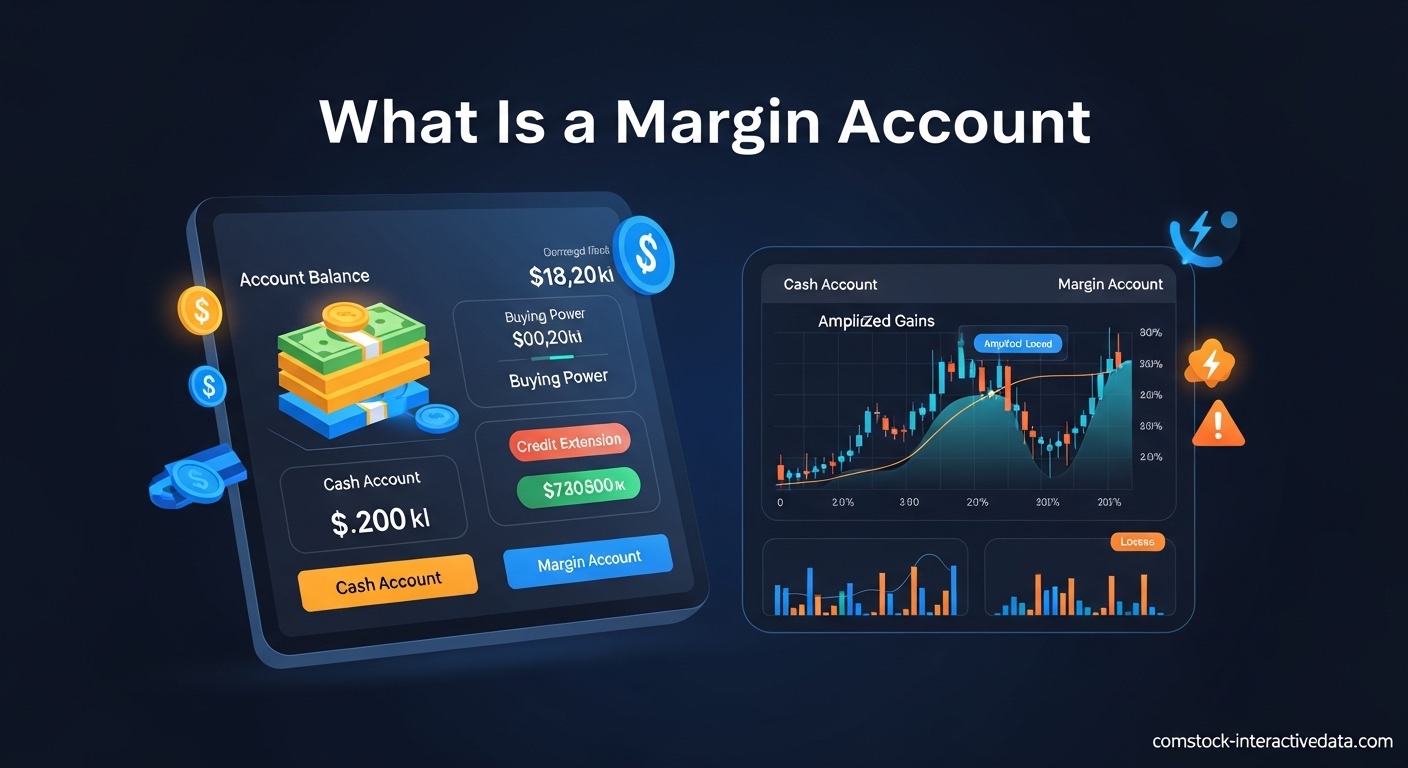
A margin account is a brokerage account that allows investors to borrow money from their broker using existing securities as collateral. This borrowing power enables leverage for increased purchasing power or the ability to sell securities short.
I’ve spent years studying different investment strategies, and margin trading consistently generates more questions than almost any other topic. Warren Buffett has called margin borrowing “financial cocaine” because the leverage can create an addictive cycle of risk-taking. Yet millions of investors use margin accounts responsibly to enhance returns and execute sophisticated strategies.
Understanding how margin accounts work before you open one is not optional—it is essential. The leverage that amplifies your gains works equally aggressively on losses. A position that drops 20% in a cash account can wipe out 40% or more of your equity in a margin account.
In this guide, I will explain exactly what a margin account is, how margin trading works step-by-step, the regulatory requirements you need to meet, and the real risks that have destroyed portfolios. I will also walk through detailed numerical examples showing both profit and loss scenarios with actual calculations.
Table of Contents
What Is a Margin Account?
A margin account is a type of brokerage account where the broker-dealer extends credit to the investor, allowing them to borrow funds using the securities in their account as collateral. Unlike a cash account, where you can only trade with settled funds, a margin account gives you access to additional buying power beyond your cash balance.
The Federal Reserve Board’s Regulation T governs margin accounts in the United States. Under Regulation T, investors can borrow up to 50% of the purchase price of eligible securities. This means with $10,000 in cash, you could potentially purchase up to $20,000 worth of marginable securities.
FINRA (Financial Industry Regulatory Authority) and the SEC (Securities and Exchange Commission) also impose rules on margin accounts. FINRA requires a minimum of $2,000 in your account before you can trade on margin. Some brokers set even higher minimums based on their risk management policies.
The key distinction between margin and cash accounts lies in the settlement process. Cash accounts operate on T+2 settlement—meaning funds from a sale become available two business days after the trade date. Margin accounts use T+1 settlement, giving you faster access to proceeds. This difference matters for active traders who need liquidity.
How Does Margin Trading Work?
Margin trading works through a straightforward but regulated process. When you want to buy more securities than your cash balance allows, your broker lends you the difference. The securities you purchase serve as collateral for the loan, and you pay interest on the borrowed amount until you repay it.
Step 1: Opening a Margin Account
To open a margin account, you complete an application that includes questions about your investment experience, financial situation, and risk tolerance. Brokers must assess whether margin trading is suitable for you based on these factors. You also sign a margin agreement that spells out the terms, including interest rates and your obligations if the market moves against you.
Step 2: Understanding Initial Margin
Initial margin represents the minimum amount you must pay when purchasing securities on margin. Regulation T sets this at 50% for most stocks. If you want to buy $20,000 worth of stock, you need at least $10,000 in your account—either cash or the loan value of securities you already own.
Some brokers offer portfolio margin for qualified investors with substantial accounts. Portfolio margin calculates requirements based on the overall risk of your positions rather than individual securities. This can reduce margin requirements for hedged positions but increases complexity.
Step 3: Maintenance Margin Requirements
After purchasing on margin, you must maintain a minimum equity level called the maintenance margin. Regulation T requires at least 25% equity in your account at all times. Many brokers set higher house requirements—typically 30% to 35%—to provide an additional buffer against volatility.
Your equity percentage is calculated as: (Market Value of Securities – Amount Borrowed) / Market Value of Securities. If this percentage drops below your broker’s maintenance requirement, you face a margin call.
Step 4: Paying Interest on Margin Loans
You pay interest on the borrowed portion of your margin balance. Interest accrues daily and posts to your account monthly. Rates vary by broker and typically range from base rate plus 1.5% to base rate plus 5%, depending on your debit balance. Larger accounts often qualify for lower rates.
Margin Account Requirements
Opening and maintaining a margin account requires meeting several regulatory and broker-specific requirements. Understanding these thresholds helps you avoid unexpected restrictions or account liquidations.
Minimum Account Balance
FINRA mandates a minimum deposit of $2,000 to open a margin account. Some brokers require more—$5,000 or $10,000 is common for full-service firms. This minimum must be maintained in cash or marginable securities.
Pattern Day Trader Rules
If you execute four or more day trades within five business days, your broker will classify you as a Pattern Day Trader. This classification triggers a $25,000 minimum equity requirement. If your account falls below $25,000, you cannot day trade until you restore the balance.
Pattern Day Traders receive four times their maintenance margin excess in buying power for day trading. This enhanced leverage provides significant opportunity but also magnifies risk substantially.
Regulation T Requirements
Regulation T allows borrowing up to 50% of the purchase price of eligible securities. Not all securities qualify—brokers publish lists of marginable securities, typically including most stocks trading above $5 per share on major exchanges. Pink sheet stocks, penny stocks, and certain IPOs may be ineligible.
There is a five-business-day settlement period for Regulation T violations. If your account violates the 50% initial margin requirement, you must deposit additional funds or sell securities within five business days to restore compliance.
| Requirement | Initial Margin | Maintenance Margin |
|---|---|---|
| When Applied | At purchase | Ongoing holding |
| Minimum (Regulation T) | 50% of purchase price | 25% of current value |
| Broker Requirements | Typically 50% | Often 30-35% (house requirement) |
| Purpose | Control initial leverage | Prevent excessive losses |
What Is a Margin Call?
A margin call occurs when your account equity falls below the maintenance margin requirement. When this happens, your broker demands that you deposit additional funds or sell securities to restore the required equity level. Margin calls typically happen during market volatility when security prices drop rapidly.
How to Calculate a Margin Call
To determine if a margin call would occur, calculate your current equity percentage. Suppose you purchased $20,000 of stock with $10,000 of your own money and a $10,000 margin loan. Your initial equity is 50%.
If the stock value drops to $15,000, your equity becomes $5,000 ($15,000 value minus $10,000 loan). Your equity percentage drops to 33.3% ($5,000 / $15,000). With a 35% house maintenance requirement, you face a margin call.
To calculate the exact call amount, use this formula: Required Equity = Current Market Value × Maintenance Requirement. Then subtract your current equity. If the result is positive, that is your margin call amount.
Meeting a Margin Call
You have three options when facing a margin call. First, deposit cash equal to the call amount. Second, deposit fully paid marginable securities with a loan value sufficient to cover the call. Third, sell securities in your account to reduce the debit balance.
Brokers typically require you to meet a margin call within two to five business days. Some volatile market conditions trigger immediate liquidation rights, meaning your broker can sell your positions without waiting for your response. This forced liquidation protects the broker from further losses but removes your control over which securities get sold.
Forced Liquidation
If you do not meet a margin call within the required timeframe, your broker will liquidate positions to restore compliance. They choose which securities to sell based on their collateral value and market conditions. You have no say in which positions get liquidated.
Forced liquidation often occurs at unfavorable prices. When many margin accounts face calls simultaneously, selling pressure drives prices lower, creating a cascade effect. Your broker’s priority is protecting their loan, not maximizing your recovery.
Margin Trading Examples with Calculations
Real numbers make margin mechanics concrete. These examples show both profit and loss scenarios with step-by-step calculations.
Example 1: Profitable Margin Trade
Imagine you have $10,000 cash and want to buy $20,000 worth of XYZ stock at $100 per share. Under Regulation T, you put up $10,000 and borrow $10,000 from your broker. You purchase 200 shares.
Six months later, XYZ rises to $130 per share. Your position is now worth $26,000. After selling, you repay the $10,000 loan plus $400 in interest (assuming 8% annual rate for six months). Your net proceeds are $15,600.
Your return on investment is 56% ($15,600 final value minus $10,000 initial investment divided by $10,000). Without margin, you could only have purchased 100 shares, which would have grown to $13,000—a 30% return. Margin amplified your gains by 86%.
Example 2: Margin Call Scenario
Using the same initial purchase of 200 shares at $100 ($20,000 total, $10,000 borrowed), suppose XYZ drops to $70 per share instead. Your position value falls to $14,000.
Your equity is now $4,000 ($14,000 value minus $10,000 loan). Your equity percentage is 28.6% ($4,000 / $14,000). If your broker requires 35% maintenance margin, you face a margin call.
To calculate the call amount: Required equity at 35% = $14,000 × 0.35 = $4,900. Your current equity is $4,000. The margin call is $900. You must deposit $900 cash, deposit securities worth approximately $1,385 (to account for the 35% marginable value), or sell enough stock to reduce your loan by $900.
Example 3: Short Selling with Margin
Short selling requires a margin account. Suppose you believe ABC stock, currently at $80, will decline. You short 100 shares, generating $8,000 in proceeds. Regulation T requires 150% of the short sale value as collateral—$12,000 total. The $8,000 sale proceeds count toward this, so you need $4,000 additional equity.
If ABC drops to $60, you buy back the shares for $6,000. You return the shares to your lender and keep the $2,000 profit minus borrowing costs. Your return on the $4,000 equity requirement is 50% before costs.
However, if ABC rises to $110, your position shows a $3,000 loss. Your required collateral increases to $16,500 (150% of $11,000). You face a margin call for additional funds. Short selling has theoretically unlimited loss potential since a stock can rise indefinitely.
Example 4: Interest Cost Calculation
Understanding interest costs is crucial for margin profitability. Assume your broker charges a 9.5% annual margin rate on your $10,000 loan from the previous examples.
Daily interest = $10,000 × 0.095 ÷ 365 = $2.60 per day. Monthly interest = approximately $79.17. Annual interest on a constant $10,000 balance = $950.
For your profitable trade in Example 1, the $400 interest cost reduced your net return from 60% to 56%. If you held the position for one year instead of six months, the $950 interest cost would reduce your return to 50.5%—still better than the 30% cash account return, but significantly less than the short-term result.
Benefits of Using a Margin Account
Margin accounts offer several advantages for informed investors who understand and manage the risks. These benefits explain why millions of active traders and sophisticated investors use margin despite the dangers.
Increased Purchasing Power
The primary benefit of margin is leverage. With 50% initial margin requirements, you control twice the assets for the same cash outlay. This magnifies returns when investments perform well. A 10% gain on a leveraged position becomes a 20% return on your equity.
Short Selling Capability
Margin accounts enable short selling—profiting from price declines. You can only sell short in a margin account because you are technically borrowing shares to sell. This ability to profit in both rising and falling markets provides portfolio flexibility and hedging opportunities.
Portfolio Diversification
Margin allows you to diversify a concentrated position without selling your core holdings. If you own $100,000 of stock in your employer and want to diversify, you could borrow against those shares to purchase other securities rather than triggering capital gains taxes by selling.
Convenient Line of Credit
A margin account functions as a ready line of credit. You can access cash quickly without selling investments or applying for traditional loans. This liquidity proves valuable for unexpected expenses or investment opportunities. No loan applications, credit checks, or waiting periods are required once the account is established.
Tax-Deductible Interest
Margin interest may be tax-deductible if you itemize deductions and use the loan to purchase taxable investments. The IRS allows deducting investment interest up to the amount of your net investment income. This deduction can offset some of the cost of borrowing. Consult a tax professional to understand how this applies to your situation.
Advanced Options Strategies
Many sophisticated options strategies require margin accounts. Spreads, uncovered options, and certain combination strategies need margin approval. These strategies can generate income, hedge positions, or speculate with defined risk parameters that cash accounts cannot accommodate.
Risks and Downsides of Margin Trading
The risks of margin trading are substantial and well-documented by regulatory authorities and market history. Understanding these dangers helps you make an informed decision about whether margin suits your investment approach.
Amplified Losses
Leverage works both ways. Just as a 10% gain becomes 20% on your equity, a 10% loss becomes 20%. In declining markets, margin accelerates wealth destruction. The 1929 stock market crash was exacerbated by widespread margin usage—when prices fell, cascading margin calls forced liquidation, driving prices lower and triggering more calls.
Losses Exceeding Your Investment
In a cash account, your maximum loss equals your investment. With margin, you can lose more than you deposited. If a leveraged position becomes worthless, you owe the full loan amount plus interest regardless of the security’s value. You remain liable for the debt even if your account balance goes to zero.
Margin Call Stress
Reddit discussions on r/interactivebrokers reveal the psychological toll of monitoring margin levels during volatile markets. Traders report constant anxiety about potential margin calls. One user described building a custom dashboard to monitor margin risk probabilistically in real-time. The stress of leveraged positions can lead to poor decision-making and emotional trading.
Forced Liquidation
When you cannot meet a margin call, your broker liquidates your positions. You have no control over which holdings get sold. During market panics, forced selling locks in losses at the worst possible moment. You might be forced to sell quality long-term holdings to cover short-term margin deficits.
Interest Costs Eroding Returns
Margin interest compounds against you. Even in flat markets, interest charges reduce your returns. Many traders underestimate how quickly interest erodes profits. A position that breaks even in price terms loses money after accounting for borrowing costs.
Rising Interest Rate Risk
Margin rates typically float with benchmark interest rates. When rates rise, your borrowing costs increase. A strategy profitable at 5% margin rates might lose money at 9%. Rising rates also tend to pressure stock prices, creating a double headwind for leveraged positions.
Risk Management Strategies
Several practices help manage margin risk. Maintain a cash cushion—keep your account well above minimum requirements. Use stop-loss orders to limit downside, though these do not guarantee execution during gaps. Avoid maximum leverage—using only 25% of available margin provides safety buffer. Diversify across uncorrelated positions rather than concentrating borrowed capital. Monitor your account daily during volatile periods. Consider portfolio margin only if you fully understand the risk models.
Margin Account vs Cash Account
Choosing between margin and cash accounts depends on your trading style, risk tolerance, and investment goals. This comparison clarifies the key differences to inform your decision.
| Feature | Margin Account | Cash Account |
|---|---|---|
| Borrowing | Yes – can borrow up to 50% | No borrowing allowed |
| Short Selling | Yes – permitted | No – not allowed |
| Minimum Balance | $2,000 minimum | No minimum |
| Settlement | T+1 (next day) | T+2 (two days) |
| Interest Costs | Yes – on borrowed funds | None |
| Risk Level | Higher – amplified losses | Lower – limited to invested capital |
| Options Strategies | Advanced strategies allowed | Basic only |
| Good Faith Violations | Not applicable | Possible with unsettled funds |
Cash accounts suit buy-and-hold investors who do not need leverage or short-selling capability. The T+2 settlement creates some operational constraints—you cannot use proceeds from a sale until settlement completes. However, you eliminate margin risk entirely.
Margin accounts suit active traders who need leverage, short-selling capability, or faster settlement. The risks are substantial but manageable for experienced investors with strong risk management practices.
Margin Interest Rates and Costs
Understanding margin costs is essential for profitability. Interest charges can transform winning trades into losers and amplify losses on declining positions.
How Interest Is Calculated
Margin interest accrues daily on your outstanding debit balance. The calculation uses the following formula: Daily Interest = Debit Balance × Annual Rate ÷ 365. Interest posts to your account monthly. You can view running interest totals in your brokerage account dashboard.
Typical Rate Ranges
Margin rates vary significantly by broker and account size. Discount brokers typically charge base rate plus 1.5% to 4% depending on debit balance. Full-service brokers may charge higher rates. As of 2026, rates generally range from 7% to 12% annually for typical account balances.
Many brokers use tiered pricing. Borrowing under $10,000 might cost 11%, while balances over $100,000 pay 8.5%. Larger accounts qualify for better rates. Shop around if margin costs significantly impact your strategy.
Comparison to Other Borrowing Options
Compared to alternatives, margin loans offer unique advantages and disadvantages. Home equity loans often provide lower rates but require real estate collateral and longer approval processes. Personal loans have fixed terms but higher rates for unsecured borrowing. Credit cards carry substantially higher rates—margin is cheaper but riskier due to investment volatility.
Tax Deductibility
Margin interest may be deductible as investment interest expense. To qualify, you must itemize deductions and use the borrowed funds to purchase taxable investments. The deduction cannot exceed your net investment income for the year. Unused deductions can carry forward to future years. Consult a tax professional because rules are complex and change periodically.
Who Should and Shouldn’t Use Margin?
Margin is not appropriate for everyone. Several factors determine whether margin trading aligns with your financial situation and investment experience.
Who Should Consider Margin
Experienced investors with high risk tolerance and substantial capital may benefit from margin. You should have at least three to five years of active trading experience and a thorough understanding of market mechanics. Stable income and emergency reserves outside your investment account provide necessary buffers.
Sophisticated strategies requiring margin—such as hedging concentrated positions, pairs trading, or certain options strategies—justify the risks for knowledgeable practitioners. Day traders meeting Pattern Day Trader requirements and maintaining substantial cushions above minimums can use the enhanced buying power responsibly.
Who Should Avoid Margin
Beginning investors should avoid margin entirely. The complexity and risk exceed what new traders can safely manage. If you have less than $25,000 in investable assets, margin offers limited benefit relative to the risk. Investors nearing retirement should minimize or eliminate margin usage—sequence-of-returns risk can devastate leveraged portfolios at critical moments.
Anyone who cannot afford to lose more than their initial investment should not use margin. If a margin call would create financial hardship, the risk is too high. Emotional or impulsive traders often make poor decisions under margin pressure. If you struggle with discipline in cash accounts, margin will magnify those problems.
Decision Framework
Before opening a margin account, answer these questions honestly. Can you withstand a 50% drop in your leveraged positions without facing financial distress? Do you have six months of living expenses saved outside your investment accounts? Have you successfully managed a cash account through at least one significant market decline? Do you understand exactly how margin calls work and how to calculate them? Can you commit to monitoring positions daily during volatile periods? If you answered no to any question, delay margin trading until you meet all criteria.
Frequently Asked Questions
What are the downsides of a margin account?
The primary downsides include amplified losses that can exceed your initial investment, margin calls requiring additional deposits or forced selling, interest costs that erode returns, psychological stress from monitoring leverage, and forced liquidation during market volatility. You can lose more money than you deposited, and brokers may sell your positions without consent if you cannot meet margin calls.
What does Warren Buffett say about margin?
Warren Buffett has strongly warned against using margin, calling it financial cocaine. He emphasizes that leverage amplifies both gains and losses, and the psychological pressure can lead to poor decisions. Buffett prefers companies with strong balance sheets that avoid excessive leverage, and he advises individual investors to never borrow money to buy stocks.
How much money is needed for a margin account?
FINRA requires a minimum of $2,000 to open a margin account, though many brokers require $5,000 or more. If you are classified as a Pattern Day Trader (four or more day trades in five business days), you must maintain at least $25,000 in your account. Individual brokers may set higher minimums based on their risk policies.
How do margin accounts make money?
Margin accounts generate returns through leverage—borrowing to control larger positions than your cash alone allows. When investments rise, the percentage gain on your equity exceeds the gain on the asset itself. For example, a 10% stock gain can produce a 20% return on your invested capital when using 50% margin. Accounts also enable short selling profits from price declines.
How risky is a margin account?
Margin accounts carry substantially higher risk than cash accounts. You can lose more than your initial investment, face forced liquidation during market declines, and suffer amplified losses from relatively small price movements. The SEC warns that margin exposes investors to potential for larger losses. Risk level depends on your leverage amount, position concentration, and market volatility.
What are the risks of margin trading?
Key risks include amplified losses exceeding your investment, margin calls requiring immediate additional funds, forced liquidation by your broker, interest costs eroding returns, rising rates increasing borrowing costs, and psychological stress. Historical examples like the 1929 crash show how margin can accelerate wealth destruction during market panics when cascading liquidations drive prices lower.
Is 30% margin safe?
A 30% maintenance margin is relatively conservative compared to the 25% regulatory minimum, but safety depends on portfolio volatility and diversification. A 30% requirement means a stock can drop approximately 28% before triggering a margin call on a fully leveraged position. Many experienced traders maintain 50% or higher equity levels to provide substantial buffers against volatility.
Conclusion
A margin account is a powerful tool that amplifies both opportunities and risks. Understanding what a margin account is and how margin trading works gives you the foundation to make an informed decision about whether leverage belongs in your investment strategy.
The benefits are real—increased purchasing power, short-selling capability, portfolio diversification options, and convenient liquidity access. But the risks are equally substantial. You can lose more than your initial investment. Margin calls can force liquidation at unfavorable prices. Interest costs compound against you over time.
Before opening a margin account, honestly assess your experience level, financial stability, and emotional ability to handle leveraged volatility. If you are a beginning investor, focus on mastering cash account trading first. If you are experienced with substantial reserves and disciplined risk management, margin can enhance your strategy when used conservatively.
The question is not whether margin trading works—it clearly can generate enhanced returns. The question is whether it works for your specific situation, risk tolerance, and investment timeline. Consider carefully before borrowing against your portfolio.