
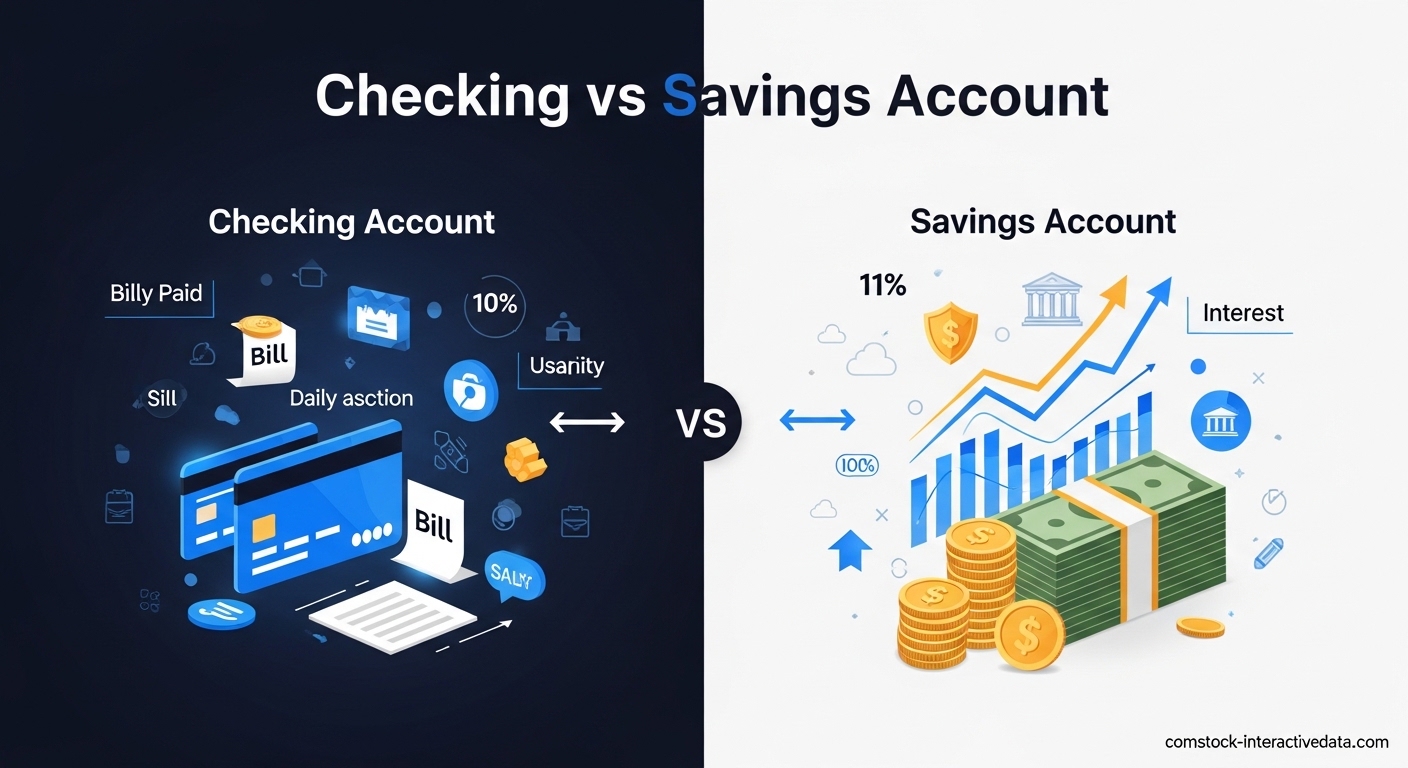
The main difference between checking and savings accounts is that checking accounts are designed for daily transactions and spending with unlimited access to your money, while savings accounts are meant for storing money long-term and earning interest with limited withdrawals. Understanding this distinction helps you manage your money wisely and avoid unnecessary fees.
When I opened my first bank account at 18, I couldn’t tell you the difference between these two account types. The banker asked if I wanted checking, savings, or both. I stared blankly and said, “Just give me whatever lets me get my paycheck.” That checking account served me well for daily expenses, but I missed out on earning interest for years because I didn’t understand how savings accounts work.
This guide breaks down everything you need to know about checking and savings accounts. Whether you’re opening your first account or optimizing your banking setup, you’ll learn which account type fits each financial need and why having both makes sense for most people.
Table of Contents
Quick Summary: Checking vs Savings at a Glance
Before diving into details, here’s a side-by-side comparison of the two account types:
| Feature | Checking Account | Savings Account |
|---|---|---|
| Primary Purpose | Daily spending and transactions | Building savings and earning interest |
| Interest Earned | Little to none | Yes (0.5% to 4%+ APY) |
| Withdrawal Limits | Unlimited | Typically 6 per month |
| Debit Card | Yes | Sometimes (ATM only) |
| Check Writing | Yes | No |
| Best For | Bills, groceries, daily purchases | Emergency funds, goals, excess cash |
What is a Checking Account?
A checking account is a deposit account designed for frequent transactions and daily access to your money. Think of it as your financial hub for everyday spending.
Banks created checking accounts to give customers easy ways to pay for goods and services. These accounts prioritize accessibility over growth. Your money sits there waiting for you to use it, not working to multiply itself.
Key Features of Checking Accounts
Checking accounts come with several tools that make spending and accessing money convenient:
Debit Cards: Every checking account includes a debit card that works like a credit card for purchases, but draws directly from your account balance. You can swipe at stores, shop online, and use contactless payments like Apple Pay or Google Pay.
Check Writing: Despite the decline in paper checks, this feature remains important for paying rent, sending money to individuals, and situations where electronic payment isn’t accepted.
Unlimited Transactions: Federal regulations don’t limit how often you can move money in or out of checking accounts. Make 50 purchases in a day or none at all. Transfer money freely between accounts at the same bank.
Direct Deposit: Employers can deposit paychecks directly into checking accounts, giving you immediate access to funds without visiting a branch or ATM.
Online Bill Pay: Most checking accounts include tools to pay bills electronically, set up recurring payments for rent or utilities, and schedule future transfers.
Common Checking Account Fees
While many banks offer free checking, some accounts carry fees you should understand:
Monthly Maintenance Fees: Some banks charge $5 to $15 monthly unless you maintain a minimum balance or set up direct deposit. Online banks typically skip this fee entirely.
Overdraft Fees: If you spend more than your balance, banks may cover the transaction and charge $25 to $35 per overdraft. Some offer overdraft protection by linking to savings accounts for a smaller transfer fee.
Out-of-Network ATM Fees: Using ATMs outside your bank’s network often costs $2 to $3 per withdrawal, plus any fee the ATM owner charges.
Non-Sufficient Funds (NSF) Fees: When a transaction gets declined due to insufficient balance, some banks charge $25 to $35 per attempt.
What is a Savings Account?
A savings account is a deposit account designed to hold money you don’t need for immediate spending, while paying you interest for keeping it there. These accounts help you build financial security and work toward goals.
Unlike checking accounts, savings accounts reward you for leaving money untouched. Banks pay interest (expressed as APY, or Annual Percentage Yield) based on your balance. The more you save and the longer you keep it there, the more you earn through compound interest.
Key Features of Savings Accounts
Savings accounts have features that encourage building your financial cushion:
Interest Earnings: Traditional savings accounts currently offer 0.5% to 1% APY, while high-yield savings accounts at online banks pay 3% to 4% or more as of 2026. A $10,000 balance earning 4% APY generates about $400 in interest per year.
Limited Access: Federal Regulation D historically limited savings accounts to six convenient withdrawals per month. While this regulation was relaxed in 2020, many banks still enforce withdrawal limits and charge excess withdrawal fees of $5 to $10 per transaction beyond the limit.
ATM Access Only: Most savings accounts don’t offer debit cards for purchases, though many provide ATM cards for cash withdrawals. Some online banks now offer debit cards that work for both account types.
No Check Writing: You cannot write checks from savings accounts. If you need to pay someone, you transfer money to checking first or use electronic payment methods.
Automatic Transfers: Set up recurring transfers from checking to savings on payday. Even $50 per week builds to $2,600 in a year plus interest.
High-Yield Savings Accounts vs Traditional Savings
Not all savings accounts are created equal. The difference between traditional and high-yield savings can mean hundreds of dollars per year.
Traditional savings accounts at brick-and-mortar banks often pay minimal interest, sometimes as low as 0.01% APY. Your $10,000 earns $1 per year. High-yield savings accounts from online banks (Ally, Marcus, Capital One 360, Discover) pay significantly more because they have lower overhead costs without physical branches.
Here’s a comparison of earnings on a $10,000 balance over one year:
- 0.01% APY (traditional): $1 interest earned
- 0.50% APY: $50 interest earned
- 4.00% APY (high-yield): $400 interest earned
The catch? High-yield accounts exist only at online banks, so you sacrifice branch access for better rates. Most people solve this by keeping a checking account at a local bank and a high-yield savings account online.
Key Differences Between Checking and Savings Accounts
Now that you understand each account type individually, let’s examine the five key differences that matter most for your financial life.
1. Access to Your Money
Checking accounts provide unlimited access through multiple channels. You get a debit card for purchases, checks for payments, ATM access for cash, online transfers, and mobile deposits. Your money moves freely whenever you need it.
Savings accounts restrict access intentionally. Federal regulations and bank policies limit withdrawals to encourage saving behavior. While you can access your money in emergencies, the friction helps prevent impulse spending.
2. Interest Earnings
Checking accounts rarely pay meaningful interest. The national average hovers around 0.05% APY. Some high-interest checking accounts offer better rates (up to 3% APY), but require meeting specific criteria like minimum transaction counts or direct deposits.
Savings accounts exist specifically to pay interest. Even basic savings accounts pay more than most checking accounts, and high-yield options dramatically outperform both. The power of compound interest means your savings grow faster over time without additional deposits.
3. Withdrawal and Transfer Limits
Checking accounts face no federal limits on transactions. You can make unlimited purchases, transfers, and withdrawals without penalties. This makes them perfect for high-frequency usage.
Savings accounts traditionally allowed six “convenient” transfers or withdrawals per statement cycle under Regulation D. While the Federal Reserve removed this requirement in April 2020, many banks still enforce similar limits. Exceeding them triggers fees ranging from $5 to $15 per transaction, or in some cases, account conversion to checking.
4. Fees and Minimum Balance Requirements
Both account types may carry fees, but the patterns differ. Checking accounts more commonly charge monthly maintenance fees unless you maintain minimum balances or meet activity requirements. Overdraft fees affect checking accounts specifically since that’s where spending happens.
Savings accounts less frequently charge monthly fees, but excess withdrawal fees are unique to savings. Some banks require minimum balances ($100 to $500) to avoid fees or earn stated APY rates.
5. Primary Purpose and Best Uses
Checking accounts serve transactional needs. Use them for receiving income, paying bills, daily purchases, and any expense requiring immediate payment.
Savings accounts serve preservation and growth goals. Use them for emergency funds (3-6 months of expenses), short-term savings (vacations, car purchases), and any money you want to protect from accidental spending.
When to Use Each Account Type?
Let me walk through real scenarios that show when each account makes sense.
Use Your Checking Account For:
Receiving Your Paycheck: Direct deposit into checking gives you immediate access to money for bills and spending. Transfer any excess to savings after covering monthly obligations.
Daily Spending: Groceries, gas, coffee, online shopping, and restaurant meals all come from checking. The debit card makes these transactions seamless.
Paying Bills: Set up automatic payments for rent, utilities, subscriptions, loan payments, and insurance from checking. The unlimited transaction allowance prevents issues with frequent bill payments.
ATM Cash Withdrawals: When you need physical cash, pull it from checking where you have unlimited access without withdrawal limits.
Use Your Savings Account For:
Emergency Fund: Financial advisors recommend keeping 3 to 6 months of essential expenses in a savings account. This money sits safely, earns interest, and remains accessible for true emergencies like job loss or medical bills.
Short-Term Goals: Saving for a vacation next summer? Need a down payment for a car in six months? Parking this money in savings separates it from daily spending while earning interest.
Excess Cash: Once your checking account holds enough for monthly bills plus a small buffer ($500 to $1,000 depending on your situation), move surplus money to savings where it works harder.
Large Future Purchases: Home down payments, wedding funds, college tuition, and other major expenses benefit from dedicated savings accounts. Some banks let you create multiple savings accounts with nicknames like “Vacation Fund” or “New Car” for organization.
Should You Have Both a Checking and Savings Account?
For most people, the answer is yes. Having both account types creates a complete financial foundation that covers daily needs and long-term security.
Here’s why the combination works so well:
Automatic Money Separation: When your paycheck hits checking, you see the full amount and feel wealthier than you are. By immediately transferring a set amount to savings, you pay yourself first and remove temptation to overspend.
Protection from Accidental Spending: Keeping your emergency fund in savings creates a psychological barrier. You won’t accidentally spend rent money on an impulse purchase because it’s not sitting in your checking account waiting to be swiped.
Earning Interest on Idle Cash: Money sitting in checking earns nothing. Money in savings, especially high-yield accounts, generates passive income. Even $5,000 at 4% APY earns $200 per year just for existing in the right account.
Overdraft Protection: Linking your savings to checking provides a safety net. If you overspend slightly, the bank transfers from savings rather than charging overdraft fees or declining transactions.
Financial Organization: Separating transactional money from savings goals clarifies your financial picture. You know exactly what you can spend versus what you’re building for the future.
Young adults opening their first accounts should strongly consider starting with both. Even if you can only deposit $50 into savings initially, you establish the habit of saving alongside spending.
How to Choose the Right Accounts for Your Needs?
If you’re opening new accounts or evaluating existing ones, follow this decision framework:
Step 1: Assess Your Needs
Do you need branch access for cash deposits or in-person help? If yes, choose a bank with local branches. If you handle everything digitally, online banks offer better rates.
Step 2: Compare Fee Structures
Look for accounts with no monthly maintenance fees, or fees you can easily waive through direct deposit or minimum balances. Avoid accounts with excessive overdraft or ATM fees.
Step 3: Check Interest Rates
For savings accounts, compare APY rates across multiple banks. A 0.5% difference on $10,000 equals $50 per year. For checking, interest is a bonus but not essential.
Step 4: Evaluate Digital Tools
Mobile app quality matters for day-to-day banking. Read reviews and test apps if possible. Look for features like mobile check deposit, instant transfers, and spending insights.
Step 5: Consider FDIC Insurance
Verify your bank carries FDIC insurance (or NCUA for credit unions), which protects deposits up to $250,000 per account holder. This applies to both checking and savings accounts.
Frequently Asked Questions
Is it better to have a savings or checking account?
Neither is inherently better. Most people need both. A checking account handles daily transactions like paying bills and buying groceries. A savings account builds your emergency fund and earns interest. If forced to choose one, checking works for immediate needs, but you’ll miss out on interest earnings and have nowhere safe to store extra cash.
How much will $10,000 make in a savings account?
It depends on the interest rate. At 0.01% APY (common at traditional banks), $10,000 earns $1 per year. At 4% APY (available at high-yield online banks), that same $10,000 earns approximately $400 in interest over one year. Over five years at 4% APY with monthly compounding, $10,000 grows to about $12,200 without adding any additional deposits.
What is a disadvantage of a checking account?
The biggest disadvantage is that checking accounts typically pay no interest, meaning your money loses purchasing power to inflation over time. Other disadvantages include overdraft fees ($25-$35 per incident), vulnerability to fraud through debit card usage, and monthly maintenance fees at some banks. Money in checking is also easier to spend impulsively since it’s designed for constant access.
Does it matter if I put checking or savings?
Yes, it matters significantly. Putting money in the wrong account type costs you interest earnings or limits your access. Keep money for daily spending and bills in checking. Put money for emergencies and future goals in savings where it earns interest. Using savings for daily transactions can trigger excess withdrawal fees. Using checking for long-term storage means missing out on growth.
Final Thoughts on Checking Account vs Savings Account
Understanding the difference between checking and savings accounts empowers you to make smarter banking decisions. The checking account vs savings account decision isn’t either-or for most people. It’s both, working together.
Use checking for the money you need now. Use savings for the money you’ll need later. Set up automatic transfers between them so your finances run smoothly without constant attention.
If you’re just starting out, open both account types at the same bank for easy transfers. As your savings grow, consider moving to a high-yield online savings account while keeping your checking local. That combination maximizes both convenience and interest earnings.
Your banking setup should serve your life, not complicate it. With both a checking and savings account in place, you’ll handle daily expenses confidently while building the financial cushion that provides true peace of mind.