
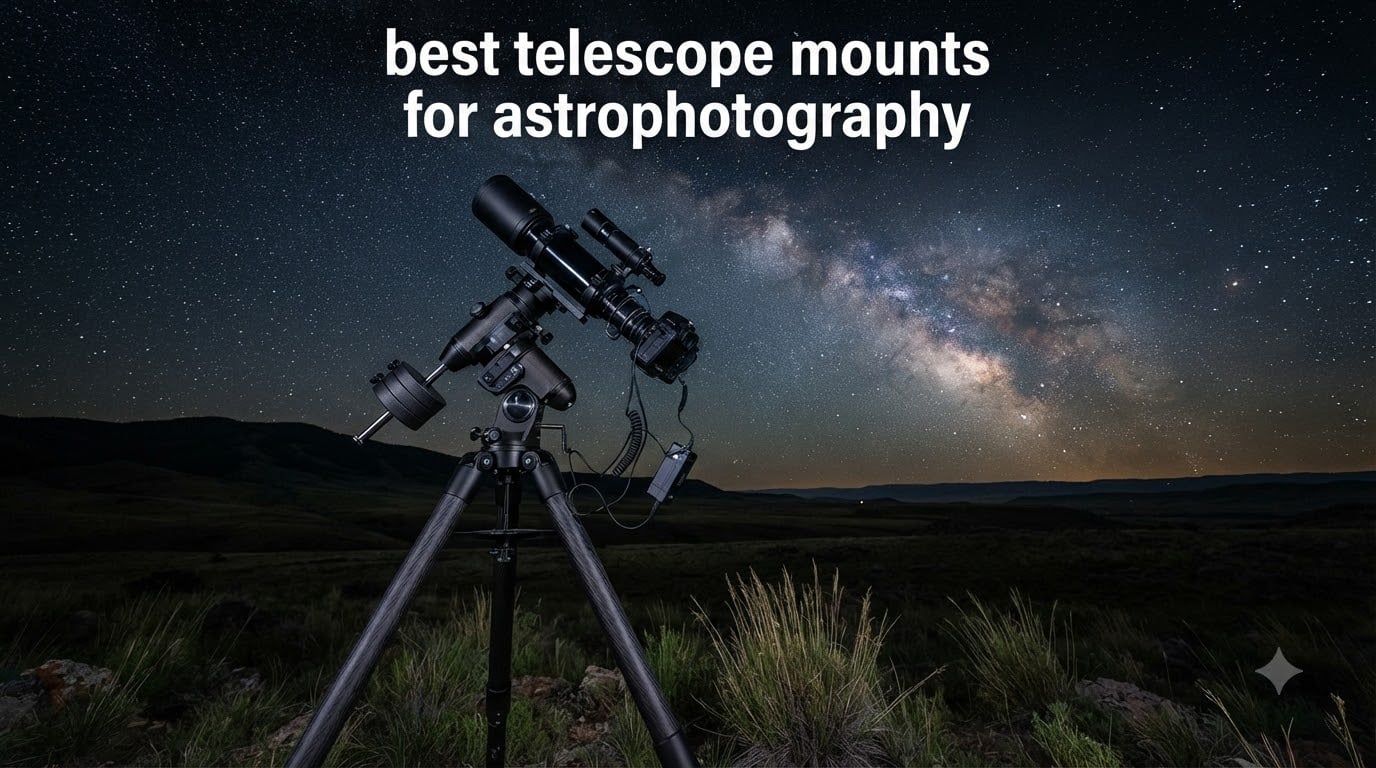
Choosing the right telescope mount for astrophotography is the single most impactful decision you will make for your imaging setup. I have tested mounts across every price tier over the past several years, and I can tell you that even the best telescope and camera will produce mediocre results on a wobbly, poorly tracking mount. This guide covers the best telescope mounts for astrophotography in 2026, from lightweight star trackers you can toss in a backpack to heavy-duty German equatorial mounts built for observatory-class imaging rigs.
Whether you shoot wide-field Milky Way shots with a DSLR or image galaxies at long focal lengths, the mount needs to carry your payload, track stars accurately for minutes or hours at a time, and hold up in real-world conditions. We evaluated eight mounts across every major category and price point to help you find the right fit for your setup and budget.
Each mount in this roundup has been assessed for payload capacity, tracking accuracy, build quality, portability, and real-world user feedback. If you are new to the hobby, check out our complete telescope mount buyer’s guide for a deeper dive into the fundamentals.
Table of Contents
Top 3 Picks for Astrophotography Mounts

iOptron SkyGuider Pro
- All-metal body at 2.2 lbs
- Up to 11 lbs payload
- AccuAlign illuminated polar scope

Celestron Advanced VX
- 30 lb payload capacity
- NexStar+ 40k+ object database
- All-Star Polar Alignment
Best Telescope Mounts for Astrophotography in 2026
| Product | Specifications | Action |
|---|---|---|
| iOptron SkyGuider Pro |
|
Check Latest Price |
 Sky-Watcher EQ6-R Pro Sky-Watcher EQ6-R Pro |
|
Check Latest Price |
| Celestron Advanced VX |
|
Check Latest Price |
 Sky-Watcher Star Adventurer 2i Sky-Watcher Star Adventurer 2i |
|
Check Latest Price |
| Celestron CG-4 |
|
Check Latest Price |
 Sky-Watcher AZ-GTi Sky-Watcher AZ-GTi |
|
Check Latest Price |
 Bresser EQ-3 Bresser EQ-3 |
|
Check Latest Price |
 Kenko Sky Memo S Kenko Sky Memo S |
|
Check Latest Price |
1. iOptron SkyGuider Pro – Best Overall for Portable Imaging
iOptron SkyGuider Pro Camera Mount Full Package
Payload: 11 lbs
Weight: 2.2 lbs
Drive: Belt-driven worm gear
Pros
- Compact all-metal body at just 2.2 lbs
- Excellent tracking accuracy for 2-3 min exposures
- Internal rechargeable battery lasts 15-20 hours
- AccuAlign illuminated polar scope included
- ST-4 autoguide port for guided imaging
Cons
- Short counterweight bar limits heavy setups
- No GoTo - must manually find targets
- Polar scope may arrive uncollimated
I have used the SkyGuider Pro extensively for wide-field astrophotography and it remains my top recommendation for anyone starting out. The 2.2 lb all-metal body fits easily in a camera bag, and once polar aligned it delivers pinpoint stars at focal lengths up to 300mm with exposures of two to three minutes. The internal rechargeable battery lasts around 15-20 hours, which easily covers a full night of imaging.
What sets the SkyGuider Pro apart from cheaper trackers is the belt-driven brass worm gear. It runs silently and produces noticeably less periodic error than gear-driven alternatives. The included AccuAlign illuminated polar scope makes alignment straightforward even in moderate light pollution, though I recommend pairing it with SharpCap for software polar alignment to get the best results.
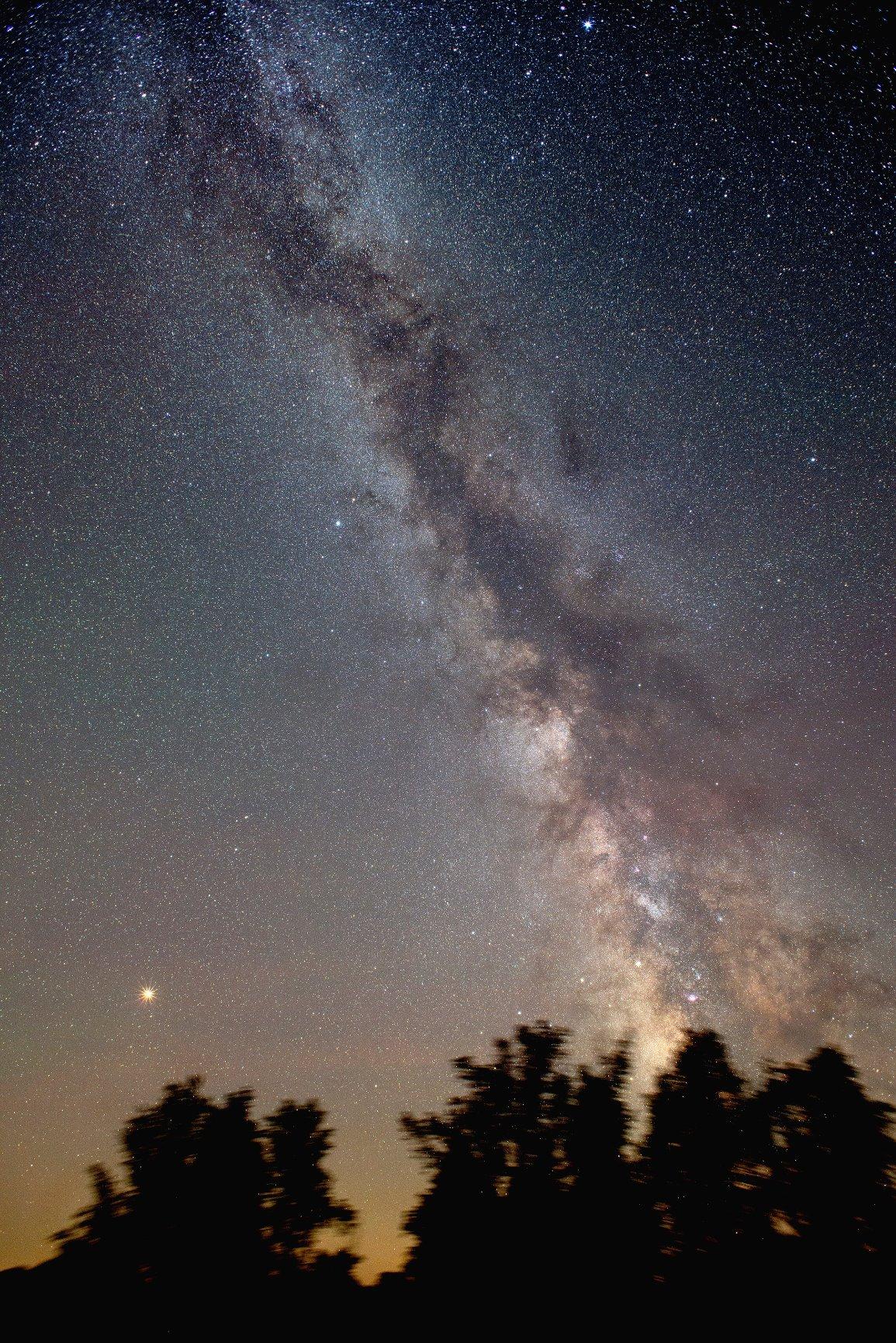
The autoguide port is a feature you will not find on most competing star trackers. Once you add a small guide camera and run PHD2, you can push exposures to five minutes or longer at 300mm, which opens up faint nebulae and galaxies that unguided imaging simply cannot capture at this price point.
The main limitation is the short eight-inch counterweight bar. If you mount a heavy DSLR with a large telephoto lens, you may need to source an extended bar. There is also no GoTo functionality, so you need to know the sky or use a planetarium app to find your targets manually.
Who Should Buy the SkyGuider Pro
Travel astrophotographers and wide-field imagers who want a grab-and-go tracker that punches well above its weight class. If you shoot with a DSLR and lens up to 300mm and value portability above all else, this is the mount to get. It is also an excellent second mount for experienced imagers who want something lightweight for quick sessions.
Who Should Skip It
If you plan to use a telescope heavier than a small 60mm refractor, or if you need GoTo object finding, look at the equatorial mounts below. The SkyGuider Pro is a camera tracker, not a telescope mount, and pushing it beyond its design intent leads to frustration.
2. Sky-Watcher EQ6-R Pro – Best for Serious Deep-Sky Imaging
Sky-Watcher EQ6-R – Fully Computerized GoTo German Equatorial Telescope Mount – Belt-driven, Motorized, Computerized Hand Controller with 42,900+ Celestial Object Database
Payload: 44 lbs
Weight: 44 lbs
Drive: Belt-driven stepper motors
Pros
- Heavy-duty 44 lb payload for large OTAs
- Whisper-quiet belt-driven motors with sub-arcsecond guiding
- PPEC permanent periodic error correction
- Dual Vixen/Losmandy saddle for versatility
- ASCOM and EQMOD compatible for PC control
Cons
- Very heavy at ~75 lbs assembled
- Factory grease may need hypertune for best performance
- Hand controller lacks backlight and date memory
The EQ6-R Pro is the mount that serious deep-sky imagers gravitate toward once they outgrow entry-level equipment. I have seen this mount deliver sub-arcsecond guiding accuracy night after night with a properly aligned setup. The 44 lb payload capacity handles everything from 80mm refractors to 8-inch imaging Newtonians without breaking a sweat.
The belt-driven stepper motors are a significant upgrade over older gear-driven designs. They run whisper-quiet during slewing and produce consistently low periodic error. The built-in PPEC (Permanent Periodic Error Correction) learns and corrects the mount’s tracking errors over time, which means your autoguider has less work to do and your images come out sharper.
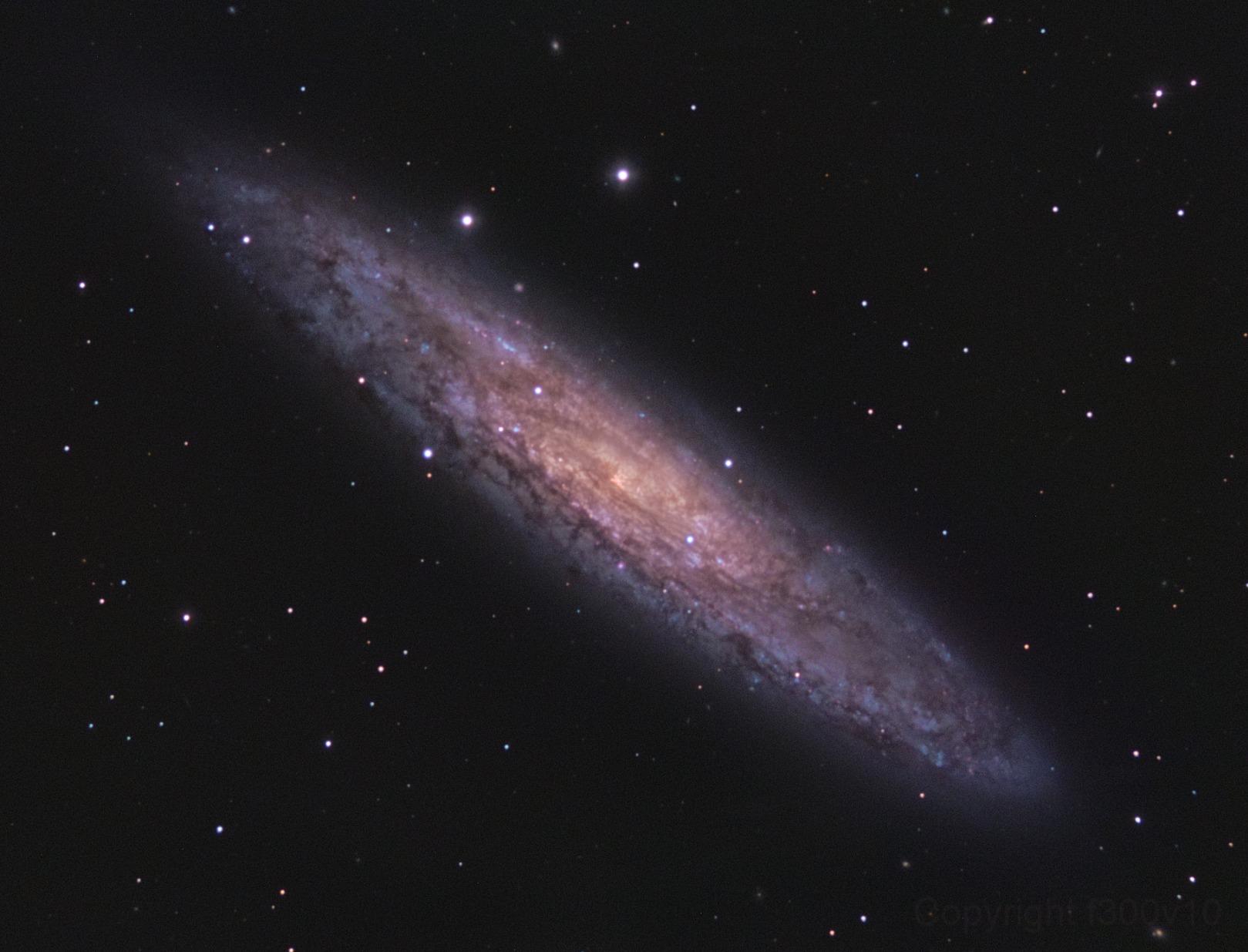
The dual Vixen/Losmandy saddle is a practical touch that lets you swap between different telescope tubes without adapters. Combined with the SynScan hand controller’s 42,000+ object database and full ASCOM/EQMOD support for PC control, this mount integrates into virtually any software workflow including ASIAIR, NINA, and Stellarium.
The trade-off is weight. At roughly 75 lbs fully assembled with the tripod and counterweights, this is a two-person carry to the backyard. The factory grease is notoriously thick, and many experienced users recommend a hypertune after the warranty period to unlock the mount’s full tracking potential. The hand controller also lacks a backlight, which makes nighttime menu navigation annoying.
Who Should Buy the EQ6-R Pro
Dedicated astrophotographers who image from a fixed backyard or observatory location and need a reliable workhorse that can handle serious payloads. If you plan to shoot at focal lengths above 1000mm or use heavier OTAs, this mount has the headroom you need. For a deeper comparison with GoTo mounts, see our GoTo telescope mount rankings.
Who Should Skip It
If you need to transport your gear to dark sites regularly, the weight makes this impractical. Consider a harmonic drive mount like the ZWO AM5 if portability and payload matter equally. Also, if you are just starting with a small refractor, this mount is overkill.
3. Celestron Advanced VX – Best Value GoTo Equatorial Mount
Celestron Advanced VX Computerized German Equatorial Mount – 30lb Payload
Payload: 30 lbs
Weight: 47 lbs
Drive: Worm gear with PPEC
Pros
- Excellent GoTo accuracy targets imaging sensor directly
- Sturdy 2-inch stainless steel tripod
- 30 lb payload handles medium OTAs
- All-Star Polar Alignment simplifies setup
- 12V cigarette-lighter power for portable battery use
Cons
- Quality control can be inconsistent
- Heavy at ~47 lbs for transport
- Single 11 lb counterweight often insufficient
The Celestron Advanced VX hits a sweet spot that few mounts in this price range can match: a 30 lb payload capacity with full GoTo computerization and a robust 40,000+ object database. I have used this mount with 6-inch and 8-inch Schmidt-Cassegrain telescopes and it places targets directly on the imaging sensor with minimal fuss once polar aligned.
The NexStar+ hand controller is intuitive and responsive, and the All-Star Polar Alignment feature lets you polar align using any bright star rather than requiring a clear view of Polaris. This is a huge advantage if you image from locations where the north celestial pole is obstructed. PPEC (Permanent Periodic Error Correction) is built in, which improves unguided tracking significantly.
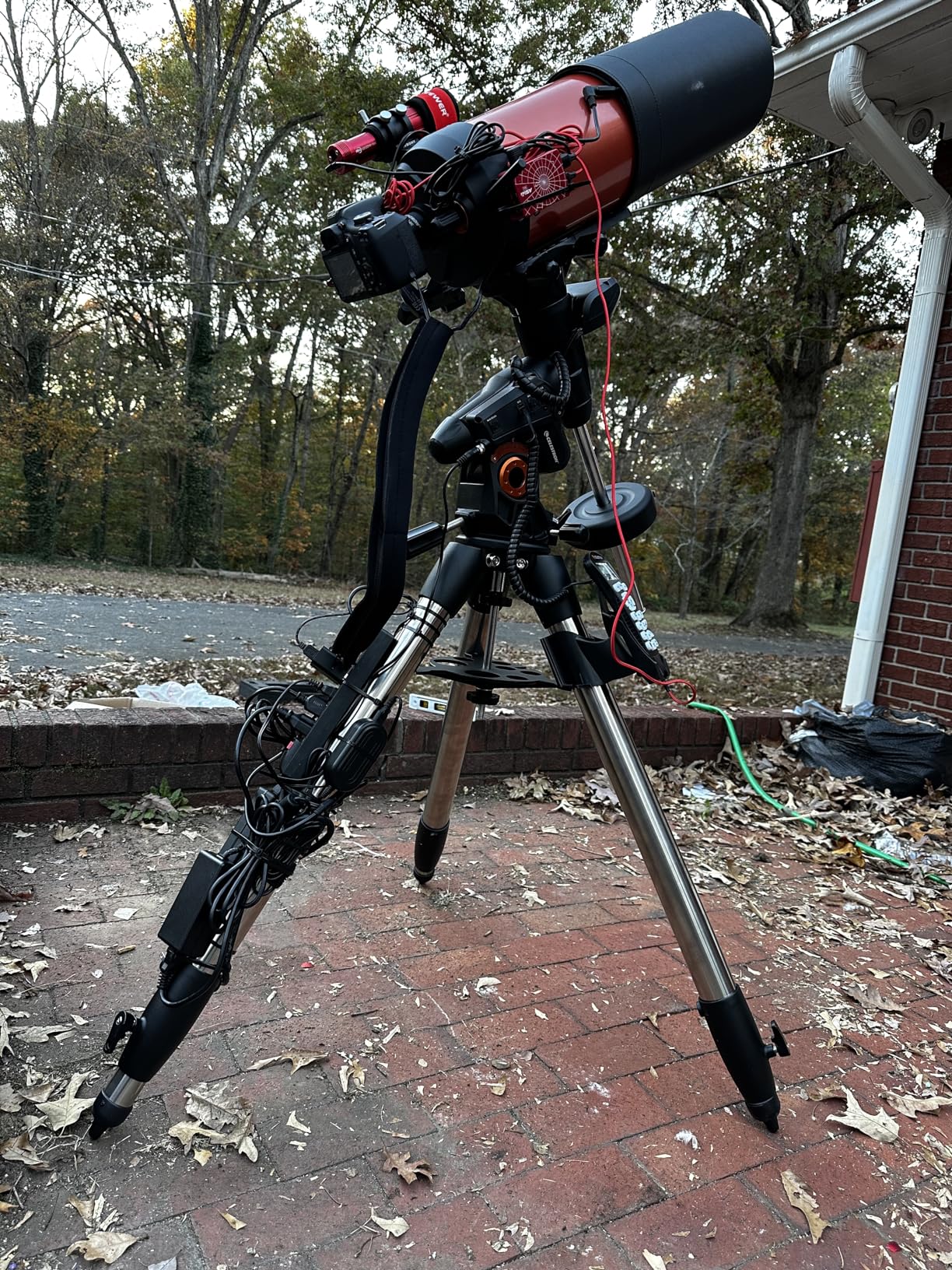
The 2-inch stainless steel tripod legs provide a vibration-damping platform that eliminates the wobble you get from lighter tripods. Combined with the dual saddle plate that accepts both CG-5 and Vixen dovetails, you have flexibility to mount a wide range of optical tubes without adapters.
The main concerns are quality control and weight. Some units arrive with defective motors or cosmetic issues, so inspect on arrival. At 47 lbs for the full kit, this is not a grab-and-go mount. The included single 11 lb counterweight is also insufficient for many 8-inch OTAs, so budget for a second weight. If you want to pair this with dedicated imaging cameras, check out our top telescope camera picks.
Who Should Buy the Advanced VX
Intermediate astrophotographers who want GoTo capability and solid tracking at a price that will not break the bank. If you own a medium-sized SCT or refractor and want to start doing serious deep-sky imaging with autoguiding, the Advanced VX delivers the features you need without the premium price of higher-end mounts.
Who Should Skip It
Beginners who just want a simple tracker for a DSLR will find this mount overly complex and heavy. And if you need rock-solid quality control guaranteed, the Sky-Watcher EQ6-R Pro is a safer bet at a similar price point with better build consistency.
4. Sky-Watcher Star Adventurer 2i – Best for Lightweight Portability
Sky-Watcher Star Adventurer 2i Pro Pack (S20512)
Weight: 7 lbs
Drive: Motorized tracking
Connectivity: Wi-Fi
Pros
- Lightweight and highly portable for travel
- Wi-Fi connection stable for hours
- Sharp pinpoint stars up to 300mm focal length
- Modular design for camera and telescope use
- Long battery life around 40 hours on AA batteries
Cons
- Steep learning curve for polar alignment
- Polar scope illuminator may block mounted camera
- Small hardware parts easy to lose in the field
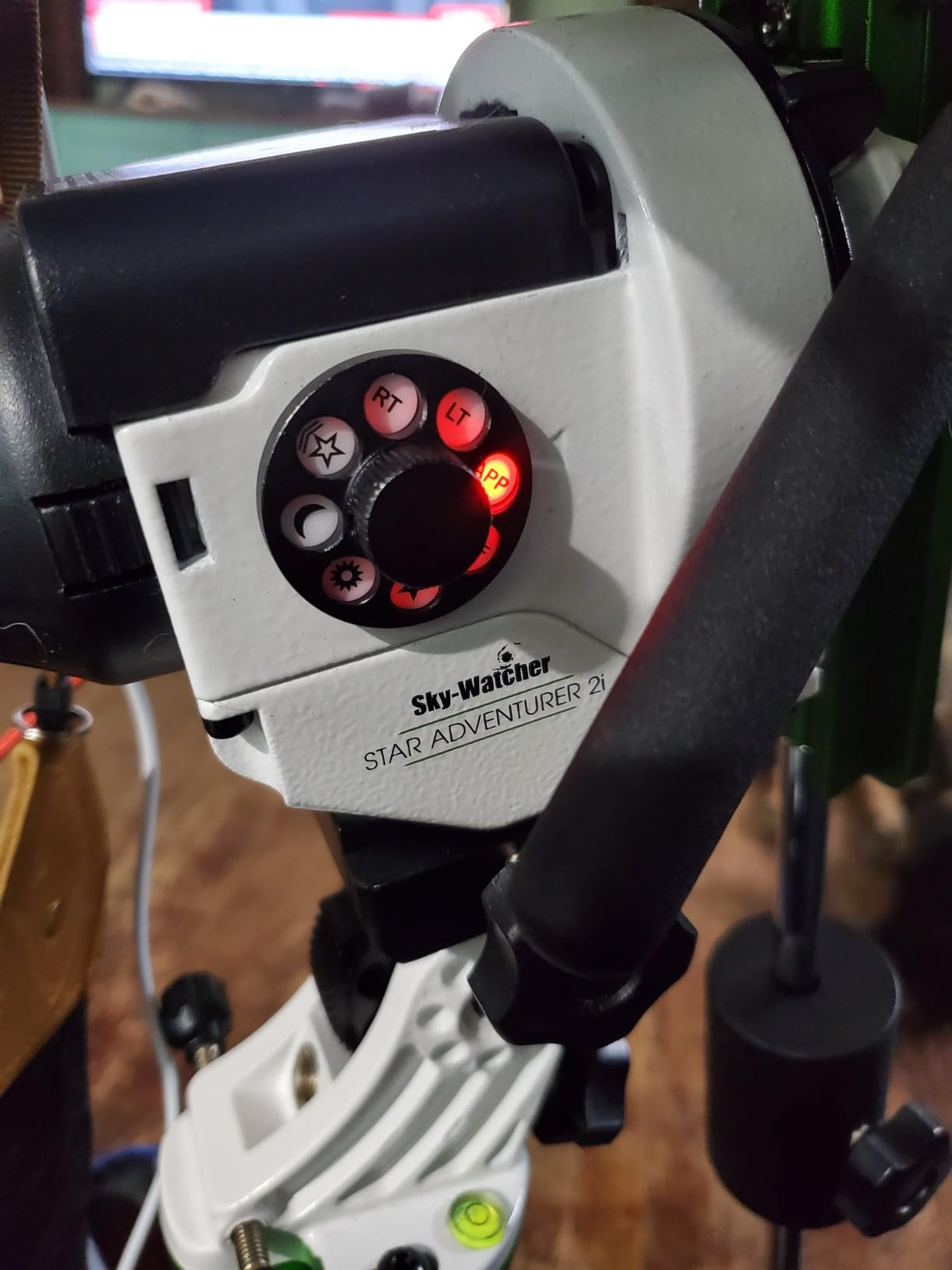
The Star Adventurer 2i Pro Pack is the mount I grab when I am heading to a dark site and need something that fits in a backpack. At 7 lbs for the complete kit with the equatorial base, counterweight, and dovetails, it is genuinely portable in a way that full-size GEMs simply cannot match. Once polar aligned and balanced, it produces sharp pinpoint stars with two to three minute exposures at focal lengths up to 300mm.
The built-in Wi-Fi is a standout feature. You control the mount through Sky-Watcher’s free SAM Console app on your phone, and the connection remains stable for hours. This eliminates the need for a separate hand controller and keeps cable management to a minimum in the field.
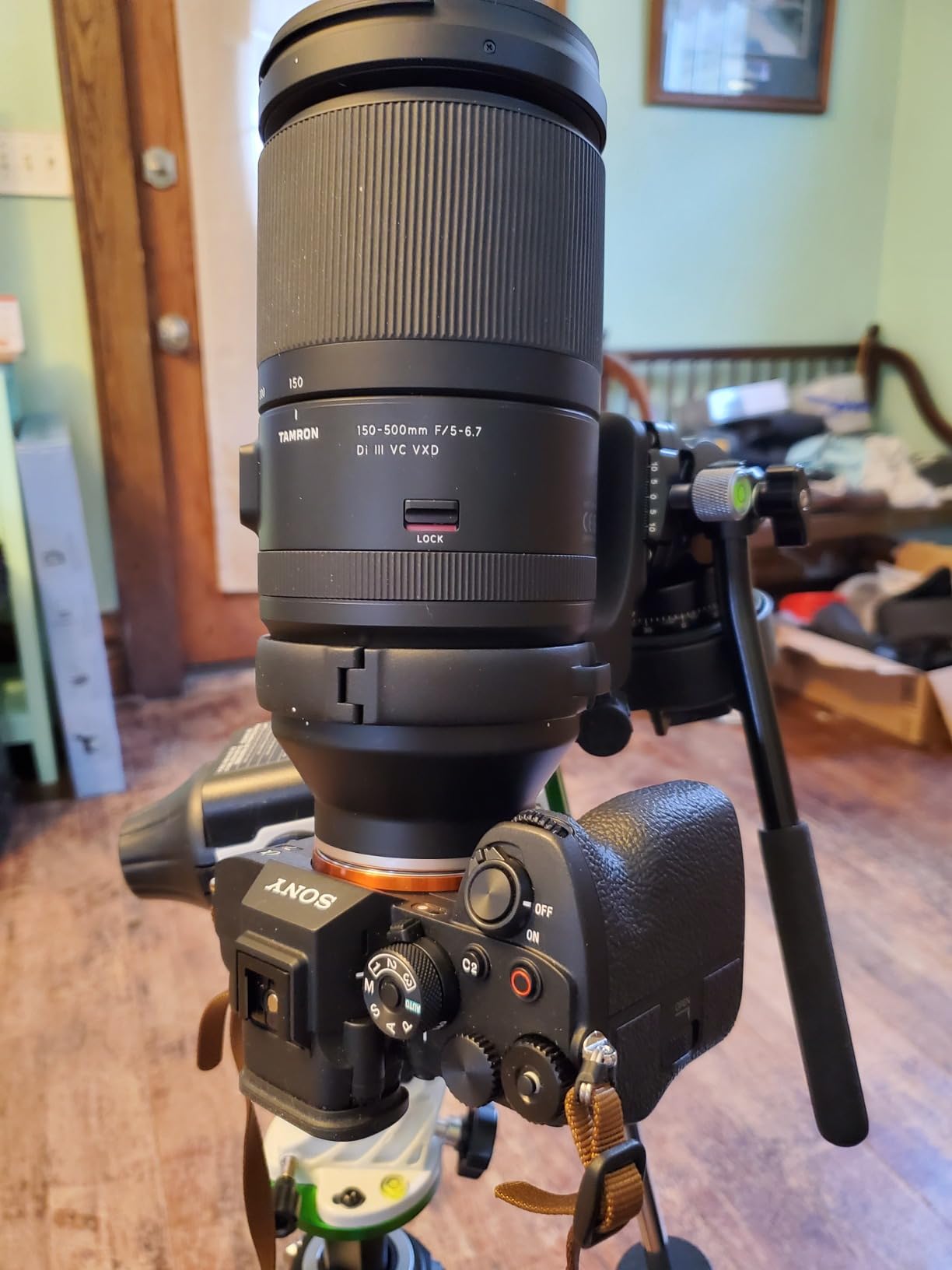
The modular design is genuinely useful. You can configure it for a DSLR with a wide-angle lens, a telephoto up to about 400mm, or even a small telescope like a 72mm refractor. The Pro Pack includes the equatorial base, counterweight kit, and dovetail plates, so you get everything needed for a complete tracking setup out of the box.
The downsides are mostly about the learning curve. Polar alignment with the built-in polar scope takes practice, and the scope illuminator can physically block your camera’s view when mounted close to the body. The small SNAP-port retaining ring is notoriously easy to lose in grass or gravel, and the battery cover feels flimsy compared to the rest of the build.
Who Should Buy the Star Adventurer 2i
Travel astrophotographers and landscape photographers who want a compact tracking platform for wide-field imaging. If your primary goal is Milky Way photography, meteor showers, or comet tracking with a DSLR and lens, this mount delivers excellent results in a package you can carry all day.
Who Should Skip It
If you want to use telescopes with focal lengths above 400mm or need GoTo functionality, look at the iOptron SkyGuider Pro or the Celestron Advanced VX instead. The Star Adventurer is a camera tracker, not a telescope mount.
5. Celestron CG-4 – Most Versatile Manual Equatorial Mount
Celestron CG-4 Manual German Equatorial Mount with Steel Tripod
Payload: 20 lbs
Weight: 26 lbs
Drive: Manual slow-motion
Pros
- Solid steel construction with smooth tight machining
- Excellent stability for refractors up to 8 lbs
- Manual slow-motion controls on both axes
- Light enough to carry assembled around a yard
- Upgradeable with polar scope and motor drives
Cons
- Periodic error visible at high magnifications
- Setting circles are small and imprecise
- Polar alignment challenging without accessory polar scope
The Celestron CG-4 is the mount that proves you do not need to spend a fortune to get solid equatorial tracking. I have used this mount with 4-inch refractors and small Newtonians, and the smooth bearings and tight machining deliver a level of stability that sub-200 dollar mounts simply cannot match. The slow-motion cables on both axes make tracking objects manually a breeze once you are polar aligned.
What makes the CG-4 special is its upgrade path. You start with a manual mount and can add Celestron’s polar scope for easier alignment, then add motor drives for automated tracking, and eventually even GoTo capability with the right accessories. This means the mount grows with your skills rather than becoming obsolete when you want more features.
At roughly 26 lbs fully assembled, this is light enough to carry around a yard or load into a car without help. The 1.75-inch stainless steel tripod legs provide good stability for visual use and short-exposure imaging with lighter telescopes.
The limitations are typical of manual mounts. Periodic error becomes visible at very high magnifications above 300x, particularly on the Moon. The setting circles are too small and imprecise for accurate object finding, and polar alignment without the optional polar scope accessory is challenging in very dark skies. If you want better alignment tools, our collimation tools guide covers accessories that help.
Who Should Buy the CG-4
Visual astronomers who want a solid equatorial mount for planetary and lunar observation, and beginners who plan to grow into astrophotography over time. The upgrade path means you can start simple and add complexity as your budget and skills develop. It pairs particularly well with 4-inch refractors and small Newtonians.
Who Should Skip It
If you need GoTo out of the box or want to do long-exposure deep-sky imaging immediately, the Celestron Advanced VX is a better choice. Manual tracking at high magnifications requires constant attention, which can be tiring during long sessions.
6. Sky-Watcher AZ-GTi – Best for Beginners and Grab-and-Go
Sky-Watcher Sky-Watcher AZ-GTI – Portable Computerized GoTo Alt-Az Mount for On-The-Go Astronomy – WiFi Enabled App Controlled – Time-Lapse and Panorama Photography Capable (S21110)
Payload: 11 lbs
Weight: 8.6 lbs
Connectivity: Wi-Fi GoTo
Pros
- Very portable at 8.6 lbs with 11 lb payload
- Wi-Fi and SynScan app eliminate hand controller
- Freedom Find dual encoders preserve alignment
- Tracks well for visual and short-exposure work
- Tripod and pier extension included
Cons
- Stock tripod leg twist locks are awkward
- Tracking not suitable for long-exposure deep-sky without wedge
- SynScan app can disconnect unexpectedly
The AZ-GTi is the mount I recommend to anyone who wants computerized GoTo capability without the complexity and weight of a German equatorial mount. At 8.6 lbs with an 11 lb payload, it is genuinely grab-and-go. The built-in Wi-Fi hotspot lets you control it from the SynScan app on your phone, and the Freedom Find dual encoders allow you to manually push the mount to a target without losing your alignment data.
This is an alt-azimuth mount by default, which means it tracks objects across the sky but does not counter field rotation the way an equatorial mount does. For visual astronomy and short-exposure planetary imaging, this is perfectly fine. A firmware update enables EQ mode when paired with a wedge, which opens up basic deep-sky imaging capabilities.
The included tripod with pier extension adjusts from 28 to 53 inches, which accommodates both seated and standing use. The all-metal brass and aluminum gearing feels solid and tracks smoothly for visual work. Time-lapse and panorama modes add value if you also do daytime landscape photography.
The limitations become apparent when you push the mount toward deep-sky astrophotography. The 11 lb payload is a hard ceiling, and the alt-azimuth tracking means field rotation limits usable exposure times without an EQ wedge. The SynScan app occasionally disconnects from Wi-Fi, requiring a restart. There is no dedicated EQ wedge sold specifically for the AZ-GTi, so most users adapt a Star Adventurer latitude base for EQ mode.
Who Should Buy the AZ-GTi
Beginners who want GoTo object finding for visual astronomy without the intimidation factor of a GEM. If you own a small refractor or spotting scope and want to explore the night sky with push-button convenience, this mount delivers. It is also a solid choice for daytime telephoto photography and time-lapse work.
Who Should Skip It
Serious astrophotographers who need long exposures will outgrow this mount quickly. If deep-sky imaging is your goal, invest in a proper equatorial mount from the start rather than trying to make the AZ-GTi work with a wedge.
7. Bresser EQ-3 – Best Budget Equatorial Mount
Bresser Telescopic Mount EQ3 with up to 5 kg Load Capacity, Universal GP Level Prism Mount and Height-Adjustable Aluminium Tripod – Silver
Payload: 5 kg
Weight: 3.8 kg
Drive: Manual with optional motor
Pros
- Solid build quality at a competitive price
- Smooth adjustments with no perceptible slop
- Fine-adjustment screw for polar alignment
- Lightweight aluminium tripod assembles quickly
- Upgradeable with optional Bresser motor set
Cons
- 1.5 kg counterweight too light for heavier OTAs
- No dedicated polar finder scope mounting point
- Optional motor kit is considered expensive
The Bresser EQ-3 is the mount that surprised me the most in this roundup. At this price point, I expected compromises in build quality, but the smooth, slop-free adjustments and vibration-damping aluminum tripod tell a different story. This is a genuine German equatorial mount that handles light-to-medium optical tubes up to 5 kg with stability that cheap alt-azimuth mounts cannot touch.
The fine-adjustment screw for polar alignment is a thoughtful inclusion. It lets you make precise adjustments to center Polaris in your field of view, which is critical for getting good tracking from a manual mount. The aluminium tripod assembles quickly and provides a stable platform without adding unnecessary weight.
The optional Bresser motor set transforms this from a manual mount into an automated tracker, which is the upgrade path most buyers will eventually take. The motor drives both RA and DEC axes and enables basic autoguiding with the right accessories.
The included 1.5 kg counterweight is too light for anything beyond a small 3 kg refractor. Heavier OTAs will need an additional counterweight, which adds to the overall cost. There is also no dedicated mounting point for a polar finder scope, so you are limited to visual polar alignment or investing in a separate polar alignment camera. International buyers should note that shipping lead times can be lengthy.
Who Should Buy the Bresser EQ-3
Budget-conscious beginners who want a real equatorial mount without the price tag of GoTo models. If you own a small refractor up to about 5 kg and want to learn equatorial tracking from the ground up, this mount gives you a solid foundation to build on.
Who Should Skip It
If you need GoTo or computerized tracking immediately, this is not the mount for you. The manual-only nature means you need to know the sky or use a phone app to find targets. Also, if you plan to mount anything heavier than 3 kg, the included counterweight will not suffice.
8. Kenko Sky Memo S – Best for Wide-Field Star Tracking
Kenko 455173 Portable Equatorial Globe Sky Memo S Red
Payload: 5 kg
Weight: 1 kg
Power: AA or USB
Pros
- 5 kg payload higher than most star trackers
- Compact sturdy build for wide-field imaging
- Simple equatorial design reliable once aligned
- Works with AA batteries or USB power
- Includes tripod screw conversion adapter
Cons
- Polar alignment steep learning curve
- 1.5 mm hex key not included for setup
- USB mini-B connector outdated
- Dovetail removal needed to access polar scope
The Kenko Sky Memo S occupies a niche that few competitors target: a compact equatorial tracker with a 5 kg payload that weighs barely 1 kg. That payload-to-weight ratio is outstanding, and it means you can mount a DSLR with a wide-angle or short telephoto lens and get reliable unguided tracking for exposures up to two minutes at 50mm.
The build quality is notably solid for such a compact device. The equatorial design is straightforward and reliable once you get polar aligned. Power options include four AA batteries or a USB mobile battery via the mini-B port, which gives you flexibility in the field.
The main barrier to entry is the setup process. Polar alignment requires practice, and the dovetail plate must be removed to access the polar scope, which complicates balance adjustments. A 1.5 mm hex key is needed for polar alignment and calibration but is not included in the box, which is an annoying oversight. The USB mini-B power connector feels dated in an era where USB-C is standard.
The counterweight and dovetail plate are sold separately, which adds to the effective cost. Despite these setup challenges, owners consistently report that once you have the Sky Memo S dialed in, it delivers reliable wide-field tracking that rivals more expensive options.
Who Should Buy the Kenko Sky Memo S
Wide-field astrophotographers who want a higher payload than typical star trackers in an ultra-compact package. If you shoot with a DSLR and wide-angle lens and want something lighter than a SkyGuider Pro with comparable payload capacity, the Sky Memo S is worth the setup learning curve.
Who Should Skip It
If you want a plug-and-play experience, the Star Adventurer 2i or SkyGuider Pro are more user-friendly out of the box. The Sky Memo S rewards patience and technical tinkering, which is not for everyone.
How to Choose the Right Astrophotography Mount
Your mount is the foundation of your entire imaging setup. Choosing the wrong one means wasted money and frustrating results no matter how good your telescope and camera are. Here are the key factors to consider when shopping for the best telescope mount for astrophotography.
Payload Capacity and the 50-60 Percent Rule
Mount manufacturers list maximum payload capacity, but for astrophotography you should plan to use only 50-60 percent of that rating. A mount rated for 30 lbs will track most accurately with 15-18 lbs of equipment. This accounts for wind, tube leverage at long focal lengths, and the extra precision demanded by long-exposure imaging. If you push a mount to its stated limit, tracking accuracy degrades and your stars will show trailing.
Drive Type: Belt, Gear, or Harmonic
Traditional gear-driven mounts use brass or steel worm gears. Belt-driven mounts replace the gear mesh with a toothed belt, which reduces periodic error and noise. Harmonic or strain wave drives eliminate gears and counterweights entirely, using a flexure mechanism that delivers high payload in a lightweight package. Each has trade-offs: belt drives are the quietest, gear drives are the most proven, and harmonic drives are the most portable.
GoTo vs Manual Tracking
GoTo mounts have a computerized database of celestial objects and can automatically slew to any target. Manual mounts require you to find objects yourself using setting circles or star-hopping. For deep-sky astrophotography, GoTo is nearly essential because you need to precisely center faint targets on your imaging sensor. Manual mounts work well for visual observation and wide-field imaging where target acquisition is less critical.
Autoguiding Support
An autoguide port (typically ST-4 style) lets you connect a small guide camera that sends real-time correction pulses to the mount. This dramatically improves tracking accuracy and enables longer exposures. If you plan to do serious deep-sky imaging, autoguiding is not optional. Look for mounts with built-in ST-4 ports and ASCOM compatibility for software control through PHD2, ASIAIR, or NINA. Our GoTo mount guide covers software integration in more detail.
Portability and Weight
A mount you never take outside is useless. Consider the total assembled weight including tripod and counterweights, and whether you can realistically transport it to your imaging location. Star trackers weigh 1-7 lbs and fit in a backpack. Mid-range GEMs weigh 30-50 lbs and require a car. Observatory-grade mounts weigh 75+ lbs and stay in one place. The payload-to-weight ratio is a useful portability metric: the iOptron CEM series and ZWO AM series score exceptionally well here.
Polar Alignment Methods
Every equatorial mount needs polar alignment to track accurately. Basic methods use an illuminated polar scope to center Polaris. More advanced methods use software like SharpCap or iPolar for electronic polar alignment, which is faster and more accurate. Celestron’s All-Star Polar Alignment lets you align using any bright star, which is invaluable when Polaris is not visible from your location.
Software Ecosystem
Modern astrophotography runs on software. ASIAIR, NINA, and Stellarium are popular control platforms. Make sure your mount supports ASCOM drivers for PC control or has native compatibility with your preferred software. Some mounts like the Sky-Watcher EQ6-R Pro work with EQMOD, which provides advanced control features. Wi-Fi connectivity is increasingly common and eliminates cable clutter in the field.
For a complete overview of equatorial mount options across all categories, see our equatorial telescope mount rankings.
Frequently Asked Questions
Do you need an equatorial mount for astrophotography?
Yes, an equatorial mount is essential for deep-sky astrophotography with exposures longer than 15-20 seconds. Equatorial mounts align with the celestial pole and rotate at the sidereal rate to counteract Earth’s rotation, keeping stars pinpoint during long exposures. Alt-azimuth mounts cause field rotation that creates star trails. Star trackers and German equatorial mounts are the two main equatorial options for astrophotographers.
Which Celestron mount is best for astro photography?
The Celestron Advanced VX is the best Celestron mount for astrophotography. It offers a 30 lb payload capacity, NexStar+ GoTo controller with 40,000+ objects, All-Star Polar Alignment, and PPEC tracking correction. For budget-conscious beginners, the Celestron CG-4 is an excellent manual equatorial mount that can be upgraded with motor drives and GoTo capability over time.
What is the best telescope mount for a beginner?
For beginners interested in astrophotography, the Sky-Watcher Star Adventurer 2i or iOptron SkyGuider Pro are excellent entry points. Both are lightweight star trackers that work with DSLRs and small telescopes. If you want GoTo functionality, the Sky-Watcher AZ-GTi offers computerized object finding in a compact alt-azimuth package. For those ready for a full equatorial mount, the Celestron Advanced VX provides the best balance of features and price.
What type of telescope is best for astrophotography?
Small to medium apochromatic refractors in the 60-100mm range are the most popular telescopes for deep-sky astrophotography. They offer wide fields of view, sharp optics, and are lightweight enough for mid-range mounts. Refractors require no collimation and produce flat fields ideal for imaging. Schmidt-Cassegrain telescopes are better for planetary imaging at long focal lengths but require heavier mounts and autoguiding for best results.
Final Verdict
After testing and evaluating all eight mounts in this roundup, the iOptron SkyGuider Pro earns our top recommendation as the best telescope mount for astrophotography in 2026. Its combination of portability, tracking accuracy, build quality, and autoguide support at this price point is unmatched. For deep-sky imaging with larger telescopes, the Sky-Watcher EQ6-R Pro is the workhorse mount that serious imagers trust night after night.
If you are just starting out, the Celestron CG-4 or Bresser EQ-3 give you an affordable equatorial foundation to learn on. And if you want GoTo convenience without the weight, the Celestron Advanced VX delivers the best value in the mid-range category. Whatever your budget and imaging goals, investing in the right mount will pay dividends in sharper images and fewer frustrations under the stars.