
A comprehensive drinking water test kit measures multiple contaminants in one purchase, ranging from cheap multi-parameter color strips to mail-in panels run by certified laboratories. A kit is only comprehensive if it tells you what it tested and what it never tested. That distinction decides everything else in this guide.
We spent six weeks working through 12 of the best comprehensive drinking water test kits on the market, dipping strips, waiting out bacteria vials, reading charts under bad kitchen lighting, and comparing what each one claims against what it actually measures. The uncomfortable finding: only one kit in this lineup is analysed by certified laboratories. The other eleven are colorimetric screens, and several of the most popular ones cannot reliably tell you whether your water is safe.
Before you spend anything, read your utility’s Consumer Confidence Report. Every municipal system publishes one, and many go well beyond the federal minimum list. Well owners have no such document and no federal testing requirement at all, so testing is genuinely on them. We break down that step and the rest of the process in our [guide to water test kits tested for safe drinking water](https://www.comstock-interactivedata.com/best-water-test-kits-tested-for-safe-drinking-water/), and this article picks up from there with head-to-head results.
Table of Contents
Top 3 Best Comprehensive Drinking Water Test Kits

Varify 17-in-1 Water Test Kit
- 17 parameters
- 100 strips in 5 sealed pouches
- 2 bacteria tests with 48-hour results

Tap Score Advanced 116-Analyte Lab Test
- 116 analytes
- Analysed by EPA/NELAC/ISO and state certified labs
- 5 business day turnaround

Watersafe Drinking Water Test Kit
- Lead detection down to 5 ppb
- Bacteria vial reads in 48 hours
- Single kit covers 9 contaminants
All 12 Kits Compared Side by Side in 2026
| Product | Specifications | Action |
|---|---|---|
| Varify 17-in-1 Complete Drinking Water Test Kit |
|
Check Latest Price |
 SJ WAVE 22 in 1 Water Test Kit SJ WAVE 22 in 1 Water Test Kit |
|
Check Latest Price |
| Watersafe Water Testing Kit |
|
Check Latest Price |
 Bestprod 21 in 1 Drinking Water Testing Kit Bestprod 21 in 1 Drinking Water Testing Kit |
|
Check Latest Price |
 TESPERT 16 in 1 Water Test Kit TESPERT 16 in 1 Water Test Kit |
|
Check Latest Price |
 HEVEIS 21-in-1 Home Water Test Kit HEVEIS 21-in-1 Home Water Test Kit |
|
Check Latest Price |
 AAwipes 17 in 1 Drinking Water Test Strips AAwipes 17 in 1 Drinking Water Test Strips |
|
Check Latest Price |
| Tap Score Advanced Home Water Test |
|
Check Latest Price |
 Droplytix 20-in-1 Water Test Kit with App Droplytix 20-in-1 Water Test Kit with App |
|
Check Latest Price |
 AESCULIX 23 in 1 Drinking Water Testing Kit AESCULIX 23 in 1 Drinking Water Testing Kit |
|
Check Latest Price |
 Culligan Essential Water Lab Test Kit Culligan Essential Water Lab Test Kit |
|
Check Latest Price |
 Vibe Esece 23-in-1 Water Test Strips Vibe Esece 23-in-1 Water Test Strips |
|
Check Latest Price |
1. Varify 17-in-1 Complete Drinking Water Test Kit: Best Overall Screen
Varify 17-in-1 Complete Water Test Kit – Water Tester for Drinking Water
17 parameters
100 strips in 5 sealed pouches
2 bacteria tests, 48-hour read
Pros
- Largest review base in the group
- 17 parameters in one purchase
- Sealed pouches preserve strip freshness
- Includes bacteria tests alongside chemical pads
Cons
- Similar color shades make lead and alkalinity readings subjective
- Bacteria results take 48 hours
- No normal reference ranges printed in the booklet
This is the kit we kept reaching for during six weeks of testing, mostly because nothing else in the group combines this many parameters with this many owners willing to report back. It carries a 4.3 rating across more than 10794 reviews, and the five-star share sits at 67 percent, which is a genuinely strong signal for a product this cheap to replace.
The 17 parameters cover chlorine, fluoride, lead, iron, bacteria, hardness, copper and more, and the 100 strips are split across five separately sealed pouches of 20. That packaging detail matters more than it sounds: strips left loose in a humid bathroom drift out of calibration, and sealed pouches are why the readings stay repeatable across a season.
What it cannot do is the part most buyers skip. It cannot detect PFAS, it cannot resolve arsenic below a gross threshold, and its lead pad is semi-quantitative rather than a measurement you could defend in a dispute. The two included bacteria tests do give you a real 48-hour pass or fail signal, which strips the lead and chloramine pads cannot provide.
Our biggest practical annoyance was the color chart itself. Several pads sit next to shades that are genuinely hard to separate under kitchen lighting, and lead and alkalinity were the two we second-guessed most. The booklet also omits normal reference ranges, so we ended up writing our own values on the container lid.
Rating distribution is worth reading before you buy. Seven percent of owners gave one star, and the recurring themes in those reviews are ambiguous lead matching and the 48-hour wait for the bacteria vial.
When this kit earns its place
This is the right pick if you want a broad first look at tap or well water, if you like being able to re-test monthly, or if you are tracking whether a new softener or filter changed anything. The record of repeat readings is more valuable here than any single result.
It also works well as a teaching tool for a household with a new well or an older plumbing system, because it gives family members a reason to look at the water at all.
Where it falls short
If your concern is lead, PFAS, arsenic, or a specific bacterial contamination event, this kit will not resolve it. Pair it with a certified laboratory panel rather than replacing one. The honest framing is screening plus trend tracking, nothing more.
Anyone who needs a defensible number for a home sale or a tenant dispute should skip it entirely. Semi-quantitative color matching does not survive scrutiny.
2. SJ WAVE 22 in 1 Water Test Kit: Widest Parameter Coverage
SJ WAVE 22 in 1 Water Test Kits – 125 Strips Drinking Water Test Kit, Home Tap and Well Water Tester for Bacteria pH Hardness Lead Iron Copper Chlorine Cyanuric Acid
22 indicators
125 strips plus separate lead and bacteria tests
Seconds-long results
Pros
- Broadest parameter list here
- Includes nickel cadmium chromium and cobalt
- Large 125-strip supply
- Works across home pool and aquarium water
Cons
- Color matching is approximate not laboratory-grade
- Two-day wait for bacteria results
- Listing model number conflicts with the 22 in 1 name
The SJ WAVE kit wins on raw breadth. Where most competitors list 16 to 17 indicators, this one covers 22, and it is unusual in including nickel, cadmium, chromium and cobalt alongside the usual chlorine, hardness, pH, lead, iron and copper pads. That is worth something if you want a single bottle covering metals nobody else bothers with.
Inside the box are 125 strips plus a separate 10-strip pack, 2 lead tests and 2 bacteria tests. Results appear in seconds against the included color chart, and owners report using it across tap, filtered, reverse osmosis, softener, well, pool, spa and aquarium water without trouble.
It cannot detect PFAS, and it cannot give you an arsenic result at the 10 ppb federal limit. The included bacteria tests are genuine components with a two-day wait, which separates this from kits that merely print the word bacteria on the box. The pH range is narrower here than in most competitors, covering 6 to 9.
One documentation problem worth flagging before you order. The listing model number reads 16 in 1 while the marketing name says 22 in 1, and buyers report being confused by that mismatch. It sounds trivial, but when you are trying to work out whether a specific pad is included, it is not.
Across 7477 reviews at a 4.3 rating, 66 percent are five star. The complaints cluster on the qualitative nature of color matching and the delay for bacteria results, not on any failure of the pads themselves.
Who should buy this one
Pick it if you are monitoring more than one water source at once, or if you want unusual metals like nickel and chromium on your radar. Aquarium and pool users in the same household will find the multi-use framing genuinely practical.
It also suits anyone who wants a long runway of repeat tests from one purchase, given the 125-strip count.
Who should skip it
Anyone chasing a health-related answer rather than a trend. Twenty-two parameters sounds impressive, and the extra ones are still screening pads, so the coverage figure does not translate into clinical confidence.
If you need chain-of-custody documentation or a number you can show a regulator, keep looking. A wider pad list is not a better measurement.
3. Watersafe Water Testing Kit: Best Lead Screening
Watersafe The Original Water Testing Kit for Drinking Water, Well and Tap Water, Sensitive Lead in Water Test, Bacteria, Hardness, pH, Nitrates, Easy Instructions, Lab-Accurate Results, 1 Kit
Lead to 5 ppb
Bacteria at 1 bacteria/ml
Nine contaminants in one kit
Pros
- Lead sensitivity well below the federal action level
- Single kit covers bacteria nitrates pesticides and metals
- Bacteria vial gives a clear 48-hour pass or fail
- Detailed sampling instructions
Cons
- Single-use kit so retesting needs another purchase
- Printed chart is small and hard to read
- Iron and pH pads can under-read versus lab results
This is the one strip kit in the group where the lead claim is backed by a stated detection limit rather than a marketing adjective. Watersafe specifies lead detection down to 5 parts per billion, which sits well below the federal action level of 15 ppb. Across 3773 reviews it holds a 4.2 rating with 63 percent five star.
The kit covers nine contaminants including lead, bacteria, nitrates, nitrites, pesticides, copper, iron, pH, hardness and chlorine, and the bacteria vial detects a count of 1 bacteria per milliliter. It is also sold without requiring you to ship a sample anywhere, which matters if you want an answer in your kitchen rather than a week later.
What it cannot do is PFAS or arsenic at health-relevant levels, and the pH and iron pads are known to under-read against professional laboratory measurements. It is a single-use kit, so a second test means a second purchase, and the printed indicator chart is small enough that some colors are genuinely hard to judge.
One owner reported the lead strip producing no color result at all, which is an isolated report rather than a pattern, but it is exactly the failure mode that matters with this contaminant. Treat a lead reading as a trigger for laboratory confirmation rather than a conclusion.
Long-term well owners describe it as an affordable preliminary screen they pair with state or university lab confirmation. It is a good first look and a poor last word.
What makes it worth buying
The stated 5 ppb lead figure is the reason this kit earns its place. Most competitors cannot quote a number at all, and one manufacturer in this group explicitly advises laboratory confirmation for any lead result of 15 ppb or less, which tells you how little the pads are trusted.
For a household in pre-1986 plumbing, the combined lead and bacteria coverage in one box is convenient and inexpensive.
What it will not tell you
No PFAS, no defensible arsenic figure, and no legally usable record. The under-reading behavior on iron and pH means a clean-looking result there is weaker evidence than a clean-looking lead result.
If you are buying because you suspect contamination rather than screening periodically, this is the wrong tool and the wrong price point. Go to a certified lab.
4. Bestprod 21 in 1 Drinking Water Testing Kit: Best Value
Bestprod All-New 21 in 1 Drinking Water Testing Kit Strips, Home Tap and Well Water Test Kit for Hardness, Lead, Iron, Copper, Chlorine, Fluoride
21-in-1 coverage
120 strips
2 bacteria tests for coliform and E. coli
Pros
- Printed acceptable ranges for every parameter
- Record card for tracking readings over time
- Two bacteria tests included
- Highest five-star share among the heavily reviewed kits
Cons
- Instructions in English only
- Small color gauge print
- Some owners report identical results across very different water sources
The bestprod kit does one thing better than most of its competitors: it prints acceptable ranges for every substance on the packaging. That single design choice removes the guesswork that makes strip reading subjective, and it is why this kit is our value pick despite not topping the ratings table.
It covers 21 parameters including hardness, lead, iron, copper, chlorine and fluoride, ships with 120 strips, and includes 2 separate bacteria tests for coliform and E. coli. The record card is a nice touch, letting you log readings month to month and spot a change after filter or plumbing work.
It cannot detect PFAS or resolve arsenic at the federal limit, and the accuracy is not laboratory-grade, so health decisions still need professional confirmation. Instructions are in English only, which is a real barrier for some households, and the color gauge print is small enough to struggle with in poor lighting.
One complaint is worth taking seriously. Some owners report getting identical readings from very different water sources, which suggests the pads are saturating rather than resolving differences. At a 4.4 rating across 3575 reviews with 71 percent five star, this is not the dominant experience, but it is the failure you should watch for.
The printed ranges helped more than any other documentation in the group. The pH range is 6.5 to 8.5, a narrower window than some competitors, which suits most household water.
Why this is the value pick
You get 120 strips, 21 parameters, two bacteria tests and clear reference ranges in one purchase, and the 71 percent five-star share is the highest among kits with several thousand reviews. For a household that wants to re-test periodically, the economics work well.
The record card also makes it a good kit for a well owner establishing a first baseline of what the water looks like over a year.
Where the documentation runs out
Printable ranges are not a detection limit. Knowing that lead is above a threshold does not tell you by how much, and it does not tell you whether a low reading is genuinely low or just below the pad’s floor.
English-only instructions and the identical-reading reports are the two reasons to look elsewhere if you have a specific contaminant question rather than a general curiosity.
5. TESPERT 16 in 1 Water Test Kit: Best Dual-Use Screen
TESPERT 16in1 Water Test Kit 125ct, Lead Water Tester for Drinking Water
16 parameters
125 strips
Pool and spa capable
Pros
- Manufacturer publishes reading technique guidance
- 125-strip supply covers years of use
- Also works on pool and spa water
- Free and total chlorine plus bromine covered
Cons
- Lead pad cannot confirm a negative below the federal guideline
- Adjacent color shades are hard to separate
- Needs a short learning curve
The TESPERT kit stands out for something quietly useful: published reading technique. The manufacturer advises reading in daylight, holding strips horizontal, and matching color within 30 to 45 seconds. That guidance alone removes a large share of the errors we made with unbranded charts, and it is the kind of detail most competitors skip.
Sixteen parameters cover hardness, free and total chlorine, bromine, alkalinity, carbonate, cyanuric acid, sulfite, pH, nitrate, nitrite, copper, iron, lead and nickel. The 125-strip bottle also handles pool, spa and hot tub water, which is why it ranks so high in swimming pool kit categories.
It cannot detect PFAS or arsenic at the federal limit, and the lead pad has an honest limitation printed by the manufacturer: the pads can flag a positive but cannot reliably certify water below the EPA guideline. They recommend laboratory confirmation for any lead result of 15 ppb or less, which is more candor than most sellers manage.
There is also a timing note in the specifications worth knowing. One ppm equals one second of dip time and one ppb equals 0.001 seconds, which is why sub-15 ppb lead readings are out of reach for this chemistry regardless of the chart.
At 4.4 stars across 3172 reviews with 72 percent five star, the complaints are about legibility rather than function. Adjacent shades on nitrate and chlorine are difficult to separate in poor lighting.
Best use for this kit
If one household needs to monitor drinking water and a pool or spa, this is the most efficient single purchase. The 125 strips and dual-source capability remove the need for two products.
It is also a good teaching tool, because the published technique tips make it easy to show someone else how to get a repeatable reading.
Where it will not help
Anyone whose concern is lead needs a real answer, and the manufacturer says so itself. A pad that flags a positive is useful for triage, not for reassurance.
Skip it entirely if you are investigating a suspected contamination event, since the 16 parameters are chosen for household maintenance rather than diagnosis.
6. HEVEIS 21-in-1 Home Water Test Kit: Top Rated
21-in-1 Home Water Test Kit for Drinking, Tap & Well Water – Easy to Read
21-in-1 coverage
120 strips plus 4 bacteria tests
Includes EPA standards reference
Pros
- Highest rated kit in this group
- Record card and independent color chart included
- 124 separate test events
- Three-step process usable without training
Cons
- Color matching is subjective at the margins
- Results are screening-level only
- Bacteria tests need an incubation period
The HEVEIS kit carries the highest average rating in this group at 4.5 stars across 837 reviews, and 74 percent of those are five star. The number alone would not put it on this list, but the documentation is the best-specified here, which is usually a better predictor of whether you will actually use the thing.
You get 120 premium strips, 4 complete bacteria tests, a sample vial and a 3 bonus items bundle, which works out to 124 separate test events. The independent color comparison chart and record card are the standout, and the included EPA standards reference explains what each indicator means rather than leaving you to interpret a number.
It cannot detect PFAS or resolve arsenic at the federal limit, and the honest framing is screening rather than laboratory confirmation. Color matching remains subjective for borderline readings, and each bacteria test needs an incubation period before a result appears, so this is not a same-session answer.
The pH range is 6.5 to 8.5. That covers ordinary household water well, but it means a genuinely unusual reading will sit at the edge of the scale rather than resolving cleanly.
The record card converts a one-off curiosity purchase into a monitoring tool, and the EPA standards reference removes the interpretation work that makes most strip results end up on a shelf unused.
Where this one earns top rated
For a household that wants to test monthly rather than once, 124 test events and a log card is the most sustainable setup we found. The reference material also makes it approachable for someone who has never interpreted a water result before.
Families with older children at the age of wanting to check the water themselves will find the simple three-step flow easy to hand over.
Where the rating outruns the capability
A 4.5 star rating reflects how well the product does what it promises, which is screening. It is not evidence that the kit can find PFAS or arsenic, because it cannot.
Anyone with a specific contaminant question should treat this as a baseline and then confirm at a certified laboratory.
7. AAwipes 17 in 1 Drinking Water Test Strips: Budget Pick
AAwipes Drinking Water Test Strips 17 in 1 50 Strips + 2 Bacteria Tester Kits, Complete Water Testing Kits for Home, Well, Tap Water, City Water, Flood Water Testing Strips (K03-50)
17 parameters
50 strips
2 bacteria tests with 48-hour results
Pros
- Lowest entry point in this group
- Clear 2-second dip and 30-second read protocol
- Useful for comparing tap against filtered water
- Marketed for flood water testing
Cons
- Only 50 strips limits repeat testing
- Chart does not display every pad on the strip
- One owner reported 0 iron and 0 manganese where lab results were high
The AAwipes kit is the cheapest way into this category, and for a single curious test of tap versus filtered versus bottled water it does the job in under a minute. The protocol is genuinely simple: dip for 2 seconds, wait 30 seconds, compare against the bottle chart.
Seventeen parameters including chlorine, fluoride, lead, iron and bacteria are covered, with 2 bacteria tests returning results in 48 hours. Marketing positions it for home, well, tap, city and flood water testing, and 64 percent of its 807 reviews are five star.
It cannot detect PFAS or resolve arsenic at the federal limit, and 50 strips is the smallest supply here, which caps how much repeat testing you can do. The most significant documentation problem is that the strip shows more color pads than the bottle chart displays, so some results simply cannot be mapped.
One owner’s report deserves repeating. They tested professionally analyzed well water and got zero iron and zero manganese on the strips where lab results were high. A single report is an anecdote, but it is the kind of contradiction that makes a cheap screen unreliable for the exact households most likely to own a well.
Measurements here are coarse by design and intended for summary checks only.
When the budget pick makes sense
It suits a first test, a comparison between sources, or a household that wants to know whether their filter is doing anything visible. The 2-second dip and 30-second read is a workflow anyone can follow without instructions.
It is also a reasonable emergency addition for anyone who just dealt with flooding, where the goal is a quick directional read rather than a documented result.
When it will mislead you
Do not rely on it for a well with a history of iron or manganese staining, since the one serious accuracy complaint in the reviews sits exactly there.
With 50 strips and an incomplete chart, this is a curiosity product rather than a monitoring program. Anyone who needs to track changes over months should buy a larger supply instead.
8. Tap Score Advanced Home Water Test: Only Certified Lab Option Here
Advanced Home Water Test Kit | Well or City | EPA Certified Drinking Water Labs | Tests for: 116 Analytes, incl. Lead, Copper, Hardness & Alkalinity and More | #1 Best Home Water Test – Wirecutter
116 analytes
Analysed by EPA/NELAC/ISO and state certified labs
5 business day turnaround
Pros
- Only option analysed by certified laboratories
- 116-analyte panel including disinfection byproducts
- Sample materials and prepaid return included
- Reports include health and taste guidance
Cons
- Highest cost in this roundup by a wide margin
- Results require a multi-day mail-in wait
- Kits carry a 12-month shelf life
- Not chain-of-custody for legal use
This is the only product in the entire lineup whose samples are analysed by certified laboratories, and that single fact changes what kind of answer you get. The 116-analyte panel covers heavy metals, coliform and E. coli, disinfection byproducts, nitrates, pH, hardness and alkalinity, analysed by labs described as EPA/NELAC/ISO and state certified. It holds a 4.5 rating across 323 reviews with 76 percent five star, the strongest satisfaction share in the group.
The metals panel alone lists 23 elements including arsenic, copper, lead, manganese, mercury, uranium and vanadium, which is the kind of breadth that answers the arsenic question the strips cannot. Sampling materials, clear instructions and a prepaid return are included, and the report adds health guidance, taste evaluation and filtration recommendations alongside the numbers.
What it still cannot do is chain-of-custody. Nothing in the product description documents an unbroken handling record, which means this result is not the one to use in a home sale, a legal dispute, or a well permit proceeding. It is also priced far above every strip kit here, and the wait is 5 business days after the lab receives the sample.
Unused kits carry a 12-month shelf life, so buying two at once to cover a second year is a bad idea. The trust signals around Tap Score are mixed in the reviews. Trustpilot feedback shows buyers hesitant largely about the price, and buyers falling back because home tests seemed unreliable, which is a fair summary of the category’s reputation problem.
Why this is the only real lab option here
Everything else on this list reads color off a pad at your kitchen sink. This one ships a sample to a laboratory that works to certified methods, and it is the only kit in the group that can speak to arsenic, uranium, disinfection byproducts and the full metals panel with a number and a detection limit.
For a private well owner establishing a genuine baseline, or anyone who needs PFAS-adjacent organic screening beyond what a pad can do, this is the shortlist answer.
Where the value still falls short
A 116-analyte panel produces a long report, and more parameters do not automatically mean more understanding. Expect to spend time with the results rather than reading a single verdict line.
If your question is whether the water tastes better after a softener, none of the 116 analytes answers that as directly as a basic strip kit would.
9. Droplytix 20-in-1 Water Test Kit with App: Best App-Based Readings
DROPLYTIX 20-in-1 Drinking Water Test Kit with App, Digital Water Tester for Drinking Water, Home Water Test Kit, Well Water Testing Kit, Water Test Strips for Lead, Hardness, Chlorine, Nitrate & more
20 parameters
App scans strips for numbers
Results stored and compared over time
Pros
- App converts color pads into numerical readings
- Historical tracking spots changes after filter work
- Plain-language explanations of each parameter
- About 60 seconds per test
Cons
- Only 10 strips included
- Lowest rating in this group at 4.1
- One owner reported inflated hardness and chlorine readings
- Still colorimetric underneath
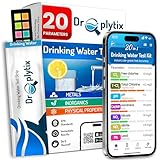
The Droplytix kit attacks the single biggest weakness of strip testing, which is that matching a pad to a color by eye is subjective. You photograph the strip with the app, and it returns numerical readings you can store and compare over time. Across 266 reviews it holds a 4.1 rating with 65 percent five star, and the trend history is the part reviewers value most.
Twenty parameters are covered including pH, hardness, chlorine, nitrate, nitrite, fluoride, iron, lead and heavy metals, with a pH range of 1.0 to 14.0, the widest in the group. The workflow is dip, wait, scan, roughly 60 seconds, and the app explains what each parameter means and whether the level is normal.
It cannot detect PFAS or resolve arsenic at the federal limit, because the underlying chemistry is still colorimetric. The app improves the reading, not the measurement, and that distinction is easy to miss if you assume a phone camera is doing laboratory work.
Ten strips is the smallest supply in the roundup, which makes this more of a demonstration than a monitoring tool. The most serious complaint is a specific accuracy report: one owner scanned a system with neither hard water nor free chlorine and the app returned 175 mg/L hardness and 1 mg/L free chlorine. That is an 11 percent one-star share, the highest here.
Some reviewers also find the app interface less polished than the results justify. It works, it just is not a polished product.
Where the app approach pays off
Two household members testing the same water will get closer to the same number than two people matching colors by hand, which removes a real source of household argument. For a family that re-tests monthly and watches for change, stored history is genuinely useful.
It is also well suited to checking a refrigerator filter, a reverse osmosis unit or a softener, where the question is whether something changed rather than what is present.
Where it falls down
Ten strips will not support ongoing monitoring, so you are reordering constantly or testing only occasionally. The app cannot fix a pad that reads wrong, which is the failure one owner documented.
If you are testing a private well, an older home, or anything after a flood, the accuracy complaint matters more than the interface. Go to a laboratory.
10. AESCULIX 23 in 1 Drinking Water Testing Kit: Best for High-Volume Monitoring
All-New 23 in 1 Drinking Water Testing Kit 158 Strips,Well Water Testing Kit & Water Test Strip for House Water for Hardness,Chlorine,Copper,Iron,Lead,pH and More
23 parameters
158 strips
Dedicated E. coli component
Pros
- Largest strip count in the roundup
- Includes test tubes and droppers for cleaner handling
- Color-coded normal zones on the chart
- 23 parameters including manganese and cyanuric acid
Cons
- Lead pad barely changes color between safe and unsafe
- Confusing colors when pads develop similar hues
- Includes a chlorine test that is useless on untreated well water
The AESCULIX kit wins on volume. At 158 strips it is the largest supply here, and if you want to compare every faucet in the house, re-test after a plumbing change, or track results across seasons and multiple properties, that count removes the reorder cycle entirely. It holds a 4.3 rating from 193 reviews with 69 percent five star.
Twenty-three parameters include cyanuric acid, manganese, aluminum, zinc, bromine, sodium chloride, hardness, residual chlorine, pH, total alkalinity, copper, iron, lead and nitrate. Test tubes and transfer pipettes are included, which makes sample handling noticeably cleaner, and the chart uses color-coded normal zones to make expected ranges easier to judge.
It cannot detect PFAS or resolve arsenic at the federal limit. The lead pad is the specific weak point: reviewers describe the orange color as barely shifting between safe and unsafe results, which means a lead reading from this kit is close to uninformative.
There is a dedicated E. coli detection component alongside the 23-in-1 strip, which is more than most competitors in this price range offer. Note that a chlorine pad is wasted on untreated well water, since there is no residual disinfectant to measure.
Most owners who recommend it add the same caveat, which we agree with: they have not validated it against a laboratory. Treat it as a wide net, not a verdict.
When 158 strips is the right answer
Multi-property households, landlords, or anyone with several water sources to monitor will get far more value from the supply than from any single parameter. The included test tubes and droppers also make it a better kit for teaching a teenager to sample properly.
For seasonal tracking, particularly around a filter replacement, the volume means you can build an actual history rather than a single data point.
When to pass
Lead. If lead is your reason for testing, the pad on this strip is the wrong instrument, and the manufacturer does not claim otherwise.
It is also the wrong pick for a single one-off question, where a smaller kit would leave you with the same information and less storage.
11. Culligan Essential Water Lab Test Kit: Best With a TDS Meter
Culligan Essential Water Lab Test Kit – Comprehensive Home Water Testing for Lead, Bacteria, Nitrates, pH, Hardness, Chlorine, Copper, Iron & More – Includes TDS Meter – Ideal for Tap & Well Water
10+ contaminants
Includes a reusable digital TDS meter
Single kit for tap and well
Pros
- Only kit here with a digital TDS meter for a hard number
- Recognizable water treatment brand
- Covers lead bacteria nitrates nitrites and pesticides
- Linked site explains each contaminant
Cons
- Single-use kit cannot be repeated
- Color charts are coarse and the copper scale jumps 0 to 10 ppm
- Some strips failed to change color
- Highest cost among the DIY strip kits
The Culligan kit is the only product in this group that includes a digital TDS meter, and that is the whole reason it is here. Total dissolved solids gives you a repeatable physical number rather than a color impression, and a reusable meter is the one component you keep for years instead of consuming. It holds a 4.2 rating from 154 reviews.
It tests lead, bacteria, nitrates, nitrites, chlorine, copper, iron, pH, hardness and pesticides, and pairs with a linked website explaining what each contaminant means. A coupon toward local Culligan service is included, which is the only thing in the roundup resembling an upsell and worth noting as you weigh it.
It cannot detect PFAS or resolve arsenic at the federal limit. The color charts are coarse, and one reviewer made the sharpest point anyone in this roundup has about chart quality: the copper scale jumps from 0 to 10 ppm against a federal limit of 1.3 ppm, so the kit cannot distinguish an acceptable copper reading from one well over the line.
It is also a single-use kit, which undercuts the value argument when a larger strip supply costs less. A few owners report strips that never changed color at all, and the 59 percent five-star share is the lowest among the multi-parameter kits here.
Buyers consistently value the brand recognition and the TDS meter, and consistently complain about the one-shot format. Both are true simultaneously.
What the TDS meter actually adds
TDS is an aggregate reading and never identifies a specific contaminant, so it cannot tell you what is in the water. What it does give you is a number you can watch for change, which makes it the best cheap signal for whether a softener, RO unit, or whole house filter is doing something.
It is also the fastest honest check on whether your tap water differs meaningfully from your filtered water.
Why the chart quality matters here
A scale that offers 0 and 10 ppm against a 1.3 ppm limit is not a scale you can act on. If copper is your concern, this kit is worse than useless because the reading will look reassuring.
Combined with the single-use format and the highest cost among DIY strip kits here, the TDS meter is the reason to consider it and the reason not to.
12. Vibe Esece 23-in-1 Water Test Strips: Best for Seasonal Tracking
Water Test Kit for Drinking Water, 23-in-1 Water Test Strips for Tap & Well Water, Tests Hardness, Lead, Iron, Copper, Chlorine, Fluoride, pH, Nitrate & More, Fast Home Water Testing, 155 Strips
23-in-1 screening
155 strips
Color chart printed on the bottle
Pros
- Highest average rating in the roundup at 4.5 stars
- 155 strips support seasonal and multi-property testing
- Chart printed on the bottle removes a loose extra
- 76 percent five-star share
Cons
- Instructions split between manual and bottle
- Unlabeled strip pads are easy to misread
- Colors hard to distinguish for exact comparison
- Confusing at first glance
The Vibe Esece kit posts the highest average rating in this roundup at 4.5 stars, with 76 percent five star and only 4 percent one star across 136 reviews. The 155-strip supply is the second largest here, and printing the color chart directly on the bottle removes the most common way strip readings go wrong, which is losing the chart.
Screening covers bacteria, hardness, pH, lead, iron, copper, chlorine, fluoride, nitrate, nitrite and sulfate, intended for household tap water, private wells and city water. The manufacturer is explicit that it is positioned as home screening rather than a substitute for certified laboratory testing, and we would keep that framing in view.
It cannot detect PFAS or resolve arsenic at the federal limit, and the documentation layout is the recurring complaint. Instructions, color coding and test descriptions are split between the manual and the bottle instead of sitting in one place, and first-time users describe the kit as confusing until the process is learned.
The specific issue is unlabeled pads. The strips show plain boxes, so it is easy to lose track of which parameter you are reading, and that is the kind of error that produces a confidently wrong answer rather than an obvious mistake.
Once you have the routine down, the volume is excellent. The pH range is 6.5 to 8.5, which suits ordinary household water but leaves little headroom at either end.
Why the rating is earned
Strong satisfaction scores usually mean the product does something the category makes difficult. Here it is supply and honest positioning, so you are not misled about what the kit is for. For seasonal tracking across a well, that combination is worth having.
It is also a good kit for a household with several properties, since 155 strips divides comfortably across them.
Where the layout costs you
Unlabeled pads are a documentation failure, not a preference. If you misread which box is which, every other thing about this kit becomes irrelevant.
Budget ten minutes with the manual before your first real test, and it stops being a problem. Skip it if you will not.
How to Choose a Drinking Water Test Kit
Start free, always
If you are on municipal water, read your utility’s Consumer Confidence Report before ordering anything. It is a public document, it lists what the system tested for, and many utilities publish a broader parameter list than the federal minimum. A free report plus a targeted strip kit usually beats an expensive panel aimed at the wrong contaminant.
If you are on a private well, there is no federal monitoring at all, and roughly 23 million U.S. households depend on one. Testing is entirely the owner’s responsibility, which makes a certified panel a reasonable expense rather than an optional one.
State health departments and university extension labs also run testing for residents, often at a reduced cost, and several cities run their own free tap water kit request programs. If a local option exists, use it before buying retail. The same lab-panel-versus-strip logic runs below ground, and our picks for the [best professional soil test kits](https://www.comstock-interactivedata.com/best-professional-soil-test-kits/) cover that side of the decision.
Match the tier to the contaminant
Strips and dip pads reliably screen chlorine, hardness, pH and iron, which makes them a good fit for taste, odor, staining and routine trend tracking. They are semi-quantitative, which means the color match is your interpretation rather than an instrument reading.
Lead, PFAS, arsenic, and bacterial contamination are different questions. PFAS sits at parts per trillion and needs EPA Method 537.1 or 533, which no home pad can deliver. Arsenic needs a laboratory. Bacteria need a sterile bottle, since touching the inside voids the sample.
The technical terms worth understanding before you read any report: the MCL is the legal limit, the MCLG is the health-based goal, and the two are not the same thing. A result at or under the MCL is still legal and may still be above the health goal. Chain of custody is the documented, unbroken handling record, and it decides whether a result is legally defensible. Detection limit is the lowest concentration a method can reliably measure, and on r/WaterTreatment it is the number people argue about most, because an inaccurate result for a parts-per-billion compound can be off by orders of magnitude.
Collect the sample correctly
The most common mistake is flushing before a first-draw lead sample. A first-draw sample is taken from the tap without running the water first, because stagnation overnight is what draws lead and copper out of plumbing. Flush first and you dilute away exactly what you were testing for.
For bacteria, use the sterile bottle provided, do not touch the inside of the cap or the neck, and refrigerate if the lab asks. For general chemistry, flush the tap for several minutes first, which is the opposite of the lead protocol and the reason one kit cannot serve both.
Avoid pool and aquarium kits for drinking water. TractorByNet members make the point well: the carbonate hardness and salt resolution those kits are built for is nowhere near sufficient for household analysis, and r/DIY has an active thread on sewage contamination questions that no pool kit can answer.
Two more practical notes. First, never skip the free option and go straight to a paid screen if a utility report exists. Second, be wary of free on-site tests that end in a filtration sales pitch, a complaint raised more than once in the discussions we reviewed.
Frequently Asked Questions
Which drinking water test kit is the most accurate?
Accuracy comes from the method and the laboratory, not the number of pads. For lead, PFAS, arsenic and bacteria, the most accurate option is a mail-in panel analysed by a certified laboratory using EPA-approved methods, such as EPA Method 537.1 or 533 for PFAS. Strips are semi-quantitative screens for chlorine, hardness, pH and iron. No single kit is most accurate for everyone, because accuracy depends on whether the method is certified for your specific contaminant.
Are there any home water test kits that actually work?
Yes, but only for the parameters they actually measure. Strips reliably screen hardness, chlorine, pH and iron, and they are useful for tracking change over time. Nothing sold for home use reliably detects lead at health-relevant levels, PFAS, arsenic or bacteria at the federal limits. Treat a clean strip result as the absence of an obvious problem, not as proof that your water is safe.
What is the best water purity tester for home use?
For a broad screen, the Varify 17-in-1 offers 17 parameters, 100 sealed strips and bacteria tests. For the widest parameter list, the SJ WAVE 22-in-1 covers 22 indicators. For lead specifically, the Watersafe kit states detection down to 5 ppb. For a genuine laboratory measurement, the Tap Score Advanced panel runs 116 analytes through certified laboratories. For a repeatable physical number, the Culligan kit bundles a digital TDS meter.
Are home well water test kits accurate?
Only when they include coliform and E. coli testing via sterile sampling and cover nitrate, metals and hardness. Many kits sold as well water kits omit the microbiology component that well owners most need tested annually. A strip can flag a gross problem, but groundwater can carry arsenic, radon, iron and nitrate at levels that require a certified laboratory to resolve, and one owner in this roundup reported zero iron and zero manganese where a laboratory found high levels.
How often should private well water be tested for bacteria?
At least annually for total coliform and nitrate, with a broader panel every two to three years, and an immediate retest after flooding, nearby construction, or any change in taste, color or odor. Private wells have no federal testing requirement, so the cadence is entirely the owner’s decision. If a well must show a zero bacteria count to be placed in service, a strip result reading as clean is a much weaker standard than that.
Can I get my water tested for free?
Yes, in several situations. Every municipal water utility publishes an annual Consumer Confidence Report listing what was tested. Many state health departments and university extension laboratories test resident samples at reduced cost, and some cities run their own free tap water kit request programs. Start with those before ordering any retail kit, and treat any free on-site test that ends in a filtration sales pitch accordingly.
The Verdict
After six weeks and 12 kits, the honest conclusion is that most comprehensive drinking water test kits in this roundup are screens, not measurements. The Varify 17-in-1 is the best general-purpose buy for broad, repeatable screening with plenty of re-test capacity. The Watersafe kit is the one to buy if lead is the specific worry, because it is the only strip here quoting a detection limit below the federal action level.
For anything involving PFAS, arsenic, or a question you may need answered in a dispute, only the Tap Score 116-analyte panel qualifies, and even it is not documented as chain-of-custody. Read your Consumer Confidence Report first, sample correctly, and treat every result on this list as a reason to test properly rather than a reason to relax. Related reading: our picks for the [best soil test kits](https://www.comstock-interactivedata.com/best-soil-test-kits/) if you are testing more than water this 2026.