
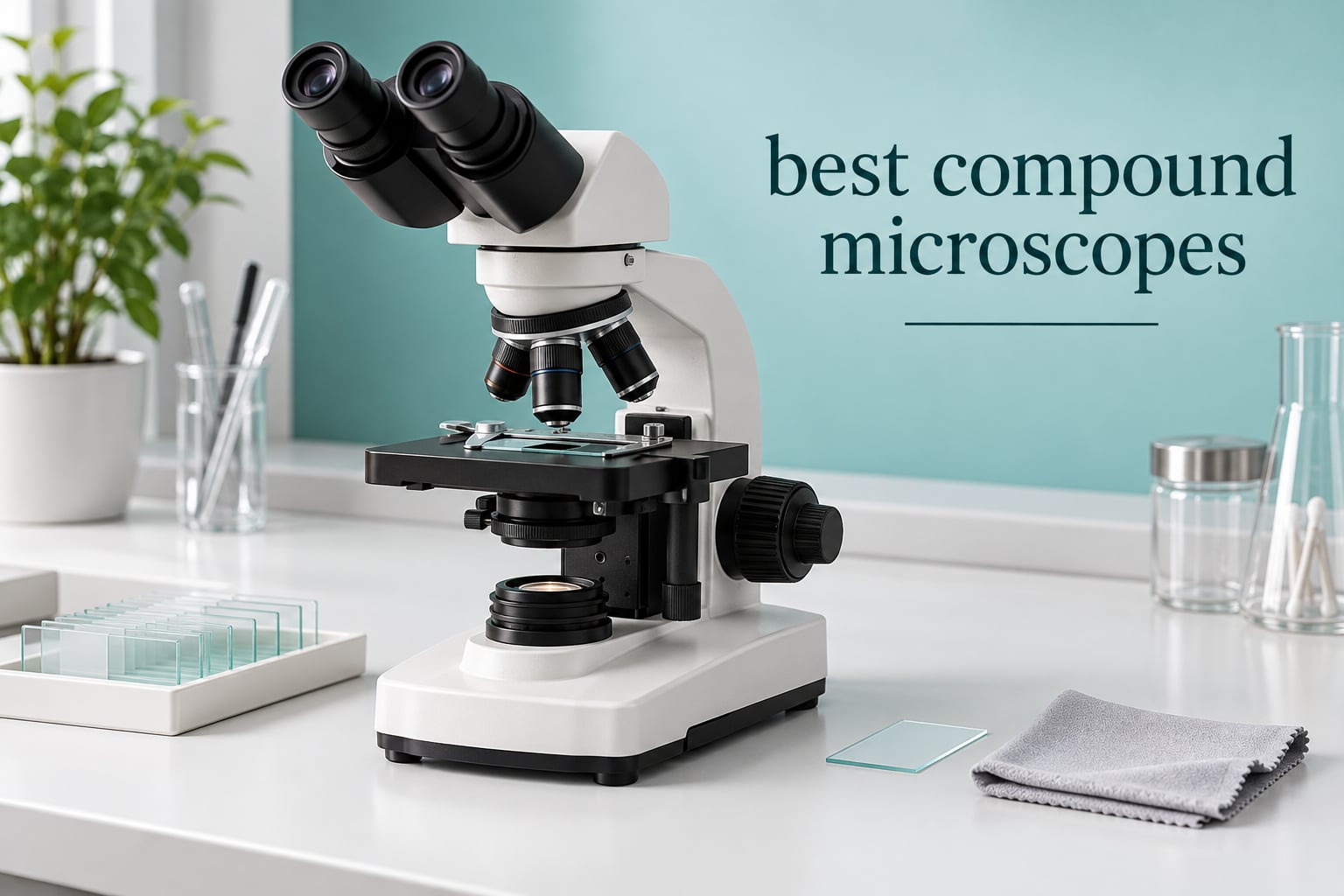
A compound microscope is the only instrument you can buy that puts individual cells, bacteria, and fine specimen detail in front of your eye. Light passes through or reflects off a specimen on a glass slide, an objective lens near the stage forms an enlarged real image, and an eyepiece at the top enlarges it again. Total magnification is simply the objective power multiplied by the eyepiece power.
That simple formula is also where most disappointment starts. The number printed on the box is the product of the largest objective and the largest eyepiece bundled in the box, and it tells you almost nothing about how much detail you will actually see. Our team has spent 2026 reading thousands of buyer reviews across twelve scopes and comparing what each one resolves at 100X, 400X, and 1000X.
This guide covers the best compound microscopes for 2026 across the full range: budget kits for kids and homeschool, the binocular and trinocular models serious hobbyists graduate to, and one digital scope for people who need specimens on a screen. We explain empty versus useful magnification, break the binocular and trinocular question down, and name the research brands that sit above everything here. If you are still narrowing the field, our general best microscopes guide covers the other microscope types too.
Table of Contents
- Top 3 Best Compound Microscopes in 2026
- All 12 Compound Microscopes Compared Side by Side in 2026
- 1. OMAX M82ES 2000X Binocular Compound Microscope: Best Overall
- 2. Swift SW380T 40X-2500X Trinocular Microscope: Best for Photography
- 3. TOMLOV CM101 40X-2000X Monocular Microscope: Best Value
- 4. AmScope M162C 1000X All-Metal Microscope Kit: Best for Families
- 5. Emarth 40X-1000X 52-Piece Compound Microscope Kit: Most Versatile
- 6. BEBANG YW-3006 2000X Compound Microscope: Best Accessory Bundle
- 7. AmScope M40-K-MDM35 1200X Microscope with Digital Camera: Best Built-In Camera
- 8. AmScope M102C-PB10 1000X Biological Microscope: Best for Classroom Budgets
- 9. Herwicm 40X-2500X Binocular Microscope: Best for Binocular Comfort
- 10. Poothoh 40X-2000X Binocular Microscope: Best for Shared Screen Viewing
- 11. PalliPartners 40X-2000X Microscope with 28-Slide Kit: Best for Young Children
- 12. OMAX MD82ES10 2000X Digital Compound Microscope: Best for Digital Documentation
- How to Choose a Compound Microscope
- Empty vs Useful Magnification: What 1000X Really Means
- Compound Microscope Brands Explained: Big Four vs the Value Tier
- Frequently Asked Questions
- Which Compound Microscope Should You Buy?
Top 3 Best Compound Microscopes in 2026
OMAX M82ES 2000X Binocular
- 40X-2000X across eight settings
- NA1.25 Abbe condenser
- Double-layer X-Y mechanical stage
- Five-year warranty

Swift SW380T Trinocular
- Rotatable Siedentopf trinocular head
- WF10X and WF25X eyepieces
- C-mount camera port
- Ultra-precise fine focus

TOMLOV CM101 Monocular
- Coaxial coarse and fine focus
- Dual top and bottom LED
- Achromatic 4X 10X and 40X objectives
- Slides and coverslips included
All 12 Compound Microscopes Compared Side by Side in 2026
| Product | Specifications | Action |
|---|---|---|
| OMAX M82ES 2000X Binocular |
|
Check Latest Price |
| Swift SW380T Trinocular |
|
Check Latest Price |
| TOMLOV CM101 |
|
Check Latest Price |
 AmScope M162C 1000X AmScope M162C 1000X |
|
Check Latest Price |
 Emarth 52-Piece Kit Emarth 52-Piece Kit |
|
Check Latest Price |
 BEBANG YW-3006 BEBANG YW-3006 |
|
Check Latest Price |
 AmScope M40-K-MDM35 AmScope M40-K-MDM35 |
|
Check Latest Price |
 AmScope M102C-PB10 AmScope M102C-PB10 |
|
Check Latest Price |
 Herwicm Binocular Herwicm Binocular |
|
Check Latest Price |
 Poothoh Binocular Poothoh Binocular |
|
Check Latest Price |
 PalliPartners 28-Slide Kit PalliPartners 28-Slide Kit |
|
Check Latest Price |
 OMAX MD82ES10 Digital OMAX MD82ES10 Digital |
|
Check Latest Price |
1. OMAX M82ES 2000X Binocular Compound Microscope: Best Overall
Awarded Best Compound Microscope 2016 – OMAX 40X-2000X Lab LED Binocular Microscope with Double Layer Mechanical Stage w Blank Slides Covers and Lens Cleaning Paper
40X-2000X across eight settings
DIN 4X 10X 40X and 100X oil objectives
NA1.25 Abbe condenser
9.6 lb all-metal frame
Pros
- Eight real magnification levels including a 100X oil immersion objective
- Abbe condenser with iris diaphragm gives properly contrasty brightfield images
- Double-layer X-Y mechanical stage with scales
- Full metal frame and five-year warranty
- Bundles 100 slides 100 coverslips and lens paper
Cons
- Transmitted light only so opaque samples need a separate lamp
- Heaviest scope here at 9.6 pounds
- Bundled accessory package is oversized for casual use
The M82ES is the scope we keep coming back to because it is the rare budget-adjacent model with real lab architecture underneath. You get a 45-degree inclined binocular head that swivels through 360 degrees, interpupillary distance adjustment, and a diopter ring on both tubes. That combination matters more than any magnification figure on the box.
Optical performance comes from four DIN achromatic objectives, including a 100X oil immersion objective. At 1000X with a proper coverslip and immersion oil, buyers with laboratory backgrounds report clear bacterial and mycology detail. This is the tier where a compound microscope stops being a toy and starts being an instrument.
The double-layer mechanical stage is the feature that changes daily use. Slides move on two axes with printed scales, so you can return to a specific cell without re-searching the field. The upward-moving stage lock lifts the slide away from the objectives when you change lenses, which prevents the single most common beginner accident: cracking a slide against a 40X objective.
Two things to plan around. Illumination is transmitted only, so anything opaque needs a separate external light. And at 9.6 pounds this is not a scope you carry to a kitchen table, it wants a sturdy bench. Both are fair trades for the build quality. If the third port for a camera is what you actually need, our trinocular microscope guide covers that path in detail.
Who this suits
Anyone moving past prepared-slide viewing into pond water, prepared bacterial smears, or fabric and mineral thin sections. The oil immersion objective, Abbe condenser, and mechanical stage together make it a scope capable of running undergraduate lab work without an upgrade.
It also works for a home lab where one person will use the scope several times a week. Its five-year warranty covers the longest period we see in this group, which matters when a single part failure would otherwise mean a new instrument.
Who should skip it
Skip it if you only expect occasional viewing and storage space is tight. A lighter monocular model handles a first microscope just as well and costs less. The stage, condenser, and diopter controls only start to pay off after you already know what you are looking for.
Also skip it if you plan to photograph through a camera port. This is a binocular head, so adding a camera later means working around the eyepieces rather than through a dedicated trinocular port.
2. Swift SW380T 40X-2500X Trinocular Microscope: Best for Photography
Swift SW380T 40X-2500X Magnification, Siedentopf Head, Research-Grade Trinocular Microscope Compound Lab with Wide-Field 10X/25X Eyepieces, Mechanical Stage, Ultra-Precise Focusing, Camera-Compatible
Rotatable Siedentopf trinocular head
WF10X and WF25X eyepieces at 30 degree tilt
Four DIN achromatic objectives
C-mount camera port
Pros
- Trinocular port accepts C-mount and eyepiece cameras for capture and livestreaming
- Siedentopf head tilts and rotates to cut neck strain at long sessions
- Interchangeable glass eyepieces with interpupillary adjustment
- Fine focus makes a real difference above 400X
- Sharp optics praised by working pathologists
Cons
- Transmitted light only above 100X for thick or opaque samples
- Thin undersized dust cover
- Very short working distance at 400X and 1000X
The SW380T is the one in this group built around the assumption that you will want to put a camera on it. The trinocular head carries a dedicated third port that accepts C-mount cameras and eyepiece cameras, so you can image and still look through both eyepieces. Forum regulars on r/labrats consistently list this as the reason to spend up front rather than plan a head swap later.
Optically it holds up to serious scrutiny. Four DIN achromatic objectives on a revolving turret give six levels from 40X through 2500X, and the included WF10X and WF25X wide-field eyepieces are real glass rather than plastic. One working pathologist reviewing the scope described the resolution as comparable to far costlier hospital instruments, which is a strong signal at this tier.
Focusing is the other half of the story. The coarse and fine system is described as ultra-precise, and reviewers repeatedly single out the fine knob as the difference between a usable and an unusable 1000X image. The Siedentopf head rotates fully and tilts to 30 degrees, which is not a gimmick after an hour at a high magnification.
What you give up is illumination flexibility. Light comes from below only, so thick or opaque specimens need external lighting above 100X, and the objective safety housings partially block a front light source. The included dust cover is also thinner and smaller than the instrument deserves.
Deciding on this head type
A trinocular head costs more than binocular because the third port is a machined optical path, not a plastic insert. You are buying the option to attach a camera later without removing an eyepiece or replacing the whole body. If you think you will ever want images, this is the head to buy first.
Our professional trinocular microscope roundup goes deeper on when a third port earns its cost.
What to watch before buying
Working distance gets short at 400X and 1000X, so focusing becomes a delicate touch. Plan on a steady surface and slow fine adjustments. If most of your samples will be opaque, the transmitted-only lighting will limit you more than the optics will.
For immersion work, budget for immersion oil and coverslips separately. The parfocal DIN objectives and glass eyepieces make camera work far more predictable than eyepiece cameras on plastic-bodied scopes.
3. TOMLOV CM101 40X-2000X Monocular Microscope: Best Value
TOMLOV Compound Microscope with Coarse & Fine Focus for Adults & Students,
40X-2000X stated range
Achromatic 4X 10X and 40X objectives
WF10X and WF25X eyepieces
2.7 lb metal and ABS body
Pros
- Coaxial coarse and fine focus for a price that usually buys coarse only
- Dual top and bottom LED supports reflected and transmitted work
- Metal base adds real stability
- Includes prepared slides blank slides and coverslips
- 6-position disc diaphragm with color filter
Cons
- Usable magnification is far below the advertised 2000X
- Monocular head tires one eye over long sessions
- Base could be heavier for high-power work
The CM101 is the value pick because of one feature more than any other: real coaxial fine focus. Forum moderators on r/microscopy list coarse-focus-only mechanics as the first deal breaker, and most scopes at this level ship without a fine knob. This one has it, and that single addition changes what you can do above 400X.
You get achromatic 4X, 10X, and 40X objectives, which is the correct set for pond water, plant cells, and prepared slides. WF10X and WF25X wide-field eyepieces are included, and dual top and bottom LED illumination means you can look at opaque objects as well as translucent specimens. A 6-position disc diaphragm with a color filter handles contrast adjustment.
Buyers also pick this scope up for coins, stamps, gems, and electronics inspection, where the wide screen and movable lighting make a real difference. At 2.7 pounds and roughly 6 by 5 by 12 inches it is genuinely portable, which is unusual at this tier.
The honest caveat is the headline number. A credentialed reviewer flagged that the advertised 2000X is marketing-driven and that realistic usable magnification tops out far lower. Judge it on the 4X, 10X, and 40X objectives, which is where the honest work happens.
Is 2000X printed on the box real?
No. The 2000X figure comes from multiplying the 40X objective by the 25X eyepiece and an auxiliary lens, and past a point adding magnification adds size to the image without adding resolvable detail. Experienced buyers on r/microscopy treat 400X as the practical working ceiling on optics of this class.
That is not a flaw specific to this scope. It is how nearly every listing in the budget tier builds its headline number, which is why we explain the useful-magnification ceiling in full further down.
Choosing between monocular and binocular
Monocular means one eye at the eyepiece, and long sessions on one eye get tiring. For children under about ten, or for anyone looking at specimens for five minutes at a time, monocular is easier and less costly.
For long adult sessions, plan an upgrade to a binocular head model at some point. The optics are not the limiting factor here, the ergonomics are.
4. AmScope M162C 1000X All-Metal Microscope Kit: Best for Families
AmScope M162C-2L-PB10-WM “Awarded 2018 Best and Microscope Kit” – 1000X
All-metal construction
40X to 1000X with six settings
Dual-layer mechanical stage
3.7 lb with carrying case
Pros
- Highest average rating in this group with owners citing university-grade clarity
- All-metal frame and optical components
- Coaxial X-Y controls on a dual-layer mechanical stage
- Includes 10X and 25X eyepieces plus a carrying case
- Works well for children thanks to a simple rotating head
Cons
- 40X objective is less sharp than the 4X and 10X
- Included manual is general rather than model specific
- Only five prepared slides included
This is the scope our team recommends when one instrument has to serve both a curious child and an adult who actually knows optics. The all-metal frame does not flex when you turn the coarse knob, and parents report the dual lighting setup keeps kids engaged because opaque objects work as well as prepared slides.
A former university biology lab instructor compared the 4X and 10X objectives favorably against instruments costing several times more, noting the 40X falls slightly behind. That is exactly the pattern you want in a family scope, because most interesting kid-viewing happens at low power.
You get six magnification settings from 40X through 1000X, a dual-layer mechanical stage with coaxial X-Y controls, and both 10X and 25X eyepieces. A carrying case is included, which matters more than it sounds like it should when a child is the primary user.
Two practical notes. The included manual is a general book rather than instructions for this specific model, and the five prepared slides run out fast, so order an extra slide kit alongside it. Compatible AmScope digital cameras attach if you want images later.
Why the 4.6 rating holds up
Most of the owners writing about this scope have real laboratory experience behind their comments, which is unusual at this tier. The rating is not inflated by gift-givers. Parents with lab backgrounds describe it as the natural stepping-up purchase from a plastic marketplace scope, which is the position AmScope holds in the hobby community.
If your child will outgrow a 1000X ceiling for college work, plan a second instrument later. For school and home study through roughly age fourteen, it holds.
Where the money is not
Do not overspend on a 40X oil immersion objective for a young learner. The 40X here is already the weakest optic in the set, and most children never get to a stage where oil immersion makes sense.
Spend instead on prepared slide sets, cover slips, and a slide clip. Those consumables drive repeat sessions far more than another magnification step would.
5. Emarth 40X-1000X 52-Piece Compound Microscope Kit: Most Versatile
Microscope for Kids Beginners Children Student, 40X- 1000X Compound Microscopes with 52 pcs Educational Kits
40X-1000X true compound design
52-piece kit with slides and tools
Top and bottom LED illumination
38 degree true angle of view
Pros
- Genuine compound design rather than a toy
- 52-piece kit includes prepared slides blank slides and tools
- Dual top and bottom LED handles opaque and translucent specimens
- 6 color filters and a rotatable head
- Metal objective housings
Cons
- Plastic frame makes it shakier than metal-bodied models
- Included plastic slides are limited so extra glass slides are advisable
- Dust cover mentioned in the manual is not included
When a head-to-head comparison put three budget scopes side by side, this one came out ahead for clarity at high magnification. That is the single result that matters most here, because everything else on the list is a feature you can add later and resolution is something the box cannot give you back.
The 52-piece kit is the real headline at this level. You get prepared slides, blank slides, tools, and 6 color filters, which is enough to keep a curious kid busy for months. A rotatable head and metal objective lens housings are unusual finds this low down.
Owners treat it as a capable school and homeschool scope rather than a novelty, and specifically praise image brightness and the inclusion of both 10X and 25X eyepieces. Battery power and a top-light and bottom-light switch are well received for specimen flexibility.
The plastic frame is the honest weakness. It is noticeably shakier than the metal-bodied models in this roundup, and the bundled plastic slides are thin, so buy a box of glass slides separately. The manual mentions a dust cover, but none is included in the box.
Who this is genuinely for
Children roughly six to twelve, homeschool setups where several children share one instrument, and anyone who wants a first real microscope without a large outlay. The dual illumination is the feature that extends its life, because it handles opaque objects as well as slides.
A 38-degree angle of view gives a wide, comfortable field for small hands. That sounds trivial until you watch a child hunt for a specimen they can barely see.
When to step up instead
Move up when you notice yourself straining to bring a 400X image into focus, or when you want to start looking at live pond water and need a proper mechanical stage. Neither is a criticism of this scope, it simply is not a laboratory instrument.
Do not expect the 1000X figure to deliver anything at high power. Judge it on 100X and 400X, where it performs well for the money.
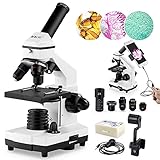
6. BEBANG YW-3006 2000X Compound Microscope: Best Accessory Bundle
2000X Compound Microscope for Kids Adults: Microscope for Biology Education
Six settings from 100X to 2000X
0.65 NA condenser with disc diaphragm
Dual top and bottom LED
Solid metal frame at 2.4 lb
Pros
- WF25X eyepiece with 2X lens gives six magnification settings
- Coarse and fine focus knobs mounted on a solid metal frame
- Dual LED illumination with a 0.65 NA condenser
- Bundle includes 15 slides a phone adapter a wire shutter a carrying bag and 10 operating tools
Cons
- The high advertised magnification is not achievable with the bundled optics
- Bundled accessories and slides are basic relative to the feature list
With close to 2,900 ratings this is one of the most reviewed budget monocular scopes in circulation, and the review volume itself is informative. Buyers accept it for school and hobby biology use and point to the metal frame, dual illumination, and slide bundle as the strongest elements.
The bundle is the argument. You get 15 slides, a phone adapter, a wire shutter, 10 operating tools, and a carrying bag, which covers almost everything a first-time buyer would otherwise order piecemeal. The 0.65 numerical aperture condenser is a genuine spec worth noting, since a weak condenser is what makes cheap scopes look flat.
Mechanically it is better than most of its tier. Coarse and fine focus knobs sit on a solid metal frame rather than a plastic base, and the frame itself weighs 2.4 pounds, which helps stability at higher power.
Experienced buyers are consistent about one thing: the 2000X ceiling is marketing, not usable magnification. The optics that matter are the 4X, 10X, and 40X achromatic objectives, and at those powers the scope performs as expected.
What the bundle saves you
The phone adapter and wire shutter alone are the pieces most beginners forget to buy. A phone adapter is how you get your first images without a camera, and the wire shutter avoids the blurry result of triggering a phone by hand.
Extra glass slides and proper cover slips are the two things you will still need. Cover slips are not optional at 40X, and forum moderators routinely correct beginners who skip them.
Where it falls short
The accessories are more numerous than they are good, which is a common pattern in this tier. Tools included are basic, and the slides that ship in the box are plain.
The 2000X headline sets an expectation the optics cannot meet, and experienced users will feel shortchanged at first. Know the useful ceiling before you unbox it and the scope does its job well.
7. AmScope M40-K-MDM35 1200X Microscope with Digital Camera: Best Built-In Camera
AmScope M40-K-MDM35 1200X Monocular Compound Microscope Digital Camera Kit
120X-1200X with a USB 2.0 color camera
Software for Windows and Mac
All-metal frame with rack-and-pinion focus
Rotating four-color filter wheel
Pros
- USB 2.0 color camera with software for live viewing and image capture
- 85-plus piece accessory collection plus an ABS carrying case
- All-metal frame with rack-and-pinion focusing
- Dual illumination from a natural-light mirror and LED
- Rotating four-color filter wheel
Cons
- Focus drifts and needs repeated recentering
- Images lose clarity at higher magnifications
- Eyepiece camera looks through the eyepiece so it does not replace it
This is the pick if your interest in a microscope is documentation rather than resolution. The bundled USB 2.0 color camera and imaging software give live viewing on a Windows or Mac computer, with capture built in. For a kid, a screen showing what the eyepiece sees is often the thing that keeps them coming back.
The hardware underneath is decent. An all-metal frame with rack-and-pinion focusing feels more solid than most scopes in this price band, and dual illumination from a natural-light mirror plus an LED covers both opaque and translucent work. A rotating four-color filter wheel handles contrast.
Buyers consistently describe it as an excellent gift or a toy-grade instrument rather than a school microscope, and the camera plus software are the reason. AmScope customer service is praised when issues arise, including a corroded battery pack that was replaced quickly.
Two limitations shape how you use it. Focus drifts, so you recenter the slide regularly, and image clarity falls off at higher magnifications compared with school-grade models. Because it is an eyepiece camera, it looks through the eyepiece rather than replacing it, which means the image is slightly dimmer than the view you see directly.
What an eyepiece camera does and does not do
An eyepiece camera is a small sensor sitting on top of one eyepiece. It is cheap, portable, and needs no port on the head, which is why it exists. What it cannot do is replace the binocular viewing path, so brightness drops and you photograph through the same optics as the eyepiece.
Forum users on r/microscope treat these cameras as a documentation tool for larger surface detail, not a route to real cellular work. Treat it the same way and it is genuinely useful.
Who should pass
Pass if your goal is resolving bacteria or anything at 1000X. The optics will not get you there, and a screen does not add resolution it was never there to begin with.
Also expect some assembly friction. Not every accessory fits the case and the light has no dedicated on/off switch, so set aside ten minutes before the first session.
8. AmScope M102C-PB10 1000X Biological Microscope: Best for Classroom Budgets
AmScope M102C-PB10 1000X Biological Compound Microscope with Prepared
Monocular head with five powers to 1000X
All-metal framework and optical glass lenses
LED illumination from a wall outlet
5 blank and 5 prepared slides included
Pros
- All-metal framework with all optical glass lenses at an entry price
- Plug-in LED illumination is brighter and more reliable than battery bulbs
- Single-lens condenser with disc diaphragm
- Focusing is straightforward enough for beginners and middle-school users
Cons
- No fine adjustment knob for precise focusing
- LED light reported to burn out quickly with no readily available replacement
- Some users report glare and an unclear image
Several owners report this model outperformed the plastic-bodied budget scopes they compared it against, and that early negative reviews overstated its problems. The reason is simple: it is all metal with optical glass lenses, where most competitors at this level use plastic.
For a classroom buying several units, that construction difference is what decides it. It also runs off a wall outlet, and plug-in LED illumination is brighter and more reliable than the battery bulbs used by many cheaper scopes, which is a real operational advantage when twenty students rotate through one instrument.
You get five magnification powers up to 1000X, a single-lens condenser with disc diaphragm, and five blank plus five prepared slides to start. Focusing is coarse only, and that is the significant compromise.
Owners also note that 1000X is the ceiling here, with users expecting to upgrade for later college-level classes. Durability around the LED illuminator is the other recurring concern, since several buyers experienced early burnout and a replacement is not easy to source.
Is coarse focus only acceptable?
At 40X and 100X, yes. The image plane is shallow but wide enough that the coarse knob gets you there reliably. Around 400X and above, critical focus becomes nearly impossible without a fine knob, which is why forum lists of deal breakers always include this one.
For middle-school observation of prepared slides, coarse focus is workable. For cell work or anything at high power, save for a model with a fine knob.
Buying for a classroom
Buy a spare set of slides and coverslips with every unit, because five slides per scope disappears quickly. A stage clip and a lens cleaning cloth matter even more with shared equipment than with a single home instrument.
The 1000X ceiling means these are school instruments, not college lab instruments. For upper-level work, move to a binocular model with a proper mechanical stage.
9. Herwicm 40X-2500X Binocular Microscope: Best for Binocular Comfort
Compound Microscope,40X-2500X ,WF10x and WF25x eyepieces, Dual LED Lighting and Two-Layer Mechanical Stage,Microscope for Adults… ASIN B0CCNZFJ61
Ultra-wide-angle binocular eyepieces
Coaxial focus knobs on both sides
Telescopic lens to prevent collisions
Two-layer mechanical stage
Pros
- Ultra-wide-angle binocular eyepieces with a large field of view reduce eye fatigue
- Coaxial coarse and fine focus handwheels on both sides of the base
- Two-layer mechanical stage with a spiral moving scale
- Telescopic lens helps prevent sample and lens collision
Cons
- Listing data is internally inconsistent with the 2500X headline
- Body and stage are metal and plastic rather than all-metal
- Fewer written reviews than most picks here
A binocular head with a two-layer mechanical stage and coaxial fine focus is a real step up from monocular, and that combination is the reason to look at this scope. Ultra-wide-angle eyepieces with a large field of view are genuinely less tiring over a long session, and the coaxial coarse and fine handwheels are fitted to both sides of the base so you can drive the stage without switching hands.
The telescopic observation lens keeps the objective from dropping into a tall specimen when you swing the head around, which is how slides get cracked on entry-level binocular scopes.
There is a documentation problem here worth knowing about before you buy. The specification listing reports a maximum magnification of only 40X, which does not match the 2500X claim in the title, and buyers familiar with optics point out that figures above 1000X come from swapping eyepieces rather than adding objective power.
Review volume is modest at 256 ratings, so the written feedback is thinner than the rest of this list. Sentiment on the wide-field viewing and smooth coaxial focus is positive, but we would verify the optics on arrival rather than trust the listing.
When a binocular head earns its cost
Two eyes reduce eyestrain and improve depth perception, which makes finding and holding a specimen noticeably easier. That benefit is largest for adults doing extended sessions and for anyone who has already found monocular viewing uncomfortable.
A binocular head without a mechanical stage or a real condenser is a partial upgrade. With a two-layer stage and coaxial fine focus, this is closer to a complete one.
Handle the listing claims carefully
Treat the headline magnification as marketing until you have measured it. Test the 4X, 10X, and 40X objectives on a prepared slide and see whether the image is crisp and evenly lit. If it is, the rest follows.
The metal and plastic body is a step down in rigidity from the all-metal models here. Check for flex when you turn the focus knob, and steady the base if you notice it.
10. Poothoh 40X-2000X Binocular Microscope: Best for Shared Screen Viewing
Binocular Compound Microscope 40X-2000X, Research Grade Professional Microscope with Dual Mechanical Stages and Coaxial Coarse/Fine Focus Knobs, Built-in Electronic Eyepieces, Adult Microscope
Binocular head with built-in electronic eyepieces
Four objectives up to 2000X
Dual LED with a five-color filter bar
Protective case included
Pros
- Built-in electronic eyepieces let you share the view on a screen
- Coaxial coarse and fine focus for fast specimen location
- Dual LED illumination with adjustable brightness and a five-color filter bar
- Metal construction at a mid-range tier
- Children can operate it easily
Cons
- PC driver software described as inaccessible or non-functional by several reviewers
- One buyer reported antivirus flagging the software
- Lighting brightness toggle does not always work
- Manual uses tiny print and broken English
The idea here is simple and genuinely useful: put a small camera in the eyepiece path so you can show a specimen to a class, a screen, or a child across the room without passing the slide around. The electronic eyepieces handle that, and the binocular head still lets you look directly when you want to.
Mechanically it is well specified for the tier. Coaxial coarse and fine focus handwheels, metal construction, dual LED illumination with adjustable brightness, and a five-color filter bar. Several buyers call it well tuned and good value for a binocular head, and kids reportedly use it happily.
The software is the problem, and it is the main reason this sits mid-list rather than higher. Multiple reviewers report the PC driver as inaccessible or non-functional, and one buyer had their antivirus flag the software outright. There is also a discrepancy between the listing, which shows three eyepiece sets, and what is actually in the box.
The manual is also a weak point. Tiny print, broken English, and little useful content mean you will be working from general microscope knowledge rather than the documentation. Budget time for that.
Is a screen eyepiece worth it
For teaching, yes, and screen viewing of the eyepiece path is the feature no other pick here offers. Children who are shy about looking through an eyepiece engage far more readily when the image is on a screen they can lean toward.
For personal research imaging, no. A dedicated USB camera on a trinocular head gives better control and far better software, and you can see our picks in the trinocular lab guide.
What to verify on arrival
Confirm the electronic eyepiece works with your computer before you need it, since several reviewers hit driver problems. Check the brightness toggle, which does not respond reliably on every unit.
Count the eyepieces in the box against the listing, and confirm the battery type if the lighting is battery powered, since that detail is not documented consistently.
11. PalliPartners 40X-2000X Microscope with 28-Slide Kit: Best for Young Children
PalliPartners Compound Microscope for Adults & Students, White
4X 10X and 40X objectives with a WF25X eyepiece
28-slide kit with a phone clip
Coaxial coarse and fine focus
SGS certified for ages 8-18
Pros
- Adjustable top and bottom LED handles opaque items and translucent cells
- 28-slide kit includes 10 prepared and 18 blank slides plus a phone adapter and remote shutter
- Bright USB-powered light gives even illumination without harsh shadows
- Coaxial coarse and fine focus for sharper adjustment
- SGS certified for non-toxic materials and electrical safety
Cons
- Lens fit can wobble inside the housing if handled roughly
- Adjusted magnification typically falls short of the advertised 2000X
- No movable viewing platform so specimens are harder to locate
Buyers frequently describe this as good value and easy to use for children roughly five to twelve, and the 28-slide kit is the reason. Ten prepared and 18 blank slides means a child can work through prepared material and then start making their own, which is where the interest actually develops.
Two features separate it from similar kits. The Bluetooth remote shutter lets a child capture a phone photo without touching the scope, which is a small thing that makes a big difference to a phone photo of a moving live specimen. And the SGS certification for non-toxic materials and electrical safety is worth having for a product a child handles unsupervised.
Optically you get 4X, 10X, and 40X objectives with a WF25X eyepiece and a 2X auxiliary lens. The objectives are described as a 40X achromatic. Adjustable top and bottom LED illumination and coaxial coarse and fine focus are both good signs at this level.
The recurring complaints are wobble in the lens housing if it is handled roughly, a focusing experience that feels coarse next to a real lab scope, and a no-platform stage that makes locating a specimen harder. Overseas buyers have reported an incompatible power supply and an unhelpful manual, so check your plug type.
Monocular for a first microscope
For a child under ten, monocular is the right call. One eye at the eyepiece is much easier for small facial features and developing depth perception, and it is also the simplest thing for a parent to set up and explain.
The trade is adult comfort. If you are the one who will be doing most of the looking, plan to upgrade to a binocular head later rather than fighting a monocular eyepiece after an hour.
Preparing it for a child
Start at 40X with a prepared slide. A child who cannot find a specimen at 400X concludes the microscope is broken, and it is not, it is just harder to aim.
Keep the scope on a stable table with a clear light background, and use the phone clip for images rather than leaning the phone against the eyepiece. The remote shutter makes that work properly.
12. OMAX MD82ES10 2000X Digital Compound Microscope: Best for Digital Documentation
OMAX MD82ES10 2000X Digital LED Compound Microscope with Built-in 1.3MP
Built-in 1.3MP CMOS sensor
40X-2000X binocular magnification
Double-layer mechanical stage
5-year manufacturer warranty
Pros
- Built-in camera shows the eyepiece view live on a laptop and avoids eyestrain
- Reviewers with bacteriology and mycology backgrounds report clear 1000X oil immersion images
- Heavy solid lab-grade feel with smooth coarse and fine focus
- Double-layer mechanical stage moves slides on two axes
- Dimmable substage lamp and slides load from the side
Cons
- 1.3MP camera resolution is low
- No slides or coverslips are included
- Bundled software frequently failed to read and documentation is thin
The MD82ES10 is the only scope in this roundup with a sensor built into the head rather than an eyepiece camera, which means the binocular view is fully preserved while a laptop shows a live image. For long sessions or anyone with eye strain from the eyepiece, that is a meaningful difference rather than a gimmick.
Owners with laboratory backgrounds, including an environmental toxicologist and a microbiology adjunct, praise the optical quality and the value of integrated capture. The double-layer mechanical stage lets slides move on two axes without touching them, and the substage lamp is dimmable for transparent low-contrast specimens.
Two things temper that. The 1.3MP sensor is low resolution by modern standards, so images are adequate for documentation and teaching but will not hold up to cropping or large prints. And no slides or coverslips are included, so factor consumables into the total cost.
Reliability is the other concern. The bundled software on the mini CD frequently failed to read and had to be sourced online, and some buyers reported the camera or lamp failing within months alongside slow warranty handling. The five-year warranty is a genuine asset, provided the process works when you need it.
Built-in camera versus eyepiece camera
A built-in sensor keeps the eyepieces at full brightness and adds no extra weight on top. An eyepiece camera is cheaper, portable between scopes, and dims the image slightly, but works on any microscope in this roundup.
If you already own a good optical scope, an eyepiece camera is the cheaper path to images. If you are buying one instrument and images are central to what you want to do, a head-integrated camera avoids the compromise.
Deciding on resolution
At 1.3MP you can see a specimen clearly on a laptop and capture it for records, class notes, or a journal. You are not going to publish those images, and for most home and teaching use that is not the point.
Owners who need publication-quality or high-magnification stills should pair a trinocular scope with a separate C-mount camera instead. That is the same reason our professional trinocular picks lean on dedicated ports.
How to Choose a Compound Microscope
Head type is the first real decision. Monocular scopes have one eyepiece, are the lighter and less costly option, and suit children and short sessions. Binocular scopes give you two eyepieces with interpupillary and diopter adjustment, which cuts eyestrain over long sessions. Trinocular scopes keep both eyepieces and add a third port for a camera, and that port is the expensive part. If you think you will ever want images, buy the trinocular head first rather than planning to swap a head later, which is the single most common regret reported on r/microscopy.
Fine focus is not optional above 400X. Coaxial coarse and fine knobs mean both controls are centered together. A coarse-only scope is fine for 40X and 100X viewing, and frustrating beyond that, because the image plane is too shallow to land on by hand. No amount of magnification compensates for this.
Read objective sets, not headline numbers. A 4X, 10X, 40X set covers the overwhelming majority of useful work. A 100X oil immersion objective is a genuine addition, and the difference in bacterial and mycology detail is real, but only if you have immersion oil, proper coverslips, and a condenser that will accept the light.
Achromatic versus plan achromat objectives. Achromatic objectives correct color fringing at two wavelengths and are the standard in this tier. Plan achromats correct three wavelengths and flatten the field of view, which is what you want for photography and for wide-view inspection. They cost more, and in this roundup the optics across the value tier are achromatic throughout.
The stage and condenser do more work than the specs suggest. A mechanical stage with X-Y scales lets you return to a specific cell without re-searching the field, which is transformative once you are looking at anything living. A condenser with an iris diaphragm controls contrast; scopes with a weak or missing condenser produce flat, washed-out images that look like a lens problem and are actually a lighting problem.
Build weight predicts long-term satisfaction. All-metal frames do not flex when you turn the focus knob. Plastic bodies flex, and flex at 400X feels like a drifting image. Several buyers in this roundup describe exactly that drift on plastic-bodied models, and it is the most common reason scopes get replaced within a year.
Accessories matter more than people expect. Cover slips are mandatory at 40X and above, and nothing frustrates a beginner faster than a fuzzy 400X image caused by a missing coverslip. Budget for a slide kit, extra glass slides, cover slips, a stage clip, lens cleaning wipes, immersion oil if you go to 1000X, and a phone adapter if you want images.
Empty vs Useful Magnification: What 1000X Really Means
Yes, you can see bacteria with a 1000X microscope, but only if that 1000X is real objective power rather than a multiplication trick. The number on the box is the largest objective multiplied by the largest eyepiece, and often by an auxiliary lens as well. What matters is the resolution of the objective, which is set by its numerical aperture, not the printed total.
Past the point where the eyepiece resolves everything the objective shows, extra magnification simply enlarges the image without adding detail. That is empty magnification, and experienced users on r/microscopy call it out constantly. In practice, the useful range on optics of this class runs from 40X up to somewhere between 400X and 1000X, and everything above that is size, not information.
Mapping specimens to magnification is the fastest way to know what you actually need. Pond water and algae need 100X to 400X. Plant cells and prepared tissue sections want 400X. Bacteria on a stained smear need 1000X with a 100X oil immersion objective, immersion oil, and a proper 0.65 NA or better condenser. Fabrics, paper, and printed surfaces read well at 40X to 100X. Rock and mineral thin sections sit at 40X to 100X for structure, with 400X for fine grain. Electronics and circuit board inspection is 40X to 200X.
The corollary is about eyepieces. Many budget scopes bundle a 25X eyepiece alongside the 10X purely to inflate the headline figure, and a 25X eyepiece also produces a dimmer image with a narrower field of view than a 10X. Most experienced buyers use the 10X almost exclusively and treat the 25X as an occasional tool.
Compound Microscope Brands Explained: Big Four vs the Value Tier
The big four microscope brands are Olympus, Zeiss, Leica, and Nikon. Experienced users across r/microscopy and r/labrats consistently call these the highest quality names in the industry, and they are what universities and clinical pathology labs buy. They are also priced for that market, so for home and school use you are paying for capability you will not use.
The value tier is where everything in this roundup sits. AmScope and OMAX are widely described as the same company with very similar build quality, which means comparing them head to head is largely a comparison of bundles. Transparency about who actually manufactures a scope builds more trust than a brand premium, and it is worth knowing before you pay for a name.
Swift sits alongside them at the enthusiast tier, with the SW380T being the clearest example of what that tier buys you: a real trinocular head and DIN objectives. Celestron is best known for telescopes, and its compound microscopes are competent rather than exceptional. AmScope microscopes are made in China, as are most of the value tier.
Ranked by optical build quality, the shortlist of top microscope brands is Olympus, Zeiss, Leica, and Nikon, followed by the value tier of AmScope, OMAX, and Swift. Celestron sits closer to the general consumer end, and Levenhuk, Bresser, Motic, and Euromex fill the middle ground between the value tier and the research names.
The practical takeaway is that the brand name matters less than the specification. A metal frame, a real condenser, a mechanical stage, and coaxial fine focus tell you far more about the experience you will have than any logo on the box.
Frequently Asked Questions
Which brand of microscope is considered the best?
Olympus, Zeiss, Leica, and Nikon are consistently considered the best microscope brands, and they are what universities and clinical labs use. For home and school use, an AmScope, OMAX, or Swift model delivers most of the practical experience at a fraction of the outlay.
Is AmScope a good microscope brand?
Yes. Experienced users describe AmScope as nothing to envy in the value tier for hobby and teaching use, and the M162C is one of the best-reviewed models in this roundup. AmScope microscopes are made in China, and the brand competes on build quality and bundles rather than on optics above the entry tier.
Is OMAX the same as AmScope?
Forum users consistently report that OMAX and AmScope share manufacturing and build quality, so comparing them is mostly a comparison of what comes in the box. The M82ES bundles 100 slides, 100 coverslips, and lens paper, which is where OMAX tends to lead.
Can you see bacteria with a 1000X microscope?
Only if the 1000X comes from a real 100X oil immersion objective rather than eyepiece multiplication. You need immersion oil, a cover slip, and a condenser of 0.65 NA or better. On budget optics, useful detail usually runs out between 400X and 1000X.
What is the difference between binocular and trinocular microscopes?
A binocular head has two eyepieces for comfortable viewing. A trinocular head keeps both eyepieces and adds a third port for a camera. The extra port is the expensive part, and buying trinocular up front avoids the head swap that many buyers regret later.
Do I need 1000x magnification?
For pond water, plant cells, and prepared slides, 400X is where nearly all the useful detail lives. You need 1000X only for stained bacterial smears and mycology work, which also requires immersion oil and a 100X oil immersion objective.
Is a used compound microscope worth buying?
Forum users frequently recommend it, pointing out that a solid used compound scope can be found for a modest sum and still beats a cheap new one. Look for an all-metal frame, a condenser, and a mechanical stage, and check the focus knobs for play before you commit.
Which Compound Microscope Should You Buy?
For most people the answer is the OMAX M82ES, our top pick. It has a real Abbe condenser, a double-layer mechanical stage, a 100X oil immersion objective, and a five-year warranty, which is the combination that keeps working years after the novelty fades.
If you will be photographing or livestreaming specimens, take the Swift SW380T instead. Its trinocular port and Siedentopf head are built for that, and the head swap you would otherwise attempt is not worth the frustration. For a first microscope for a child, the Emarth kit and the TOMLOV CM101 both deliver real compound optics with fine focus, which is the feature that matters most.
Match the instrument to the specimens and the sessions, not to the number on the box. Most of these best compound microscopes are limited by the sample in front of them, not by the instrument itself.