

A multimeter tells you the voltage right now. An oscilloscope tells you what happened over the last few milliseconds, and that is the difference between chasing a bug and guessing at it. If you have been searching for the best digital storage oscilloscopes under 1000, the short version is this: the field is crowded, the spec sheets all look impressive, and the wrong pick will frustrate you within a week.
So we did the work for you. We grouped ten instruments by what they actually do well, checked the specs that decide real measurements, and wrote down who each one is for and who should skip it. Ten picks, from 4-channel bench units to battery-powered handhelds that fit in a tool bag.
One thing to clear up first, because a lot of the confusion on this topic starts here. A digital storage oscilloscope, or DSO, is a bench instrument that samples a voltage signal over time, runs it through an analog-to-digital converter, and stores the samples in digital memory. It waits for a trigger event, then draws what it captured.
That stored waveform is what lets you see glitches, duty cycle, ringing, noise, and serial bus traffic that a multimeter physically cannot resolve. Every instrument in this roundup is a DSO. If you want the broader picture across brands and price bands, we also keep a wider list at 12 best digital oscilloscopes tested and ranked.
Last updated October 2026. We earn a commission on qualifying purchases, and that never changes what we write here. Every pick below lists what it does well and what it does not, because a scope with no real weaknesses at this budget does not exist.
Table of Contents
- Quick Answer: The Best Digital Storage Oscilloscope Under 1000
- Top 3 Best Digital Storage Oscilloscopes (October 2026)
- All 10 Picks Compared Side by Side in 2026
- 1. Siglent SDS1202X-E – Best Overall 2-Channel 200 MHz Scope
- 2. Siglent SDS1104X-E – Best 4-Channel Scope With Every Decoder Included
- 3. FNIRSI 2C53T – Best 3-in-1 for Field and Travel
- 4. Rigol DS1054Z – Best Value 4-Channel Starter
- 5. Rigol DS1202Z-E – Best With an External Trigger
- 6. FNIRSI 1013D Plus – Best Touchscreen Scope for Travel
- 7. Hantek DSO2D15 – Best With Serial Decoding and an Optional Generator
- 8. HANMATEK DOS1102 – Best for Current Measurements
- 9. Siglent SDS1102CML+ – Best for Per-Channel Vertical Controls
- 10. ZOYI ZT-703 – Best Budget 3-in-1 Handheld
- How Much Bandwidth Do You Actually Need?
- Sample Rate and the 10x Rule
- Memory Depth: How Long a Capture You Really Get?
- 8-Bit vs 12-Bit ADC and Vertical Resolution
- Channels, Decoders, and Embedded Debugging
- Probes, Ground Reference, and Bench Safety
- Used vs New: What to Inspect Before Buying?
- Which Scope Should You Buy? A Routing Guide?
- Frequently Asked Questions
- Which digital oscilloscope is the best to buy?
- What is a good, cheap oscilloscope for hobbyists?
- Which oscilloscope is better, Siglent or Rigol?
- What is the recommended bandwidth for an oscilloscope?
- Is 100 MHz good for an oscilloscope?
- What memory depth do I need on an oscilloscope?
- How many oscilloscope channels do I need?
- Conclusion
Quick Answer: The Best Digital Storage Oscilloscope Under 1000
The best overall pick under 1000 is the Siglent SDS1202X-E: 200 MHz of bandwidth, two channels, 14 Mpts of memory, and I2C, SPI, UART, RS232, CAN, and LIN decoding included in the box rather than sold as an upgrade. It has the strongest combination of rating and review volume in this group, a 7-inch display, and a built-in web server for remote viewing.
If you need four channels, take the Siglent SDS1104X-E, which pairs four analog channels with a dual ADC and every serial decoder standard. If you want the cheapest credible entry point with the biggest community knowledge base behind it, the Rigol DS1054Z is the value pick.
Top 3 Best Digital Storage Oscilloscopes (October 2026)
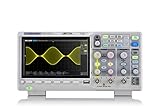
Siglent SDS1202X-E
- 200 MHz bandwidth
- 14 Mpts memory
- 1 GSa/s sampling
- Serial decode standard
The SDS1202X-E takes the top slot on the strength of bandwidth per dollar, memory depth, and free protocol decoding. The SDS1104X-E earns the premium slot for anyone who needs more than two channels without dropping below 100 MHz. The DS1054Z is the one most beginners end up owning, and for good reason.
All 10 Picks Compared Side by Side in 2026
| Product | Specifications | Action |
|---|---|---|
| Siglent SDS1202X-E |
|
Check Latest Price |
 Siglent SDS1104X-E Siglent SDS1104X-E |
|
Check Latest Price |
 FNIRSI 2C53T FNIRSI 2C53T |
|
Check Latest Price |
 Rigol DS1054Z Rigol DS1054Z |
|
Check Latest Price |
 Rigol DS1202Z-E Rigol DS1202Z-E |
|
Check Latest Price |
 FNIRSI 1013D Plus FNIRSI 1013D Plus |
|
Check Latest Price |
 Hantek DSO2D15 Hantek DSO2D15 |
|
Check Latest Price |
 HANMATEK DOS1102 HANMATEK DOS1102 |
|
Check Latest Price |
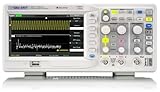 Siglent SDS1102CML+ Siglent SDS1102CML+ |
|
Check Latest Price |
 ZOYI ZT-703 ZOYI ZT-703 |
|
Check Latest Price |
Two numbers deserve a note before the individual reviews. First, the sample rate in this table is the real-time figure, and the ratio of sample rate to bandwidth is what decides how cleanly an edge appears. Second, the decoders listed as standard are the ones the manufacturer does not charge extra for.
1. Siglent SDS1202X-E – Best Overall 2-Channel 200 MHz Scope
Siglent Technologies SDS1202X-E 200 mhz Digital Oscilloscope 2 Channels, Grey
200 MHz
2 channels
1 GSa/s
14 Mpts
I2C SPI UART RS232 CAN LIN
Pros
- 200 MHz of bandwidth at a budget price
- Responsive interface and modern menu system
- Serial decoding for I2C SPI UART RS232 CAN and LIN included
- 14 Mpts of memory depth
- Built-in web server for remote viewing
Cons
- Fan can be audible in a quiet room
- Multifunction knob can overshoot a selection
- The soft menu system has a learning curve
Our pick of the ten for a reason: nothing else in this list gives you 200 MHz of bandwidth, 14 Mpts of record length, and CAN and LIN decoding as standard in a two-channel box. That combination is the whole argument. Owners rate it 4.7 out of 5 across 1455 reviews, which makes it the most heavily reviewed instrument here.
In practice the 14 Mpts of memory matters more than people expect. At its full 1 GSa/s rate you get roughly 14 milliseconds of continuous capture. That is enough to see a burst of I2C transactions, a switching regulator settling through several cycles, or an entire packet on a serial line without the scope quietly throttling itself.
What stands out after a few sessions is the interface. It responds immediately to knob turns and menu presses, and the on-screen help explains each setting in plain language. The 7-inch display is large enough to read from a normal working distance, which matters when you are leaning over a half-open pedal or a breadboard.
The serial decoding is the quiet headline. I2C, SPI, UART, RS232, CAN, and LIN all decode without a purchased module, and because CAN and LIN are automotive protocols, this is the model to pick if your work involves a vehicle rather than a microcontroller. Add the web server and you can open a capture on a phone from the same network.
Why the SDS1202X-E suits embedded and automotive work?
Two channels is the right number for most firmware bring-up. You put one probe on a clock and one on a data line, decode the transaction, and check whether the timing matches the datasheet. The 200 MHz of headroom means a fast SPI clock still has several samples across each edge.
Free CAN and LIN decoding is what separates it from cheaper two-channel models. You are not buying a licence, and there is no option key to lose in a drawer. For anyone diagnosing a vehicle bus or a sensor network, that is worth more than an extra 100 MHz.
Where this scope disappoints?
The fan is audible in a quiet room, and reviewers mention it consistently. It is not a dealbreaker on a busy workbench, but it is noticeable next to a fanless design.
The multifunction knob can overshoot a selection when you spin it quickly, which is an irritation rather than a fault. There is also no four-channel option here. If you routinely need to watch three rails plus a signal at the same time, look at the SDS1104X-E instead.
2. Siglent SDS1104X-E – Best 4-Channel Scope With Every Decoder Included
Siglent Technologies SDS1104X-E 100Mhz Digital Oscilloscope 4 Channels Standard Decoder, Grey
100 MHz
4 channels
1 GSa/s 2CH
Dual ADC
LAN and web server
Pros
- Four channels with a dual ADC architecture
- Every serial decoder ships standard
- Responsive UI with a 14 division grid
- Built-in web server and LAN
- Ethernet included
- High waveform capture rate
Cons
- MSO and AWG expansions cost a lot
- Adjustment knob can be twitchy
- CH3 and CH4 colors are hard to tell apart
- Fan is somewhat loud
This is the highest-rated instrument in the roundup at 4.8 out of 5 across 966 reviews, and for a specific reason: it gives you four analog channels with every serial decoder already enabled. No option key, no paid module, no web utility to run first.
The dual ADC architecture is the technical detail that separates it from the Rigol DS1054Z at a similar channel count. With a dual ADC, four channels do not all collapse onto one digitizer. You get 1 GSa/s on two channels and 500 MSa/s on all four, which keeps fast edges resolved even when every probe is attached.
Reviewers repeatedly single out the 14-division vertical grid and the responsive menu system. Both sound like small things until you spend an afternoon with a crowded screen and a scope that lags, at which point they are the difference between a productive afternoon and a frustrating one.
Connectivity is genuinely useful for a bench. The built-in web server lets you pull up a live capture from a browser, and Ethernet is included rather than optional. For a lab with a shared instrument, or for teaching, that removes a lot of friction.
When four channels actually earn their keep?
A power supply is the classic case. Input voltage, switch node, current probe, and the timing signal all need to be visible at once, and a two-channel scope forces you to make two passes and correlate them by eye. Four channels let you look at the cause and the effect in the same capture.
Three-phase checks, motor drive work, and I2C plus SPI on the same board all benefit the same way. The 100 MHz bandwidth is ample for essentially all of this, and the manufacturer notes the unit can be upgraded to 200 MHz later if your work shifts upward.
What you give up compared with the two-channel models?
The MSO digital channels and the AWG are sold as optional expansions, and owners point out the cost approaches the price of an entire budget scope. If you need a signal generator, budget for the expansion before you buy.
Two smaller annoyances show up often in reviews: the adjustment knob can be twitchy, and the light blue and green channel colors for CH3 and CH4 are hard to distinguish on a bright bench. The fan is also somewhat loud. None of these affect measurement accuracy, but all of them cost you a little patience.
3. FNIRSI 2C53T – Best 3-in-1 for Field and Travel
FNIRSI 2C53T 3-in-1 50MHz 2CH Oscilloscope Multimeter DDS Signal Generator
50 MHz
2 channels
250 MSa/s
1 Kpts
19999 count DMM
Pros
- Three instruments in one body
- Portable handheld format with a battery
- Accurate 19999 count multimeter
- Automatic measurement functions
- Waveform export over Type-C
- Built-in high voltage protection
Cons
- Bandwidth capped at 50 MHz
- Small 2.8 inch display
- Only 1 Kpts of record depth
- Signal generator stops at 50 kHz
Some of the most useful measurements happen away from a bench, and this is the pick for that. The FNIRSI 2C53T combines a 50 MHz two-channel oscilloscope, a 4.5-digit 19999-count multimeter, and a DDS signal generator in a 400 g handheld with a 3000 mAh battery. Owners rate it 4.3 out of 5 across 883 reviews, and the multimeter is the part reviewers praise most.
Think of it as a field multimeter that occasionally draws a waveform. When you are tracing a sensor harness, checking a relay circuit in a vehicle, or verifying a supply rail somewhere with no bench nearby, having the scope and the meter in the same case removes a real amount of setup friction.
One detail worth knowing before you commit: the record depth is 1 Kpts, which at 250 MSa/s is about 4 microseconds of capture. That is a waveform you can see, not one you can analyse. Protocol decoding, long captures, and anything involving intermittent bursts are out of reach.
The 2.8 inch LCD is small but bright, and the 3000 mAh battery gives roughly six hours of standby. Type-C charging handles both power and data transfer, so saving a waveform to your laptop takes one step.
Where the 2C53T replaces three pieces of gear?
Installation and fault-finding work is the ideal case. A technician can check continuity and resistance with the meter, then switch to the scope to confirm a switching transient or a PWM signal without unpacking anything else.
Hobbyists building something portable, or students who need a self-contained kit for a lab bag, get the same benefit. The 400 V input protection rating is a sensible safety margin for mains-adjacent work, provided you treat the ground lead with the same respect you would on any bench scope.
Why this is not a bench scope substitute?
Fifty megahertz is the ceiling, and 1 Kpts of memory is the floor. A narrowband amplifier stage, a clean audio circuit, or a digital bus simply will not fit inside those limits in a way you can trust.
The signal generator topping out at 50 kHz also rules it out for anything above audio. If your work lives at a desk and involves real signal integrity questions, choose one of the bench units in this roundup instead and carry the multimeter separately.
4. Rigol DS1054Z – Best Value 4-Channel Starter
Rigol DS1054Z Digital Oscilloscope, 50MHz, 4 Channel, 1GSa/s, Best Value
50 MHz
4 channels
1 GSa/s
24 Mpts
30,000 wfms/s
Pros
- Four channels at a budget price
- 24 Mpts of memory depth standard
- 30000 wfms/s capture rate
- Serial decode for RS232 I2C and SPI
- LAN and USB connectivity
- Three-year warranty
Cons
- Single ADC drops to 250 MSa/s on three or four channels
- Fan noise is noticeable
- UI response is slower than Siglent
- No external trigger input
The DS1054Z is the scope most first-time buyers end up with, and for the plainest of reasons: four channels, 24 Mpts of memory, and serial decoding, all at a price that leaves room in the budget for probes. It holds a 4.7 rating across 725 reviews, and the community knowledge base around it is enormous.
That 24 Mpts of memory is the figure that makes this scope interesting. At its full 1 GSa/s rate that is 24 milliseconds of capture on one channel, 12 Mpts on two, and 6 Mpts on three or four. By the time the record is full, the instrument has stopped throwing samples away, which is exactly when cheaper scopes get quiet and start lying to you.
The 30,000 waveforms per second capture rate is a second quiet strength. A fast rate means intermittent glitches show up on screen instead of hiding between slow refreshes, and owners of noisy power circuits consistently mention how much this helps.
Standard serial trigger and decode for RS232, UART, I2C, and SPI, plus USB and LXI-compliant LAN, means the scope drops into a bench workflow without adapters. Rigol also backs it with a three-year warranty.
Why four channels and deep memory keep this one relevant?
Channel count and memory depth are the two specs that quietly determine whether a scope is still useful two years later. Four channels let you watch a whole system at once. Deep memory lets you zoom into a single edge inside a long capture instead of re-triggering and hoping the glitch repeats.
For a student or a hobbyist learning embedded work, this combination supports the standard progression: PWM and duty cycle first, then UART baud errors, then I2C clock stretching, then SPI transactions. Each of those needs a record longer than a screen refresh to diagnose properly.
Where the single ADC shows up?
With a single ADC, sample rate falls as channels are added: 1 GSa/s on one channel, 500 MSa/s on two, and 250 MSa/s on three or four. That is still workable for 50 MHz signals, but it is the trade you make against the two-channel Siglent models in this list, which hold their rate with fewer channels attached.
Reviewers also note fan noise, a slower interface than Siglent’s, and no external trigger input. None of these are faults, but if you are shopping purely on measurement quality the four-channel Siglent SDS1104X-E is the stronger instrument.
5. Rigol DS1202Z-E – Best With an External Trigger
RIGOL DS1202Z-E Digital Oscilloscope, 200MHz, 2 Channel, 1GSa/s Sampling
200 MHz
2 channels plus ext trigger
1 GSa/s
24 Mpts
7 inch display
Pros
- 200 MHz of bandwidth at a budget price
- External trigger input is rare at this price
- 24 Mpts of memory depth
- Intensity graded display
- Hardware waveform recording and playback
- All options enabled as standard
Cons
- Multifunction knob overshoots selections
- Softkey legends stay on screen
- USB 2.0 makes deep transfers slow
- Ultrascope cannot read the full record
The DS1202Z-E is the pick when 200 MHz matters and you need to trigger on something other than the channels you are looking at. The external trigger input is genuinely rare at this budget, and it is the reason this scope exists separately from the two-channel entry models.
Memory depth is 24 Mpts on a single channel and 12 Mpts on two, at a 1 GSa/s real-time sample rate. That works out to 24 milliseconds of full-rate capture on one channel. Hardware waveform recording and playback stores up to 60,000 frames, so a rare glitch can be caught and then reviewed frame by frame.
The intensity graded 7-inch display colours the trace by how often it is hit, which is a digital phosphor effect at a fraction of the cost. On repetitive signals such as a clock or a switching node you can see jitter and instability as a colour gradient rather than a single ambiguous line.
Owners rate it 4.7 out of 5 across 468 reviews, and the hardware record function is praised far more often than expected. Every option is enabled as standard, so there is no feature to unlock and no utility to run after delivery.
When an external trigger changes the measurement?
Any time the interesting event is not on one of the two channels, an external trigger pays for itself. Synchronising two instruments, triggering a sequence from a different system, or capturing a one-shot event that only occurs after a specific pulse are all cases where you need a trigger source that is not channel 1 or 2.
At 200 MHz the bandwidth also suits faster digital edges and short rise times than the 100 MHz units in this roundup. If your work includes USB, high-speed digital, or stiff switching edges, this is the model that stays inside its spec sheet.
The USB transfer problem you should know about
The interface is USB 2.0 only, and owners report that pulling a full 24 Mpts record to a computer takes 45 to 60 minutes. Ultrascope also cannot access the full record, and large USB drives above 32 GB are not recognised. Plan to analyse waveforms in a smaller window rather than exporting the entire capture.
The two lesser irritations: the multifunction knob overshoots selections, and the softkey legends permanently occupy the sides of the display, which reduces usable screen area. Both are manageable once you know they are there.
6. FNIRSI 1013D Plus – Best Touchscreen Scope for Travel
FNIRSI 1013D Plus 100MHz Oscilloscope, 2 Channel Oscilloscope 7″ TFT Touch
100 MHz
2 channels
1 GSa/s
7 inch touch
6000 mAh battery
Pros
- Capacitive 7 inch touchscreen
- 100 MHz of bandwidth at a low price
- 1 GSa/s sampling rate
- 6000 mAh battery gives about four hours
- 1 GB of internal storage
- FFT and Lissajous display
Cons
- Build quality below bench scope level
- Touchscreen is less precise than knobs
- Limited advanced triggering
- No signal generator
- Included probes are basic
The 1013D Plus is the model to buy if you want a modern touchscreen interface and a battery, and you want to carry the whole thing to a customer site or a classroom rather than sitting at a bench. It runs 100 MHz on two channels at 1 GSa/s, which is plenty for microcontroller work and audio-band circuits.
The 7-inch capacitive touchscreen at 800 by 480 makes cursor work and menu navigation direct. You tap a trace, drag a measurement box, and read the result, which is a much shorter path than scrolling through softkey menus. The 1 GB of internal storage holds roughly 1000 screenshots and 1000 waveform sets with thumbnail previews.
FFT and Lissajous displays are built in, which makes it a reasonable low-cost way to look at a filter response or check phase between two channels. The 6000 mAh battery gives roughly four hours of use, and the input protection rating is 400 V continuous.
Owners rate it 4.4 out of 5 across 312 reviews. The recurring theme is that it does a lot for the money and looks far more modern than the alternative at this level, with a few clear compromises once you start doing careful work.
Where a touchscreen actually helps?
Touch control pays off in two situations. On the bench, selecting a region of a waveform for measurement is faster and more accurate than dragging a knob past a number. Off the bench, where you are one-handed or wearing gloves, it removes a lot of fiddly adjustment.
The internal storage also matters more than it sounds. Thousands of stored screenshots with thumbnails let you document a fault and review it later instead of writing down readings, which is valuable for field service work where the fault is intermittent.
Where the compromises show?
The build quality is not at bench standard, and reviewers consistently note the touchscreen is less precise than physical knobs for fine adjustments. If you will be working at 50 mV per division or trimming a vertical offset carefully, a knob you can feel is faster.
Advanced triggering is limited, there is no signal generator in the package, and the included probes are basic. If your work depends on precise edge triggering or on generating a reference signal, add a bench unit to the budget instead.
7. Hantek DSO2D15 – Best With Serial Decoding and an Optional Generator
Hantek DSO2D15 Digital Storage Lab Oscilloscopes150MHz Bandwidth 2CH
150 MHz
2 channels
1 GSa/s
14 trigger modes
5 serial decodes
Pros
- 150 MHz of bandwidth at a good price
- Five serial protocol decodes ship standard
- Fourteen trigger modes
- Optional waveform generator variant
- Firmware updates improve stability
Cons
- Processor is slow so the display lags
- Can lock up and need a power cycle
- Front and rear USB share one port
- Less precise above 5 MHz
150 MHz of bandwidth, a 1 GSa/s sample rate, five serial protocol decodes, and fourteen trigger modes is a lot of instrument for the money. The Hantek DSO2D15 holds a 4.6 rating across 194 reviews, and the serial decoding is the part that stands out because it is standard rather than optional.
That matters for embedded work. When you are chasing a UART baud mismatch or an I2C device that holds the clock line low, having the decode available out of the box removes one variable. There is also a variant with a built-in waveform generator, which is useful for driving a filter or an amplifier stage while you watch the response.
Firmware updates have a track record of improving this model. Owners report that early stability issues were substantially resolved after updates, and the unit is updatable, which is unusual at this budget. There is also an active community around modifying and extending it.
Where it falls short is responsiveness. Owners describe display lag from the slower processor, and some report the unit locking up with certain misconfigured settings, fixed by a power cycle. Neither issue affects accuracy, but both interrupt your flow.
When the DSO2D15 is the right tool?
If your work sits between 50 and 150 MHz and you want protocol decoding without a paid module, this scope fits. Audio circuits, small motor control, and general embedded debugging all fall inside its range with margin.
The fourteen trigger modes are more than most of this roundup offers, which helps on noisy signals where a simple edge trigger keeps firing on the wrong event. The optional generator variant also makes it usable as a simple loop tester.
What to look out for?
Accuracy above about 5 MHz is reported as less precise, so for high-fidelity audio measurement or anything where amplitude accuracy is the point, choose a scope with a higher rated bandwidth. A faster 200 MHz model will be more faithful above that frequency.
Design constraints are worth knowing: the front and rear USB share a single port, so you cannot use both at once, and auto-set is not fully automatic. The unit has no internal battery, so it stays on the bench.
8. HANMATEK DOS1102 – Best for Current Measurements
HANMATEK 110mhz Bandwidth DOS1102 Digital Oscilloscope with 2 Channels and Screen 7 inch / 18 cm, TFT-LCD Display, Portable Professional Oscilloscope Kit with 500 MS/s *2 Sampling Rate
110 MHz
2 channels
500 MS/s
10K points
6-digit frequency counter
Pros
- 110 MHz of bandwidth at a budget price
- 500 MS/s on each of two channels
- Thirty automatic measurement functions
- Six-digit hardware frequency counter
- Current measurement capability
- SCPI and LabVIEW support
Cons
- Memory depth is only 10K points
- Build quality feels less premium
- Limited advanced trigger options
- Included probes are basic
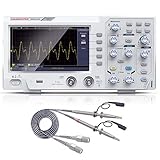
The DOS1102 stands out for a specific capability: a current measurement input, specified at 100.0 mA per volt up to 1 kA per volt with the right shunt. Very few instruments in this roundup measure current at all, and for anyone working on switching supplies, motor circuits, or battery systems, that input can save a separate instrument.
Otherwise it is a capable 110 MHz two-channel scope with 500 MSa/s on each channel and thirty automatic measurement functions. The six-digit hardware frequency counter covering 2 Hz to 20 MHz is also unusual in a unit at this level, and it is a genuinely useful tool for verifying a clock or an oscillator.
Measurement range runs from 20 mV per division to 5 V per division, which is wider than some handhelds in this list. The 7-inch TFT LCD at 800 by 480 with 65535 colours is clear, and SCPI and LabVIEW support mean the scope can be driven from a test script.
Owners rate it 4.4 out of 5 across 248 reviews. The consistent note is that the measurement feature set punches well above the price while the physical build and the software interface lag behind the major brands.
Why the current input is worth planning for?
Measuring current directly changes how you approach a power circuit. Instead of inferring current from a voltage across a known resistor, you can look at the waveform directly, which tells you about inrush, ripple, and switching peaks rather than just an average.
Combined with the frequency counter, the scope covers a lot of bench diagnostics. If your work involves verifying a regulator, tracing a motor drive, or characterising a battery, these two features justify the choice on their own.
The memory limit is the catch
Record depth is at least 10K points per acquisition, which at 500 MSa/s gives you about 20 microseconds of capture. That is short. It is enough to see a cycle of a switching waveform, but not enough to catch an intermittent burst or analyse a serial transaction.
Reviewers also mention that the build feels less premium, advanced trigger options are limited, and the included probes are basic. If you need long captures, look at a model with megapoint memory instead.
9. Siglent SDS1102CML+ – Best for Per-Channel Vertical Controls
Siglent Technologies SDS1102CML+ Digital Storage Oscilloscope, 100 MHz
100 MHz
2 channels
1 GSa/s
1 Mpts
per-channel vertical knobs
Pros
- Independent vertical controls for each channel
- Good build quality and probe quality
- Large display with good resolution
- LAN connectivity for remote access
- Easy to learn for beginners
Cons
- Only 1 Mpts of memory depth
- No serial protocol decoding
- Channel 2 color is hard to read
- Only five on-screen measurement slots
Most modern scopes replaced the per-channel vertical knobs with a menu system. This Siglent kept them, and that is the whole appeal. If you learned on an analog scope with a knob per channel and prefer adjusting volts per division by feel, this is the instrument in the roundup that will feel familiar.
Underneath, it is a 100 MHz two-channel scope with a 1 GSa/s maximum real-time sample rate, a built-in frequency counter, and USB and LAN interfaces. Owners rate it 4.4 out of 5 across 198 reviews and consistently praise the build quality and the included probes, which are better than what ships with several cheaper units here.
EasyScopeX PC software handles remote control and data export, and the bandwidth limit filter at 20 MHz plus the digital filters are useful when you want to look at slow detail without a fast transient wandering off screen.
The limitation is memory. Record length is 1 Mpts on a single channel, which at 1 GSa/s is one millisecond of capture. That is fine for a repeating waveform and a poor choice for finding something that happens twice a second.
Who will love physical channel knobs?
Teaching and bench work both benefit. A student learning to read a scope can turn a knob and watch the trace move, which builds intuition that a menu-driven interface slows down. On a busy bench, direct access to volts per division saves repeated menu trips.
It is also a good choice for analog-style work where you are simply looking at a repeating signal, checking a filter response, or verifying a supply rail. The large display and good resolution make that straightforward.
Why it is not a fit for embedded debugging?
There is no serial protocol decoding. For I2C, SPI, UART, or CAN work, reading a bus with this scope means counting edges by hand, which is slow and error-prone. Two other picks in this roundup include every decoder as standard for a reason.
The 1 Mpts of memory compounds that, and owners also mention the channel 2 colour being hard to read and only five on-screen measurement slots. If firmware debugging is your main activity, this is the wrong tool for the job.
10. ZOYI ZT-703 – Best Budget 3-in-1 Handheld
3 in 1 Handheld Oscilloscope Automotive Dual Channel 50MHz with Digital Multimeter and Signal Generator
50 MHz
2 channels
280 MSa/s
128K points
25000 count DMM
Pros
- Exceptional three-in-one value
- 25000 count multimeter is excellent
- Good build quality with a solid feel
- Replaceable rechargeable battery
- Auto waveform recognition
- Bright readable colour display
Cons
- Bandwidth is limited in practice
- No physical knobs on the front panel
- Signal generator is very basic
- Square wave rise time deforms at higher frequencies
At the bottom of the budget, the ZOYI ZT-703 is remarkable. A 4.7 rating across 307 reviews for a two-channel oscilloscope, a 25000-count multimeter, and a signal generator in a single handheld is difficult to argue with as a starting point.
The multimeter is the standout. A 25000-count meter is more resolution than most mid-range handheld meters, and it turns the device into a genuinely useful field tool before you ever connect a probe to a signal. The replaceable rechargeable lithium battery and Type-C fast charging address the usual complaint that integrated batteries end the device’s useful life.
There are two operating modes. Normal mode gives 30 MHz of bandwidth at 200 MSa/s, and high-speed mode lifts that to 50 MHz at 280 MSa/s. With 128K of storage depth, a capture at the higher rate runs for roughly 450 microseconds, which is short but enough to see the shape of a periodic signal.
Auto waveform recognition tries to identify what it is looking at and pick a sensible display setup, which helps when you are new to using a scope. Owners frequently cite the build quality and solid feel as better than expected for the price.
What a budget handheld is genuinely good for?
Slow signals and field diagnostics. A thermistor, a pressure sensor, a battery voltage under load, a relay switching event, a low-frequency control signal. For these, 50 MHz of headline bandwidth is more than sufficient and the meter is an unexpected bonus.
Automotive and appliance work benefit most. The screen is bright and readable, the case is portable, and having continuity, resistance, and a basic waveform check in one device speeds up diagnosis when the fault is intermittent.
Where the low bandwidth becomes a real limit?
Owners are candid that useful bandwidth is nearer 10 to 20 MHz in practice, and square wave rise times deform above about 5 MHz. There are no physical knobs, so every adjustment runs through buttons, which gets old over a full day of work.
The signal generator is very basic and there is no temperature measurement. If your work involves any signal above roughly 20 MHz, or you will use this instrument daily on a bench, spend the extra and buy one of the bench scopes in this roundup.
How Much Bandwidth Do You Actually Need?
Pick roughly five times the highest frequency component in your signal, and you will not regret it. That rule is why 100 MHz covers almost every microcontroller and audio circuit, and why 200 MHz is worth the step up for faster digital edges and switching nodes.
Here is how the common workloads map to a bandwidth figure.
Arduino and basic digital (clock up to 20 MHz): 50 MHz is enough, and 100 MHz gives you comfortable margin on slow edges.
ESP32 and ESP-IDF firmware (signals to 80 MHz): 100 MHz minimum, 200 MHz if you need to resolve a fast clock cleanly.
Switch-mode power supplies (edges under 50 ns): 100 MHz minimum, 150 to 200 MHz preferred for spike capture.
Audio, preamp, and guitar pedal work (20 Hz to 20 kHz): 50 MHz is more than sufficient, and here resolution and a low noise floor matter more than bandwidth.
Automotive CAN and LIN (signals under 1 MHz): 50 MHz is fine as long as the decoders are included, which is the real specification to check.
High-speed digital and USB (above 100 MHz): you are outside this roundup. 200 MHz is the ceiling here, and this is where a used higher-bandwidth instrument makes more sense.
The mistake we see most often is overspending on bandwidth and underspending on memory. A 200 MHz scope with 1 Mpts of memory will miss the very glitch you bought it to find, while a 100 MHz scope with 24 Mpts will catch it.
Sample Rate and the 10x Rule
Sample at least ten times faster than your bandwidth to resolve edges properly. The Siglent and Rigol bench scopes here clear that bar at their full rated bandwidth. The HANMATEK and the two budget handhelds sit lower, which is why we look at each of them more closely below.
Nyquist gives you the theoretical floor at twice the signal frequency, but a bare 2x ratio produces a trace with visible stair-stepping on transitions. At 5x the edges start to look like edges, and at 10x you can trust rise-time measurements and see real overshoot and ringing.
Here is the practical picture. The 1 GSa/s units give you ten times a 100 MHz bandwidth and five times a 200 MHz bandwidth. The HANMATEK DOS1102 runs 500 MSa/s per channel against 110 MHz, which is close to 5x and still usable. The FNIRSI 2C53T at 250 MSa/s against 50 MHz and the ZOYI ZT-703 at 280 MSa/s against 50 MHz both sit near 5x, which is fine below 10 MHz and gets marginal above it. Remember also that sample rate typically drops as you add channels, so the two-channel headline rate is rarely what you get with every probe attached.
Memory Depth: How Long a Capture You Really Get?
Memory depth decides how long you can record at full speed before the instrument has to start dropping samples or reducing its rate. This is the spec most often listed and least often explained.
The arithmetic is simple. Divide the record length by the sample rate and you get the capture duration. The Rigol DS1054Z at 24 Mpts and 1 GSa/s gives 24 milliseconds on one channel, 12 Mpts and 12 milliseconds on two, and 6 Mpts and 6 milliseconds on three or four. The Siglent SDS1202X-E at 14 Mpts and 1 GSa/s gives 14 milliseconds. The Siglent SDS1102CML+ at 1 Mpts and 1 GSa/s gives 1 millisecond. The FNIRSI 2C53T at 1 Kpts and 250 MSa/s gives 4 microseconds, and the ZOYI ZT-703 at 128K points and 280 MSa/s gives roughly 450 microseconds.
Read those numbers against your work. Six milliseconds across four channels is enough for a switching regulator settling. One millisecond is enough for a periodic waveform but not for a serial bus. Four microseconds is enough to look at a shape and nothing more.
Two specs here are worth naming explicitly rather than leaving in the table. The FNIRSI 1013D Plus is rated at 1 GSa/s but the record length behind that rate is short, so the capture window matters more than the sample figure. The Rigol DS1202Z-E stores up to 60,000 frames in hardware, and for hunting a rare glitch that is worth more than raw memory depth on a competing model.
8-Bit vs 12-Bit ADC and Vertical Resolution
Vertical resolution is the count of discrete steps the analog-to-digital converter divides the input range into. An 8-bit converter gives 256 steps and a 12-bit converter gives 4096, which is sixteen times the detail.
That difference shows up on small signals sitting near the noise floor. With 8 bits, a signal one step above the noise is hard to distinguish from noise at all. With 12 bits, you can raise the volts-per-division, let the converter’s extra steps do their work, and pull a small signal cleanly out of the noise. That is the entire argument for 12-bit instruments and it is a real one.
It is also worth being straight about our list. None of the ten scopes in this roundup advertise a 12-bit converter, so if vertical resolution is your deciding specification, this is the wrong roundup for you and you will need to look at higher-priced 12-bit platforms. What these instruments do offer is enough vertical range and enough memory to get a useful answer for most bench work, and the low noise floor matters as much as the bit count.
For small-signal and audio work, the practical substitutes are a scope that goes down to a sensitive volts-per-division range, a record length long enough to average noise down, and averaging or maths functions in the instrument. Several picks here do all three.
Channels, Decoders, and Embedded Debugging
Two channels is enough for most firmware work. Four channels earn their place when you need a cause and an effect in the same capture, which is the normal case for power electronics.
Protocol decoding is the feature that changes how long a bug hunt takes. Without it, an I2C transaction is a visual puzzle read off the screen edge by edge. With it, the scope prints the address, the data bytes, and the acknowledge bits as text. Check the decoder list before you buy, because several manufacturers charge for these as add-on modules.
In this roundup, free decoding means different things per model. The Siglent SDS1202X-E includes I2C, SPI, UART, RS232, CAN, and LIN. The SDS1104X-E includes I2C, SPI, UART, RS232, CAN, and LIN across all four channels. The Rigol DS1054Z and DS1202Z-E include RS232, UART, I2C, and SPI. The Hantek DSO2D15 includes five serial protocols as standard. The Siglent SDS1102CML+ has none, and the handheld units in the lower tiers do not offer them.
For a broader look at scopes that travel well, our portable oscilloscope guide for hobbyists covers the battery-powered end of the market in more detail.
Probes, Ground Reference, and Bench Safety
Every scope in this roundup ties its ground clip to the mains earth through the power supply, and that single fact is the one to understand before probing anything. It is also why our portable and handheld oscilloscope picks are worth a separate look if you work on live switch-mode supplies.
Connecting a grounded scope probe to a hot ground point, such as the negative terminal of a switching transistor on a boost converter, creates a direct short from that point to earth. On a low-voltage circuit the result is a tripped supply or a damaged probe. On a mains-derived circuit it is dangerous. Battery-powered and USB-isolated handhelds do not have this problem because their ground floats with the instrument.
Two habits prevent most of it. If you need to probe a hot ground, use a differential probe or a battery-powered scope. If you are unsure whether a ground point is earth-referenced, measure the voltage between it and your scope ground first with a meter, before connecting anything.
Probes are the other half of the equation. The included probes on the Siglent units are frequently praised, while the FNIRSI and HANMATEK probes are described as basic. Check the probe compensation output on the front panel and adjust the small trimmer screw with the supplied screwdriver before your first measurement, and recalibrate whenever you change probe or channel.
Used vs New: What to Inspect Before Buying?
A used scope can be excellent value if you know what to check, and a bad purchase if you do not. Used Tektronix, Keysight, and Agilent units in particular can deliver bandwidth that new budget instruments cannot reach at all.
Ask for, and verify, a recent calibration certificate. Calibration drift is the main mechanical risk with any scope, and a unit that has not been calibrated in years may read high or low at the top of its range. Run the built-in self-test if the instrument has one, and check every channel responds at a known signal.
Look at the connectors and the screen. Bent BNC sockets, a display with dead pixels, and intermittent channel dropout are the three most common faults. Power the unit on and leave it for fifteen minutes, because thermal problems often do not appear in the first few minutes of operation.
Finally, confirm the bandwidth still performs. Feed it a known signal and check the amplitude, because a worn input stage or a cracked crystal can quietly reduce usable bandwidth well below the label. If the seller will not let you test it, the risk is not worth the saving.
Which Scope Should You Buy? A Routing Guide?
Start from your workload, not from the spec sheet. The routing below maps the jobs we hear about most often to the right instrument from this roundup.
Learning electronics, first scope, Arduino and ESP32: the Rigol DS1054Z. Four channels, deep memory, and a large community that will answer your questions.
General embedded firmware with serial bus debugging: the Siglent SDS1202X-E. 200 MHz and every decoder included at no extra cost.
Power electronics and switch-mode supplies: the Siglent SDS1104X-E for four channels, or the Rigol DS1202Z-E if you need 200 MHz and an external trigger.
Audio, preamp, and guitar pedal work: the Siglent SDS1102CML+ for its per-channel knobs, or the Siglent SDS1202X-E for the extra bandwidth. Check vertical sensitivity before buying.
Automotive CAN and LIN diagnostics: the Siglent SDS1202X-E, because CAN and LIN decoding is standard and the two-channel format suits a vehicle harness.
Field service, vehicles, and site work: the ZOYI ZT-703 or the FNIRSI 2C53T, both of which combine a meter and a scope in a battery-powered body.
Teaching or a shared lab bench: the Siglent SDS1104X-E, where four channels, a web server, and Ethernet matter more than raw bandwidth.
Build your ideal bench with two instruments: pair the Siglent SDS1202X-E for general bench work with the ZOYI ZT-703 for field and meter work. The handheld covers the jobs a mains-powered scope should not touch.
Frequently Asked Questions
Which digital oscilloscope is the best to buy?
Under 1000, the Siglent SDS1202X-E is the strongest all-round choice. It gives you 200 MHz of bandwidth, two channels, 14 Mpts of memory, and I2C, SPI, UART, RS232, CAN, and LIN decoding with no paid modules. If you need four channels, the Siglent SDS1104X-E is the step up. If you want the cheapest credible first scope with four channels, the Rigol DS1054Z remains the value pick.
What is a good, cheap oscilloscope for hobbyists?
For a tight budget the ZOYI ZT-703 is the cheapest credible instrument here, combining a two-channel 50 MHz scope with a 25000-count multimeter in a battery-powered body. It handles signals below roughly 20 MHz well. For a first bench scope, the Rigol DS1054Z gives you four channels and 24 Mpts of memory, which is what actually determines whether you will outgrow it.
Which oscilloscope is better, Siglent or Rigol?
Siglent generally leads on interface responsiveness, memory depth on the 200 MHz two-channel model, and free protocol decoding. Rigol leads on community knowledge, warranty length, and value per channel at the entry level. At the top of this price range the Siglent SDS1104X-E offers a dual ADC that keeps 500 MSa/s on all four channels, while the Rigol DS1054Z uses a single ADC and drops to 250 MSa/s on three or four.
What is the recommended bandwidth for an oscilloscope?
Choose about five times the highest frequency component in the signal you need to measure. For Arduino, audio, and most sensor work that means 50 MHz. For ESP32 firmware and switch-mode power supplies, 100 MHz is the practical minimum and 200 MHz is better. Sampling at ten times the bandwidth lets you resolve edges, overshoot, and ringing rather than a smeared approximation.
Is 100 MHz good for an oscilloscope?
For most electronics work, yes. 100 MHz comfortably covers microcontroller signals, audio-band circuits, sensors, and low-frequency switching regulators, and seven of the ten scopes in this roundup reach it or better. Where it falls short is above roughly 50 MHz signal content, where you have only about two samples per cycle and edge shape becomes hard to read. Those users should step up to a 200 MHz model.
What memory depth do I need on an oscilloscope?
Divide the record length by the sample rate to get capture duration. A 24 Mpts record at 1 GSa/s gives 24 milliseconds, which is enough to see a switching regulator settle or a serial transaction. A 1 Mpts record gives 1 millisecond, fine for periodic waveforms but not for intermittent bursts. Prioritise memory over bandwidth when hunting glitches, because a fast scope with shallow memory silently drops the event you bought it to find.
How many oscilloscope channels do I need?
Two channels cover most firmware debugging, where you watch a clock and a data line. Four channels matter for power electronics, where you need input voltage, switch node, current, and timing visible in the same capture. Four channels is also the point where dual ADC architectures start to matter, because a single ADC design drops its sample rate sharply once three or four probes are attached.
Conclusion
Ten picks, one clear winner. The Siglent SDS1202X-E is the best digital storage oscilloscope under 1000 for most people, because 200 MHz, 14 Mpts of memory, and free CAN and LIN decoding in a two-channel box is a combination nothing else here matches. It also carries the most reviews in the group, which means fewer surprises when you need support or a second opinion.
Buy the Siglent SDS1104X-E instead if four channels and a dual ADC matter to your work. Buy the Rigol DS1054Z if channel count and deep memory per dollar matter more, and you are comfortable with a slower interface. Buy the Rigol DS1202Z-E if you need 200 MHz plus an external trigger and 60,000 frames of hardware recording.
For field work away from a bench, the ZOYI ZT-703 and the FNIRSI 2C53T put a scope and a multimeter in one battery-powered case, and their mains-free ground is safer for hot-ground probing. Whatever you choose, run probe compensation before your first measurement and read the ground reference section above before you clip a probe to anything unfamiliar.
Check the current listing for each model, read a few recent owner reviews for the exact unit you are buying, and buy the instrument that matches your slowest workload rather than the one with the largest headline number.