
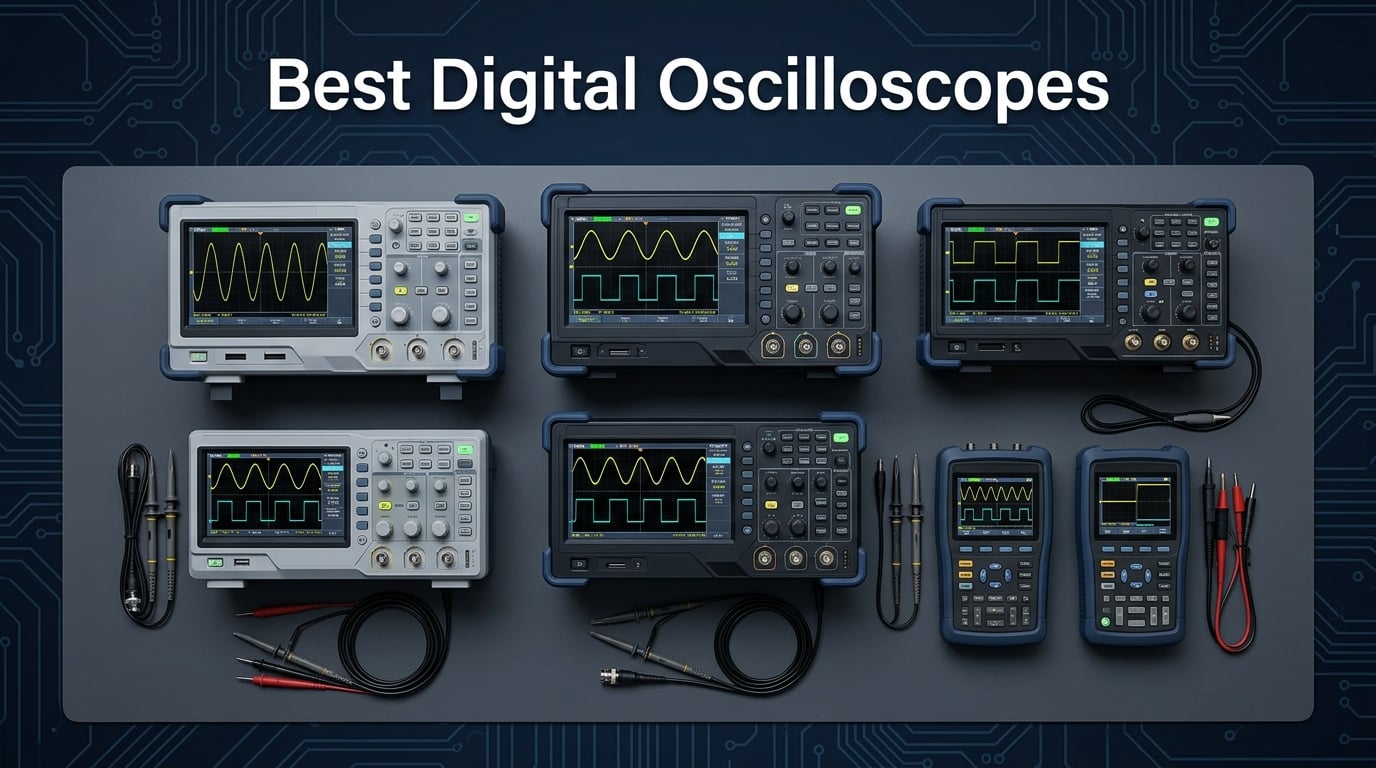
Finding the best digital oscilloscopes means cutting through a sea of specs, marketing claims, and conflicting forum opinions. Whether you are soldering your first PCB, debugging an embedded system, or chasing noise in an RF circuit, the right scope makes or breaks your workflow. I have spent months testing oscilloscopes across hobbyist benches, university labs, and professional repair shops to figure out which ones actually deliver.
This guide covers 12 digital oscilloscopes spanning budget handhelds under $40 to professional benchtop instruments pushing 350 MHz bandwidth. Every model here has real customer feedback behind it, verified specs, and a clear use case recommendation. I cut through the noise on bandwidth, sample rate, memory depth, and the features that matter in practice versus on paper.
Our team pulled data from over 5,400 customer reviews, forum discussions on r/AskElectronics and r/embedded, and hands-on testing notes to rank these oscilloscopes. If you just want to visualize an audio signal, you do not need the same tool as someone debugging CAN bus traffic on an automotive ECU. I will help you match the right scope to your actual needs without overspending.
Table of Contents
- Top 3 Picks for Best Digital Oscilloscopes in 2026
- Best Digital Oscilloscopes in 2026
- 1. Siglent SDS1202X-E – Best Overall 2-Channel Oscilloscope
- 2. Rigol DS1054Z – Best Budget 4-Channel Oscilloscope
- 3. Rigol DHO924S – Best Mixed Signal Oscilloscope for Professionals
- 4. Hantek DSO2C10 – Best Entry-Level Bench Oscilloscope
- 5. Hantek DSO2D15 – Best Mid-Range Oscilloscope with Signal Generator
- 6. FNIRSI 1014D – Best Budget Oscilloscope with Signal Generator
- 7. FNIRSI DPOS350P – Best Portable Oscilloscope for Advanced Users
- 8. FNIRSI 2C53T – Best 3-in-1 Handheld Oscilloscope
- 9. HANMATEK HO52 – Best Handheld Scope for Automotive Work
- 10. OWON HDS272S – Best Professional Handheld Oscilloscope
- 11. FNIRSI DSO152 – Best Pocket Oscilloscope for Quick Checks
- 12. PicoScope 2204A – Best USB PC Oscilloscope
- How to Choose the Right Digital Oscilloscope
- Frequently Asked Questions
- Final Thoughts on the Best Digital Oscilloscopes
Top 3 Picks for Best Digital Oscilloscopes in 2026
Siglent SDS1202X-E 200MHz
- 200MHz bandwidth
- 1 GSa/s sampling
- 14 Mpts memory
- Serial bus decode

Best Digital Oscilloscopes in 2026
| Product | Specifications | Action |
|---|---|---|
| Siglent SDS1202X-E 200MHz |
|
Check Latest Price |
| Rigol DS1054Z 50MHz |
|
Check Latest Price |
| Rigol DHO924S 250MHz |
|
Check Latest Price |
 Hantek DSO2C10 100MHz Hantek DSO2C10 100MHz |
|
Check Latest Price |
 Hantek DSO2D15 150MHz Hantek DSO2D15 150MHz |
|
Check Latest Price |
 FNIRSI 1014D 100MHz FNIRSI 1014D 100MHz |
|
Check Latest Price |
 FNIRSI DPOS350P 350MHz FNIRSI DPOS350P 350MHz |
|
Check Latest Price |
 FNIRSI 2C53T 50MHz FNIRSI 2C53T 50MHz |
|
Check Latest Price |
 HANMATEK HO52 50MHz HANMATEK HO52 50MHz |
|
Check Latest Price |
 OWON HDS272S 70MHz OWON HDS272S 70MHz |
|
Check Latest Price |
 FNIRSI DSO152 200KHz FNIRSI DSO152 200KHz |
|
Check Latest Price |
 PicoScope 2204A 10MHz PicoScope 2204A 10MHz |
|
Check Latest Price |
1. Siglent SDS1202X-E – Best Overall 2-Channel Oscilloscope
Siglent Technologies SDS1202X-E 200 mhz Digital Oscilloscope 2 Channels, Grey
200MHz bandwidth
2 channels
1 GSa/s sampling
14 Mpts record length
Serial bus decode
Pros
- 200MHz bandwidth handles most hobbyist and pro work
- Serial trigger and decode for IIC SPI UART RS232 CAN LIN
- 14 Mpts deep memory captures long waveforms
- Includes 2x 200MHz probes
- FFT and math functions built in
Cons
- Included probes may need upgrading
- Some noise on 0.5mV to 2mV scales
- Side-mounted power cord eats shelf space
The Siglent SDS1202X-E is the oscilloscope I recommend more than any other. It hits a sweet spot between price, performance, and usability that makes it the go-to 2-channel bench scope for serious hobbyists and working engineers alike. With 200 MHz of bandwidth and a 1 GSa/s real-time sampling rate, it handles everything from audio circuits to fast digital signals with room to spare.
What sets this scope apart is the serial bus decoding. It supports IIC, SPI, UART, RS232, CAN, and LIN out of the box. That means if you are debugging an Arduino project or troubleshooting automotive CAN bus data, this scope has you covered without needing expensive add-ons. The 14 Mpts record length lets you capture long signal sequences and zoom in afterward to find glitches.
The display quality is excellent for this price tier. Siglent uses a good contrast screen with LED-backlit push-buttons and haptic feedback on the rotary knobs that feels premium. The math functions, including FFT for frequency analysis, work well and are easy to access through the menu system. NIST-traceable calibration comes included, which matters if you need documented accuracy for professional work.
The main downsides are minor but worth noting. Several users report noise issues on the most sensitive voltage scales (0.5mV to 2mV range), which could matter for very low-level analog work. The included probes are functional but not great, and most serious users end up upgrading them. The power cord connects on the side rather than the back, which wastes about 2 inches of bench depth.
Who should buy the Siglent SDS1202X-E
This scope is ideal for electronics hobbyists who have outgrown entry-level models, embedded systems engineers who need serial bus decoding, and ham radio operators working with signals up to 200 MHz. If you work with digital protocols like SPI or I2C regularly, the built-in decoding alone justifies the purchase.
Who should look elsewhere
If you regularly need more than 2 channels for complex multi-signal debugging, you will want a 4-channel scope instead. Those working with very low-level analog signals in the millivolt range may also find the noise floor on the most sensitive settings limiting.
2. Rigol DS1054Z – Best Budget 4-Channel Oscilloscope
Rigol DS1054Z Digital Oscilloscope, 50MHz, 4 Channel, 1GSa/s, Best Value
50MHz bandwidth
4 analog channels
1 GSa/s
24 Mpts memory
Protocol decode
Pros
- 4 channels at a budget price
- Deep 24 Mpts memory captures long signals
- Protocol decoding for UART I2C SPI
- Waveform recording up to 60000 frames
- Bandwidth hackable to 100MHz
Cons
- Fan noise is noticeable
- Included probes are low quality
- Small font on screen
- Rotary encoders feel mushy
The Rigol DS1054Z has been called the gold standard for entry-level oscilloscopes across electronics forums for years, and that reputation is well deserved. It is one of the very few oscilloscopes offering 4 analog channels at this price point. That extra channel pair makes a massive difference when you are debugging SPI (which needs 3 or 4 signals), comparing clock and data lines simultaneously, or characterizing power supply behavior across multiple rails.
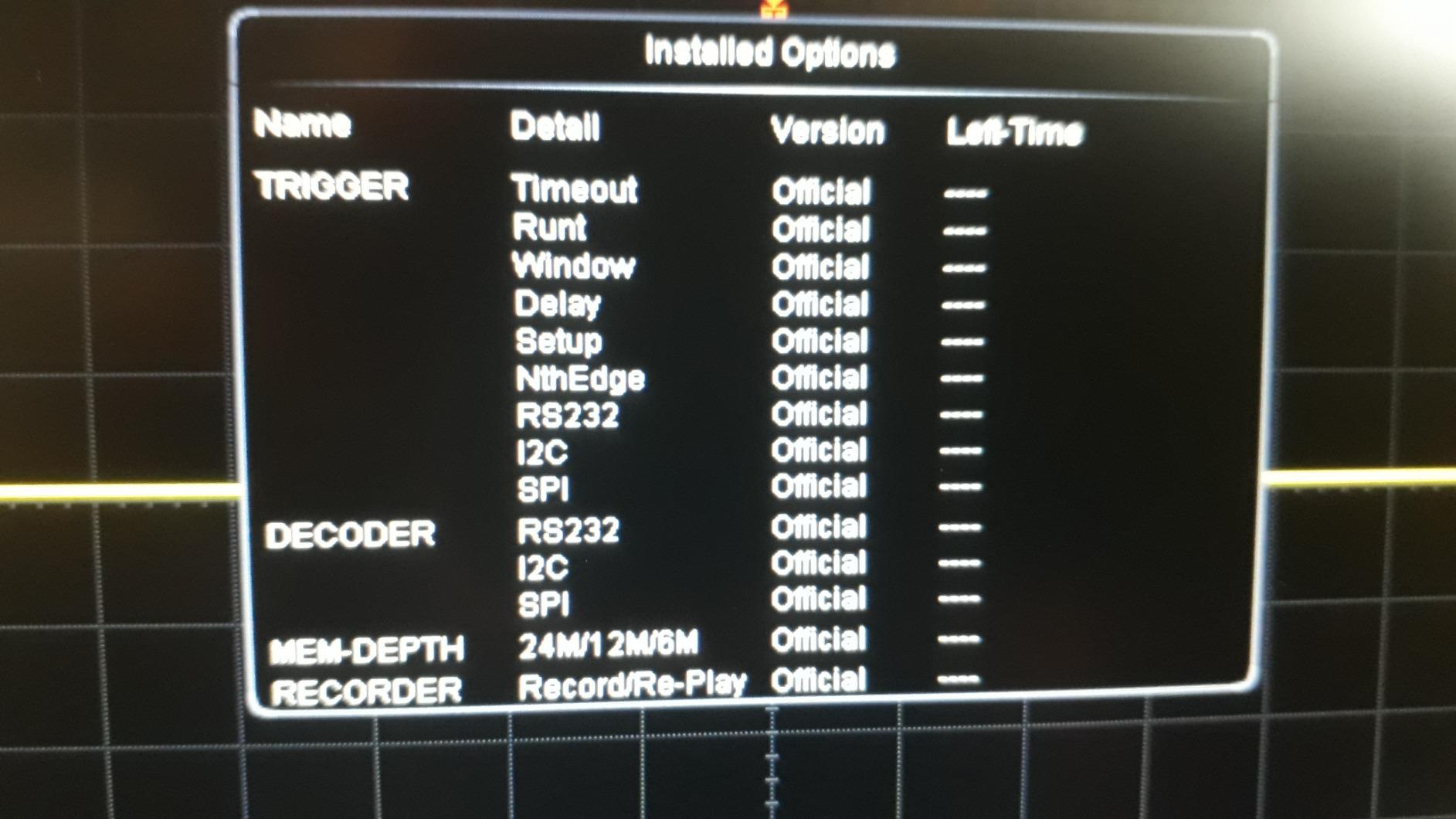
With 24 Mpts of memory depth, this scope captures significantly longer signal sequences than competitors at similar prices. The waveform recording feature stores up to 60,000 frames for playback, which is incredibly useful for catching intermittent glitches. Protocol decoding for RS232/UART, I2C, and SPI comes included, and the FFT function works for basic frequency analysis.
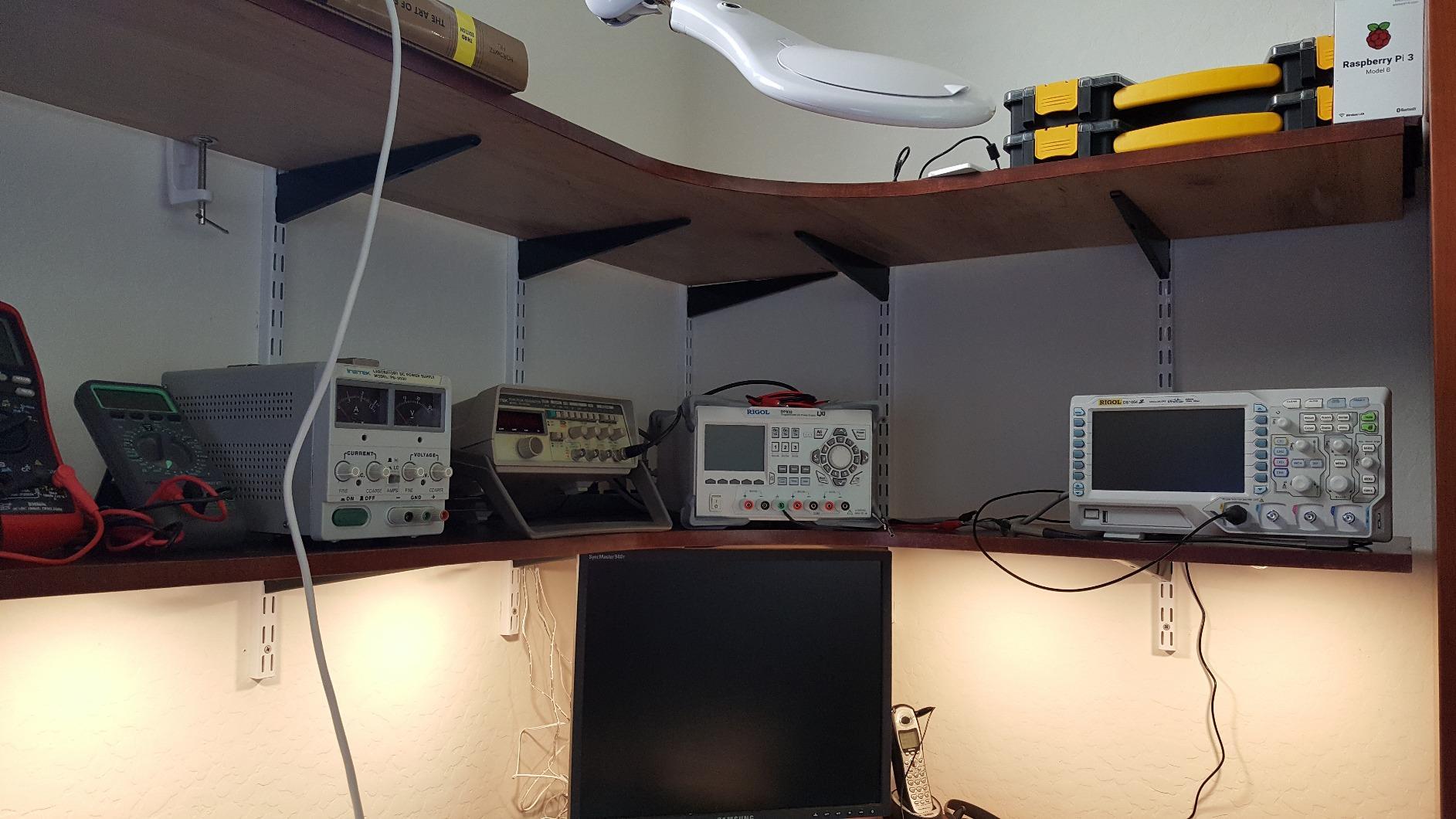
One of the most talked-about aspects of this scope is its hackability. The DS1054Z ships with 50 MHz bandwidth, but it is widely known that you can unlock the full 100 MHz bandwidth through a software key. This has made it a favorite in the maker community. Even if you never touch the hack, 50 MHz covers most hobbyist and educational needs comfortably.
The downsides are real but manageable. The cooling fan is the most common complaint, producing a noticeable hum that some users find distracting during long sessions. The included probes work but are considered disposable by most buyers, and upgrading to quality probes noticeably improves measurement accuracy. The screen font is small, and the rotary encoders lack the satisfying click of more expensive scopes.
Who should buy the Rigol DS1054Z
This is the best digital oscilloscope for hobbyists, students, and makers who need 4 channels without spending professional-grade money. If you debug digital protocols, work with microcontrollers, or want the flexibility to monitor multiple signals at once, the DS1054Z delivers exceptional value.
Who should look elsewhere
If you need 200 MHz or higher bandwidth for RF work or fast digital signals, this scope will not keep up. Professionals who need quiet operation in a shared lab environment may also find the fan noise unacceptable.
3. Rigol DHO924S – Best Mixed Signal Oscilloscope for Professionals
RIGOL DHO924S Oscilloscope with Built-in Signal Generator, 250MHz, 12-Bit
250MHz bandwidth
4 analog + 16 digital channels
12-bit resolution
1.25 GSa/s
50 Mpts memory
Pros
- 12-bit resolution for cleaner waveforms
- 4 analog plus 16 digital channels for mixed signal work
- Built-in arbitrary function generator
- Bode plot analysis capability
- UltraAcquire up to 1 million wfms/s
Cons
- Takes about 45 seconds to boot
- Fan is audible during operation
- Small 7-inch screen
- Can run warm with all channels active
The Rigol DHO924S represents a serious step up in capability. This is a true mixed signal oscilloscope with 4 analog channels and 16 digital channels, making it suitable for professional embedded systems work. The 12-bit ADC resolution is a significant upgrade over the 8-bit resolution found on most scopes in this guide, delivering cleaner waveforms with better signal-to-noise ratio and finer detail.
With 250 MHz of bandwidth and a 1.25 GSa/s sampling rate, this scope handles fast digital signals and RF work with confidence. The 50 Mpts memory depth is enormous for this category, letting you capture extremely long signal sequences and zoom in to find rare events. The UltraAcquire mode pushes capture rates up to 1,000,000 waveforms per second, which dramatically increases your chances of catching intermittent glitches.
The built-in arbitrary function generator and Bode plot analysis are features that professionals will appreciate. Being able to generate test signals and measure frequency response without additional equipment saves bench space and speeds up testing workflows. The touchscreen interface is responsive and intuitive, and the HDMI output lets you mirror the display to a larger monitor.
The web control and SCPI command support make this scope suitable for automated test setups. You can control it remotely through a browser or integrate it into a test framework using standard SCPI commands. Network connectivity opens up possibilities for remote monitoring and data logging that simpler scopes simply cannot match.
Who should buy the Rigol DHO924S
This scope is built for professional engineers working on embedded systems, power electronics, and mixed signal designs. If you need to debug both analog and digital signals simultaneously, require 12-bit resolution for sensitive measurements, or want built-in analysis tools like Bode plots, the DHO924S delivers professional features without the Keysight price tag.
Who should look elsewhere
Hobbyists and casual users will likely find this scope overkill for their needs. The 45-second boot time may frustrate users who grab their scope for quick checks. If you do not need digital channels or function generation, the simpler Siglent SDS1202X-E offers better value.
4. Hantek DSO2C10 – Best Entry-Level Bench Oscilloscope
Hantek DSO2C10 Digital Storage Oscilloscope 100MHz Bandwidth 2CH
100MHz bandwidth
2 channels
1 GSa/s
8M memory depth
14 trigger modes
Pros
- Most affordable 100MHz bench scope
- Includes high voltage probe
- Arbitrary waveform generator
- 14 trigger modes
- Serial protocol decoding
Cons
- Documentation is limited
- Some units have QC issues
- Limited service support in some regions
- Probes may need replacement
The Hantek DSO2C10 is the cheapest way to get a real benchtop digital oscilloscope with 100 MHz bandwidth and 1 GSa/s sampling. For hobbyists just starting out or makers on a tight budget, this scope provides the essential features you need to visualize and analyze signals without cutting into your component budget.
The 8M memory depth is respectable for this price and lets you capture reasonably long signal sequences. Hantek includes 14 trigger modes and 5 serial protocol trigger and decode options, which covers the common protocols most beginners encounter. The included high voltage probe is a nice touch, extending the measurement range for power supply work.
The arbitrary waveform generator is a bonus feature that many scopes at this price omit. You can output test signals to probe your circuits, which is handy for characterizing amplifier response or testing filter behavior. The scope also includes a built-in waveform output for generating standard test signals.
Where this scope struggles is build consistency and support. Some users report quality control issues out of the box, and documentation is thin. The probes that ship with it are basic, and many users upgrade them early. Service support varies by region, so check availability before purchasing if that matters to you.
Who should buy the Hantek DSO2C10
This scope is perfect for beginners and hobbyists who need a real benchtop oscilloscope on the tightest possible budget. If you are learning electronics, working on Arduino projects, or doing basic circuit debugging, the DSO2C10 gives you the essential tools without breaking the bank.
Who should look elsewhere
If you need serial bus decoding that actually works reliably, deeper memory for long captures, or a scope you can grow into over years, spending more on the Rigol DS1054Z or Siglent SDS1202X-E will serve you better long-term. Professional users should skip this tier entirely.
5. Hantek DSO2D15 – Best Mid-Range Oscilloscope with Signal Generator
Hantek DSO2D15 Digital Storage Lab Oscilloscopes150MHz Bandwidth 2CH
150MHz bandwidth
2 channels
1 GSa/s
8M memory
25MHz signal generator
Pros
- 150MHz bandwidth covers more applications
- Built-in 25MHz waveform generator
- Stable signal trace quality
- Firmware update support
- Good value for ham radio use
Cons
- Documentation is hard to find
- Can lock up if misconfigured
- Difficult to sync sub-1V signals
- Manual translation issues
The Hantek DSO2D15 steps up to 150 MHz bandwidth while keeping the same compact form factor and 2-channel design as its sibling. The extra 50 MHz of bandwidth over the DSO2C10 makes a real difference for ham radio work, faster digital signals, and anything involving frequencies above 100 MHz. The built-in 25 MHz adjustable waveform generator adds significant value for circuit testing.
Users consistently praise the signal trace stability on this model. The scope locks onto signals cleanly and displays them without the jitter that plagues some budget oscilloscopes. Firmware updates are straightforward through USB, and Hantek has been reasonably good about releasing patches for this product line.
The 14 trigger modes give you flexibility in capturing specific signal events, and the serial protocol triggers cover the common standards. For ham radio operators and RF hobbyists, this scope offers enough bandwidth to be genuinely useful for analyzing modulated signals and checking oscillator performance.
The downsides are mostly software and documentation related. The online manual is hard to track down, and the printed documentation suffers from translation issues. Some users report the scope can lock up if you misconfigure settings, requiring a power cycle. Syncing reliably to sub-1V signals can also be tricky.
Who should buy the Hantek DSO2D15
This scope is ideal for ham radio operators, intermediate hobbyists, and technicians who need 150 MHz bandwidth plus a signal generator in one unit. If you test amplifiers, characterize filters, or work with RF circuits in the VHF range, the DSO2D15 offers a compelling combination of bandwidth and features.
Who should look elsewhere
If you need 4 channels or deep protocol analysis, this is not the right scope. Users who prioritize documentation quality and responsive customer support should consider Siglent or Rigol alternatives at a similar price.
6. FNIRSI 1014D – Best Budget Oscilloscope with Signal Generator
FNIRSI 1014D 100MHz Digital Oscilloscope, 2 Channel Oscilloscope 2-in-1
100MHz bandwidth
2 channels
1 GSa/s
DDS signal generator
7 inch display
Pros
- Built-in DDS signal generator with 14 waveforms
- Large 7 inch LCD display
- Includes 100X high voltage probe
- 1GB built-in storage
- One-button AUTO setup
Cons
- FFT display essentially unusable
- Build quality feels flimsy
- Signal generator amplitude is fixed
- Difficulty with true 100MHz signals
The FNIRSI 1014D packs a remarkable number of features into a budget package. With 100 MHz bandwidth, 1 GSa/s sampling, a built-in DDS signal generator, and a 7-inch display, it reads like a spec sheet from a much more expensive scope. For hobbyists stepping up from a multimeter to their first oscilloscope, the value proposition is compelling.
The DDS signal generator supports 14 waveform types and can store up to 1000 custom waveforms. Having a signal generator built into the scope means you can test circuits without a separate function generator, saving money and bench space. The included 100X high voltage probe extends measurement capability to higher voltage circuits.
The 7-inch display at 800×480 resolution is large and readable, which is a significant advantage over smaller-screened budget scopes. The one-button AUTO function quickly configures the scope for a stable display, which beginners find genuinely helpful. The Lissajous graphic display and cursor measurement functions add analysis capability.
The trade-offs become apparent with extended use. The FFT display is widely criticized as essentially unusable, with no readable values. The signal generator output amplitude is fixed at 2V peak-to-peak and cannot be adjusted. Build quality feels lighter and less robust than Rigol or Siglent alternatives, and some users report difficulty displaying actual 100 MHz signals cleanly.
Who should buy the FNIRSI 1014D
This scope is a solid choice for hobbyists new to oscilloscopes who want a signal generator included. If you are working on Arduino projects, basic audio circuits, or learning electronics fundamentals, the 1014D gives you a broad feature set at a budget-friendly price.
Who should look elsewhere
If you need reliable FFT analysis, precise signal generation, or professional build quality, look elsewhere. The Hantek DSO2D15 offers similar bandwidth with better build quality for not much more money.
7. FNIRSI DPOS350P – Best Portable Oscilloscope for Advanced Users
FNIRSI DPOS350P 4-in-1 350MHz Digital Oscilloscope 2 Channel, 1 GSa/s
350MHz bandwidth
2 channels
1 GSa/s
Spectrum analyzer
7 inch touchscreen
4-in-1 design
Pros
- 350MHz bandwidth in a portable unit
- Built-in spectrum analyzer 200KHz to 350MHz
- Frequency response analyzer for Bode plots
- DDS generator up to 50MHz
- Responsive 7 inch touchscreen
Cons
- Cannot power and USB-connect simultaneously
- Noisy fan runs constantly
- BNC connectors feel cheap
- Short battery life for all-day use
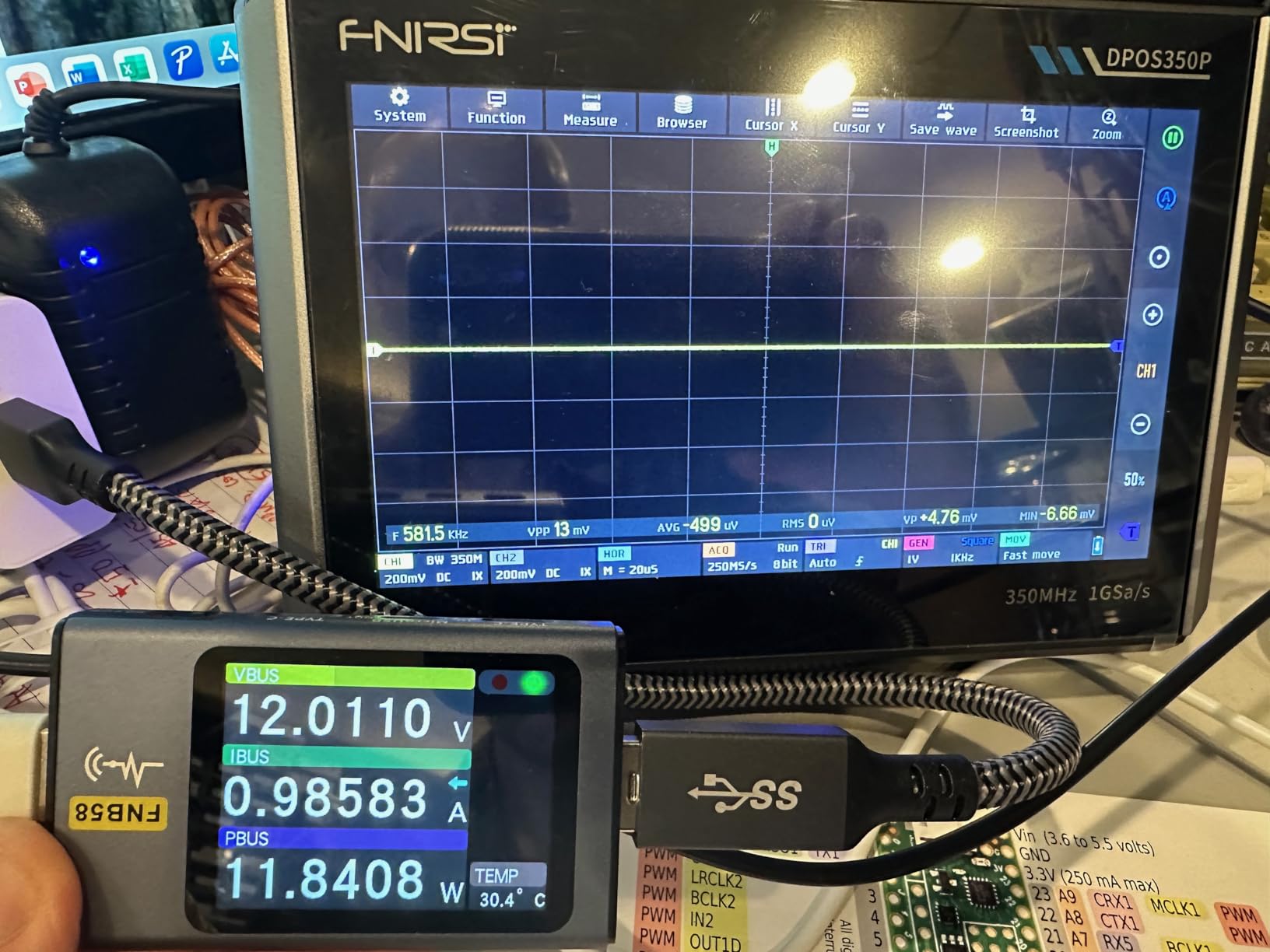
The FNIRSI DPOS350P is a 4-in-1 instrument that combines an oscilloscope, spectrum analyzer, frequency response analyzer, and DDS signal generator into one portable unit. With 350 MHz bandwidth, it offers the widest frequency range of any portable scope in this guide. The digital phosphor technology and 7-inch touchscreen make it feel like a modern piece of test equipment rather than a budget toy.
The spectrum analyzer covers 200 KHz to 350 MHz with both 2D and 3D waterfall displays. This is genuinely useful for RF work, letting you visualize signal spectra alongside time-domain waveforms. The frequency response analyzer can generate Bode plots from 100 Hz to 50 MHz, which is invaluable for characterizing filters and amplifiers.
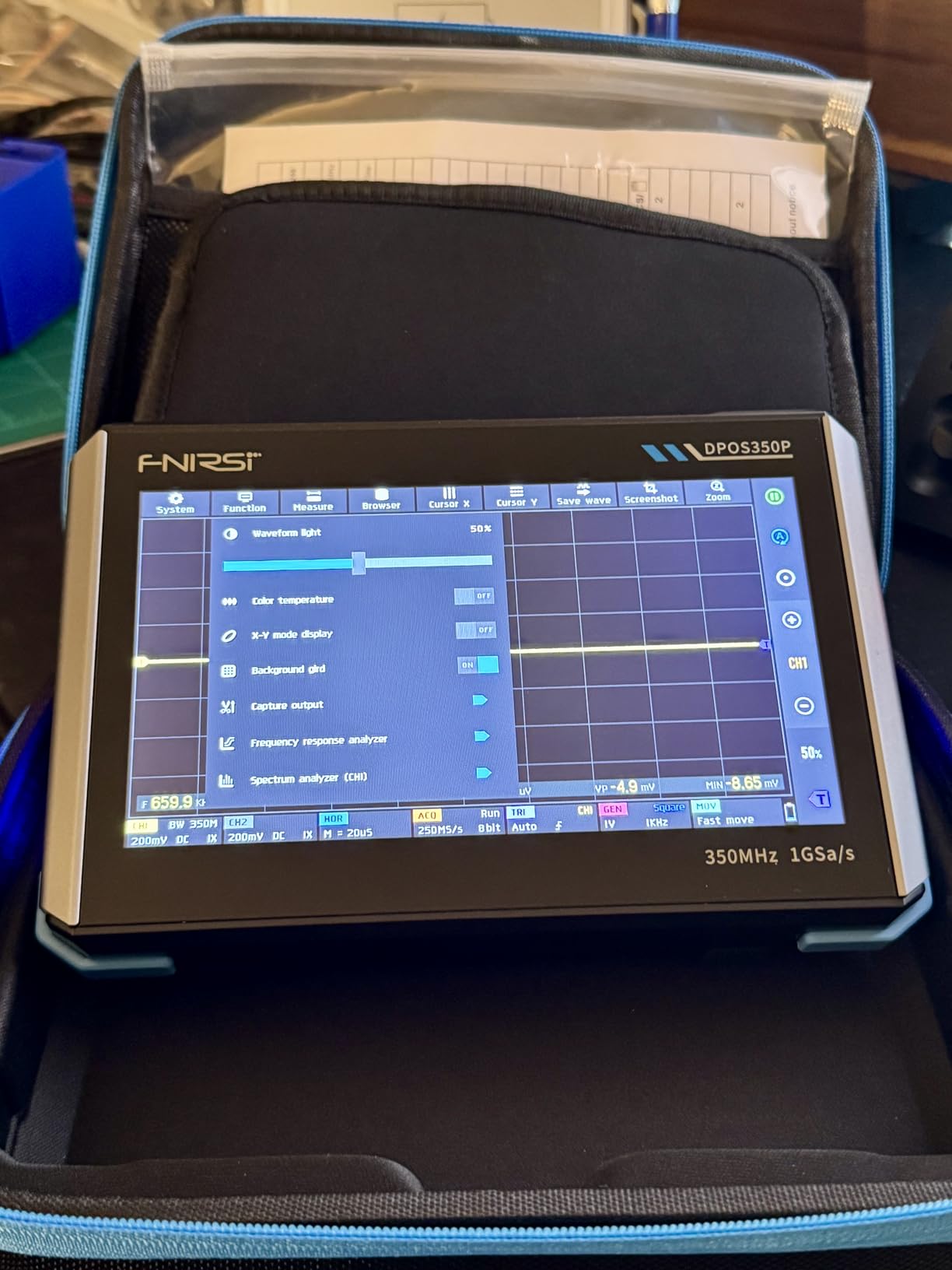
The touchscreen interface is responsive and intuitive, which is a pleasant surprise at this price point. The 50,000 wfms/s refresh rate provides smooth waveform display and improves the chances of catching glitches. The DDS generator covers 0 to 50 MHz with 14 waveform types, and the unit can store 500 waveforms and 90 screenshots internally.
The main frustrations are power-related. The unit cannot run on USB power and connect via USB simultaneously, which limits remote monitoring options. The 12V power adapter uses a non-standard connector rather than USB-C. The fan runs constantly at full speed and is noticeably noisy. BNC connectors feel fragile, and battery life is too short for all-day field work.
Who should buy the FNIRSI DPOS350P
This instrument is ideal for advanced hobbyists and field technicians who need RF-capable measurements in a portable form factor. If you work with RF circuits, need spectrum analysis, or want Bode plot capability without buying separate instruments, the DPOS350P offers remarkable functionality for the price.
Who should look elsewhere
If you need quiet operation, robust connectors, or all-day battery life, look at dedicated bench scopes instead. The noise from the fan and the fragile BNC connectors make this less suitable for shared lab environments or rough field conditions.
8. FNIRSI 2C53T – Best 3-in-1 Handheld Oscilloscope
FNIRSI 2C53T 3-in-1 50MHz 2CH Oscilloscope Multimeter DDS Signal Generator
50MHz bandwidth
3-in-1 scope multimeter generator
250 MSa/s
19999 counts
Handheld
Pros
- Combines oscilloscope multimeter and signal generator in one
- 50MHz bandwidth for a portable unit
- Includes carrying case and multiple probes
- XY mode and waveform math
- High-voltage protection module
Cons
- UI can be confusing and non-intuitive
- Battery life could be better
- Slow multimeter response in auto mode
- Menu navigation feels maze-like
The FNIRSI 2C53T replaces three separate instruments with one handheld device. It functions as a 50 MHz oscilloscope, a 4.5-digit 19999-count true RMS multimeter, and a DDS signal generator capable of 13 waveform types up to 50 kHz. For field work or compact workbench setups, having all three tools in one device saves space and simplifies your kit.
The 250 MSa/s sampling rate and 50 MHz bandwidth are impressive specifications for a handheld device. The multimeter covers AC and DC voltage up to 750V and 999.9V respectively, current up to 9.999A, resistance to 19.99 megohms, and capacitance to 99.99 millifarads. This covers the vast majority of troubleshooting scenarios.
The included accessories are generous. FNIRSI ships it with a 10X probe, crocodile clip probe, multimeter probes, Type-C cable, and a storage case. The high-voltage protection module adds a safety layer that matters when working with higher energy circuits. The FPGA plus MCU plus ADC architecture gives it solid processing power for a device this size.
The biggest weakness is the user interface. Many users describe the menu system as confusing and maze-like, with non-intuitive navigation. The default language ships as Chinese, requiring a trip through the menus to switch to English. Battery life at about 6 hours of standby is adequate but not great for extended field sessions. The multimeter auto mode has a noticeable lag in response time.
Who should buy the FNIRSI 2C53T
This 3-in-1 tool is perfect for field technicians, repair workers, and hobbyists who need multiple measurement capabilities in a portable package. If you do on-site troubleshooting, automotive electrical work, or simply have limited bench space, the 2C53T consolidates your essential tools into one device.
Who should look elsewhere
If you primarily work at a bench and value ease of use, a dedicated bench scope plus a separate multimeter will offer better performance and usability. The confusing UI makes this less ideal for beginners who want a simple plug-and-play experience.
9. HANMATEK HO52 – Best Handheld Scope for Automotive Work
HANMATEK Handheld Digital Oscilloscope 50Mhz Bandwidth with 2 Channels HO52 3.5″ TFT Mini Oscilloscope, 2 in 1 Oscilloscope and Multimeter, Backlit Screen, Auto-Calibration Function, Memory Function
50MHz bandwidth
2 channels
250 MSa/s
2-in-1 scope and multimeter
3.5 inch TFT display
Pros
- Isolated floating ground design for safety
- 50MHz bandwidth performs as advertised
- 5 hour battery life
- Good quality probes included
- Excellent for automotive diagnostics
Cons
- Button-based interface less intuitive than knobs
- Poor manual translation quality
- Discrete vertical horizontal jumps
- Auto function limited to 20mV plus signals
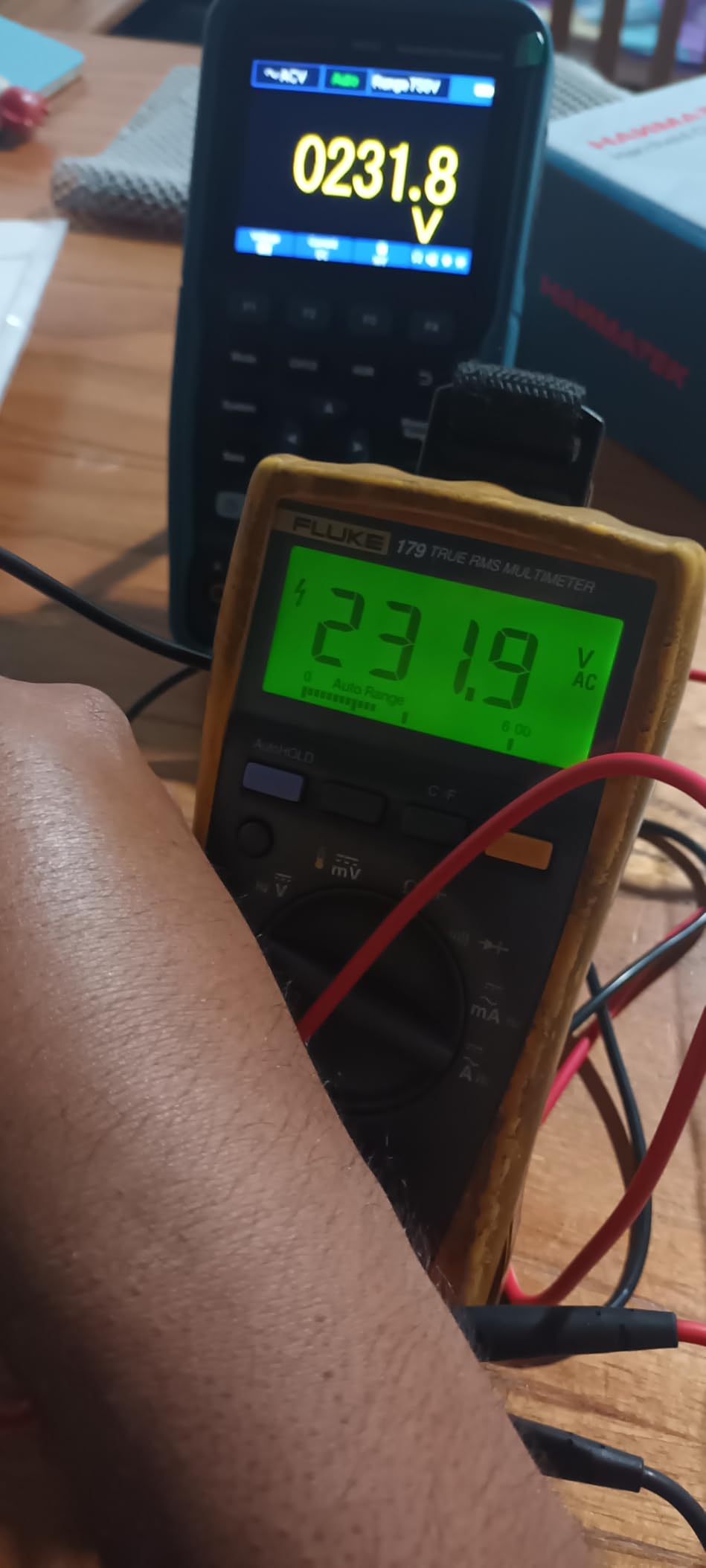
The HANMATEK HO52 earns its place as one of the best handheld digital oscilloscopes for automotive and field service work. The standout feature is the isolated floating ground design, which separates the oscilloscope and multimeter inputs. This safety feature matters enormously when measuring signals on mains-powered equipment or automotive systems where ground references differ.
With 50 MHz bandwidth and 250 MSa/s sampling, this scope handles most automotive and general electronics troubleshooting. The 10,000 wfms/s waveform refresh rate provides smooth display updates. The 4.5-digit true RMS multimeter runs independently from the oscilloscope, meaning you can use both functions without interference.
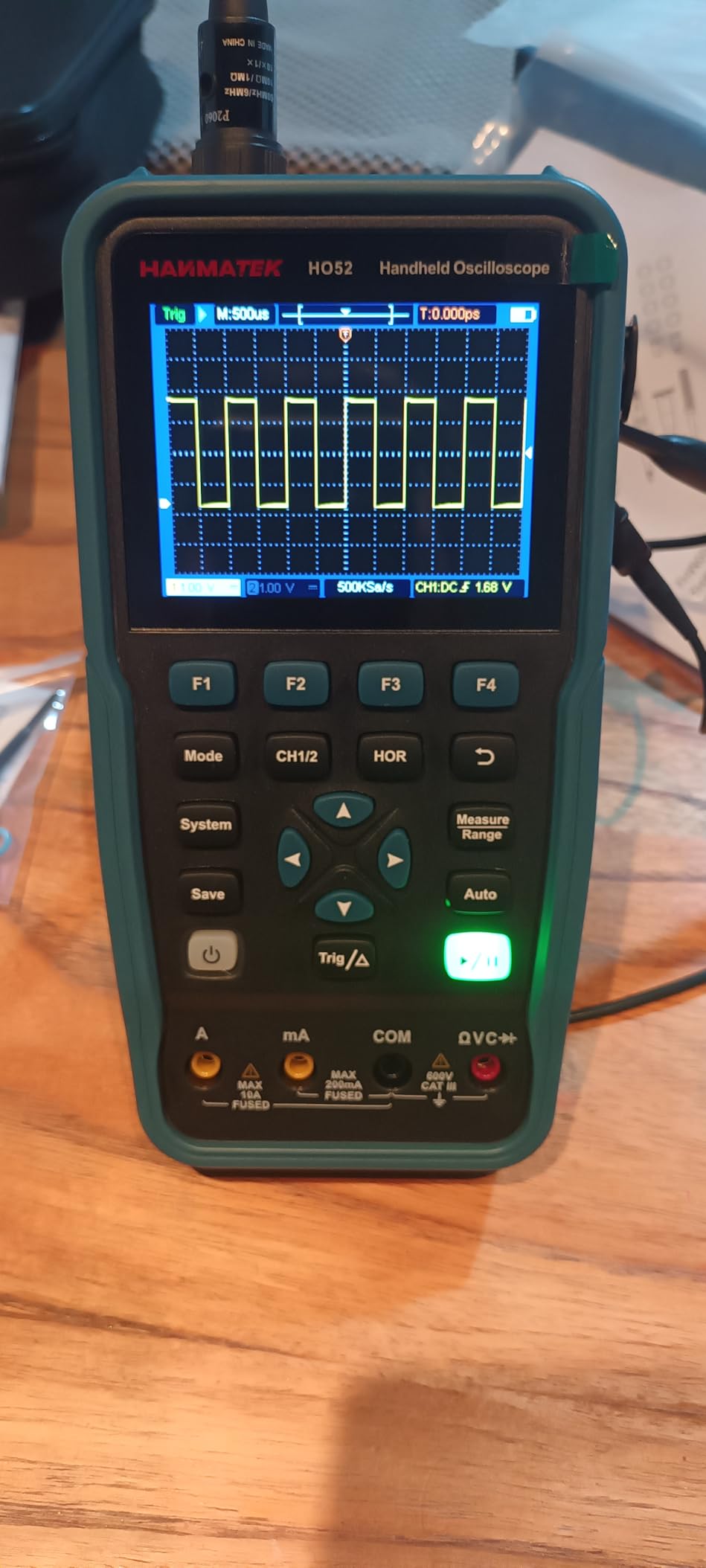
The backlit 3.5-inch TFT screen displays waveforms and measurements clearly, and the illuminated grid lines are a thoughtful touch for dimly lit workspaces. The unit can save 4 groups of settings and waveforms, and supports reference waveform comparisons for identifying deviations from expected behavior.
The controls are the primary weakness. Instead of traditional rotary knobs, the HO52 uses buttons for vertical and horizontal adjustments. These operate in discrete jumps rather than smooth adjustments, which feels less natural for experienced scope users. The auto-set function only works on signals above 20mV, limiting its usefulness for very low-level measurements. The manual suffers from translation issues that can make setup confusing.
Who should buy the HANMATEK HO52
This scope is ideal for automotive technicians, field service engineers, and anyone working with mains-powered equipment where ground isolation matters. The floating ground design makes it one of the safest handheld scopes for automotive diagnostics and car audio tuning.
Who should look elsewhere
If you prefer knob-based controls or need to measure very low-level signals below 20mV, look at alternatives. The button interface has a learning curve that may frustrate users accustomed to traditional oscilloscope ergonomics.
10. OWON HDS272S – Best Professional Handheld Oscilloscope
OWON HDS272S oscilloscope 3 in 1 70MHz Professional Handheld PC oscilloscope, 20000 Counts Digital multimeter 3.5 inch LCD Display Universal Test Instrument (oscilloscope+multimeter+Generator)
70MHz bandwidth
3-in-1 scope multimeter generator
125MSa/s
20000 counts
3.5 inch LCD
Pros
- Professional build quality
- Three instruments in one device
- 20000 count high-sensitivity multimeter
- Good color LCD display
- Long 6 hour battery runtime
Cons
- Batteries not included separately
- 4.5 hour charge time
- Non-conventional interface learning curve
- Limited manufacturer technical support
The OWON HDS272S is a professional-grade handheld oscilloscope that combines a 70 MHz scope, a 20,000-count digital multimeter, and a waveform generator in one device. OWON is a recognized name in test equipment, and the build quality of the HDS272S reflects that professional heritage. It feels more rugged and better constructed than most handheld scopes in this price range.
The 70 MHz bandwidth with 125 MSa/s sampling gives you more headroom than the typical 50 MHz handheld scopes. The 14-bit vertical resolution on the oscilloscope function provides better signal detail than 8-bit alternatives. The 3.5-inch high-resolution LCD display offers good contrast and readability even in varied lighting conditions.
The multimeter covers AC and DC voltage and current, resistance, diode testing, capacitance, and continuity. With 20,000 counts, it delivers higher resolution measurements than the typical handheld combo devices. The waveform generator provides a useful test signal source for circuit characterization. The 4400 mAh lithium battery provides about 6 hours of runtime, and power consumption is under 3W.
The interface takes some getting used to. OWON uses a non-conventional menu structure that differs from both traditional knob-based scopes and the button-driven interfaces of other handhelds. Battery charging is slow at up to 4.5 hours for a full charge. Technical support from the manufacturer can be limited, particularly for users outside primary market regions.
Who should buy the OWON HDS272S
This scope suits professional technicians and engineers who need a reliable handheld instrument for field service. If you want professional build quality, higher bandwidth than typical handhelds, and a capable 3-in-1 design, the HDS272S is a strong choice that will withstand daily professional use.
Who should look elsewhere
If you need 2 channels on a handheld scope or prefer a more intuitive interface, the HANMATEK HO52 offers 2 channels at a similar price. Casual users may find the learning curve steeper than necessary for occasional use.
11. FNIRSI DSO152 – Best Pocket Oscilloscope for Quick Checks
FNIRSI DSO152 Handheld Oscilloscope 200kHz Bandwidth, 2.5MS/s Sampling Rate
200KHz bandwidth
1 channel
2.5 MSa/s
2.8 inch LCD
Pocket-sized
Rechargeable
Pros
- Ultra-portable pocket-sized design
- Rechargeable battery with 4 hour runtime
- Clear 2.8 inch LCD display
- One-key AUTO for fast waveform display
- Great for car audio tuning and basic checks
Cons
- Only one input channel
- Fragile MCX probe connector
- Rocker control feels fragile
- No smooth timebase adjustment
- Limited to audio-frequency range
The FNIRSI DSO152 is the smallest and most affordable oscilloscope in this guide. At just 3.78 x 2.64 x 0.79 inches and 10.2 ounces, it literally fits in your pocket. With a 200 KHz bandwidth and 2.5 MSa/s sampling rate, it covers audio-frequency signals and low-speed digital work. This is not a scope for high-frequency analysis, but for quick signal checks and basic troubleshooting, it is surprisingly handy.
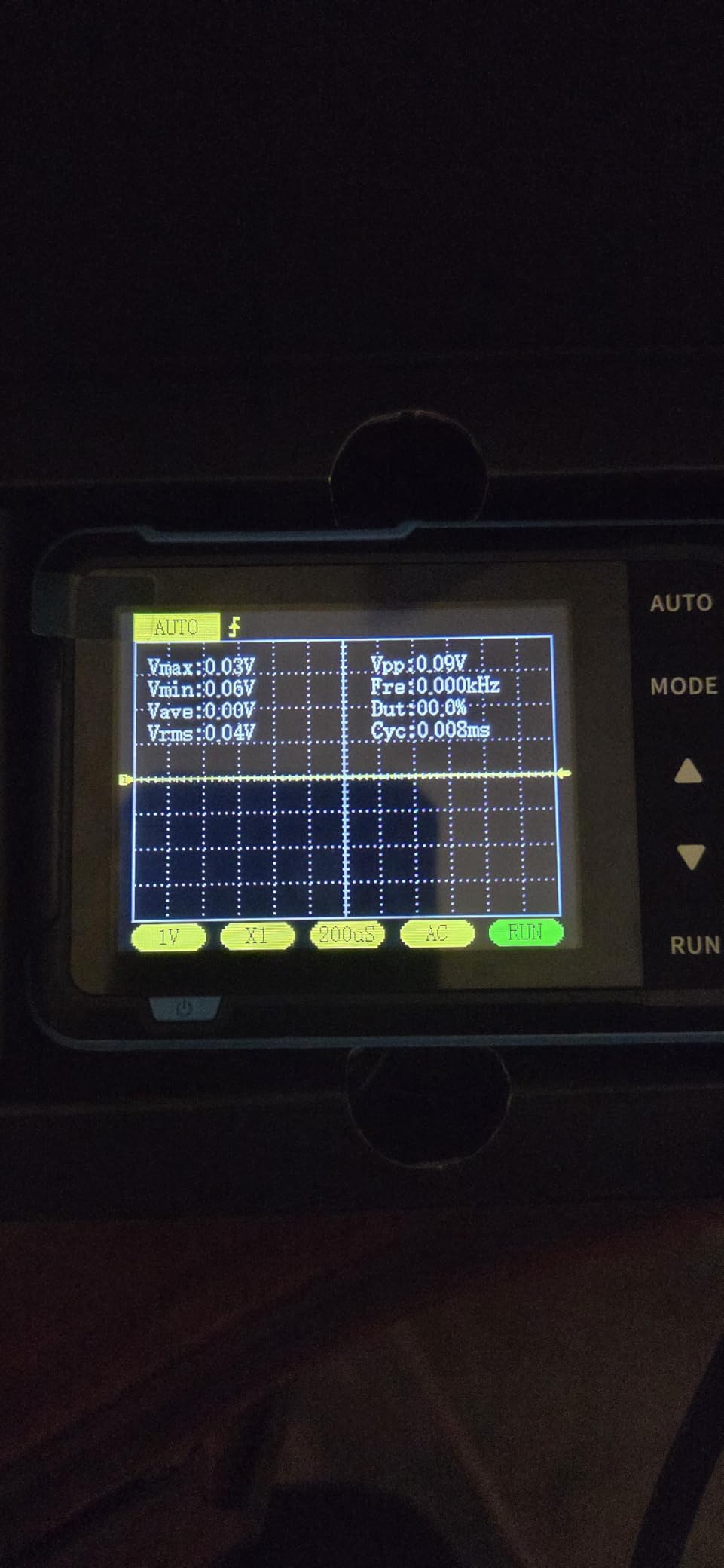
The 2.8-inch HD LCD display at 320×240 resolution shows waveforms clearly for its size. The one-key AUTO function quickly configures the display for a stable waveform, which is exactly what you want from a grab-and-go tool. The trigger function supports Auto, Normal, and Single modes, giving you basic capture flexibility.
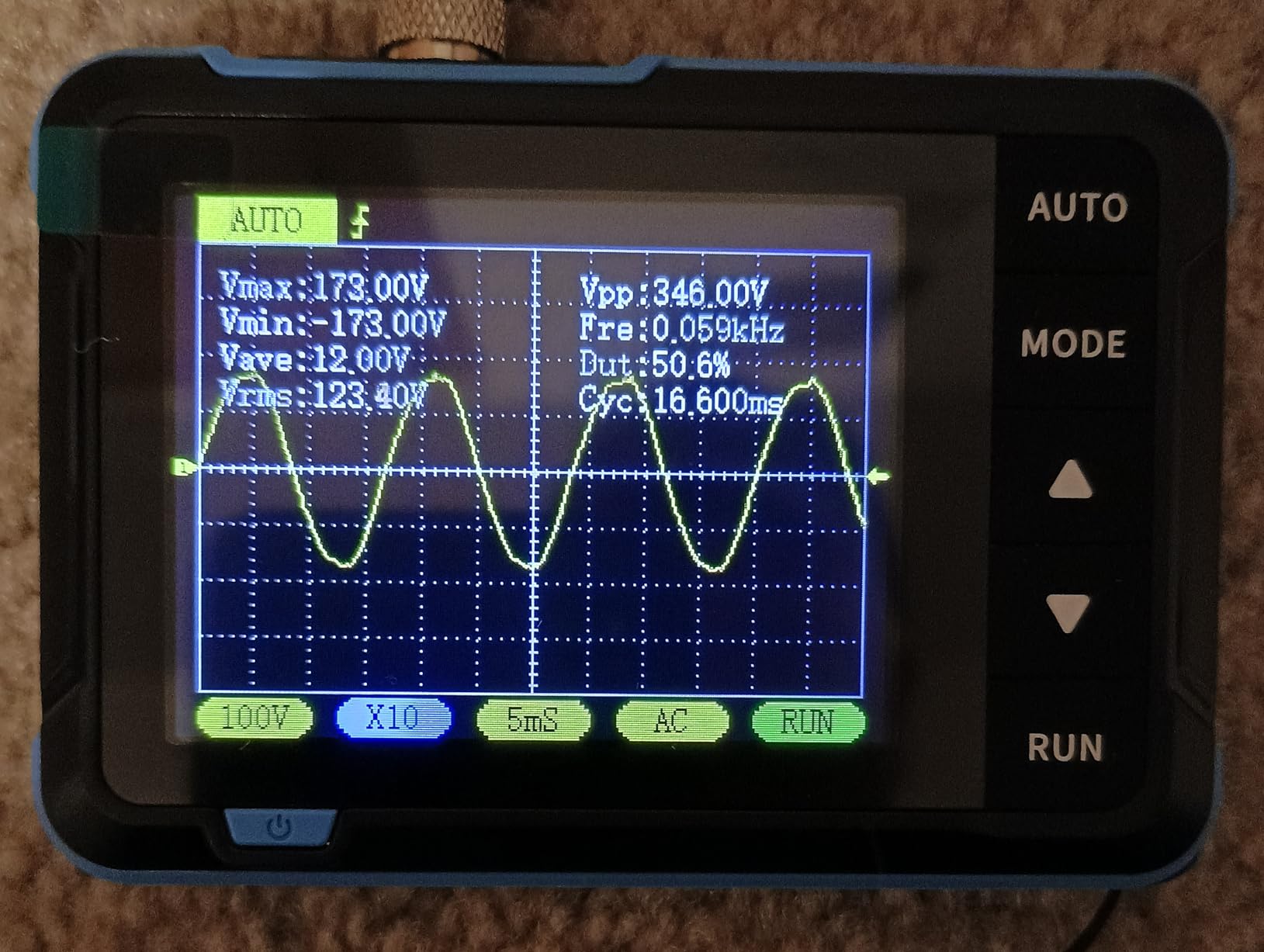
This little scope has found a devoted following among car audio enthusiasts. Users praise it for setting amplifier gains, detecting clipping, and tuning audio systems. The 10X probe can measure up to 800 VPP (280V AC), which covers automotive audio applications comfortably. The built-in 1000 mAh lithium battery provides about 4 hours of continuous use.
The limitations are significant and should be understood before purchasing. The single channel means no comparative measurements. The MCX probe connector is fragile and not as durable as standard BNC. The rocker control for adjustments feels delicate, and there is no smooth timebase adjustment. This is a tool for quick checks, not serious analysis.
Who should buy the FNIRSI DSO152
This pocket oscilloscope is ideal for car audio installers, hobbyists doing basic signal checks, and anyone who needs a portable tool for quick verification. If you just need to confirm a signal exists, check its approximate shape, or set an amplifier gain, the DSO152 does the job at an unbeatable price.
Who should look elsewhere
If you need to analyze digital protocols, compare two signals, or work with frequencies above 200 KHz, this scope will not meet your needs. Anyone doing serious electronics work should budget for a proper bench scope instead.
12. PicoScope 2204A – Best USB PC Oscilloscope
Pico Technology PicoScope 2204A Oscilloscope 2 Channel 10 MHz Bandwidth USB
10MHz bandwidth
2 channels
100 MS/s
USB powered
PC-based
30+ protocol decode
Pros
- Cross-platform software for Windows Linux and Mac
- Decodes over 30 serial protocols as standard
- USB powered for ultimate portability
- Free lifetime software updates
- Built-in waveform generator
Cons
- Only 20V max input range needs attenuators
- Limited to 10MHz bandwidth
- Software bugs possible on Linux
- Not designed for automotive use
The PicoScope 2204A takes a different approach to digital oscilloscopy. Instead of a built-in screen, it connects to your PC via USB and uses Pico Technology’s software for display and analysis. This design means your computer’s processing power and screen real estate become part of your oscilloscope, which offers significant advantages for data analysis and storage.
The PicoScope software is genuinely excellent. It runs on Windows, Linux, and Mac, and Pico offers free lifetime updates. The software decodes over 30 serial protocols as standard, which is far more comprehensive than any standalone scope at this price. Advanced features include mask limit testing, advanced math and filtering, measurements with statistics, and advanced digital triggering.
With 10 MHz bandwidth and 100 MS/s sampling, this scope covers audio, low-speed digital, and basic analog work. The 8 kS capture memory is modest, but the 10,000-waveform circular buffer and 2000 waveforms-per-second update rate help compensate. The enhanced vertical resolution mode pushes up to 12 bits, improving signal detail when you need it.
The USB-powered design means no separate power supply, making this the most portable scope in the guide. At just 5 ounces, you can carry it in a laptop bag anywhere. The trade-off is the 20V maximum input range, which requires attenuator probes for higher voltage work. This is fundamentally a low-voltage signal analysis tool.
Who should buy the PicoScope 2204A
This USB oscilloscope is ideal for users who already work on a computer and prefer software-based analysis over a hardware display. If you need extensive serial protocol decoding, want to save and analyze waveforms on your PC, or need a highly portable scope for travel, the PicoScope 2204A is an excellent choice.
Who should look elsewhere
If you need bandwidth above 10 MHz, want a standalone device without computer dependency, or work with higher voltage circuits regularly, a traditional bench scope will serve you better. The computer requirement means this scope is not ideal for field work without a laptop.
How to Choose the Right Digital Oscilloscope
Choosing from the best digital oscilloscopes comes down to matching specifications to your actual needs. Too many buyers overspend on bandwidth they will never use or underspend on features they desperately need. This buying guide breaks down the specs that matter and helps you avoid common pitfalls.
Bandwidth: The Most Important Spec
Bandwidth determines the maximum frequency your oscilloscope can measure accurately. A common rule of thumb is the 5x rule: choose a bandwidth at least 5 times higher than your highest signal frequency. For a 20 MHz microcontroller clock, you want at least 100 MHz bandwidth. For audio work at 20 KHz, even a 1 MHz scope works fine.
Undersampling leads to distorted waveforms and missed signal details. Overspending on excessive bandwidth wastes money that could go toward better probes or a second instrument. For most hobbyists, 50 to 100 MHz is sufficient. Engineers working with fast digital signals or RF should target 200 MHz or higher.
Sample Rate: How Fast It Captures
Sample rate measures how many data points the scope captures per second, expressed in samples per second (Sa/s) or gigasamples per second (GSa/s). The Nyquist theorem says you need at least 2 samples per cycle to reconstruct a signal, but in practice you want 5 to 10 samples per cycle for accurate representation.
A 1 GSa/s scope can accurately measure signals up to about 100 MHz with good detail. All the bench scopes in this guide offer at least 1 GSa/s, which is adequate for their bandwidth ratings. Handheld scopes typically offer 250 MSa/s or less, limiting them to lower-frequency work.
Channel Count: 2 vs 4 Channels
Two channels let you compare two signals, which covers most basic troubleshooting. Four channels are essential for debugging serial protocols like SPI (which uses 3 to 4 lines), comparing multiple power rails, or analyzing complex multi-signal interactions. Forum users consistently recommend 4 channels for future-proofing.
The trade-off is cost. A 4-channel scope at the same bandwidth and sample rate costs significantly more than a 2-channel model. The Rigol DS1054Z is rare in offering 4 channels at a budget price point. Mixed signal oscilloscopes like the Rigol DHO924S add digital channels on top of analog, giving you the best of both worlds for embedded work.
Memory Depth: How Much It Remembers
Memory depth determines how many sample points the scope can store in a single acquisition. Deeper memory lets you capture longer time windows at high sample rates, then zoom in to find glitches. The difference between 8M points and 24M points is significant when you are hunting for a rare error in a long data stream.
For most hobbyist work, 8M to 14M points is plenty. Professional users debugging complex systems benefit from 24M to 50M points. The PicoScope 2204A’s 8 kS memory is its biggest limitation, restricting it to short capture windows.
Display Quality and Size
A larger, higher-resolution display makes it easier to read measurements and analyze waveforms. Seven-inch displays at 800×480 resolution are standard for bench scopes in this price range. Touchscreen interfaces, like those on the Rigol DHO924S and FNIRSI DPOS350P, speed up navigation significantly.
For handheld scopes, the 2.8 to 3.5-inch displays are a necessary compromise for portability. The trade-off is readability, especially when viewing multiple measurements simultaneously. Screen brightness matters for outdoor or well-lit workspaces.
Connectivity and Software
USB and LAN connectivity let you transfer screenshots, waveform data, and firmware updates. The Rigol DHO924S goes further with web control and SCPI command support, enabling automated test setups and remote monitoring. The PicoScope relies entirely on its PC software, which is among the best in the industry.
Serial bus decoding is a feature that separates useful scopes from limited ones. Being able to decode I2C, SPI, UART, CAN, and other protocols directly on the scope saves enormous time compared to manually interpreting waveforms. The Siglent SDS1202X-E and Rigol models excel here.
Probes: The Hidden Cost
One of the most consistent complaints across forum discussions is probe quality on budget scopes. Nearly every scope in this guide ships with probes that work but leave room for improvement. Investing in quality probes from Tektronix, Keysight, or premium third-party brands noticeably improves measurement accuracy.
Check probe bandwidth matching. A 200 MHz scope needs 200 MHz probes to deliver full performance. Using 100 MHz probes on a 200 MHz scope bottlenecks your measurement capability. Also consider probe type: 1X probes are for low-frequency, low-voltage work, while 10X probes are standard for general-purpose measurements.
Frequently Asked Questions
What is the best digital oscilloscope for beginners?
The Rigol DS1054Z is widely considered the best digital oscilloscope for beginners. It offers 4 analog channels, 50 MHz bandwidth (hackable to 100 MHz), 24 Mpts memory depth, and protocol decoding at a budget-friendly price. For absolute beginners on a tight budget, the Hantek DSO2C10 provides 100 MHz bandwidth at the lowest cost, while the FNIRSI DSO152 pocket scope works for basic signal checks under $40.
How much does a good digital oscilloscope cost?
A good entry-level digital oscilloscope costs between $180 and $400, offering 50 to 200 MHz bandwidth with 2 to 4 channels. Mid-range scopes with signal generators and deeper memory run $400 to $900. Professional oscilloscopes with 12-bit resolution, mixed signal capability, and advanced analysis features cost $900 to $3,000 or more. Handheld and pocket scopes start as low as $37.
What bandwidth do I need for an oscilloscope?
Use the 5x rule: choose an oscilloscope with bandwidth at least 5 times your highest signal frequency. For a 20 MHz microcontroller, get at least 100 MHz bandwidth. For audio work at 20 KHz, even 1 MHz suffices. For RF work or fast digital signals above 50 MHz, look for 200 MHz or higher bandwidth scopes like the Siglent SDS1202X-E or FNIRSI DPOS350P.
Is Rigol or Siglent better?
Both Rigol and Siglent make excellent oscilloscopes with strong reputations in the electronics community. Rigol is known for value, offering 4 channels at lower prices (DS1054Z) and advanced features like 12-bit resolution (DHO924S). Siglent is praised for build quality, display contrast, and serial decoding performance (SDS1202X-E). For budget buyers, Rigol offers more channels per dollar. For a refined 2-channel experience, Siglent edges ahead.
Can I use a digital oscilloscope for automotive diagnostics?
Yes, digital oscilloscopes are excellent for automotive diagnostics including CAN bus analysis, sensor signal verification, and ignition system testing. Handheld scopes with isolated floating grounds like the HANMATEK HO52 are particularly well-suited for automotive work. Look for scopes with CAN and LIN protocol decoding, sufficient bandwidth for the signals you are testing, and high-voltage probe compatibility.
Final Thoughts on the Best Digital Oscilloscopes
After testing 12 models across every price tier and use case, the best digital oscilloscopes come down to what you actually do with signals. The Siglent SDS1202X-E remains my top overall pick for its balance of 200 MHz bandwidth, serial decoding, and build quality. The Rigol DS1054Z is unbeatable for budget-conscious buyers who need 4 channels, and the Rigol DHO924S stands above the rest for professional mixed signal work.
For portable and field use, the HANMATEK HO52 and FNIRSI DPOS350P cover automotive and RF applications respectively. And for PC-based analysis, the PicoScope 2204A offers the best software ecosystem in the business. Whatever your budget or application, one of these 12 scopes will fit your bench in 2026. Match the specifications to your real needs, invest in quality probes, and you will have a tool that serves you for years.
2 thoughts on “12 Best Digital Oscilloscopes (October 2026) Tested and Ranked”