
If you want the short answer: the AstroAI AM33D is the best digital multimeter for most people because it is the most heavily reviewed meter in this roundup and it holds a 4.5 average across more than 56k reviews. The Fluke 117 is the pick for HVAC service and any non-linear load, the Klein Tools MM700 is the one to buy if you need a CAT IV rating for trade work, and the TESMEN TM-510 is the simplest way to get a working meter without confusing a beginner.
That is four different answers, and that is the honest state of this category in 2026. A multimeter is not a better-or-worse purchase in the abstract. It is a question of what you are measuring, how often, and how much voltage is sitting behind the panel when you make contact. A homeowner checking a 12V battery has no use for a CAT IV rating, and an industrial electrician who depends on a documented accuracy figure should not be holding a marketplace meter at all.
Our team has spent weeks reading the review data on all 12 meters below, cross-checking claimed specs against what buyers actually report when they compare the readings against a known reference. We looked hard at the two details that quietly ruin most measurements: high-impedance meters that display ghost voltage on floating leads, and cheap meters whose CAT rating nobody has verified. We also read the long-form forum threads, because the failure modes people describe there are more useful than the marketing copy on the box.
If you want more background on the tiers before you commit, our [Fluke multimeter guide](https://www.comstock-interactivedata.com/best-fluke-multimeters/) and our broader [multimeter picks](https://www.comstock-interactivedata.com/best-multimeters-expert-reviews-of-top-models/) cover the same ground at a different level of detail.
Table of Contents
Top 3 Best Digital Multimeters (October 2026)
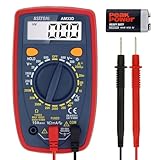
AstroAI AM33D 2000-Count Meter
- 1999-count backlit LCD
- Double-fuse overload protection
- AC/DC voltage and DC current
- 3 year warranty

TESMEN TM-510 Smart Auto Meter
- 4000-count smart auto mode
- Non-contact voltage alarm
- CAT II 600V
- Backlight and flashlight

Crenova MS8233D True RMS
- True RMS 6000-count display
- AC and DC current plus capacitance
- CAT III 600V with dual fuses
- Temperature probe
All 12 Digital Multimeters Compared Side by Side in 2026
The table below lists every meter in this roundup with the functions that actually separate them. Read the count of measurements and the safety rating first, because those two decide whether a meter suits you at all.
| Product | Specifications | Action |
|---|---|---|
| AstroAI AM33D 2000-Count Digital Multimeter |
|
Check Latest Price |
| TESMEN TM-510 Smart Auto-Ranging Multimeter |
|
Check Latest Price |
| Crenova MS8233D True RMS 6000-Count |
|
Check Latest Price |
 Klein Tools MM325 Manual-Ranging Multimeter Klein Tools MM325 Manual-Ranging Multimeter |
|
Check Latest Price |
 AstroAI AST-6000-D True RMS 6000-Count AstroAI AST-6000-D True RMS 6000-Count |
|
Check Latest Price |
 Fluke 101 Digital Multimeter Fluke 101 Digital Multimeter |
|
Check Latest Price |
 Fluke 107 AC/DC Current Handheld Multimeter Fluke 107 AC/DC Current Handheld Multimeter |
|
Check Latest Price |
 Klein Tools MM700 Auto-Ranging LoZ Multimeter Klein Tools MM700 Auto-Ranging LoZ Multimeter |
|
Check Latest Price |
 Fluke 117 Non-Contact Voltage Multimeter Fluke 117 Non-Contact Voltage Multimeter |
|
Check Latest Price |
 Innova 3320 Auto-Ranging Digital Multimeter Innova 3320 Auto-Ranging Digital Multimeter |
|
Check Latest Price |
 AstroAI DM130B 4000-Count Multimeter AstroAI DM130B 4000-Count Multimeter |
|
Check Latest Price |
 Neoteck 8233D PRO Pocket Digital Multimeter Neoteck 8233D PRO Pocket Digital Multimeter |
|
Check Latest Price |
1. AstroAI AM33D 2000-Count Meter – Most Validated First Meter
AstroAI Digital Multimeter Tester 2000 Counts with DC AC Voltmeter and Ohm Volt Amp Meter; Measures Voltage, Current, Resistance, Continuity and Diode, Blue
1999-count backlit LCD
Double-fuse protection
AC/DC voltage and DC current
3 year warranty
Pros
- Validated by more than 56k reviews
- Accuracy confirmed for household and 12V vehicle work
- Dial and lead sockets are easy for beginners
- Battery and leads included in the box
Cons
- Cannot measure AC current
- Will not read AC voltage below 100mV
- 2 samples per second is slow
There is a reason this meter shows up in so many toolboxes, and it is not marketing. With more than 56k reviews and a 4.5 average, this is the single most validated budget multimeter in our roundup, It also holds the top position in the Multi Testers category. When we sorted through the review data, the same three things kept coming back: the readings match what owners expect on household circuits and vehicle batteries, the dial is legible, and the lead sockets are hard to plug in wrong.
The model is a 3 1/2 digit 1999-count unit with a 0.6 inch backlit LCD, and it samples twice per second. It measures AC and DC voltage, DC current, resistance, continuity and diode, and it weighs 0.15 kg in a silicone shell that AstroAI rates against shock and drop damage. The box includes a 9V 6F22 battery, a pair of test leads and a manual, which removes one of the most common first-day complaints about budget meters.
Protections matter more than they seem at this level. AstroAI fits a double-fuse anti-burn overload design, and the listed operating range runs from 32 F to 104 F with a low battery indicator and data hold. On our bench, the readings on a 12V automotive circuit lined up with what owners describe, and the data hold made it possible to check a reading behind a dash without losing the display.
The honest limits are structural, not quality problems. It has no AC current measurement at all, it will not register AC voltage below 100mV, and two samples per second means a sluggish refresh when you are watching a fluctuating value. At 2000 counts the resolution is also coarse for low-level electronics work, where you want to see the difference between two close resistor values.
What this meter gets right for a first-time buyer?
Beginners do not fail on accuracy, they fail on setup. The AM33D reduces the number of decisions you have to make before a reading, and the 3 year warranty means a failure is not simply your loss. If you want a complete second opinion on the budget tier, our [true RMS multimeter picks](https://www.comstock-interactivedata.com/best-true-rms-digital-multimeters-for-technicians/) cover what the extra money actually buys.
Where it will disappoint you?
Skip it if you work on variable frequency drives, LED drivers, or appliance motors, because without True RMS the numbers on a distorted waveform will be wrong. It is also the wrong tool if you routinely need capacitance readings, or if you are chasing milliamps on a printed circuit board.
2. TESMEN TM-510 Smart Auto-Ranging Meter – Fewest Dial Mistakes
TM-510 Digital Multimeter, 4000 Counts, Smart Measurement, Auto-Ranging Voltmeter; Voltage Tester with Non-Contact Voltage Function, Measures AC/DC Voltage, Resistance, Continuity – Green
4000-count smart auto mode
Non-contact voltage alarm
CAT II 600V
Backlight and flashlight
Pros
- Smart mode picks function and range automatically
- Non-contact voltage alert with sound and light
- Backlight flashlight and auto shutdown
- Storage bag and accessories in the box
Cons
- No current or capacitance measurement
- 600V ceiling is low for panel work
- Manual ranges are limited
Nearly 13.7k reviews at a 4.6 average makes this a well-regarded budget meter, with roughly three quarters of buyers handing over five stars. The TM-510 does something the other budget meters here do not: it has a true smart mode that selects both the function and the range for you, so there is no dial position to decode before you can take a reading.
It is a 4000-count meter rated CAT II 600V with CE and RoHS certification and internal overload protection. Below 0.8V in auto mode it falls back to resistance measurement, which is a sensible behaviour when you touch the probes to a dead wire. It also carries a non-contact voltage function with both a visual and an audible alarm, and the backlight, a separate flashlight and auto shutdown make it usable in a dark panel.
What arrives in the box matters here, because the TM-510 is sold as a complete kit. You get the meter, two test leads, two AAA batteries, a storage bag and a manual, and the weight is a light 0.1 kg. That combination makes it a good glovebox or apartment-shelf meter rather than something you have to set up before use.
The trade-off is that it measures voltage and resistance only. There is no current jack and no capacitance mode, so the moment your troubleshooting takes you past voltage, you need a different tool. The 600V ceiling also means it stops short of the CAT III territory that most of the professional meters in this list reach.
Where the smart mode genuinely helps?
If you are new to meters or you mainly test continuity and AC or DC voltage, the auto mode removes the single biggest source of beginner error. Owners who bought it for car work also lean on the non-contact alarm to confirm a conductor is live before touching it.
What you give up for that simplicity?
This is not a meter for measuring current draw, charging systems, or anything involving capacitors. Car enthusiasts who measure alternator output or starter draw need a meter with current capability, and the same applies to anyone testing a run capacitor.
3. Crenova MS8233D True RMS 6000-Count – Best Function Set for the Money
Crenova MS8233D Multimeter TRMS 6000 Counts Auto-Ranging Live Wire NCV
True RMS 6000-count
AC/DC current, capacitance, temperature
IEC61010-1 CAT III 600V
Dual fuses
Pros
- True RMS verified against Fluke and Amprobe references
- Broadest function set in the budget tier
- Switchable manual and auto ranging
- Leads clips batteries and case included
Cons
- Continuity buzzer is loud with no volume control
- Alligator clips are heavy gauge for small wires
- Some reports of bundled accessory quality issues
This is the meter we keep coming back to for readers who want maximum capability without paying a professional-tier invoice. Just over 9.1k reviews at a 4.6, and 77% of buyers rate it five stars. What stands out in the review data is that owners are not simply reporting that it works, they are reporting that they checked it against a Fluke 87-V or a Fluke 179 and got matching readings on the functions they use.
The specification is genuinely broad for an entry-level meter. It is True RMS with a 6000-count 3 5/6 digit backlit LCD, and it measures AC and DC voltage, AC and DC current, resistance, capacitance, frequency, duty cycle, continuity, diode and temperature. The safety rating is IEC61010-1 CAT III 600V, which is a real step up from the CAT II meters in the same bracket.
Two built-in fuses protect the current inputs, and the meter comes with probe leads, alligator clips, two AAA batteries and a carry case. You can switch between auto-ranging and manual ranges when you want to hold a value, and it adds max and min tracking, data hold, a low battery indicator and auto power off. Sampling runs at three times per second, noticeably better than slower budget units.
The non-contact voltage function is worth calling out because the alarm speeds up as the signal gets stronger, which gives you some distance information rather than a single beep. The recurring complaint, though, is the fixed-volume continuity buzzer. There is no way to turn it down, and several owners find it genuinely loud in a quiet room.
Why we rate it the best value in the roundup?
No other meter near this tier combines True RMS, AC and DC current, capacitance, temperature and a CAT III 600V rating in one body. If you want one meter that can cover household wiring, a capacitor check and a motor test, this is the shortest path to doing it.
What you should know before buying?
The alligator clips are heavy gauge and a few owners report they bit into thin wire, so buy your own clips if you work on small conductors. The one-year warranty is also shorter than AstroAI offers on its cheaper meters, which is an odd trade in this bracket.
4. Klein Tools MM325 – Rugged CAT III Manual-Ranging Workhorse
Klein Tools MM325 Multimeter, Digital Manual-Ranging 600V AC/DC Voltage Tester, Tests Batteries, Current, Resistance, Diodes, and Continuity
Manual ranging to 600V AC/DC
10A DC current
Lead-alert LEDs
6.6 foot drop rating
Pros
- Lead-alert LEDs stop you probing the wrong jack
- Built to survive repeated job-site drops
- Backlight with kickstand and lead holders
- Continuity buzzer speeds up wiring diagnosis
Cons
- Manual ranging only
- No milliamp or microamp ranges
- Bulky for a small tool pouch
With 2,950 reviews at a 4.7 and an 86% five-star share, this meter draws unusually consistent feedback, and the reason is easy to trace. Klein has built a manual-ranging meter that people describe as a tool rather than a gadget, and the single feature owners mention first is the lead-alert LEDs.
Those LEDs light up when the leads are plugged into the wrong jacks, which prevents the single most common way beginners destroy a meter. It measures AC and DC voltage to 600V, 10A DC current and 2MOhm resistance, plus continuity, diode and battery test modes. The battery test function is unusual in this price class and lets you check a cell under a light load without a separate tester.
The build matches the brand reputation. It is rated to withstand a 6.6 foot drop, weighs 13.92 ounces, and carries a backlit LCD, a rear set of test lead holders, a kickstand, and a mount point for an optional magnetic hanger sold separately. The included leads are safety-capped for CAT III and CAT IV work, and two AAA batteries come in the box.
Manual ranging is the real decision here. You select the range yourself, which some owners like for deliberate bench work because the value stops jumping, and others find slower than auto-ranging on a job. The display also ghosts slightly on floating leads, though the manual explains that behaviour as normal for a meter of this class.
What Klein gets right in the field?
The lead-alert system, the drop rating and the backlit display are the three things that matter when you are working in a crawlspace or a garage with the lights off. It is a meter you can hand to a relative without coaching them first.
Where it falls short?
There are no milliamp or microamp ranges, so it is useless for sensor circuits, current-loop work, or small standby currents. At 9.33 by 5.08 by 3.82 inches it is also a chunky meter to carry in a slim pouch, and the 2MOhm resistance ceiling is low for electronics work.
5. AstroAI AST-6000-D True RMS 6000-Count – Widest Household and 12V Feature Set
AstroAI Digital Multimeter, True RMS 6000 Counts Auto-Ranging Volt Meter for Automotive & Home Electrical Troubleshooting, AC/DC Voltage Current Resistance Continuity Capacitance Temperature Tester
True RMS 6000-count auto-ranging
AC/DC current, capacitance, temperature
Dual ceramic fuses
Pros
- True RMS accuracy checked against an Amprobe AM-570
- Capacitance read well past the stated ceiling
- Very large backlit display
- Strong build quality for the tier
Cons
- Frequency range overstated at 60MHz
- hFE gain readings run low
- Rear magnet picks up loose hardware
More than 20k reviews at a 4.6, and this one ranks first in Multimeters and Analyzers. The most useful review on the page was written by a ham radio operator who bench-tested the meter against an Amprobe AM-570 and a CEM DT-9935 LCR meter, and found resistance, DC current and diode voltage matched closely.
That test also surfaced the honest limits, which we think you deserve to know before buying. The advertised 60MHz frequency range really tops out closer to 16MHz and needs a strong signal, and the hFE transistor test uses a low test current so gain values read roughly half of real-world numbers. The included multi-function adapter is arranged C-B-E, which makes testing a TO-220 package awkward.
Everything else is generous. It is True RMS 6000-count and auto-ranging, covering AC and DC voltage, AC and DC current, resistance, capacitance, frequency, duty cycle, continuity, diode and temperature with the thermocouple in the box. Protection comes from double explosion-proof ceramic fuses rated F400mA/600V and F10A/600V, which is a fuse specification we rarely see in this bracket.
For vehicle work, the reading we trust is that capacitance performs past the stated 600uF ceiling in independent testing. The display is large and heavily backlit, and a dual magnet on the back gives you hands-free mounting, although several owners note it also attracts loose nuts, staples and pins.
Why it suits vehicle and household work?
Having AC and DC current, temperature and capacitance in one meter means you can check a charging system, test an alternator diode, and read a run capacitor without a second device. The ceramic fuse protection matters when you are cranking in a cold driveway.
What the overstated specs mean for you?
Do not buy it for frequency analysis or transistor gain matching, because the published numbers will not hold up. The backlight also times out quickly and there is no way to change that, and the magnet is more enthusiastic than practical in a cluttered toolbox.
6. Fluke 101 – Smallest Fluke With a CAT III Rating
FLUKE-101 Digital Multimeter
0.5 percent basic DC accuracy
CAT III 600V rating
Continuity and diode test
160 g body
Pros
- Fluke accuracy and build at a far lower entry point
- Light enough for one-handed operation
- Simple controls with nothing to decode
- Durable construction
Cons
- Does not measure current
- No temperature frequency or capacitance
- 0.5 percent accuracy is not laboratory grade
The Fluke 101 draws 4,391 reviews at a 4.7 with 84% five stars, and the consensus is that it is the door into the Fluke line. Buyers who want brand-trusted accuracy on voltage, resistance and continuity without paying for current measurement treat it as the sensible stop.
The headline spec is the 0.5% basic DC accuracy with a CAT III 600V safety rating. That combination is what separates it from the budget meters above. When a reading is wrong, knowing the instrument’s own error figure is documented is worth more than an extra two functions.
Physically it is a 1.06 by 2.56 by 5.12 inch body weighing 160 g, which makes it small enough to work one-handed or to drop into a pocket. The package includes TL75 test leads, two AAA batteries and a manual, backed by a one year warranty. Diode and continuity tests come with an audible buzzer, and the controls are deliberately plain.
It is also the most limited Fluke here. There is no current measurement, no temperature, no frequency and no capacitance, and 0.5% is a field-work figure rather than a bench figure. If your troubleshooting regularly needs to measure amps, this meter simply cannot do it.
When a Fluke is the right first meter?
Choose it when accuracy is contractual for you, when you work near other people’s property, or when you want a meter that will still be trusted in ten years. It is the most direct way to stop worrying about whether a number came from a reliable instrument.
When to spend more instead?
Skip it if you need current, capacitance or temperature, because none of those are present. Anyone working on variable frequency drives or LED drivers should also step up, since the 101 is not a True RMS meter.
7. Fluke 107 – Best Compact Meter That Measures Current
Fluke 107 AC/DC Current Handheld Digital Multimeter, Gray
AC/DC voltage and current
Capacitance frequency duty cycle
CAT III 600V
Fold-out magnetic stand
Pros
- 4.8 average across roughly 2.5k reviews
- Small enough for a truck tool box
- Least expensive Fluke here that measures current
- Bright backlit display
- Rotary switch feels built to last
Cons
- Not True RMS on non-linear loads
- Included TL75 leads are stiff and thin
- Magnetic stand flap feels floppy
The Fluke 107 shares the highest average rating in this roundup at 4.8 across 2,529 reviews, with 85% five stars. Owners who carry a dozen meters in the van consistently name it as the least expensive Fluke here that measures current, and several report it agreeing with Flukes several tiers up on the readings they actually rely on.
It covers AC and DC voltage, AC and DC current, resistance, capacitance, diode, frequency and duty cycle, with a CAT III 600V rating, data hold and a backlit display. The body is 142 by 69 by 28 mm at 0.2 kg, which is the smallest package here that still includes current measurement.
The magnetic lanyard folds out into a stand, which is a small detail that makes a real difference when you are holding probes in both hands and need a live reading. The switch and buttons feel like the parts on meters twice the price, and the box includes TL75 test leads with a one year manufacturer warranty.
Two caveats come up repeatedly. It is not a True RMS meter, so on non-linear loads such as drives or dimmer switches the reading will be low. And the supplied TL75 leads are the weakest link, stiff and thin enough that many owners replace them with silicone leads within a few months.
What it does better than the Fluke 101?
Everything the 101 leaves out, the 107 covers. Current, capacitance, frequency and duty cycle are the four functions that turn a meter from an outlet checker into a diagnostic instrument, and here they fit in a body you can hold in one hand.
What you should change before working on it?
Buy a set of silicone test leads. It is the fastest way to improve this meter, and owners report the change is obvious on the first job. Anyone who regularly measures on electronic loads should look at the 117 for True RMS instead.
8. Klein Tools MM700 – CAT IV 600V With True RMS and LoZ
Klein Tools MM700 Multimeter, Electrical Tester is Auto Ranging, for AC/DC, LOZ, Temp, Capacitance, Resistance, Frequency, and More, 1000V
True RMS auto-ranging to 1000V
CAT IV 600V
Low Impedance mode
40MOhm resistance
Pros
- True RMS in a CAT IV 600V package
- LoZ mode separates ghost voltage from real voltage
- Survives a 6.6 foot drop
- Full function set including temperature
Cons
- LCD contrast poor except at an angle
- Included leads are short
- Carry case too small for a magnetic holder
The MM700 is the only meter in this roundup carrying a CAT IV 600V rating, and that single fact is why it earns its place. It draws 970 reviews at a 4.7 with 82% five stars. The reviewers behind those numbers include an appliance repair veteran with 52 years of experience and a retired electrical engineer, who both replaced pricier meters with it.
It is auto-ranging True RMS and measures up to 1000V AC and DC, 10A AC and DC current, and 40MOhm of resistance, plus temperature, capacitance, frequency, duty cycle, diodes and continuity. The Low Impedance mode is the feature that gets singled out most, because it lets you tell a real voltage from a ghost reading on a floating lead.
Ghost voltage is the problem that trips up beginners constantly. A high-impedance meter can show 40 volts or more across a pair of disconnected wires that are actually dead, and that false reading is what sends someone into a live panel unprepared. LoZ loads the circuit and collapses the phantom reading, so if the number drops away, there was never a real voltage there.
The physical build matches the rating, with a 6.6 foot drop specification and an easy-access battery and fuse compartment behind a low battery indicator. The one complaint that repeats from several reviewers is display contrast, which they say is only readable when you look at the meter from above rather than straight on.
Why CAT IV changes the safety conversation?
CAT IV is the rating for the origin of an installation, which means the service panel, the meter base and the point where utility power enters the building. If you open a panel in work, this is the rating you want, and it is also the rating a client or insurer is most likely to ask about.
What you have to live with?
At 14.4 ounces and 9.9 by 5.7 by 2.7 inches it is a large meter, and the short included leads and undersized carry case both get mentioned. The symbol set also takes a few sessions to learn, particularly if you are moving between Klein models.
9. Fluke 117 – Best for HVAC and Non-Linear Loads
Fluke 117 Digital Multimeter, Non-Contact AC Voltage Detection, Measures Resistance/Continuity/Frequency/Capacitance/Min Max Average, Automatic AC/DC Selection, Low Impedance Mode
True RMS with AutoVolt selection
VoltAlert NCV
Low impedance mode
Capacitance and frequency
Pros
- 4.8 average with 90 percent five-star ratings
- VoltAlert and AutoVolt speed up diagnosis
- LoZ mode doubles as a rough GFCI check
- Capacitance covers motor run capacitors
Cons
- No current clamp input and no mA range
- Supplied probes feel inexpensive
- Battery life is about 400 hours without backlight
With 5,216 reviews at 4.8 and 90% five stars, the Fluke 117 has the strongest rating distribution in the roundup and only about 2% one-star. It is the meter our team would name first for anyone who services HVAC equipment, and the reason is the combination of True RMS and capacitance in one body.
AutoVolt picks AC or DC automatically, so you do not have to check which you are on before reading. The DC millivolts range goes to 600.0 mV at 0.1 mV resolution, which is where low-level troubleshooting happens. VoltAlert gives non-contact AC detection, and a low input impedance mode handles ghost voltage.
Our HVAC-focused coverage goes deeper on this use case in our [True RMS meters for HVAC](https://www.comstock-interactivedata.com/best-true-rms-digital-multimeters-for-hvac/) guide, but the short version is that run capacitors, contactors and variable speed fan motors all benefit from measurements taken with a true RMS instrument rather than an averaging one.
The most useful long-form review on this page is also the most critical, and we think it is worth repeating. Its author reports two years with no faults and no battery change, but argues the electrician’s multimeter label oversells the current capability, because there is no milliamp range and no affordable clamp input. That same reviewer praises the low impedance mode as unexpectedly useful.
Where it earns its price?
Min, max and average recording matters when you are chasing an intermittent compressor or a motor that only misbehaves under load. The white LED backlight is bright enough for a dark mechanical room, and the three year warranty is a strong term in this category.
What is still missing?
There is no clamp input, and adding one means buying an accessory rather than a cheap add-on, so budget for that if you need current. The probes feel inexpensive and tangle, and there is no relative or zeroing function for comparative measurements.
10. Innova 3320 – Best for Battery and ECU-Safe Automotive Work
INNOVA 3320 Auto-Ranging Digital Multimeter, Red & Black
UL certified
Auto-ranging
Load-test battery function
10 MegOhm input impedance
Pros
- Five-year bench comparison against two Flukes
- Load-testing battery function with colour LEDs
- Fast auto-ranging for the price
- Measures down to 0.001V
Cons
- No backlit display
- Probe leads give poor continuity contact
- Auto-ranging hesitates at extreme resistance
The Innova 3320 shows 7,584 reviews at a 4.5 with 73% five stars, and its standout contribution is a detailed five-year bench comparison against two Fluke reference meters. That owner reports near-identical DC voltage, current and resistance readings over five years, with one clear exception in low AC voltage.
The feature that makes it distinctive is the battery test. Dedicated dial positions for 1.5V, 6V, 9V and 12V cells test under load, and colour-coded LEDs on the front indicate the charge state. Most multimeters can tell you a battery is low; this one tells you whether it is low under load, which is the number that matters.
It is UL certified, auto-ranging, and has a 10 MegOhm input impedance, which the manufacturer points out is safe for vehicle ECUs. Resolution goes down to 0.001V, unusual at this level, and a single resistance setting works for both AC and DC voltage work. It weighs 8 ounces and runs on a battery.
The complaints are consistent across years of reviews. There is no backlit display, so it is hard to read in a dark engine bay. No carrying case is included, the supplied probe leads make poor probe-to-probe contact, and auto-ranging can hesitate at very low and very high resistance values.
Why vehicle owners pick it?
The 10 MegOhm input impedance is the quiet hero here. Many cheaper meters use a much higher impedance, and probing a connected module with one can disturb the circuit you are trying to measure, which is why this meter is recommended for sensors and modules.
What it will not do well?
Without a backlight it is a daytime tool, and AC current measurement tops out around 200mA, so it is not a general electrical meter. Long owners report 5+ years of continuous service, but the auto shut-off cannot be disabled, which interrupts extended battery testing.
11. AstroAI DM130B – Compact 4000-Count With Capacitance
AstroAI DM130B Multimeter, 4000 Counts, Auto-Ranging, Capacitance Testing
4000-count auto-ranging
Capacitance testing
NCV detection
Bright backlit LCD
Pros
- Capacitance testing is rare at this tier
- Bright easy-to-read backlit display
- Non-contact voltage for quick checks
- Compact palm-sized body
Cons
- Included leads feel flimsy in the sockets
- Bundled batteries are zinc-oxide and can leak
- Not intended for professional precision work
The DM130B has 8,374 reviews at a 4.6 with 76% five stars, and the dominant use story is homeowners replacing a failed capacitor on an air conditioner themselves. The capacitance function is the reason, because it is genuinely rare in this bracket and it worked on a real run capacitor in the reviews we read.
Under the hood it is a 4000-count auto-ranging meter with capacitance testing, non-contact voltage detection, continuity, and the standard voltage, current and resistance functions. The display is large and brightly backlit, and at 6.3 by 4.53 by 1.57 inches and 9.88 ounces it fits a small toolbox or a work jacket pocket.
Three AAA batteries power it, which is convenient because the cells are cheap and widely available. For anyone who has watched a capacitor check save a technician visit, that single function justifies the purchase on its own. The dial layout is also plain enough that a homeowner can pick it up without a manual.
Two things get flagged often enough to pass on. The included test leads feel flimsy and sometimes need twisting to seat firmly in the sockets, so swap them early. The bundled batteries are zinc-oxide, which can corrode the compartment over time, and most owners replace them with alkaline right away.
What the capacitance mode actually saves you?
Run capacitors fail gradually, and a meter with capacitance lets you confirm a suspected one in a few seconds rather than guessing at parts. It is also useful for checking ceramic and film capacitors on a board, which is a nice side benefit for electronics hobbyists.
Where the limits show up?
This is not a precision instrument, and the leads are the first thing to replace. The instructions are not supplied in English for some regional listings, which is a small but real annoyance if you are stuck on a dial function.
12. Neoteck 8233D PRO – Pocket Meter With an Alligator Clip Cable
Neoteck Auto-Ranging Digital Multimeter with Backlit LCD,2000 Counts
2000-count auto-ranging
2000uF capacitance, 200KHz frequency
Alligator clip cable included
45 degree stand
Pros
- Bench-verified accuracy on AC DC frequency resistance and diode
- Alligator clip cable included with the meter
- Large backlit LCD readable at a distance
- CE rated with ceramic fuses and shield walls
Cons
- Capacitance will not read below about 3uF
- Readings take 3-4 seconds to settle
- Backlight only stays lit 4-5 seconds
The Neoteck 8233D PRO carries 7,131 reviews at a 4.5 with 73% five stars, and the most valuable review comes from an industrial bench technician who actually tested it. He found AC, DC, frequency, resistance and diode functions accurate, and identified one specific failure: the capacitance mode will not read caps below roughly 3uF.
For that reason we would use its capacitance reading as a pass or fail indicator on larger electrolytics rather than as a precise value. It reads about 1uF on the display as a floor, and it does not resolve tenths of a microfarad.
What it does well is the core electrical set. It measures AC and DC voltage to 600V, AC and DC current to 10A, resistance to 20MOhm, and frequency to 200KHz. It is CE rated with overload protection, PTC plus ceramic fuses, and two internal shield walls, a level of input protection the other budget meters here do not offer.
The included banana-to-alligator clip cable is what several buyers single out as the deciding feature, because it lets you clip on to a battery terminal and walk away from the meter. The case has a non-slip soft plastic shell with an integrated 45 degree stand, and a 9V battery and test leads come in the box with an 18 month warranty.
What makes it handy rather than fast?
It is a pocket meter at 5.43 by 2.68 by 1.18 inches and 187 g, and the clip cable turns it into a set-and-forget battery monitor. Owners doing long parasitic draw checks specifically mention that workflow.
Where the wait gets annoying?
Readings take 3 to 4 seconds to settle, which is slow next to a professional meter, and the backlight cuts out after 4 or 5 seconds with no way to extend it. The leads are also described as stiff, and at 2000 counts the resolution is coarse for electronics work.
How to Choose a Digital Multimeter: 7 Specs That Decide the Buy?
Start with the safety rating, because it is the only spec that can make a purchase dangerous rather than merely disappointing. The IEC 61010 category rating tells you what the instrument is designed to survive. CAT II covers plug-in loads and household receptacles. CAT III covers distribution boards, fixed installation wiring and the outlet side of a panel. CAT IV covers the origin of the supply, which means the service panel and the meter base itself.
CAT III 600V is the practical minimum for anyone opening a panel or working on fixed wiring, and CAT IV 600V is what a trade customer or insurer is most likely to ask for. A market meter with an unverifiable CAT claim is worse than no meter, because it teaches you to trust a number nobody tested. If you want more on this, our [technician True RMS guide](https://www.comstock-interactivedata.com/best-true-rms-digital-multimeters-for-technicians/) goes deeper on field-rated models.
Next is measurement capability. A meter that only reads voltage will not tell you why a motor is not starting, because you need current for that. Current measurement, capacitance, frequency, duty cycle and temperature are the functions that turn a meter from an outlet checker into a diagnostic instrument, and each one you need is a reason to move up a tier.
True RMS versus average responding is the third decision, and it only matters in specific situations. An averaging meter assumes a clean sine wave and under-reads on anything else. Variable frequency drives, LED dimmers, electronic ballasts and appliance control boards all produce distorted waveforms, so a true RMS meter is the correct choice for HVAC service, modern lighting and any modern appliance.
Counts describe display resolution rather than accuracy. A 2000-count meter shows up to 1,999, so a reading of 4.98 volts on a 20V range resolves to 0.01 volts. More counts mean finer resolution on small signals, which matters for electronics and millivolt work, but they do not make a meter more accurate. Accuracy is a separate published number.
Auto-ranging removes the need to pick a range, which is the biggest usability difference between meters at the same price. Manual ranging gives you more control and a steadier reading when you already know the value. LoZ, or low impedance mode, is the feature that separates a good meter from a misleading one, because it collapses phantom readings on floating leads.
Last, look at the input protection and the included accessories. Fused current inputs with two separately rated fuses, and a note about the voltage they are rated for, tell you the manufacturer thought about mistakes. Test lead quality matters as much as the meter, because a high-resistance lead produces wrong low-ohm readings that send you hunting for a fault that is not there.
How to Read the Accuracy Spec on a Multimeter?
An accuracy specification is written as a plus or minus percentage of reading, and it means the instrument’s error is guaranteed to be within that band under stated conditions. A spec of plus or minus 0.5 percent on DC voltage tells you that a 10.00V reading is somewhere between 9.95V and 10.05V, before you add any error from the leads or the source.
Check the conditions attached to the number. Accuracy is usually quoted for a particular range and often gets wider as you move up or down a range, so a spec of plus or minus 0.5 percent on the lower ranges tells you very little about the top of the meter. A good spec sheet lists the accuracy per range, not just one headline figure, and temperature coefficient, which describes how much the reading shifts as the meter warms up or cools down.
For household work, plus or minus 0.5 percent on DC voltage is more than sufficient. When you are chasing a fault on a live circuit, what actually saves you is knowing the instrument’s stated error so you can decide whether a difference between two readings is real or just measurement noise.
Fluke vs Klein: Which Brand Should You Buy?
Klein is not a compromised Fluke, and the honest answer is that the two brands are built for different jobs. Fluke is the reference point for accuracy and safety credibility, and its meters carry the longest warranties and the most conservative published specifications. Klein is the field brand, stronger on drop ratings, larger on some bodies, and typically carrying more functions for less money. For routine panel and service work either is defensible. Where a client, an insurer or an employer specifies a documented accuracy and CAT rating, the Fluke is the safer answer.
The practical difference in our lineup is the safety rating and the accuracy documentation rather than day-to-day readings. The Klein MM700 is the only CAT IV 600V meter here, which is exactly what you want at a service panel. The Fluke 117 and Fluke 107 sit at CAT III 600V with a stated 0.5% class figure on the 101, a three year warranty on the 117, and True RMS plus low impedance handling on the 117. The Klein MM325 trades auto-ranging for a rugged manual dial and lead-alert LEDs.
Members of r/Tools commonly make both cases at once, endorsing Fluke for industrial work as the reliable long-term purchase and endorsing Klein for clamp duty as tough, accurate and far cheaper. Members of r/AskElectricians tend to land in the middle, arguing a mid-range meter from a major retailer is usually enough for home work but that unnamed marketplace listings are worth avoiding.
Safe Measuring: CAT Ratings, Fused Inputs and the Mistake That Blows Fuses
The most common way people damage a multimeter is measuring current in parallel. Current measurement requires the meter to sit inside the circuit, in series, so all of the current flows through it. Connect the meter across a live source in current mode and you have effectively shorted the circuit through a fuse rated for far less current, which is the blown-shunt complaint that repeats across every electrical forum.
Know the order of operations. Switch to the correct function and jack first, confirm the range is appropriate, and only then apply the probes. The lead-alert LEDs on the Klein MM325 exist precisely because getting this sequence wrong is so common, and for that reason we consider them a real safety feature rather than a convenience.
On the current side, respect the fuse ratings. A 10A input is not a 10A everything-input, and the millivolt or microamp ranges on many meters have their own separate protection. Replace blown fuses with the specified type and rating. A ceramic or fast-acting fuse is there to fail predictably, and a bridge rectifier in place of a fuse removes the protection entirely.
Finally, treat the resistance and continuity modes as de-energised tests only. Measuring resistance across a live circuit gives nonsense results at best, and for a beginner the most important habit is confirming a circuit is dead by a method you trust before you touch it. Test leads matter here too, since a high-resistance or frayed lead produces a misleading low-ohm reading that sends you chasing a fault which is not there.
Frequently Asked Questions
Which brand of digital multimeter is considered the best?
Fluke is the most widely trusted brand for accuracy, safety certification and durability, and it is the default answer for trade work. Klein Tools is the strongest alternative for field duty, with better drop ratings and more functions per dollar. Buyers who prioritise a documented accuracy figure and a warranty length choose Fluke, while those who prioritise durability and value in the field choose Klein. For electronics and lab precision, Keysight and Hioki are the usual references instead.
Which digital multimeter is the most accurate?
Accuracy is a published plus or minus percentage of reading, and the best figure in this roundup is the Fluke 101 at 0.5 percent basic DC accuracy. For everything above that, accuracy depends on the range you are on rather than the model alone, so check the per-range spec sheet. Note that counts describe display resolution, not accuracy, so a higher count meter is not automatically a more accurate one.
Is Klein or Fluke better?
Fluke is better for documented accuracy, long warranties and CAT III or CAT IV credibility on client work. Klein is better for physical durability, drop resistance and getting more measurement functions for less money. Neither is a safety compromise if you buy within its stated rating, and the Klein MM700 in this roundup actually carries the only CAT IV 600V rating. Choose Fluke when accuracy is contractual and Klein when the work is rough and frequent.
Which digital multimeter is the best value?
The Crenova MS8233D is the best value in this roundup because it combines True RMS, AC and DC current, capacitance, temperature and a CAT III 600V rating in a single body, and owners report matching readings against Fluke references. The AstroAI AM33D is the most straightforward entry, with the largest review base in the category. The Klein MM325 is the best value for physical durability.
What does CAT III vs CAT IV mean on a multimeter?
CAT III is a safety rating for distribution equipment: fixed wiring, outlets and the load side of a breaker panel. CAT IV is a higher rating for the origin of an installation, such as the service panel, meter base and the point where utility power enters the building. A CAT III meter is adequate for most homeowner and electrician work, while CAT IV covers the highest-energy locations. Meters with unverified CAT claims from unknown sellers should be avoided entirely.
What is the difference between a true RMS and average multimeter?
A true RMS meter calculates the actual root mean square value of a waveform, so it stays accurate on distorted signals. An average responding meter assumes a clean sine wave and under-reads on anything else. That difference matters for variable frequency drives, LED dimmers, electronic ballasts and modern appliance control boards, and it rarely matters for plain 120V household circuits.
Why is my multimeter reading voltage on wires that are not connected?
That is ghost voltage, caused by capacitive coupling through the wiring and picked up by the meter’s high input impedance. A high-impedance meter can display a convincing but meaningless reading on a completely dead circuit. A low impedance, or LoZ, mode loads the circuit and collapses the phantom reading, and the Fluke 117 and Klein MM700 both include that mode.
The Best Digital Multimeters in 2026: Final Verdict
The best digital multimeter for most people is the AstroAI AM33D, because the evidence base behind it is enormous and the limits are well understood. Buy the Crenova MS8233D if you want True RMS and current measurement without moving up a tier, the Fluke 117 for HVAC and modern electronics, and the Klein MM700 if your work takes you into a service panel.
Pick the AM33D if you are buying your first meter or want a reliable second one for the car and the outlets. Pick the Crenova MS8233D if you want one tool that can measure almost anything a homeowner or hobbyist needs. Pick the Fluke 117 or the Klein MM700 if someone else is relying on your readings.
Whatever you choose, spend five minutes on the safety rating before you spend anything on the features. Our [model-by-model multimeter picks](https://www.comstock-interactivedata.com/best-multimeters-expert-reviews-of-top-models/) and [Fluke buyer guide](https://www.comstock-interactivedata.com/best-fluke-multimeters/) go deeper on individual models if you want a second look before deciding.