
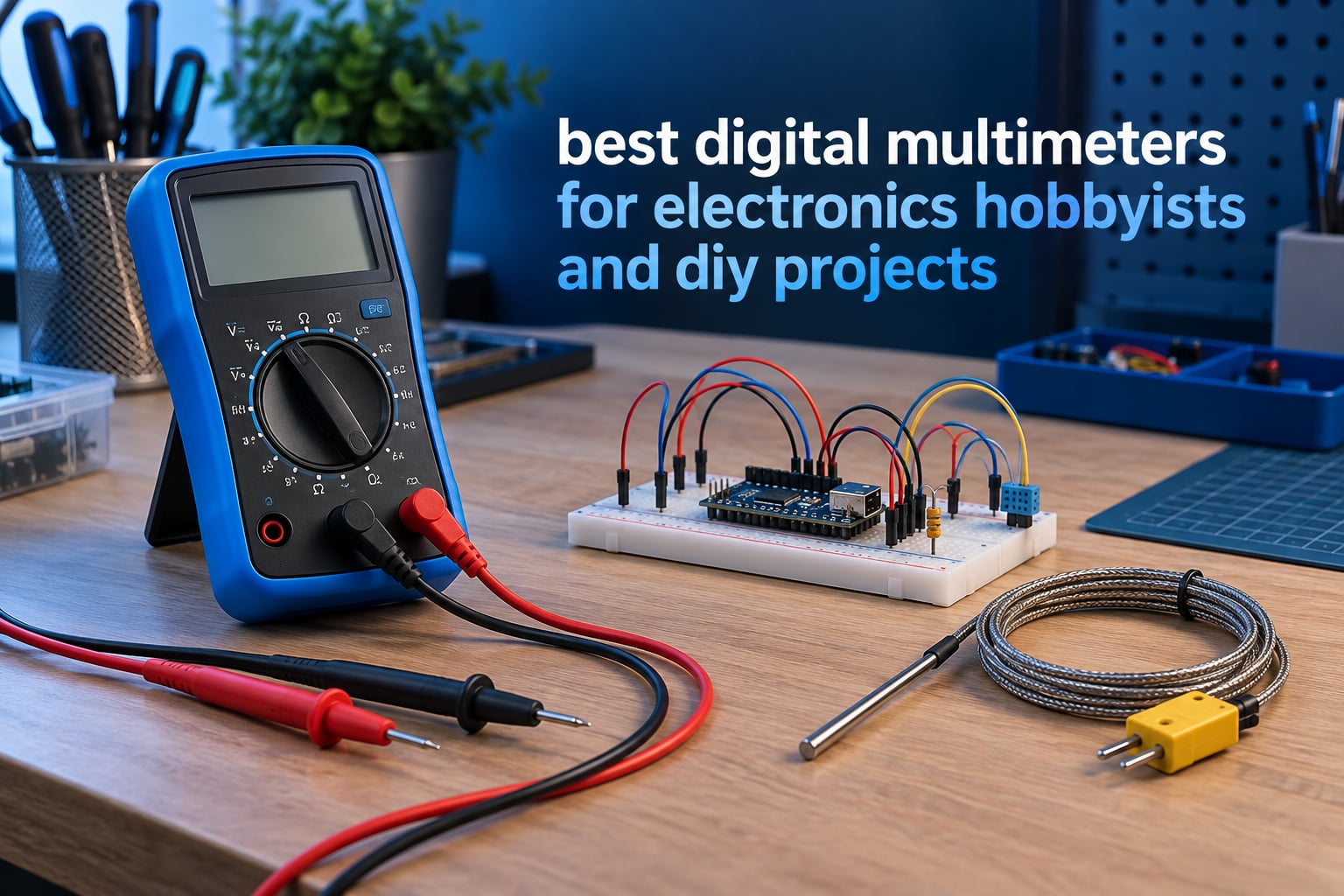
The best digital multimeters for electronics hobbyists are the ones rated CAT III 600V with at least 4000 counts, auto-ranging, and a real current measurement. Beyond that, the decision comes down to what you build: a breadboard Arduino needs continuity and diode test, a motor project needs true RMS, and a mains job needs non-contact voltage detection and a proper CAT rating.
I have put twelve meters through their paces at the bench and read the review data closely, and the spread is wider than the price gap suggests. A 2000-count meter covers a first year of hobby work. A 9999-count unit with a colour screen shows you ripple on a rail that a cheap meter hides completely.
What follows is the full list, ordered so the strongest all-round picks come first, plus the safety mistakes that blow fuses and the spec terms that actually change what you can measure. If you want a shorter read, jump to the beginner multimeter guide and come back here once you know your tier.
Table of Contents
- Top 3 Best Digital Multimeters For Electronics Hobbyists (October 2026)
- The Best Digital Multimeters at a Glance in 2026
- How We Picked These Meters?
- 1. AstroAI AM33D – Best First Meter for Hobbyist Work
- 2. KAIWEETS HT118A – Best for Automotive and 600V Work
- 3. AstroAI AST-6000-D – Best Value True RMS Meter
- 4. TESMEN TM-510 – Best for First-Time Users Who Hate Dials
- 5. Crenova MS8233D – Best for Capacitance and Component Work
- 6. INNOVA 3320 – Best for Battery and Vehicle Work
- 7. Klein Tools MM325 – Best Manual-Ranging Meter That Endures
- 8. FNIRSI DMT-99 – Best for Seeing Ripple and Transients
- 9. Klein Tools MM420 – Best Build Quality With Auto-Ranging
- 10. Fluke 117 – Best for Mains Work and Ghost Voltage
- 11. Fluke 17B+ – Best for Temperature and Higher Voltage Ranges
- 12. Extech EX330 – Best Compact Meter for Tight Spaces
- What Should You Not Do With a Multimeter?
- How to Choose a Digital Multimeter: Ranging, Counts, True RMS and CAT Ratings Explained?
- Frequently Asked Questions
- Conclusion: Which Digital Multimeter Should You Buy?
Top 3 Best Digital Multimeters For Electronics Hobbyists (October 2026)
The Best Digital Multimeters at a Glance in 2026
Every meter below is written up in detail further down. This table is the fast version.
| Product | Specifications | Action |
|---|---|---|
| AstroAI AM33D |
|
Check Latest Price |
 KAIWEETS HT118A KAIWEETS HT118A |
|
Check Latest Price |
 AstroAI AST-6000-D AstroAI AST-6000-D |
|
Check Latest Price |
 TESMEN TM-510 TESMEN TM-510 |
|
Check Latest Price |
 Crenova MS8233D Crenova MS8233D |
|
Check Latest Price |
 INNOVA 3320 INNOVA 3320 |
|
Check Latest Price |
 Klein Tools MM325 Klein Tools MM325 |
|
Check Latest Price |
 FNIRSI DMT-99 FNIRSI DMT-99 |
|
Check Latest Price |
 Klein Tools MM420 Klein Tools MM420 |
|
Check Latest Price |
 Fluke 117 Fluke 117 |
|
Check Latest Price |
 Fluke 17B+ Fluke 17B+ |
|
Check Latest Price |
 Extech EX330 Extech EX330 |
|
Check Latest Price |
How We Picked These Meters?
Review counts on this category are close to meaningless. The most-reviewed meter in this list is a 2000-count model that cannot measure AC current at all, and the least-reviewed has 9999 counts and a waveform display. Capability and review volume do not track each other.
So we ranked by job. Each pick was checked against what it actually measures, what its safety category permits, and what reviewers report after months of use rather than days. We also weighed the forum consensus that surfaces repeatedly in electronics communities, where the ANENG AN8008 and UNI-T UT61B are the names most often recommended as the value step-up, and where a Fluke 87V or 287 is the standard answer for the enthusiast tier.
One warning about this category: retailer listings contradict their own spec tables more often than not. Check the measurement count and the CAT rating in the technical details rather than trusting the product title.
1. AstroAI AM33D – Best First Meter for Hobbyist Work
AstroAI Digital Multimeter Tester 2000 Counts with DC AC Voltmeter and Ohm Volt Amp Meter; Measures Voltage, Current, Resistance, Continuity and Diode, Blue
2000-count auto-ranging
AC/DC voltage, DC current
Resistance, continuity, diode
Backlit LCD and data hold
Pros
- Backlit 3.5 digit LCD for dim benches
- Continuity buzzer plus diode test
- Double fuse anti-burn protection
- Silicone cover survives drops
- 3-year warranty with California-based support
Cons
- No AC current measurement
- AC voltage unreliable below 100mV
- 2000 counts is the lowest resolution here
This is the meter I hand to anyone starting out. It measures AC and DC voltage, DC current, resistance, continuity and diode forward voltage, and it auto-ranges so there is no dial guesswork to make while a board is half built.
On a breadboard it does the three jobs that matter most: confirming a 5V rail, checking a sensor output, and beeping through a broken solder joint. The continuity response is quick enough that I stopped double-checking readings on the breadboard.
The 2000-count display is the real limit. It resolves down to a few millivolts on the low range, which is fine for 3.3V and 5V logic but thin when you want to see a 50mV ripple figure on a switching regulator. Reach for a 6000-count unit when that matters.
Is it accurate enough for Arduino and ESP32 work?
Yes, for the 3.3V and 5V rails and sensor lines that dominate microcontroller work. The input impedance is high enough that probing a GPIO pin does not drag the line down, and the accuracy on DC voltage is well inside what a breadboard build can resolve.
What it will not tell you?
There is no AC current range, so motor and mains work is out of scope. AC voltage below 100mV is also unreliable, which rules it out for low-level signal work on audio or sensor analogue stages.
What I would spend the difference on?
A bench power supply and a pack of better test leads beat an expensive meter for a first build. Our signal generator picks cover the other side of the bench, where injected signals matter more than meter resolution.
2. KAIWEETS HT118A – Best for Automotive and 600V Work
KAIWEETS Digital Multimeter Automotive TRMS Tester 6000 Counts NCV for Car
6000-count true RMS
1000V DC, 750V AC, 10A
Temperature, capacitance, duty cycle
NCV live wire alarm
Pros
- 6000-count true RMS at a mid price
- NCV and live wire detection with audible alarm
- Measures AC and DC current up to 10A
- Min/max/average recording
- 36-month service with lifetime technical support
Cons
- Listed maximum operating voltage of 80V looks wrong
- Battery cap must be removed before probing
- 0.55 kg body is heavy in a tool bag
This one covers more ground than anything else in the budget half of the list. It measures up to 1000V DC and 750V AC, 10A of AC and DC current, 60 MOhms of resistance, and it adds temperature, capacitance, frequency and duty cycle.
For a car it is a genuinely complete tool. Alternator output, battery draw under load, and a starter circuit all sit inside the ranges, and the true RMS engine keeps AC readings honest on dimmed lighting circuits.
The CAT III 1000V and CAT IV 600V ratings are unusually high for the money, and the non-contact voltage mode gives both a light and a sound alarm. There is a flashlight on the back and a pen slot, which sounds minor until you are under a dash.
Is it safe near a vehicle or a consumer unit?
On the ratings, yes, and the included thermocouple extends it to temperature checks on cooling systems and exhaust components. The one blemish is a spec sheet that lists maximum operating voltage as 80V, which contradicts the 1000V DC figure everywhere else in the listing. Treat the printed manual as authoritative.
Where it gets in the way?
At 0.55 kg it is the heaviest meter here, and the battery compartment has a cap that reviewers say must come off before you can use the probes. Neither is a dealbreaker, but both are daily friction if the meter lives in a laptop bag.
Which projects should skip it?
It measures what most hobby benches need, so the honest answer is few. Skip it only if your work is SMD-level, where the lead thickness and the lack of a waveform view will slow you down more than the weight will.
3. AstroAI AST-6000-D – Best Value True RMS Meter
AstroAI Digital Multimeter, True RMS 6000 Counts Auto-Ranging Volt Meter for Automotive & Home Electrical Troubleshooting, AC/DC Voltage Current Resistance Continuity Capacitance Temperature Tester
True RMS 6000 counts
AC and DC voltage and current
Capacitance, frequency, temperature
Pros
- True RMS 6000 counts with the full function set
- Measures AC and DC current up to 10A
- Temperature probe and multi-function socket in the box
- Kickstand and backlit display for bench work
- 3-year warranty
Cons
- Frequency counter stops around 16MHz
- hFE transistor test runs at only 1V and 1mA
- Multi-function socket is C-B-E not B-C-E
This is the meter I recommend more often than any other. It combines 6000 counts with true RMS, and it measures AC current as well as DC, which removes the single most common flaw in cheap meters.
On a PWM or motor driver board the true RMS engine is the reason to buy it. An average-responding meter reads low on a chopped waveform, and you end up chasing a fault that is not there.
Resistance goes to 60 MOhms, capacitance and duty cycle are included, and the temperature probe plus a multi-function socket arrive in the box. Two ceramic fuses protect the current ranges, and the kickstand holds it upright on a bench while both hands stay on the probes.
Is the transistor socket any use?
Partly. It runs the hFE test at 1V and 1mA, which reads roughly half the gain of a typical small-signal transistor, so treat it as a pass or fail sorting tool rather than a gain measurement. The socket is also wired C-B-E, so check the pinout before inserting anything.
What breaks first in practice?
The backlight times out quickly, and the frequency counter tops out near 16MHz rather than the higher figure the title implies. If you are probing oscillator or switching signals above that range, look elsewhere. Test leads are also short, which is awkward inside a chassis.
How it compares to the Fluke tier?
On DC voltage and resistance the readings track a professional reference closely. The difference between this and a Fluke is not accuracy, it is fuse protection, build quality and the paperwork behind the safety rating.
4. TESMEN TM-510 – Best for First-Time Users Who Hate Dials
TM-510 Digital Multimeter, 4000 Counts, Smart Measurement, Auto-Ranging Voltmeter; Voltage Tester with Non-Contact Voltage Function, Measures AC/DC Voltage, Resistance, Continuity – Green
4000-count smart auto mode
AC/DC voltage, resistance, continuity
0.1 kg with backlight and torch
Pros
- Smart auto mode removes the range dial guesswork
- Only 0.1 kg so it lives in a laptop bag
- Backlight plus a flashlight on the back
- NCV alarm with light and sound
- Storage bag and AAA batteries included
Cons
- Measures no current at all
- No capacitance frequency or temperature
- Auto mode switches to resistance below 0.8V
The TM-510 does something none of the others do. Instead of a rotary switch, it auto-detects what you are measuring and picks the range for you, so a beginner cannot set the dial wrong and blame the meter.
It reads AC and DC voltage, resistance and continuity, and the 4000-count display has enough resolution for rail checks. At 0.1 kg it is by far the lightest meter in this roundup, and the backlight and torch make it usable in a dark cupboard or behind a panel.
The storage bag and a pair of AAA batteries are included, which is more than most of the field manages. Non-contact voltage detection gives both a visual and an audible alarm, and it carries a CAT II 600V rating, which is the correct category for household socket and appliance work.
What you give up for the smart mode?
It measures no current at all, and there is no capacitance, frequency or temperature. If you ever need to check draw from a USB power supply or a motor, this meter simply cannot answer the question.
Is the auto mode ever wrong?
Below 0.8V the auto mode can switch into resistance, which is the classic beginner confusion. Once you know that, you simply avoid probing very small signals with it. For everything above 0.8V it behaves predictably.
Is 4000 counts enough?
For 3.3V and 5V logic, yes. For millivolt-scale work on an analogue sensor front end, no. That is the ceiling of this meter, and it is a reasonable trade for the weight and the simplicity.
5. Crenova MS8233D – Best for Capacitance and Component Work
Crenova MS8233D Multimeter TRMS 6000 Counts Auto-Ranging Live Wire NCV
6000-count true RMS
AC and DC voltage and current
Capacitance, frequency, duty cycle, resistance
Pros
- True RMS 6000 counts with capacitance frequency and duty cycle
- Manual override if you want to pick the range
- Includes alligator clips as well as probes
- Carrying case and batteries in the box
- Max/min recording plus data hold
Cons
- Backlight cuts out after a few seconds
- Alligator clips are strong enough to nip small wire
- Buzzer beeps while you turn the dial
The MS8233D is the meter I reach for when the question is about a capacitor or a PWM duty cycle. It measures capacitance, frequency and duty cycle alongside true RMS voltage and AC and DC current, at 6000 counts.
Ranging is automatic with a manual override, which is rare at this end of the market. That override matters when you already know the value you expect and want to confirm it on a fixed range rather than watching the meter hunt.
Both probe leads and a set of alligator clips come in the box, along with a carrying case and the batteries. The clips are handy for a long logging session where you cannot hold probes steady, and NCV plus live wire detection handles quick checks on cable runs.
How good are the capacitance readings?
Good enough to sort a suspect electrolytic from a good one and to check a debounce capacitor. Do not expect lab accuracy on small film values, and probe in-circuit only if you have discharged the node first, or you will be reading the circuit around it.
What annoys owners?
The backlight cuts out after a few seconds and will not stay lit, so dim-bench work needs the overhead light. The alligator clips are stiff and strong enough to cut through thin hookup wire, and the buzzer chirps every time you turn the dial.
Does it handle a starter motor or an alternator?
It will read 10A AC and DC and has a CAT III 600V rating, so yes for most vehicle electrical checks. For anything above 600V, or for a clamp-only current measurement, this is not the tool.
6. INNOVA 3320 – Best for Battery and Vehicle Work
INNOVA 3320 Auto-Ranging Digital Multimeter, Red & Black
Auto-ranging with 10 MOhm input
Circuit-safe for vehicle ECUs
1.5V, 9V and 12V battery load test
Pros
- Battery load test is still the only one of its kind here
- 10 MOhm input impedance protects vehicle ECUs
- Color-coded LEDs show battery charge state
- Users report five-plus years of service
- One dial setting for AC and DC voltage
Cons
- No backlight on the display
- No data hold and no temperature
- AC current tops out at 200mA
- No carrying case included
Nobody else in this roundup does what the INNOVA 3320 does. Its battery test applies a real load to 1.5V, 9V and 12V cells and shows the result with colour-coded LEDs, which tells you whether a battery holds charge instead of merely reading full.
It is also the meter electronics communities keep recommending to beginners. On r/diyelectronics the recurring verdict is that the 3320 is accurate and simple to use, and that Klein Tools is a solid alternative whose CAT IV rating is more than a hobbyist needs.
The 10 MOhm input impedance is the detail that matters more than the price. It means probing a vehicle ECU or a modern logic line will not disturb the circuit you are measuring, which is where cheap analog-style meters cause real damage.
Is it still worth buying new?
Yes. The auto-ranging is fast, the voltage accuracy holds up against professional references on DC, and owners report five-plus year service lives. It is UL certified, and it has been in continuous production for years, which tells you something about the support behind it.
What you have to live without?
There is no backlight, no data hold, no temperature and no capacitance. AC current is limited to 200mA, so it is a voltage, resistance and current-in-DC meter rather than a general instrument. It also has no milliamp or microamp range, which hurts when you are chasing a sensor draw.
Is it right for a first Arduino project?
For continuity, resistance, diode and DC voltage, entirely. For capacitance or a reading in a low-current sensor line, no. Many hobbyists run this as a car and household meter and keep a second meter on the bench for fine work.
7. Klein Tools MM325 – Best Manual-Ranging Meter That Endures
Klein Tools MM325 Multimeter, Digital Manual-Ranging 600V AC/DC Voltage Tester, Tests Batteries, Current, Resistance, Diodes, and Continuity
Manual-ranging to 600V AC and DC
10A DC current, 2 MOhm resistance
Lead-Alert safety LEDs
Pros
- Lead-Alert LEDs warn you before the leads go in the wrong jack
- Drop tested to 6.6 feet with a rubber boot
- CAT III and CAT IV safety caps fitted to the leads
- Backlit display with a kickstand and lead holders
- Klein Tools build quality you can put in a service van
Cons
- Manual ranging only
- No AC current and no capacitance or temperature
- 2 MOhm resistance range is low for electronics
- Bulky in a small tool pouch
The MM325 is manual-ranging, and that is the point. With a dial you set the range yourself, so the meter never sits there showing OL while you work out why. It holds 600V AC and DC, 10A DC current and a 2 MOhm resistance range.
Its standout feature is Lead-Alert protection: LEDs tell you when the probes are in the wrong input jack. That single safeguard prevents the most common beginner error there is, and no other meter in this list has it.
The build is genuinely rugged, drop tested to 6.6 feet, with a kickstand, test lead holders and an optional magnetic hanger. The leads arrive with CAT III and CAT IV safety caps fitted, and the CAT III 600V rating is right for household circuits and automotive work.
Is manual ranging a problem for beginners?
Only if nobody tells you how it works. Set the dial to the quantity first, then pick a range above the value you expect. The mistake that confuses people is setting a range too low and seeing a meaningless overload reading, then assuming the circuit is wrong.
What it gives up against an auto-ranging meter?
There is no AC current range at all, and nothing beyond voltage, current, resistance, continuity, diode and battery test. The 2 MOhm resistance ceiling is the real electronics limitation, since high-value circuits and some sensors read above it.
Does it measure current for Arduino projects?
10A DC, in series, is enough for a USB load or a motor rail but far too coarse for a 20mA sensor. If your project needs milliamp readings, this is the wrong meter, and that is also the limitation Klein users mention most often.
8. FNIRSI DMT-99 – Best for Seeing Ripple and Transients
FNIRSI DMT-99 Digital Multimeter 9999 Counts TRMS, Rechargeable Volt Meter
9999-count true RMS
2.4 inch colour TFT with waveform view
USB-C rechargeable 1500mAh cell
Pros
- Graphic waveform view reveals ripple and transients
- Monitoring mode alarms on set thresholds
- USB-C rechargeable so no 9V battery
- 9999 counts resolves very small DC signals
- Ultra-fine leads reach SMD pads
Cons
- Over-sensitive near conductors
- Some functions sit behind menus
- Internal cell is not user replaceable
- Graph mode has no scroll-back
The DMT-99 is the only meter here that shows a waveform. Its 2.4 inch colour TFT can plot voltage or current against time, which turns a static number into evidence. A 40mV ripple spike that a fixed display rounds away is plainly visible on a trace.
At 9999 counts with true RMS, it also resolves small DC signals better than anything else here. For a 3.3V rail sag or a sensor reference, the extra digits are the difference between a guess and a measurement.
It is also USB-C rechargeable, so there is no 9V battery to forget, and monitoring mode will alarm you when a reading crosses a threshold you set. That is how you catch an intermittent fault on a long test without sitting and watching the screen.
Is it really for hobby work?
Yes, and it is arguably the most interesting tool in the roundup for power supply debugging. The ultra-fine leads are thin enough to touch an SMD pad without bridging a neighbouring component, which no other meter here manages.
What frustrates users?
It is over-sensitive, so probes near a conductor show fluctuating numbers that are really capacitive pickup. Some functions sit behind menus and take practice to find, the internal cell is not user replaceable, and the graph has no scroll-back after about 30 seconds.
Is the smaller review count a warning?
It is a newer brand with a shorter track record, and long-term durability is not yet proven. Mechanically it feels solid, and the review data across 1335 ratings is consistent, but treat it as a tool you will replace sooner than a Klein or a Fluke.
9. Klein Tools MM420 – Best Build Quality With Auto-Ranging
Klein Tools MM420 Digital Multimeter, Auto-Ranging TRMS Multimeter, 600V AC/DC Voltage, 10A AC/DC Current, 50 MOhms Resistance
Auto-ranging true RMS to 600V
10A AC/DC current, 50 MOhm resistance
Capacitance, temperature
Pros
- Auto-ranging true RMS from a trusted brand
- Measures AC and DC current at 10A
- 50 MOhm resistance suits high-value circuits
- Thermocouple included for temperature
- Lead-Alert LEDs and 6.6 foot drop rating
Cons
- Dial uses symbols only
- Capacitance readings run slightly off
- mA current readings about 5 percent out
- No case in the box
The MM420 is the MM325 idea rebuilt for people who want the range set for them. It auto-ranges, it measures true RMS, and it handles 10A of both AC and DC current, which the manual-ranging model does not.
Resistance goes to 50 MOhms, a big step up from 2 MOhms, and it adds capacitance, frequency, duty cycle and temperature with a thermocouple in the box. For a hobby bench that covers nearly everything short of a clamp measurement.
It keeps the family strengths: Lead-Alert LEDs, a rubber boot drop tested to 6.6 feet, lead holders, a kickstand, a backlit display, an optional magnetic hanger, and leads with CAT III and CAT IV caps fitted. The CAT III 600V rating is right for household and automotive work.
How does it read on fine measurements?
DC voltage and resistance are solid. Capacitance runs slightly high and the milliamp current readings are about five percent out, so treat those two as good for sorting rather than calibration. That is a fair trade for a meter that will survive being dropped in a van.
Is the interface a problem?
The dial uses symbols with no words, so there is a short learning curve for anyone who has not used a Klein. Once you know the layout, the position of each function is logical, and the safety indicators are worth learning first.
Is the small review count a problem?
It sits below the middle of this group, and reviewers are consistent rather than polarised. The accuracy complaints are specific and minor, which is the pattern you want from a model with a mature parent company behind it.
10. Fluke 117 – Best for Mains Work and Ghost Voltage
Fluke 117 Digital Multimeter, Non-Contact AC Voltage Detection, Measures Resistance/Continuity/Frequency/Capacitance/Min Max Average, Automatic AC/DC Selection, Low Impedance Mode
True RMS with AutoVolt AC/DC select
LoZ mode rejects ghost voltages
VoltAlert NCV detection
Pros
- LoZ mode kills the ghost voltage that confuses beginners
- VoltAlert finds live conductors without contact
- AutoVolt picks AC or DC for you
- 400-hour battery life without the backlight
- 3-year warranty and true RMS accuracy
Cons
- No milliamp or microamp ranges
- No temperature measurement
- Probes feel cheap for a meter in this class
- 10A only through a series connection
The Fluke 117 solves the two problems that make mains work nerve-wracking for beginners. LoZ mode puts a low impedance across the circuit, so a floating conductor that shows a phantom 120V on a normal meter reads as what it is: nothing.
VoltAlert gives an audible and visible alarm when a conductor is live, so you can find the feed before you touch anything. AutoVolt then picks AC or DC voltage on its own, which removes the classic dial mistake in the field.
The true RMS engine is accurate on non-linear loads, the DC millivolt range resolves to 0.1mV, and the CAT III 600V rating covers household circuits. Battery life is 400 hours without the backlight, and the warranty runs three years.
Is it worth the jump in price for hobby work?
Only if you touch mains or you are chasing millivolt signals. On a bench limited to 5V and 3.3V rails, a good budget meter reads the same value. The LoZ mode and VoltAlert are what your money buys, and neither has a budget equivalent.
What it cannot do?
There are no milliamp or microamp ranges, which many sensor projects need, and no temperature measurement. There is no clamp, so measuring a conductor means breaking the circuit and putting the meter in series, which is awkward in a consumer unit.
Do the supplied probes hold up?
They are the weakest part of the package and reviewers say so consistently. Many electricians pair the 117 with a separate tester or clamp meter for that reason, which is also why our premium multimeter guide covers it in more depth.
11. Fluke 17B+ – Best for Temperature and Higher Voltage Ranges
Fluke 17B+ Digital Multimeter, for Electrical Applications, Measures AC/DC Voltage 1000V, Current Measurements to 10A, Resistance, Continuity, Diode, Capacitance, Frequency, and Temperature Testing
1000V AC and DC voltage
10A current plus resistance and capacitance
Type K thermocouple to 400C
Pros
- K-type thermocouple to 400C in the box
- 1000V AC and DC range
- Protective case and TL75 leads included
- Reads like the higher Fluke models
- Large display with big digits
Cons
- No LoZ mode like the 117
- Test leads are stiff rubber that kinks
- Button beeps cannot be muted
- No milliamp or microamp ranges
The 17B+ is the Fluke for anyone who needs temperature. The K-type thermocouple in the box reads to 400C, and combined with a 1000V AC and DC range it covers bench electronics, motor drives and heat checks without a second instrument.
It measures 10A current, resistance, continuity, capacitance, frequency and diode, and the readings sit close to the higher Fluke models on DC voltage and resistance. For a hobbyist that is genuinely professional-grade measurement.
A protective case comes in the box along with TL75 test leads, which matters more than it sounds when a meter lives in a bag next to solder tins. The display uses large digits and reads well at arm’s length.
Should you buy this or the 117?
Buy the 17B+ if you measure heat or need the 1000V range. Buy the 117 if you work around mains and want LoZ and VoltAlert. They are built for different jobs, and the 17B+ gives up the ghost voltage protection and non-contact detection.
What to watch out for?
The supplied leads are hard rubber that stays bent and kinked, and the button beep cannot be switched off, which is irritating in a quiet room. It also lacks milliamp and microamp ranges, so sensor current work still needs another meter.
Is there a catch with the accuracy?
Reviewers report readings that match higher Fluke models, so the accuracy claim holds up. The listed warranty length is vague and packaging is minimal, so keep the receipt and check the coverage terms with the vendor before you rely on it.
12. Extech EX330 – Best Compact Meter for Tight Spaces
Extech EX330 Autoranging Mini Multimeter, 12-Function, NCV, Type K
12-function auto-ranging
AC/DC voltage, current, resistance
Capacitance, Type K temperature
Pros
- Compact body fits tight panels and enclosures
- Type K probe included in the box
- NCV with a red LED and a beeper
- Rubber holster doubles as a tilt stand
- UL listed with a 1-year warranty
Cons
- 4000 counts is modest for the money
- No backlight and no data hold
- Mini body is cramped for large hands
- 1-year warranty is the shortest here
The EX330 exists for the jobs where a full-size meter will not fit. At 5.7 by 1.6 by 2.9 inches it goes into a control cabinet or behind a wall plate where nothing else will, and the rubber holster with its integrated tilt stand keeps it usable in that position.
Twelve auto-ranging functions cover AC and DC voltage and current, resistance, capacitance, frequency and Type K temperature, and the probe is in the box. Non-contact voltage detection gives a red LED and a beeper.
The 4000-count display uses digits about an inch tall, which is genuinely readable in a badly lit panel. UL listed construction matters here, because this is the meter most likely to end up near mains wiring.
Is it accurate enough for a workbench?
For voltage, current and resistance, yes. It is not the meter I would use to measure a 5V rail sag to two decimal places, since 4000 counts and the lack of a data hold make that awkward. For sorting and service work, it is more than adequate.
What are the trade-offs?
There is no backlight, so dim conditions rely on the room lighting. The mini body is cramped with large hands, and the one-year parts and labour warranty is the shortest coverage in this roundup.
Is it worth it over a budget meter?
If you work in confined spaces, absolutely. If you sit at a bench with room to move, the resolution and the missing backlight make a better general-purpose meter a smarter spend. Buy it for access, not for accuracy.
What Should You Not Do With a Multimeter?
Most blown fuses and damaged boards come from a short list of mistakes, and every one of them is avoidable. This is the list I give to anyone I hand a meter to.
Never measure current across a battery or power source. Current measurement means breaking the circuit and putting the meter in series. Bridge the probes across a source and you are shorting it through the fuse.
Check the input jack before you probe. The leads must be in the V and the correct current socket. The Klein MM325 and MM420 both have Lead-Alert LEDs for this reason.
Never measure resistance or continuity on a live circuit. Your own meter voltage appears as a reading, and on a powered board you can damage the meter or the circuit.
Do not exceed the CAT rating for the location. The number states the transient the meter survives, not a rough guideline. A CAT III meter is not a CAT IV meter with a bigger sticker.
Switch leads out of the current socket between measurements. A lead left in the 10A jack while you measure voltage is how meters get destroyed.
Do not touch exposed metal on probes near mains. Fingerprints and sweat on the probe tip reduce insulation and are a real shock path.
Do not assume a reading is a ground truth. A ghost voltage is a capacitive artefact, not a live conductor. LoZ mode exists to expose it.
Do not measure 10A continuously. Most meters are rated for short bursts only. Sustained 10A overheats the shunt and the fuse.
Do not use a meter with a cracked case or nicked leads. The insulation is the only thing between you and the circuit.
How to Choose a Digital Multimeter: Ranging, Counts, True RMS and CAT Ratings Explained?
Auto-ranging picks the range for you from the input voltage, which removes the single biggest source of beginner frustration. Manual ranging asks you to set a range above the value you expect, and it never guesses wrong. Set a range too low and you get an overload reading that means nothing.
Forum users are near-universal on this point. If you are picking your first meter, take the auto-ranging one unless you specifically want to learn ranges deliberately.
What display count actually means?
The count tells you how finely the meter resolves a reading. A 2000-count meter shows up to 1999 units, a 4000-count shows 3999, a 6000-count shows 5999, and the FNIRSI reaches 9999. On a 3.3V rail with a 2000-count meter, the finest step is roughly 1mV. That is fine for logic levels and useless for ripple work.
Ranking by review count instead of resolution is the trap this category sets. The most-reviewed meter here has the lowest count in the group and cannot measure AC current.
True RMS versus average responding
True RMS calculates the real root mean square of an AC waveform. Average-responding meters assume a clean sine wave and read low on anything chopped, which is exactly what a PWM signal, a dimmer, or a motor drive is. If your projects are DC only, true RMS buys you little.
CAT ratings in plain English
The category tells you where you are allowed to probe, based on the transient energy a fault upstream could deliver. CAT II covers plug-in sockets and appliance circuits. CAT III covers the consumer unit and everything downstream of it, which is the minimum for household work. CAT IV covers the service entrance and overhead lines, where the fault current is far higher.
For hobbyist bench work, CAT II or CAT III is enough, which matches the recurring advice on electronics forums that a CAT IV rating is more than most hobbyists need. If you touch consumer units, CAT III 600V is the floor, not a target.
Non-contact voltage detection and input impedance
NCV finds an energised conductor through insulation. It is a screening tool, not a measurement, and a negative result proves nothing, so confirm with a proper two-pole check before touching anything.
Input impedance is the number most hobbyists never think about. A meter with 10 MOhm of input barely loads a circuit, so probing a GPIO pin does not change what the pin is doing. This is the single technical reason a cheap modern DMM is safe on a microcontroller board, and our hobbyist and professional roundup goes deeper on it.
What a hobbyist can safely skip?
You do not need milliamps and microamps unless you are chasing a sensor’s supply current. You do not need a clamp, data logging or a thermocouple until temperature work arrives. You do not need CAT IV. Prioritise in this order: a correct CAT rating, accurate DC voltage, continuity, diode test, then everything else.
The two-meter strategy
Almost nobody buys the meter they will still be using in five years. The community pattern is a capable budget meter first, and a Fluke or a high-end Klein later, once the work justifies it. On electronics forums the enthusiast tier is consistently the Fluke 87V or 287, and the value step-up is the ANENG AN8008 or a UNI-T UT61B. Budget the second meter for when a job actually demands it.
Frequently Asked Questions
What is the best multimeter for DIY projects?
The AstroAI AM33D is the strongest all-round first meter in this roundup: auto-ranging, a backlit display, continuity and diode test, and double fuse protection at the entry point of the market. For projects that involve current measurement or capacitance, step up to the AstroAI AST-6000-D, which adds true RMS and AC current. For anything near household wiring, choose a CAT III 600V model such as the Fluke 117 or Klein MM420.
Is a Fluke or Klein multimeter better?
Klein gives you more measurement features per unit of money: AC and DC current, capacitance, frequency, duty cycle, a thermocouple and Lead-Alert safety LEDs, backed by a 6.6 foot drop rating. Fluke concentrates on accuracy, build quality, a three-year warranty and safety features that budget brands omit, including LoZ ghost voltage rejection and VoltAlert non-contact detection. Electricians tend to end up with Fluke, while technicians and serious hobbyists often choose Klein.
What should you not do with a multimeter?
Never measure current across a battery or power source, because current measurement requires the meter in series and bridging the probes shorts the source. Do not measure resistance or continuity on a live circuit. Confirm the leads are in the V socket and the correct current socket before probing, and never exceed the CAT rating for the location where you are working.
Do I need a true RMS meter for electronics?
Only if your circuits carry non-sinusoidal AC. Average-responding meters read low on chopped waveforms such as PWM signals, dimmers and motor drive outputs. If you only work on 3.3V and 5V DC rails, a standard meter reads the same value as a true RMS model and you can spend the money on a higher display count or better test leads instead.
What does CAT III mean on a multimeter?
CAT III means the meter is rated for measurements at the consumer unit and on circuits downstream of it, where a fault can draw a high transient current through installed wiring. CAT II covers plug-in sockets and appliance circuits, while CAT IV covers the service entrance and overhead lines. For household work, CAT III 600V is the sensible minimum. On a bench limited to low-voltage electronics, CAT II is enough.
Conclusion: Which Digital Multimeter Should You Buy?
The AstroAI AM33D is our editor’s choice and the best digital multimeter for electronics hobbyists who are starting out, because it covers every routine bench task and has the longest service life of its price tier. Add the AstroAI AST-6000-D when you need AC current, capacitance and true RMS, and the Fluke 117 the day you start opening consumer units.
Budget a bench power supply and proper test leads before you budget a second expensive meter, and check the safety section above before your first live measurement. Whatever you choose in 2026, buy by the job you are doing rather than by the review count on the listing.