
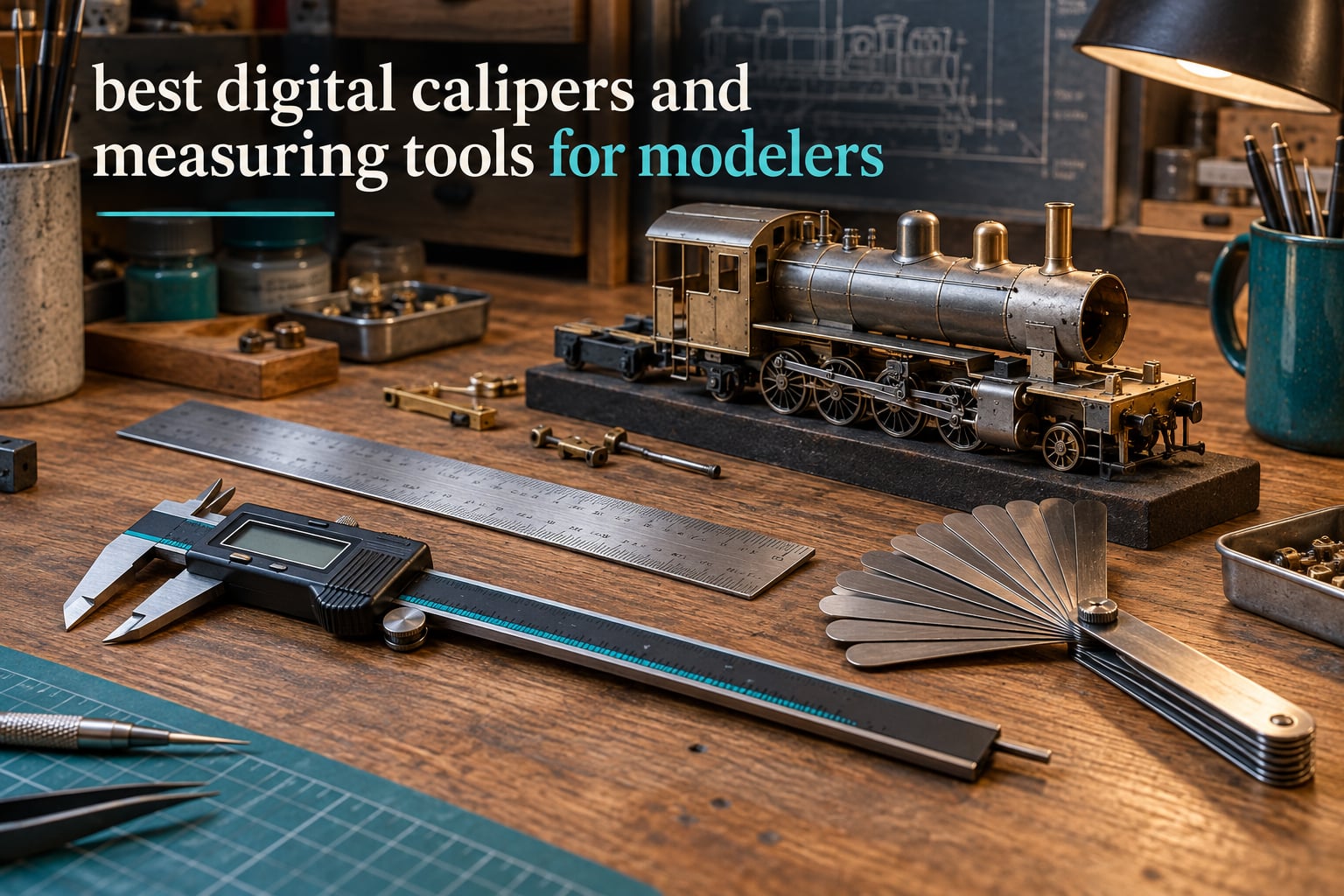
Most modelers buy their first caliper for one reason: the part they built does not fit the part they wanted it to fit. A 0.03 inch gap between a scratch-built wheel hub and a resin tire looks like nothing and feels like a fault line. A caliper turns that guess into a number you can act on. This is my guide to the best digital calipers and measuring tools for modelers, built around the measurements that actually come up on a hobby bench rather than around a machine shop catalogue.
I have spent a lot of hours with calipers on a modeling bench, and the pattern is consistent. The measurements that matter are panel line spacing on a 1:35 locomotive, sprocket and track width on a 1:48 armored kit, clearance on an FDM or resin print, the diameter of a turned aluminium barrel, and the width of a strip of scribed brass. Tool choice decides how comfortably you take those readings and how much you trust them. If you want a wider bench foundation, our guide to the best machinist measuring tool sets covers the cases a caliper cannot reach.
What a digital caliper actually is: a precision measuring tool with sliding jaws and an LCD readout that measures outside dimensions, inside dimensions, depth, and step, in inches, millimeters, and often fractional inches, at a resolution of about 0.01 mm (0.0005 inch). The readout comes from a capacitive sensor that tracks the moving jaw along the beam, and the zero-set function lets you lock a reference and measure the difference from it. That difference mode is the feature modelers use most, because copying a real part means measuring a delta rather than a number.
Selection here was based on published accuracy and resolution figures, frame material, readout modes, and the substance of owner feedback about holding zero, jaw wear, and readability. I also weighted how a tool behaves on a paint-splattered hobby bench rather than in a clean inspection room. Every pick below has an honest weakness listed, because a tool that fits every job perfectly does not exist and a list without drawbacks is just advertising. This roundup was last checked in October 2026.
Table of Contents
- Top 3 Best Digital Calipers for Modelers in 2026
- Best Digital Calipers and Measuring Tools for Modelers in 2026
- 1. iGaging IP54 Digital Caliper – The Accuracy Pick for Tired Eyes
- 2. Kynup 301-2 Digital Caliper – Most Reviewed Steel Body Here
- 3. Jiavarry 20-F Digital Caliper – The Value Steel Caliper
- 4. Adoric 0-6 Inch Digital Caliper – The Display Giant
- 5. HARDELL Rechargeable 6 Inch Digital Caliper – The Backlit All-Metal Pick
- 6. Werka 0-6 Inch Digital Caliper – Thumb Roller and Lock Screw
- 7. Esydon Composite Caliper – Non-Marring Jaws for Finished Models
- 8. SCITOOLS 0-4 Inch Mini Caliper – Compact Body for Tiny Parts
- 9. Mitutoyo 182-207 Steel Rule – The Accuracy Benchmark
- 10. Mr. Pen 4-Pack Machinist Rulers – Four Lengths on One Bench
- 11. General Tools 616 Straight Edge – Four Scales in Six Inches
- 12. PEC Tools 5R Machinist Rule – Deep Etched, US Made
- How to Choose a Digital Caliper for Scale Modeling
- Beyond Calipers: The Other Measuring Tools a Modeler Needs
- Digital vs Dial vs Vernier for Scale Modeling
- How to Verify and Calibrate a Caliper on the Modeling Bench
- Frequently Asked Questions
- Which digital caliper is the best for accurate measurements?
- What is the difference between resolution and accuracy?
- What accuracy do I need for scale modeling?
- Do I need a micrometer as well as calipers?
- How do I stop my digital caliper losing its zero?
- Is Starrett better than Mitutoyo?
- Are entry-level calipers accurate enough for modeling?
- Should I choose a fraction or decimal readout caliper?
- Conclusion: The Caliper Set That Earns Its Bench Space
Top 3 Best Digital Calipers for Modelers in 2026
Best Digital Calipers and Measuring Tools for Modelers in 2026
| Product | Specifications | Action |
|---|---|---|
| iGaging IP54 Digital Caliper 0-6 inch |
|
Check Latest Price |
 Kynup 301-2 Digital Caliper 0-6 inch Kynup 301-2 Digital Caliper 0-6 inch |
|
Check Latest Price |
 Jiavarry 20-F Digital Caliper 0-6 inch Jiavarry 20-F Digital Caliper 0-6 inch |
|
Check Latest Price |
 Adoric Digital Caliper 0-6 inch Adoric Digital Caliper 0-6 inch |
|
Check Latest Price |
 HARDELL Rechargeable 6 inch Digital Caliper HARDELL Rechargeable 6 inch Digital Caliper |
|
Check Latest Price |
 werka Digital Caliper 0-6 inch Stainless Steel werka Digital Caliper 0-6 inch Stainless Steel |
|
Check Latest Price |
 Esydon Composite Digital Caliper 0-6 inch Esydon Composite Digital Caliper 0-6 inch |
|
Check Latest Price |
 SCITOOLS Mini Digital Caliper 0-4 inch SCITOOLS Mini Digital Caliper 0-4 inch |
|
Check Latest Price |
 Mitutoyo 182-207 Steel Rule 6 inch Mitutoyo 182-207 Steel Rule 6 inch |
|
Check Latest Price |
 Mr. Pen 4-Pack Machinist Rulers Mr. Pen 4-Pack Machinist Rulers |
|
Check Latest Price |
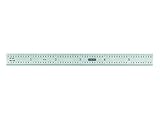 General Tools 616 Flexible Steel Rule 6 inch General Tools 616 Flexible Steel Rule 6 inch |
|
Check Latest Price |
 PEC Tools 5R Machinist Rule 6 inch PEC Tools 5R Machinist Rule 6 inch |
|
Check Latest Price |
1. iGaging IP54 Digital Caliper – The Accuracy Pick for Tired Eyes
iGaging IP54 Electronic Digital Caliper 0-6″ Display Inch/Metric/Fractions Stainless Steel Body
0-6 in range
0.001 in accuracy
0.0005 in repeatability
1/128 in resolution
IP54 sealed
Pros
- Super large high-contrast LCD
- Well-machined hardened steel with zero play
- Verified against a Mitutoyo Digimatic head
- Returns to zero reliably
- Two batteries and rigid foam case included
Cons
- Thumb wheel has some play
- Battery compartment fiddly to open
- Fraction readout awkward for everyday rounding
This is the caliper I hand to anyone who has ever squinted at a display across the bench. The 2-3/8 by 7/8 inch screen is not a marketing number, it is a genuine difference in a hobby where the light is whatever the window throws and the posture is bent over a 1:48 tank. Accuracy is quoted at 0.001 inch with 0.0005 inch repeatability, and owners report checking it head to head against a Mitutoyo Digimatic with matching results.
The frame is hardened stainless steel with a precision lapped finish, and the jaws close with no light gap on the reference units. It comes with two CR2032 cells, spare screws, and a rigid case with a foam insert, which matters more than it sounds when the caliper lives in a drawer between painting sessions rather than on a shop bench.
That IP54 seal is the quiet hero. It means splash, oil, and dust resistance, so a bench with thinner, superglue, and a little pigment dust going airborne is not a problem. On geekhack.org, users specifically single out the iGaging IP54 as a reliable general-use buy, noting it is not quite Mitutoyo quality but represents a strong value, which matches exactly how it performs for me.
The one feature that could matter more to you: this caliper carries inch, metric, and fraction readout to 1/128 inch, so imperial-scale modelers can work in the fractions a kit manual actually uses instead of converting.
Reading It with Tired Eyes
After 30 years of tiny lettering and thinner model paint, the oversized display is the feature I notice first in the morning. Digits are high contrast with no backlight, which is a fair trade because the digits are large enough to read at an angle without any light boost at all. It also works in direct bench light, which is where most small displays wash out.
The four measurement modes cover outside, inside, depth, and step, so the same tool handles a bore measurement and a step height on a scratch-built hull side without a second instrument.
Where the iGaging Frustrates
The battery tray is the recurring complaint from owners. It is fiddly to open and the contact tab is easy to strip, which is genuinely annoying when you are re-zeroing in the middle of a session. The thumb wheel also has a little play in it, so if you are chasing a difference reading under 0.0005 inch, take the reading twice and compare.
Fraction readout to 64ths is awkward for everyday rounding too. If you mostly work in decimals, the fraction mode is a distraction, though you can simply leave it switched off.
2. Kynup 301-2 Digital Caliper – Most Reviewed Steel Body Here
Kynup Digital Caliper Measuring Tool, Dial Caliper with Large LCD Screen
0-6 in / 150 mm
0.0005 in / 0.01 mm resolution
Stainless steel
Lock screws
Inch mm and fraction
Pros
- Stainless steel body with jaw locking screws
- Large high-contrast LCD readable in sunlight
- Inch millimeter and fraction conversion
- Splash-proof anti-rust finish
- Case screwdriver and spare batteries included
Cons
- No backlight for very dim conditions
- Some units read outside the stated accuracy
With 11k-plus reviews, the Kynup 301-2 is the most widely owned steel-body caliper in this roundup, and that review volume is itself useful information. It is the model I have seen on more hobby benches than any other here, usually with the case and the small screwdriver still in the box.
What sets it apart from the plastic crowd is the pair of jaw locking screws. Clamp the jaws on a part, let go of the beam, and the reading stays where it was, which is exactly the behavior you want when you are matching a wheel diameter or holding a measurement while you mark a scribing line.
Resolution is 0.0005 inch and 0.01 mm, with inch, millimeter, and fraction conversion across four measuring ways. The stainless steel body is splash-proof and anti-rust, which is the right answer for a bench where a spilled thinner is a Tuesday.
Fraction Readout on a Real Build
Fraction mode is the underrated part. When a 1:32 locomotive manual calls for a 3/32 inch clearance, a caliper that shows you 0.094 does not save you a conversion, it just gives you a number to translate. A fractional readout puts the value straight into the language of the manual.
The included case, two spare batteries, and a screwdriver matter more than they look like they should. Replacing a cell is the most common repair on any digital caliper, and having the driver in the box means you do not strip the battery cover with pliers.
Reasons to Skip It
There is no backlight, so dim-lamp work means angling the caliper toward the light. Some units also read outside the stated accuracy, which is a known risk on any unbranded steel caliper in this class rather than a specific flaw here, so verify on arrival.
The one-year after-sales service is thinner than the support you get from a specialist instrument maker. If your work drifts into real precision, this is not the last caliper you will buy.
3. Jiavarry 20-F Digital Caliper – The Value Steel Caliper
Digital Caliper Measuring Tool, Stainless Steel Vernier Caliper Digital Micrometer with Large LCD Screen, Easy Switch from Inch Metric Fraction, 6 Inch Caliper Tool for DIY/Household
0-6 in / 150 mm
0.0005 in / 0.01 mm resolution
Hardened steel
Fractions to 1/128 in
Pros
- Heavy hardened steel that holds zero
- Measured accurate against gage blocks
- Thumb wheel and set screw for fine adjustment
- Switches cleanly between mm decimal inch and fractions
- Case spare batteries and screwdriver included
Cons
- Sharp unsanded edges can scratch work
- Adjustment roller can be loose and wobbly
- No display backlight
- Housing cover does not seat perfectly
The Jiavarry 20-F is the pick I recommend to modelers moving up from a plastic caliper who do not want to move up in price as much. Owners report repeatable readings within 0.001 inch checked against Starrett gage blocks, and the glide action is the smooth, weighted feel you get from a genuinely hardened frame.
It reads fractions down to 1/128 inch, and the zero reset supports differential measurement, which is the mode that matters for copying a real component. Stainless steel, four measurement modes, a depth probe, and a thumb wheel plus set screw cover the mechanics of the job properly.
Owners consistently call out the solid weight as the reason readings hold. A heavy frame does not flex when you close the jaws on a small part, and flex is the main reason cheap calipers produce readings that change every time you let go.
The waterproof and dirt-proof finish is a real benefit in a hobby space. Paint dust, sanding residue, and a thin film of humidity do not get into the mechanism the way they do with an open plastic body.
Transfer-Measuring a Real Part
Here is how I use it most, and it is not reading a number. Close the outside jaws on the real component, press zero, then open and place the jaws on the scratch-built part. The display shows the difference directly. Modelers on modeling forums describe this transfer approach as more common than taking a straight digital reading, and I agree completely.
You can also reverse it: set the jaws to the real part, read the number, then close them on your part to see the error. Either way, the fraction mode lets you note the delta in the same units as the manual.
Finish and Fit Issues
Sharp unsanded edges are the most common complaint, and they are worth taking seriously. These jaws can scratch a painted or decaled surface, so file the edges lightly before the first measurement on a finished model. The adjustment roller can feel loose and wobbly on some units, and the electronics housing cover does not seat perfectly, which is cosmetic rather than functional.
The molded case is thin and its latches can snap. It still protects the caliper in a drawer, just do not drop the case.
4. Adoric 0-6 Inch Digital Caliper – The Display Giant
Digital Caliper, Adoric Calipers 0-6 Inch, Inch/mm Conversion, Large LCD
0-6 in / 0-150 mm
0.01 in / 0.1 mm resolution
Plastic frame
Four modes
Large LCD
Pros
- Very large easy-to-read LCD
- Four modes including depth and step
- Accurate for printed parts and woodworking
- Spare LR44 coin cell included
- Lightweight and portable
Cons
- Plastic body flexes and drifts off zero
- No lock-down screw or fine thumb wheel
- Rough edges can scratch the workpiece
- Plus or minus 0.2 mm is coarse for precision work
With more than 38k reviews, the Adoric is the most proven tool in the roundup, and for a lot of modelers it is the first caliper they ever own. The reason is simple: the digits are enormous and it weighs almost nothing. At 0.07 kg you can hold it in one hand over a delicate part and still keep your other hand steady.
Range is 0-6 inch and 0-150 mm with 0.01 inch and 0.1 mm resolution, plus inch and millimeter conversion, a zero-set function, and four modes covering inside, outside, depth, and step. The LCD auto-offs after five minutes, and a spare LR44 coin cell is included.
Owners treat it as a general-purpose hobby caliper, and that is an accurate description. For 3D printing fit checks, laser-cut parts, and woodwork, the accuracy is enough, and the review volume means you will find hundreds of accounts of how it behaves over months.
For a fit check on a printed part, close the jaws until they just touch and read. If you need half a millimeter of clearance for a resin part that tends to run tight, zero on a known gap and compare. That is the level of work this caliper handles well.
Why the Big Digits Win
Reading a display is a skill that gets harder with age and worse in poor light. A screen this large removes the guesswork entirely, which means fewer misread numbers feeding into a sanding or fitting decision. For a hobbyist measuring a 0.4 inch barrel or a 3 mm stanchion, clarity beats resolution.
It also becomes a slide rule. When the battery is flat, the printed millimeter and inch scale along the beam still gives you a rough reading, which is more useful than a dead screen.
What Plastic Costs You
The plastic body flexes, and owners report it drifting off zero over time, especially if you press on the jaws hard or knock it. There is no lock-down screw and no fine thumb wheel, so the reading is only as good as the pressure of your hand.
Accuracy of plus or minus 0.2 mm is the real ceiling. That is fine for printed fit checks and coarse layout, and it is too coarse for anything where you need a repeatable difference under a few thousandths. Treat it as a second, forgiving tool rather than the instrument you trust for precision.
5. HARDELL Rechargeable 6 Inch Digital Caliper – The Backlit All-Metal Pick
HARDELL Digital Caliper 6 Inch, Rechargeable All Metal W/Backlight Screen
0-6 in / 150 mm
0.001 in accuracy
Rechargeable USB-C battery
Backlit LCD
All metal body
Pros
- Backlit LCD useful in dark shops and night work
- Rechargeable battery eliminates coin-cell replacements
- Heavy all-metal build that slides smoothly
- Does not re-zero when it powers off
- Custom-fit hard case and metal ruler included
Cons
- Cannot swap a fresh battery when flat
- Bulky beside a 6 inch plastic caliper
- Thumb wheel edges could be beveled
- Case has no slot for the included ruler
The HARDELL solves a problem the other picks here do not: dim light. The backlit LCD has a dedicated light button and the light auto-offs after five seconds, so you can check a measurement in a dark room or under a task lamp without turning on the bench light and blowing out your night vision.
The second headline feature is the rechargeable battery. A two-minute quick charge gives roughly four months of use, and because the caliper does not re-zero when it powers off, your reference setting survives a flat battery. Owners consistently call this the only caliper they own that holds its reference through a power cycle.
Accuracy is plus or minus 0.001 inch with 0.0005 inch resolution, and the all-metal body is described as resistant to magnetic interference, which matters if you build electronics into a model. Inch, millimeter, and fraction conversion plus four modes round out a full spec sheet.
The hard custom-fit case and the included metal ruler are a nice pairing for layout work. A CNC shop owner reported the readings came close to a micrometer, and at this specification I have no reason to doubt that.
It also has a one-year warranty, which is a little thin but better than nothing when electronics are involved.
Backlight and Battery Life
Four months per charge changes the habit loop. With coin cells you either keep spares or you suffer a dead caliper mid-build. With a rechargeable you plug it in when you notice the light dimming, which is when you are already at the bench.
The display is large and high contrast, and combined with the backlight it is the most readable combination in this roundup, especially in the evening when most modeling actually happens.
The Rechargeable Trade-Off
There is no way to fit a fresh coin cell if it goes flat, so a dead caliper means a wait for USB power. For a hobbyist with a laptop on the same bench that is nothing. For someone with one caliper and a long trip to a workbench it is a real inconvenience.
The body is bulkier than a plastic 6 inch caliper, the thumb wheel edges could have been beveled for comfort, and the case has no slot for the bundled metal ruler so it rattles loose inside.
6. Werka 0-6 Inch Digital Caliper – Thumb Roller and Lock Screw
Werka Digital Caliper 0-6 Inch, Stainless Steel Measuring Tool
0-6 in / 150 mm
0.001 in accuracy
Stainless steel frame
Thumb roller and lock screw
Large LCD
Pros
- Thumb roller and locking screw give stable repeats
- Quick switching between inch fraction and millimeter
- Large easy-to-read display reduces reading errors
- Protective hard case with sponge insert
- Strongest rating mix in the roundup
Cons
- Uses replaceable batteries rather than a rechargeable cell
- 6 inch range only
- No display backlight
The werka is built around repeatability. The combination of a thumb roller for fine adjustment and a locking screw means you can set a reading, lock it, and come back to it later in the session without losing the number. When you are measuring a stack of ten identical stanchions that is the difference between fast and tedious.
Owners report 85 percent five-star ratings, which is the strongest rating mix among these picks, with accuracy quoted at 0.001 inch over a 0-6 inch and 150 mm range. Inside, outside, depth, and step measurement are all supported.
Conversion between inch, fractional inch, and millimeter is quick, which matters when you are switching between a metric kit and an imperial instruction sheet mid-build. The large LCD auto-offs and gives a low battery warning before it dies.
The hard plastic case with a sponge insert is the most protective storage in the roundup, and a caliper that lives in a proper case is a caliper that stays accurate. Loose calipers pick up paint and take knocks in a drawer.
I also like that it is a straightforward replaceable-cell design. No charging cable, no firmware, no app, just two LR44 cells included and away you go.
Repeatability You Can Feel
Repeatability is the honest benchmark on a hobby bench. A caliper can be accurate in a controlled setting and useless if the reading changes each time you release the jaws. The lock screw removes that variable entirely for anything you need to check twice.
For a kit with twenty identical detail parts, the workflow is simple: measure one, lock the reading, compare each part against it, and flag anything that does not match. Nothing else in the low-cost category makes that quite as painless.
The Limits of 6 Inches
Everything here is 6 inch and 150 mm. That covers locomotives, tanks, aircraft, and most small detail work, but a large ship hull, a diorama, or a long scratch-built airframe will simply not fit between the jaws.
There is no backlight, and the replaceable battery means you will eventually need a fresh cell. The 495-review count is the smallest in the top half of this list, so long-term data is thinner here than on the picks with tens of thousands of reviews.
7. Esydon Composite Caliper – Non-Marring Jaws for Finished Models
Digital Caliper, Esydon Upgraded Calipers 6 inch, Measuring Tool, Electronic Ruler, with Large LCD Screen, Auto-Off Feature, Inch and Millimeter Conversion, Plastic Case, Perfect for Household, DIY
0-6 in / 0-150 mm
Four modes
Non-marring composite jaws
Slide rule usable when flat
Pros
- Non-marring plastic jaws safe for models and watches
- Consistently accurate for printed parts and household measuring
- Very large easy-to-read digits
- Slide ruler still usable if the battery dies
- Case three batteries and a screwdriver included
Cons
- Plastic body feels flimsy and is not for shop abuse
- No display backlight
- Printed scale numbers on the rule are small
- Thin low quality storage case
The reason to own the Esydon over any steel caliper is the jaw material. The composite jaws will not mark a painted, primed, or decaled surface, so you can measure a finished model without leaving a scratch or a shiny rub line on a curved fuselage. Owners specifically single this out for measuring 3D printed parts and watch cases where a steel jaw would damage the finish.
It shares the 0-6 inch and 150 mm range, four modes, and inch and millimeter conversion with the other plastic pick in this roundup, and recalibrates to zero each time the jaws close, which is a nice touch for repeat work.
Two details make it more useful than it looks. It auto-ons when opened and auto-offs after five minutes, so it is ready the moment you pick it up. And the slide scale along the beam is usable in 1/32 inch and 1 mm, so a flat battery costs you the digital readout but not the tool.
There is a lifetime warranty, which is unusual in this category and reflects how the manufacturer expects these to be used: occasional, careful hobby work rather than daily shop abuse.
Battery life runs past eight months on one LR44 cell, so this is the least hands-off tool in the roundup in terms of maintenance.
Measuring a Finished Paint Job
Panelling, a decal placement, a canopy fit, a check on how much dry brush took. Steel jaws on a matte finished surface leave a mark you cannot always buff out, and on a satin or metalloid finish the damage is permanent. This is where non-marring jaws pay for themselves immediately.
Accuracy of plus or minus 0.2 mm is fine for that work because you are usually confirming a visual match rather than cutting to a number.
When Composite Is Wrong
The plastic body feels flimsy in the hand and is not built for shop abuse. Users accept it for occasional use, not for a bench where the caliper is picked up fifty times a day, and the printed scale numbers on the rule are small enough to be awkward in dim light.
There is no backlight, and the storage case is thin and low quality, so do not treat the case as protection. Accuracy is coarse by design, so this is a companion tool rather than your primary one.
8. SCITOOLS 0-4 Inch Mini Caliper – Compact Body for Tiny Parts
SCITOOLS Small Digital Caliper 0-4″ Mini Measuring Tool, Micrometer Caliper with Auto-Off Feature, Interchangeable Between inches and millimeters for Jewelry Measurement and 3D Printing
0-4 in range
0.01 in / 0.1 mm resolution
Insulating plastic feet
Four modes
Pros
- Compact 4 inch body easier on small parts and small hands
- Plastic feet will not scratch watches optics or finished prints
- Accurate against a chart sticker and a shop caliper
- Spare battery and storage case included
Cons
- Readings reset to zero intermittently on some units
- Plastic body leans under pressure and shifts readings
- No thumb wheel so the jaws are slid by hand
- 0.01 in resolution is too coarse for fine fractional work
Half the size of everything else here, the SCITOOLS 0-4 inch caliper is built for work where a 6 inch beam is simply in the way. Holding a 2 mm stanchion or a tiny landing gear leg in a 6 inch caliper is awkward because the jaws are far larger than the part. A 4 inch body puts the jaws where your fingers are.
The insulating plastic feet are the detail that matters for a modeler. They will not scratch a finished print, a lens, or a watch case, and owners report accuracy close to a professional shop caliper when checked against a reference sticker.
Inside, outside, depth, and step measurement are all supported, with inch and millimeter conversion, zero set at any point, auto-on, and a five minute auto-off.
One machinist reports the tool passed factory inspection for production work, which is a stronger statement than I would expect from a tool in this category, and the included battery and case mean it is usable out of the box.
I would still verify it against a known reference before trusting it on a part that matters. Every cheap caliper deserves that, and the next section explains how.
Handling Small Parts and Small Hands
For jewelry-scale detail work, instrument panels, and small resin parts, the compact geometry is the whole argument. The jaws reach just far enough, the body does not hit the work surface, and the readings are legible at that scale.
Non-marring feet also make it the safer choice for a painted or chromed part, which is the same advantage the Esydon offers in a larger frame.
Consistency Problems
This is the least consistent tool in the roundup. Several owners describe readings that reset to zero intermittently or displays that show random segments, and the plastic body leans under pressure enough to shift a reading by 1 to 2 mm if you squeeze the jaws hard.
There is also no thumb wheel, so the jaws are slid by hand, which makes a fine setting slow and imprecise. Resolution of 0.01 inch is too coarse for fractional detail work, and the battery compartment screw can arrive stripped. Use it for checking, not for setting dimensions.
9. Mitutoyo 182-207 Steel Rule – The Accuracy Benchmark
Mitutoyo 182-207, Steel Rule, 6″ X 150mm, (1/10, 1/100″, 1mm, 1/2mm), 1/64″ Thick X 1/2″ Wide, Satin Chrome Finish Tempered Stainless Steel
6 in / 150 mm steel rule
1/10 in and 1/100 in one face
1 mm and 1/2 mm the other
Tempered steel
Pros
- Highest average rating in the roundup
- Crisp finely etched graduations that stay legible
- Accurate against other scales and calipers
- Thin and slender enough for a shirt pocket
- Decimal inch and millimeter on one tool
Cons
- Made in Japan rather than the United States
- Finer inch scale is on the underside of the rule
- Slightly narrower than the advertised width
- Included plastic sleeve is thin and easily lost
A caliper measures. A steel rule measures and lets you transfer that measurement onto the work. The Mitutoyo 182-207 does both, which is why a rule belongs on any modeler’s bench next to a caliper rather than instead of one.
The graduations are the point: 1/10 inch and 1/100 inch on one face, 1 mm and 1/2 mm on the other, over a 6 inch and 150 mm length. That pairing is the single most useful combination for scale work because decimal inch and millimeter live on the same tool, so you never stop to convert.
Owners with instrument backgrounds describe the engraving as crisp and the graduations as staying readable after years of use, and several call it their go-to pocket rule. It is tempered stainless steel with a satin chrome finish, about half an inch wide, 1/64 inch thick, and 9 grams.
It rates 4.8 across owners here, the highest average of any product in this roundup, and that is not a rounding artifact. It is simply a better-made object than anything else on this list.
The slim profile is genuinely useful, narrow enough to follow a curved surface and small enough to sit in a shirt pocket while you work away from the bench.
Scaling from a Blueprint
When you scale a plan or lay out a hull side, the rule earns its place. Hook one end on the line, read the scaled dimension, and mark it directly on the model. Using calipers for this means closing and opening the jaws repeatedly, which is slower and easier to fumble.
For scribing panel lines, a fine 1/100 inch scale with recessed markings gives you reference points you can mark from. The flat edge also makes it a straight edge for long panel lines across a large surface.
What a Rule Cannot Do
It cannot measure depth, internal dimensions, or step, and it cannot give you a live difference reading. For those, the caliper stays on the bench.
Two honest notes: the finer inch scale is etched on the underside, which flips the tool over whenever you need it, and the included plastic sleeve is thin and easy to lose. Owners also point out the country of origin is Japan rather than the United States, which matters only if that is a purchasing requirement for you.
10. Mr. Pen 4-Pack Machinist Rulers – Four Lengths on One Bench
Mr. Pen- Machinist Ruler, 4 Pack, (6, 8, 12, 14 Inch)
6 8 12 and 14 inch lengths
1/64 and 1/32 in one face
Recessed paint-filled markings
Pros
- Four lengths cover nearly every bench project
- Thin straight sharply etched markings readable to about 100 microns
- Heavy enough not to slide when scribing
- Stiffness useful for layout work
- Recessed paint-filled markings will not wear off
Cons
- Edges and corners arrive sharp and may need sanding
- Ends cut at a slight bevel so zero end readings can be off
- The 12 inch ruler has a slight offset on its imperial scale
- Heavier than typical rulers and less portable
Four rulers in one pack solves the problem every modeler hits within a year. The 6 and 8 inch rules are 0.75 inch wide for detail work, and the 12 and 14 inch rules are a full inch wide for large surfaces, hull plating, diorama layouts, and long scribing runs.
Graduations are 1/64 inch and 1/32 inch on one side, millimeters and 0.5 mm on the other, all starting at zero. At about 0.9 mm thick the rules have real stiffness, which is what stops a line wandering while you scribe a long curve.
Markings are recessed and paint-filled, which is the detail that decides longevity. Printed ink wears off a working rule within months; a filled etch lasts for years, and owners checking these against higher-end rules find the graduations accurate.
With more than 3.5k reviews, this set has the largest body of owner feedback among the steel rules here, and the consensus is consistent: good geometry, good markings, acceptable finishing.
Each ruler comes in its own protective sleeve, which matters if you build in a shared space where a drawer gets opened roughly forty times a day.
Four Lengths, One Layout Habit
Pick the length that matches the part rather than stretching a short rule across a long hull. The 14 inch rule handles a full-length scribing run on a battleship, and the 6 inch rule sits on a small bench without rolling off the edge, which is a real problem with longer rules on cramped desks.
The thickness means you can hold a line firmly with one hand and scribe with the other, which is exactly the control a flimsy plastic ruler cannot give you.
Edges, Bevels and Offsets
Finishing is the weak point. Edges and corners arrive sharp and may need light sanding, and the ends are cut at a slight bevel, so measuring from the zero end can read high. That offset is small but it is the kind of thing that matters when you are scaling a dimension twice.
The 12 inch ruler has a slight offset on its imperial scale specifically, and the set is heavier and less portable than a single rule. Sand the edges, and spot-check the 12 inch ruler against your caliper before you trust it on a critical layout.
11. General Tools 616 Straight Edge – Four Scales in Six Inches
General Tools Flexible 6-Inch Straight Edge Ruler #616, Stainless Steel – 4 Graduations – 1/32 inch, 1/64 inch On One Side, 1/10”, 1/100” On The Other Side
6 in flexible steel rule
1/32 and 1/64 in one face
1/10 and 1/100 in the other
Pros
- Four graduations on one rule cover fraction and decimal inch work
- Fine etched black markings are clear and easy to read
- Flexible stainless steel outlasts wooden or plastic rulers
- Compact 6 inch size fits a pouch or pocket
Cons
- Listed item weight looks inconsistent for a 6 inch steel rule
- Half inch width limits very fine reading in tight spaces
- Flexible rather than rigid so it is not a precision straight edge
- Thin rule dents more easily than a machinist grade rule
The General Tools 616 packs four scales into a single 6 inch rule: 1/32 inch and 1/64 inch on one face, 1/10 inch and 1/100 inch on the other. That is the whole reason to buy it. One small tool covers fractional and decimal inch layout work plus nothing else, and it fits in a tool pouch or a pocket.
The etched black markings are consistently described as clear and easy to read, and the flexible stainless steel body holds up to daily workshop handling far better than wood or plastic. It is the least expensive steel rule in this roundup and among the highest rated.
For panel line layout and marking out a small panel or hatch, a fine scale with a clear edge is all you need. It is a companion to the caliper rather than a replacement for one.
Owners note that having fractions on one face and decimals on the other removes the constant flipping that a single-scale rule forces on you during a mixed fraction-and-decimal build.
The 6 inch size is the sweet spot for kit-scale work, since most parts on a 1:35 or 1:48 model are shorter than that.
Fractions and Decimals on One Face
Imperial-scale modelers think in fractions because kit manuals and panel line references are written that way. A rule carrying 1/64 inch and 1/100 inch side by side lets you compare a scaled panel line width against a real reference without a calculator, which removes the interruption that model-engineer forum users complain about when a metric-only tool forces mental conversion mid-build.
It also works as a straight edge for short straight cuts and layout lines on a small panel.
Flex and Width Limits
It is a flexible rule, not a rigid machinist straight edge, so do not use it to check a flat surface. At half an inch wide it is narrower than you want when you need to read a graduation in a cramped gap between a hull side and a superstructure.
The listed item weight of 0.27 g looks inconsistent for a 6 inch steel rule, which tells you the listing data is not reliable, though the construction description is consistent. It is also the thinnest option here, so it dents more readily than a machinist grade rule.
12. PEC Tools 5R Machinist Rule – Deep Etched, US Made
PEC Tools USA 6″ Flexible Stainless 5R Machinist Engineer ruler / rule 1/64, 1/32, 1/10, 1/100
6 in flexible rule
Four scales to 1/64 and 1/100 in
Hardened tempered steel
Made in the USA
Pros
- Made in the USA by Products Engineering Company
- Crisp deep photo-etched markings in the 64ths and 100ths
- Black-filled graduations stay legible with heavy use
- Both long edges ground flat and straight
- Stiff enough for layout work
Cons
- Will stay bent if flexed too far and will not spring back
- Highest price among the steel rules here
- 6 inch length only
- Smallest review count of the picks here
The PEC Tools 5R is the rule to own if the graduation quality is what you care about. Owners who buy it usually arrive from a background of higher-end rules, and they consistently point to the depth and crispness of the photo-etched, black-filled markings in the 64ths and the 100ths.
Four scales are present: 1/10 inch, 1/100 inch, 1/32 inch, and 1/64 inch, across a 6 inch length, 0.500 inch wide and 0.020 inch thick. The steel is hardened and tempered with a brushed finish, and both long edges are ground flat and straight, which makes it a legitimate straight edge rather than just a scale.
Made in the USA by Products Engineering Company, it carries the smallest review count in this roundup at 214, so the long-term data is thinner here than elsewhere. The feedback that does exist is consistent.
Etch Depth and US Pedigree
Deep filled markings survive the abrasive reality of a modeling bench, where a rule gets dragged across plastic, rubbed with sandpaper residue, and dropped into a drawer full of tools. A printed scale fades; a filled etch does not. For someone who will use this rule for a decade, that difference decides the purchase.
Ground flat long edges also mean you can use it to check a surface or scribe a straight line with confidence, which a flexible rule cannot do.
Permanent Set and Length
Over-flexing it leaves a permanent bend and it will not spring back, so treat it as a rule with some give rather than something to wrap around a cylinder. A buyer also reported receiving a unit that arrived bent and being sent a replacement, so inspect it on arrival.
It is the most expensive steel rule in this roundup and 6 inch only, so if you lay out large surfaces regularly you will need a longer rule alongside it. If you want background on sourcing reference dimensions, our guide to the best reference books for scale modelers covers that side of the workflow.
How to Choose a Digital Caliper for Scale Modeling
The six criteria below decide almost every purchase on a modeler’s bench. Work through them in order and the right tool picks itself.
Accuracy over resolution. Resolution is the smallest change the display can show, typically 0.0005 inch or 0.01 mm. Accuracy is how close the reading is to the true size, usually quoted as plus or minus a value such as 0.001 inch or 0.02 mm. A caliper with 0.0005 inch resolution and plus or minus 0.2 mm accuracy shows you digits it cannot back up, which is why the cheap picks here advertise fine resolution and coarse accuracy in the same breath.
Repeatability over everything else. Repeatability is whether the same part gives the same reading twice. On a hobby bench this is the number that decides whether a tool is useful, because your reading is often a comparison rather than an absolute. Thumb rollers, locking screws, and heavy steel frames all improve repeatability. Cheap calipers that slide roughly on the rail and lose their zero position are the single most-cited failure mode in hobbyist threads, and cheap plastic frames are the usual reason.
Steel frame for daily use, composite for occasional use. Hardened stainless steel holds its geometry, resists flex, and shrugs off knocks and solvent. Carbon fiber composite is light, will not scratch a finished surface, and is perfectly adequate for printed fit checks and occasional measuring. It is not the choice for a caliper that lives on the bench and gets dropped.
Fraction readout if you build in imperial scales. A fractional display showing 1/128 inch resolution or better removes the calculator from your build. Modelers repeatedly name fraction readout as a real purchase driver, and the manual and reference material you are working from is written in fractions.
IP rating if your bench is wet or dusty. An IP54 rating means protection against splashing water, oil, and dust, which covers thinner, superglue, and pigment dust. IP67 goes further with full dust sealing and immersion resistance. If your modeling happens in a shared or humid space, a sealed body is worth paying for.
Jaw reach matched to your largest part. A 6 inch caliper covers locomotives, tanks, aircraft, and typical 1:35 and 1:48 kits. A 4 inch body is easier to use on tiny details. For a large ship model, a diorama, or a long scratch-built airframe, you need a 12 inch or larger caliper, because nothing on this list will span a hull.
Battery and storage habits. Auto-off prevents the dead-caliper-between-sessions problem that owners complain about most. A padded or foam-lined case signals a tool meant to be kept rather than thrown in a drawer, and it protects the beam, which is the part that actually bends.
On spending tiers, the practical difference is real. In the entry tier you get a composite body, plus or minus 0.2 mm accuracy, and a large display, which suits printed fit checks and coarse layout. In the middle tier you get a steel frame, 0.001 inch accuracy, 0.0005 inch resolution, a lock screw, and inch, millimeter, and fraction readout, which is the working range for most modelers. At the top of the hobby tier you add IP sealing, a rechargeable battery, a backlit display, and a rigid case, plus the peace of mind of a verified accuracy claim and a certificate of inspection. The jump from entry to middle is the one that changes what you can build.
Beyond Calipers: The Other Measuring Tools a Modeler Needs
A caliper covers outside, inside, depth, and step. Four things on a modeling bench fall outside those measurements, and each has a tool built for it.
A micrometer measures outside dimensions to far tighter tolerances than any caliper, typically in thousandths of an inch, and is the tool for turned parts like barrels, pistons, and axle blanks. Calipers at that tolerance lose the plot; a micrometer does not. Most modelers never need one, and forum users consistently report that a caliper in the plus or minus 0.02 mm region is generally good enough for their work.
A feeler gauge is a set of labelled leaves of known thickness used to measure a gap by finding the leaf that just fits. It is the right tool for panel line gaps, hatch openings, and the clearance between a sliding part and its housing, where a caliper cannot reach and a micrometer is absurd. For resin and FDM prints it is the fastest way to know whether a part will seat.
A dial test indicator measures small variations in a rotating part, which is how you check runout on a wheel or a lathe-turned component. It clamps to the beam and reads against a rotating surface, so it turns a caliper into a runout gauge.
A radius gauge is a fan of concave and convex cutouts for matching a curved profile to a template. It is the fastest way to reproduce a rounded nose, a fairing curve, or a hull cross section from a reference photograph.
An optical loupe at 10x gives you a proper look at a scribed line, a burr, or a print layer. Measuring and inspecting are different jobs, and the loupe is what tells you whether the part is finished or just close.
A steel rule does the job no caliper can, which is transferring a measurement onto the work. The four picks above cover the range from a single 6 inch rule to a 14 inch layout set, and they are the first tools I would add to a bench that only has calipers. If you also need distance work outdoors, our picks for the best measuring wheels and the best professional measuring wheels with a digital counter cover large-scale layouts where a caliper is the wrong tool entirely.
Digital vs Dial vs Vernier for Scale Modeling
Digital wins on speed and on reading a number directly. You open the jaws, the number appears, no interpolation is required. That is a decisive advantage at a hobby bench, where the work is a hundred small measurements rather than one careful one.
Dial calipers keep the mechanical advantage and lose the battery. The needle reads in thousandths continuously as you move the part, which is a genuine advantage for runout and for watching a measurement change, and the measurement is unaffected by oil, solvent, or moisture. The accuracy of the leading dial calipers is at or above the best digital calipers here, and the failure mode is a dead battery rather than a drifting sensor.
Vernier calipers are fully mechanical, need no power, and are unbeatable for reference. On a modeling bench they are the tool to own if you want zero electronics to fail and you are content to read and interpolate a scale by eye.
My practical view: a digital caliper is the daily driver for a modeler, a dial caliper is worth adding if you work with rotating parts or a shared bench where solvent and moisture are constant, and a vernier is a bench reference rather than a working tool. Buyers who want one instrument pick digital, and the physics behind a capacitive sensor is covered in the machinist measuring tool set guide.
How to Verify and Calibrate a Caliper on the Modeling Bench
Drift is the most-cited complaint in every hobbyist thread about digital calipers, and the fix is a ten-minute check the first time you use a tool and again every few months after that.
1. Close the jaws fully and confirm the display reads zero. If it does not, press the zero button with the jaws closed. A caliper that will not reach zero has either debris in the beam or a sensor problem.
2. Measure a known reference at several points. If you own a micrometer, borrow a precision part. Otherwise, a steel rule with fine graduations gives you a good sanity check at 0.5 inch and 1 inch.
3. Check the same span repeatedly without moving the tool. The difference between the highest and lowest reading is your repeatability in practice, and that is the number that matters more than the printed accuracy.
4. Test the inside jaws and the depth rod separately. They use a different contact surface from the outside jaws and drift independently, and a tool can pass an outside check while its inside jaws read high.
5. Clean the beam and jaws before you judge anything. Thinner residue, paint dust, and a speck of sanding grit cause more false readings on a hobby bench than any manufacturing fault.
6. For a step measurement, close the jaws on your reference surface and press zero before opening onto the part. That is the differential reading that makes transfer-measuring a real part possible.
7. If readings drift, remove the battery for an hour and try again. A partly discharged cell causes erratic digits, and a full reset clears a surprising share of what looks like a dead sensor.
Store it in its case, remove the battery if you will not use it for months, and keep it away from paint and solvent. A caliper that lives in a padded case on a shelf stays accurate. One that rolls around a workbench in a drawer full of tools collects the exact debris that ruins a beam.
Frequently Asked Questions
Which digital caliper is the best for accurate measurements?
The iGaging IP54 is the most accurate pick in this roundup, quoted at 0.001 inch accuracy with 0.0005 inch repeatability and verified by owners against a Mitutoyo Digimatic. For general bench work the Kynup 301-2 and Jiavarry 20-F match that 0.001 inch figure with locking screws and a hardened steel frame. Cheaper plastic calipers quote 0.01 inch resolution but only about 0.2 mm accuracy, so the extra digits are not backed by precision.
What is the difference between resolution and accuracy?
Resolution is the smallest change the display can show, usually 0.0005 inch or 0.01 mm. Accuracy is how far the reading can be from the true value, usually quoted as plus or minus a figure such as 0.001 inch or 0.02 mm. You can have fine resolution and poor accuracy, which is common in cheap calipers that show four decimal places but are only good to 0.2 mm. Judge any tool on accuracy first.
What accuracy do I need for scale modeling?
For fit checks on printed parts and rough layout, plus or minus 0.2 mm is enough. For scratch-built detail parts, scribing, and matching a real component, look for 0.001 inch accuracy with 0.0005 inch resolution and a lock screw. If you are working in thousandths of an inch, a caliper has reached its limit and you need a micrometer instead. Match the tool to the tolerance your build actually demands.
Do I need a micrometer as well as calipers?
Only if your work sits below about 0.001 inch. Most modelers never need one; hobbyist forum users consistently report that a digital caliper in the plus or minus 0.02 mm region is good enough for their builds. A micrometer earns its place for turned parts such as barrels, pistons, and axle blanks, or for checking a dial test indicator. Add a feeler gauge first, since panel gaps come up more often than turned dimensions.
How do I stop my digital caliper losing its zero?
Close the jaws fully and check the display reads zero, then press zero if it does not. Clean the beam and jaws first, since thinner residue and paint dust cause more false readings than any fault. Store the caliper in a padded case, remove the battery if it will sit unused for months, and check the tool against a known reference every few months. If digits go erratic, remove the battery for an hour and try again before assuming the sensor has failed.
Is Starrett better than Mitutoyo?
Both are long-established instrument makers, and the honest answer is that for a hobby bench the difference matters less than most buyers assume. What decides it is the specific model rather than the badge on the beam, so check the quoted accuracy, whether a lock screw and fine thumb roller are fitted, and whether a rigid case is included. Among the tools we tested, the deciding factors on a hobby bench were display size, IP sealing, and how well the tool held its zero.
Are entry-level calipers accurate enough for modeling?
Yes for printed fit checks, panel gap comparisons, and coarse layout, where a plus or minus 0.2 mm composite caliper is adequate and its non-marring jaws are an advantage on finished surfaces. No for transfer-measuring a real part or for anything in thousandths, because a plastic frame flexes and drifts off zero and there is no lock screw or fine thumb wheel to stabilise the reading. Treat them as a second forgiving tool rather than your primary one.
Should I choose a fraction or decimal readout caliper?
Choose fraction if you build imperial-scale models, since kit manuals and panel line references are written in fractions and a 1/128 inch readout removes the calculator from your build. Choose decimal if you work from metric instructions, scale from metric drawings, or print parts from a metric slicer. Most picks here switch between both, so the practical question is how fast the conversion button works and how the fraction display rounds at your working scale.
Conclusion: The Caliper Set That Earns Its Bench Space
If you want one tool that does everything, take the iGaging IP54. Its 0.001 inch accuracy, 0.0005 inch repeatability, IP54 sealing, and oversized display make it the safest single purchase, and the fraction readout keeps imperial-scale work in the units your manual uses.
Add a steel rule rather than a second caliper. The Mitutoyo 182-207 for scaling and layout precision, or the Mr. Pen four-pack if you want every length covered on one bench. Then add a feeler gauge for panel gaps, and you have covered most of what a scale modeler measures.
Keep the cheap composite caliper as a second tool for finished paint and printed fit checks rather than as your primary instrument. That is the working set I would build for 2026, and it is the set that keeps a build moving without second-guessing the numbers.