
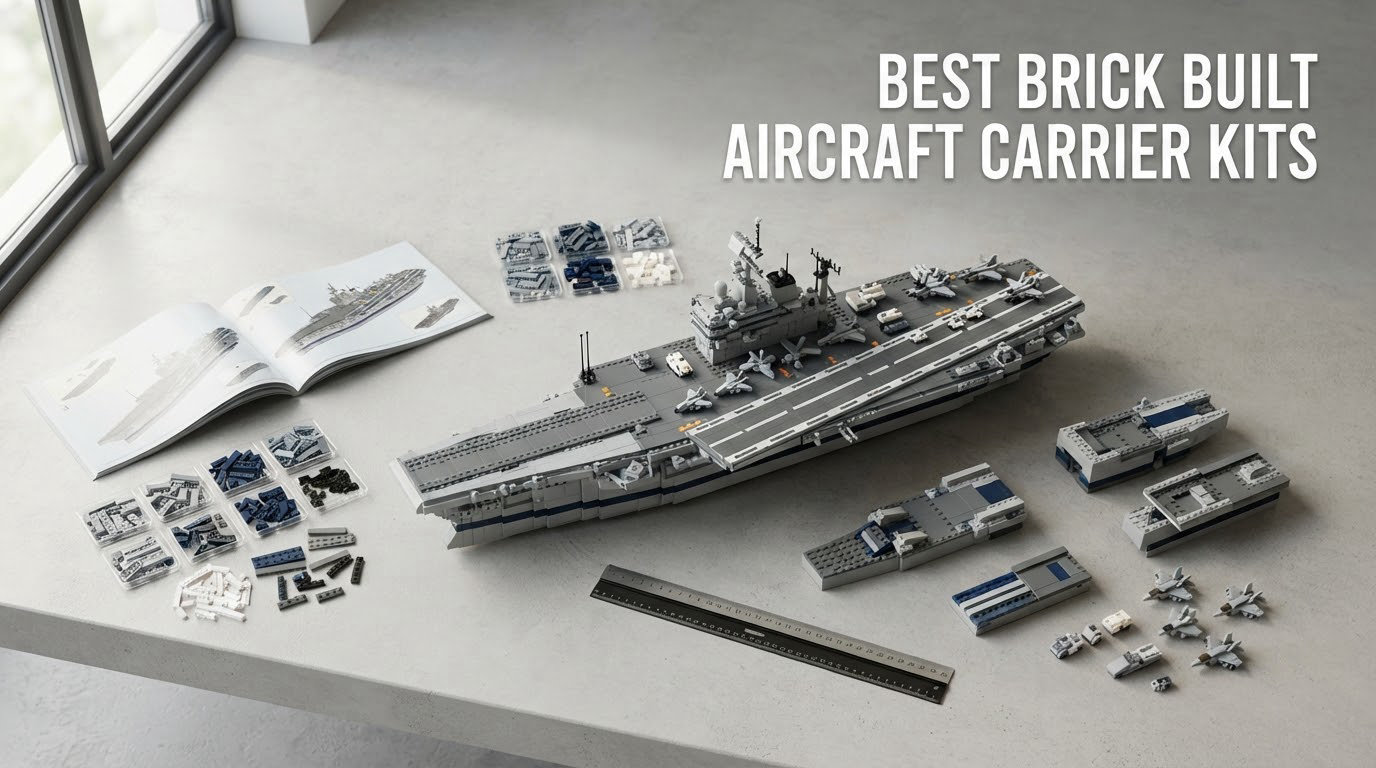
If you are searching for the best brick built aircraft carrier kits, the honest answer is that no single kit wins every category. A carrier built for a child’s bedroom plays very differently from a 1:300 museum-grade model, and a compatible-brand set that arrives in two loose bags cannot be compared on the same ladder as a boxed licensed release with printed instructions and a replacement-parts policy. What matters is picking the right scale for your shelf and the right brand tier for your patience.
Three brand tiers fill this niche. COBI is the officially licensed specialist and the safest instruction-and-spares bet. Independent MOC designs (My Own Creation) are built by individual designers and are the only route to hulls no brand covers, including the USS Gerald R. Ford CVN-78. Compatible clone brands are the cheapest way to get a large hull onto a shelf, and the ones that ship parts in numbered bags can genuinely be worth it for a first build. Our picks below cover all three tiers, with a piece count, declared finished size and a clear who-it-is-for verdict for every kit.
One thing to settle first: LEGO has never issued a dedicated brick-built aircraft carrier set. That single fact explains the whole market, because it is why COBI, MOC designers and no-name brands fill the shelves instead. If you want a shelf model of a real carrier, you are choosing between those three groups, not between LEGO and something else.
Readers coming from glue-and-paint plastic kits usually land well here. We have covered the traditional side in our HMS Invincible carrier model roundup and in universal carrier kit picks, and the difference in workflow is mostly the missing paint and glue stage. Our aircraft kit roundup covers the planes that eventually populate the deck.
Table of Contents
Top 3 Best Brick Built Aircraft Carrier Picks in 2026
These three are the safest buys in the group: the best-proven set overall, the best officially licensed model, and the best large first build for a new collector. Everything else in the list is either smaller, cheaper, or thinly reviewed.

Liberty Imports 825-Piece Carrier Fleet
- 825 pieces
- 8-in-1 model set
- Storage case included
- Linked with major brands


EP Exercise N Play 2234 Pieces
- 2234 pieces
- 38 inch finished length
- 12 helicopters
- Graphic instructions
Every Brick Carrier Kit Compared in 2026
All ten kits in one place, with the details that decide a purchase: piece count, declared finished size, and whether aircraft are included. Scale matters more than piece count here, because a smaller model with the right ratio can be dressed with aircraft while a larger one cannot.
| Product | Specifications | Action |
|---|---|---|
| Liberty Imports 825-Piece Carrier Fleet |
|
Check Latest Price |
| EP Exercise N Play 2234-Piece Carrier |
|
Check Latest Price |
 MISINI M7024 Wasp-Class 1:300 MISINI M7024 Wasp-Class 1:300 |
|
Check Latest Price |
| COBI IJN Akagi 1:300 |
|
Check Latest Price |
 SEMKY USS Enterprise 1883 Pieces SEMKY USS Enterprise 1883 Pieces |
|
Check Latest Price |
 Chodia 6-in-1 X-Large Warship Chodia 6-in-1 X-Large Warship |
|
Check Latest Price |
 WULOBOOI 8-in-1 WW2 Carrier WULOBOOI 8-in-1 WW2 Carrier |
|
Check Latest Price |
 XMalNexity 1:350 Enterprise CVN-65 XMalNexity 1:350 Enterprise CVN-65 |
|
Check Latest Price |
| Karoyd 1:350 Enterprise CVN-65 |
|
Check Latest Price |
 COBI TOP Gun Carrier 1:300 COBI TOP Gun Carrier 1:300 |
|
Check Latest Price |
1. Liberty Imports 825-Piece Military Aircraft Carrier Fleet
Liberty Imports 825pc Military Aircraft Carrier Fleet Construction Bricks Toy – 8-in-1 Naval Battleship Models with Navy Vehicles, Jets & More – Compatible with Major Brands – Storage Case Included
825 pieces
8-in-1 models
10.6 x 6.89 x 5.08 inch box
Ages 5 and up
Pros
- Most reviews of any kit here at 557
- 8-in-1 set includes carrier plus jets and helicopters
- Storage case with baseplate lid
- Connects with major-brand bricks
- Lowest barrier to a first carrier build
Cons
- Instructions are hard to read
- Missing small interior pieces reported
- Piece budget usually covers the carrier or the vehicles not both
The best brick built aircraft carrier kit for most households is this one, and the reason is review depth rather than specification. With 557 ratings averaging 4.4 stars, it carries more owner feedback than any other kit here, and what that record shows is broadly positive about value and buildability.
The 825 pieces build an aircraft carrier plus a jet fighter, helicopters, tanks and other vehicles in an 8-in-1 layout. Pieces connect with major-brand bricks, so it slots into an existing collection rather than sitting in a sealed bucket.
Two things catch people out. Owners repeatedly note that the piece budget usually builds the carrier or the smaller vehicles rather than everything at once, so plan the display before you start. Instructions also draw the most criticism, with several builders saying they needed help to follow them.
There is also a storage case with a baseplate lid, which is unusual at this level and genuinely useful for a kit this size. The listed age range starts at five, which makes it the most gift-friendly carrier here.
Check before you build it for a child
If this is a parent or grandparent purchase, the honest picture is mixed on quality control. Some sets arrive with missing small interior pieces, which forces either sourcing replacements or a return, and that friction lands on whoever is supervising the build.
It is still the right first carrier, because the alternative at this level usually has fewer reviews and worse instructions. Just allow time for a possible parts top-up.
Where it falls short against licensed sets
Against a COBI set the gap is obvious in three places: printed versus stickered markings, the presence of a real display stand, and a parts-support policy. Reviewers also flag that some subassemblies feel delicate and need reinforcing, and that vehicle frames can splay during assembly.
If you are building for an adult display shelf rather than a playroom, the Akagi below is the better object. If you are buying a first carrier for a determined child, this one wins on price and approachability.
2. EP Exercise N Play 2234-Piece Aircraft Carrier
2234 Pieces Military Ship Aircraft Carrier Building Set, 38×8.5×12.5 Inch
2234 pieces
38 x 8.5 x 12.5 inch finished
Ages 14 and up
Storage box
Pros
- Enormous finished length above 38 inches
- 2234 pieces plus 12 helicopters
- Graphic step instructions
- Modular design with storage box
- Long satisfying build for teens and adults
Cons
- Build commitment is substantial for younger buyers
- Generic branding with no named hull
The best first large carrier build is the 2234-piece set, because the finished object is genuinely display-sized at over 38 inches long and the element count keeps a committed builder busy for weeks. Seventy-two reviews averaging 4.4 stars, with 75 percent at five stars, is a solid base of evidence.
Owners single out the sheer finished dimensions as the reason to buy it, then the twelve integral helicopters and the included storage box. The modular design means the ship can be displayed in more than one position rather than sitting as one fixed block.
Graphic instructions guide the build step by step, and the listed age range starts at fourteen, which sets expectations honestly. Builders describe it as good STEM value for a teenager or an adult unwinding in the evening.
The main drawback is time. At 2234 pieces, this is a project rather than a weekend, and younger buyers routinely underestimate that. Plan a dedicated table and roughly a dozen sessions.
Check the shelf before you order
At over 38 inches long, 8.5 inches wide and 12.5 inches tall, this is one of the biggest display models in the roundup for the entry-level outlay. Measure your shelf and your doorways first, because a model this size is awkward to move once assembled.
That check settles the decision: if the shelf can take it and you want a big build without diving into a five-thousand-piece project, this is the fit.
Where it falls short for collectors
This is a general military carrier rather than a named hull, and reviewers point that out as the main caveat for naval-history buyers. There is no deck scale to work with, so aircraft you add later will be whatever size looks right rather than a correct ratio.
There is also no display stand and no nameplate. The modular design partly compensates, but a collector wanting a specific ship with a printed nameboard should look at the COBI Akagi or the 1:350 Enterprise kits instead.
3. MISINI M7024 Wasp-Class Amphibious Assault Ship
Pros
- True 1:300 scale based on USS Wasp LHD-1
- Openable decks and hatches with landing bays
- Recreated interior compartments
- Two instruction booklets
- Prints on bricks not stickers
Cons
- Advanced difficulty
- not for beginners
- Missing pieces reported in several boxes
- Instructions do not flag which bag holds which sub-build
For 1:300 display detail specifically, the MISINI M7024 is the one that opens up, and its distinguishing feature is what happens under the flight deck. The quick-release deck and hatches let you open the ship after assembly and look at openable side power rooms, aft landing bays and a full interior.
Inside there are recreated compartments including the second-floor engine room, a combat conference room, crew rest and shower areas, and electrical and mechanical rooms. The aft landing craft compartment is designed to take two hovercraft. One reviewer who served on the real ship praised the interior accuracy, which is not a small thing for this subject.
At 5220 pieces, 86.7 cm long and 8.02 kg, this is a serious build that builders describe as an intense multi-day project. Fifty-six reviews at 4.3 stars suggest the payoff is real for people who finish large models.
Two instruction booklets are included, and the decals are printed directly onto bricks rather than applied as stickers. That last point matters more than it sounds, because stickers on a hull this size are the first thing to peel and the first thing collectors complain about.
Check whether you can finish a 5,000-piece build
The single most repeated complaint about this kit is difficulty. It is not a beginner project, and the interiors that make it impressive are also what make it long. If you have never sorted numbered bags of bricks before, start smaller.
Quality control is the second check. Several builders reported missing pieces and a few disfigured bricks, and one box had a misspelled print reading Jet Elast instead of Jet Blast. Because this is a nameplate-style detail rather than a structural part, it is cosmetic, but you should know it is possible.
Where it falls short
The instructions do not clearly flag which bag holds which sub-build, which matters more here than on a simpler kit because the interior sections are built out of order. Budget time to sort the bags yourself before you open a booklet.
Worth noting for aircraft hunters: this is a Wasp-class amphibious assault ship, not a supercarrier, so it will not take a full heavy air wing on deck. If you want a crowded flight deck, the 1:350 Enterprise kit below is the one that ships with aircraft.
4. COBI IJN Akagi Historical Collection
COBI Historical Collection WWII – IJN Akagi Imperial Japanese Navy Fleet Carrier
3573 elements
1:300 scale
87 cm long
Ages 14 and up
Pros
- Highest rated kit in the roundup at 4.8 from 42 reviews
- Tight brick fit and firm clamping force
- Printed tiles instead of stickers
- Display stand plus nameplate and 5 mini planes
- Historically accurate WWII carrier subject
Cons
- One hull-fitting shipment with missing pieces
- Small flat elements vary slightly in tolerance
- Deck struts are fiddly to reach
The best officially licensed brick built aircraft carrier kit is the COBI IJN Akagi, and it carries the highest average rating in this roundup at 4.8 stars across 42 reviews, with 85 percent of those ratings at five stars. Collectors repeatedly single out the brick fit and clamping force as the reason large COBI hulls stay square.
You get 3573 elements at 1:300 scale, finishing at 87 cm long and 20.5 cm wide. The box includes an aesthetic display stand, five mini planes and a printed nameplate carrying the ship’s name, which means the model arrives ready to display rather than needing a stand bought separately.
Markings are printed tiles rather than stickers, and for a carrier the size of this one that decision is what separates a model that still looks right in five years from one with lifting decals. Instructions are illustration-led and step by step, and most builders followed them without trouble.
Historically, the Akagi was a Japanese fleet carrier converted from battlecruiser, so the model shows a hull that is longer and narrower than a purpose-built carrier. That shape is the point for naval-history buyers, and it reads clearly on the shelf.
Check the flat elements and the deck underside
COBI is not flawless. A few builders report small flat elements with slight tolerance variation that fit only one way, which slows the sub-builds that use a lot of plates. Under the flight deck, the struts are reported as fiddly to reach during assembly, so build that section before the deck goes on top.
One reviewer had a hull-fitting problem and missing pieces and needed to order replacements, which is a single report rather than a pattern. It is still the reason to keep the box and the paperwork until the model is finished.
Where it falls short
Five mini planes is a token air group, not a populated deck. The r/cobiblocks community asks this question constantly, and the answer for a 1:300 COBI carrier is that additional aircraft has to be sourced separately, usually from smaller COBI sets or 3D-printed miniatures.
If a full air wing matters more than printed accuracy, skip to the 1:350 Enterprise kit with 28 aircraft. If historical subject matter and build quality matter more, this is the one to buy.
5. SEMKY USS Enterprise 1883-Piece Carrier
SEMKY Military Series USS Enterprise Aircraft Carriers MOC Building Blocks and Engineering Toy(1883 Pieces)
1883 pieces
30 x 5.5 x 9 inch
2.58 kg
Ages 10 and up
Pros
- Good detail and realism for a mid-sized kit
- A satisfying multi-day project for teens and adults
- Instruction booklet generally easy to follow
- Manufacturer sorts and inspects pieces
- Free replacement parts on request
Cons
- Loaded with tiny parts
- not for beginners
- Small print in the manual
- Transfer stickers tear easily
- One box missing a repeated part
The SEMKY USS Enterprise is the most straightforward route into a named hull at 1883 pieces, finishing around 30 inches long. Owners like the level of detail it puts on the table, and several describe the finished model as a history lesson in a box, which is roughly what a collector wants from a named ship.
Unlike most kits at this level, the manufacturer states that pieces are sorted and inspected, and will send replacements free if your set is short. That is a parts-support policy you rarely get outside a licensed brand, and it removes the most common reason a build stalls.
There is one moving element to look forward to: sliding wheels linked to the propeller so it turns. At 2.58 kg and 30 x 5.5 x 9 inches, the model is heavy enough to feel substantial without needing a two-person lift.
Thirty-eight reviews at 4.2 stars is a reasonable amount of evidence. Owners report a multi-day build finished by teens and adults, and the manual is generally described as followable.
Check your eyesight and your patience for small parts
The most common complaint is the density of tiny parts, which is why the kit is listed from age ten but is really aimed at older builders. The manual also uses small print that several reviewers found hard to read, so if you already need reading glasses, budget more time per step.
There is a specific mechanical issue worth knowing: the hull wheels are slightly too wide and stop the hull closing, so builders remove them. Decide early whether to follow the manual or accept the modification, because you will hit it near the end otherwise.
Where it falls short
Markings come on transfer stickers and reviewers report they tear easily and are tricky to place on a hull this size. If sticker-free detailing is a requirement, the COBI Akagi handles it properly.
One buyer received a set missing a part that repeated across all 29 occurrences, which stopped the build outright. The replacement service is the answer, and it is worth testing it early rather than at step 900.
6. Chodia 6-in-1 X-Large Warship and Carrier
Chodia Battleship Building Block Set, 6-in-1 X-Large WW2 Military Battle Ship Aircraft Carrier Toys Navy Warship MOC Model Kits Ideas Birthday for Adults, Men, Boys Age 8-12, 8-14, 8+
Hull about 31.5 inches
ABS plastic
Rotating main gun
Ages 8 and up
Pros
- X-large hull around 31.5 inches long
- 6-in-1 layout adds helicopter and hovercraft
- Rotating main gun and switch-fired launcher
- Full colour instruction manual
- Good parent-child build for ages 8 plus
Cons
- Some shipments missing roughly half the pieces
- Colours did not match the instructions
- Pieces arrive in only a couple of bags
- Listing states two different piece counts
The Chodia 6-in-1 is the entry-level pick in this roundup, and the headline is size: an X-large hull at roughly 31.5 inches, which is more than two and a half feet of carrier from a set aimed at family builds. For a display shelf on a tight budget, that length is the number that matters.
The same element budget also builds a helicopter, hovercraft, frigate, tank, rescue truck and jet. Functional play features include a rotatable main gun, a mechanism that releases a lifeboat, and a switch that fires projectiles. The plastic is ABS with smooth corners and the manual is full colour.
Thirty-two reviews at 4.3 stars, with 79 percent five-star ratings, and most buyers report finishing it in about two hours. That speed is the appeal for a family build rather than a long-term project.
It is a genuinely quick win, and the pieces are described as fine workmanship with smooth corners. Parents building with a child aged eight or up get a satisfying afternoon out of it.
Check the bags before you commit a weekend
Quality control is the recurring theme in the reviews, and it is worth planning around. Some shipments arrived missing roughly half the pieces, which halted the build entirely, and other buyers found the delivered colours did not match the instructions.
The sorting issue is the one you can fix yourself. Pieces arrive in a couple of large bags rather than numbered step bags, so budget 30 minutes sorting before you start, and expect to be hunting for specific small parts mid-build.
Where it falls short
There is also a listing inconsistency worth flagging: the piece count is given as both 801 and 1456. Buyers report a 1,456-piece build, so plan your build length on the larger number and be prepared for either.
For anything beyond play value, move up a tier. This is a large toy with good play features, not a scale model, and it comes with no stand, no nameplate and no aircraft at a usable ratio.
7. WULOBOOI 8-in-1 WW2 Aircraft Carrier Set
WULOBOOI 8 in 1 WW2 Aircraft Carrier Building Set, Military Cruiser Ocean Battleship Toy with Helicopter & Boat (25 Warship Models), 562 Pieces Naval Gifts for Adults Man Teens 14+
Just over 500 pieces
12.6 x 4.2 x 5.5 inch
16 ounces
8-in-1
Pros
- Low barrier to a brick carrier build
- 25 different models from one box
- Rotary-firing gun and rotating radar
- ABS plastic described as odourless and smooth
- Accurate illustrated instructions
Cons
- Models cannot all be built at once
- Some boxes short on parts
- Small parts may need glue for display
- Sticker sheets can arrive bent
The quickest way to find out whether you enjoy brick ship building is this 8-in-1 set, which assembles into 25 different models from one box. At just over 500 pieces and 16 ounces, it is a two-evening commitment rather than a project, which is exactly what a trial should be.
Features include a rotary-firing gun, a missile system and a rotating radar, plus a stern helicopter deck. Each accessory assembles into three different models, so the same elements rebuild as patrol boats, cruisers and cannon cars once the carrier is done, and the pieces are described as odourless, smooth ABS that holds together with few parts falling off.
Twenty-one reviews at 4.3 stars is a thin but clean record, with owners who receive a complete box praising the many-model value and the plastic quality. The military grey scheme stays consistent across every model, which keeps the rebuilds looking like a matched set.
The manual illustrates each step accurately, including part angles, which sounds minor and is not when you are new to this kind of model.
Check whether you want a display model or a toy
At 12.6 inches long, this is a desk-scale carrier, and the gap against the larger kits is where the decision is actually made. If you want something on a shelf you can look at from across the room, this is too small, and a mid-size kit is where display value starts.
Expect the usual entry-level compromise on completeness. Some buyers received boxes missing quite a few parts and sourced spares from another brand, and sticker sheets can arrive bent or creased.
Where it falls short
The same element budget that gives you 25 models means you cannot build them all at once, so think of it as a box of parts with a starting point rather than a collection. Small parts also mean the model can need glue to hold together for display, which builders mention directly.
Treat it as a sampler. If you finish it wanting a bigger carrier, the 825-piece Liberty Imports set is the natural step up and doubles as a play set for a child at the same time.
8. XMalNexity 1:350 USS Enterprise CVN-65 with 28 Aircraft
Pros
- Full 28-aircraft air wing in the box
- Faithful angled deck and island superstructure
- Jet exhaust deflectors and arresting cables
- Four working external elevators
- Lift-off flight deck
- Wooden pedestal and nameplate
Cons
- Small-type manual with no parts list per sub-section
- 35 to 40 loosely grouped bags
- Choppy hull surface
- Stand is small for a 93.7 cm hull
The kit here that solves the empty-deck problem outright is this 1:350 USS Enterprise CVN-65, and it does it in one box. You get 4941 pieces at 93.7 cm long, plus 28 scaled aircraft: ten F/A-18 Super Hornets, five EA-6B Prowlers, three S-3 Vikings, three E-2 Hawkeyes, three C-2 Greyhounds and four SH-60 Seahawks.
That is a full air wing, and it answers the most common question in the r/cobiblocks community about where to find aircraft at a usable ratio. The design is credited to the MOC designer bru_bri_mocs, and the box includes a wooden-colour pedestal and a nameplate.
Functional details are where this kit separates itself: jet exhaust deflectors, arresting cables, four external elevators and a flight deck that lifts off. On a model this size those are the features you notice from a distance.
Brick grip is reported as tight, and the one detailed reviewer had no missing parts. At 4.4 kg the model has real presence, and the declared age range starts at sixteen.
Check the evidence before you commit
Only three reviews exist, so treat this as an unproven set rather than a safe one. What those three say is encouraging about brick quality and the finished result, but that is not enough history to lean on.
The bag situation is the practical concern. Pieces arrive in 35 to 40 bags that are only loosely grouped, and the manual uses small type without listing parts per sub-section, so you will hunt for individual pieces rather than working from a sorted list.
Where it falls short
Reviewers are blunt about the surface finish. The hull is described as choppy and brick-like rather than smooth and continuous, and the included stand is small relative to a 93.7 cm model, so you will probably want a proper display base.
The 28 mini aircraft also carry less detail than the carrier itself, and a few small parts needed glue to hold. If smoothness of finish is your priority over air wing, choose the COBI Akagi instead.
9. Karoyd 1:350 USS Enterprise CVN-65 Technic-Style Kit
Karoyd Technic UCS USS Enterprise CVN-65 Nuclear-Powered Aircraft Carrier Building Kit, 4866Pcs+ 1/350 Scale Building Blocks Set Compatible with 10294
4866 pieces
1:350 scale
36.89 x 10.12 x 10.28 inch
4386 g
Pros
- Recreates the bru_bri_mocs Enterprise design at 1:350
- Over 4866 pieces for a long-form build
- Pieces work with set 10294
- Digital PDF instructions suit screen-based building
Cons
- Lowest average rating of the ten kits here
- 34 percent of reviews sit at one star
- Digital-only PDF instructions rather than a booklet
- Minimal brand recognition
This 4866-piece Karoyd kit reproduces the same bru_bri_mocs USS Enterprise design as the previous entry, and the deciding factor is how you like to read instructions. It comes with professional, detailed PDF instructions for screen-based building and no printed booklet, and the pieces are compatible with set 10294 so they drop into a standard large-piece collection.
Five reviews at 3.4 stars is the lowest average in this roundup, and the distribution is sharply split: 41 percent at five stars and 34 percent at one. Buyers who complete the build rate the piece count and design fidelity highly, while the one-star reviews describe a frustrating build and regret at that outlay, which is worth weighing before a 4866-piece commitment.
At 36.89 x 10.12 x 10.28 inches and 4386 g, the finished size matches the XMalNexity kit, and the recommended age is 14 and up. So on paper this is an equivalent model with a different documentation format.
The problem is evidence. Five reviews is too few to establish whether the missing-parts and frustration complaints are isolated or systemic, and the sales ranking sits far below comparable MOC kits.
Check your screen setup first
PDF-only instructions are the reason to buy this kit and the reason some builders dislike it. A second device or a printed copy of the pages is close to essential, because you will be flipping back and forth constantly over thousands of steps.
If you build on a tablet, a laptop stand and a clear surface, this works. If you prefer paper, the XMalNexity version with a printed manual is the better buy for the same design.
Where it falls short
The rating is the warning. One-star reviews describing build problems and buyer regret on a multi-thousand-piece model are the specific failure mode that gets you an unfinished project and a cupboard full of sorted bags.
It is also the least established listing here, with minimal brand recognition. We would only pick this if you specifically want PDF instructions and 10294 compatibility, and you accept the risk of thin support.
10. COBI TOP Gun Aircraft Carrier 1:300, 6130 Pieces
COBI TOP Gun™ Aircraft Carrier, 1:300 Scale, 6,130 Pieces
6130 pieces
1:300 scale
114.5 x 38 x 31.5 cm
21.5 pounds
Pros
- Largest piece count and longest hull in the roundup
- Elevating decks and movable aircraft elevators
- Rotating propellers and rudders
- Pad-printed detail instead of stickers
- Display stand with TOP GUN plaque and mini aircraft fleet
Cons
- One review reported a whole bag of parts missing
- Same reviewer saw no support response after two weeks
- Advanced difficulty for experienced modellers
- Only two reviews and a volatile 3.5 average
For moving parts, the COBI TOP Gun carrier is the clear choice, because it is the only kit in this roundup with a working elevating deck. The elevating decks, movable aircraft elevators, rotating propellers and rudders give a finished model that changes state when you touch it, which is what separates an interactive display piece from a static one.
At 6130 pieces it is the largest set here, finishing at 114.5 x 38 x 31.5 cm on its stand, which is a metre and a quarter of carrier. The weight is listed at 21.5 pounds, so plan the shelf and the route to it before starting.
Details are pad-printed rather than stickered, the COBI approach collectors prefer, and the box includes an elegant display stand with a TOP GUN plaque plus a fleet of miniature aircraft. It is made in the EU and aimed at ages fourteen and up.
This is the movie carrier rather than a specific historical hull, so it belongs in a cinema or fan collection rather than a naval-history one.
Check support and the box count before you start
Two reviews is almost no evidence, and one of those describes an entire bag of parts missing, which made the build impossible to finish. The same reviewer reports no response from the manufacturer after two weeks, which is the specific risk that comes with a set this large.
It is also an advanced build for experienced brick modellers rather than casual builders. Six thousand pieces with moving superstructure is a serious commitment of evenings, and the 3.5 average is heavily weighted by that single complaint.
Where it falls short
At 114.5 cm long this is not a shelf model, it is a floor or dedicated-cabinet piece. Almost half of the reported rating sits in the two-star band, and that reflects fulfilment problems on a set where a single missing bag is fatal.
For most buyers, the COBI Akagi gives a large, well-supported carrier with a display stand and a real historical subject. Choose this one for the moving parts and the size, and make sure you can handle a support request if something is absent.
Official Brand, MOC or Clone: What the Three Tiers Mean
The three tiers differ in exactly one thing that matters: who stands behind the set when something is wrong. An officially licensed brand has a company, a support address and a replacement-parts process behind it. An independent MOC has a designer and usually a small retailer. A compatible clone brand has a listing page, which is the main reason those sets cost less.
Licensed brand (COBI). Printed elements instead of stickers, illustration-led instructions, a display stand in the box and the firmest clamping force owners describe on a hull this size. You also get a named historical hull rather than a generic ship, and a parts-support route when something is absent. The costs are a higher entry point per piece and a narrower range of subjects, since the brand only makes what it has licensed or chosen to depict.
Independent MOC. A MOC is an original design by an individual builder, sometimes based on another designer’s work and credited to them. This is the only route to hulls no brand has produced, which is why MOC sellers dominate the search results for the USS Gerald R. Ford CVN-78. In this roundup, the 1:350 Enterprise designs credited to bru_bri_mocs are the clearest examples. Quality varies enormously, and authorisation is the thing to check.
Compatible clone brand. The cheapest route and the highest risk. Listing copy leans on material claims such as durable ABS and BPA-free, which tell you nothing about build experience. What actually predicts quality is whether parts arrive in numbered bags matched to build stages, and whether the manual has real step detail. The Liberty Imports and Chodia sets score well on the first measure; the Liberty Imports set is weaker on the second.
Compatibility itself deserves a caveat. Compatible bricks connect physically. That does not guarantee identical colour, finish, tolerance or minifigure geometry, and mixing a licensed set with clone elements is where mixed builds lose their crispness.
Choosing Your Scale: What Actually Fits Your Shelf
Scale decides everything downstream, because it determines finished length, aircraft options and build time. The mistake buyers make is treating a scale ratio as decoration on a listing rather than as a promise about what will fit on the deck.
1:200 gives the largest models and needs the most space, generally a metre or more of hull for a supercarrier. It suits a dedicated cabinet or a display case, not a bookshelf.
1:300 is the sweet spot in this roundup and the community’s default for modern carriers. The COBI Akagi lands at 87 cm and the MISINI Wasp at 86.7 cm, so both sit on a normal display surface and both take 1:300 aircraft.
1:350 is a little smaller and the most common MOC ratio for modern supercarriers. The 1:350 Enterprise kits here finish at 93.7 cm because they depict a long hull, and both come with 28 aircraft already at the right scale.
1:485 sits between play set and display model, closer to the multi-model sets at the cheaper end of this list. 1:700 is the small end, where aircraft are plentiful and the carrier becomes a desk piece.
The rule that catches people: scale ratios do not convert cleanly across kits. 1:300 aircraft will not sit correctly on a 1:350 deck, and a generic multi-model set has no declared scale at all, so anything you add is a guess. If aircraft on the deck matter to you, buy a kit with a declared ratio and a matching aircraft set.
Where to Get Aircraft for an Empty Flight Deck
Nearly every carrier listing uses the words aircraft carrier and very few of them ship a usable air wing. Decks end up empty because the correct-scale aircraft are genuinely harder to find than the carriers themselves, and this is the question that comes up most often in the brick-built ship community.
The first route is a kit whose aircraft are included, which is why the 1:350 Enterprise kit with its 28-plane air wing settles the problem outright. The second is to reuse aircraft from smaller sets in the same brand, which works only when the scales match exactly, so check the ratio before you buy.
The third route is 3D-printed or resin miniatures at the ratio your deck needs, and it is the practical answer when no brick set exists at your scale, particularly for modern and WWII types that licensed lines cover thinly.
Two things to avoid. Do not accept aircraft described as included when they are visibly the wrong size for the deck, which is a listed deal-breaker among buyers. And do not assume pieces from a different brand will sit flush, because compatible connectors still vary in dimension.
Seven Checks to Run Before You Buy a Carrier
These seven checks take ten minutes and eliminate most of the disappointment reported in the reviews. Run them in order, and stop if a listed one fails.
1. Find a real build photo. Rendered marketing images tell you nothing. Look for a photograph of somebody’s finished model on a table, ideally with the deck populated, because that is the only proof that the finished proportions work.
2. Check how parts are bagged. Numbered bags matched to build stages save hours. A handful of loose bags on a 2000-piece set means you will sort for an evening before the build starts, which is exactly the friction some buyers report.
3. Establish the instruction format. Printed booklet, PDF, or QR code to an app. PDF-only is workable on a second screen and painful otherwise. Small type in the manual is a specific and common complaint, so check the sample pages.
4. Read reviews of the exact set, not the brand. Ratings attached to a brand tell you about the brand’s other products. A 1:350 MOC and a 1:300 COBI share nothing but a subject, and missing-part complaints are specific to individual listings.
5. Look for a replacement-parts policy. One kit in this roundup states plainly that pieces are inspected and replaced free on request. Where you find that in writing, a missing part is an inconvenience. Where you do not, it can end a long build.
6. Measure your shelf and your route. The largest kit here finishes at 114.5 cm and weighs 21.5 pounds. Finished length, width and height are on every listing, and they decide more purchases than piece count does.
7. Vet the seller before you pay. A buyer in the r/cobiblocks community asked directly for a 1:300 model of the Gerald R. Ford and wrote that they could not tell which sellers were trustworthy. That is the most common reason people hesitate in this niche, and the checks are simple. Look for a named designer credit. Look for real build photos rather than renders. Check that the retailer sells other designers’ work with permission, since authorised MOC retailers stock a range. Prefer sellers who answer pre-purchase questions about bagging and instructions, because a seller who will not answer those has already told you something.
Price per piece is a poor guide for carriers, because a large set with loose bagging can cost more in time than a smaller set with good documentation. Judge the outlay against build commitment, not element count.
Frequently Asked Questions
Does LEGO make an aircraft carrier?
No. LEGO has never released a dedicated brick-built aircraft carrier set, which is the reason COBI, independent MOC designers and compatible brands fill this niche. If you want a carrier as a display model, you are choosing between those three groups, and the licensed COBI line and independent MOC designs are where the largest models sit.
Do brick built aircraft carrier kits come with aircraft?
Usually not in useful numbers. Most kits include a small token group, such as the five mini planes with the COBI Akagi, or none at all. The 1:350 USS Enterprise kit in this roundup is the exception, shipping with 28 aircraft. If a full deck matters, check the aircraft count and the aircraft scale before buying, because scales do not convert between kits.
Where can I buy a brick built aircraft carrier?
Licensed sets come from the brand’s own catalogue and major marketplaces, while independent MOC designs are sold by specialist brick retailers and the designer’s own shop. The most reliable buying signal is a named designer credit alongside real photographs of a completed build, not rendered marketing images.
What scale brick aircraft carrier is best for beginners?
Start with the scale that matches the kit you buy rather than picking a scale first, because scale is a property of the model, not a choice you make independently. For a first build, something under 2500 pieces with numbered parts bags and graphic instructions is manageable. A 1:300 model around 3000 pieces is a realistic first serious project.
How do I know if a MOC aircraft carrier seller is legitimate?
Check four things: a named designer credit, real build photographs rather than renders, a product range showing other designers’ work sold with permission, and answers to pre-purchase questions about parts bagging and instruction format. A seller who declines to say which bags hold which stage on a multi-thousand-piece build is telling you something useful.
How long does it take to build a large brick aircraft carrier?
Expect a few evenings for a kit under 1000 pieces, roughly a week of sessions between 2000 and 3000, and a month or more for anything approaching 5000 pieces. Sorting loose parts before you start can add an evening on its own, which is why numbered bagging is worth checking before purchase.
What is the difference between a MOC and an official brick set?
A MOC is an original design by an independent builder, sometimes credited to another designer, and it fills subjects no brand has produced. An official set comes from a licensed manufacturer with printed instructions, a support address and a replacement-parts process. A MOC can be excellent, but the safety net after purchase is usually thinner.
The Best Brick Built Aircraft Carrier Kit for Your Build
The best brick built aircraft carrier kit for most people in 2026 is the Liberty Imports 825-piece fleet, because it has more real reviews than anything else here and the lowest barrier to a first build. For the best licensed model, take the COBI IJN Akagi, which rated highest of the lot at 4.8 and arrives with a stand, nameplate and printed tiles. For a large first project, the EP 2234-piece carrier gives you a 38-inch display model without a five-thousand-piece commitment.
If a full air wing is the deciding factor, choose the 1:350 Enterprise kit that comes with 28 aircraft rather than planning to source planes later. Whatever you pick, measure the shelf, check the bagging, and settle the scale before you spend a single evening sorting bricks.