
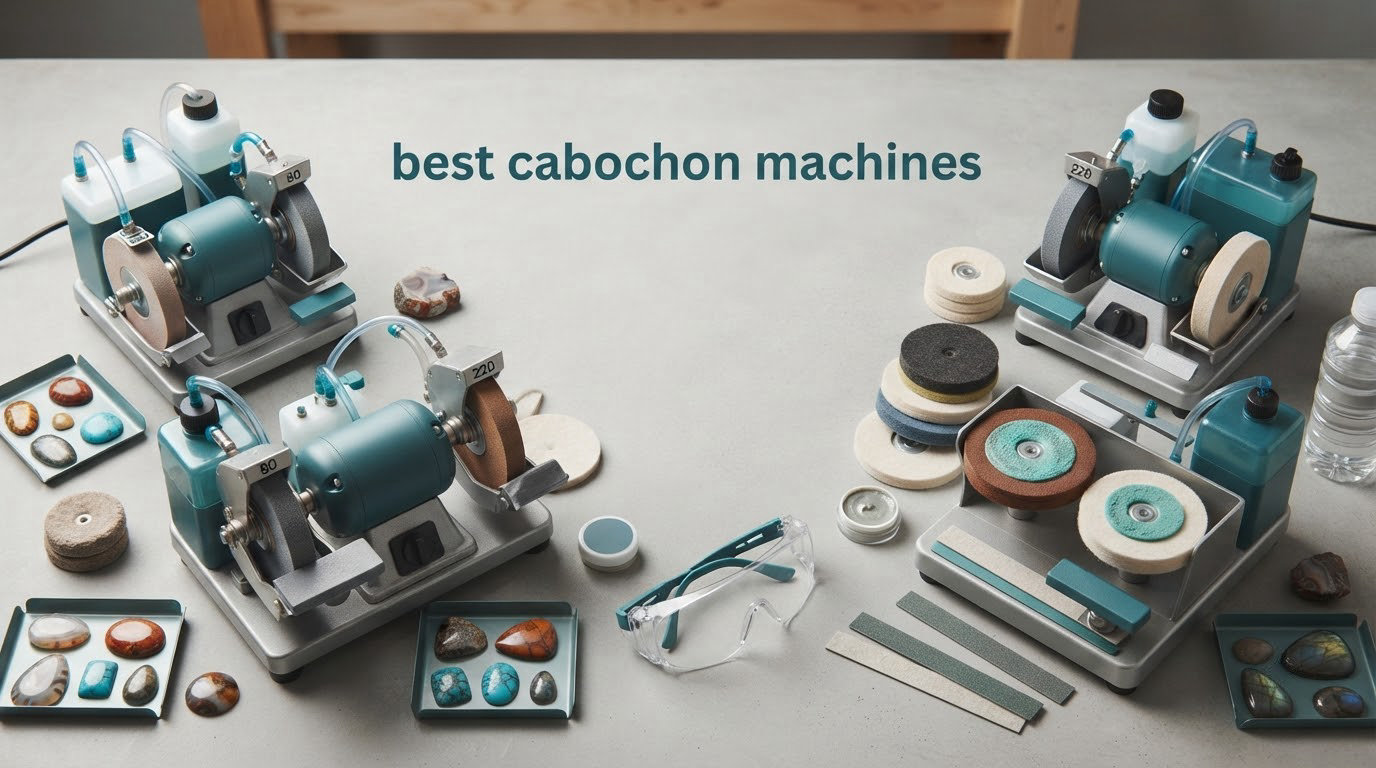
The best cabochon machine for most cutters is the CabKing 6-inch cabber, a six-wheel wet machine rated 4.8 stars across 337 owner reviews, with two coarse hard wheels, four resin finishing wheels and independent water flow to every wheel. Cutter on a tight bench or working pre-shaped slabs instead? The Hi-Tech Diamond 8-inch All-U-Need and slant cabber are both rated 4.5 stars and cost a fraction of the open-face six-wheelers.
That is the short version. The rest of this guide covers all six machines in detail, plus the decisions that trip up first-time buyers: which machine type suits your rough, how wet work behaves in a small apartment, whether a used machine is worth the risk, and how to run a grit progression that finishes a stone instead of tearing it apart.
One note on how this list was built. We do not claim to have run these machines ourselves. Every pick here is chosen from published manufacturer specifications plus the aggregate owner review record for each listing, which is the same research-led approach specialist lapidary reviewers use. Where owners repeatedly report the same complaint, we repeat it. Where owner feedback is thin, we say so plainly rather than dressing up two reviews as a track record.
That honesty matters more in this category than it might elsewhere. Cabbing machines run wet, throw grit slurry, and cost real money to replace, and the single most repeated question across lapidary forum threads is whether a buyer should go new or used. Our editor-tested equipment roundup format follows the same principle: publish the specifications, publish the review record, publish the trade-offs.
Table of Contents
Top 3 Picks for Best Cabochon Machines in 2026
Three picks rise above the rest, and all three carry review counts well above the middle of this list. The CabKing 6-inch leads on rating volume and owner satisfaction. The Hi-Tech Diamond All-U-Need wins on value per feature. The slant cabber wins on portability and footprint.

CabKing 6-Inch Cabbing Machine
- Six 6-inch diamond wheels
- 1/4 hp 1800 rpm motor
- Per-wheel water control
- Full accessories kit

Hi-Tech Diamond 8-Inch All-U-Need
- 8-inch flat lap face
- 1/4 hp variable 800-3400 rpm
- 13-pound ABS body
- Made in USA

Hi-Tech Diamond 8-Inch Slant Cabber
- 8-inch slant wheel face
- 800-3400 rpm variable speed
- One-quart water reservoir
- 15-pound portable build
Best Cabochon Machines in 2026 Quick Comparison
All six machines appear below with their core specifications, so you can compare body material, motor size and wheel layout before reading any individual review.
| Product | Specifications | Action |
|---|---|---|
| CabKing 6-Inch Cabbing Machine |
|
Check Latest Price |
 CabKing 8-Inch Cabbing Machine CabKing 8-Inch Cabbing Machine |
|
Check Latest Price |
| Hi-Tech Diamond 8-Inch All-U-Need |
|
Check Latest Price |
| Hi-Tech Diamond 8-Inch Slant Cabber |
|
Check Latest Price |
 VEVOR 8-Inch Cabbing Machine VEVOR 8-Inch Cabbing Machine |
|
Check Latest Price |
 VEVOR 6-Inch Cabbing Machine VEVOR 6-Inch Cabbing Machine |
|
Check Latest Price |
The two CabKing machines are open-face six-wheel production units. The two Hi-Tech Diamond machines are single-disc flat-lap and slant designs aimed at pre-shaped material and small workpieces. The two VEVOR units bundle a saw module with a six-wheel head, which is unusual in this category and useful if you want one machine to do both jobs.
1. CabKing 6-Inch Cabbing Machine: Best Overall for Most Cutters
CabKing 6″ Cabbing Machine Lapidary Equipment – Complete Grinder Polisher
Six 6-inch wheels
1/4 hp 1800 rpm
62 pounds
Per-wheel water spray
Pros
- Consistent high-quality cabs from six wheels in one pass
- Independent water flow to every wheel stops cross-contamination
- Quiet motor and shafts for its size
- Full kit ships with wheels lamp paste goggles and apron
Cons
- Thin drain hoses bow upward and resist drain fittings
- Mostly plastic housing vibrates when a lap disc is mounted
- No horizontal nozzle adjustment so wheel spacing matters
Six wheels in a row is the reason this machine sits at the top. A cutter can take a slab from 360 grit through four resin stages to a canvas polish pad without moving the stone to a different machine or changing workspace, and that single-station workflow is what separates a production cabber from a hobby flat lap.
The build is a direct-drive 1/4 hp motor turning at 1800 rpm, with the wheels mounted on a frame measuring 12 inches deep, 13.5 inches wide and 12 inches high. Total weight is 62 pounds, which is heavy enough that the machine stays put on a wet bench and light enough that two people can move it.
Two of the six wheels are electroplated hard wheels for rapid roughing, and four are resin-bonded wheels that carry the work through to a final polish. The left-hand side of the machine accepts standard half-inch arbor laps, so the same station handles flat-back work and jewelry setting prep.
Water delivery is the feature owners cite most. Every wheel has its own triple-jet nozzle with an independent valve, so you can flood a coarse wheel and starve a polishing wheel as the stone changes state. That control also stops fine slurry from being dragged back onto a coarse wheel and scratching the surface you just polished.
The accessory list is genuinely complete. The package includes the six diamond wheels, a 360-grit full-face diamond lap, a canvas polishing pad, diamond paste, an LED work lamp, a water pump, stone trays, hand rests, goggles and an apron. First-time buyers repeatedly single out the quality of the instructions and the ease of setup, which matters when the learning curve already includes grit sequencing.
Rating across 337 reviews sits at 4.8, with 87 percent five-star and 2 percent one-star. That is the deepest owner record of any machine in this guide, and it is why the badge goes here rather than to a higher-priced unit with a thin sample.
How the water system holds up in daily use
The spray system works well; the plumbing downstream of it is the weak spot. Owners describe the nozzles themselves as predictable, but the drain hoses that ship with the machine as thin and collapsible, hard to push into a standard drain fitting and prone to bow upward, which restricts flow.
Most owners fix this in minutes rather than returning the unit. Replacing the supplied hose with a thicker garden-hose-style line, or trimming it to a length that does not fight the fitting, resolves the issue and costs almost nothing.
Where this machine disappoints
The housing is mostly plastic, and it transmits vibration under two specific conditions: when a lap disc is mounted on the side arbor, and when drain hoses are routed in a way that pulls against the frame. Neither condition is dangerous, but both are noticeable.
Two other limitations show up repeatedly. The nozzles have no horizontal adjustment, so wheel spacing under the valves has to be set carefully or the spray misses. And the 220-grit wheel, which arrives as a consumable, wore out faster than some owners expected under heavy use. Budget for wheel replacement from the start.
One specification detail to check before you commit outside the United States: this machine is 115-volt only and is not intended for 220-volt regions. That limitation is printed in the technical specifications, and it applies to the 8-inch CabKing as well.
2. CabKing 8-Inch Cabbing Machine: Best for Oversized Cabochons
CabKing 8″ Cabbing Machine Lapidary Equipment – Complete Accessories Kit
Six 8-inch wheels
3/4 hp 1800 rpm
160 pounds
2.5 inch wheel spacing
Pros
- Wide wheel spacing handles larger stones than 6-inch cabbers
- 3/4 hp motor stays quiet under load
- Finish quality compared favorably to shop work
- Fast email support on out-of-box issues
Cons
- Original resin wheels wore out in about a year
- Thin ridged drain hoses kink easily
- Overhead water sprayers can leak or clog
Everything that makes the 6-inch CabKing appealing scales up here, and one number matters more than the rest: 2.5 inches of spacing between wheels. Forum threads asking about cramming between closely spaced wheels are almost always talking about 6-inch machines, and the gap on this one is the physical answer.
The motor is 3/4 hp at 1800 rpm on a direct drive, and the cast frame weighs 160 pounds with a 42-inch length, 16-inch width and 14-inch height. That is a serious bench footprint, and it is the main reason this machine is not our top pick for a home setup.
The wheel set follows the same pattern as the 6-inch model, with two 8-inch electroplated wheels and four 8-inch resin wheels, plus an 8-inch 360-grit diamond lap, a canvas pad, diamond paste, an LED lamp, a water pump, trays, splash guards, hand rests, goggles and an apron.
Owners with several hundred cabs behind them treat this as professional-grade value. The motor is described as powerful and quiet, and the finished results are repeatedly compared favorably to work done in professional shops, which is a high bar for a machine at this tier.
The rating is 4.8 across 73 reviews, with 88 percent five-star and no one-star ratings at all. The review count is lower than the 6-inch model’s, which reflects how many buyers treat an 8-inch open-face cabber as a shop or dedicated-room purchase rather than a first machine.
When the 8-inch size actually pays off
The advantage shows up with wide slabs, large face cabochons and material that will not fit between close-set 6-inch wheels. If your rough comes from field collecting or from cutting your own slabs, the spacing difference removes a real bottleneck from your process.
Water control is again independent per wheel, and the simplified drain routes away from the machine. The advantages over under-wheel fountains are significant, since a fountain sprays outward and a controlled stream keeps the working surface of the wheel clean and cool.
Where this machine disappoints
Consumable cost is the honest downside. The original padded resin wheels wore out in roughly a year with regular use, so factor a wheel replacement into your running cost rather than treating the starter set as a permanent asset.
The overhead water sprayers have a mixed record. Some owners report leaks and clogs, and more report that adjusting water delivery to individual wheels means removing the hood first, which is an awkward reach during a production run. The drain hoses are described as thin and ridged and kink more easily than they should.
Add the 160-pound weight and the 115-volt-only electrical design, and this is clearly a machine for a dedicated bench with a drain nearby.
3. Hi-Tech Diamond 8-Inch All-U-Need: Budget Pick Flat Lap
Hi-Tech Diamond 8″ All-U-Need Lapidary Machine, Rock Polishing Kit
8-inch flat lap face
1/4 hp 800-3400 rpm
13 pounds
US-made ABS body
Pros
- Wide 800-3400 rpm range matches speed to each grit step
- Only 13 pounds so it moves between bench classroom or garage
- Reaches an impressive finish on pre-cut stones quickly
- Built in Westmont Illinois since 1984
Cons
- No drain hole so water must be dumped by hand
- Plastic water valve feels imprecise with no clear closed position
- Included wheels are serviceable rather than long lasting
The All-U-Need design is the reason this machine punches above its tier. Instead of touching one small arc of a rotating disc, the work surface follows the whole face of the 8-inch wheel, so more stone contacts abrasive at any moment and the finish arrives faster than the wheel size alone would suggest.
Power comes from a 1/4 hp direct-drive permanent magnet motor with sealed ball bearings, adjustable from 800 to 3,400 rpm. That range is the feature owners praise most, because it lets you run hard rpm for coarse shaping and drop speed for the polishing step where heat and chatter cause problems.
The body is durable ABS plastic that resists rust and wipes clean, measuring 11 inches deep, 11 inches wide and 15 inches high at 13 pounds. A half-inch arbor accepts compatible backing plates, and four acrylic backing plates are included.
The kit ships with 8-inch 180-grit, 325-grit, 600-grit and 1,200-grit electroplated diamond discs, a Tech-11 polishing pad, 14,000 mesh diamond paste, a waterproof apron and instructions. The same manufacturer also builds glass and crystal coldworking equipment, so this machine is genuinely useful outside the rock-cabochon workflow.
The rating is 4.5 across 266 reviews, with 79 percent five-star. Several buyers specifically call out the made-in-USA origin, and that preference shows up repeatedly across lapidary forums where repairability and parts availability factor into long-term ownership decisions.
For reference, we cover other variable-speed bench machines in our precision equipment roundup, where the same logic applies: a speed range beats raw horsepower for controlled finishing work.
Who this flat lap suits best
This machine rewards pre-shaped material. If you cut slabs on a trim saw or buy slabs already cut, a flat lap takes them to a finished cab with a flat back far faster than an open-face cabber would, and the wide speed range helps you avoid burning a mirror surface.
Beginners report it is easy to set up and learn on, and the 13-pound weight means it can live in a closet between sessions or move to a lapidary club room for a class. For anyone with limited space, that portability is the deciding factor.
One practical caution from owner reports: a minority add their own grinding wheels or raise the face plate to reduce splashing, because there is no drain and the water has to be emptied by hand after a session.
Where this machine disappoints
Water handling is the weak point, and it is the one complaint that repeats. There is no drain hole, so a bucket or sink is part of the setup. The plastic water on/off knob is described as imprecise, with no clear indication of when it is fully closed, which means slow leaks are easy to miss.
The drip tank and water delivery design are also called out as executable rather than well-conceived. And the included saw blades and discs, while perfectly serviceable, are not long-lasting consumables; heavy use means replacing them sooner than you might expect.
None of these are deal-breakers, but if you generate a lot of slurry in one sitting, budget for a larger catch container and a way to route water away from the bench.
4. Hi-Tech Diamond 8-Inch Slant Cabber: Compact Workhorse for Small Benches
Hi-Tech Diamond 8″ Slant Cabber Lapidary Machine, Rock Polishing Kit
8-inch slant wheel face
1/4 hp 800-3400 rpm
15 pounds
One-quart reservoir
Pros
- Slanted face shapes and finishes cabs well on a compact bench
- 800-3400 rpm range gives control across every step
- Light enough to move between workspaces
- Built-in reservoir removes the need for a separate pump
Cons
- One-quart reservoir needs frequent refills on long sessions
- 1/4 hp motor has less power than an open-face cabber
- Included wheels are consumables and replace sooner under heavy use
The slant cabber sits between a flat lap and a full cabber. The wheel face is angled, which gives a better contact angle for shaping a dome and a larger usable area than a flat lap, while the whole machine stays in a single-disc footprint that a 6-inch open-face cabber cannot match.
Specifications mirror the All-U-Need in most respects: a 1/4 hp direct-drive permanent magnet motor with sealed ball bearings, adjustable from 800 to 3,400 rpm, a half-inch arbor and four acrylic backing plates. The difference is the built-in water reservoir, which holds up to one quart.
Dimensions are 11 inches deep, 15 inches wide and 11 inches high, and the housing is cross-link polyethylene rated around 12 to 15 pounds. It is rust resistant, easy to wipe down and light enough to lift with one hand.
The kit includes an 8-inch 180-grit electroplated diamond disc, a 325-grit brown disc, a 600-grit red disc, a 1,200-grit blue disc, a Tech-11 polishing pad, a 14,000-grit diamond paste syringe, four acrylic plates, an apron and instructions.
Owners consistently describe this as a dependable, compact workhorse rather than a production machine, and the 4.5 rating across 255 reviews reflects that. Seventy-nine percent of ratings are five-star, with 4 percent one-star, and the US manufacture is repeatedly valued.
The colour-coding of the discs is a small detail that matters more than it sounds. Brown, red and blue discs are easy to tell apart at a glance when grit slurry is on your hands and the bench is wet, which reduces the chance of a 600-grit step being skipped.
Where a slant cabber beats a flat lap
The angled face gives you more control on a curved surface. When you are shaping the shoulder of a cab and rolling the stone through your fingers, a slant face lets you lean the work into the wheel at a comfortable angle rather than fighting a vertical disc.
For apartments and shared-wall housing, this is the quietest footprint in the guide alongside the All-U-Need. It is light, compact, and the water lives in a small internal reservoir rather than a tray system that needs a drain connection.
It also handles glass, metals and enamels as well as rocks, which makes it a reasonable coldworking machine for a jewellery studio that cuts both stone and glass elements.
Where this machine disappoints
One quart is not much water. During a long session you will drain and refill repeatedly, and that cycle is the most common complaint owners register. If you cut stones in batches, plan for the interruptions rather than discovering them halfway through a run.
The 1/4 hp motor also has less power than any of the three open-face six-wheel machines here. On hard material such as dense jasper or quartz, expect more time per stone and more frequent pauses to let the wheel and the stone cool.
Finally, the included discs are consumables. Reviewers describe them as working well but needing replacement sooner under heavy use, so budget for an extra set of coarse and medium discs.
5. VEVOR 8-Inch Cabbing Machine: All-in-One With a Saw Module
VEVOR Cabbing Machine, 8″ 3/4 HP 1800 RPM Efficient, Lapidary Rock Grinder Polisher with Diamond and Resin Wheels, LED Lamp, Water System, Lapidary Equipment for Gemstone Grinding, Stone Polishing
Six 8-inch wheels
3/4 hp 1800 rpm
79 pounds
304 stainless housing
Pros
- Six 8-inch wheels plus a diamond lap in one head
- Integrated saw cutting module and side polishing
- 3/4 hp direct drive with electromagnetic overcurrent switch
- 304 stainless housing resists fingerprints
Cons
- One buyer received a unit assembled incorrectly
- Support reported as slow when fit issues were reported
- Owner feedback is extremely thin at two ratings
This is the most feature-dense machine in the guide, and also the one with the least owner history. Six 8-inch diamond wheels across a range of roughness levels, plus a diamond lap, plus a saw cutting module and a side-polishing function, in a single 79-pound unit.
Power is a 3/4 hp direct-drive motor at 1,800 rpm with an electromagnetic overcurrent switch for protection. Water flow adjusts independently at each wheel to keep the abrasive from running dry, which is the failure mode that shortens wheel life fastest.
The housing is 304 stainless steel with an adjustable top-mounted lamp. The listed uses cover gemstones, ceramics, metal pendants, wood and other crafts, and the machine carries a model number of VV-JH-8P.
Now the honest part. The rating is 2.5 across just two reviews, and that is not a track record. The single critical report describes a unit that arrived assembled incorrectly, with wheels that would not connect on one side and a guard mounted too close to the wheels on the other, requiring owner repair before it would run.
That same buyer reported slow support, with instructions to correct the fit rather than a replacement. The other reviewer was positive about the machine’s capability relative to its cost and about the saw attachment, but had not yet run it.
We include this machine because the hardware specification is genuinely competitive and the saw-bundled format has no equivalent elsewhere in the list. We do not recommend it as a first purchase, for a simple reason: with two ratings, you have no way to judge how it behaves after 200 hours of wet work.
When the bundled saw module is worth it
A saw cutting module turns rough field-collected material into slabs in the same footprint as the cabbing head, which removes a separate bench from a small shop. For a cutter who wants one machine rather than two, that consolidation is the entire argument.
The 3/4 hp motor also matches the 8-inch CabKing, and the stainless housing is a step up from plastic in terms of long-term rust resistance and general durability. Independent per-wheel water control is a real feature at this level.
Where this machine disappoints
The deal-breakers listed by owners in this category generally are vibration through the housing, motors running hot, and poorly machined pan holes with weak assembly quality control. The single VEVOR report is a direct instance of the last two.
Assemble and inspect the machine yourself on arrival, before you cut anything. Check that every wheel spins freely by hand, that the guard sits clear of the wheel face, and that the water valves open and close fully. If something is out of alignment, document it with photographs before contacting support.
This is a machine where the specification sheet and the review record disagree sharply, and the review record is the more useful signal.
On voltage, the listing does not return a voltage specification for this unit. If you are outside the United States, confirm the electrical rating with the manufacturer before you commit to this specific model.
6. VEVOR 6-Inch Cabbing Machine: Compact Starter With a Saw Module
VEVOR Cabbing Machine, 6″ 2/5 HP 1800 RPM Efficient, Lapidary Rock Grinder Polisher with Diamond and Resin Wheels, LED Lamp, Water System, Lapidary Equipment for Gemstone Grinding, Stone Polishing
Six 6-inch wheels
2/5 hp 1800 rpm
58 pounds
304 stainless housing
Pros
- Six 6-inch wheels plus a diamond lap and saw module in one unit
- 2/5 hp motor described as smooth and low noise
- 58-pound footprint is compact for a six-wheel cabber
- Per-wheel water control and adjustable top lamp included
Cons
- Only a small number of owner ratings so far
- 2/5 hp motor is weaker than the 3/4 hp 8-inch model on hard material
This is the smaller sibling of the 8-inch VEVOR, and the specification difference is more than a diameter change. The motor drops from 3/4 hp to 2/5 hp, while the weight falls from about 79 pounds to 58 pounds and the listed dimensions come in at 26.38 by 7.24 by 11.22 inches.
The rest of the layout is familiar: six 6-inch diamond wheels across a range of roughness levels plus a diamond lap, independently adjustable water flow to each wheel, a 304 stainless steel housing and an adjustable top-mounted lamp with an electromagnetic overcurrent switch.
The box includes a saw blade module, a side polishing module, a user manual and two open-end wrenches. That package list is more complete than several competitors at this tier, and having the wrenches included means you are not hunting for a tool the day the machine arrives.
Early owner feedback is strongly positive, at a 4.7 rating across eight reviews with no ratings below three stars. Buyers describe a lot of machine for the money and a smooth, quiet motor at rated speed.
Where this machine fits
At 58 pounds with six wheels, this is the most compact true six-wheel cabber in the guide, which makes it relevant to buyers who want the open-face workflow without the 42-inch footprint of a production cabber. The measured height of about 11 inches also keeps it under a typical workbench shelf.
The 2/5 hp motor is adequate for agate, jasper and most common cabbing material, and softer material such as turquoise or opal will feel comfortable at this power level. The saw module adds rough-to-slab capability in the same box.
Where this machine disappoints
Eight ratings is not a durability record. The honest limitation is that long-term reliability is not yet established for this specific model, and no one outside the manufacturer’s own listing can tell you how the stainless pan and housing hold up over years of wet work.
The 2/5 hp motor is also meaningfully less powerful than the 3/4 hp 8-inch machine in the same line, so hard material takes longer per stone. If you mostly cut dense material, the power difference will be felt before the price difference is.
Buyer feedback notes specifically that the housing resists fingerprints and that the lamp is adjustable, which are small quality-of-life details that matter at a wet bench. We would pair either VEVOR with the same arrival inspection we described for the 8-inch model, simply because assembly quality control is the variable to watch.
How to Choose a Cabbing Machine in 2026
The six machines above span three different machine types and two brand families with very different philosophies. The right choice depends less on budget than on what your rough looks like, where the machine will live, and how much water you can route away from the bench.
Flat lap, slant cabber or open-face six-wheeler: which type fits your work
Choose a flat lap such as the Hi-Tech Diamond All-U-Need if your material is already cut into slabs and you want a fast flat back plus a finished dome on one small machine. Choose a slant cabber if you want a more forgiving contact angle while keeping a compact footprint and variable speed.
Choose an open-face six-wheel cabber such as either CabKing or the VEVOR units if you want to run coarse-to-fine without re-spacifying between steps, work on large pieces, or produce in volume. Six wheels in a row is a workflow decision as much as a capability decision.
There is a fourth option worth naming honestly: a bench grinder fitted with lapidary wheels. It appears regularly in forum threads as a cheap first step. It works for coarse shaping and it will not produce a flat back or a controlled polish, so treat it as a stepping stone rather than a cabbing machine.
6 inch versus 8 inch wheels
Wheel size decides how big a piece you can handle and how much room you need. A 6-inch cabber suits cabs up to roughly palm size and fits a normal bench. An 8-inch cabber handles larger faces, and the 8-inch CabKing adds 2.5 inches of spacing between wheels so a big stone never has to thread between two discs.
On a flat lap the difference is less about size and more about contact area. An 8-inch All-U-Need presents a larger face to the work, which speeds finishing on pre-shaped material compared with a 6-inch disc of the same design.
Weight follows the same line. The 6-inch CabKing is 62 pounds, the 6-inch VEVOR is 58 pounds, the 8-inch CabKing is 160 pounds and the 8-inch VEVOR is about 79 pounds. If you are moving machines between rooms or carrying them to a club, that spread decides for you.
Used or new: what to inspect before you commit
Used is the most recommended route in the lapidary community, and the reasoning is sound. Durable brands are documented as still running after 40-plus years, so a well-kept used machine is not a gamble so much as a known quantity with a lower entry point.
Before you commit, run this inspection. Turn each wheel by hand and look for wobble or a bent shaft. Open the water tray and check the drain line for mineral scale. Confirm the motor starts and let it run for several minutes while you listen for bearing whine or grinding. Photograph the serial plate and every wheel.
Ask directly whether the wheels are original or replacement, because resin wheels are consumables and their condition tells you how the machine was treated. A seller who answers that question plainly is a better bet than one who does not.
Buying new makes more sense when you need the warranty, when you have no bench or drainage sorted out yet, or when the machine is for someone who will not maintain it. Our beginner-machine buying guide format covers the same new-versus-used logic for a different class of tool.
One more community-sourced option: local rock, gem and lapidary clubs frequently let members use machines that would be out of reach individually. A club visit costs almost nothing and tells you which machine type you actually enjoy before you commit.
There is a second used-machine question worth answering: whether a used faceting machine can double as a flat lap. Forum posters do exactly this, running a faceting head as a single-disc flat surface instead of paying for a dedicated unit. It works for coarse shaping and general surface work, and it does not reproduce the wide-contact finish of an All-U-Need or the control of a variable-speed slant cabber.
Judging condition on a used machine also means judging the motor, not just the wheels. A motor that has sat for years with a wet shaft can seize or draw excessive current, and that is the failure most likely to turn a bargain into a parts hunt. Running the machine under load for a few minutes while you listen tells you more than any photograph.
Budget for the first resupply either way. New machines arrive with a set of wheels that are meant to get you started, and owners of both CabKing machines describe replacing resin wheels within roughly a year of regular use. The machines are not short-lived; the abrasives are, and they should be costed from day one.
Ergonomics, grip and long sessions
Cabbing is repetitive hand work, and lapidary buyers with arthritic hands or grip problems ask about it directly. The factors that matter are the machine’s weight, whether it holds position under load, and how much force the stone needs.
A 160-pound machine does not need to be held at all, which is an advantage for anyone with limited grip strength. A 13-pound machine has to be steadied, but it can be placed and repositioned easily, and its 800 to 3,400 rpm range means you can do more work at lower force rather than pushing harder at high speed.
Hand rests are worth using on the machines that include them. Both CabKing packages ship with hand rests as part of the kit, and they let you support the workpiece while still controlling it, which reduces the sustained grip effort across a long batch of stones.
Plan breaks during the coarse stages. Heat builds faster on hard material than most beginners expect, and both the wet supply and your hands need recovery time. Machines with larger water reservoirs need fewer refills, which indirectly means fewer interruptions and a more comfortable pace.
Wet-work setup, drainage and noise in small spaces
Wet cabbing is a plumbing problem before it is a lapidary problem. Every machine here runs water across the wheel face continuously, and that water carries grit slurry off the bench whether or not you planned for it.
For the three open-face cabbers, plan a standpipe or a bucket under the drain point and route the hose to a floor drain. Both CabKing machines use removable water trays with splash guards, which helps contain splashing, but the drain hose still has to reach somewhere sensible.
The Hi-Tech slant cabber holds its own quart internally, so a sink is all you need. The All-U-Need has no drain at all, which means you empty it by hand; put a large container beside the machine and empty it before the slurry settles.
On noise, the open-face cabbers are louder because more material spins at once, and the 3/4 hp 8-inch CabKing is the heaviest contributor even though owners describe its motor as quiet. The two Hi-Tech machines are the better choice for a shared wall, and the variable motor on both helps you keep speeds down during the polishing stages where noise peaks.
For apartment and small-shop setups, our compact equipment roundup covers the general principle: footprint and noise come before horsepower in a confined room.
Grit progression mapped to stone type
Start coarse, move in predictable steps, and finish with a polish stage. The exact grits shipped with a machine vary, so the sequence below is the framework rather than a fixed recipe.
For agate and dense jasper, work from roughly 180 to 325 to 600 to 1,200, then a canvas pad with 14,000 mesh diamond paste for the mirror finish. Hard material generates heat, so slow the wheel and the water here.
For turquoise, treat it as a soft material. Skip the coarse stages, keep pressure light, and never let the stone sit in one spot on a fast wheel. Turquoise and similar material cut on the high end of the 800 to 3,400 rpm range on a variable-speed machine.
For opal, go slowly and stay wet. Opal is heat-sensitive and can craze, so short passes with frequent cooling are the rule. Slant and flat-lap machines suit opal better than a fast open-face cabber.
For glass and crystal, which is where the Hi-Tech machines earn their keep, use 325 to 600 for shaping and finish with the polishing pad and paste. Fired glass polishes faster than rough stone because there is no crystalline structure to grind away.
Whichever sequence you use, replace or dress a wheel when it stops cutting cleanly. A glazed wheel is the most common reason a beginner thinks their grit progression is wrong.
Wheel construction matters here, and the terminology is worth knowing. Electroplated wheels hold diamond in a thin metal layer over a rigid core, which makes them aggressive and fast-cutting at coarse grits but short-lived on hard material. Resin-bond wheels hold diamond in a moulded resin matrix, which makes them slower on roughing work but far longer-lasting through the fine and polishing stages.
That is precisely why both CabKing machines ship a mix: electroplated wheels for speed on the roughing steps, resin wheels for everything after. The Hi-Tech Diamond kits use electroplated discs at 180 through 1,200 grit and reserve the canvas pad and 14,000 mesh paste for the final stage, so the same logic applies at a smaller scale.
Backing plates matter too. The Hi-Tech machines run a half-inch arbor and include four acrylic backing plates, so you can change discs without disturbing a neighbouring stage. On a machine where wheels sit close together, a plate that is too thick for its gap will cause a collision long before it causes a problem you can see.
Always keep water flowing across the whole working face. A dry wheel polishes rather than cuts, and it also generates heat, which is how a resin wheel gets burned and warped during a single long session.
A good working rhythm is to change grit, not to change pressure. Increase the water before you increase the load, and let the machine do the work on the resin stages rather than leaning on the stone.
Brands, parts availability and where to buy
Two brands dominate this list, and the difference is a genuine one rather than marketing. CabKing machines are larger open-face units with per-wheel water control and heavy frames, and the Hi-Tech Diamond machines are compact single-disc designs built in Westmont, Illinois since 1984.
The wider lapidary world also names Highland Park, Diamond Pacific, Lortone, Covington, Crystalite, Kingsley North, Fac-Ette GemMaster, Ultratec and Diamond Genie as durable workhorse brands. Forum consensus repeatedly favours the older American builders, with owners citing machines still operating after 40-plus years, stainless construction and the availability of parts decades later.
For buying routes, you have three. Manufacturer-direct purchasing from a brand gives you the best support and the clearest warranty terms. Specialist lapidary retailers carry the brands that are not sold through general marketplaces. And general marketplaces give you the review record, which is genuinely useful for the machines on this list.
For the VEVOR units in particular, the marketplace listing is the only place you will find a rating history at all, so read it even though the sample is small. Our how we verify equipment picks approach applies: check the owner record before you trust the specification sheet.
Voltage, bench space and ventilation checklist
Check voltage first, because it can end a purchase. Both CabKing machines are specified for 115-volt systems only and are explicitly not intended for 220-volt regions. The Hi-Tech Diamond machines are listed at 115 volts. The VEVOR 6-inch listing returns a corded power source with no voltage figure, and the 8-inch listing does the same, so confirm with the manufacturer if you are outside the United States.
On space, measure the bench before you order. The 8-inch CabKing needs a 42-inch length, and with a 160-pound weight it also needs a bench rated for that load. Both Hi-Tech machines fit under a typical workbench shelf.
On ventilation, wet grinding produces a fine aerosol rather than the heavy dust of dry grinding, but it is still worth running a small extraction fan if you work indoors for long sessions. A splash guard does not stop all mist, and the resin wheel stages in particular produce a wet, sticky slurry that is best cleared often.
Finally, protect your eyes and your clothes. Every CabKing ships with goggles, an apron, hand rests and splash guards, and the Hi-Tech kits include an apron. The goggles are not optional.
Maintenance routine and trim saw pairing
Flush the drain every session. Grit slurry settles in the tray and in the drain line, and once it hardens it restricts flow and is unpleasant to remove.
Dry the machine before you leave it. Blades and shafts will spot-rust if they sit wet overnight, which is the most common maintenance complaint in this category.
Grease the shafts periodically according to the manufacturer’s guidance, and check the water pump and valve seals a few times a year. On the Hi-Tech machines, the plastic water valve is the part most likely to need attention.
Keep the splash guards and removable water trays clean on the CabKing machines. Both packages include stone trays and hand rests that lift out for washing, and a machine kept free of dried slurry is one that will still be running in ten years rather than ten months.
Winterising matters if you work somewhere that freezes. Empty the trays, drain the lines, dry every surface, and leave the machine uncovered in a warm space. Standing water in a tray is what produces the rusted blades and stiff shafts that turn up in used-machine inspections years later.
Store abrasive wheels away from damp. A resin wheel left in a humid shed is a glazed wheel by spring, and a glazed wheel will quietly produce scratches you spend hours trying to polish out.
On pairing, most buyers end up owning a trim saw as well. A 10-inch trim saw handles slabs, while a 4-inch or 5-inch unit covers small pieces and thinner rough. Lapidary saws cost more than comparable woodworking saws because of the diamond blade, the water cooling system and the low-kickback frame, which is the usual answer to why saws in this category are priced as they are.
If your rough is already slabbed, you can skip the saw entirely and start with a flat lap. If you cut your own material, a six-wheel cabber plus a trim saw is the natural pairing, and the VEVOR units bundle both functions in one box.
Frequently Asked Questions
What is the best cabbing machine?
For most cutters the CabKing 6-inch cabber is the best overall pick, rated 4.8 stars across 337 owner reviews, with six wheels covering coarse to fine in one station and independent water flow to each wheel. On a small bench, the Hi-Tech Diamond 8-inch All-U-Need and slant cabber are stronger choices, both rated 4.5 stars at roughly 13 to 15 pounds.
What is the difference between a cabbing machine and a faceting machine?
A cabbing machine uses a series of wet diamond wheels in successively finer grits to grind a rough into a rounded dome with a flat back. A faceting machine indexes a flat stone against a single rotating lap to produce flat, geometrically arranged facets. Cabbing produces curved, domed surfaces; faceting produces flat, angled surfaces. A faceting machine will not make a cabochon, and a cabbing machine will not make a faceted gem.
Is the VEVOR cabbing machine good?
The specifications are competitive, with six wheels, a 3/4 hp motor on the 8-inch model, per-wheel water control, a saw cutting module and a 304 stainless steel housing. The owner record is thin, however, with only 2 reviews on the 8-inch unit and 8 on the 6-inch unit, and one 8-inch buyer reported incorrect assembly and slow support. Treat the specification sheet as promising and the review record as unproven.
Where can I buy a cabbing machine?
You can buy from the manufacturer direct, which gives the clearest warranty and support terms, from specialist lapidary retailers that carry the American workhorse brands, or through general marketplaces where the owner review record is published. Local rock, gem and lapidary clubs also frequently let members use machines, which is the cheapest way to try cabbing before you buy.
Why are lapidary saws so expensive?
Lapidary trim saws cost more than comparable woodworking saws because they use diamond blades that need a continuous water cooling system, and because the frames must be rigid and low-kickback to cut stone without binding or throwing a blade. Diamond blades themselves are a consumable cost that runs far higher than a wood blade, and the wet-cutting design adds a tray, pump and drainage requirements.
Final Verdict
The best cabochon machine for most people in 2026 is the CabKing 6-inch cabber. It has the deepest owner record in this guide at 4.8 stars across 337 reviews, six wheels that cover a full grit sequence without changing stations, and per-wheel water control that no compact machine on the list can match.
Buy the Hi-Tech Diamond 8-inch All-U-Need if your material is already slabbed and your bench is small; it reaches a finished cab faster than its size suggests and moves between rooms at 13 pounds. Buy the slant cabber instead if you want a more forgiving working angle and a built-in water reservoir.
Consider the VEVOR units only if you specifically want a saw module in the same box, and inspect them carefully on arrival, because the owner record on both is too thin to rely on. For anyone still unsure, visit a local lapidary club and use a real machine first; that one afternoon will save you from a purchase you are not sure about.