
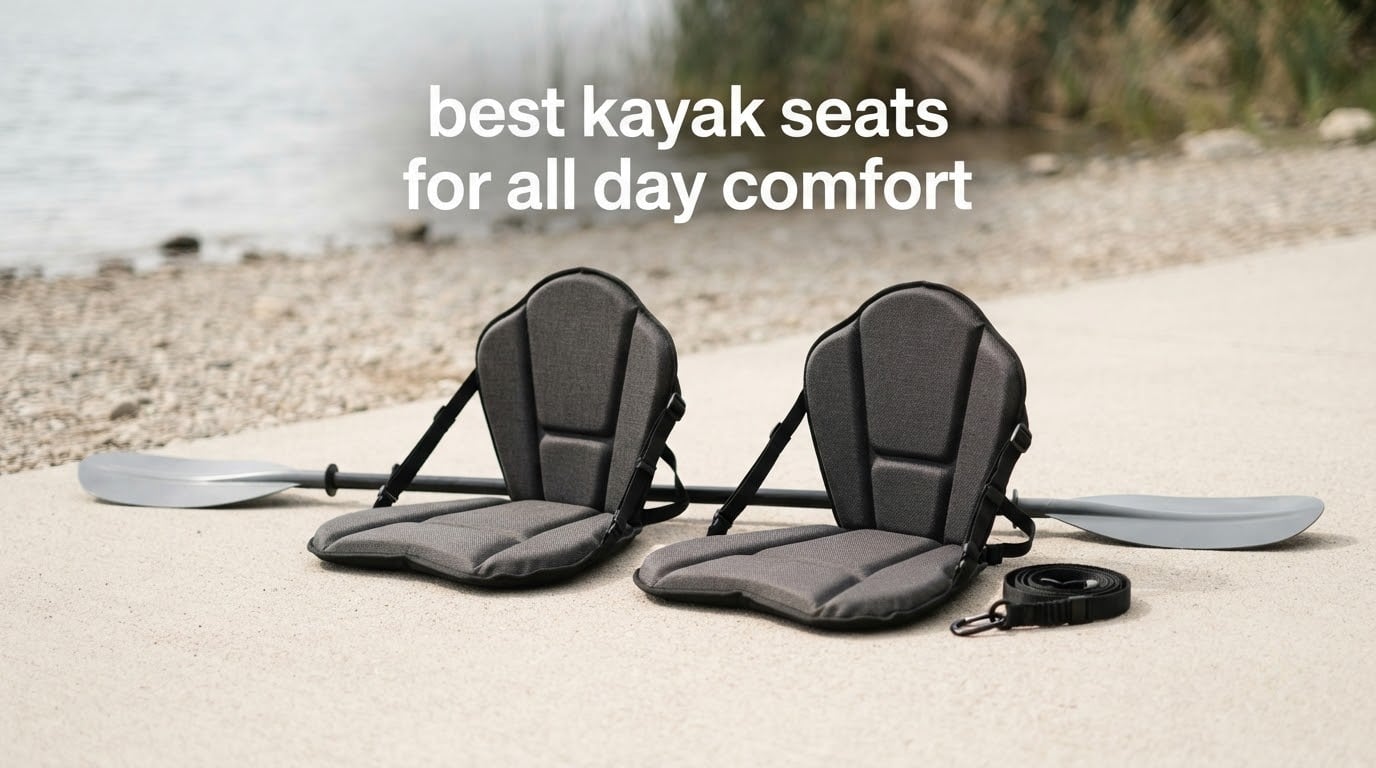
The most comfortable kayak seat is a mesh lawn-chair style frame seat where your hull accepts one. Where it does not, the next best thing is a tall foam back panel around 17 to 18 inches with a thick non-slip cushion underneath.
That answer only works if the discomfort you are trying to fix has the right cause. I have spent a lot of time reading what paddlers report after full days on the water, and the pattern is consistent: a hard molded seat pan produces numbness in 30 to 60 minutes, while a low or absent backrest produces an aching lower back somewhere past the three to four hour mark.
Those are two different problems, and a cushion will not fix the second one. This roundup of the best kayak seats for all day comfort covers every product in the group I compared, from a budget nylon replacement to a reinforced touring seat, and states plainly who each one suits and who should skip it.
Every spec below comes from the manufacturer’s published product data, and every performance note comes from the owner reviews attached to that product. Where I have a first-hand read, I say so; where I do not, I do not pretend to.
Table of Contents
Diagnose Your Discomfort Before You Buy Anything
Before you pick a product, work out which of these you actually have. Buying a thicker cushion when your problem is lumbar support wastes money, and buying a tall seat when your problem is pressure makes a tippy hull feel worse.
Numb or burning rear inside the first hour. This is a pressure problem. Your sit bones and tailbone are loading directly onto a hard pan. A drop-in cushion with a thick fill and an integrated non-skid base is the correct fix.
Aching lower back after three to four hours. This is a support problem. No cushion of any thickness will hold your spine in a neutral curve. You need a full replacement seat with a back panel tall enough to reach your lumbar curve.
Both. Buy the cushion first. A pressure problem makes a supportive seat feel worse, because you cannot settle into the back panel while your tailbone hurts. Once the pressure is handled, move to the seat.
Back stiffness, not pain, after long sessions. Often a mounting issue rather than a cushioning issue. A seat that slides lets you brace with your legs all day, and leg bracing is more tiring than the original complaint.
There is a fifth category worth naming: a seat that is genuinely fine for a two-hour paddle but becomes a liability on a longer trip if you need to rest in it. Rest-ability is a different requirement from comfort, and it is the reason a rigid reinforced back beats a soft plush pad for touring paddlers.
Top 3 Best Kayak Seats (October 2026)

Leader Accessories Universal Kayak Seat
- Molded EVA foam
- High back ergonomic support
- 4 adjustable straps
- Detachable waterproof bag

WOOWAVE Deluxe Padded Kayak Seat
- Grooved memory foam
- Anti-slip base
- Contoured high back
- 4-way straps

RELIANCER Deluxe Padded Seats 2-Pack
- 18 inch backrest
- EVA foam plus PE plate
- Brass clips
- Built-in ventilation
The 10 Best Kayak Seats for All-Day Comfort in 2026
| Product | Specifications | Action |
|---|---|---|
| Leader Accessories Universal Kayak Seat |
|
Check Latest Price |
| WOOWAVE Deluxe Padded Kayak Seat |
|
Check Latest Price |
| RELIANCER Deluxe Padded Seats 2-Pack |
|
Check Latest Price |
 BKC UH-PS223 Memory Foam Kayak Seat BKC UH-PS223 Memory Foam Kayak Seat |
|
Check Latest Price |
 BKC UH-KS222 Padded Nylon Kayak Seat BKC UH-KS222 Padded Nylon Kayak Seat |
|
Check Latest Price |
 PenBan Universal Deluxe Kayak Seat PenBan Universal Deluxe Kayak Seat |
|
Check Latest Price |
 Pelican PS0480-3 Sit-On-Top Seat Pelican PS0480-3 Sit-On-Top Seat |
|
Check Latest Price |
 CLIO Deluxe Padded Fishing Kayak Seat CLIO Deluxe Padded Fishing Kayak Seat |
|
Check Latest Price |
 HLOGREE Thickened Kayak Seat HLOGREE Thickened Kayak Seat |
|
Check Latest Price |
 OceanMotion Ergo-Fit Kayak Seat OceanMotion Ergo-Fit Kayak Seat |
|
Check Latest Price |
How We Ranked These Seats?
We score every seat against five published criteria, and we weight them the way paddlers actually complain. Pressure relief and lumbar support carry the most weight because those are the two complaints that end trips early. Attachment security comes next, because a seat that slides creates a second problem while solving the first. Durability and value finish the list.
The evidence base is manufacturer-published specifications plus the owner review record for each product. We have not paddled with all of this gear, so we lean on hard numbers where they exist, like backrest height in inches, seat thickness in inches, and shipped weight, and we lean on the recurring patterns in owner reviews where they do not.
Two criteria deserve a word before the reviews. First, non-skid base: a cushion that slides is worse than no cushion at all, because you end up gripping with your legs to stay centred, and that leg bracing is more tiring than the pressure problem you were solving. Second, back height: the number that matters is whether the panel reaches your lumbar curve, which for most adults sits somewhere between 16 and 18 inches above the seat pan.
1. Leader Accessories Universal Kayak Seat – Best All-Rounder With the Deepest Review Base
Leader Accessories Kayak Seat SUP Seat Canoe Seat Boat Seat (Black/Gray)
Molded EVA foam with 210D polyester
High ergonomic back
2.7 pounds, 33 cm seat width
4 adjustable straps
Pros
- Deepest review base in the group at nearly 1900 reviews
- Thick molded foam holds up over a full day
- Four-way strap adjustment fits most kayaks
- Corrosion resistant hooks
- Waterproof detachable rear bag
Cons
- Molded foam gives less sink than memory foam
- Some owners want more lumbar contouring
This is the seat I keep coming back to because the evidence behind it is the largest in the group. Nearly 1,900 reviews at a 4.5 average is a much stronger basis for a recommendation than a five-star average across a dozen reviews, and the praise is consistent rather than scattered.
The construction is straightforward and hard to fault: a molded EVA foam interior under a 210D polyester exterior, a high back with padded support for the lower back and hips, and four adjustable straps, two front and two rear, that let you set the position against your particular hull. At 2.7 pounds it is not the lightest option here, but for a full replacement seat that weight is unremarkable.
The hardware deserves attention because it is where cheaper seats tend to fail. Leader fits high-grade corrosion-resistant hooks rather than the standard market hooks, which matters if you are paddling saltwater or storing gear in a damp truck bed. The detachable waterproof rear bag is genuinely useful, not a token extra, because it puts small items behind your back instead of loose in the hull.
One thing to know: molded foam is firmer than memory foam. Over a short afternoon that reads as supportive. Over ten hours, a paddler who prefers to sink into a cushion may find it less accommodating than a memory foam alternative. There is also no stated lumbar contour, so if your complaint is specifically a curve that is not being met, a multi-panel memory foam design may serve you better.
What you get on a sit-on-top fishing kayak?
Strap it to a sit-on-top and the four-point adjustment lets you pull the back panel into contact with your lower back, which is the single most important variable in whether a seat works. Owners fishing from a sit-on-top report that the pan stays put once the straps are tensioned, and the high back takes the load off the lower back during long stationary sessions.
On a sit-inside it works too, though you should check that the 33 centimetre seat width clears your cockpit and that your existing fittings match the strap spacing. On an inflatable, the strap system is the weak point, since inflatables flex and the seat needs a rigid anchor point to stop working against you.
Where it falls short for you?
Skip it if you are a very tall paddler who needs more than 18 inches of lumbar coverage, or if you specifically want a soft sink rather than a firm supportive surface. The listed compatibility is universal fit for kayaks, canoes and SUP boards, and in practice the seat suits people who want a balanced, well-supported ride rather than a specialized one.
Also weigh the 2.7 pounds if you are moving the seat between hulls regularly or carrying a boat on a roof rack solo. It is a real consideration, but a small one compared to the comfort difference over a full day.
2. WOOWAVE Deluxe Padded Kayak Seat – Best Value for Larger Paddlers
WOOWAVE Kayak Seat Thickened Padded Paddleboard Seat Adjustable Boat Seat Cushioned Fishing Seats High Back Comfortable Backrest Support with Detachable Back Storage Bag for Universal Sit
Thickened grooved foam,Memory foam fill
Contoured high backrest
Anti-slip base
2 kg
Pros
- Grooved foam stays breathable over long hours
- Anti-slip base holds the seat in place
- Contoured back removes lower back ache
- Includes rear storage pouch
Cons
- Webbing straps are stiff to adjust
- Some clips described as flimsy and sand-prone
- Storage pouch awkward on curved hulls
This one shows up constantly in reports from heavier paddlers, and that is not a coincidence. The thickened grooved foam is genuinely deep, the high contoured backrest follows the shape of the lower back rather than sitting as a flat panel, and the anti-slip base is specified rather than implied. Owners report that it removed their back pain, including a paddler around six feet and 250 pounds.
The grooves are the detail most people miss when comparing listings. They are cut into the foam to let air move, which matters more than it sounds like it should on a hot afternoon. A solid foam seat in direct sun becomes a heat trap, and heat compounds pressure discomfort long before the padding itself gives up.
Installation is fast. You fasten the connecting snaps of the straps at the kayak attachment points and adjust from there, and the manufacturer states it takes about a minute. The four-way adjustable reinforced webbing straps let you set the back panel angle, which is what makes the contoured shape usable rather than decorative.
Where the value proposition weakens is in the hardware. Owners repeatedly describe the webbing as stiff to adjust and some of the mounting clips as flimsy and prone to picking up sand. On a boat where you clip and unclip the seat every launch, that friction adds up, and it is the main reason this sits second rather than first.
Fit and performance for bigger paddlers
If you are over roughly 200 pounds, this is one of the two seats in the group worth shortlisting first. The thickened foam resists bottoming out better than a thin nylon pad, and the contoured back distributes the load across a wider surface than a flat panel. For a full day of fishing where you stay in one position, that geometry is the difference between a workable seat and an ache by midafternoon.
For a lighter paddler on a two-hour paddle, it is more padding than you need, and the extra 2 kilograms is dead weight in a boat that already moves freely.
Where it falls short for you?
Skip it if you adjust your seat position often and you will be irritated by stiff webbing every time. The rear storage pouch is also a common irritation: it sits behind you, its zipper lacks pull tabs, and on a hull with a curved back the seat can squeeze it. One reviewer also reported loose pouch stitching, which is worth watching in the first month of use.
If hardware longevity on a used hull is your main concern, look at the CLIO seat further down, which ships with D-rings and stainless steel screws so the seat can be fixed permanently instead of clipped.
3. RELIANCER Deluxe Padded Kayak Seats – Best Tall Backrest, Two Seats in One Pack
2 Pack of Kayak Seat Deluxe Padded Canoe Backrest Seat Sit On Top Cushioned Back Support SUP Paddle Board Seats with Detachable Storage Bag 4 Adjustable Straps for Kayaking Canoeing Rafting Fishing
18 by 20.4 inch backrest,12.2 by 15.3 inch seat
EVA foam with PE plate core
UV-resistant neoprene, 600D polyester
Marine grade brass snaps
Pros
- Tallest published backrest in this group
- Deep molded panels feel like a premium car seat
- EVA foam and PE plate absorb shock well
- Brass clips resist rust in seawater
- Ventilation system keeps the seat cooler
Cons
- Seat can slide on hulls without dedicated fittings
- Rear bag is awkward to reach while seated
The 18 inch backrest is the headline number here, and it is the tallest published back height in this group. Measured against the 16 to 18 inch range that adult lumbar curves generally need, this seat sits at the top of it, which is why it earns a place on any all-day list. The backrest is 18 by 20.4 inches and the seat pan is 12.2 by 15.3 inches.
Underneath the cover is an EVA foam interior with a PE plate for extra cushioning and shock absorption, wrapped in UV-resistant neoprene and a 600D polyester exterior. Reviewers describe the deep molded centre panels and the contrasting perimeter padding as feeling closer to a high-end car seat than a kayak accessory, and that impression is consistent enough to trust.
This is also a two-pack. If you own a sit-on-top and a canoe, or want a spare for a second boat, the effective cost per seat drops sharply and the brass clips, which resist rust in seawater, are the right hardware for coastal use. The built-in ventilation system is a genuine design feature rather than marketing, and paddlers notice the difference in heat.
The caveat is attachment. Owners on hulls without dedicated attachment points report that the seat can shift or slide, and the widened attachment straps help but do not eliminate the problem. On a boat where you can add D-rings or pad eyes, this is a five-minute fix. On a boat where you cannot, you are relying on friction alone.
What the 18 inch backrest actually changes?
Back height is the difference between a seat that holds your lumbar curve and one that sits below it. When the panel is too low, your lower back works isometrically for the whole paddle, and the fatigue shows up in your core rather than your back. The RELIANCER panel is tall enough to contact the curve, and owners fishing and drifting report that their back and hips stay supported through a full day.
One practical warning: a tall back panel occupies the same space as a high-backed personal flotation device. Before you commit, check that your vest has a mesh or cut-away lower back, or you will be choosing between the seat and the vest.
Where it falls short for you?
Skip it if you only need one seat and you are sensitive to spend, since a two-pack doubles the outlay for something you will not use twice. The rear water-resistant storage bag also sits behind the paddler and is awkward to reach while seated, so treat it as a deck bag rather than a wallet.
Also check your hull width. The 12.2 inch seat pan is generous for a sit-on-top but tight in a narrow sit-inside cockpit, and a seat pan that does not reach your thigh braces will not hold your paddling position.
4. BKC UH-PS223 Memory Foam Kayak Seat – Best Multi-Panel Support
BKC Brooklyn UH-PS223 Memory Foam Kayak Seat
Memory foam multi-panel padding
17.7 by 20.25 inch backrest
12 by 14.75 inch seat pan
2.5 pounds
Pros
- Multiple panels support legs
- lower back and torso
- 600D polyester and neoprene resist sun and water
- One-minute installation
- 17.7 inch backrest gives good mid-back support
Cons
- Straps may need extra pad eyes to stop sliding
- Softer foam base can shift on slippery hulls
The distinguishing feature here is that the padding is divided into multiple panels rather than being one continuous block. BKC describes them as cushioning the legs, the lower back and the torso separately, and that segmentation is why owners report a meaningful reduction in back fatigue rather than simply a softer seat.
Dimensions are published precisely: the back is 17.7 inches high by 20.25 inches wide, and the seat pan is 12 inches long by 14.75 inches wide, at 2.5 pounds. The cover is a 600D polyester and neoprene blend chosen to resist sun fading, water damage, tearing and puncturing, which is a sensible material choice for a seat that lives in a wet, bright environment.
Installation takes about a minute, using front and rear adjustable straps that clip on and off. The four-way adjustment accommodates most sit-on-top craft and is sized for small to extra-large paddlers. There is a one year limited warranty, which is not generous, but it is a stated commitment from an established brand rather than a marketplace listing with no support at all.
The consistent report from owners is that the seat reduces back fatigue substantially, and that it is a large step up from a factory molded pan. The caveat is that the softer foam base can allow the seat bottom to shift on a slippery hull, and some owners had to add pad eyes or extra hardware to stop it moving. That is a ten-minute fix if your boat allows drilling, and a reason to choose the CLIO seat if it does not.
How the multi-panel padding feels over a long day?
Segmentation matters because your contact points are not in one place. Your thighs press forward, your sit bones press down, and your lower back presses back, each with a different direction and a different sustained load. A single slab of padding compromises between them, while separate panels can each be shaped for their own job.
For a paddler who already has lower back trouble, that torso panel is the point. It fills the gap between the lumbar curve and the shoulders so you are not leaning on a 17.7 inch edge, and owners with back injuries specifically call out the broad support.
Where it falls short for you?
Skip it if you cannot or will not drill your hull and your deck is wet and slippery, because a softer base is more prone to shifting than a firmer molded one. If you need more than 17.7 inches of back height, the shorter RELIANCER or HLOGREE panels are marginal gains, and none of the seats here reach 20 inches.
Memory foam also compresses over a season. New foam will feel firmer than the same foam after months of use, so give it a few outings before you judge it, and expect a softer pan over time rather than a defect.
5. BKC UH-KS222 Padded Nylon Kayak Seat – Best Lightweight Budget Upgrade
BKC Brooklyn UH-KS222 Padded Nylon Kayak Seat
Low profile woven nylon seat,18 inch seat width
Zinc-plated alloy hardware
Front and rear adjustable straps
Rear zippered pocket
Pros
- Low profile design adds comfort without weight
- Holds position well once tightened
- Easy one-minute install and removal
- Rear zippered pocket
- Good value
Cons
- Thin bottom padding suits lighter paddlers
- Slippery nylon underside can let it slide
- Hardware is plated alloy rather than brass
This is the pick for a straightforward reason: it does the basic job at a low profile and does not weigh much. The woven nylon resists sun fading, water damage, rips and punctures, and the zinc-plated alloy hardware does the fastening. At 18 inches of seat width it fits a good range of sit-on-top decks.
Owners like that the seat holds its position well once the front and rear straps are tightened, and that it can be installed, adjusted or removed in about a minute. The rear zippered pocket is small but genuinely there, which is more than most competitors at this level offer.
The honest weakness is padding depth. The bottom is thin by adult standards, and reviewers say it is better suited to lighter or younger paddlers than to anyone heavy. If you are over roughly 200 pounds and your problem is pressure, a thin nylon pan will feel like the factory seat you are trying to escape.
There is also a slippery underside issue. Some owners pop-rivet it into place to stop it moving, which works but means the quick-clip convenience is gone. Separately, one reviewer caught that the hardware is plated aluminium rather than the brass the listing implies, which is a useful reminder to check the material claims on any of these seats.
When a low profile is the right call?
Low profile matters more than most buying guides admit. Every inch of pad thickness raises your centre of gravity, and on a narrow or already tippy hull that cost shows up as a boat that no longer tracks straight. A paddler on a small sit-on-top who feels twitchy after adding padding is usually not having a cushion problem at all.
This seat also suits anyone moving between boats, since it adds comfort without meaningfully changing the weight of the craft, and anyone who wants a two-season test before committing to a thick foam seat.
Where it falls short for you?
Skip it if your main complaint is pressure on a long fishing day, because a thin pan will not solve it. Also skip it if you paddle in saltwater regularly, since plated alloy hardware ages faster than the brass clips used in the group, and if you want a soft sink rather than a light rigid feel.
Pair it with a separate drop-in cushion if you need pressure relief on a lighter frame, and keep the padded nylon back as your lumbar support. That combination covers both complaints for less than a single thick replacement seat.
6. PenBan Universal Deluxe Kayak Seat – Best Configurability Across Craft Types
PenBan Universal Deluxe Kayak Seat Cushion with Storage Bag for Kayak
Molded EVA foam, 210D polyester
12 inch deep, 18 inch high seat
40 cm seat width
1 year warranty
Pros
- Thick molded foam for long sessions
- High back supports back and hips
- Four-point strap adjustment
- Works on kayaks
- SUPs
- canoes
- rowboats and fishing boats
- Waterproof detachable bag
Cons
- Firmest molded foam in the group
- Back height can feel short for very tall paddlers
- Holds the lowest average rating here
PenBan is the most flexible of the group in terms of what it will attach to. The listing covers sit-on-top kayaks, canoes, SUP boards, compatible rowboats and fishing boats, and the form-fitting design is pitched at all body sizes. If your paddle sports involve more than one type of craft, that versatility is the argument for it.
The build is a molded EVA foam interior under a 210D polyester exterior, with a high back design, four adjustable straps split two front and two rear, corrosion-resistant high-grade hooks, and a waterproof detachable storage bag at the back. Published dimensions are 12 inches deep, 18 inches high, and 40 centimetres wide, with a one year warranty.
Owners consistently like the thick molded foam and the four-way adjustment. It is a strong general-purpose seat and it holds a very strong sales rank in Kayak Accessories, which tells you it is moving in volume rather than sitting as a legacy listing.
It also carries the lowest average rating in this group, at 4.3, with a 6 percent one-star share. The specific complaints are consistent: the molded foam is firmer than memory foam alternatives, so it is less accommodating over long hours, and some very tall paddlers find the 18 inch back height leaves them wanting more lumbar coverage. Neither is a defect, but both are boundary conditions worth weighing.
What makes it work across different boats?
Four-point strap adjustment is the reason this fits so many hulls. Two front and two rear straps let you set the seat’s footprint to your deck rather than assuming a fixed geometry, and the corrosion-resistant hooks are specified to outlast the standard market alternatives. On a boat where you want to move the seat between trips, that adjustability is the feature that earns its place.
For a sit-inside owner, the 12 inch depth and 40 centimetre width need checking against your cockpit before you order. A seat that is too wide pushes your knees out and forces a bowlegged posture, which is a common source of the very discomfort you are trying to remove.
Where it falls short for you?
Skip it if your problem is specifically a soft sink or a deep pressure relief, because the molded foam is the firmest in this group. Tall paddlers over six feet should also look at the RELIANCER or HLOGREE back heights first, since 18 inches is at the low end of what a full lumbar curve needs.
If your complaint is numbness rather than back ache, a dedicated cushion will do the job for a fraction of the commitment, and the PenBan is overkill for that problem.
7. Pelican PS0480-3 Sit-On-Top Kayak and SUP Seat – Best for Boats You Already Have D-Rings On
Pelican – Sit-on-top Kayak or SUP Seat – Universal Fit Water Repellent Cushion with Back Support – Black
Water repellent nylon construction
8 inch back height, 15 inch wide
Articulated seat back
Forward strap to 28 inches
Pros
- Water repellent build holds up in wet conditions
- Generous strap adjustment range
- Backrest unzips for roof rack transport
- Clear improvement over stock plastic
- Quick to install
Cons
- 8 inch back gives little lumbar support for adults
- Seat can slide forward with no backrest contact
- Underside zipper can loosen
- May need a mounting kit or added bungee
This is the honest budget-brand compromise in the group, and the trade-off is written in the dimensions. The seat back is 15 inches wide and only 8 inches tall, and the bottom is 17.5 inches wide by 14 inches deep. That 8 inch height is the entire issue: it is a back, but it is not a lumbar support.
What you do get is a well-made seat. The water-repellent nylon construction holds up in wet conditions, the multi-adjustment web-strap system has real range with the forward strap extending to 28 inches and the back strap to 21 inches, and the articulated seat back design is a nicer piece of engineering than the flat panels used elsewhere.
One feature we like is the removable backrest zipper. You can detach the back section and pack the seat flat for roof rack transport, which matters if you move between lakes. The seat attaches to D-rings, and Pelican notes that the accessory mounting kit PS1015-2 may be required if your boat does not already have them.
Owner reports describe a clear improvement over stock plastic, and also describe the two predictable problems: the short back height leaves taller adults wanting more support, and the seat can shift forward and back when there is no contact against the backrest. The underside zipper, which enables the flat-packing feature, is also the part reported to loosen with use and let the seat slide.
Is a universal fit actually universal?
For a D-ring-equipped sit-on-top or SUP, yes. Pelican is a recognised brand and the strap geometry is conventional. For a hull with no D-rings and no willingness to add any, the listing’s own warning applies: owners report that they added bungee loops and used a rivet gun to make it work, which puts it outside the quick-install category.
The deciding question is whether your boat already has D-rings. If it does, this installs in minutes and packs flat. If it does not, budget for hardware or choose a seat that includes it, and reconsider the 8 inch back height while you are at it.
Where it falls short for you?
Skip it if lower back support is the goal, because 8 inches will not get you there regardless of how well it is made. Also skip it if you are a heavier paddler, since the nylon pan is not a pressure solution, and if your boat has no existing D-rings and no drilling option.
It is a reasonable second seat for a fleet of boats, or a wet-weather backup, but it should not be your all-day choice if the ache starts at hour three.
8. CLIO Deluxe Padded Fishing Kayak Seat – Best Hardware Included for a Drilled-In Fit
Kayak Seat Deluxe Padded Fishing Boat Seat, 1Pcs
EVA foam interior, polyester exterior
High contoured padded backrest
Anti-slip base
1.47 kg, D-rings and screws included
Pros
- D-rings and stainless screws enable a permanent drilled fit
- High back gives strong mid and upper back support
- Brass snaps resist corrosion
- Sheds water and dries quickly
- Installs in about ten minutes
Cons
- Bottom cushion is narrow and fairly firm
- Bottom can slide if straps are used alone
- Storage bag seams reported to fail
This is the mounting answer in the group. It ships with four fixed D-rings and four pairs of stainless steel screws, which means you can drill the seat into your deck once and stop thinking about it. Every other quick-clip seat in this roundup relies on tension between straps, and tension is what lets a seat move.
The padding is an EVA foam interior under a high quality polyester exterior, described as skid resistant and UV fade resistant, with a high back contoured padded backrest and an anti-slip base. Owners consistently call this a major upgrade over factory seats and single out the broad high backrest as helping paddlers with back injuries.
Hardware quality is a step above most of the field. The connecting snaps are marine grade solid brass, which resists corrosion far better than plated alternatives, and the whole seat weighs 1.47 kg, the lightest of the full replacement seats here. It also sheds water and dries fast, which is what you want in a seat that lives on an open deck in the sun.
Installation is quick, and the fact that the D-rings and screws come in the box is what makes it quick, since you are not sourcing hardware first. If you own a fishing kayak you intend to keep, a permanent fit is a better long-term decision than a strap-only seat you will keep re-tensioning.
Why a drilled fit beats straps on a fishing boat?
An angler spends hours stationary in one position, then stands up to cast or to land a fish. That repeated stand-and-sit cycle is where a strap-mounted seat announces itself, because the whole thing shifts a little each time and you correct it with your legs. Fix the seat to the deck and that cycle becomes neutral.
The anti-slip base helps, but anti-slip and anti-shift are different properties. A non-slip base resists you sliding across it; it does not stop the entire seat translating across a wet deck. The D-rings address the second problem, and that is the one that tires you out.
Where it falls short for you?
Skip it if you do not want to drill your hull, if your kayak is a rental, or if you move boats often enough that a permanent fitting is a liability. The bottom cushion is also narrow and firm, so a heavy paddler whose main complaint is pressure will still want a separate drop-in pad on top of it.
Watch the storage bag. Owners report the seams failing, so treat it as convenient rather than load-bearing, and do not put anything you care about in it.
9. HLOGREE Thickened Kayak Seat – Best Rigging Kit for a Boat With No Fittings
Hlogree Kayak Thicken Seat, High Back Deluxe Plus Seat, Storage Bag, 1 Pack
2.17 inch thick seat, 17.73 inch backrest
EVA foam plus PE plate core
UV-resistant neoprene, 600D polyester
1.92 kg
Pros
- 2.17 inch seat thickness resists bottoming out
- 17.73 inch backrest follows the body shape
- Full deck rigging kit included
- Upper straps fine tune back panel position
- 12 month warranty
Cons
- Each strap adjusted individually at install
- Suits strap-mount craft rather than every hull
The 2.17 inch seat thickness is the most useful number on this listing, and it is one of the few seats here that publishes it. Most manufacturers say thick or extra thick without a figure. At just over two inches of cushioning, this is the seat least likely to bottom out under a heavier paddler, which is the failure mode that turns a comfort upgrade into a hard pan again.
The backrest is 17.73 by 20.16 inches, close to the tallest in the group, and the seat pan is 12.61 by 15.4 inches. The core is EVA foam with a PE plate for shock absorption, under a UV-resistant neoprene and 600D polyester shell. Owners like the couch-like feel of the extra thick seat and backrest padding.
What makes this one different is the hardware. The box includes a full deck rigging kit: two kayak handles, twelve rivets with gaskets, six C-buckles, eight screws, two T-handles, four D-rings, and eight M6 screws and nuts. If your boat has no existing fittings, you have everything needed to build them rather than improvising with bungee cord.
The four adjustable straps include upper straps that fine tune the back panel position, which is the control that actually determines whether the lumbar curve gets met. The main drawback is the setup: each strap has to be adjusted individually, which takes real time on first install. Budget twenty minutes rather than five.
What thickness actually buys you?
Thickness buys pressure relief by spreading your weight over a deeper column of material, so the peak force under your sit bones drops. That is the whole mechanism, and it is why forum consensus lands on roughly three inches for genuine full-day support. At 2.17 inches you are close to that target but not at it, and this is a full seat rather than a bare cushion, so the effective pan depth is greater than the figure alone suggests.
The cost is centre of gravity. Every extra inch moves you higher in the hull, which matters most in a narrow sit-inside or a small sit-on-top. And a thicker pan pushes your spine further from the backrest, which is why the upper strap adjustment on this seat is not a minor feature.
Where it falls short for you?
Skip it if you want a fast clip-on install, because the individual strap adjustment is genuinely fiddly, and if you paddle a sit-inside narrow enough that a 20.5 inch wide seat crowds your knees. The mounting approach also suits craft with strap attachment points rather than every hull shape.
The 1.92 kg weight is fine for a permanent fit and poor for someone moving seats between boats every launch.
10. OceanMotion Ergo-Fit Kayak Seat – Best Reinforced Rigid Back for Full Touring Days
Ultra thick OceanMotion Ergo-Fit sit on top Kayak seat w/storage bag
Ultra thick padding, reinforced back
Four straps to 22 inches
15 inch seat width
1.49 kg, 1 year US warranty
Pros
- Reinforced back stays rigid rather than flexing
- Ultra thick padding reduces fatigue on long days
- Lowest one-star share in the group
- US company with a one year defect warranty
- Detachable storage bag included
Cons
- Attachment hardware is not included
- Higher cost than foam-only alternatives
- Back height is not published
This is the touring pick, and the reason is the reinforced back. Every other seat in this group uses a foam-backed panel that flexes under load. A reinforced panel holds its shape, which means you can actually rest against it on a long crossing instead of fighting a surface that moves with you. For a paddler who needs to sit back and stop paddling for a while, that rigidity is the whole feature.
The padding is described as extra thick with a reinforced back for a more rigid design, and the manufacturer states plainly that it is designed to reduce fatigue on long days on the water. The seat width is 15 inches and it weighs 1.49 kilograms, and the rating distribution here is the cleanest in the group with a 1 percent one-star share.
Four attachment straps extend up to 22 inches, two toward the front and two toward the back, which is a generous reach for most sit-on-top decks. A detachable storage bag is included, and the company is US-based and owned with a one year warranty against product defects.
Two things to plan for. Attachment points such as pad eyes and D-rings are not included, so if your boat has no existing fittings you will need to source hardware, and the HLOGREE kit earlier in this list covers that case. And the back height is not published, so we cannot confirm it reaches the 16 to 18 inch lumbar range; that is worth asking about before ordering if lumbar support is your main complaint.
Rigidity versus comfort on a long crossing
A flexing back panel forces a small amount of core engagement continuously, because your body never fully settles against it. Over a two-hour paddle you will not notice. Over a full day of touring, that constant micro-engagement is exactly the lower-back fatigue that paddlers spend money trying to escape. A reinforced panel removes the feedback loop.
The trade-off is that a rigid panel does not contour. You are sitting against a firm plane rather than a shaped one, so if you prefer a seat that wraps around you, this is not it. It is for the paddler who wants a stable back to lean into during rest stops and a thick pan underneath.
Where it falls short for you?
Skip it if you cannot source attachment hardware separately, if you want a soft contoured feel, or if a cushion-only solution would solve your problem. It is also the most expensive seat in this group, and that spend is harder to justify for a two-hour weekend paddle.
Check the backrest height before you commit, since it is the one dimension not published here and it is the one that decides whether this fixes a lower back complaint.
How to Choose a Kayak Seat That Lasts a Full Day?
If you take one idea from the buying guides on this topic, take the symptom split. Pressure and support are separate problems with separate products, and most expensive mistakes come from buying the wrong one. Start there, then work through the compatibility questions below.
Match the seat to your kayak type
Sit-on-top kayaks are the easiest case. The deck is flat and wide, so nearly every seat in this roundup fits, and the main decision is width versus your deck and thigh braces. A seat pan that does not reach the brace contact points will not hold your position, and a pan that is too wide forces your knees outward into a posture that tires your lower back over a full day.
Sit-inside kayaks are the hardest case. The cockpit is narrow and usually has molded thigh braces that define where a seat can sit. A wide universal seat can push your legs out and undo the ergonomics the boat designer built in. Measure your cockpit width and check the published seat width before ordering, and expect that a cushion inside the cockpit is a better answer than a wide replacement seat.
Inflatable kayaks need a different approach again. The deck moves, so a seat that depends on strap tension alone will never settle. An inflatable-specific seat with an internal bladder or a hard base is the practical answer, and if your inflatable accepts D-rings, the drilled-fit approach in the CLIO seat works well on one too.
Gel, foam, or inflatable fill
Closed-cell EVA foam, which is what most seats here use, is the default for a reason. It does not absorb water, it dries quickly, it resists UV, and it returns to shape after compression. Memory foam gives a deeper sink and better contouring but compresses faster and holds moisture longer, which makes it a compromise rather than a clear win in a wet environment.
Gel cushions, which sit in the drop-in cushion category rather than the full seat category, distribute pressure differently. Gel lets your sit bones sink in rather than perch on top, which is why forum users consistently rate it highly for numbness. The trade-off is heat: solid gel gets hot in direct sun, and a honeycomb gel structure exists specifically to let air move through it.
Inflatable fill is the most packable and the least supportive over long hours, because air compresses under sustained load and does not recover between sessions. It is the right choice for a portable kit that lives in a dry bag, not for a full day on a fishing seat.
Back height, rigidity, and the life jacket collision
Back height in inches is the number that decides whether your lower back is supported. Most adult lumbar curves need a panel roughly 16 to 18 inches above the seat pan, and the seats here span from 8 inches to just over 18. That 8 inch seat will not fix a lower back complaint no matter how well it is built.
Rigidity matters on longer trips for the reason described above. A reinforced panel lets you rest against it; a flexing foam panel never lets you settle. If your day involves sitting still for long stretches, prioritise rigidity. If your day involves constant movement and repositioning, prioritise contour and give.
Now the part almost no roundup mentions. A tall back panel and a high-backed personal flotation device occupy the same space at your lower back, and the seat usually wins because it is rigid and the vest is not. Before you add an 18 inch back, check your vest. You need a paddle-specific vest with a mesh or cut-away lower back panel, not a general boating vest with solid foam across the lumbar area.
This is a purchase-blocking conflict, not a minor annoyance. People discover it after buying both, and it is one of the most avoidable two-purchase failures in this whole category. Check the vest first.
Thickness, centre of gravity, and body fit
Pad thickness buys pressure relief but charges you in stability. Every inch of added height moves your centre of gravity up, and on a narrow or tippy hull a seat that felt fine yesterday can feel unstable after a thick pad goes in. If your boat is twitchy, resist the urge to add a third inch and solve pressure relief with a thinner cushion instead.
There is a second cost. A thicker pan pushes your spine further from the backrest, which can quietly reduce the back support you paid for. The seats with upper back panel straps, like the HLOGREE, exist to let you recover that lost support by pulling the panel into contact.
For paddlers over roughly 200 to 220 pounds, foam compression is the limit to watch. Thin foam bottoms out, and once it does you are sitting on the shell with a thin pad over it, which is worse than either. Choose a published thickness above two inches, or add a separate cushion over a thin pan. For paddlers over six feet, check the back height against the 16 to 18 inch target and the seat pan depth against your thighs, since short pans are common at this price level.
Check the mounting before you order
Ask three questions about your boat. Do you have existing pad eyes, D-rings or dedicated strap attachment points? Can you drill if you need to? And how wide is the deck or cockpit where the seat will sit? If you cannot drill and there are no fittings, buy a seat that ships with a rigging kit, such as the HLOGREE, or plan on bungee and ties that will never be as secure.
On a used hull, do a repair check before you buy anything. Perished straps, a cracked plastic buckle, or a rusted hook are hardware problems, and replacing them costs a fraction of a new seat. A seat that is structurally sound but has faded webbing needs a strap set, not a replacement. Only replace the whole seat when the foam is permanently compressed or the shell is cracked.
Finally, expect a break-in. New foam compresses before it settles, so give a new cushion two or three outings before you judge it. A seat that feels firm on day one and softer by the fifth outing is working normally, not failing.
Frequently Asked Questions
What is the most comfortable seat for a kayak?
The most comfortable kayak seat is a mesh lawn-chair style frame seat where your hull accepts one, since tensioned mesh over an aluminum frame spreads load and breathes. Where a frame seat does not fit, the next best option is a full replacement seat with a back panel around 17 to 18 inches tall plus a thick non-slip cushion underneath. Both community forums and paddling forums point to the same conclusion, and the frame seat wins on flexibility, airflow and the ability to change position.
What is the most comfortable kayak seat cushion?
A thick honeycomb gel cushion with an integrated non-skid base is the most comfortable cushion option, because gel lets your sit bones sink in rather than perch on a hard surface. Confirm the base is a published integrated polyurethane non-skid layer rather than an anti-slip claim, since a sliding cushion is worse than none at all. Note that cushion thickness fixes pressure only, not lower back support, and that a 1 inch pad is enough for pressure relief but not for a full day of lumbar support.
Which is better for a seat cushion, gel or memory foam?
Gel wins on pressure distribution and heat behaviour if you choose a honeycomb structure, since air moves through the cells and it stays cooler in the sun. Closed-cell EVA foam wins on durability, water resistance and how little it compresses over a season, and it is the right pick above roughly 200 pounds. Memory foam gives the deepest sink and best contouring but absorbs water and compresses faster. For most paddlers in a wet, sun-exposed boat, foam or gel beats memory foam.
What type of foam is best for kayak seats?
High-density closed-cell EVA foam is the best choice for kayak seats, ideally at 3 inches or more for genuine full-day sitting, or self-draining if you can find it. Very soft open-cell foam is the wrong material here because it absorbs water and stops insulating over a long day. A polyethylene plate paired with the foam adds shock absorption and helps the panel hold its shape against a reinforced back.
Do kayak seat cushions slide around?
Cheap ones do, and a sliding cushion is worse than no cushion because you end up gripping with your legs to stay centred, which is more tiring than the pressure problem you were solving. Look for a published integrated polyurethane non-skid base rather than an anti-slip bullet point with no detail. If your deck stays wet, a seat with an anti-slip base plus D-rings or a drilled fix is the only combination we would trust for an all-day fishing seat.
Will a new kayak seat interfere with my life jacket?
Yes, if you add a tall back. An 18 inch seat back and a high-backed personal flotation device occupy the same space at your lower back, and the rigid seat usually wins the fight. You need a vest with a mesh or cut-away lower back panel, which means a paddle-specific PFD rather than a general boating vest. Check your vest before you order the seat, because discovering the conflict after buying both wastes two purchases.
How thick should a kayak seat pad be?
Community consensus among paddlers lands on at least 3 inches for genuine full-day support, which is enough column of material to spread your weight so the sit bones stop digging in. One inch gives you pressure relief only and will not handle a full day. The cost is centre of gravity, because every extra inch makes a narrow hull feel tippy, and a thick pad also pushes your spine away from the backrest. Above roughly 200 pounds, avoid thin gel that bottoms out under load.
What is the 120 rule for kayaking?
If the air temperature plus the water temperature is under 120 degrees Fahrenheit, you should wear a wetsuit or drysuit. As an example, 70 degree air over 50 degree water is exactly 120, so a wetsuit is the correct call. Comfort upgrades are worth planning alongside your thermal protection, not instead of it, because a seat that lets you stay out longer only helps if you are still safe when the temperature drops.
Final Verdict: Which Kayak Seat to Buy?
The best kayak seats for all day comfort come down to one honest question: are you fixing pressure or are you fixing support? If you are not sure, start with a cushion, because a pressure problem makes every supportive seat feel worse until it is resolved.
For most paddlers, the Leader Accessories Universal Kayak Seat is where we land. It has the deepest review base in the group, thick molded foam, corrosion-resistant hardware, four-way strap adjustment and a detachable waterproof bag, and nothing in the owner record suggests a structural weak point. It is the pick for someone who wants one seat that handles a sit-on-top, a canoe or a paddle board without a second decision.
Go heavier on padding and choose the WOOWAVE grooved foam seat if you are a larger paddler, and choose the RELIANCER two-pack if you want the tallest backrest here and own more than one boat. Choose the CLIO if you can drill your hull and want the seat to stop moving for good, and the HLOGREE if your boat has no fittings at all because the rigging kit is already in the box.
Whatever you choose, check the life jacket clearance first and give the foam two or three outings to break in. The last forty minutes of a session is where comfort is actually decided, and our kayak anchor picks cover the other half of a full day on the water.
One last thought. Most of the comfort principles here are not specific to boats. Pressure distribution, support height and the cost of adding bulk are the same problems that shape how you set up a desk, which is why we broke down office chairs for long sitting and anti-fatigue mats on the same criteria. If you are still stuck between two seats, send us the hull and the length of your typical day and we will narrow it to one.