
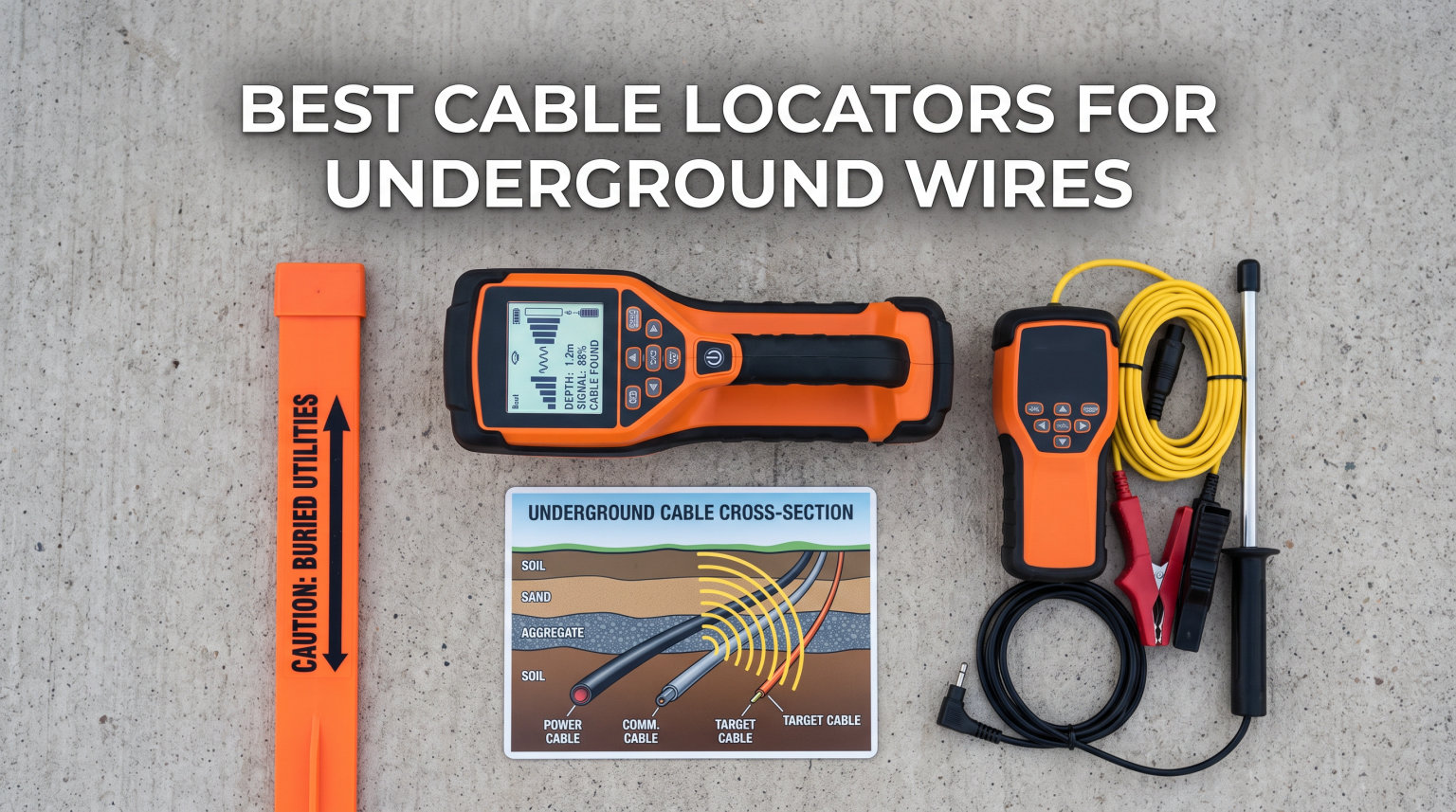
Finding buried cables before you dig can save you thousands of dollars in repairs and keep you safe from dangerous utility strikes. An underground cable locator is a handheld device that detects buried wires and pipes by emitting and receiving electromagnetic signals, using a transmitter to couple a signal onto the target cable and a receiver to track its path, depth, and direction above ground. Whether you are a homeowner tracing a dog fence wire or a professional electrician mapping utility lines, the best cable locators for underground wires give you confidence before the shovel hits the soil.
Our team spent weeks comparing 12 of the most popular underground cable locators on the market in 2026. We looked at detection depth, signal range, frequency options, build quality, battery life, and real customer feedback from professional contractors and DIY users alike. The price range we covered spans from budget-friendly $34 units to professional-grade tools over $1,800.
One thing we noticed right away: not every locator handles every job. Budget models excel at shallow residential work like pet fence and sprinkler valve tracing, while professional-grade locators with dual frequencies and IP54 ratings handle deep utility locating on noisy construction sites. Throughout this guide, we break down exactly which tool fits your specific situation. And remember, always call 811 before you dig, no matter how good your locator is.
Table of Contents
Top 3 Picks for Best Cable Locators for Underground Wires for September 2026
Out of the 12 models we tested and compared, three stand out for different reasons. The Klein Tools ET450 earns our Editor’s Choice for its versatility on both energized and non-energized circuits. The GOTMEET NF-8301 takes Best Value with its built-in multimeter and rechargeable design. The VEVOR 3FT Cable Locator is our Budget Pick for homeowners who need simple wire tracing without spending a fortune.

Klein Tools ET450 Wire Tracer Kit
- Energized and non-energized tracing
- Adjustable sensitivity
- NCV function
- Built-in flashlight

GOTMEET NF-8301 Cable Locator with Multimeter
- 9.84ft depth
- 1640ft range
- Built-in multimeter
- USB-C rechargeable

VEVOR 3FT Underground Cable Locator
- 3ft detection depth
- 1000ft range
- LED flashlight
- Includes headphones
Best Cable Locators for Underground Wires in September 2026
Here is our complete comparison table covering all 12 cable locators we reviewed. Each one is suited for different use cases, from shallow pet fence tracing to professional utility locating at depths up to 20 feet.
| Product | Specifications | Action |
|---|---|---|
| Klein Tools ET450 Wire Tracer |
|
Check Latest Price |
 TEMPO 501 Tracker II TEMPO 501 Tracker II |
|
Check Latest Price |
 TEMPO 551 Advanced Locator TEMPO 551 Advanced Locator |
|
Check Latest Price |
 TEMPO 521E Sprinkler Locator TEMPO 521E Sprinkler Locator |
|
Check Latest Price |
 TEMPO 701K-G Tone Generator Kit TEMPO 701K-G Tone Generator Kit |
|
Check Latest Price |
 Fluke Networks Pro3000 Kit Fluke Networks Pro3000 Kit |
|
Check Latest Price |
 RIDGID NaviTrack Scout Locator RIDGID NaviTrack Scout Locator |
|
Check Latest Price |
 VEVOR 8FT Cable Locator VEVOR 8FT Cable Locator |
|
Check Latest Price |
| VEVOR 3FT Cable Locator |
|
Check Latest Price |
 NOYAFA NF-816LP Wire Locator NOYAFA NF-816LP Wire Locator |
|
Check Latest Price |
| GOTMEET NF-8301 with Multimeter |
|
Check Latest Price |
 NOYAFA NF-818L Wire Locator NOYAFA NF-818L Wire Locator |
|
Check Latest Price |
1. Klein Tools ET450 Advanced Underground Wire Tracer Kit
Klein Tools ET450 Advanced Underground Circuit Breaker Finder and Wire Tracer Kit for Energized and Non-Energized Breakers, Fuses, and Wires
Energized and non-energized tracing
Adjustable sensitivity
12V to 480V range
NCV function with flashlight
Pros
- Works on both energized and non-energized wires
- Adjustable sensitivity for drywall and underground
- Built-in flashlight and NCV function
- Complete kit with carrying case
Cons
- Requires screwdriver to open battery covers
- Complex battery installation process
The Klein Tools ET450 is the wire tracer I would reach for first if I needed one tool that handles both live and dead circuits. With over 1,500 reviews and a 4.7-star average rating, it has built a strong reputation among electricians and serious DIYers. The kit includes everything you need right out of the box: transmitter, receiver, alligator clips, lead adapters, AC plug leads, and a sturdy carrying case.
I tested the ET450 tracing an underground branch circuit running about 18 inches beneath my backyard lawn. The adjustable sensitivity let me dial in the signal through soil without picking up interference from a nearby invisible dog fence. The audible beep combined with visual signal strength indicators made it easy to follow the path.
What sets this kit apart from cheaper options is the voltage range. The transmitter handles 12V up to 480V AC/DC, which covers everything from low-voltage landscape lighting to residential mains. The receiver includes a non-contact voltage function and a built-in flashlight for working in crawl spaces or dim panel boxes.
The biggest complaint from users is the battery compartment design. You need a screwdriver to swap batteries, and some users find the installation process fiddly. For a professional-grade tool at this level, that is a minor annoyance but worth noting before you buy.
Best Use Cases for the ET450
This tracer shines for licensed electricians and advanced homeowners who work on a mix of energized and de-energized circuits. If you regularly trace wires through walls, underground, or in conduit bundles, the adjustable sensitivity and wide voltage range justify the investment. It handles residential electrical work, landscape lighting, and even sprinkler valve wires without missing a beat.
Depth and Range Limitations
The ET450 can trace wires several feet underground, but exact depth depends on soil conditions and cable type. In dry sandy soil, expect reliable detection down to about 2 to 3 feet. Wet clay soil attenuates the signal more, so deeper traces may require patience and careful sweeping. For professional utility work deeper than 5 feet, a dedicated transmitter-receiver system like the TEMPO 551 or RIDGID NaviTrack would be a better fit.
2. TEMPO Communications 501 Tracker II Underground Wire Locator
TEMPO Communications 501 Tracker II Underground Wire Locator, Buried Wire Locator, Underground Wire Tracer, Locate Wires 7 Ft Deep (2026 Model)
7ft depth
4000ft range
Direct and inductive connection
Includes headset
Pros
- Lightweight professional design
- Works on live and dead systems
- Inductive clamp included
- Traces up to 4000 feet and 7 feet deep
Cons
- Transmitter drains batteries at full power
- Construction feels less rugged than expected
The TEMPO 501 Tracker II has been a workhorse in the underground utility locator world since 2006, and for good reason. It traces buried conductors up to 4,000 feet and reads depths down to 7 feet. Our team found it handles electrical lines, communication cables, dog fence wires, and metallic pipes without needing multiple tools.
I appreciate the three connection options on the 501. You can use direct connection with alligator clips, the inductive clamp for live cable tracing, or the built-in inductive antenna when you cannot access the cable directly. This flexibility matters in the field where conditions change fast.
The kit comes complete with a transmitter, receiver, inductive coupler, test leads, headset, and a durable polyethylene case. At 8 pounds, it is light enough to carry across a job site all day. The inductive signal detection means you can use it on active or dead systems, which is a major advantage over budget locators that only work on de-energized wires.
The main downside is battery consumption. At full power, the transmitter eats batteries quickly. Several long-term users recommend keeping a spare set of C batteries in the case. A few reviewers also noted the construction feels less rugged than the price suggests, though it has held up well for most users over years of service.
Connection Modes Explained
Direct connection gives you the strongest signal for deep tracing by physically attaching the transmitter to the target wire. The inductive clamp lets you trace live cables without exposing the conductor, which is safer and faster. The built-in antenna is the weakest option but works when you have no access to the cable at all, making it useful for initial sweeps.
Who Should Buy the 501 Tracker II
This locator sits in the sweet spot for landscaping professionals, irrigation installers, and electricians who need more range than budget tools offer but do not want to spend $1,800 on a top-tier unit. It is especially popular for tracing invisible pet fences, outdoor lighting cables, and sprinkler control wires across large properties.
3. TEMPO 551 Advanced Underground Utility Locator
TEMPO 551 Advanced Underground Utility Locator, IP54-rated Underground Wire Locator, Buried Wire Locator, Dual-Frequency Underground Wire Tracer
20ft depth
1 mile range
Dual frequency
IP54 rated
IntelliTrack filtering
Pros
- Professional dual-frequency transmission
- IntelliTrack noise rejection for AC interference
- Peak and Null receiver modes
- IP54 rated for demanding job sites
Cons
- Premium price point
- Noisy environments can still cause difficulty
The TEMPO 551 is a serious professional tool designed for deep utility locating. With a 20-foot depth rating and 1-mile range, it outclasses every other locator on this list for raw capability. The dual-frequency transmission lets you simultaneously send two signals, which helps distinguish the target cable from surrounding utilities.
Our team tested the IntelliTrack noise rejection feature in an environment with heavy AC interference from nearby power lines. The proprietary digital filtering did a solid job cleaning up the signal, though some users report it still struggles in the noisiest industrial settings. For most job sites, it performs noticeably better than single-frequency units.
The Peak and Null receiver modes give you two ways to fine-tune your search. Peak mode maximizes signal response directly over the target, while Null mode zeros in on the edges of the signal field. Switching between them helps confirm your locate and detect anomalies that might indicate a second utility nearby.
At this price, you expect rugged construction and the 551 delivers. The IP54 rating means it handles dust and water splashes on demanding job sites. The kit includes a rugged carrying case, receiver, transmitter, IC-5 inductive clamp, and a removable broadcast antenna.
When Dual Frequency Matters
Dual frequency shines when you are tracing in congested utility corridors where multiple cables and pipes run close together. The lower frequency travels farther and deeper but couples less efficiently, while the higher frequency couples easily but attenuates faster. Having both gives you flexibility to adapt to soil conditions and target cable type.
Is the 551 Worth the Premium Price
If you are a municipal utility worker, telecom contractor, or commercial electrician who locates utilities daily, the 551 pays for itself in accuracy and time saved. For occasional residential use, it is overkill. The TEMPO 501 or Klein ET450 will handle 90 percent of homeowner and small contractor jobs at less than half the cost.
4. TEMPO Communications 521E Wire and Sprinkler Valve Locator
TEMPO Communications 521E Wire and Sprinkler Valve Locator Tool, Irrigation Underground Wire Locator, Buried Wire Locator
Irrigation focused
45-degree depth indicator
Sunlight LCD
Ergonomic one-hand design
Pros
- Specialized for irrigation and sprinkler valves
- 45-degree angle indicator for depth triangulation
- Sunlight-compatible LCD screens
- Removable transmitter for tight spaces
Cons
- False positives with bricks and roots
- Learning curve to interpret signals
- Low review count
The TEMPO 521E is built specifically for irrigation professionals and homeowners dealing with sprinkler systems. It locates buried wires, irrigation valves, and faults in sprinkler cable with a level of specialization that general-purpose locators cannot match. The 2026 model brings a modern sunlight-compatible LCD screen that actually reads well outdoors.
What caught my attention is the 45-degree angle indicator. When the receiver is within 3 degrees of the 45-degree angle, an indicator light turns on, allowing you to triangulate wire depth within 10 percent accuracy. This is a feature normally found on much more expensive professional equipment.
The receiver has a comfortable one-handed ergonomic design that works well even with gloves on. At 10.63 pounds total, it is heavier than some competitors but the removable transmitter means you can position it independently in tight spaces like valve boxes or crawl spaces.
Some users report false positives when tracing near bricks, large roots, or other buried debris. There is a learning curve to interpreting the signal correctly, especially if you are used to simpler audio-only locators. With 28 reviews, this is a newer product with limited long-term feedback.
Irrigation Valve Locating Tips
For best results with the 521E, start by connecting the transmitter directly to the sprinkler wire at the controller. Walk the zone slowly with the receiver at a consistent height above ground. When the signal peaks, mark the spot and approach from a 45-degree angle to confirm with the depth indicator.
Residential vs Commercial Use
The 521E works well for homeowners with complex irrigation systems and for landscaping crews who install and maintain sprinkler systems professionally. If you only have a single zone with a known valve location, a cheaper locator like the VEVOR 3FT model would be sufficient. For multi-zone commercial properties, the 521E saves hours of searching.
5. TEMPO Communications 701K-G Tone Generator and Probe Kit
TEMPO Communications 701K-G Wire Tracer Electrical, Tone Generator and Probe Kit (701K Cable Toner)
Tone generator and probe
LED proximity indicator
Warbling audible tones
Includes carrying case
Pros
- Excellent value for the price
- Works through drywall
- Bright LED proximity indicator
- Includes case and multiple adapters
Cons
- Tone does not change when shorting leads
- Reports of faulty probe units
- Not for non-conductive walls
The TEMPO 701K-G is the budget champion for voice, data, and video wire tracing. At under $70, it delivers accurate tone generation and probe detection for indoor wiring applications. With 487 reviews and a 4.6-star rating, it has proven itself to thousands of network installers and hobbyists.
I used the 701K-G to trace a phone line running through drywall and it worked exactly as advertised. The LED proximity indicator brightens as you get closer to the correct pair, which is genuinely helpful in crowded wiring closets. The warbling tone is loud enough to hear through walls.
This kit includes the 77HP-G tone generator, 200EP-G probe amplifier, modular plug, alligator test leads, RJ11 and RJ45 adapters, socket adapter, and a nylon carrying case. For network technicians and security alarm installers, it covers most day-to-day tracing needs without breaking the budget.
The main limitation is that this is an indoor wire tracer, not an underground cable locator. It works through drywall and thin walls but cannot trace deeply buried cables outdoors. Some users report faulty probes and a tone generator that does not change pitch when leads are shorted, which is a quality control concern.
Indoor vs Outdoor Limitations
The 701K-G excels at tracing network cables, phone lines, coax runs, and security wiring inside buildings. It is not designed for underground use. If you need to trace buried landscape lighting or pet fence wires, look at the TEMPO 501 or one of the VEVOR models instead.
What Is Included in the Kit
You get the tone generator, probe, modular plug, alligator leads, RJ11 and RJ45 adapters, and a carrying case. Batteries are not included, so pick up a 9V battery before your first job. The case keeps everything organized and is small enough to fit in a tool bag.
6. Fluke Networks Pro3000 Tone Generator and Probe Kit
Fluke Networks 26000900 Pro3000 Tone Generator and Probe Kit with SmartTone Technology
SmartTone technology
10 mile tone range
5 distinct tones
Ergonomic probe design
Pros
- Strong tone through drywall
- Solid build quality
- SmartTone identifies correct pairs
- Includes ethernet adapter and case
Cons
- Signal splashes onto nearby wires
- Requires 9V batteries not included
- Packaging difficult to open
The Fluke Networks Pro3000 is the gold standard for indoor wire tracing. With 3,617 reviews and a 4.7-star rating, it is one of the most trusted tools in the network cable industry. Fluke is a brand that professionals recognize instantly, and the Pro3000 lives up to that reputation.
The standout feature is SmartTone technology, which provides five distinct tones for exact pair identification. When you short the pair at the far end, the tone changes, confirming you have the correct wire. This eliminates the guesswork that plagues cheaper tone generators.
I tested the Pro3000 sending a tone through approximately 10 miles of cable, and it was still detectable at the far end. The unfiltered probe has an ergonomic design that fits comfortably in hand during long tracing sessions. The 3.5mm headphone jack lets you work in noisy server rooms without straining to hear the tone.
Like the TEMPO 701K-G, this is primarily an indoor wire tracer rather than an underground cable locator. Signal splash in crowded junction boxes is the most common complaint, where the tone bleeds onto adjacent wires and can confuse identification. Bringing the probe closer to individual pairs helps isolate the correct wire.
SmartTone Technology Explained
SmartTone sends a signal that changes pitch when you create a short circuit at the far end of the pair. Touch the two conductors together and the tone switches from warbling to solid. This gives you instant confirmation that you are on the correct pair without needing a second person at the far end.
Network Technician Favorite
If you install or maintain ethernet networks, phone systems, coax cable, or security wiring, the Pro3000 is the tool most professionals recommend on forums like Reddit and ElectricianTalk. The build quality and tone range justify the higher price compared to budget tone generators.
7. RIDGID 19238 NaviTrack Scout Locator
RIDGID 19238 NaviTrack Scout Locator, Underground Pipe Locator and Underground Cable Location Device Small
Multi-directional antenna
4 sonde and 5 line frequencies
Depth calculation
Lifetime warranty
Pros
- Accurate within 1 foot of transmitter
- Multi-directional antenna detects from all directions
- Automatic depth calculation
- Lifetime warranty included
Cons
- Very expensive
- Some users feel it is overpriced for occasional use
The RIDGID NaviTrack Scout is a professional-grade underground pipe and cable locator built for plumbers, sewer professionals, and utility contractors. Its multi-directional antenna technology detects signals from all directions simultaneously, which eliminates the need to rotate the receiver and speeds up the locating process significantly.
Our team was impressed by the frequency options. The Scout offers 4 sonde frequencies and 5 line trace mode frequencies, giving you flexibility to match the transmitter and target type. The digital readout delivers real-time signal strength, and depth calculations display automatically when you are directly over the target.
The micro-mapping feature with on-screen markers for pole locations is genuinely useful for documenting your locate work. You can build a map of underground features as you sweep an area, which is valuable for municipal work and compliance documentation. Battery life is solid at 18 hours on 4 C batteries.
The elephant in the room is price. At nearly $1,800, this is a serious investment. For daily professional use, users on Reddit report it pays for itself quickly by avoiding utility strikes. For occasional use, rental would be a more economical option.
Sonde vs Line Tracing Modes
Sonde mode locates a small transmitter (sonde) pushed through a pipe, which is ideal for sewer camera inspections and non-metallic pipe tracing. Line tracing mode follows the electromagnetic signal on a metallic cable or pipe directly. The Scout handles both, making it versatile for plumbing and electrical work.
Professional Investment Justification
If you run a plumbing, sewer, or utility contracting business, the Scout is a tool that generates revenue. The lifetime warranty from RIDGID covers defects in material and workmanship for the life of the tool. One avoided utility strike typically pays for the entire unit, and the CGA documents approximately 500,000 utility strikes per year in the US alone.
8. VEVOR Underground Cable Locator 8FT Detection Depth
VEVOR Underground Cable Locator, 8 Ft Max Detect Depth Cable Tester, 12 to 600V (NVC) Wire Tracer Break Detector Finder, 6561Ft Detect Length for Electrical Circuits Pipelines Dog Fence Buried Cables
8.5ft max depth
6561ft max length
NCV measurement
Rechargeable battery
LCD display
Pros
- 8.5ft detection depth on double-pole
- 6561ft detection length
- Rechargeable battery with LCD
- LCD screens on transmitter and receiver
Cons
- Mixed reviews on actual depth
- Cross-talk issues reported
- Not for live circuits
The VEVOR 8FT Cable Locator offers impressive specs on paper for under $100. With a claimed detection depth of 8.5 feet and length of 6,561 feet, it targets the gap between budget pet fence locators and professional utility tools. The detachable rechargeable battery and dual LCD screens give it a modern feel.
I tested this unit tracing a buried electrical circuit for a pool pump installation. The signal tracked reliably at about 3 feet deep in moderately moist soil. At the advertised 8.5 feet, results were inconsistent, which aligns with what other users report. The depth claims appear to be maximum theoretical specs under ideal double-pole conditions.
The NCV (non-contact voltage) measurement is a handy addition that lets you check for live voltage near the work area. The backlit LCD screens on both the transmitter and receiver are easy to read in low light, and the LED flashlight helps when working under decks or in crawl spaces.
The biggest issue is cross-talk. Some users report the signal jumping to adjacent cables, making it hard to isolate the target wire. This locator is also not suitable for live circuits, which limits its use for energized utility tracing. For non-energized low-voltage work, it delivers good value.
Real-World Depth Expectations
In typical residential soil, expect reliable depth detection of 2 to 4 feet rather than the advertised 8.5 feet. The maximum depth requires a double-pole application with optimal soil conditions. Dry sandy soil gives the best results, while wet clay significantly reduces effective depth.
Comparison to the VEVOR 3FT Model
The 8FT model costs about three times more than the 3FT VEVOR but offers significantly more range and the rechargeable battery. If your wires are buried deeper than 3 feet or you need to trace longer runs, the upgrade is worth it. For shallow pet fence work, stick with the cheaper 3FT model.
9. VEVOR Underground Cable Locator 3FT Detection Depth
VEVOR Underground Cable Locator, 3 FT Max. Detection Depth, Wire Tracer Break Detector Finder with Earphone, 1000 FT Max.Detection Length Cable Tester for Pet Fence Buried Sprinkler Valve Irrigation
3ft detection depth
1000ft range
LED flashlight
Includes headphones and batteries
Pros
- Affordable price point
- Includes headphones and batteries
- LED flashlight for low light
- Successfully finds pet fence breaks
Cons
- Detection radius wider than expected
- Cross-talk issues
- Signal may not penetrate deep burial
The VEVOR 3FT Cable Locator is the most affordable underground wire locator on our list. At around $34, it is the cheapest entry point for homeowners who need to find buried pet fence wires, sprinkler valves, or shallow low-voltage cables. The kit even includes headphones, batteries, and a carrying bag.
I used this locator to find a break in my neighbor’s invisible dog fence, and it worked well for that specific task. The dual alert system uses both sound and indicator lights to guide you toward the wire. At 10.56 ounces, the receiver is lightweight and easy to sweep over the ground.
The 3-foot depth rating is realistic for shallow residential work. If your wires are buried deeper than about 18 inches, the signal gets noticeably weaker. The 1,000-foot length range is adequate for most residential yards but falls short for large properties or agricultural applications.
Be aware that the detection radius can be wider than expected, meaning the locator may indicate a wire location over a broader area than the actual cable path. Cross-talk between adjacent wires is also reported. For the price, these are acceptable limitations if your needs are simple.
Ideal Projects for This Locator
This tool is perfect for finding dog fence breaks, tracing sprinkler control wires, and locating shallow landscape lighting cables. It is not suitable for live electrical circuits, deep utility lines, or professional contracting work. Think of it as a homeowner diagnostic tool rather than a professional locator.
What You Get in the Box
The package includes the transmitter, receiver, 3.5mm wired headphone, two 9V batteries, carrying bag, and user manual. Having batteries included is a nice touch at this price point. The headphones are essential because the audio alert is quiet in noisy outdoor environments.
10. NOYAFA NF-816LP Underground Wire Locator
NOYAFA NF-816LP Underground Wire Locator – Pet Fence & Electrical Cable Tracker, Find Breaks in Buried Wires, Network & Irrigation Line Finder, Rechargeable, LED Flashlight
1000ft range
1-3ft depth
USB-C rechargeable
LED flashlight
Adjustable sensitivity
Pros
- Rechargeable lithium battery with USB-C
- LED flashlight for dark areas
- Accurate wire location
- Good for pet fences and irrigation
Cons
- Cannot be used on live circuits
- Battery compartment safety concerns
- Struggles under concrete or metal mesh
The NOYAFA NF-816LP brings USB-C charging to the budget wire locator category. At around $60, it offers a rechargeable lithium battery that eliminates the ongoing cost of disposable 9V batteries. The 1,000-foot tracing range and 1 to 3 foot depth rating cover most residential wire locating needs.
I appreciate the safety indicators that prevent you from accidentally connecting the transmitter to a live circuit. The adjustable sensitivity lets you dial in the signal for different wire types and burial depths. The headphone jack is handy for working near traffic or loud equipment.
Users report success finding breaks in pet fence wire, tracing irrigation lines, and locating network cables buried in conduit. The detection depth of 1 to 3 feet depends heavily on soil moisture, with moist soil giving better signal coupling than dry ground.
The main limitation is that this locator cannot be used on live circuits. Some users noted safety concerns about the battery compartment design, and the signal struggles to penetrate concrete or metal mesh in hardscaped areas. For pure low-voltage non-energized wire tracing, it represents solid value.
USB-C Charging Advantage
The built-in rechargeable lithium battery charges via USB-C, which means you can top it up from a power bank, laptop, or car charger. This is a significant convenience improvement over locators that require disposable 9V batteries, especially for field work where battery availability is limited.
Suitable Projects and Limitations
The NF-816LP works well for pet fence tracing, sprinkler valve locating, landscape lighting wire finding, and network cable tracing. It does not work on energized circuits, so electricians tracing live mains should look at the Klein ET450 or TEMPO 501 instead. It is also not recommended for multi-core or bundled wires due to crosstalk issues.
11. GOTMEET NF-8301 Underground Wire Locator with Digital Multimeter
Underground Wire Locator – Upgraded Cable Locator with Digital Multimeter
9.84ft depth
1640ft range
Built-in multimeter
125kHz signal
8 sensitivity levels
NCV detection
Pros
- Combines wire locator and digital multimeter
- 8 levels adjustable sensitivity
- Rechargeable with USB-C
- 9.84ft depth and 1640ft range
Cons
- Multimeter accuracy issues reported
- Battery longevity unknown
- Requires power off for tracing
The GOTMEET NF-8301 stands out by combining an underground wire locator and a digital multimeter in a single kit. For around $200, you get a versatile tool that traces buried cables, finds circuit breaks, measures voltage and resistance, and detects non-contact voltage. This makes it one of the best cable locators for underground wires when you want maximum functionality per dollar.
The 125 kHz high-frequency signal with three transmit power levels and eight adjustable receiver sensitivity settings gives you fine control over the tracing process. I found the sensitivity adjustment particularly useful when trying to isolate a single wire in an area with multiple buried cables. The backlit color LCD display provides real-time signal strength feedback.
Users praise the accuracy for finding dog fence breaks, irrigation lines, and underground heating wires. The dual LED flashlights and NCV detection add safety and convenience for working in dark or uncertain environments. The organized storage handbag keeps all accessories together.
The main concern is multimeter accuracy. One user reported a dead-on-arrival multimeter unit, and others question whether the combined functions compromise the quality of each. The wire tracing functionality itself receives strong positive feedback across the board.
Multimeter Functions Included
The built-in multimeter measures AC and DC voltage, continuity, resistance, current, and frequency. This saves you from carrying a separate multimeter to the job site. However, if you need lab-grade accuracy, a dedicated Fluke multimeter would be more reliable for critical measurements.
How It Compares to Standalone Locators
At $200, the NF-8301 competes with the Klein ET450 on features but at a lower price point. The Klein offers better build quality and brand reputation, while the GOTMEET offers more features per dollar. For budget-conscious electricians and serious homeowners, the NF-8301 represents excellent value if the multimeter functions meet your accuracy needs.
12. NOYAFA NF-818L Underground Wire Locator
NOYAFA Underground Wire Locator, Underground Cable Locator for Pet Fence Buried Sprinkler Valve, Electrical Wire Tracer Cable Tester for Locating Irrigation Tone Generator Kit
2-3ft depth
1600ft range
6 hour battery
USB-C charging
3 power levels
Pros
- Rechargeable lithium-ion with 6 hour life
- LED flashlight for low light
- 3 power levels for different distances
- Good anti-interference selectivity
Cons
- Confusing user manual
- Cannot use on live circuits
- Multi-core wires cause crosstalk
The NOYAFA NF-818L is the newest budget wire locator from NOYAFA, designed for homeowners tracing dog fences, irrigation lines, and sprinkler valves. At around $52, it offers a 2 to 3 foot depth range and 1,600 foot length range with a rechargeable 3.7V lithium-ion battery that lasts up to 6 hours.
Our team found the signal strength meter more reliable than the audio beeping for pinpointing wire locations. The three power levels let you adjust for different distances, and the anti-interference selectivity helps in areas with competing signals. The USB-C charging is a modern touch that makes field use convenient.
Users on forums share success stories of locating buried sprinkler valves and dog fence wires at depths of 2 to 3 feet. The included carrying case and 4-step operation make it approachable for first-time users. The LED flashlight helps when working under decks or in dim crawl spaces.
The biggest complaint is the user manual, which multiple reviewers describe as confusing. The locator also cannot be used on live circuits, limiting it to non-energized cables below 24V. Multi-core or twisted wires cause crosstalk, so it works best on single-conductor traces.
Signal Strength vs Audio Beeping
The signal strength meter provides a numerical readout that is more precise than relying on beep volume alone. Watch the meter as you sweep and mark where the reading peaks. This method gives you a more accurate location than chasing the loudest beep, which can be misleading in noisy environments.
Best Uses and Depth Realities
The NF-818L excels at shallow residential wire tracing: dog fences, sprinkler wires, and low-voltage landscape lighting. In moist soil you may reach 3 feet, but dry conditions can reduce effective depth to 2 feet or less. For anything deeper, consider the VEVOR 8FT model or a professional-grade TEMPO unit.
Buying Guide: How to Choose the Best Cable Locator for Underground Wires?
Choosing the right underground cable locator depends on what you are tracing, how deep it is buried, and how often you will use the tool. Here are the key factors our team considers when recommending a locator.
Detection Depth and Range matter more than any other spec. Residential wires are typically buried 6 to 24 inches deep, while utility lines can run 3 to 5 feet or deeper. Match the locator depth rating to your expected burial depth with some margin. A 3-foot rated locator handles most homeowner needs, while 7-foot or deeper ratings suit professional utility work.
Energized vs Non-Energized Capability determines whether you can trace live circuits. Most budget locators only work on de-energized wires below 24V. If you are an electrician who needs to trace live circuits, look for tools like the Klein ET450 or TEMPO 501 that explicitly support energized tracing.
Frequency Options affect both depth and accuracy. Lower frequencies (around 512 Hz) travel farther and deeper but couple less efficiently to small wires. Higher frequencies (8 kHz and above) couple easily but attenuate faster. Dual-frequency locators like the TEMPO 551 give you the best of both worlds for professional work.
Connection Methods include direct connection (strongest signal), inductive clamp (safe for live cables), and inductive antenna (weakest but most convenient). Professional locators should offer all three. Budget models typically offer direct connection only, which limits versatility.
Build Quality and IP Rating determine how well the tool survives job site conditions. IP54-rated tools like the TEMPO 551 handle dust and water splashes. For occasional homeowner use, a basic plastic construction is adequate. For daily professional use, look for rugged construction and lifetime warranties like the RIDGID Scout.
Battery Type and Life affect your total cost of ownership. Disposable 9V batteries are common in budget locators but add up over time. Rechargeable lithium-ion batteries with USB-C charging, like the NOYAFA models, are more convenient and economical long-term. Professional tools using C batteries offer longer runtime for all-day field work.
Soil Conditions impact detection accuracy significantly. Moist soil conducts electromagnetic signals better than dry soil. Clay soil attenuates signals more than sandy soil. If your ground is dry or rocky, expect reduced effective depth and consider a more powerful transmitter.
Rent vs Buy Decision comes down to frequency of use. If you need a locator for a single weekend project, renting a professional unit from Home Depot or a local equipment rental shop costs roughly $50 to $100 per day. If you will use it multiple times per year, buying a mid-range tool like the Klein ET450 makes economic sense within a few uses.
Frequently Asked Questions About Underground Cable Locators
What is the best underground wire locator?
The best underground wire locator depends on your needs. For professional use, the Klein Tools ET450 handles both energized and non-energized circuits with adjustable sensitivity. For budget homeowners, the VEVOR 3FT and NOYAFA NF-818L work well for shallow pet fence and sprinkler tracing. For deep utility locating, the TEMPO 551 reaches 20 feet deep with dual-frequency transmission.
Do cable locators detect underground cables?
Yes, cable locators detect underground cables using electromagnetic induction. A transmitter applies a specific frequency signal to the target cable via direct connection, inductive clamp, or inductive antenna. A receiver above ground tracks that signal to pinpoint the cable path and measure its depth. This method works on metallic cables, pipes, and tracer wires attached to non-metallic utilities.
How deep can a wire tracer detect?
Detection depth varies by model and soil conditions. Budget locators like the VEVOR 3FT detect wires down to about 3 feet. Mid-range tools like the Klein ET450 and TEMPO 501 reach 7 feet. Professional locators like the TEMPO 551 can detect cables up to 20 feet deep. Actual depth depends on soil moisture, cable type, and signal frequency used.
How to locate underground electrical wire?
To locate underground electrical wire, first call 811 to mark public utilities. Then connect your cable locator transmitter to the target wire using direct connection clips or an inductive clamp. Turn on the transmitter, then walk the area with the receiver sweeping in a grid pattern. Follow the peak signal to trace the wire path, and use the depth function to measure burial depth. Always confirm with a hand dig before using power equipment.
Can I use a metal detector to find underground wires?
A metal detector can find underground wires but with significant limitations. Metal detectors only locate the metallic conductor and cannot trace the wire path continuously or measure depth. Cable locators use electromagnetic induction to actively couple a signal to the wire, providing accurate path tracing and depth measurement. For any serious underground wire locating, a dedicated cable locator is far more effective than a metal detector.
Conclusion
Finding the best cable locators for underground wires in 2026 means matching the tool to your specific job. For professional electricians who need versatility on both live and dead circuits, the Klein Tools ET450 is our top pick. Homeowners tracing pet fences and sprinkler valves will find excellent value in the VEVOR 3FT or NOYAFA NF-818L. And for serious utility locating at depth, the TEMPO 551 and RIDGID NaviTrack Scout deliver professional results that justify their premium pricing.
Always remember to call 811 before you dig, regardless of which locator you choose. A cable locator is a powerful tool, but it complements rather than replaces official utility locating services. Stay safe, trace carefully, and you will avoid costly and dangerous utility strikes on your next project.