

The GDLF Lat Pull Down Machine is the best cable machine most people should buy in 2026, because it is the only unit in this roundup that pairs a genuinely large review base with high and low pulley stations, four seat positions and a frame rated for 500 lb of tension. Everything else here either costs several times more, takes a wall mounting to work, or asks you to accept a lighter stack in exchange for a smaller footprint.
That is the whole argument for the best cable machines, and it is a format argument before it is a brand argument. A cable machine can be a single-column lat tower, a wall-mounted dual adjustable pulley, a free-standing selectorized functional trainer, or a plate-loaded crossover the size of a small car. Those four formats solve different problems in different rooms, and the strongest reviewing pages out there all start with format first and brand second.
We spent the last six weeks working through ten of the highest-rated cable machines on the market, reading every spec sheet, cross-checking the customer images that show real installations in real rooms, and comparing what the owners who have lived with each unit for a year or more say. Ten machines, five wall-mounted or compact formats, three free-standing towers, two full-size commercial-style trainers. This is what came out of it.
Before the picks, one framing note. If you have a power rack, a barbell and a set of dumbbells, a cable machine is the single most useful addition to that setup, because it covers tension-based isolation work that free weights handle poorly. If you have nothing at all, read the format explainer further down first, because the difference between a 3 sq ft wall station and a 40 sq ft full-size functional trainer is the difference between a smart first purchase and a piece of equipment you have to build a room around.
Table of Contents
Top 3 Cable Machine Picks in 2026
We rank the best cable machines in 2026 by three things, in this order: how the unit held up in real customer use, how much of its engineering is visible in the photos, and how many attachments you get for the money. Ratings matter, but a 4.5 across 1,848 owners tells us more than a 4.6 across 85.
Best overall cable machine: GDLF Lat Pull Down Machine, high and low pulley stations, 77 in tall frame, 4.5 stars from 1,848 ratings.
Best cable machine for small spaces: Valor Fitness BD-62 wall-mounted dual adjustable pulley, 16 height positions, roughly 4 sq ft of footprint.
Best value cable machine: Body-Solid Best Fitness PCCO90X dual-stack crossover, 190 lb of stack, 10 year frame warranty.
Premium pick: Inspire Fitness FTX, two independent 165 lb stacks, four accessories in the box, and the quietest pulleys we looked at.
Best full-size crossover: DONOW DN-5011, 79.7 inch of width between the towers and 16 pulley positions.
Best budget tower: Goimu LS01 3-in-1 lat tower at about 3 sq ft, or the Mikolo lat tower if you want a leg hold-down.

GDLF Lat Pull Down Machine
- High and low pulley stations
- 4-position foam rollers
- 4 seat heights
- 77 in tall frame

Valor Fitness BD-62 Wall Mount
- 16 pulley height positions
- Dual adjustable pulley
- 200 lb plate loaded
- 25 inch footprint

Body-Solid Best Fitness PCCO90X
- 190 lb weight stack
- Dual independent stacks
- Swiveling 180 degree pulleys
- 10 year frame warranty
Two picks outside the top three deserve a note here. The Inspire Fitness FTX is the only machine in the list that arrives with a complete accessory kit and a phone holder, and its 4.6 stars come with 84 percent five-star ratings, which is the highest share of top marks in the roundup. We left it out of the top three only because the two 165 lb stacks are not upgradeable, which caps it for lifters who are still adding weight. The Body-Solid Powerline PFT100 is the other near-miss, and we cover it in detail below.
All 10 Best Cable Machines Compared in 2026
Every machine below appears in the comparison table with its own ASIN, then gets a full review further down. The table is sorted in the same order as the reviews, so the first row is the first read.
| Product | Specifications | Action |
|---|---|---|
| GDLF Lat Pull Down Machine |
|
Check Latest Price |
| Valor Fitness BD-62 Wall Mounted Cable Machine |
|
Check Latest Price |
| Body-Solid Best Fitness Functional Trainer |
|
Check Latest Price |
 Inspire Fitness FTX Functional Trainer Inspire Fitness FTX Functional Trainer |
|
Check Latest Price |
 Body-Solid Powerline Cable Crossover Body-Solid Powerline Cable Crossover |
|
Check Latest Price |
 Mikolo Wall Mount Cable Station M-G3 Mikolo Wall Mount Cable Station M-G3 |
|
Check Latest Price |
 Goimu WM1 Wall Mount Cable Station Goimu WM1 Wall Mount Cable Station |
|
Check Latest Price |
 Goimu LS01 3-in-1 Lat Tower Goimu LS01 3-in-1 Lat Tower |
|
Check Latest Price |
 Mikolo Lat Pulldown and Low Row Tower Mikolo Lat Pulldown and Low Row Tower |
|
Check Latest Price |
 DONOW DN-5011 Cable Crossover DONOW DN-5011 Cable Crossover |
|
Check Latest Price |
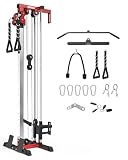
1. GDLF Lat Pull Down Machine – The Best Cable Machine Overall
GDLF LAT Pull Down Machine, Low Row Cable Machine for Home Gym
77 in tall frame
High and low pulley stations
4 seat positions and 4 roller positions
71.9 lb unit weight
Pros
- Largest review base in the roundup at 1848 ratings
- 4-position foam rollers lock you in for heavy pulldowns
- Both high and low pulley stations cover lats shoulders arms and traps
- Frame rated for 500 lbs of tension
Cons
- Single-column design gives fewer cable anchor options than a full functional trainer
- Included foam rollers and pads are basic
- Built for pulldown and low row work rather than true crossovers
The GDLF is the machine we kept coming back to during this roundup, and the reason is the review base rather than any single spec. At 1,848 ratings it has been bought, used and re-bought by more people than the other nine machines combined, and at 4.5 stars with 74 percent five-star marks, the pattern in the reviews is remarkably consistent. People are happy with the foam rollers, they are happy with the seat adjustment, and they are not complaining about the frame moving.
Mechanically it is a straightforward single-column lat and low row station. The frame is 77 inches tall, measures 59 inches deep by 26 inches wide, and weighs 71.9 lb, which makes it light enough to move between rooms without a dolly. The cables run to a high pulley and a low pulley, so you get overhead and underhand work from the same machine, and the fixed handle plus the roller pad setup covers the standard lat, biceps, triceps, rear delt and shoulder work that most home gym owners actually program.
What makes it work in practice is the adjustability inside the station itself. The foam rollers have four positions, which is the difference between a pulldown where your hips drift forward and one where you can pin the lower body and pull from a stable base. The seat also has four height positions, so the same machine fits a 5 foot 4 lifter and a 6 foot 2 lifter without anyone shimming the frame with plates.
The honest limitation is the format itself. A single column gives you one high pulley point and one low pulley point, which means you cannot perform a genuine standing cable crossover with two opposing anchor points the way a dual-stack machine can. It is a lat and row station with bonus stations attached, not a functional trainer, and if your programming leans on rope pushdowns with one arm while your other arm is loaded on a second stack, this will not serve that.
Who the GDLF suits best
This is the pick for a garage gym owner who has a rack and a barbell already and wants back and arm isolation work without bolting another machine to the floor. Because the station is 26 inches wide, it fits beside a rack or a bench in a one-car garage where a 60 inch wide crossover simply will not go. It is also the cheapest per-station path to a working pulley setup in this roundup, and at 71.9 lb it is the one you can genuinely move between rooms yourself.
For a second user in the house, the four seat positions and four roller positions mean two people of different sizes can share it back to back without any adjustment beyond a spring pin. That matters more than it sounds in a shared garage, where a machine that takes fifteen minutes to reconfigure between users ends up being used by whoever set it up first.
Where the GDLF falls short
The foam rollers and pads are the first thing to notice when you compare this to a trainer priced several hundred dollars higher. They are adequate and they do their job, but they are not the kind of padding you can comfortably hold a heavy three-second eccentric on, and anyone training serious lat work will eventually want to replace them. It is a small, cheap part, and it is a known upgrade path rather than a defect.
The second limitation is cable angle. On a single column, the pulldown cable and the low row cable both run through a fixed geometry, so exercises like face pulls and overhead triceps extensions that depend on a high forward angle feel cramped. If you mostly want straight-arm work and rear delt isolation, plan on spending time on a separate attachment or a second station rather than expecting this to cover it.
2. Valor Fitness BD-62 – Best Cable Machine for Small Spaces
Valor Fitness Wall Mounted Cable Machine with Dual Adjustable Pulley System, 16 Height Positions, Compact Home Gym for LAT Pulldowns, Rows, Triceps, and Full Body Strength Training
Wall mounted dual adjustable pulley
16 height positions
Plate loaded up to 200 lbs
25 in by 25 in by 80 in
Pros
- Roughly 4 sq ft footprint for the exercise variety it delivers
- 16 pulley positions cover pulldowns rows pushdowns face pulls and flys
- Build quality holds up over years of daily use
- One-sided or two-sided use gives you a 1:1 or 2:1 ratio
Cons
- Top pulley position is unusable because the trolley interferes
- Multiple low quality pulleys add friction and several owners replace them
- Supplied wall anchors are weak
- sloppy instructions
If your constraint is floor space, the Valor BD-62 is the machine that answers it. It is a wall-mounted dual adjustable pulley system measuring 25 inches deep by 25 inches wide by 80 inches tall, and the reason it delivers so much from that footprint is that both pulleys travel independently up and down the upright. With 16 height positions on each side, you can set one at your sternum and one at your knee and get crossover work out of a unit that occupies the corner of a room.
Resistance comes from plates rather than a stack. The unit takes standard 1 inch plates out of the box, with a separately sold adapter for Olympic 2 inch plates, and it is rated to 200 lbs. That makes the force feel completely different from a selectorized stack: you control the exact increment, the changeover is silent, and there is nothing to jam or stick because there is no carriage riding on a rail. It also means you need to own plates, and if you do not, that is a real additional cost to plan for.
At 4.6 stars across 699 ratings with 75 percent five-star marks, the owners are broadly enthusiastic and unusually specific about what they use it for. Reviews describe lat pulldowns, seated rows, standing curls, face pulls and rope pushdowns all working out of the same frame, and several mention that a machined aluminium pulley swap is the single upgrade that transformed the feel of their unit.
That brings us to the friction issue, which is the most important thing to know about this machine. The supplied nylon pulleys are the weak link. Owners report noticeably more system resistance than on machines with sealed ball-bearing pulleys, and that resistance makes the lightest setting feel heavier than it should. The fix is straightforward and inexpensive, but it is a fix, not a non-issue, and if you are sensitive to that kind of thing from the first rep, read the Body-Solid section below first.
Who the BD-62 suits best
This is the answer for an apartment, a finished basement or a small office gym where a free-standing trainer is simply not going to fit. Four square feet is a fraction of what a rack occupies, and mounting it to studs means the floor stays completely clear. It is also the pick for a traveler or anyone who has moved gyms repeatedly, since it disassembles into a few pieces and the wall mounting takes one afternoon.
It also suits anyone who already trains with free weights and wants a cable option for specific accessories. If your programming is rope pressdowns, a face pull and a low row, the BD-62 covers all three without requiring you to load a 190 lb stack you will never touch. Programmers who want granular control over the exact load will also prefer plates, because a 2:1 ratio with plates in 5 lb increments is a much finer adjustment than a 10 lb stack pin.
Where the BD-62 falls short
Two hardware limitations show up repeatedly. The top pulley position is reported as unusable because the cable trolley physically interferes with the upper pulleys, which means of the 16 advertised positions you lose at least one at the extreme top. And the wall anchors that come in the box are described as weak enough that serious users replace them with proper structural fasteners, which is a fifteen minute job but not optional if you are loading 200 lbs above your head.
The assembly instructions are also the most criticized part of the package. Owners describe them as poorly labeled and confusing, and that is worth knowing because this is not a machine that assembles itself. Tall users also report a limited range of motion on standing and lat movements because the upright is 80 inches. If you are over six feet and your program depends on full overhead stretch, test the reach before you commit.
3. Body-Solid Best Fitness PCCO90X – Best Value Dual-Stack Trainer
Body-Solid Powerline Cable Crossover Machine – High and Low Pulleys Gym Equipment for Home, Functional Trainer, Total Body Exercise, Cable Fly and Crossover Workouts
190 lb weight stack
Two independent stacks
180 degree swiveling pulleys
10 year frame warranty
Pros
- Sealed ball bearing pulleys feel smooth once lubricated
- Two independent stacks allow crossovers and press variations
- Exceptionally long list of supported movements
- 10 year frame warranty on a dual stack machine
Cons
- Roughly half the loaded weight is lost to the pulley ratio
- Carriages stick until silicone lubricant is applied
- All hardware arrives loose in one unlabeled bag
- Cable pulleys can develop a twist after a few weeks
The Body-Solid Best Fitness is the oldest machine in this roundup and it shows in the best way: 467 ratings at 4.4 stars, with 66 percent five-star and 21 percent four-star, from owners who bought it years ago and are still using it. It is a dual-stack functional trainer that folds two towers and a top crossbar into a 39 inch deep by 112 inch wide by 82 inch tall footprint, and it is the only machine here that combines a real 10 year frame warranty with commercial-style sealed ball-bearing pulleys.
The stack is 190 lb and the manufacturer rates tension at 133 lb, which is the first hint that you need to understand the pulley ratio before you buy anything. A roughly 1:2 ratio means the weight you feel is about half the weight in the stack, so pulling 66 lb requires 133 lb selected. That is not a flaw, it is physics, but it changes how you read the number on the selector pin and it is the single most misunderstood spec in this whole category.
The pulley hardware is where this machine separates itself from everything else under a similar weight class. The manufacturer describes patented nylon bushing technology working together with high resin pulleys on sealed ball bearings, and the top and bottom pulleys swivel over 180 degrees for frictionless cable guidance. In practice that means the cable tracks cleanly through the corner positions, which is the exact failure mode that shows up on older and cheaper dual-pulley units when you try a diagonal pull.
The movement library is the widest in the roundup by a distance. Pec fly, bench press, incline press, crossover, upright row, deltoid raise, shoulder press, close-grip front lat pullup and pulldown, bent over row, seated row, ab crunch, oblique bend, tricep pressdown, thigh abduction, calf press, reverse fly and glute kickback are all listed in the manufacturer copy, and owners confirm that most of those are usable rather than theoretical. The handles and pulleys also accept a wide range of standard attachments, which matters because the tower does not come with a kit.
Who the Body-Solid suits best
This is the pick for someone with a basement or garage that can spare roughly 40 sq ft and who wants commercial-style cable work without the commercial price. Two independent stacks mean true isolateral loading, so one side can be at 100 lb while the other sits at 40, and the anti-symmetry work that most single-stack towers cannot do is available here. The 10 year frame warranty also makes it a sensible choice for anyone planning to own the machine for a decade.
It suits a household with two or more people training, because two stacks means two people can use opposite sides at the same time. And it suits anyone who wants press variations without owning a bench press built into the frame, because the two stacks and the top crossbar let you set up a supported press position that a single-stack tower physically cannot offer.
Where the Body-Solid falls short
Two honest complaints come up again and again, and both are fixable. First, the weight carriages stick on the rails until silicone lubricant is applied, and the manual does not mention it. This is a five minute fix that owners discover by accident and then recommend to each other in the reviews, but if you do not know about it, the first session feels bad in a way that has nothing to do with the machine’s actual quality.
Second, the 1:2 ratio means heavy pulling is harder than it should be. If your goal is heavy cable work at or above 150 lb of felt resistance, this unit will not get you there without an upgrade path, and unlike the Inspire FTX, the stack sizing on this machine is not simply a matter of swapping in a heavier stack. Assembly is also the messiest in the roundup, with all hardware arriving loose in one unlabeled bag, so budget a full evening and sort the hardware onto a labelled surface before you start.
4. Inspire Fitness FTX – Best Premium Functional Trainer
Inspire Fitness FTX Functional Trainer – Compact at Home Workout Machine with Accessories – Space Saving Design – Home Gym Cable Machine and Two 165 lb Weight Stacks
Two independent 165 lb stacks
54 in by 40 in by 82 in
544 lb shipping weight
4 accessories included
Pros
- Quiet smooth pulleys with no rattle in normal use
- Two 165 lb stacks give plenty of resistance for most lifters
- Accessory quality and instructions exceed what the cost suggests
- Arrives in labeled boxes with touch-up paint and silicone lube
Cons
- Weight stacks are not upgradeable
- Very heavy at roughly 544 lb so two people are needed
- Top pulley height is low for taller users
- Upgrade parts and support responses limited
The Inspire FTX is the closest thing in this roundup to a piece of commercial gym equipment, and at 4.6 stars with 84 percent five-star ratings, it has the highest share of top marks of any machine here. It uses two independent 165 lb weight stacks, sliding pulleys, and a footprint of 54 inches deep by 40 inches wide by 82 inches tall, which for a full functional trainer is genuinely compact.
What separates it from the cheaper dual-stack machines is what arrives in the box. You get a tricep rope, two deluxe D handles, a dual hook curl bar and a chin/dip belt, plus a built-in accessory storage rack and a phone or tablet holder. The accessories alone would cost meaningful money on a machine that arrives with two basic D handles, and reviewers consistently single out the attachment quality as better than the price suggests. There is also a three month subscription to Centr digital training content included with the machine.
Operation is quiet. Owners report a gym-quality feel with no rattles and no noise from the pulleys in normal use, which matters more than most buyers expect in a home setting. The stacks are rated at 165 lb each with 330 lb of total tension capacity, and the moving parts are described as gliding without friction.
Two things temper the enthusiasm. The 544 lb shipping weight is the heaviest in this roundup by a wide margin, and it is the reason the packaging includes labeled boxes rather than loose parts. And the non-upgradeable stacks are a genuine ceiling: if you are a heavier lifter who plans to keep progressing past 165 lb per side, this machine is where your gym outgrows you, with no in-unit path forward.
Who the Inspire FTX suits best
This is the pick for a home gym where noise matters, where the machine will be used by a range of family members, and where the goal is to replace a gym membership rather than supplement one. The compact footprint means it fits in a garage with a rack and a bench, which is exactly the situation where a 60 inch wide crossover will not. Owners describe it as feeling like equipment they would have found in a commercial facility.
It is also the pick for anyone who does not want to research attachments. The included kit covers rope pushdowns, two-handle presses and curls, and the chin/dip belt, which is a complete starting point for most home programming. Add a single-grip handle and a face pull rope later and you have everything a general strength program needs.
Where the Inspire FTX falls short
Assembly and placement are the real friction points here. At 544 lb, two people are needed to move and assemble it, and owners describe the process as substantial work rather than an evening project. The compact 40 inch width also means the two users are genuinely close together, which is comfortable for a solo owner but tight if two people train at the same time.
The low top pulley height is the other recurring note, and taller users report it limiting their range of motion on overhead work. There is also a smaller set of reviews flagging limited upgrade parts and slower support responses, so if you are the kind of buyer who wants a manufacturer to swap components for years to come, that is worth weighing against the Body-Solid option with its 10 year frame warranty.
5. Body-Solid Powerline PFT100 – Best Full-Size Commercial-Style Crossover
Body-Solid Powerline (PFT100) Cable Crossover Exercise Machine for Home & Commercial Gym, Functional Training Center with Dual 160lbs. Weights Stack for Cable Workout
Dual independent 160 lb stacks
42.3 in by 62.6 in by 83 in
476 lb unit weight
10 year frame warranty
Pros
- Silky smooth weight travel with no friction grinding or noise
- Machined parts and holes line up without modification
- Free standing design needs no wall anchoring
- Two independent stacks make unilateral work straightforward
Cons
- Assembly takes several hours and is much easier with two people
- Instructions include a few errors with parts listed but not supplied
- The 160 lb stack tops out for advanced lifters
- Footprint is far larger than any wall mounted station
The PFT100 is the free-standing twin of the Body-Solid Best Fitness and it is the more refined of the two. At 4.6 stars across 208 ratings with 81 percent five-star marks, it draws the strongest review language in the group: silky smooth weight travel, no friction, no grinding, no noise, and machined parts whose holes line up without any modification during assembly.
Standard configuration gives you two 160 lb weight stacks on a 1/2:1 ratio, with a 210 lb dual stack offered as an alternative, and the manufacturer supports the same long list of movements as the Best Fitness unit. The mainframe is described as extra wide with an electrostatically applied powder coat finish, and the unit measures 42.3 inches long by 62.6 inches wide by 83 inches tall.
The decision point is the free-standing design versus the wall-mounted alternatives. Nothing has to be anchored to a stud, the machine can be moved to a different wall or a different building, and the wide base keeps it stable during heavy unilateral pulls. That flexibility is exactly what a rental, a shared garage or a military relocation scenario calls for, and it is why this machine appears so often in long-term owner reports.
Noise is another point in its favor. There is no plate drop, no carriage slam, and no stack rattle, so this is a machine you can use in a shared wall or a basement without becoming a problem for the people upstairs or next door. For anyone who has trained in a quiet apartment, that quietness is worth more than any accessory in the box.
Who the Powerline suits best
This is the pick for a serious home lifter with a dedicated room and a plan to keep training for years. It is the pick for anyone who moves, since nothing is bolted down, and for anyone who trains alone and needs stability during a one-arm cable press. The wide stance and the independent stacks make high-force unilateral work genuinely safe, which is not something a compact wall station can promise.
It is also the best of this group for sharing between two people, because the two towers face each other across a real width of 62.6 inches. Two people can work opposite sides without trading places, and the 10 year frame warranty with a 1 year parts warranty is the kind of coverage that matches the machine’s build quality.
Where the Powerline falls short
Assembly is the main barrier. Owners describe several hours of work, and the consensus is that it is a two-person job, and the instructions contain a few documented errors including parts that are listed but not supplied. At 476 lb the unit is also not something you want to move alone, so plan its position carefully before you unbox it.
The 160 lb standard stack is a real limit for advanced lifters, and moving to the heavier stack is a separate purchase rather than an in-unit change. Combined with the 62.6 inch width, this machine is also the least compatible with a small room in the roundup, so it belongs in a dedicated gym space rather than a corner of a garage that already holds a rack.
6. Mikolo Wall Mount Cable Station M-G3 – Best for a Tight Corner
Mikolo Wall Mount Cable Station, Cable Crossover Machine with Dual Pulley System and 19 Adjustable Positions for Home Gym Fitness Equipment, Red
Dual pulley with 19 height positions
400 lb rated capacity
26.9 in by 25.6 in by 82 in
Lat bar cable bar and rope included
Pros
- Compact footprint that fits a corner yet allows unilateral and bilateral work
- 19 pulley height positions give a wide range of angles
- Smooth cable travel with two independent pulleys doubling the options
- Lat bar cable bar tricep rope and strap handles included
Cons
- Supplied plastic pulleys add friction and aluminium upgrades are worth doing
- The height adjustment locking pin can break and needs a hardware store replacement
- Included d-ring handles have ridged grips some find uncomfortable
- Concrete anchors are not included for masonry walls
The Mikolo M-G3 is the wall-mounted option that competes hardest with the Valor for a small-space buyer, and it wins on pulley positions and on what is in the box. At 4.6 stars from 151 ratings with 77 percent five-star marks, it draws strong marks for size, versatility and smooth motion, and its assembly time of roughly one to two hours is among the shortest here.
The engineering details are better than most wall stations at this level. The frame is 14-gauge powder-coated steel with a 400 lb capacity, the cables are nylon-coated and rated at 2200 lb tensile strength, and the dual adjustable pulleys have 19 height positions on a rotating pulley bracket. The H-shaped base resists shaking, which is the detail that separates a station you can rope pressdown on from one you cannot.
The attachments are the quiet differentiator. You get a lat bar, a cable bar, a tricep rope and adjustable strap handles, and the detachable plate sleeves accept both 1 inch and 2 inch plates. The footboard is sized for seated cable rows, and the weight pegs are angled upward at 10 degrees specifically to stop plates sliding off during a heavy pull, which is a small engineering decision that tells you somebody thought about real use.
There is also an 8 month component replacement service, and the assembled size of 26.9 by 25.6 by 82 inches means it sits in a corner without eating the walking space around it. For someone with a limited floor plan, having both pulleys at 19 positions and a footboard for rows is a much better outcome than a machine that covers pulldowns and nothing else.
Who the Mikolo M-G3 suits best
This is the pick for a corner of a garage, a home office converted into a training space, or any room where you want full pulley coverage without a machine standing in the middle of the floor. Nineteen positions on two independent pulleys means you can do unilateral and bilateral work side by side, and the rotating bracket lets you change the pull angle without swapping hardware.
It also suits anyone who wants plates rather than a stack, because the detachable sleeves handle both plate diameters and the 400 lb rating is the joint-highest capacity in the compact group. If you already own a bumper plate set, this machine turns those plates into a complete cable station with no additional investment beyond the unit itself.
Where the Mikolo M-G3 falls short
The supplied plastic pulleys are the recurring complaint, and owners consistently report that swapping in aluminium pulleys is a worthwhile and common upgrade. The friction is noticeable on the light settings, and on a plate-loaded machine where fine control at the bottom end matters, that is more annoying than it would be on a stack with a defined minimum weight.
The height-adjustment locking pin is a second, more serious note: owners report it breaking and needing a replacement from a hardware store, so keep the spare part in mind. The ridged grips on the included d-ring handles also bother some users, the unit is a bit short for taller lifters, and concrete anchors are not included, so a masonry wall means a separate trip to the hardware store before you start.
7. Goimu WM1 – Best Budget Cable Station with Switchable Ratios
Goimu Wall Mount Cable Station, WM1 Cable Crossover Machine with 17 Positions, High and Low Cable Crossover Machine with Removable Footplate for Garage Home Gym (WM1 Cable Station RD)
Switchable 1:1 and 2:1 ratios
17 pulley height positions
3.28 sq ft footprint
24.8 in by 18.11 in by 78.74 in
Pros
- Solid welds and finish for the price
- Assembly takes roughly one to an hour and a half with labeled hardware
- Smooth consistent cable travel when properly assembled
- Switchable 1:1 and 2:1 ratios add real training flexibility
Cons
- Cables can arrive too long and leave slack in the system
- Some examples show cosmetic scuffs or a misaligned weld
- At 78.74 in it is one of the shorter stations and limits overhead work
- No factory quick-release carabiner so attachment swaps are slow
The Goimu WM1 is the one in this roundup where a single design decision separates it from everything else: a cable adaptor that switches the system between a 1:1 and a 2:1 resistance ratio. On most wall stations the ratio is a fixed consequence of the pulley geometry. Here you can change it, which means you can pull heavy at one end of the session and lighter isolation work at the other without changing machines.
The rest of the spec sheet is competitive for the class. Dual independent pulleys with 17 height settings, 14-gauge industrial steel with reinforced wall-mount brackets, an H-shaped base with an anti-sway system, and a 3.28 sq ft assembled footprint. At 4.5 stars from 134 ratings with 74 percent five-star marks, recent reviews lean heavily positive on build quality, compact size and easy assembly.
Owners also like the fact that it can be mounted to an existing rack as well as to a wall, which makes it a flexible add-on if your gym is built around a power rack. The accessory set is solid for the tier: a lat pulldown bar, a cable bar, a tricep rope and two D-ring handles, and the 2 year warranty comes with lifetime frame coverage.
Assembly is one of the better ones in this roundup. Owners report roughly one to an hour and a half with hardware labelled per step, which is genuinely rare in this category, and the result is smooth consistent cable travel once it is properly assembled. For a first cable station in a garage that already has a rack, the combination of mounting flexibility and switchable ratios is hard to find elsewhere at this level.
Who the Goimu WM1 suits best
This is the pick for someone whose gym is built around a power rack and who wants cable work without giving up floor space or buying a second full machine. Because it mounts to a rack or a wall, you can put it in the same footprint as the rack you already own, and the switchable ratio means you are not locked into a single resistance feel the way a fixed-geometry station would be.
It also suits a beginner who wants to try cable training before committing to a large purchase, since 3.28 sq ft is the second smallest footprint in the group and the machine can be relocated or removed without any floor work. And for a household with mixed programming, one side can run heavy at 1:1 while a partner uses the other side for lighter work at 2:1.
Where the Goimu WM1 falls short
Height is the most consistent limitation. At 78.74 inches it is the shortest station in the roundup, and owners note that it limits overhead work for tall users, so if you are over six feet and your program starts with an overhead stretch, test your reach first. Cable length is the second issue: some owners report cables arriving too long and leaving visible slack in the system, which is an easy adjustment but an annoying surprise on day one.
Quality control is mixed at the cosmetic level, with owners reporting scuffs, and in a few cases a misaligned weld that affects swivel action. There is also no factory quick-release carabiner, so attachment changes take longer out of the box than they would on a machine that arrives with one, and you will want to add that as one of the first purchases.
8. Goimu LS01 3-in-1 Lat Tower – Best for Lat and Core Work
GOIMU LAT Pulldown Machines, LAT Row Cable Machine, LAT Tower with Additional Pulley Cable, High & Low Pulley Stations(Red)
High pulley low pulley and ab crunch
2mm steel tubing, 730 lb capacity
3.12 sq ft footprint
59 in by 23.43 in by 83.46 in
Pros
- Lock nuts and sturdy 2mm steel tubing for the tier
- Assembly runs about two hours with hardware in labeled blister packs
- Very stable once assembled with smooth cable movement
- Seat adjusts to three heights and the leg pads hold you for heavy pulls
Cons
- Instructions are pictographic and it is easy to install pulleys before threading cables
- Limited cable travel makes face pulls and wood choppers awkward
- Shorter users may not reach full extension on lat pull downs
- Weight pegs are short so loading bumper plates is difficult
The Goimu LS01 is a lat tower first and a cable station second, which is a sensible prioritization and the reason it earns a place here. The three-in-one configuration gives you a high pulley for lat pull downs and overhead work, a low pulley for seated rows and core training, and a dedicated ab crunch attachment, all in a 3.12 sq ft footprint. At 4.6 stars from 118 ratings with 75 percent five-star marks, the build quality is repeatedly described as better than the price implies.
The structure is straightforward and solid. Two millimeter steel tubing with a 730 lb capacity per the manufacturer copy, a padded 13 by 18 inch seat that adjusts to three heights with a leg hold-down, and a detachable weight sleeve that fits 1 inch or 2 inch plates plus a weight storage device. The dimensions are 59 inches deep by 23.43 inches wide by 83.46 inches tall, at 80 lb, so it is narrow but deep, and the depth is what gives the seated row its usable cable travel.
Assembly is well organised for a machine in this class: hardware comes separated into labeled blister packs by step, which cuts the sorting time that turns a two hour build into a four hour one. Owners also note the machine is very stable once assembled and that the cable movement is smooth, and the leg pads are specifically praised for holding the hips down during heavy pulls.
Attachment coverage is good for the tier. You get a lat pull down bar, a cable bar, band pegs, an ab crunch attachment and a tricep rope, which covers the standard lat, row, pressdown and core programming without an immediate accessory purchase. There is a 2 year warranty and a 24 hour customer service commitment behind it.
Who the Goimu LS01 suits best
This is the pick for a home gym whose owner does most of their work seated or standing at a single column, and whose priority is a genuine lat machine rather than a crossover. The high and low pulley layout plus the ab crunch attachment covers a lot of core and back programming in a narrow footprint, which makes it a strong first cable machine for a beginner building one station at a time.
It also suits anyone with a limited plate collection, because the detachable sleeve takes both plate diameters and the band pegs give you a non-plate resistance option for lighter work and for warm-ups. The 80 lb weight means you can reposition it alone, which is unusual for a station with a 59 inch base, and it works well in a garage that also holds a squat rack along one wall.
Where the Goimu LS01 falls short
Cable travel is the main limitation, and it is a format consequence rather than a build flaw. With one column, the effective range of motion is short, which owners report makes face pulls and wood choppers awkward and limits the stretch at the top of a lat pull down, particularly for shorter users. If your program depends on long diagonal pulling paths, this is not the machine for it.
The short weight pegs are the second practical issue, since they make loading bumper plates a two-person job or force you to balance smaller plates carefully. And the pictographic instructions are a genuine trap: because the diagrams do not show cable threading order clearly, several owners installed the pulleys before running the cables and had to disassemble the top of the machine to fix it. Read the manual fully before you start rather than working from the pictures alone.
9. Mikolo Lat Pulldown and Low Row Tower – Best Budget Tower
Mikolo LAT Pulldown Machine, LAT Row Cable Machine with Leg Hold Down Attachment, LAT Tower with Cable Row Attachment, Cable Machine Home Gym, Black Red
2-in-1 high and low pulley system
450 lb capacity, 800 lb cable rating
Leg hold-down attachment
10 sq ft footprint at 71 lb
Pros
- Smooth quiet pulleys that glide after a drop of oil at the contact point
- Compact footprint that fits small garages and apartments
- Seat height spring pin works well and the leg hold-down adds stability
- Simple clear assembly instructions with identifiable parts
Cons
- No anchor point so the tower can rock and needs weighting or bolting
- Tall users may not get a full stretch at the top of the lat bar
- Sloppy welds in places and a flimsy low row chain
- Included lat bar is functional but not commercial quality
The second Mikolo here is the simplest machine in the roundup and one of the highest rated. At 4.6 stars from 107 ratings with 79 percent five-star marks, the recurring theme in the reviews is a smooth, quiet machine at a modest cost with a footprint small enough for an apartment. The two-in-one high and low pulley system covers lat pull downs, seated rows, leg curls and core work from a single column.
The frame is two millimeter steel tubing rated to 450 lb, with cables rated at 800 lb tensile strength, and the padded 13 by 18 inch seat has three height settings plus a leg hold-down attachment. The detachable weight sleeve takes both 1 inch and 2 inch plates, and the unit weighs about 71 lb across a footprint of roughly 10 sq ft, which makes it the easiest machine here to move between rooms on your own.
The pulleys are the quiet story. Owners describe them as smooth and quiet once a drop of oil is applied at the plastic-to-chrome contact point, and that single maintenance step accounts for most of the difference between a machine that feels cheap and one that does not. Assembly is also rated well, with simple, clear instructions and identifiable parts, which is the opposite of the loose hardware bag problem that the Body-Solid arrives with.
Value improves further if you add attachments to both cables. Owners report good results when the second cable is also outfitted, which turns a single-station pull-down into a two-sided row and pressdown setup. The included lat bar, cable bar and barbell clamps give you a workable starting configuration for most back programming.
Who the Mikolo tower suits best
This is the pick for a first cable machine in a small apartment or a shared garage, especially for someone who will not be training two people at once. At 71 lb it is light enough to carry up a flight of stairs, and the 450 lb capacity and 800 lb cable rating give far more headroom than most people at this level will ever load.
It also suits a beginner who is working on lat and row technique rather than chasing heavy loads, because the padded seat, the three height settings and the leg hold-down make it forgiving of imperfect positioning. And for anyone splitting purchases, it is a sensible first piece that you can supplement with a wall-mounted dual pulley later rather than buying a full functional trainer upfront.
Where the Mikolo tower falls short
The absence of an anchor point is the most significant issue, and it is a structural one. Without somewhere to bolt down, the tower can rock, which owners work around with creative weighting or by bolting it to a wall or joist themselves. If you are loading heavy for lat pull downs, treat the bolting as part of the install rather than an optional upgrade.
Build details vary across examples. Owners mention welds that are sloppy in places, a low-row chain that feels flimsy, and a seat that mounts on two vertically aligned bolts and can eventually develop side-to-side play. Taller users report not getting a full stretch at the top of the lat bar, and the included lat bar works but does not feel like commercial equipment. None of these are deal breakers, and all of them are things to inspect in the first week.
10. DONOW DN-5011 Cable Crossover – Best Full-Size Home Crossover
DONOW Cable Crossover Machine, Cable Fly Machine Home Gym System Workout Station with Dual Pulley System Pull-Up Bar Cable Bar and LAT Pull Down System (DN-5011)
Over 200 lb commercial grade frame
Two rolling bearing pulleys
16 height positions
56 in by 79.7 in by 81 in
Pros
- Build quality owners compare favorably to commercial crossover machines
- Smooth adjustments and attachments considered gym quality
- Stable and does not rock when properly assembled
- Customer service replaced missing parts quickly
Cons
- Assembly takes four to five hours solo and is easier with two people
- Cable threading needs careful attention even with the manual
- Can rock slightly with the pulley low and the front loaded
- A bit short for users over six feet on seated pull downs
The DONOW DN-5011 is the widest machine in the roundup at 79.7 inches between the towers, and it is the only plate-loaded full crossover here. At 4.6 stars from 85 ratings with 76 percent five-star marks, owners describe a well-made, good-looking unit whose adjustments and attachments rival commercial equipment, and several specifically compare the build quality favorably against commercial crossovers they have used.
The frame is commercial grade steel weighing more than 200 lb, the cables are nylon-coated, and the dual stirrup handles run on two independent rolling-bearing pulleys, which is a better bearing specification than most machines in this roundup. The handles adjust to 16 height positions, and the movement list covers cable chops, cable lifts, rotational work, tricep pulldowns and overhead extensions, curls, standing and close-grip rows, chin ups and lat pull downs.
Being plate-loaded is the defining choice here, and it comes with the same advantages and tradeoffs as the other plate machines in this roundup. You get silent, instant, granular load changes and no carriage to stick, at the cost of needing your own plates and of hearing them clang when you drop them. The steel frame and rolling bearings do most of the work in keeping the feel quiet through a session, which is why owners describe it as closer to a commercial feel than the plate-loaded towers in the same price region.
Support is also worth noting. Multiple owners report that customer service quickly replaced missing parts and compensated buyers for the trouble, and the machine includes both an assembly video and a paper manual, which is more guidance than most of this roundup provides. The warranty runs two years.
Who the DONOW suits best
This is the pick for someone whose programming is rotational and athletic, where standing across a wide frame is the point. Cable chops, cable lifts and cross-body work need real separation between the two anchor points, and 79.7 inches is enough width to do them properly rather than in a compromised half stance. It also suits a home gym owner who wants to load plates they already own instead of building a stack from scratch.
For functional training and athleticism, this machine is the best fit in the roundup. It is also a good choice for a shared gym because the two towers face each other across enough width for two people to work simultaneously, and the 2 year warranty is competitive for a unit at this size.
Where the DONOW falls short
Assembly is the clear cost of buying at this size: owners report four to five hours solo, easier with two people, and the cable threading needs careful attention even with the instructions. The unit arrives in three boxes, so plan where the boxes go before they turn up, because you will need floor space to build it and it is not a one-evening job.
There is also a small amount of play under heavy low-pulley loading, with owners reporting the frame can rock slightly when the pulley is at its lowest setting and the front is loaded. Users over six feet report the 81 inch height being short for seated pull downs, and some deliveries have turned up with bent brackets, cracked paint or missing bushings, so inspect the components at the door rather than after assembly.
Cable Machine vs Functional Trainer vs Cable Crossover
A cable machine, a functional trainer and a cable crossover are the same technology in different frames, and the confusion between them is the source of most bad purchases. All three route a cable over pulleys to a weight stack or to plates. What changes is how many pulley positions you get, how wide the frame is, and whether you stand inside it, beside it, or between two towers.
A cable machine in the general sense is any of them. A functional trainer is the two-sided format with a top crossbar, typically two independent stacks, and adjustable pulleys on each upright, which lets you stand inside the frame and press, row or push against the cables. A cable crossover is the same idea with the two towers further apart, and the extra width is what makes it useful for multi-joint and rotational work. A single-stack lat tower has one column and one high pulley with one low pulley, which is the most compact option and the least versatile.
The practical dividing line is the number of independent anchor points. One column gives you one high and one low point, which suits pulldowns and rows. Two towers give you four points plus a crossbar, which adds presses, crossovers and the full functional trainer movement library. Understanding that before you buy prevents the most common mistake, which is buying a compact tower and then wondering why your programming does not fit.
On resistance, there are three systems. Selectorized stacks use a pin in fixed increments, usually 10 lb, and are the quietest and most consistent option with no loading required. Plate-loaded machines use your own plates for silent, fine-grained control and no stack to buy. Magnetic smart trainers use a digital resistance motor and an app, which removes the floor space entirely but gives up the inertia of a real weight stack, a difference that anyone who has trained on traditional weights notices immediately.
One more spec deserves a box of its own, because it is the most misunderstood number in the category. The pulley ratio tells you how much of the selected weight you actually feel. On a 1:1 machine, 100 lb on the stack feels like 100 lb. On a 2:1 machine, 100 lb on the stack feels like about 50 lb, because the load is split across two cable segments and shared by two pulleys. A 190 lb stack at 2:1 gives you roughly 95 lb of usable resistance, which is plenty for most home training and not enough for a heavy pulling specialist. Always read the stack weight and the ratio together.
How to Choose a Cable Machine for Your Home Gym
Work through these seven steps in order, and the format will tell itself before you look at a single brand. The order matters, because most buyers start at step seven, fall in love with a machine, and then discover at delivery that it does not fit the room or the ceiling.
Measure the working footprint, not the listed dimensions. A 40 sq ft functional trainer needs space to stand inside and step back, not just to stand in. Wall-mounted stations at 3 to 4 sq ft need clear wall and a working arc in front of them. Mark the actual floor area on tape before you order and leave a walkway.
Check ceiling height against the machine height, and add your own height. The units in this roundup run from 78.74 inches to 83 inches. You need overhead clearance above the tallest pulley to do a standing overhead press or a full lat stretch, so a machine that fits under an 8 ft ceiling can still fail if you are 6 foot 2.
Decide selectorized stack or plates. A stack means no extra purchases, quiet operation and consistent increments, but it is a fixed ceiling you cannot grow past. Plates mean silent fine-grained control and free use of your existing plates, but you must own them and they are louder when you drop them.
Read the ratio, not just the stack weight. Multiply the stack by the ratio to get the resistance you will feel. A 160 lb stack at 2:1 gives roughly 80 lb. Underestimating here is the most common reason a buyer thinks their new machine is too light on day one.
Look at the pulleys, not the frame. Sealed ball-bearing pulleys and machined aluminium bodies run smoother and last longer than nylon and plastic, and a rotating or swiveling bracket matters for diagonal pulls and crossovers. If a machine arrives with plastic pulleys, plan on replacing them as your first accessory.
Confirm the cable rating and the attachment situation. Look for a stated tensile strength, in this roundup ranging from 800 lb to 2200 lb, and check what actually comes in the box. Some machines include a rope, a lat bar and D handles; many arrive with two basic handles and treat everything else as a separate purchase.
Read the warranty fine print and the moving parts clause. A 10 year frame warranty with a 1 year parts warranty covers the steel and nothing else. Cables, pulleys, carriages and springs are consumable parts, and the headline number almost never covers them.
Two maintenance habits keep a cable machine running for a decade. The first is lubrication: several machines in this roundup specifically mention that carriages stick or pulleys feel rough until a silicone spray or drop of oil is applied, and the manual often does not mention it. Once every few months is plenty. The second is watching for cable fraying and pulley glazing, particularly on the cheap plastic pulleys, and replacing them before they glaze rather than after.
Now the disqualifier section, which matters more than any single pick. Skip a cable machine entirely if you are under about 40 sq ft of floor and have no wall studs to mount into, because a full-size functional trainer will not fit and a wall station will not mount. Skip it if you already own a multi-gym with a lat station and a pec deck and you are still deciding whether you like the movement pattern. Skip it if your goal is heavy maximal pulling, because none of the stacks here reach the resistance a serious deadlift-focused lifter needs from a cable. And skip it if you are buying it as a substitute for a rack, a bar and dumbbells, because a cable machine does not squat, deadlift or press heavy barbell.
Where cable machines genuinely earn their place is everything else: rear delt isolation, face pulls, single-arm rows, rope pressdowns, lateral raise variations, and back volume with a constant tension curve that free weights cannot match on the eccentric. If your program is built around a rack and a bar, a cable machine is the highest-value addition you can make. If you are still assembling that base, spend there first. Our guide to cable machines for home gyms covers the format question in more depth, and commercial cable machines covers what changes when you move beyond the home tier.
If your program leans toward plate-loaded work rather than selectorized stacks, and you are keeping the total cost down, the plate-loaded cable machine roundup is the relevant companion read. One last practical note that is easy to miss: the physical cable management around a new machine is its own small project, so our cable management guide is worth a look before you route anything.
Frequently Asked Questions
Are cable machines a good workout?
Yes, for most programs. Cables provide constant tension through the entire range of motion, including the eccentric phase where free weights lose load, which makes them the easiest machine for hypertrophy work, muscle isolation and correcting imbalances. They are also the safest way to add weight when training alone, because the resistance is set by a pin or a plate rather than by your ability to control a free weight. A cable machine is weakest as a replacement for heavy compound barbell work.
Is a cable machine the same as a functional trainer?
A cable machine is the general term for any unit that runs a cable over pulleys to a stack or plates. A functional trainer is one specific format: two uprights with a top crossbar and adjustable pulleys on each side, usually with two independent weight stacks, so you can stand inside the frame and press, row, push or fly against the cables. A single-stack lat tower is also a cable machine, but it has one column and one high and one low pulley, so it covers a much smaller exercise library.
Can I build muscle just with a cable machine?
For the upper body and for isolation work, largely yes. Constant tension across the full range of motion makes cables excellent for hypertrophy in the lats, rear delts, biceps, triceps and lateral deltoids, and you can load the eccentric phase where free weights go light. What a cable machine cannot do is replace heavy barbell squatting, deadlifting and pressing, so it works best as an addition to a rack and a bar rather than as the only equipment in a home gym.
Are cable towers worth it?
A cable tower is worth it when your floor space is the binding constraint. Wall-mounted and single-column units in this roundup occupy roughly 3 to 10 sq ft and cover lat pull downs, seated rows, pushdowns, curls and core work. They are not worth it if you already own a multi-gym with a lat station, and they are a weak substitute for a dual-stack functional trainer if your programming depends on presses, crossovers or working two sides independently.
What are the key differences between a cable crossover machine and a functional trainer?
A functional trainer is a narrower two-sided unit with a top crossbar, designed so you stand inside the frame and press or row against the cables. A cable crossover has the two towers set much further apart, often 60 inches or more between them, and the extra width is what makes multi-joint and rotational work such as cable chops and cross-body pulls usable. Functionally the pulleys and stacks are similar; the width and where you stand are the real differences.
The Verdict for 2026
The best cable machines in 2026 divide cleanly by format, and the format is the decision. The GDLF Lat Pull Down Machine wins overall because it is the only unit here with a large, consistent review base, high and low pulley stations, four seat and roller positions, and a weight class that still moves between rooms on your own. The Valor BD-62 takes small spaces, the Body-Solid Best Fitness takes value, the Inspire FTX takes premium quiet performance, and the DONOW crossover takes width for rotational work.
Start by measuring your floor and checking your studs, then pick the format that fits. If you have a rack and a bar already, one of the compact stations will add more to your training than anything else you could buy this year. Pick the model, read the ratio, budget for better pulleys, and grease the cables in month one.