
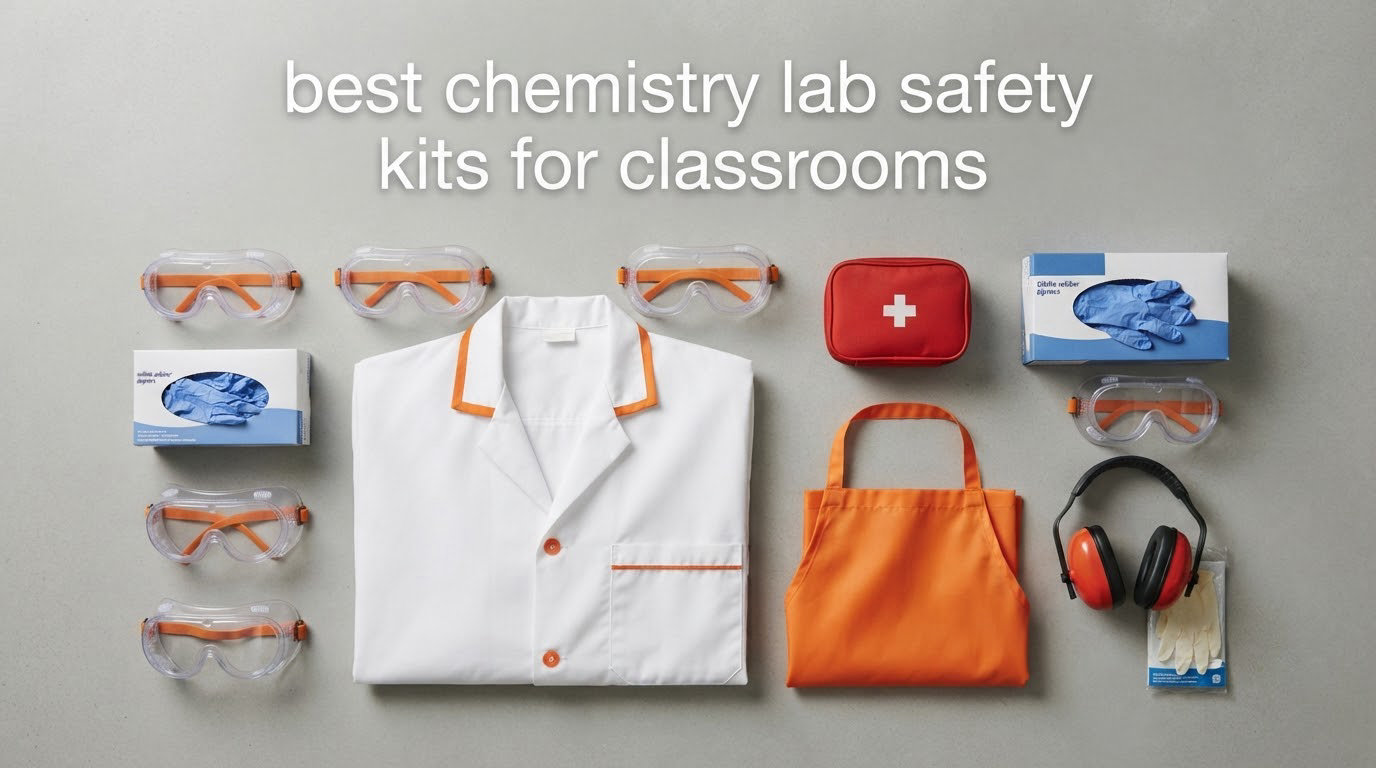
The mistake I see most often in classroom chemistry setups is not buying too little safety gear. It is buying the wrong kind of eye protection. A carton of impact-rated safety glasses looks like PPE on a shelf, fits most faces, and satisfies a purchase order. Put it in front of a student working with a dilute acid and it is the wrong product entirely, because a flying fragment and a liquid splash are different hazards that need different gear.
That is why a serious answer to the best chemistry lab safety kits for classrooms question has to start with kit categories rather than brand names. Schools do not buy one thing. They buy eye protection, spill response, and emergency equipment, and each category has its own sizing math, its own replacement cycle, and its own failure mode. Our team pulled ten kits across all three of those categories, read the listing specs against the published rating and review data, and marked every one with what it does not cover.
Everything below is built around real class sizes. We sized for 24, 30, and 32 students, included spares and a breakage allowance, and kept the spill kits honest about which chemistry they actually handle. If you are also fitting out the room itself, our STEM lab equipment kit guide covers the apparatus side. Updated for October 2026.
Table of Contents
Top 3 Picks for Best Chemistry Lab Safety Kits for Classrooms
The three picks below cover the three situations a classroom actually runs into: a mixed-age room with a hard budget, a room where every student needs their own pair, and a room full of students who have not finished growing.

G and F Products 12-Pack Safety Goggles
- ANSI Z87.1 certified
- 12 pairs per box
- UV400 polycarbonate
All 10 Chemistry Lab Safety Kits Side by Side (2026)
Every kit in the table below appears in the same order as the individual reviews, with the same ASIN, so you can move between the overview and the detail without cross-referencing.
| Product | Specifications | Action |
|---|---|---|
| G and F Products 12-Pack Safety Goggles |
|
Check Latest Price |
 amoolo 24-Pack Safety Glasses amoolo 24-Pack Safety Glasses |
|
Check Latest Price |
 Aqulius Kids Safety Glasses 24-Pack Aqulius Kids Safety Glasses 24-Pack |
|
Check Latest Price |
 BISON LIFE Kids Glasses 6-Pack BISON LIFE Kids Glasses 6-Pack |
|
Check Latest Price |
 Brady SPC Universal Portable Spill Kit Brady SPC Universal Portable Spill Kit |
|
Check Latest Price |
 Oil-Dri 5-Gallon Bucket Spill Kit Oil-Dri 5-Gallon Bucket Spill Kit |
|
Check Latest Price |
 Stardust Universal Spill Kit 2-Pack Stardust Universal Spill Kit 2-Pack |
|
Check Latest Price |
 CGOLDENWALL Portable Eye Wash Station CGOLDENWALL Portable Eye Wash Station |
|
Check Latest Price |
 PhysiciansCare Eyewash Station with Solution PhysiciansCare Eyewash Station with Solution |
|
Check Latest Price |
 Aceoptics Lab Goggles with Hard Case Aceoptics Lab Goggles with Hard Case |
|
Check Latest Price |
1. G & F Products 12-Pack Safety Goggles — Best Overall Class Set
G & F Products 13016-NEW Safety Goggles, 99% Protection Against UV-A, B & C Rays, Impact & Ballistic Resistant, Clear Lenses, 12 Pack
ANSI Z87.1 impact rated
Clear polycarbonate lenses
12 pairs, assorted colors
8 ounces
Pros
- ANSI Z87.1 certified impact protection
- Clear polycarbonate lenses
- 12 pairs in assorted frame colors
- UV400 blocking
- Lowest per-pair cost in a class-ready box
Cons
- Open frame provides no splash seal
- One-size fit sits loosely on smaller faces
- No anti-fog or anti-scratch coating listed
This is the box we hand to a first-year chemistry teacher with a class of 30 and a department budget line that has already been spent once. Twelve pairs in assorted frame colors, a contoured nose bridge, flexible adjustable temples, and a 4.6 average across more than 5400 reviews. The 77% five-star share in the rating distribution tells you the failure rate is low.
What earns it the top spot is the combination of rating and review volume. Nothing else in this list has been bought, worn, and re-bought by classrooms at this scale, and that scale is what tells you whether a lens survives a year of student handling.
The open frame is the honest trade-off. There is no facial seal, so this is impact protection for dust, debris, and flying particles, plus UV400 blocking for any outdoor demonstration. The polycarbonate frame and lens keep the whole box light at 8 ounces for twelve pairs, which is why students actually keep them on instead of pushing them up onto their foreheads.
One size means one compromise. Reviewers note the fit sits loosely on smaller or child faces, which is exactly the group most likely to slide them down and stop wearing them. A contoured nose bridge helps, but it does not replace a child-sized frame for a middle school room.
How the fit holds up across a full class period
Weight is the number that decides whether goggles stay on, and 8 ounces across twelve pairs is the lightest commitment on this list. Adjustable temples and a contoured bridge keep the frame from sliding during a titration, which is when a loose fit turns into a dropped goggle.
The mixed-age problem is real. In a room with sixth graders and seniors in the same lab section, this is a one-size answer for faces that range considerably in width. If your room skews young, pair it with a child-sized set rather than buying a second adult box.
What this kit does not cover
It does not cover liquid splash. There is no seal and no splash code, so it is the wrong protection for a beaker of concentrated acid at eye level. It also does not include gloves, aprons, a spill kit, or an eyewash, and there is no anti-fog or anti-scratch coating listed, so fogging is the complaint you will hear most in a warm room.
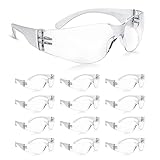
2. amoolo 24-Pack Safety Glasses — Best Value for Large Classes
amoolo Clear Safety Glasses, ANSI Z87.1 Impact Resistant, 24 Pack, Adult
ANSI Z87.1 complied
Anti-scratch coating
0.8 oz per pair
24 individually wrapped pairs
Pros
- Lightest pair on the list at 0.8 oz
- Anti-scratch coating holds up to job-site wear
- 24 pairs individually wrapped
- Wrap-around lens keeps peripheral vision open
Cons
- Will not clear prescription eyeglasses
- Frames feel basic despite strong impact ratings
- No dust or splash sealing rating
Twenty-four pairs solves the arithmetic problem that trips up most first-time buyers. A class of 30 needs more than 30, and this box plus a second unit covers a large room with room to spare. At 0.8 oz per pair, this is the pair students are least likely to take off during a long lab block.
The 4.5 average across more than 2000 reviews sits just under the class-set leader, and the reviews explain the gap. Buyers like the scratch resistance, the bulk value, and the wrap-around visibility. They also note the frames feel basic, which is a fair description of an economy pair that still carries an ANSI Z87.1 marking.
The individual wrapping matters more than it sounds. Twenty-four pairs arrive separately wrapped, so a dirty pair from a spill does not contaminate the drawer, and you can hand a student a pair without guessing whether it was worn last week. That alone removes a lot of the friction that leads teachers to let students share.
Lenses are described as premium raw polycarbonate from Japan, ballistic impact resistant, with 99% UV400 blocking and an anti-scratch coating. Flexible temples with curved tips are designed to avoid pressure at the ear over long sessions.
Whether these fit students who wear prescription glasses
They do not, and this is the most common critical review in the set. Reviewers consistently report that the lenses are too small to fit over prescription eyeglasses, which pushes roughly a tenth of a typical class toward going unprotected or skipping the goggles entirely.
That is a real compliance problem, not a comfort complaint. If your roster has more than a couple of students in corrective eyewear, budget for a prescription-compatible over-glasses option for them and use this box for everyone else. A 4.5 rating with a fixable gap is a better buy than a sealed premium goggle nobody wears.
What this kit does not cover
No splash protection and no dust seal, same as the open-frame leader. There is no ANSI dust or splash rating on the listing, and the tinted versions some buyers order reduce visibility in dim rooms, so keep the clear lenses for lab work.
3. Aqulius Kids Safety Glasses 24-Pack — Best for Young Students
Aqulius Kids Safety Glasses – Eye Protection Glasses – Safety Goggles for Kids – Classroom Goggles Set – 24-Pack, Child Size
Ages 6-14
Child-size fit
24 pairs
Lightweight construction
Pros
- Child sizing keeps glasses on smaller faces
- Colors students actually want to wear
- 24 pairs suits a full classroom
- 4.8 average across nearly 1900 reviews
Cons
- No ANSI Z87.1 marking stated in the listing
- No coating information for fogging or scratching
- Narrow child fit can be tight for older students
At 4.8 with an 85% five-star share, this is the highest-rated product we pulled. It is also the one with the least documented compliance information, and both facts belong in your decision. The listing says the glasses are crafted to meet stringent safety standards for active play and science activities, but it does not name ANSI Z87.1.
That is the trade you make here. For a middle school room, an elementary science program, or a maker-style class where students are 6 to 14, the child-specific fit and the colors students want to wear solve a problem the adult boxes cannot. For a room doing chemical work where a district safety officer will ask for a standard marking, choose the next pick instead.
No customer images were available for this listing, so we are relying on the written spec and the review distribution rather than photos. Twenty-four pairs cover a full class of younger students, which is the whole point of the pack size.
Why the fit matters more than the rating here
A 4.8 average is easy to earn when a product fits. These are built for ages 6-14, and child-specific sizing is exactly what keeps the glasses from sliding off a smaller face mid-experiment. Sliding glasses become bare-faced students, and bare-faced students become the reason a teacher gets written up.
The color assortment does quieter work. Reviewers mention it as the reason students accept the glasses rather than negotiating, which is worth a lot in a room where you cannot afford to lose a fight about PPE on day one.
What this kit does not cover
No stated ANSI Z87.1 marking, no coating information, and no seal of any kind, so it is impact and debris protection only. The narrower child fit can be tight for older or larger students, which is why we would not use this as the sole eye protection in a mixed high school section.
4. BISON LIFE Kids Safety Glasses 6-Pack — Best Documented for Ages 3-13
BISON LIFE Kids Science Safety Goggles, Anti-Fog Lenses, ANSI Z87.1, 6 Pack
Exceeds ANSI Z87.1
Anti-scratch coating
Ages 3-13
6 pairs, six colors
Pros
- Explicitly exceeds ANSI Z87.1
- Proportions scaled for ages 3-13 to cut slippage
- Anti-scratch coating with impact protection
- Case packs up to 144 pairs for schools
Cons
- Listed pack holds only six pairs
- Open vent style gives limited splash protection
- Too small for most adult students or staff
This is the child-sized set with paperwork behind it. The listing states the glasses exceed ANSI Z87.1 and carry an anti-scratch coating, which is the documentation you will be asked for if anyone questions the purchase. The uni-lens design with built-in side shields gives direct and peripheral coverage that a narrow wrap does not.
It also solves a procurement problem the six-pair pack creates. This listing is available in 6, 12, 24, and 144 case-pack quantities, so a school ordering for a full building is not forced to buy twelve small boxes.
Fit is engineered rather than adapted. The frames are scaled for smaller faces, eyes, noses, and ears specifically to minimize slippage, targeted at ages 3-13. Six color options, a full-rim frame, and a clear lens make distribution fast when thirty students need a pair in under a minute.
Reviewers rate it 4.8 across more than 1700 reviews, with the same 85% five-star share as the Aqulius set. Parents and teachers single out the certification and the snug child fit; the recurring practical complaint is pack size, not quality.
How to size a class using a six-pair pack
Multiply it. A class of 30 in the 3-13 age band needs five boxes plus spares, so a 12-count or 24-count case is the practical order, and the 144-pair case pack covers a whole elementary wing in one line item. The 0.16 kg weight per unit is the lowest per-pair figure among the child sets we reviewed.
The age range is the real limit. Anything above roughly 13 years old will outgrow the proportions, and adult staff in the room need their own pair from a different line, which is a budgeting detail many first-time buyers forget.
What this kit does not cover
The open vent style gives limited splash protection, so it stays in the impact and debris column. It is not sized for adult students or staff, and the six-pair default pack is the wrong buy for a class of 30 unless you order the case quantity deliberately.
5. Brady SPC Universal Economy Portable Spill Kit — Best Grab-and-Go Spill Kit
Brady SPC SKA-PP Allwik Universal Economy Portable Spill Kit – 107795, Yellow
Universal pads and socks
Yellow PVC bag
10 pads, 2 socks
Nitrile gloves included
Pros
- Handles water-based and petroleum-based spills
- High-visibility yellow bag is easy to locate
- Portable form suits placement near spill-prone areas
- Nitrile gloves included
Cons
- Economy sizing has less capacity than larger kits
- Not sealed so it cannot be wall-mounted
- Instruction sheet is minimal for new users
This is the kit you want on the bench cart, not in a cabinet. A yellow PVC bag at 0.45 kg, sized to grab with one hand while you are already moving, and rated for water-based, petroleum-based, and non-aggressive chemical fluids. It ranks in the top tier of the spill kit category with a 4.7 average.
The color is not decoration. In an emergency the last thing anyone wants is to open three unmarked cabinets looking for absorbent pads, and a high-visibility yellow bag solves that faster than a laminated location chart.
The contents are itemized, which is the thing teachers and teachers-of-teachers ask for most. Ten universal pads at 15 by 19 inches, two 3 by 4 foot universal socks, a disposal bag, an instruction sheet, and a pair of nitrile gloves. No guessing at what is inside when you need it.
Whether the capacity matches a classroom spill
For a dropped beaker, a tipped reagent bottle, or a small puddle, ten pads and two socks are enough. For a container failure on the floor, you will be mopping around this kit and waiting on the next one, which is why the two-pack option on the following spill kit exists.
Because the bag is portable and not sealed, this is also the right kit for a room without a dedicated prep space. It lives in a closet, on a cart, or in the room itself, and moves with you.
What this kit does not cover
It does not handle aggressive chemicals. The absorbents are rated for non-aggressive fluids, so a strong acid or base spill is outside its range. There is no neutralizer, no wall-mount hardware, and the instruction sheet is thin for a student who has never used one.
6. Oil-Dri 5-Gallon Bucket Spill Kit — Best for Larger Spills
Oil-Dri L90435 Compact Universal 5-Gallon Bucket Spill Kit, 5-Gallon Maximum Absorption Capacity
5-gallon absorption capacity
2 socks, 15 pads
Locking 5-gallon pail
5 pounds
Pros
- Bucket doubles as the storage container
- 5-gallon capacity handles substantial cleanups
- Socks conform to corners to contain rather than absorb
- Chemically inert polypropylene pads
Cons
- Not rated for aggressive chemicals or acids
- Gloves are not included
- Bulky pail is awkward in tight lab spaces
When the spill is bigger than a beaker, capacity beats portability. This kit absorbs up to 5 gallons, and the 5-gallon polyethylene pail with a locking lid and handle doubles as the storage container, so nothing gets scattered into a closet.
Two 4 foot absorbent socks with polypropylene skins filled with polymeric foam are flexible enough to fit tight spaces and wrap around corners or equipment to form a containment barrier. Fifteen perforated polypropylene pads sit in the bottom for the bulk of the volume.
Users in facility and maintenance settings report repeat purchases after real water, oil, and hydraulic cleanups, and the 4.7 average reflects a product that simply does what the label says. Chemically inert polypropylene means the pads themselves will not react with what they soak up.
When to choose this over the portable bag
Choose the bucket when you have a sink area, a floor drain nearby, or any situation where a spill spreads rather than pools. A dropped bottle on a lab bench is a pad problem. A knocked-over carboy is a containment problem, and socks are the only thing that stops it reaching a drain.
Two factors push the other way. At 5 pounds and 9.8 by 9.7 by 16.7 inches, the pail is awkward to move through a tight prep room, and it needs a dedicated spot near the sink rather than a shelf.
What this kit does not cover
It is intended for water-based and oil-based non-acid liquids, not aggressive chemicals. Gloves are not included, and reviewers specifically object to the instruction sheet showing a cleanup without gloves, so budget a separate glove supply. This is an absorbent kit, not a neutralizer kit.
7. Stardust Universal Spill Kit 2-Pack — Best for Compliance-Driven Purchasing
Stardust Spill Products Universal Spill Kit, OSHA Compliant, 2-Pack
OSHA approved and DOT compliant
Absorbs 25 times its weight
Two pre-packed duffles
5.74 pounds each
Pros
- OSHA approved and DOT compliant
- Absorbs up to 25 times its weight
- Pre-packed and organized for fast response
- Two kits cover two separate locations
Cons
- Heavier and bulkier than a single-bag kit
- Nylon duffle can be damaged by rough handling
- Higher cost per kit than economy models
This is the kit to buy when someone has to sign off on the purchase. The listing states OSHA approved and DOT compliant, which is the language a district facilities office or a grant reviewer looks for, and it is the reason this kit ranks near the top of the lab spill response category.
The performance claim is specific: up to 25 times its weight in oil, water, chemicals, and bodily fluids. That range is broader than the economy kit and closer to what a mixed-chemistry room actually encounters, including the non-chemical cleanup that eats lab budgets.
Both kits arrive pre-packed in a bright yellow lightweight nylon duffle, with universal pads, socks, disposal bags, and nitrile gloves already inside. Pre-packed matters in a room with volunteer help, because a kit that has to be assembled during an incident is a kit that gets assembled wrong. Single, 2, 6, and 12 packs are offered, so a department can standardize across every room.
Why the 2-pack version usually makes sense
A single spill kit per room leaves a gap. While one is being deployed in the prep area, nothing is available at the bench. Two kits means one stays mounted or stored near the demonstration station and one stays mobile, which matches how most classroom drills actually run.
At 5.74 pounds and 15 by 12 by 5.65 inches each, the duffle is heavier than the economy bag, and reviewers note the nylon outer can be degraded by rough handling or prolonged chemical contact. Store it out of the prep shelf and off the floor.
What this kit does not cover
It is an absorbent kit, so it manages and contains a spill rather than neutralizing a corrosive reaction. The compliance marking covers the kit, not your room: you still need an eyewash within reach, a chemical hygiene plan, and GHS labeling for every container in the space.
8. CGOLDENWALL Portable Eye Wash Station — Best for a No-Install Eyewash
CGOLDENWALL Eye Wash Station Portable Emergency Eye Wash Kit, Wall Mounted Eyewash Station OSHA Approved, 2 * 16.9oz Bottles, with Mirror & Emergency Sign, Safety Material, NO Solution
Two 16.9 oz bottle holder
Built-in mirror
Wall mount or carry
11.02 in x 10.24 in
Pros
- Holder stops bottles falling during an emergency
- Integrated mirror for checking the eye while flushing
- Wall-mountable or carryable as a mobile unit
- Squeezable bottles with a drain pipe
Cons
- Eyewash solution is not included
- Thin polyethylene holder
- Bottles rely on friction in the cradle
Not every classroom has plumbing, and this is the answer for the rooms that do not. A wall-mounted bottle holder with a built-in mirror, sized at 11.02 by 10.24 inches, with all mounting hardware included. It ranks at the top of the eye wash units category, and the mirror is the detail that gets noticed first.
Holding an eyelid open while water runs across the eye is genuinely hard to do with two hands occupied and no visibility. The mirror lets the person flushing, or a second student helping, actually see what they are doing.
At 4.4 across more than 850 reviews, this is the lowest-rated product on the list, and the reviews are consistent about why. Buyers like the hardware, the mirror, and the flexibility. They are disappointed that the solution is not included and that the polyethylene holder feels thin.
Where to mount it and what to have on the shelf beside it
Mount it near the sink and near the bench where wet chemistry happens, not in a corner. The whole value of this product is response time, and a station that is technically present but out of sight is a station that adds minutes to an incident.
Because solution is not included, budget for the bottles separately and set a replacement date when you fill them. The station also works as a mobile carry unit, which matters in a room where the eyewash needs to travel to a demonstration.
Why the friction-held bottles matter
Reviewers flag that the bottles stay in the cradle by friction alone, so a knock or a rushed grab can send a full bottle to the floor at the exact moment it is needed. Treat the weekly inspection as a bottle check, not just a visual check on the unit.
For a room doing genuine wet chemistry, this is a backup station rather than a primary one. A plumbed or plumbed-equivalent unit with continuous flow should be the primary provision, and a two-bottle unit like this is what you add when you cannot get that installed this year.
What this kit does not cover
No eyewash solution ships with it. The bottles are for flushing, not for neutralizing a chemical burn on skin, and the flexible bottles need replacing on a schedule rather than indefinitely. It is not a safety shower, and it will not handle a splash to the body.
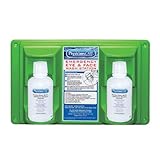
9. PhysiciansCare Eyewash Station with Solution — Best Ready-to-Use Eyewash
PhysiciansCare Wall-Mountable Eyewash Station with 2 Bottles of Eye Wash Solution, 16 Oz Each
Two 16 oz bottles included
Sterile isotonic buffered solution
Wall mount
Single use only
Pros
- Solution included so it works out of the box
- Sterile isotonic buffered formula
- Wall mountable and clearly labeled
- Single-use bottles for contamination control
Cons
- Thin plastic hanger base can crack if struck
- Bottles held by friction alone can fall out
- Single-use bottles expire on a schedule
The difference between this and the station above is that it arrives filled. Two 16 oz bottles of sterile isotonic buffered eye rinse solution, single use only, in a wall-mountable green station that is visible from across the room. For a classroom that has never had an eyewash, that completeness is the whole argument.
At 4.7 across more than 1200 reviews, it carries the strongest review base of the three eyewash options in this roundup, and the 82% five-star share reflects a product that does one thing reliably. The sterile isotonic buffered formula can flush eyes or skin, which covers the splash cases that are most common in a teaching lab.
The squeeze-bottle design directs a steady stream onto the affected area, which is easier to control than pouring. Keep the station mounted at a height an adult can reach without a step ladder, and check that the sight line to it is not blocked when students are seated at benches.
Managing the expiry date nobody tracks
Single-use bottles expire, and an expired sterile solution is worse than nothing because it looks like a working station on the wall. Put the fill date and the printed expiry on the bottle with a marker at installation, and check both during the monthly walkthrough rather than the weekly one.
Two bottles cover one emergency, not a term. A room running acid and base work should treat a replacement bottle as a consumable that appears in the department budget every year, the same way you budget for nitrile gloves.
How it compares to a plumbed station
A two-bottle station is a first-response measure for flushing a splash. It is not a substitute for a continuous-flow plumbed eyewash where a larger volume of water is needed, and it is not a safety shower for a body dousing. If your district standard requires plumbed eyewash within a set distance of the hazard, this fills the interim gap while that work is scheduled.
Owners in garages, salons, and small shops rate it highly for the ready-to-use format, and the same logic applies in a classroom: nothing gets used for the first time during an actual emergency.
What this kit does not cover
The hanger base is thin and flexible and can crack if struck, so mount it where a chair or bag will not hit it. Bottles are held by friction alone and can fall out, and the single-use format means you are always consuming stock whether you need it or not.
10. Aceoptics Lab Goggles Kit with Hard Case — Best for Fogging and Prescription Fit
Aceoptics Lab Goggles Chemistry – Anti Fog Z87.1 Lab Safety Glasses for Women | Pink Chemistry Goggles – Complete Kit with Hard Case
Anti-fog scratch-resistant lens
Fits over prescription glasses
Adjustable strap
Hard case included
Pros
- Anti-fog lenses stay clear in long sessions
- Designed to fit over prescription eyewear
- Hard case
- pouch
- and cloth included
- Lifetime warranty with U.S. support
Cons
- Temples are flimsy in normal handling
- Narrow bridge pinches and slides on smaller faces
- Strap can slip over the ear
Fogging is the complaint that ends up with students taking goggles off, and this is the pick that addresses it directly. The lenses are ClearShield anti-fog and scratch-resistant, and the 4.7 average includes an 87% five-star share, which is high for a listing with a few hundred reviews.
It is also the only pair here designed to fit over prescription eyewear without distortion, which is the exact gap that pushes correction-wearing students out of protection on an economy 24-pack. The adjustable strap holds it in place instead of relying on temple pressure alone.
At 127 reviews this is the least reviewed product we included, and we want to be straight about that. The feature claims are specific and the satisfaction level is high, but there is a shorter history of long classroom use behind it than the leaders have.
Why fogging drives the compliance decision
Teacher forums describe the same loop repeatedly: goggles fog, vision becomes unusable, students push them up, and the room quietly stops being protected. An anti-fog coating is not a comfort feature, it is a control that keeps the PPE on the face.
The kit format helps with the other failure mode. A hard case, a soft pouch, and a microfiber cloth mean the lenses get stored covered and cleaned with something other than a lab apron, and a stored covered lens is a lens that stays scratch-free for another year.
Where the sizing breaks down
Both three-star reviews point at the same problem: the temples are flimsy and the narrow bridge pinches, letting the frame slide forward on smaller faces. The strap can also slip over the ear and fall off, which is a fair trade for keeping the frame over prescription glasses but a poor trade for a younger student.
For a middle school or elementary room, this is a staff and older-student solution rather than a student class set. For a high school room with several students in corrective eyewear, it is a strong targeted purchase.
What this kit does not cover
It is sold as a single kit, so a class of 30 needs multiple units. There is no splash seal or ANSI splash code, it is not sized for large faces, and the frame is not built for the level of rough handling a shared student set sees daily.
How Many Goggles and Gloves Do You Need? Sizing a Class of 24, 30 or 32
A class of 30 needs more than 30 pairs of eye protection. The working number is 30 students plus at least two spares plus one for the teacher, so 33 minimum, and a room with a high breakage or loss rate should plan for 36.
Here is the math we use. Take your enrollment figure, add 10% for spares, then add two more for staff. A class of 24 gives 24 plus 3 spares plus 2 staff, so 29, which rounds to a 30-pair purchase. A class of 30 gives 30 plus 3 plus 2, so 35. A class of 32 gives 32 plus 4 plus 2, so 38.
Where the boxes on this list help: the amoolo 24-pack and the Aqulius 24-pack mean a class of 30 is two boxes, and the class of 32 is three boxes. The G & F 12-pack is three boxes for 36, and the BISON LIFE case quantities let you match a building rather than a room.
For gloves, the number is usage rather than enrollment. Two pairs per student per term covers a normal handling workload with a spare, and nitrile in a small, medium, and large spread matters more than total count because a glove that does not fit is a glove that comes off. Budget replacement glove stock as a consumable line, separate from the kit purchase.
For spill kits, the number is one per room plus one per demonstration cart, with a two-pack in any room doing acid and base work. For eyewash, the count is a minimum of one per room, mounted where it is visible, plus a mobile unit if the room lacks plumbing.
How to Choose a Classroom Lab Safety Kit: 7 Things to Check
1. Check the certification marking, not the marketing copy
Look for ANSI Z87.1 or CSA Z94.3 printed or molded on the product, and check the letter code for whether it covers impact or splash. A listing that says only “protects your eyes” tells you nothing, and a listing that names the standard without the hazard code still leaves you guessing. Five of the ten kits here name a standard; two do not, and we have flagged both.
2. Match the eye protection to the hazard you actually run
Open-frame safety glasses handle debris and dust. Sealed chemical splash goggles with indirect venting handle liquid. Bench work, cutting, and general shop use need the first. Titration, acid and base handling, and anything at eye level near an open vessel need the second. Buying one kind and using it for both is the compliance gap that shows up in every safety audit we have read.
3. Solve the fogging problem before it solves itself
Fogged vision is the reported reason students remove eye protection, and removal is the failure that matters. Prioritize lenses with an anti-fog coating, keep a microfiber cloth in every kit for lens maintenance, and store goggles in a case or a closed bin rather than on a bench hook. A ventilation-friendly indirect vent also helps in a warm room, though direct-vent styles do not seal against splash.
4. Match the spill kit to the reagent list, not the room size
Acid and base spills want a neutralizer or a corrosive-rated absorbent, not a universal pad. Solvent and petroleum spills want a universal absorbent rated for hydrocarbons. Water-based classroom work is the easy case. Buying a solvent-rated master kit for a room that only handles dilute acids wastes budget, and that is one of the most common procurement mistakes we found. Match the kit to the actual SDS list in your chemical hygiene plan.
5. Account for prescription eyewear and head shape
Any student in corrective eyewear needs either an over-glasses design or a sealed goggle that fits over frames, and roughly a tenth of a typical class qualifies. Stock one over-glasses option as a dedicated purchase for those students, or they will be the ones working without protection. For mixed age bands, buy a child-sized set rather than stretching an adult one size.
6. Set the replacement cadence before you need it
Scratched lenses, yellowed straps, stretched bands, and cracked frames are all reasons to pull a pair out of service. Tag eye protection when it goes into the room, inspect it weekly, and plan a budgeted replacement cycle rather than reacting to a complaint. Eyewash solution, spill absorbents, and nitrile gloves are consumables with a much shorter life than the hardware around them, and they belong on a restock calendar.
7. Grade the kit to the band, and know what not to buy
Elementary and K-5 rooms need child-sized frames, lighter gloves, fewer chemicals, and no flame. Middle school adds acid and base work, so a small spill kit and a mounted eyewash become the priority. High school and AP Chemistry add concentrated reagents, heating, and a full chemical hygiene plan with GHS labels and an SDS binder for every container. And the thing not to buy is any product marketed as safety glasses for liquid chemical handling. If the hazard is a splash, the marking has to say splash.
One funding note, because this comes up constantly: a general classroom supply budget is the wrong line for PPE. Ask for a dedicated safety equipment line in the department request, and check whether a district capital cycle, a science education grant, or a local STEM sponsorship can carry the eyewash and spill kit costs. If you are still fitting out the room, our lab hot plate guide covers the other high-use bench item, and documentation cameras help with the demonstration side of lab work.
Maintenance, Inspection and the End-of-Class Routine
A kit is only as good as its last inspection, and the inspection that matters most is the five minutes at the end of class. Walk the room and check three things: eyewash bottles present, sealed, and in date; spill kit present and closed; eye protection accounted for, with damaged pairs pulled from service rather than returned to the drawer.
Between classes, the useful habit is a head count of eye protection against the enrollment number. It takes seconds, and it surfaces the student who left wearing their goggles as a headband, which is a surprisingly common failure in a busy room.
On a weekly cycle, look at lens condition under light, check straps and elastic for stretch, and confirm every goggle has its anti-fog coating intact. Scratched lenses and yellowed lenses get pulled, because a scratched lens is a lens students will not wear correctly.
On a monthly cycle, check the eyewash expiry dates, confirm the spill kit contents match the inventory list, and verify that every chemical container still carries a GHS-compliant label. Any change to the reagent list means the spill kit choice and the chemical hygiene plan need to be revisited together.
Before students leave the room, the routine is short and consistent: goggles off and into the bin, aprons hung, bench surfaces clear, spill kit back at its marked location, and the eyewash sight line unobstructed. The point of a fixed routine is that a safety practice students do not have to remember is one they actually perform.
Frequently Asked Questions
What lab safety equipment do students use in a chemistry classroom?
Students in a chemistry classroom use chemical splash goggles or impact-rated safety glasses, nitrile gloves, a chemical-resistant lab apron or disposable coat, and they work near a mounted eyewash station with a spill response kit in the room. A properly sized classroom lab safety kit bundles these items at class quantity, one pair of eye protection per student plus spares.
What are the 5 most important pieces of lab safety equipment?
The five essentials are: eye protection matched to the hazard, nitrile gloves, a lab apron or coat, an accessible eyewash station, and a spill response kit matched to your reagents. Add safety signage and a GHS-compliant chemical label set, and you have the working safety setup for a teaching chemistry room.
Do safety glasses work for chemistry, or do I need chemical splash goggles?
For liquid chemical work, you need sealed chemical splash goggles, not open-frame safety glasses. Impact-rated glasses stop flying debris but have no facial seal, so a splash passes straight through the gap to the eye. Use impact-rated glasses for bench work, cutting, dust, and general shop protection, and sealed splash goggles for titration, acid and base handling, and anything at eye level near an open vessel.
What are the goggles used in labs called?
They are called safety goggles, and the lab-specific type is a chemical splash goggle. Look for a sealing skirt or foam body seal and an indirect vent, and confirm the product carries an ANSI Z87.1 splash designation rather than only an impact rating. Wrap-around safety glasses are a different product and are not splash-rated.
What is in a classroom chemical spill kit, and which type do I need?
A universal classroom spill kit contains absorbent pads, absorbent socks, a disposal bag, nitrile gloves, and an instruction sheet. Acid and base work needs a corrosive-rated kit with a neutralizer, while solvent and petroleum work needs a hydrocarbon-rated universal absorbent. Match the kit to the safety data sheets in your chemical hygiene plan rather than to room size.
Which Classroom Lab Safety Kit Should You Buy?
The G & F Products 12-Pack is our pick for the best chemistry lab safety kits for classrooms, because a 4.6 average across more than 5400 reviews is the strongest combination of rating and proven classroom use in this group, and twelve pairs per box makes a class of 30 three boxes rather than a messy assortment. Pair it with the Brady portable spill kit for bench response and the PhysiciansCare wall-mounted station with solution for the eyewash, and you have covered the three categories every teaching room needs.
Adjust for your room rather than copying that. Younger students get the BISON LIFE or Aqulius child-sized sets, a correction-wearing student gets the Aceoptics over-glasses design, and a room doing acid and base work gets a corrosive-rated spill kit rather than a universal one. If your room is running concentrated reagents at eye level, add sealed chemical splash goggles as a separate line item, because that is the protection gap the whole roundup cannot close for you.
Start with the class-size math, pick the three categories your room actually has hazards in, and buy the marking you can document. Everything else is detail.